
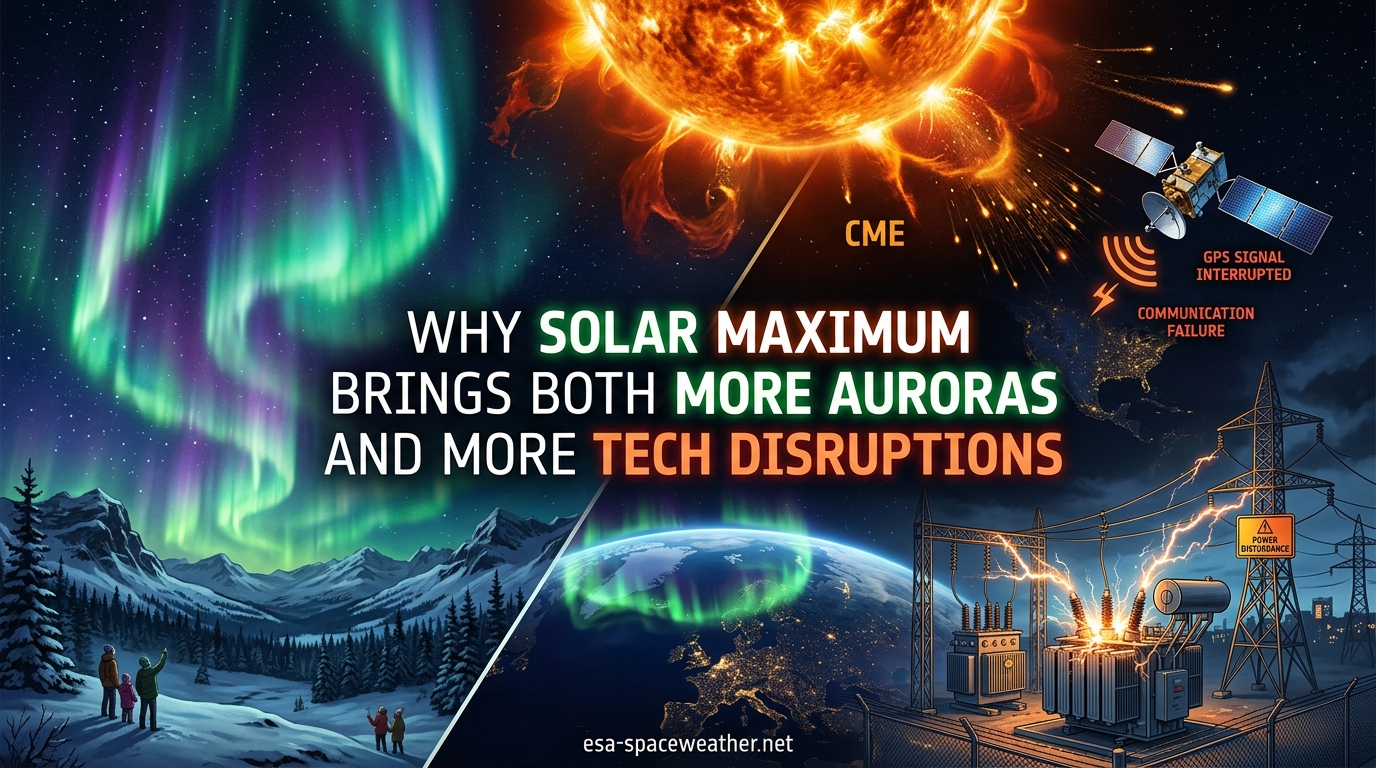
Every 11 years, the Sun ramps up to a frenzy of activity called solar maximum. During this peak phase, people across the globe witness aurora displays that stretch far beyond their usual Arctic and Antarctic haunting grounds. But the same solar storms that paint the sky in green and magenta light also carry a darker side: they can disrupt power grids, scramble GPS signals, and damage satellites in orbit.
If you have found yourself wondering why solar maximum brings both more auroras and more tech disruptions, you are asking exactly the right question. The answer comes down to a single phenomenon: enormous clouds of charged particles ejected from the Sun slamming into Earth’s magnetic field. That collision produces beauty in the sky and chaos in our technology simultaneously.
In this guide, our team breaks down what solar maximum is, how the solar cycle works, why auroras become more frequent and visible at lower latitudes, and how the exact same space weather events threaten the infrastructure we rely on every day. We also share how scientists monitor space weather in real time and what you can do to prepare.
Table of Contents
What Is Solar Maximum?
Solar maximum is the peak phase of the Sun’s approximately 11-year activity cycle. During this period, the number of sunspots, solar flares, and coronal mass ejections (CMEs) reaches its highest levels. The Sun’s magnetic field becomes tangled and unstable, releasing enormous bursts of energy and matter into space.
Think of it as the storm season on the Sun. Just as hurricane season on Earth brings concentrated periods of intense weather, solar maximum concentrates the Sun’s most violent outbursts into a window lasting roughly two to three years. The opposite phase, solar minimum, is when the Sun is quiet and its surface appears nearly spotless.
NASA and NOAA confirmed that the Sun reached its maximum phase for Solar Cycle 25 in late 2024. This means we are currently in the thick of heightened solar activity right now, in 2026. Sunspot counts have consistently exceeded predictions, and powerful X-class flares have become a regular occurrence.
Sunspots are the key indicator scientists use to track where we are in the cycle. These dark patches on the solar surface correspond to regions of intense magnetic activity. More sunspots mean more magnetic instability, which translates to more flares and CMEs heading toward Earth.
The 11-Year Solar Cycle Explained
The Sun does not shine at a constant level of activity. Instead, it oscillates between quiet and active periods on a roughly 11-year schedule known as the Schwabe cycle, named after the German astronomer Samuel Heinrich Schwabe who first documented it in 1843.
Here is how the cycle progresses:
Solar Minimum: The Sun’s magnetic field is relatively organized. Sunspots are rare or absent entirely. Few flares occur, and space weather near Earth is calm. Auroras are mostly confined to high latitudes near the Arctic and Antarctic circles.
Rising Phase: Sunspot numbers begin climbing over a period of several years. Solar flares become more frequent, and CMEs start appearing more regularly. Auroras begin pushing to slightly lower latitudes.
Solar Maximum: Sunspot counts peak. The Sun’s magnetic field flips polarity, completing a full reversal of its north and south magnetic poles. This is when the largest flares and fastest CMEs occur. Aurora displays stretch to mid-latitudes and sometimes even equator-ward.
Declining Phase: Sunspot numbers gradually decrease. Activity remains elevated above minimum levels for several years, meaning aurora viewing and tech disruption risks remain higher than during the quiet period.
We are currently in Cycle 25, which began in December 2019. Scientists originally predicted a relatively weak cycle, but the Sun has outperformed expectations. As of 2026, we remain in or near the maximum phase, which is why aurora displays and solar storm news have dominated headlines.
How Auroras Form During Solar Maximum
Auroras are the visible result of a cosmic collision between solar particles and Earth’s atmosphere. The process begins at the Sun and ends as dancing light in our polar skies.
Here is the step-by-step process:
Step 1: Solar Eruption. During solar maximum, the Sun frequently ejects massive clouds of magnetized plasma called coronal mass ejections. These CMEs can contain billions of tons of material traveling at speeds exceeding 3 million kilometers per hour.
Step 2: Solar Wind Transport. The ejected plasma travels through space as part of the solar wind, a constant stream of charged particles flowing outward from the Sun. During solar maximum, this wind becomes denser, faster, and more magnetized.
Step 3: Magnetosphere Encounter. When the solar wind reaches Earth, it encounters our planet’s magnetic field, known as the magnetosphere. This invisible shield normally deflects most particles around the planet.
Step 4: Magnetic Reconnection. Under the right conditions, the magnetic field carried by the solar wind connects with Earth’s magnetic field. This process, called magnetic reconnection, opens a gateway for charged particles to funnel down toward the polar regions along magnetic field lines.
Step 5: Atmospheric Collision. As these charged particles spiral down toward the poles, they slam into oxygen and nitrogen molecules in the upper atmosphere at altitudes between 100 and 300 kilometers. The energy from these collisions excites the atmospheric gases.
Step 6: Light Emission. When the excited gas molecules relax back to their normal state, they release photons of light. Oxygen produces green and red light, while nitrogen produces blue, purple, and pink hues. The result is the shimmering, colorful display we call aurora borealis in the Northern Hemisphere and aurora australis in the Southern.
During solar maximum, this entire process happens more frequently and with greater intensity. More CMEs mean more particles reaching Earth, and stronger storms mean those particles penetrate deeper into the atmosphere and at wider geographic ranges.
Why Solar Maximum Brings More Auroras (and at Lower Latitudes)
One of the most common questions we see in forums like r/northernlights and r/askastronomy is some variation of: “Why am I seeing the northern lights this far south?” The answer is directly tied to solar maximum.
Under normal conditions, the aurora oval sits in a ring around the magnetic poles at high latitudes. People in northern Canada, Scandinavia, Alaska, and Siberia see auroras routinely. But during solar maximum, powerful geomagnetic storms expand and intensify that ring, pushing aurora visibility to much lower latitudes.
This happens because stronger solar storms carry more energy and a more favorable magnetic orientation. When the interplanetary magnetic field embedded in the solar wind points strongly southward, it connects more efficiently with Earth’s northward-pointing magnetic field. That connection opens the floodgates for particles to pour into the atmosphere over a much wider area.
The May 2024 geomagnetic storm provided a perfect example. People reported aurora sightings as far south as Alabama, northern California, Texas, and even Mexico. Similar displays occurred in Europe, with auroras visible from Spain to southern England. These are locations that almost never see the northern lights during solar minimum.
To understand and predict these events, scientists use the Kp index, a scale from 0 to 9 that measures geomagnetic disturbance. A Kp of 3 or lower means auroras stay near the poles. A Kp of 5 (G1 storm) brings auroras to northern US states. A Kp of 7 or higher (G3 or above) can push visibility to mid-latitudes, and the rare Kp of 9 opens the door for equator-ward aurora sightings.
During solar maximum, Kp levels of 5 or higher occur far more frequently. The strongest storms, rated G4 and G5, become much more common, which is why aurora chasing has become a mainstream hobby even in southern states.
If you want to track aurora visibility for your location, watch for Kp index forecasts from the NOAA Space Weather Prediction Center. A Kp forecast of 5 or above means you should look north from any dark-sky location in the northern United States or central Europe.
Solar Storms and Technology Disruptions
The same solar particles that create stunning aurora displays also cause technology disruptions. This is the core of why solar maximum is a double-edged sword. When charged particles and fluctuating magnetic fields interact with human infrastructure, they induce electrical currents where they do not belong.
Here are the primary ways solar storms disrupt technology during solar maximum:
1. Power Grid Damage from Geomagnetically Induced Currents. When a geomagnetic storm hits, the rapid changes in Earth’s magnetic field induce electrical currents in the ground called geomagnetically induced currents (GICs). These currents flow into power lines, transformers, and grid infrastructure. In March 1989, a powerful solar storm caused GICs that overloaded transformers in Quebec, plunging the entire province into a 12-hour blackout. During solar maximum, the risk of similar events increases significantly.
2. GPS Signal Degradation. The layer of charged particles in Earth’s upper atmosphere, called the ionosphere, becomes disturbed during geomagnetic storms. Since GPS signals pass through the ionosphere, this disturbance introduces errors and delays. During strong storms, GPS accuracy can degrade from a few meters to tens of meters. This affects navigation systems in cars, aircraft, ships, and especially precision applications like agriculture and surveying.
3. Satellite Damage and Orbital Drag. Satellites in orbit are directly exposed to solar storm particles and radiation. High-energy particles can fry satellite electronics, corrupt memory, and shorten the lifespan of solar panels. Additionally, geomagnetic storms heat and expand the upper atmosphere, increasing drag on low-Earth-orbit satellites. In February 2022, a moderate geomagnetic storm contributed to the loss of 40 SpaceX Starlink satellites shortly after launch. During solar maximum, satellite operators face these risks on a near-weekly basis.
4. Radio Communication Blackouts. Solar flares emit intense X-ray radiation that hits Earth’s dayside ionosphere almost instantly. This energy ionizes the upper atmosphere, causing shortwave radio blackouts that can last for hours. High-frequency radio communication used by aviation, maritime operators, emergency responders, and military forces becomes unreliable during these events. X-class flares during solar maximum can cause radio blackouts across entire hemispheres.
5. Aviation Navigation and Radiation Exposure. Long-haul flights that cross polar regions rely on high-frequency radio and satellite navigation. During geomagnetic storms, both can fail simultaneously, forcing airlines to reroute flights at significant cost. Additionally, solar particle events increase radiation exposure at flight altitudes, particularly on polar routes. During solar maximum, airlines monitor space weather closely to protect both passengers and crew.
6. Pipeline Corrosion. GICs do not only affect power grids. They also flow through long metal pipelines, accelerating corrosion over time. Oil and gas pipeline operators in high-latitude regions like Alaska and Siberia must account for this during solar maximum to prevent infrastructure degradation.
7. Internet and Undersea Cable Disruption. Undersea communications cables use repeaters powered by electrical current running through the cable sheath. GICs can interfere with these power systems, potentially degrading or disrupting transoceanic internet connectivity during severe storms. While rare, researchers have flagged this as a growing concern as we depend more on global connectivity.
The Shared Root Cause: Why Beauty and Disruption Come Together
The reason auroras and tech disruptions happen together is simple: they are two sides of the same coin. Both are caused by the exact same stream of solar particles hitting Earth.
When a CME arrives at Earth, its energy and charged particles enter the magnetosphere through magnetic reconnection. Some of those particles spiral down magnetic field lines into the polar atmosphere, where they create aurora light. Meanwhile, the magnetic disturbance that funnels those particles also induces electrical currents in the ground, which flow into power grids, pipelines, and communication cables.
The same storm that gives you a spectacular aurora display over your backyard is simultaneously stressing transformers hundreds of miles away, degrading GPS signals for aircraft overhead, and exposing satellites to damaging radiation. You cannot have one without the other because they stem from the same root cause: a massive injection of solar energy into Earth’s near-space environment.
This is why space weather scientists never celebrate a beautiful aurora forecast without also checking infrastructure alerts. A G4 or G5 storm that produces unforgettable auroras is also the type most likely to cause real damage.
Historical and Recent Solar Storm Events
History provides vivid examples of how solar maximum delivers both breathtaking auroras and serious technology disruptions simultaneously.
The Carrington Event (1859). The most powerful solar storm on record, the Carrington Event, occurred during Solar Cycle 10. British astronomer Richard Carrington observed a brilliant white-light solar flare, and within 18 hours, the resulting CME reached Earth. Auroras were reported as far south as Cuba, Hawaii, and even sub-Saharan Africa, where people could read newspapers by the light of the aurora. At the same time, telegraph systems across Europe and North America sparked, caught fire, and continued operating even after being disconnected from their power sources. If a Carrington-level storm hit today, estimates suggest damages could exceed trillions of dollars globally.
The Quebec Blackout (March 1989). A powerful CME struck Earth during solar maximum of Cycle 22, generating GICs that destroyed a transformer at a Hydro-Quebec power station. The entire province of Quebec lost power for over 12 hours, affecting 6 million people. Auroras were visible as far south as Texas and Florida during the same event, demonstrating the dual nature perfectly. This event transformed how power companies think about space weather and led to new grid protection standards.
The Halloween Storms (October-November 2003). During the declining phase of Cycle 23, a series of powerful flares and CMEs battered Earth. The storms caused satellite failures, forced airlines to reroute flights, and triggered a power outage in Sweden. Auroras were visible across most of the United States and Europe, creating one of the most memorable aurora seasons in modern history.
The Gannon Storm (May 10-11, 2024). Named after space weather scientist Jennifer Gannon, this G5 geomagnetic storm was the strongest to hit Earth since the 2003 Halloween storms. Triggered by a series of CMEs from an active sunspot region, it produced auroras visible on every continent, including rare sightings in Mexico, the Bahamas, and parts of Africa. Farmers in the American Midwest reported GPS-guided tractors going haywire during planting season. SpaceX lost contact with some Starlink satellites temporarily, and power grid operators in the United States and Europe reported anomalies but managed to avoid major outages thanks to advance warning.
October 2024 Storms. A series of G4 storms in October 2024 once again pushed auroras to unusually low latitudes across North America and Europe. Social media exploded with aurora photos from locations like Virginia, Missouri, and southern England. At the same time, shortwave radio operators reported widespread blackouts, and satellite operators reported increased drag on low-Earth-orbit assets.
These events make one thing clear: during solar maximum, the line between natural wonder and technological threat is razor thin. Every memorable aurora season in modern history has been accompanied by infrastructure impacts of varying severity.
How Space Weather Is Monitored and What You Can Do
Space weather monitoring has improved dramatically since the Carrington Event. Today, a network of satellites and ground-based observatories watches the Sun around the clock to provide advance warning of solar storms.
Who Monitors Space Weather? The NOAA Space Weather Prediction Center (SWPC) in the United States is the primary civilian source for space weather alerts. The European Space Agency (ESA) operates its own Space Weather Office, and NASA’s Solar Dynamics Observatory provides continuous imagery of the Sun in multiple wavelengths. Together, these agencies can detect a CME leaving the Sun and estimate when it will arrive at Earth, typically providing 1 to 3 days of lead time.
Tracking the Kp Index for Aurora Viewing. If you want to see auroras, the Kp index is your most important tool. The SWPC publishes a 3-day Kp forecast that shows expected geomagnetic activity hour by hour. Aurora tracking apps like My Aurora Forecast and SpaceWeatherLive pull this data into user-friendly interfaces with push notifications. For real-time conditions, the NOAA Ovation model provides a live aurora forecast map showing where auroras are currently visible.
How to Prepare for Tech Disruptions. While individuals cannot protect power grids, there are practical steps you can take during solar maximum to reduce personal vulnerability:
Keep backup power options available. A charged power bank, battery-powered radio, and flashlights can see you through a grid disturbance. During solar maximum, having 24 to 48 hours of emergency supplies is prudent, especially if you live in a region with aging grid infrastructure.
Download offline maps. If GPS degradation occurs during a solar storm, having offline navigation on your phone prevents you from getting stranded. This is particularly relevant for travelers and outdoor enthusiasts.
Follow official space weather accounts. The SWPC and ESA Space Weather Office post real-time alerts on their websites and social media channels. Signing up for email alerts ensures you get notified before major storms arrive.
Be patient with technology. During a strong geomagnetic storm, your GPS might be slightly off, your satellite internet might flicker, or your shortwave radio might go quiet. These effects are temporary and resolve as the storm passes.
Citizen Science Opportunities. You do not need to be a professional astronomer to contribute to space weather research. Projects like Aurorasaurus, run by researchers at the University of New Hampshire, crowdsources aurora sightings from the public. Your reports help scientists validate satellite data and improve aurora forecasting models. The HamSCI citizen science network collects radio data from amateur radio operators to study ionospheric disturbances during solar storms.
FAQs
What are the effects of solar maximum on technology?
Solar maximum increases solar flares and coronal mass ejections, which disrupt technology in several ways. Power grids can experience geomagnetically induced currents that damage transformers and cause blackouts. GPS accuracy degrades due to ionospheric disturbances. Satellites face increased radiation and atmospheric drag that can damage electronics and shorten lifespans. High-frequency radio communications experience blackouts, and airlines must reroute polar flights to avoid navigation failures and radiation exposure.
Why are auroras more frequent and visible at lower latitudes during a solar maximum?
During solar maximum, the Sun produces more frequent and powerful coronal mass ejections that carry larger amounts of charged particles toward Earth. When these stronger solar storms interact with Earth’s magnetosphere, they expand the aurora oval and push aurora visibility to lower latitudes. The stronger the storm, the further equator-ward the auroras appear. A Kp index of 7 or higher can make auroras visible across much of the United States and central Europe.
Can a solar storm cause disruptions and northern lights at the same time?
Yes, and this happens during essentially every major geomagnetic storm. The same charged particles and magnetic disturbances that create aurora displays also induce electrical currents in power lines, degrade GPS signals, and disrupt radio communications. The May 2024 Gannon Storm is a perfect example: it produced auroras visible as far south as Mexico while simultaneously disrupting GPS-guided farm equipment and stressing satellite operations.
How long will the current solar maximum last?
The current solar maximum for Cycle 25 began in late 2024 and is expected to persist through approximately late 2025 to mid-2026. Solar maximum is not a single moment but a phase lasting roughly two to three years. Even after the peak passes, solar activity remains elevated above minimum levels for several more years, meaning aurora displays and tech disruption risks will continue well beyond the official peak.
How long after a solar flare does it take to hit Earth?
It depends on the type of emission. X-rays and ultraviolet radiation from a solar flare travel at the speed of light and reach Earth in about 8 minutes, causing immediate radio blackouts on the dayside. Coronal mass ejections, which carry the particles responsible for auroras and most tech disruptions, travel much slower and typically take 1 to 3 days to reach Earth, giving forecasters time to issue warnings.
Conclusion
Solar maximum brings both more auroras and more tech disruptions for one simple reason: they are two outcomes of the same process. The coronal mass ejections and solar flares that flood Earth’s magnetosphere with charged particles create breathtaking light shows in our atmosphere while simultaneously inducing currents in our power grids, scrambling GPS signals, and threatening satellites in orbit.
As we move through Solar Cycle 25 in 2026, this dual reality will continue. Every aurora forecast carries an infrastructure alert alongside it. Understanding why solar maximum brings both beauty and disruption helps us appreciate the northern lights while staying prepared for the technological challenges they bring. Keep an eye on Kp forecasts, follow NOAA and ESA space weather alerts, and enjoy the show.