
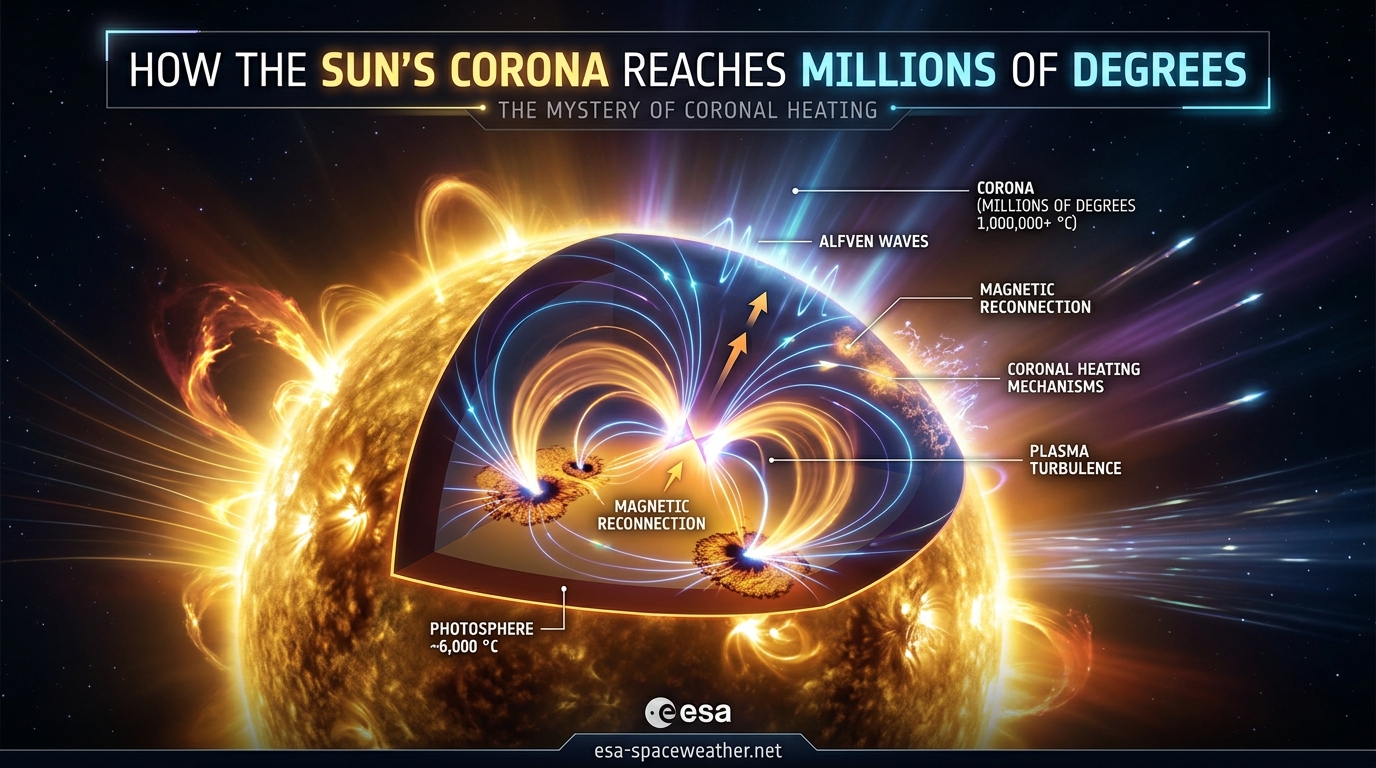
Here is a puzzle that has stumped astrophysicists for over 80 years. The visible surface of the Sun burns at about 5,500 degrees Celsius (9,940 degrees Fahrenheit). But if you move outward into the Sun’s outer atmosphere, the corona, the temperature suddenly skyrockets to between 1 and 3 million degrees. Understanding how the Sun’s corona reaches millions of degrees, when every other star gets cooler from core to surface, remains one of the most fascinating unsolved problems in all of astrophysics.
This temperature inversion defies what we expect from basic thermodynamics. Heat should flow from hot regions to cold regions, not the other way around. And yet the thin, wispy corona sitting far above the solar surface is hundreds of times hotter than the surface itself. Scientists call this the coronal heating problem, and it has driven decades of research, launched multiple spacecraft, and inspired competing theories that we still cannot fully confirm.
In this guide, our team breaks down everything we know about this mystery. We will walk through the temperature structure of the Sun layer by layer, explore the three leading theories for coronal heating, cover the breakthrough 2024 Alfvén wave experiment, and explain what NASA and ESA missions like Parker Solar Probe and Solar Orbiter are revealing as they fly closer to the Sun than any spacecraft before them. We will also connect this science to something practical: why a superheated corona matters for satellites, power grids, and daily life on Earth.
Table of Contents
The Coronal Heating Problem Explained
The coronal heating problem is the question of why the Sun’s corona sits at 1 to 3 million degrees when the visible surface below it is only about 5,500 degrees Celsius. In simple terms, something is pumping enormous energy into the outer atmosphere, and that something is not ordinary heat conduction. The answer almost certainly involves the Sun’s magnetic field, but the exact mechanism remains debated.
One source of confusion that comes up constantly on forums like Reddit is the difference between temperature and heat. Temperature measures the average energy of individual particles. Heat measures the total thermal energy in a given volume. The corona is incredibly thin, roughly 10 million times less dense than the solar surface. So while each particle in the corona is moving extremely fast (high temperature), there are so few particles that the total energy content is actually quite low compared to the surface.
Think of it this way. You can put your hand inside a hot oven at 200 degrees Celsius without injury because the thin air does not transfer much energy to your skin. But dipping your hand into boiling water at 100 degrees Celsius will cause severe burns because water is dense and transfers energy rapidly. The corona is like the oven, extremely hot per particle but so diffuse that a spacecraft can actually fly through parts of it without melting.
This distinction matters because it tells us the heating mechanism does not need to deposit massive amounts of total energy. It needs to accelerate individual particles to extreme speeds. And that is exactly what magnetic fields are good at doing.
In a Nutshell: The Coronal Heating Problem
The coronal heating problem asks why the Sun’s outer atmosphere reaches millions of degrees when its visible surface is only thousands of degrees. Scientists believe the Sun’s magnetic field transports energy upward and deposits it in the corona through processes like nanoflares, Alfvén wave dissipation, and magnetic reconnection. No single theory fully explains the heating yet, and researchers increasingly think multiple mechanisms work together.
Temperature Comparison: The Sun’s Layers
To appreciate how strange the coronal heating problem is, you need to understand the temperature profile of the Sun from its deepest core to its outermost atmosphere. No competitor article provides a complete layer-by-layer temperature breakdown, so we have assembled one here.
From Core to Corona: The Temperature Journey
The Sun’s temperature follows a strange path as you move outward from the center:
- Core (center): approximately 15 million degrees Celsius, where nuclear fusion occurs
- Radiative zone: gradually drops from 7 million to 2 million degrees Celsius
- Convective zone: continues dropping from 2 million down to about 5,700 degrees Celsius
- Photosphere (visible surface): approximately 5,500 degrees Celsius (9,940 degrees Fahrenheit)
- Chromosphere: rises from about 4,500 to 25,000 degrees Celsius
- Transition region: temperature jumps rapidly from 25,000 to over 1 million degrees in a very thin layer
- Corona (outer atmosphere): 1 to 3 million degrees Celsius, sometimes spiking higher in active regions
Notice the pattern. From the core to the photosphere, the temperature steadily decreases just as you would expect. Heat from nuclear fusion in the core works its way outward and dissipates. Then at the chromosphere, something changes. Instead of continuing to cool, the temperature starts climbing again. And at the transition region, it explodes upward by a factor of 40 or more in a layer only a few hundred kilometers thick.
This transition region is where the coronal heating problem becomes most visible. Something dramatic happens in that thin shell to reverse the temperature trend completely. Whatever mechanism heats the corona, it must operate with extraordinary efficiency right at this boundary.
Why the Temperature Inversion Breaks Expectations
NASA uses a helpful analogy. Imagine sitting far away from a campfire. The closer you get, the warmer you feel. Now imagine walking away from the fire and suddenly feeling much hotter than you did up close. That is essentially what happens in the Sun’s atmosphere, and it makes no intuitive sense if you only consider radiation as the heating source.
If the corona were heated purely by light from the photosphere, it could never exceed the photosphere’s temperature. The surface would always be hotter than the layers above it. The fact that the corona is 200 to 500 times hotter means the heating energy is not coming from below as ordinary radiation. It is being transported and deposited by something else entirely.
That something else is the Sun’s magnetic field. The surface of the Sun is a churning, boiling sphere of electrically conductive plasma. Motions in this plasma drag and twist magnetic field lines, storing enormous amounts of energy in those field configurations. When that stored energy is released, it can travel upward along the field lines and deposit itself in the corona.
How the Sun’s Corona Reaches Millions of Degrees: The Leading Theories
Researchers have proposed several mechanisms to explain coronal heating. The three leading theories each describe a different way the Sun’s magnetic field could deposit energy in the outer atmosphere. Most scientists now believe that no single mechanism accounts for all the heating. Instead, a combination of these processes likely works together, with different mechanisms dominating in different regions of the corona.
Theory 1: Nanoflares and Tiny Explosions
The nanoflare theory, originally proposed by astrophysicist Eugene Parker in the 1980s, suggests that the corona is heated by countless tiny explosions called nanoflares. A standard solar flare releases energy equivalent to millions of hydrogen bombs. A nanoflare releases about a billionth of that energy, hence the name.
Here is how it works. The Sun’s magnetic field threads through the surface in countless loops, forming structures called coronal loops that arc into the upper atmosphere. Plasma flowing along the surface constantly twists and tangles these magnetic loops. When the twisting becomes too extreme, the magnetic field lines snap and reconnect in a process called magnetic reconnection, releasing a burst of energy.
A single nanoflare is far too small to detect individually. But Parker calculated that if nanoflares happen by the millions or billions across the Sun at all times, their combined energy output would be sufficient to maintain coronal temperatures at millions of degrees. The challenge has always been detection. You cannot see something a billion times fainter than a solar flare.
Recent data from the Nuclear Spectroscopic Telescope Array (NuSTAR) has provided tentative evidence for nanoflare signatures. NuSTAR detected X-ray emissions consistent with extremely small energy releases distributed across quiet regions of the solar surface. While not definitive proof, these observations support the idea that a steady drizzle of nanoflares contributes to coronal heating.
Theory 2: Alfven Waves and Magnetic Plasma Oscillations
Alfven waves are vibrations that travel along magnetic field lines through plasma, named after Swedish physicist Hannes Alfven who predicted them theoretically. Imagine plucking a guitar string. The string vibrates and carries energy along its length. Magnetic field lines in plasma behave similarly. When the Sun’s surface churns, it sends waves traveling upward along magnetic field lines into the corona.
These waves carry enormous amounts of energy. Calculations show that the Sun’s surface motions generate more than enough Alfven wave energy to heat the corona to millions of degrees. The question is how that wave energy gets converted into heat once it reaches the corona.
One mechanism involves wave reflection. When Alfven waves travel upward and encounter changes in plasma density or magnetic field strength, some of the waves reflect back downward. The reflected waves collide with upward-traveling waves, creating turbulence. This turbulence cascades energy from large-scale wave motions down to small-scale particle motions, effectively heating the plasma.
Another mechanism involves mode conversion. Under certain conditions, Alfven waves can transform into other types of plasma waves that dissipate their energy more readily as heat. This process is particularly important near the transition region where plasma conditions change dramatically over short distances.
The 2024 breakthrough from Princeton Plasma Physics Laboratory, which we cover in detail below, provided the first experimental verification that Alfven wave reflection actually occurs under coronal conditions. This was a major step forward for the wave heating theory.
Theory 3: Magnetic Reconnection and Field Line Snapping
Magnetic reconnection is the process by which magnetic field lines break and rejoin in new configurations, releasing stored magnetic energy as heat and kinetic energy. This process powers large-scale solar flares and coronal mass ejections. But it may also operate at much smaller scales to heat the corona continuously.
In the reconnection model, the Sun’s surface motions braid magnetic field lines in the corona into increasingly complex configurations. Think of braiding hair tighter and tighter until something has to give. When the magnetic stress exceeds a critical threshold, the field lines reconnect suddenly, releasing a burst of energy that heats the surrounding plasma.
This process differs from nanoflares primarily in scale and location. Nanoflares involve very small loops in closed magnetic regions. Magnetic reconnection as a heating mechanism can also operate in open field line regions, where magnetic field lines extend far out into space rather than looping back to the surface. These open field line regions correspond to coronal holes, darker areas of the corona that are the source of fast solar wind.
The Solar Dynamics Observatory has observed magnetic reconnection events in the corona at various scales. Some of these events release energy consistent with what is needed to maintain coronal temperatures. The challenge remains determining whether enough reconnection events occur at all times and in all locations to account for the full heating budget.
Theory 4: Heat Bombs and Plasma Overheating
A fourth mechanism, sometimes called heat bombs, was discovered through observations from NASA’s Interface Region Imaging Spectrograph (IRIS) mission. IRIS found evidence of localized regions in the lower atmosphere where plasma suddenly overheats to temperatures approaching those of the corona.
The process works as follows. Magnetic field lines in the chromosphere can trap plasma in small pockets. Turbulent motions compress this trapped plasma, and magnetic reconnection events dump energy into these pockets faster than it can radiate away. The plasma temperature spikes dramatically in a localized burst, creating what researchers call a heat bomb.
These heat bombs may serve as a bridge between the chromosphere and the corona. They deposit energy in the transition region, helping explain the sharp temperature jump that occurs there. IRIS observations have detected plasma at coronal temperatures in the chromosphere, consistent with the heat bomb model.
Which Theory Is Winning?
The honest answer is that all of these theories are partially supported by evidence, and none has been conclusively proven as the dominant mechanism. This is one of the reasons the coronal heating problem remains unsolved.
Current thinking among many solar physicists is that different mechanisms dominate in different regions. In closed magnetic loop regions, nanoflares and heat bombs likely contribute significantly. In open field line regions like coronal holes, Alfven wave dissipation appears to be the primary mechanism. Magnetic reconnection probably plays a role everywhere, operating at different scales.
The most productive path forward has been combining theory with direct observation. Each new mission that gets closer to the Sun provides data that constrains the models further. The Parker Solar Probe, in particular, has been transformative because it flies through the corona itself, measuring plasma properties in situ rather than from a distance.
The 2024 Alfven Wave Breakthrough
In October 2024, researchers at the Princeton Plasma Physics Laboratory (PPPL) announced a significant advance in understanding coronal heating. Working with collaborators at UCLA, they conducted a laboratory experiment that directly verified a key prediction of the Alfven wave heating theory for the first time.
The experiment used the Large Plasma Device at UCLA, a 20-meter-long chamber capable of generating plasma conditions that partially mimic those found in the solar corona. The team launched Alfven waves into the plasma column and measured what happened as the waves encountered conditions similar to those in coronal holes, regions of open magnetic field lines on the Sun.
What they found was wave reflection. As Alfven waves traveled through regions where the magnetic field strength and plasma density changed, a significant portion of the wave energy reflected backward. This reflected energy collided with incoming waves, creating the type of turbulent cascade that theory predicts should heat the plasma.
This was the first experimental confirmation that Alfven wave reflection occurs under coronal conditions. While researchers had observed Alfven waves in the solar atmosphere before, no one had demonstrated the reflection mechanism in a controlled laboratory setting. The PPPL results provide strong support for the idea that Alfven wave turbulence contributes significantly to coronal heating, particularly in coronal holes.
The experiment also connects back to the historical roots of this problem. Hannes Alfven first proposed the existence of these waves in 1942, work that later contributed to his Nobel Prize in Physics in 1970. It took more than 80 years from his theoretical prediction to direct laboratory verification of the reflection mechanism. This kind of timescale is common in fundamental physics, but it highlights how difficult the coronal heating problem really is.
The PPPL team was careful to note that their experiment does not prove Alfven waves are the sole heating mechanism. The corona contains both open field line regions (coronal holes) and closed loop regions where conditions differ significantly. The experiment modeled coronal hole conditions specifically. In closed loop regions, other mechanisms like nanoflares may dominate.
NASA and ESA Missions Studying the Corona
Theoretical models can only take us so far. To truly understand how the corona is heated, we need to measure it directly. Over the past decade, a fleet of spacecraft has revolutionized our ability to observe the corona up close. These missions provide the data that theorists use to test and refine their models.
Parker Solar Probe: Touching the Sun
NASA’s Parker Solar Probe, launched in 2018, is the most audacious solar mission ever attempted. It flies closer to the Sun than any previous spacecraft, diving into the corona itself. In December 2021, Parker became the first spacecraft to enter the solar atmosphere, passing through the Alfven critical surface, the boundary where the solar wind becomes supersonic.
Parker carries instruments that measure magnetic fields, plasma density, particle energies, and wave activity in situ. Instead of observing the corona from millions of miles away, it flies through it and takes direct measurements. This is equivalent to the difference between studying a hurricane from satellite images and flying a weather plane directly into the storm.
One of Parker’s key findings has been the detection of magnetic field structures called switchbacks, rapid flips in the magnetic field direction that may be related to coronal heating processes. These switchbacks were not predicted by existing models and have forced theorists to revise their understanding of how energy flows through the solar atmosphere.
Parker’s heat shield, made of carbon-composite material, can withstand temperatures of about 1,377 degrees Celsius (2,500 degrees Fahrenheit). This is well below the corona’s particle temperature of millions of degrees, but remember the temperature versus heat distinction. The corona is so thin that very few particles actually contact the spacecraft, keeping the total heat transfer manageable. The shield faces the Sun while the instruments stay in its shadow, protected from the intense radiation.
IRIS: Interface Region Imaging Spectrograph
NASA’s IRIS mission, launched in 2013, focuses specifically on the transition region between the chromosphere and the corona. This is where the temperature jumps by a factor of 40 or more, and it is arguably the most important region for understanding coronal heating.
IRIS uses an ultraviolet telescope to capture high-resolution images and spectra of this thin layer. Because the transition region emits most of its light in ultraviolet wavelengths that are blocked by Earth’s atmosphere, IRIS must observe from space. Its data has revealed the heat bomb phenomenon described earlier and has provided detailed measurements of plasma velocities and temperatures in the transition region.
IRIS observations have also shown that the interface region is far more dynamic and structured than previously assumed. Rather than a smooth transition, it contains jets, bombs, and rapid flows that all contribute to the energy budget of the overlying corona.
Solar Orbiter: ESA’s Close-Up Mission
The European Space Agency’s Solar Orbiter, launched in 2020, is the first mission to image the Sun’s poles and study the corona from outside the ecliptic plane. Its unique orbit takes it over the top and bottom of the Sun, perspectives impossible to achieve from Earth.
Solar Orbiter carries six remote-sensing instruments and four in-situ instruments. One of its most exciting discoveries has been what ESA calls solar campfires, tiny bright flashes scattered across the solar surface seen in extreme ultraviolet images. These campfires may be miniature versions of the nanoflares predicted by theory, though researchers are still analyzing their properties.
The mission also collects data on the solar wind and magnetic field at various distances from the Sun, helping scientists understand how the corona transitions into the solar wind that fills interplanetary space. Solar Orbiter works in coordination with Parker Solar Probe, with the two spacecraft sometimes observing the same regions of the Sun from different distances simultaneously.
Solar Dynamics Observatory
Launched in 2010, NASA’s Solar Dynamics Observatory (SDO) has been providing continuous, full-disk images of the Sun in multiple wavelengths for over 15 years. SDO’s Atmospheric Imaging Assembly captures images in 10 different wavelengths every 12 seconds, each corresponding to a different temperature of solar plasma.
This continuous coverage allows researchers to track coronal structures over time, watching how coronal loops evolve, how active regions develop, and how energy flows through the atmosphere. SDO data has been foundational for testing coronal heating models, providing the long-baseline observations needed to distinguish between competing theories.
Why This Matters: Space Weather and Earth
The coronal heating problem might seem like abstract astrophysics with no practical relevance. That could not be further from the truth. The superheated corona is the source of the solar wind and the driver of space weather that directly affects technology and infrastructure on Earth.
The solar wind is a continuous stream of charged particles flowing outward from the corona at speeds of 300 to 800 kilometers per second. It exists because the corona is so hot that the Sun’s gravity cannot hold onto all the particles. They escape into space, carrying magnetic fields with them. Without the million-degree corona, there would be no solar wind, and the space environment around Earth would be completely different.
More dramatically, the corona produces coronal mass ejections (CMEs), enormous eruptions of plasma and magnetic field that blast outward from the Sun. A single CME can carry billions of tons of material at speeds exceeding 2,000 kilometers per second. When a CME hits Earth’s magnetic field, it triggers geomagnetic storms that can disrupt satellites, damage power grids, and interfere with radio communications.
The Carrington Event of 1859, the most powerful geomagnetic storm on record, produced auroras visible as far south as Cuba and caused telegraph systems to spark and catch fire. A similar event today could cause widespread power outages and satellite damage estimated at trillions of dollars. Understanding how the corona is heated helps us better predict when and where these eruptions will occur.
This is why space weather forecasting has become a priority for agencies like ESA and NASA. The same magnetic processes that heat the corona also drive solar flares and CMEs. By understanding coronal heating, we improve our ability to predict dangerous space weather events before they reach Earth, giving satellite operators and power grid managers time to take protective action.
For amateur astronomers, the corona is also what makes total solar eclipses so spectacular. During those brief moments when the Moon completely blocks the bright photosphere, the ghostly white corona becomes visible streaming outward from the Sun. Every eclipse observer sees the direct result of the million-degree plasma that scientists are still struggling to explain.
A Timeline of Coronal Heating Discoveries
The story of how we discovered the corona is millions of degrees is nearly as fascinating as the mystery itself. Here is a timeline of key milestones in our understanding.
- 1869: Astronomers observe a mysterious green spectral line during a total solar eclipse. The element responsible is unknown and tentatively named coronium.
- 1939-1941: Walter Grotrian and Bengt Edlen independently identify the mysterious spectral lines as coming from highly ionized iron, meaning the corona must be at millions of degrees for iron atoms to lose that many electrons.
- 1942: Hannes Alfven publishes his theory of magnetohydrodynamic waves in plasma, later named Alfven waves, which would become a leading candidate for coronal heating.
- 1940s-1950s: X-ray observations from sounding rockets confirm that the corona emits strongly in X-rays, which is only possible at temperatures of millions of degrees.
- 1970: Hannes Alfven receives the Nobel Prize in Physics for his foundational work on plasma physics and magnetohydrodynamics.
- 1980s: Eugene Parker proposes the nanoflare theory, suggesting that countless tiny energy release events heat the corona.
- 2013: NASA launches the IRIS mission to study the transition region in unprecedented detail, leading to the discovery of heat bombs.
- 2018: NASA launches the Parker Solar Probe, designed to fly directly through the corona.
- 2020: ESA launches Solar Orbiter to image the Sun’s poles and study the corona from new angles.
- 2021: Parker Solar Probe becomes the first spacecraft to enter the solar atmosphere, crossing the Alfven critical surface.
- 2024: PPPL researchers provide the first experimental verification of Alfven wave reflection under coronal conditions using the Large Plasma Device at UCLA.
This timeline shows how each discovery builds on the last. From a mysterious green line in 1869 to spacecraft flying through the corona in the 2020s, every step has brought us closer to understanding this remarkable phenomenon. Yet the central question, which mechanism actually dominates the heating, remains open.
FAQs
What is a mystery about the Sun’s corona?
The biggest mystery about the Sun’s corona is the coronal heating problem: the corona reaches 1 to 3 million degrees Celsius while the visible surface below it is only about 5,500 degrees. This temperature inversion defies expectations, since heat should flow from hot to cold. Scientists believe the Sun’s magnetic field transports energy upward, but the exact mechanism, whether nanoflares, Alfven waves, magnetic reconnection, or a combination, remains unsolved after more than 80 years of research.
What causes the high temperature of the corona?
Scientists believe the corona is heated by energy from the Sun’s magnetic field through several possible mechanisms: (1) nanoflares, tiny explosions from snapping magnetic field lines; (2) Alfven waves, magnetic plasma waves that create turbulence when they reflect and collide; (3) magnetic reconnection, where field lines break and rejoin releasing energy; and (4) heat bombs, localized overheating events in the lower atmosphere. Most researchers now think multiple mechanisms work together in different regions of the corona.
What is unusual about the temperature of the Sun’s corona?
What is unusual is that the corona is 200 to 500 times hotter than the visible surface of the Sun beneath it. The photosphere measures about 5,500 degrees Celsius, while the overlying corona reaches 1 to 3 million degrees. This temperature inversion breaks the normal pattern where objects get cooler as you move away from their heat source, similar to feeling hotter as you walk away from a campfire.
Is the coronal heating problem solved?
No, the coronal heating problem is not fully solved as of 2026. However, significant progress has been made. The 2024 PPPL experiment provided the first laboratory verification of Alfven wave reflection, the Parker Solar Probe has flown through the corona collecting direct measurements, and Solar Orbiter has discovered solar campfires that may be nanoflares. Most scientists now believe multiple heating mechanisms work together rather than a single explanation applying everywhere.
How does the Parker Solar Probe study the corona?
The Parker Solar Probe studies the corona by flying directly through it, becoming the first spacecraft to enter the solar atmosphere in December 2021. It carries instruments that measure magnetic fields, plasma density, particle energies, and wave activity in real time. A carbon-composite heat shield protects the spacecraft from intense radiation while allowing sensors to sample the million-degree plasma directly. This in-situ approach is like flying a weather plane into a storm rather than watching from a distance.
Conclusion: An Unsolved Mystery Worth Solving
The question of how the Sun’s corona reaches millions of degrees remains one of the most compelling open problems in astrophysics. We know the answer involves the Sun’s magnetic field. We know that nanoflares, Alfven waves, magnetic reconnection, and heat bombs all likely play a role. We have sent spacecraft through the corona to measure it directly and conducted laboratory experiments to verify theoretical predictions. But no single mechanism has been definitively proven as the dominant heating source.
What makes this mystery so persistent is that it requires understanding plasma physics at scales we cannot easily observe. Nanoflares are a billion times too faint to see individually. Alfven waves are invisible to the naked eye. Magnetic reconnection happens in milliseconds across distances of meters on a Sun that is 1.4 million kilometers wide. The tools we have are remarkable, but the challenge of connecting theoretical models to direct observations at the relevant scales remains enormous.
The coming years promise more answers. Parker Solar Probe continues to spiral closer to the Sun with each orbit, and future passes will bring it deeper into the corona. Solar Orbiter is still building its first complete maps of the solar poles. New ground-based observatories like the Daniel K. Inouye Solar Telescope are providing the highest-resolution images of the Sun’s magnetic field ever achieved. Each of these missions contributes another piece of the puzzle.
For those of us who follow space science, the coronal heating problem is a reminder that even our nearest star holds deep secrets. The Sun is the most studied star in the universe, and yet one of its most fundamental properties, why its atmosphere is millions of degrees hotter than its surface, is still not fully explained. That gap in our knowledge is not a failure of science. It is an invitation to keep looking, keep questioning, and keep building better instruments to probe the extraordinary physics happening just 150 million kilometers away.