
Have you ever looked up at the night sky and noticed that some lights flicker and dance while others burn calm and steady? That difference is one of the most reliable ways to tell a star from a planet with just your naked eye. The reason behind it comes down to physics, specifically how Earth’s atmosphere bends and distorts incoming light.
Understanding why planets shine steadily while stars twinkle requires a quick look at two things: the nature of the light source and the churning layers of air above our heads. Once you grasp the concept, the night sky becomes far easier to navigate. I have spent years explaining this phenomenon to astronomy students and amateur stargazers, and the explanation always comes down to one key factor that separates stars from planets.
Let me walk you through the science behind twinkling, what astronomers call scintillation, and why planets are the steady anchors of the night sky.
Table of Contents
Why Planets Shine Steadily While Stars Twinkle: The Short Answer
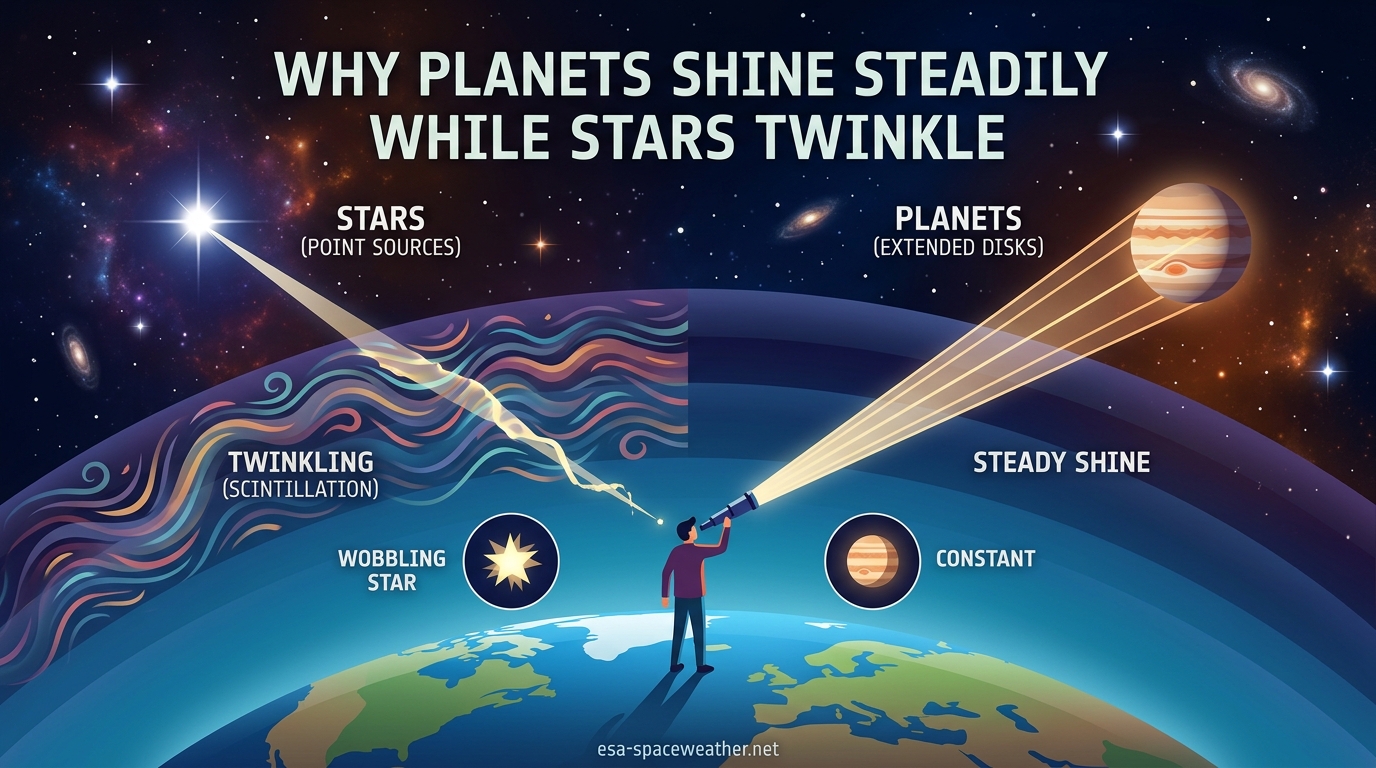
Stars twinkle because they are so far away that they appear as single, dimensionless points of light. Earth’s turbulent atmosphere bends that pinpoint of light in slightly different directions moment by moment, making it appear to flicker. Planets, on the other hand, are much closer to us and show up as tiny disks rather than points. Because a disk sends light from many slightly different angles at once, the distortions average each other out, and the planet appears to shine steadily.
That is the entire phenomenon in a nutshell. Now let me break down each piece in more detail so the science clicks.
What Causes Stars to Twinkle? Atmospheric Refraction Explained
The answer to why do stars twinkle lies in a process called atmospheric refraction. When starlight travels through the vacuum of space, it moves in a perfectly straight line. But the moment that light hits Earth’s atmosphere, things change.
Our atmosphere is not a uniform blanket of air. It is made up of countless layers with different temperatures and densities. Cold air is denser than warm air, and each layer bends light at a slightly different angle. As a beam of starlight passes through these layers, it gets refracted, or bent, over and over again in rapid succession.
Here is a simple way to picture it. Imagine shining a laser pointer through a glass of water. The beam bends where air meets water. Now imagine that glass is constantly swirling, with eddies and currents shifting every fraction of a second. The beam would jump and waver unpredictably. That is essentially what happens to starlight as it passes through miles of turbulent air.
Since stars are so incredibly distant, even the nearest one (Proxima Centauri at about 4.24 light-years) arrives as a single infinitesimal point of light. All of that starlight enters your eye along one narrow path. When the atmosphere bends that path, the entire point of light shifts at once. Your eye perceives this rapid shifting as twinkling.
The atmospheric turbulence responsible for this effect is also what makes stars appear to dance more vigorously on some nights than others. A night with strong air currents, temperature inversions, or high-altitude winds produces more violent refraction and more dramatic twinkling.
Understanding Scintillation in Astronomy
Astronomers have a formal name for twinkling: stellar scintillation. The term scintillation refers to rapid variations in apparent brightness, position, or color of a distant light source caused by atmospheric disturbances.
Scintillation in astronomy is more than a visual curiosity. Professional observatories measure it to evaluate what they call “seeing conditions,” which tells them how sharp their telescope images will be on a given night. High scintillation means poor seeing, with blurry and unstable images. Low scintillation means steady air and crisp views.
This is why the Hubble Space Telescope and other space-based observatories produce such remarkably sharp images. Above the atmosphere, there is no scintillation at all. Stars do not twinkle in space because there is no air to bend their light.
Why Planets Shine Steadily: The Extended Disk Effect
So why do planets escape this twinkling fate? The answer is their apparent size in our sky.
Even though planets are physically much smaller than stars, they are dramatically closer to Earth. Jupiter, for example, is about 365 million miles away at its closest approach. The nearest star is roughly 25 trillion miles away. That enormous difference in distance means planets appear as tiny but measurable disks, not dimensionless points.
Think of a planet’s disk as a collection of thousands of individual point sources of light, each sending photons toward your eye along a slightly different path through the atmosphere. When atmospheric turbulence bends one of those paths, that particular point might dim or shift. But at the same moment, hundreds of other points on the disk are being bent in different directions. Some get brighter, some get dimmer, and the net effect is that the overall brightness of the planet barely changes.
The distortions cancel each other out. This is why planets shine steadily while stars twinkle. Astronomers call this the extended disk effect, and it is the single most important factor in explaining the difference.
There is an important caveat. When a planet sits very low on the horizon, its light passes through a much thicker slice of atmosphere. Under those conditions, even planets can appear to shimmer slightly. But compared to nearby stars, the planet will still look far steadier.
Why Stars Twinkle More Near the Horizon
If you watch the sky for a while, you will notice that stars low on the horizon twinkle far more violently than stars overhead. This is because of the angle at which their light enters the atmosphere.
When a star is directly overhead, its light travels through the minimum thickness of atmosphere, roughly 60 miles of air. When a star sits near the horizon, its light enters the atmosphere at a shallow angle and must travel through hundreds of miles of air before reaching your eyes. More atmosphere means more turbulent layers, more refraction events, and more dramatic twinkling.
This is also why stars near the horizon often flash vivid colors. The thick atmospheric path disperses the starlight like a prism, separating it into momentary flashes of red, green, and blue. Sirius, the brightest star in the night sky, is famous for this effect when it sits low above the horizon.
Why Twinkling Stars Change Color
One of the most common questions I hear is why stars twinkle red and blue. The answer involves chromatic dispersion, which is the tendency of different wavelengths of light to bend by slightly different amounts.
Blue light bends more than red light when passing through a refractive medium. So as the atmosphere churns and a star’s light gets refracted in rapidly changing directions, the blue and red components sometimes reach your eye while the green and yellow get temporarily directed elsewhere. For a fraction of a second you might see a flash of red, then blue, then white again.
This colorful flickering is most noticeable in bright stars near the horizon, where the atmosphere is thick enough to act like a weak prism. Planets almost never show this effect because their extended disks average out the color dispersion just as they average out the brightness variations.
How Space Weather and Atmospheric Conditions Affect Twinkling
Here is something most astronomy guides do not cover: the intensity of stellar scintillation is directly influenced by atmospheric and space weather conditions. Since we monitor these conditions closely, this connection deserves attention.
Strong temperature gradients in the upper atmosphere, often associated with jet streams and weather fronts, increase turbulence and make stars twinkle more vigorously. A cold front passing through can turn a calm starry night into a disco of flickering lights within hours. High humidity also plays a role, as water vapor in the air adds additional density variations that refract light.
Space weather events contribute too. When solar activity is high, the upper atmosphere absorbs more energy and can develop stronger temperature gradients. Geomagnetic storms heat the thermosphere, which alters the density structure of the upper air layers. These changes can subtly affect the turbulence profile that starlight encounters on its way down, influencing scintillation intensity.
This is why monitoring atmospheric conditions matters for both professional astronomy and space weather prediction. The same turbulent layers that make stars twinkle are the layers that satellites, GPS signals, and radio communications must pass through. A night of violent twinkling is a night of active atmospheric disturbance.
How to Tell Planets from Stars Using Twinkling
The twinkling difference gives you a free, instant tool for identifying planets in the night sky. Here is the simple rule I teach every beginner: if it twinkles, it is almost certainly a star. If it shines with a calm, steady glow, it is probably a planet.
Venus and Jupiter are the most obvious steady lights, often outshining every star in the sky without a hint of flicker. Mars and Saturn are steadier than nearby stars as well, though they can shimmer slightly when low on the horizon. Mercury, always near the horizon at twilight, can be trickier since it may show some twinkling.
The color also helps. Venus appears brilliant white, Jupiter shines pale cream or tan, Mars glows distinctively orange-red, and Saturn has a muted golden hue. Combine the steady glow with the characteristic color and you can confidently identify planets without any equipment.
FAQs
Why do stars twinkle?
Stars twinkle because Earth’s atmosphere bends their light as it passes through layers of air with different temperatures and densities. Since stars appear as single points of light, every small bend in the light path makes the entire point shift, creating a flickering effect known as scintillation.
Do planets twinkle?
Planets generally do not twinkle because they appear as tiny disks rather than points of light. Light from different parts of the disk gets distorted by the atmosphere in different directions, and these distortions cancel each other out, producing a steady glow. Planets can shimmer slightly when very low on the horizon.
What is scintillation in astronomy?
Scintillation is the scientific term for the rapid variations in brightness, position, and color of a light source caused by atmospheric turbulence. Stellar scintillation is what we commonly call twinkling. Astronomers measure scintillation to determine the quality of viewing conditions on any given night.
Why do stars twinkle red and blue?
Stars twinkle red and blue because of chromatic dispersion. Different colors of light bend by different amounts when passing through the atmosphere, with blue light bending more than red. As turbulence rapidly redirects the light, you may catch momentary flashes of different colors, especially when the star is low on the horizon.
How can I tell if a light in the sky is a star or a planet?
If the light twinkles or flickers, it is almost certainly a star. If it shines with a calm, steady glow, it is likely a planet. Venus, Jupiter, Mars, and Saturn are the most commonly visible planets and all appear steadier than nearby stars. Bright planets also tend to show subtle colors like white, cream, orange, or gold.
Why do stars twinkle more near the horizon?
Stars near the horizon twinkle more because their light passes through a much thicker layer of atmosphere than stars directly overhead. More atmosphere means more turbulent air layers and more refraction events, which intensifies the twinkling effect and often produces vivid color flashes.
Why do planets shine like stars at night?
Planets shine like stars because they reflect sunlight, making them bright enough to stand out in the night sky. The key difference is that planets appear as small disks rather than pinpoint sources, so their light remains steady while stars twinkle. This steady glow is what makes planets look different from stars even though both appear as bright points to the casual observer.
Conclusion
The reason why planets shine steadily while stars twinkle comes down to one elegant principle: apparent size. Stars are point sources whose single beams of light get tossed around by our turbulent atmosphere, producing the flickering we call scintillation. Planets are extended disks whose many overlapping beams of light cancel out the distortions and hold steady.
Next time you are outside on a clear night, put this knowledge to work. Look for the calm, unwavering lights among the flickering field of stars. Those steady beacons are worlds in our own solar system, and now you know exactly why they refuse to dance.