
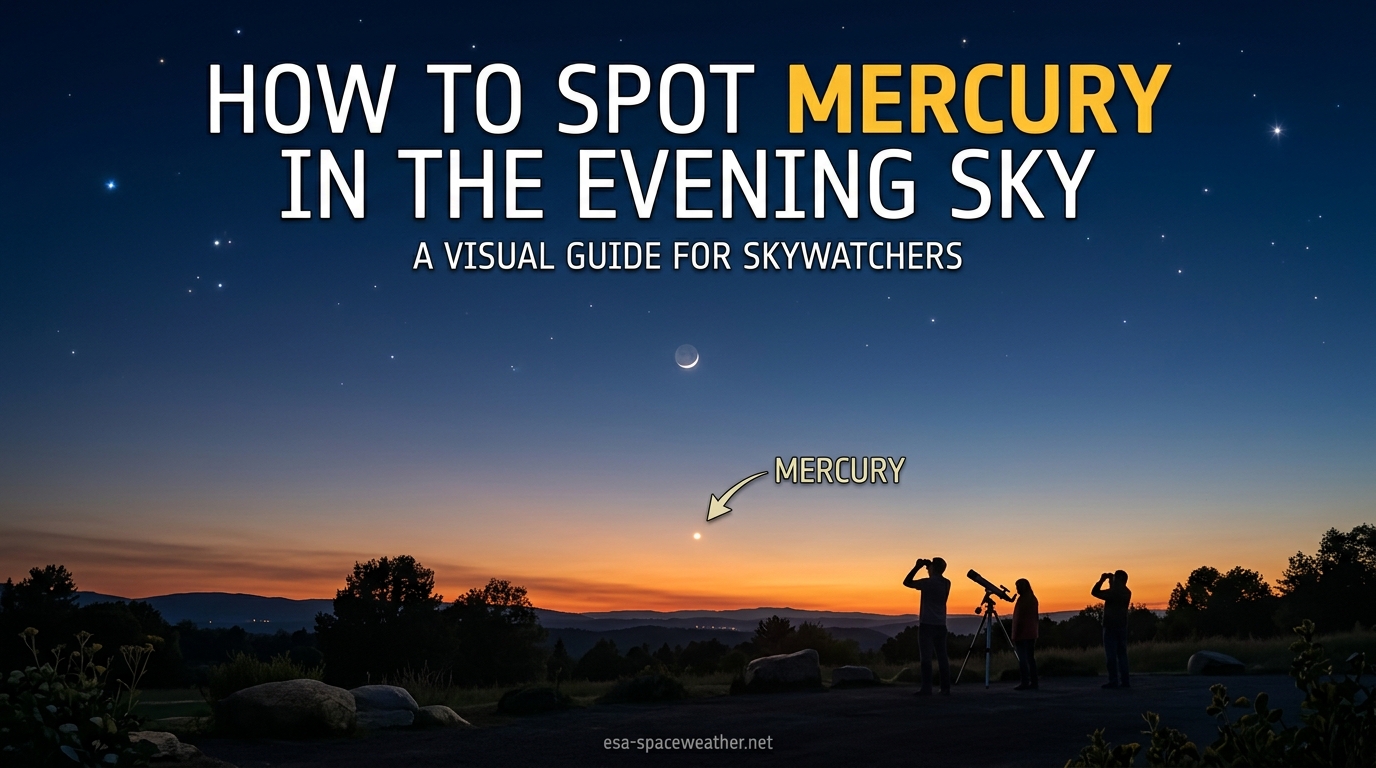
Mercury is the planet that every backyard astronomer wants to tick off their list, yet most never manage to see it. I remember spending three years of casual stargazing, spotting Venus, Jupiter, Mars, and Saturn repeatedly, before I finally caught my first glimpse of the innermost planet hugging the western horizon. Learning how to spot Mercury during its brief evening appearances takes patience, timing, and a clear understanding of when this elusive world peeks out from the Sun’s glare.
Mercury never strays far from the Sun in our sky. That single fact makes it both the most challenging and most rewarding of the five naked-eye planets to observe. While Jupiter and Venus announce themselves boldly, Mercury hides in twilight, testing your observing skills like nothing else.
In this guide, I will walk you through everything you need to know to find Mercury in the evening sky. We will cover the orbital mechanics behind its appearances, how to time your observation perfectly, where to look, what equipment helps, and the common mistakes that cause beginners to miss it. By the end, you will have a clear, practical plan to catch this swift little world.
Table of Contents
Quick Summary: Mercury Evening Viewing at a Glance
If you want the short version, here it is. Mercury becomes visible in the evening sky when it reaches greatest eastern elongation, which happens roughly every 3 to 4 months. At that point, the planet sits at its maximum angular distance east of the Sun, allowing it to linger above the western horizon for about 30 to 90 minutes after sunset.
To spot it, find a location with a flat, unobstructed western horizon. Wait 30 to 45 minutes after sunset for the sky to darken. Look low in the west, about 10 to 15 degrees above the horizon. If Venus is visible, scan downward from it toward the horizon. Mercury appears as a bright, steady point of light with a slight golden or rosy tint, noticeably not twinkling like the stars around it.
Binoculars (7×50 or 10×50) make the initial search much easier, especially if you are a first-time observer. Once you locate Mercury with binoculars, try spotting it with your naked eye. The best evening windows last about one to two weeks around each greatest eastern elongation date.
Why Mercury Is So Hard to Spot
Mercury is the smallest planet in our solar system and the closest to the Sun. Its average orbital distance is only about 36 million miles (58 million kilometers), compared to Earth’s 93 million miles. Because Mercury orbits so close to the Sun, it never appears very far from the Sun in our sky. The maximum angular separation between Mercury and the Sun, as seen from Earth, is only about 27 degrees. Compare that to Venus, which can reach 47 degrees, or Jupiter, which can appear opposite the Sun.
This tight orbital relationship means Mercury is almost always bathed in sunlight when it is above the horizon. The planet rises and sets so close to the Sun that it is typically lost in the solar glare. You can only see it during those brief periods when it reaches greatest elongation and the Sun has dipped just far enough below the horizon for the sky to darken, but Mercury has not yet followed.
Mercury’s orbital eccentricity also complicates things. Its orbit is noticeably elliptical rather than circular, with an eccentricity of 0.206, the highest of any major planet. This means that some greatest elongations are much more favorable than others. At certain elongations, Mercury may appear 27 degrees from the Sun, while at others it barely manages 18 degrees. The more angular separation, the longer Mercury stays above the horizon after sunset, and the easier it is to spot.
The angle of the ecliptic, which is the apparent path of the Sun and planets across the sky, also plays a major role. If the ecliptic makes a steep angle with the horizon at your location during the elongation, Mercury sits higher above the horizon at sunset and remains visible longer. If the ecliptic is nearly parallel to the horizon, Mercury barely clears the horizon before setting. This is why the same elongation can produce excellent viewing for observers in one hemisphere and terrible viewing for those in the other.
Atmospheric conditions add another layer of difficulty. When you look toward the horizon, you are peering through a much thicker column of atmosphere than when you look overhead. Near the horizon, the air is turbulent, dusty, and often humid. This causes atmospheric seeing to degrade significantly, making low-altitude objects appear to shimmer, blur, or fade. Mercury, sitting right in that problematic zone, bears the full brunt of atmospheric distortion.
Light pollution compounds the problem. Even a modest amount of artificial sky glow can wash out Mercury’s relatively faint light when it is low on the horizon. Many amateur astronomers report that they have seen every other naked-eye planet but never Mercury, despite years of trying. One observer on Reddit described Mercury as the “final boss” of naked-eye planet observing, and that sentiment resonates widely in the astronomy community.
Horizon obstructions are perhaps the most practical barrier. Mercury appears so low in the sky that even a line of trees, a row of buildings, or a slight hill can completely block your view. You need a genuinely flat, open western horizon for evening observations, which is surprisingly hard to find in many populated areas.
Understanding Greatest Elongation
Greatest elongation is the key concept you need to understand to find Mercury. Put simply, greatest elongation is the point in Mercury’s orbit where it appears farthest from the Sun in our sky, as observed from Earth. At this moment, the angular separation between Mercury and the Sun reaches its maximum value, and Mercury is visible for the longest possible time either after sunset or before sunrise.
Think of it this way: imagine holding your arm straight out with your thumb pointing up. Your thumb represents the Sun in the distance. Mercury is like a firefly buzzing around your thumb. Most of the time, the firefly is so close to your thumb that the glare hides it. But when the firefly reaches the farthest point in its loop, it briefly stands out against the dark background. That moment is greatest elongation.
Eastern Elongation: The Evening Window
Mercury has two types of greatest elongation, and understanding the difference is essential for evening observing. At greatest eastern elongation, Mercury appears east of the Sun in our sky. Because the sky appears to move from east to west as Earth rotates, objects that are east of the Sun set after the Sun does. This means Mercury at greatest eastern elongation is an evening object, visible low in the western sky after sunset.
This is the configuration you want for evening Mercury watching. The planet will trail the Sun below the horizon by anywhere from 30 to 90 minutes, depending on the angle of the ecliptic and the specific angular separation achieved. During favorable eastern elongations, Mercury can reach an apparent magnitude of about -0.5 to -1.0, making it brighter than most stars in the sky. The challenge is not brightness but the bright twilight background it sits in.
Western Elongation: The Morning Window
At greatest western elongation, the opposite occurs. Mercury appears west of the Sun in our sky, which means it rises before the Sun. In this configuration, Mercury is a morning object, visible low in the eastern sky before dawn. If you are reading this guide specifically for evening appearances, you can ignore western elongations, but it is helpful to know the difference so you do not confuse the two.
A common mistake beginners make is reading about a Mercury elongation event and assuming it means the planet is visible in the evening. Always check whether it is an eastern elongation (evening) or western elongation (morning). Astronomy apps and websites will specify this clearly.
Conjunctions: When Mercury Disappears
Between elongations, Mercury passes through conjunctions with the Sun, which are periods when the planet is completely invisible. At inferior conjunction, Mercury passes between Earth and the Sun. At superior conjunction, Mercury passes behind the Sun as seen from Earth. During both types of conjunction, Mercury is lost in the solar glare and cannot be observed safely.
The cycle from one greatest eastern elongation to the next takes about 3 to 4 months. Mercury completes an orbit around the Sun in just 88 Earth days, but because Earth is also moving, the synodic period, which is the time between similar apparitions as seen from Earth, is approximately 116 days. This means you get roughly three favorable evening windows per year, each lasting about one to two weeks of good viewing around the peak.
Angular Separation: Why Some Elongations Are Better Than Others
Not all elongations are created equal. Because Mercury’s orbit is so elliptical, the angular separation at greatest elongation varies significantly. The maximum possible eastern elongation is about 27 degrees, while the minimum is around 18 degrees. A 27-degree elongation gives you nearly twice the viewing window of an 18-degree elongation.
The reason for this variation comes down to where Mercury is in its orbit relative to perihelion, its closest point to the Sun, and aphelion, its farthest point. When Mercury reaches greatest eastern elongation near aphelion, it is farther from the Sun and therefore appears farther from it in our sky. When elongation occurs near perihelion, the planet is closer to the Sun and the angular separation is smaller.
For evening observers in the Northern Hemisphere, the best elongations typically occur during late winter and spring. This is because the ecliptic makes its steepest angle with the western horizon during these seasons, lifting Mercury higher above the horizon glow. Southern Hemisphere observers get their best views during their own late winter and spring months.
When Mercury Appears in the Evening Sky
Mercury offers approximately three evening apparitions per year. Each one centers around a date of greatest eastern elongation and provides a viewing window of roughly one to two weeks on either side of that peak. Outside these windows, Mercury is either too close to the Sun to observe or is in its morning phase.
The typical cycle goes like this: Mercury emerges from superior conjunction, gradually moving east of the Sun and becoming visible in the evening twilight. Over the course of about three to four weeks, it climbs higher each evening, brightening or fading depending on its phase. It reaches greatest eastern elongation, the peak of the evening apparition, then begins descending back toward the horizon as it approaches inferior conjunction. The entire favorable viewing window spans about three to five weeks, with the best nights clustered around the elongation date.
How to Determine Whether Mercury Is Evening or Morning
One of the most common questions from beginners is how to know whether Mercury is currently an evening or morning object. The simplest method is to use a stargazing app like Stellarium, Star Walk, SkySafari, or NASA’s interactive sky portal. These tools show you exactly where Mercury is relative to the Sun on any given date.
If you prefer to check without an app, several astronomy websites publish monthly elongation tables and observing calendars. Look for the next greatest eastern elongation date. In the week leading up to and following that date, Mercury will be visible in the evening. Similarly, greatest western elongation dates mark morning visibility windows.
A practical tip: if Mercury is to the left of the sunset point as you face west (for Northern Hemisphere observers), it is an evening object. If you would need to look east before dawn to find it, it is in its morning phase.
How Long Each Evening Window Lasts
Mercury’s favorable evening viewing window is surprisingly short. On the best nights, centered around greatest eastern elongation, the planet remains visible for about 60 to 90 minutes after sunset. On less favorable nights or during poor elongations, that window may shrink to 30 to 40 minutes.
This narrow window means timing is critical. If you go out too early, the sky is too bright and Mercury is lost in the twilight glow. If you wait too long, Mercury has already set below the horizon. The sweet spot for most observers is between 30 and 60 minutes after sunset, when the sky has darkened enough for Mercury to stand out but the planet has not yet set.
Northern vs Southern Hemisphere Differences
Your hemisphere dramatically affects Mercury visibility. The angle of the ecliptic relative to the horizon changes with latitude and season, which means the same elongation event can produce completely different observing conditions depending on where you live.
In the Northern Hemisphere, the ecliptic makes its steepest angle with the western horizon during February, March, and April. Eastern elongations during these months place Mercury high enough above the horizon for excellent evening viewing. Conversely, during August, September, and October, the ecliptic is nearly flat against the western horizon at sunset, making evening Mercury observations very difficult for northern observers.
Southern Hemisphere observers experience the opposite pattern. Their best evening elongations occur during August through October, when the ecliptic angle favors their latitude. February through April elongations are poor for southern observers.
Tropical and equatorial observers fall somewhere in between, with less dramatic seasonal variation but also less extreme maximum altitudes for Mercury. The key takeaway is to check Mercury’s predicted altitude for your specific location rather than assuming an elongation will be favorable based on hemisphere alone.
How to Spot Mercury During Its Brief Evening Appearances: Step-by-Step
Now we get to the practical heart of this guide. Here is the step-by-step process I use to find Mercury during its evening windows. Follow these steps in order for your best chance of success.
Step 1: Identify the Next Greatest Eastern Elongation Date
Before you do anything else, find out when Mercury’s next greatest eastern elongation occurs. Check an astronomy calendar, a stargazing app, or a space weather website for upcoming elongation dates. Mark the date and plan to observe during the week surrounding it, starting about five days before and continuing about five days after the peak.
Make sure it is specifically an eastern elongation, not a western one. Eastern elongation equals evening viewing. Western elongation equals morning viewing. This distinction is critical and a very common source of confusion for beginners.
Step 2: Find a Location With a Clear Western Horizon
Mercury appears very low in the sky, typically between 8 and 15 degrees above the western horizon at its best. Any obstruction in that direction will block your view. You need an open western horizon free of trees, buildings, hills, and other barriers.
Good locations include hilltops facing west, coastal areas overlooking water to the west, open fields, the top floors of tall buildings with west-facing windows, and rural areas away from development. Light pollution is less critical than horizon clearance, but darker skies will make Mercury easier to pick out against the twilight.
Scout your location in advance. Visit during daylight hours to confirm your sight line to the western horizon. Take note of any obstructions and find the spot that gives you the widest, flattest western view.
Step 3: Arrive Early and Let Your Eyes Adjust
Arrive at your observing location at least 15 minutes before sunset. This gives you time to set up any equipment, orient yourself, and let your eyes begin adapting to the dark. Bring a red flashlight to preserve your night vision if you need to check maps or notes.
While you wait, identify bright reference points in the western sky. Venus, if it is visible, is an excellent guide. Jupiter can also serve as a reference if it is in the right part of the sky. Note where the Sun sets on the horizon, because Mercury will appear along the same arc, offset to the left or right depending on the elongation geometry.
Step 4: Begin Scanning 30 to 45 Minutes After Sunset
Wait until the Sun has fully disappeared below the horizon and the sky begins to darken. The optimal scanning window opens about 30 minutes after sunset and closes when Mercury drops below the horizon, typically 60 to 90 minutes after sunset.
Start by sweeping the western horizon with binoculars. Use a 7×50 or 10×50 pair, which provides a wide enough field of view to cover the likely search area while gathering enough light to detect Mercury against the twilight. Sweep slowly along the horizon in a horizontal arc, scanning from about 5 degrees to 20 degrees above the horizon.
If Venus is visible, use it as your starting point. Mercury will appear well below Venus, closer to the horizon. Scan the area between Venus and the horizon, moving systematically left to right and gradually working downward.
Step 5: Confirm the Identification
Once you find a candidate object, check its characteristics. Mercury appears as a steady, bright point of light that does not twinkle the way stars do. It has a subtle golden or rosy tint that distinguishes it from the white or blue-white light of most stars. Mercury’s brightness varies with elongation but typically ranges from magnitude -1.0 to +0.5 during favorable evening windows.
Confirm your sighting with a stargazing app. Open Stellarium, Star Walk, or SkySafari on your phone, hold it up toward the western horizon, and verify that the object you found matches Mercury’s predicted position. The app will show you exactly where Mercury should be at that moment.
Watch the object for several minutes. Mercury will slowly descend toward the horizon as Earth rotates, while stars in the area will also drift but at different rates. If the object matches the app’s position and moves as expected, you have successfully found Mercury.
Step 6: Try Naked Eye Detection
Once you have confirmed Mercury’s location with binoculars, try to spot it with your naked eye. This is more challenging but very satisfying. Look at the exact spot where you saw it through binoculars and let your eyes relax. Averted vision, which involves looking slightly to the side of the target, can help because the edges of your retina are more sensitive to faint light.
If you cannot see it naked eye immediately, do not worry. Atmospheric conditions, light pollution, and the brightness of the twilight all affect visibility. Some nights require binoculars, and that is perfectly fine. The goal is to see Mercury, not to prove anything about your eyesight.
What Mercury Looks Like: Naked Eye Viewing Tips
To the naked eye, Mercury looks like a moderately bright star that refuses to twinkle. Most observers describe it as having a warm golden tone, sometimes with a faint rosy or coppery tinge. This coloration comes from Mercury’s surface, which is heavily cratered and composed of iron-rich minerals that reflect sunlight with a warm hue.
Mercury’s apparent magnitude during evening apparitions typically ranges from about -0.5 to +0.5. At its brightest, it outshines all but the very brightest stars. However, because it sits low in a bright twilight sky, it can appear deceptively faint. The twilight background robs contrast, making Mercury harder to see than its magnitude alone would suggest.
The most reliable way to distinguish Mercury from a star is by its steady light. Stars twinkle because their light passes through Earth’s turbulent atmosphere as a point source, getting rapidly refracted in different directions. Mercury, while small, presents a slightly larger apparent disk than a star, which reduces the twinkling effect. Mercury’s light appears steady and solid compared to the rapid flashing of nearby stars.
Planet color also helps with identification. Mercury’s warm golden-rose color is distinct from the blue-white of Sirius, the orange of Arcturus, or the red of Antares. If you see a golden, steady light low in the west during twilight that matches your stargazing app’s position for Mercury, you have your planet.
Many experienced observers on astronomy forums report that Mercury’s naked-eye appearance is underwhelming compared to Venus or Jupiter. It does not dominate the sky the way those planets do. But there is something uniquely satisfying about spotting this swift, elusive world that makes the effort worthwhile. It feels like an achievement in a way that seeing brighter planets does not.
Using Binoculars or a Telescope for Mercury Observation
Binoculars are the single best tool for finding Mercury during evening apparitions. A pair of 7×50 or 10×50 binoculars provides the wide field of view you need to scan the horizon and the light-gathering power to pull Mercury out of the twilight glow. I strongly recommend starting with binoculars before attempting naked-eye observation, especially if you are new to this.
The process is straightforward. Begin scanning about 30 minutes after sunset, sweeping along the western horizon at the altitude where your app predicts Mercury. Move slowly and methodically, covering the search area in overlapping horizontal sweeps. When you spot a candidate, hold steady and confirm with your app.
Binoculars also help on nights when Mercury is theoretically visible but atmospheric conditions or light pollution make naked-eye detection difficult. Even if you can see Mercury without optical aid, binoculars will enhance the view and let you appreciate its steady golden light more clearly.
Telescope Viewing: Phases of Mercury
Through a telescope, Mercury reveals something extraordinary that you cannot see with the naked eye or binoculars: phases. Like Venus and the Moon, Mercury goes through a complete cycle of phases as it orbits the Sun relative to Earth. A small telescope at moderate magnification, around 50x to 100x, can show these phases.
At greatest eastern elongation, Mercury appears roughly half-illuminated, similar to a first quarter Moon. As it moves toward inferior conjunction, the phase shrinks to a crescent. After passing through inferior conjunction and emerging in the morning sky, it waxes back through half-illuminated to a gibbous phase near superior conjunction.
Observing Mercury’s phases requires steady atmospheric conditions, which can be challenging when the planet is low on the horizon. Atmospheric seeing near the horizon is typically poor, causing the image to blur and shimmer. Patience is key. Wait for moments of steady air when the phase becomes briefly sharp and clear.
A 3-inch or larger refractor telescope works well for Mercury. Use moderate magnification rather than high power, because the turbulent low-altitude air will ruin high-magnification views. A blue or violet filter can sometimes improve contrast and reduce the glare from the bright twilight background.
Recommended Stargazing Apps
Several excellent apps can help you locate Mercury with precision. Stellarium is a free, powerful planetarium program available for desktop and mobile devices. It shows accurate real-time positions of all planets and stars from any location on Earth.
Star Walk 2 is a user-friendly mobile app that provides an augmented reality view of the sky. You point your phone at the horizon, and the app overlays the positions of planets, stars, and constellations on the live view from your camera.
SkySafari is a more advanced option for serious observers. It offers detailed orbital data, magnification simulations, and telescope control features. Even the basic version provides everything you need for Mercury observation.
For a quick reference without installing anything, the NASA sky events calendar and the In-The-Sky.org elongation tables provide reliable dates for upcoming Mercury elongation events worldwide.
Common Mistakes Beginners Make When Looking for Mercury
After years of helping other observers find Mercury, I have noticed the same mistakes repeating. Here are the most common ones and how to avoid them.
Looking too early is the number one problem. If you start scanning the western horizon immediately after sunset, the sky is still too bright and Mercury is completely invisible. You need to wait until the sky has darkened significantly, usually 30 to 45 minutes after sunset. Going out too early just leads to frustration and wasted effort.
Looking too late is equally common. Mercury sets quickly, often within an hour of sunset. If you arrive 60 to 75 minutes after sunset, Mercury may have already dropped below the horizon. The viewing window is narrow and unforgiving.
Choosing a poor observing location ruins many attempts. Mercury appears so low on the horizon that any obstruction blocks it entirely. If your western horizon has trees, buildings, or hills, you will not see Mercury regardless of timing. You need a flat, open view to the west. Many beginners fail simply because they observe from their backyard without checking the sight line.
Confusing Mercury with bright stars is another frequent error. During certain times of year, bright stars like Capella, Aldebaran, or Procyon may appear in the same general region of sky as Mercury. Use a stargazing app to verify your identification. Remember that Mercury does not twinkle like stars and has a warm golden tint.
Giving up after one failed attempt is perhaps the most important mistake to avoid. Mercury observation requires persistence. A single cloudy evening, a poor atmospheric seeing night, or a slightly miscalculated timing can cause a failed attempt. Try again the next clear night during the elongation window. Many observers need three or four attempts before their first successful sighting.
Not checking whether the elongation is favorable is a subtle but significant error. Some elongations give Mercury only 18 degrees of separation from the Sun, producing a terrible viewing window. Other elongations provide 25 to 27 degrees, making Mercury much easier to spot. Check the angular separation before heading out. If it is below 20 degrees, conditions will be tough even under ideal circumstances.
Safety Considerations: Never Look at the Sun
This section deserves your full attention. Mercury observations happen close to the Sun in the sky, which means safety must be your top priority. The Sun can cause permanent eye damage in fractions of a second if viewed directly, and this risk is even higher when using binoculars or a telescope.
Never look at the Sun directly with your naked eye, binoculars, or a telescope. This applies at all times, but it is especially relevant during Mercury observation because the planet is so close to the Sun in the sky. A slight misalignment of your binoculars could bring the Sun into view with devastating consequences for your vision.
The safe approach is simple. Only begin searching for Mercury after the Sun has completely set below the horizon. Wait until you can no longer see any part of the Sun’s disk, then begin your observation. If you are observing Mercury during morning apparitions, wait until the Sun has not yet risen above the horizon.
Never sweep the sky with binoculars near the Sun, even after sunset, if any solar glare remains on the horizon. That lingering bright glow can still be dangerous through optics. Only scan when the sky has darkened enough that you are confident no direct sunlight enters your field of view.
Do not attempt daytime Mercury observation without specialized solar filtering equipment and professional guidance. While it is technically possible to see Mercury in broad daylight with a properly equipped telescope, this is an advanced technique that carries significant risk. Stick to twilight observation until you have extensive experience.
Protecting your vision is more important than any single observation. Mercury will return in three to four months. Your eyes do not get a second chance.
FAQs
How long after sunset can you see Mercury?
Mercury is typically visible 30 to 60 minutes after sunset during favorable evening elongations, with the best viewing window falling between 30 and 45 minutes post-sunset. The exact duration depends on the angular separation from the Sun and the angle of the ecliptic at your location. On the best nights, Mercury remains detectable for up to 90 minutes after sunset before it follows the Sun below the western horizon.
Can you see Mercury with the naked eye?
Yes, Mercury is visible to the naked eye during favorable greatest eastern elongations when it reaches an apparent magnitude of about -0.5 to +0.5. The challenge is not brightness but the bright twilight background and low horizon placement. Most observers find it easier to first locate Mercury with binoculars, then attempt naked-eye detection once they know exactly where to look. Mercury appears as a steady, golden-tinted point of light that does not twinkle like stars.
How to tell if Mercury is a morning or evening star?
Check whether Mercury is at greatest eastern elongation or greatest western elongation. Eastern elongation means Mercury appears east of the Sun in the sky, making it an evening object visible after sunset in the west. Western elongation means Mercury appears west of the Sun, making it a morning object visible before sunrise in the east. Use any stargazing app like Stellarium or Star Walk to check the current configuration, or consult an astronomy calendar for upcoming elongation dates.
How do you see Mercury at night?
To see Mercury in the evening, find a location with a clear western horizon, wait 30 to 45 minutes after sunset, and scan low above the horizon with binoculars. Look for a bright, steady point of light with a golden tint. If Venus is visible, scan downward from it toward the horizon. Use a stargazing app to confirm the exact position. Mercury is only visible during brief windows around greatest eastern elongation, which occurs roughly every 3 to 4 months.
Conclusion
Learning how to spot Mercury during its brief evening appearances is one of the most rewarding challenges in amateur astronomy. The planet tests your timing, your patience, and your observing skills in ways that no other naked-eye planet does. But when you finally see that small golden light hovering above the western horizon, the effort feels entirely worthwhile.
The keys to success are straightforward. Know when the next greatest eastern elongation occurs. Find a location with a clear western horizon. Time your observation for 30 to 45 minutes after sunset. Use binoculars and a stargazing app to confirm your sighting. And above all, be patient and persistent.
Mercury offers three evening windows per year, each lasting about one to two weeks. Mark your calendar, check the weather forecast, and head out on the first clear evening during each window. Once you spot Mercury for the first time, subsequent sightings become much easier because you know exactly what to look for and how to time your search. Clear skies, and good hunting.