
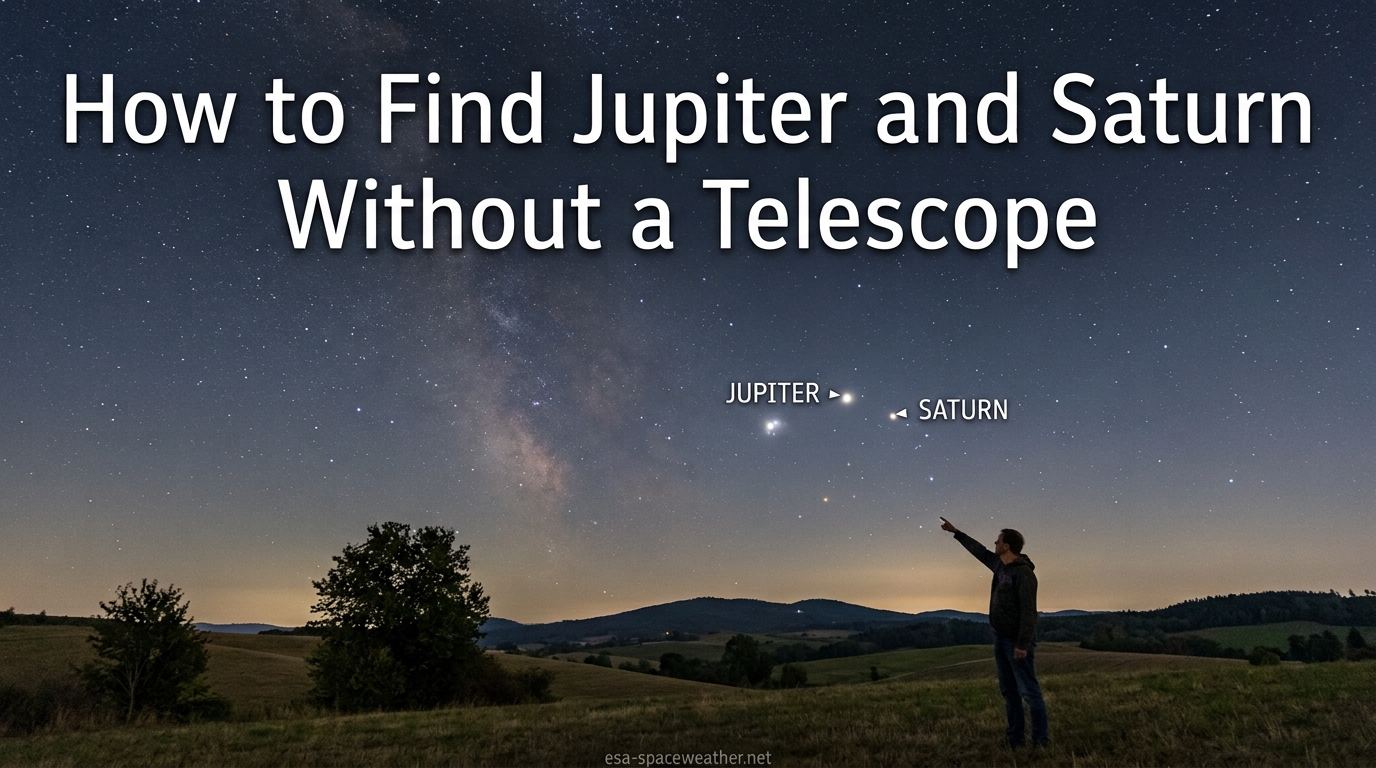
You do not need a telescope to see Jupiter and Saturn. Both of these gas giants rank among the brightest objects in the night sky, and they are visible to the naked eye from almost anywhere on Earth for much of the year. I have spent years showing complete beginners how to spot them, and once you know the signs, you will never look at the night sky the same way again.
This guide walks you through exactly how to find Jupiter and Saturn without a telescope. We will cover the single most important rule for telling planets from stars, where to look in the sky, what each planet looks like to your eye, and the best times to head outside. Whether you live under dark rural skies or in the middle of a light-polluted city, these techniques will work for you.
Jupiter shines as a brilliant, steady white light that outshines nearly every star. Saturn glows with a softer, pale yellow hue that is a bit dimmer but still easy to spot once you know where to look. The ancient Greeks called them “wanderers” because, unlike the fixed stars, these planets slowly shift their position from night to night along a path called the ecliptic. That wandering motion is one of your biggest clues.
Let us break the process down step by step so you can walk outside tonight and confidently point to both planets.
Table of Contents
How to Find Jupiter and Saturn Without a Telescope: The Quick Answer
To find Jupiter and Saturn without a telescope, go outside 30 to 60 minutes after sunset and look along the ecliptic, the arc the Sun traveled across the sky. Jupiter will appear as the brightest steady white light in that band. Saturn will sit nearby as a dimmer, pale yellow glow. Both planets shine steadily without twinkling, which distinguishes them from stars. Use a free planetarium app like Stellarium or Sky Tonight to confirm exactly where they are on any given night.
That is the short version. Now let us get into the details so you can identify them with total confidence, every single time.
Stars Twinkle, Planets Don’t: The #1 Identification Rule
If you remember just one thing from this guide, make it this: stars twinkle, and planets shine with a steady light. This is the single most reliable way to distinguish a planet from a star with the naked eye, and amateur astronomers have relied on it for centuries.
The reason comes down to physics. Stars are so far away that they appear as pinpoint sources of light. Earth’s atmosphere is constantly shifting, with turbulent pockets of air at different temperatures bending that pinpoint light in random directions. The result is the flickering, sparkling effect we call twinkling.
Planets, on the other hand, are much closer to Earth. They are close enough that they show a tiny disc shape rather than a point. Because the light comes from a small disc rather than a single point, the atmospheric turbulence averages out. Instead of flickering, a planet produces a calm, constant glow. Some observers describe it as looking like a tiny flashlight beam versus a sparkling diamond.
There is one caveat. When a planet sits very low on the horizon, you are looking through a thicker layer of atmosphere. Under those conditions, even planets can appear to shimmer or change color slightly. Once the planet climbs higher in the sky, the steady glow returns. So if a bright object is flickering like crazy near the horizon, give it some time and check again later.
This single rule alone will let you scan the sky and immediately separate planetary candidates from the hundreds of stars around them. When I take people outside for their first stargazing session, this trick always produces an “aha” moment.
The Ecliptic: Where to Look in the Sky
Planets do not appear randomly scattered across the sky. They follow a predictable band called the ecliptic, which is the same path the Sun appears to travel from east to west during the day. Since all the major planets orbit the Sun in roughly the same flat plane, they all stay close to this imaginary line in the sky.
Think of the ecliptic as a highway. The Sun travels along it during the day, and at night the planets follow the same route. If you trace the arc the Sun made across the sky from sunrise to sunset, that same arc extended into the night sky is where Jupiter and Saturn will be.
You can find the ecliptic by looking for familiar constellations that sit along it. The zodiac constellations, including Taurus, Gemini, Leo, Virgo, Scorpius, and Sagittarius, all straddle this path. Jupiter and Saturn will always appear in or near one of these constellations, never far above or below this band.
Here is a quick trick to trace the ecliptic visually. Look for the Moon. The Moon also travels close to the ecliptic, so if you spot the Moon, the planets will be somewhere along the same general arc across the sky. This gives you a starting line and narrows your search dramatically.
For beginners, this means you never need to search the entire sky. Just scan the strip from horizon to horizon along the Sun’s path, and you will find Jupiter and Saturn somewhere along it.
How to Identify Jupiter With the Naked Eye
Jupiter is the easiest planet to spot after Venus, and it is often the single brightest object in the night sky. Its apparent magnitude ranges from about -2.2 to -2.9, making it brighter than every star except the Sun and brighter than all other planets except Venus. On a clear night, Jupiter is impossible to miss.
Here is what to look for when identifying Jupiter:
Brightness: Jupiter outshines every star in the sky with the exception of Sirius, and Jupiter is distinctly brighter than Sirius too. If you see a blazingly bright, steady light that makes nearby stars look dim, you are almost certainly looking at Jupiter.
Color: Jupiter shines with a clear white or very slightly off-white light. Some observers detect a faint warm tint, almost like the color of cream. It lacks the blue of stars like Vega or the red of Mars. This clean, bright white is a strong identifier.
Position: Jupiter moves slowly through the zodiac constellations, spending roughly one year in each one. In 2026, check which constellation Jupiter is currently visiting using a free app, and then look for an impossibly bright light in that region.
Steady glow: Unlike nearby stars that flicker rapidly, Jupiter holds a calm, constant brightness. This steady light is your confirmation that the object is a planet and not a star.
One common mistake beginners make is confusing Jupiter with Sirius, the brightest star in the night sky. Sirius sits lower in the sky for Northern Hemisphere observers and twinkles intensely, often flashing through colors. Jupiter, by contrast, sits along the ecliptic and glows with that rock-steady light. If you are unsure, watch the object for a full minute. If it stays perfectly calm, it is Jupiter.
Forum discussions on Reddit’s astronomy communities frequently highlight this point. Users who spent years looking at the night sky describe the moment they realized that one particular “star” was actually Jupiter. It is brighter, steadier, and more commanding than anything around it.
Jupiter is also the planet most likely to be visible even from heavily light-polluted urban areas. Its sheer brightness cuts through city sky glow better than any other planet except Venus. If you can see any stars at all from your location, you can see Jupiter.
How to Identify Saturn With the Naked Eye
Saturn is dimmer than Jupiter but still well within naked-eye visibility. Its apparent magnitude ranges from about +0.4 to -0.5, making it comparable to the brighter stars in the sky. You will not mistake Saturn for a blazing beacon the way you might with Jupiter, but it is still a prominent object once you know what to look for.
Here is how to identify Saturn without a telescope:
Color: Saturn’s signature feature to the naked eye is its pale, creamy yellow tint. This is distinct from the white of Jupiter, the red of Mars, and the blue-white of bright stars like Vega. Once you learn to recognize this subtle golden hue, Saturn becomes much easier to pick out from surrounding stars.
Brightness: Saturn shines at roughly the brightness of a bright first-magnitude star. It is not the brightest thing in the sky, but it holds its own against stars like Arcturus, Capella, and Altair. The difference is that Saturn, being a planet, does not twinkle the way those stars do.
Position: Like Jupiter, Saturn moves along the ecliptic through the zodiac constellations. It moves even more slowly than Jupiter, spending roughly two and a half years in each constellation. The two planets are often visible at the same time, though their separation varies considerably over the years.
Steady glow: Saturn follows the same rule as all planets. It shines steadily without the rapid flickering that stars display. When you compare Saturn side by side with a nearby star of similar brightness, the difference is obvious.
The biggest challenge with Saturn is that it is less obvious than Jupiter. Beginners often scan past it because it does not dominate the sky the way Jupiter does. The trick is to look specifically for that steady, pale yellow light along the ecliptic near wherever Jupiter is hanging. The two planets are frequently in the same general region of the sky, separated by varying distances.
Saturn is also more affected by light pollution than Jupiter. From a heavily light-polluted city, you may need darker conditions or a clearer night to spot Saturn confidently. If you cannot see stars dimmer than about magnitude 2 from your location, Saturn will be a challenge. Head to a park on the edge of town or any spot with less direct light overhead.
One of the most rewarding moments in amateur astronomy is your first confident naked-eye identification of Saturn. Because Saturn does not announce itself the way Jupiter does, finding it feels like a genuine achievement. And once you spot it, you will find it again easily on subsequent nights.
Jupiter vs Saturn: Naked-Eye Comparison
Many beginners ask how to tell Jupiter and Saturn apart when both are visible. Here is a side-by-side comparison of what each planet looks like to the naked eye.
| Feature | Jupiter | Saturn |
|---|---|---|
| Brightness (magnitude) | -2.2 to -2.9 (very bright) | +0.4 to -0.5 (moderately bright) |
| Color | White to cream | Pale yellow to gold |
| Twinkling | Steady, no twinkling | Steady, no twinkling |
| Visibility from city | Easy even with light pollution | Possible but harder |
| Speed across zodiac | One constellation per year | One per 2.5 years |
| Often near each other? | Yes, both along ecliptic | Yes, both along ecliptic |
The quickest way to tell them apart is brightness and color. Jupiter is clearly brighter and whiter. Saturn is dimmer and carries that distinctive pale gold tint. If both are visible, scan between them and the differences jump out immediately.
Best Times to Observe Jupiter and Saturn
Timing matters enormously when it comes to spotting planets. Both Jupiter and Saturn go through cycles where they are well-placed for viewing and periods where they are too close to the Sun to be seen. Understanding these cycles will tell you exactly when to head outside.
The magic of opposition: The best time to see any outer planet is at opposition. Opposition occurs when Earth passes between the planet and the Sun, placing the planet directly opposite the Sun in our sky. At opposition, the planet rises at sunset, reaches its highest point around midnight, and sets at sunrise. It is also at its closest approach to Earth, meaning it appears at its brightest and largest.
Jupiter reaches opposition roughly every 13 months. Saturn reaches opposition roughly every 12.5 months, typically within a week or two of Jupiter’s opposition. When both reach opposition in the same season, you get a window of weeks or months where both planets are visible all night long. This is the ideal time for naked-eye observation.
Twilight observing: The best time to start looking is during twilight, about 30 to 60 minutes after sunset or before sunrise. The sky is dark enough for bright planets to show, but there is still enough ambient light to help you orient yourself and spot landmarks on the horizon. Jupiter in particular is often visible in bright twilight, long before any stars appear.
Monthly and seasonal visibility: Planets are not visible year-round. When a planet is on the far side of the Sun from Earth, it disappears into the Sun’s glare for weeks or months. Jupiter and Saturn each have an invisible period each year, typically lasting one to two months. Check a current sky calendar or planetarium app for the exact dates in 2026.
Conjunction events: One of the most spectacular naked-eye events is a conjunction, when two or more planets appear very close together in the sky. The famous Jupiter-Saturn great conjunction of December 2020 brought the two planets within 0.1 degrees of each other. The next close approach worth watching occurs when their slow orbits bring them near each other again. Keep an eye on skywatching calendars for upcoming conjunctions and close approaches in 2026 and beyond.
For the most reliable viewing, pick a night when the Moon is not full. A bright Moon washes out the sky and makes dimmer objects like Saturn harder to see. The week around new Moon is ideal for planet hunting.
Tools, Apps, and Tips for Naked-Eye Planet Spotting
You do not need any equipment to find Jupiter and Saturn, but a few free tools make the process much easier, especially for beginners. Here is what I recommend.
Planetarium apps: Download a free sky-mapping app on your phone. Stellarium, Sky Tonight, and Star Walk 2 are all excellent choices. These apps use your phone’s GPS and gyroscope to show you a real-time map of the sky. Point your phone at any part of the sky, and the app identifies exactly what you are looking at. Reddit users consistently recommend these apps in astronomy forums as the fastest way to confirm planetary identifications.
One important note from forum discussions: these apps are confirmation tools, not crutches. Use them to verify what you found with your eyes, not as a substitute for learning to identify planets on your own. The goal is to train your eye to recognize Jupiter and Saturn without needing a screen.
Star charts: A printed star chart for the current month is a wonderful low-tech alternative. Many astronomy websites publish free monthly sky maps. These show you exactly which constellations are visible and where the planets sit relative to them. A star chart helps you build mental maps of the sky over time.
Urban stargazing tips: If you live in a city, light pollution is your biggest enemy. Saturn in particular suffers under bright city skies. Here are some strategies that help. First, find a location shielded from direct streetlights, like a park or a rooftop with no nearby lamps. Second, observe after midnight, when some commercial and residential lights are turned off. Third, let your eyes dark-adapt for at least 15 minutes before searching for Saturn. Avoid looking at your phone screen during this period, or use a red filter to preserve your night vision.
The Bortle scale rates sky darkness from Class 1 (pristine dark sky) to Class 9 (inner-city sky). Jupiter is visible from any Bortle class. Saturn is easily visible from Class 1 through 5, challenging but doable at Class 6 and 7, and very difficult at Class 8 or 9. You can find your Bortle class using online light pollution maps.
Binoculars as a bridge: While this guide focuses on naked-eye observing, a pair of ordinary binoculars will dramatically enhance your view. With even modest binoculars, you can see Jupiter’s four Galilean moons as tiny points of light strung out beside the planet. Saturn’s rings are not visible in standard binoculars, but the planet will show a noticeable elongated shape compared to a star. Binoculars are the natural next step after you master naked-eye identification.
Step-by-Step Observation Checklist
Here is a practical checklist you can follow every time you head outside to find Jupiter and Saturn. Print this out or save it on your phone.
Step 1: Check current positions. Before going outside, open a planetarium app or check an online sky calendar to confirm Jupiter and Saturn are visible from your location tonight. Note which constellations they are in and roughly what direction to face.
Step 2: Pick the right time. Plan to go out 45 to 60 minutes after sunset, or about that long before sunrise. Avoid nights with a bright full Moon. The best viewing windows are around new Moon.
Step 3: Dark-adapt your eyes. Spend at least 15 minutes outside before seriously searching. Keep your phone screen off or use a red light filter. Your eyes need time to reach full dark sensitivity.
Step 4: Find the ecliptic. Trace the arc the Sun followed during the day. Alternatively, locate the Moon and know that planets will be near the same band.
Step 5: Scan for the brightest steady light. Look for a brilliant white light that does not twinkle. This is likely Jupiter. Confirm its position against your app.
Step 6: Search nearby for Saturn. Look along the ecliptic near Jupiter for a dimmer, pale yellow steady light. Saturn may be close to Jupiter or far from it depending on the time of year.
Step 7: Verify with the twinkle test. Compare your candidate planet with nearby stars. The planet should hold steady while stars flicker and flash.
Step 8: Track over multiple nights. Note the planet’s position relative to nearby stars. Check again in a few days. Planets will have shifted position slightly. This wandering motion confirms you are looking at a planet.
Step 9: Log your observation. Keep a simple notebook or use a stargazing app’s log feature. Recording what you saw and when builds your skill over time and helps you track planetary movement through the seasons.
Common Mistakes Beginners Make
When you are first learning naked-eye astronomy, a few pitfalls trip people up repeatedly. Knowing these in advance will save you frustration.
Mistake 1: Confusing bright stars for planets. Sirius, Vega, Arcturus, and Capella are all very bright stars that beginners frequently mistake for planets. The twinkle test solves this. If it flickers strongly, it is a star.
Mistake 2: Expecting planets to stay put. Unlike stars, which maintain fixed positions relative to each other, planets move. Jupiter shifts noticeably from week to week against the background stars. If an object you identified as Jupiter last week seems to have moved, that is exactly what should happen.
Mistake 3: Giving up too soon. On some nights, haze, high clouds, or light pollution can make planets hard to spot. Saturn in particular can be elusive under poor conditions. Try again on a clearer night.
Mistake 4: Not dark-adapting. Going from a brightly lit room to the night sky and immediately searching for Saturn almost never works. Give your eyes time to adjust.
Mistake 5: Relying only on apps. Apps are helpful, but they can become a crutch. Challenge yourself to identify Jupiter by its characteristics first, then use the app to confirm.
Tracking Planetary Movement Over Time
One of the most satisfying aspects of naked-eye planet observation is watching the slow dance of Jupiter and Saturn against the starry background. The word “planet” comes from the ancient Greek word for “wanderer,” and once you start tracking these objects, you understand why.
Try this exercise. On a clear night, identify Jupiter and note its position relative to nearby stars. Sketch a simple diagram or take a wide-angle photo. Repeat this observation every few nights for two weeks. You will see Jupiter drift noticeably against the stars, typically moving eastward. This retrograde and prograde motion is the same phenomenon that puzzled ancient astronomers for millennia.
Saturn moves even more slowly, but over a period of weeks, its shift becomes visible too. Tracking both planets simultaneously gives you a tangible sense of the solar system’s mechanics that no textbook can match.
This practice also turns casual stargazing into a hobby. Instead of glancing at the sky once, you develop an ongoing relationship with these wandering lights. Many lifelong astronomers trace their passion back to exactly this kind of simple observation routine.
What Jupiter and Saturn Look Like Without a Telescope
Setting expectations helps avoid disappointment. To the naked eye, Jupiter and Saturn do not look like the stunning images from NASA spacecraft. They look like unusually bright, steady points of light. But what makes them special is their context.
Jupiter appears as a brilliant, commanding white light that dominates whatever region of the sky it occupies. On a clear night, it is so bright that it can cast faint shadows on snow or light-colored surfaces. Its steady glow and clean white color set it apart from every star.
Saturn looks like a noticeably bright but less dominant light. Its creamy yellow tint is subtle but real, and comparing it side by side with white stars nearby makes the color difference clear. Saturn will not bowl you over with brightness the way Jupiter does, but it rewards the observer who takes the time to find it.
Neither planet shows a visible disc or shape to the naked eye. You are seeing the light they reflect, not their physical form. That said, knowing that the steady light you see is light reflected from the largest planet in our solar system, a world of swirling storms more than twice the mass of all other planets combined, gives the observation a profound sense of scale.
The same is true for Saturn. That pale gold light traveled across hundreds of millions of miles of space from a world surrounded by a ring system so vast it could stretch between Earth and the Moon. Seeing it with your own eyes, without any equipment at all, is a remarkable thing.
Frequently Asked Questions
Can I see Saturn without a telescope?
Yes, Saturn is easily visible to the naked eye. It appears as a steady, pale yellow light along the ecliptic, comparable in brightness to the brighter stars in the sky. While Saturn’s rings require a telescope to see, the planet itself is a straightforward naked-eye target on any clear night when it is above the horizon.
Can I use my phone as a telescope?
Your phone cannot replace a telescope, but planetarium apps like Stellarium, Sky Tonight, and Star Walk 2 can help you locate planets instantly. These apps overlay sky maps on your camera view, showing you exactly where Jupiter and Saturn are in real time. They are excellent tools for confirming naked-eye observations.
What is the easiest planet to spot?
Venus is the easiest planet to spot, as it is the brightest planet in the night sky. Jupiter is the second easiest and the easiest outer planet to identify. Jupiter outshines every star except the Sun and shines with a steady white light that is unmistakable once you know what to look for.
How to spot Jupiter and Saturn in the night sky?
Look along the ecliptic, the arc the Sun travels across the sky, about 30 to 60 minutes after sunset. Jupiter will be the brightest steady white light in that band. Saturn will appear nearby as a dimmer, pale yellow steady light. Use the twinkle test to confirm: planets shine steadily while stars flicker.
How many planets can you see without a telescope?
Five planets are visible to the naked eye: Mercury, Venus, Mars, Jupiter, and Saturn. Uranus is theoretically visible without optical aid under extremely dark skies, but it is so faint that most observers consider only the classical five to be reliable naked-eye targets.
Can you see Jupiter and Saturn at the same time?
Yes, Jupiter and Saturn are frequently visible simultaneously. Since both orbit in the same plane and follow the ecliptic, they often appear in the same general region of the sky. Their separation varies over the years, but there are long stretches when both are well-placed for evening viewing.
Conclusion
Finding Jupiter and Saturn without a telescope is one of the most rewarding and accessible experiences in amateur astronomy. Once you internalize the core rules, that planets shine steadily while stars twinkle, that they travel along the ecliptic, and that Jupiter is bright white while Saturn is pale gold, you can identify both planets on any clear night when they are above the horizon.
The night sky has always been there. Jupiter and Saturn have been shining down on every generation of humans throughout history, waiting to be noticed. Now you have the tools to notice them. Step outside tonight, give your eyes time to adjust, scan the ecliptic, and look for that steady light. Once you find Jupiter or Saturn with your own eyes for the first time, the sky will never look the same again.
Keep observing, keep tracking, and keep looking up. The wanderers are waiting.