
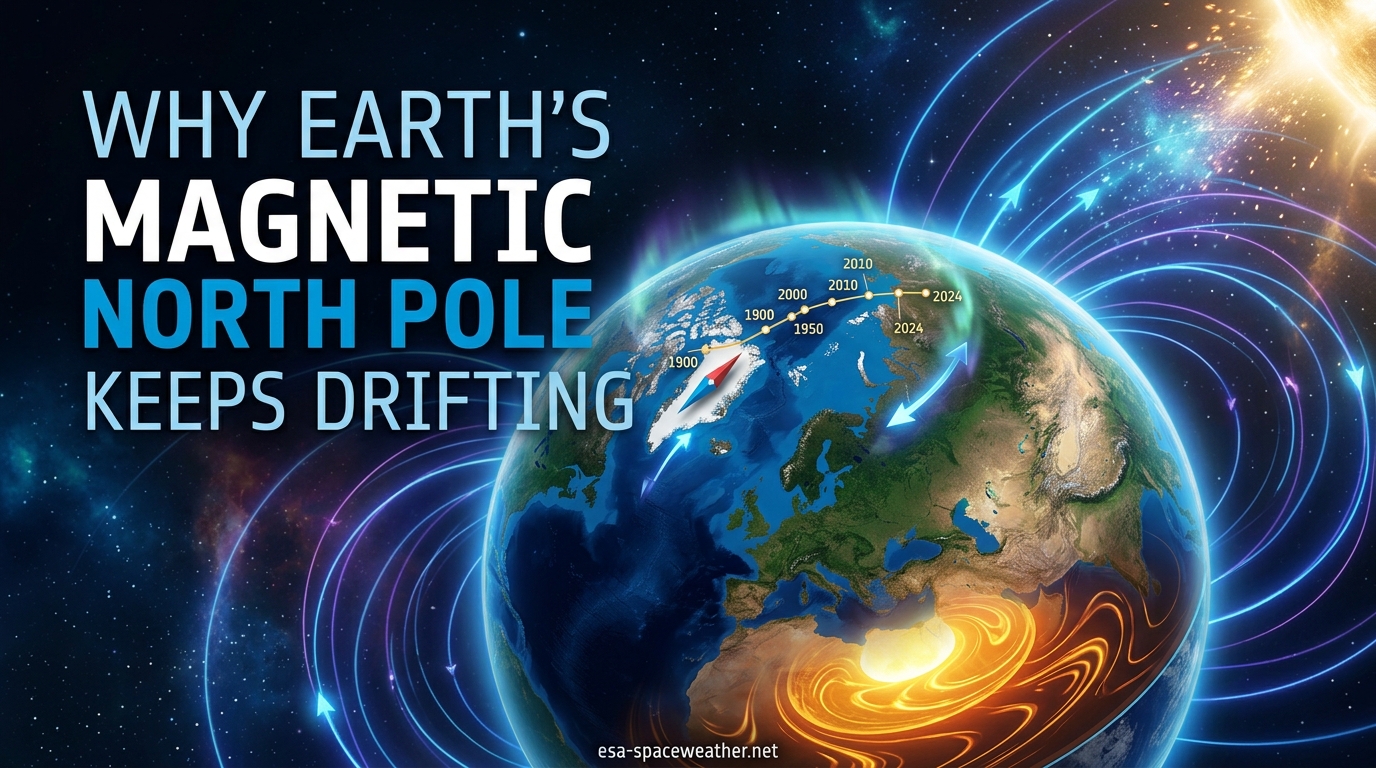
Every year, the spot your compass points to moves roughly 30 to 50 kilometers closer to Siberia. That is not a rounding error or a measurement glitch. Earth’s magnetic north pole has been wandering for over a century, and in the 1990s it suddenly accelerated to speeds scientists had never recorded before. Understanding why Earth’s magnetic north pole keeps drifting means looking nearly 3,000 kilometers beneath your feet, into a churning ocean of liquid metal that generates the invisible shield protecting our planet.
In this guide, our team breaks down what is happening inside Earth’s outer core, why the pole suddenly sped up, and what it all means for navigation systems, GPS, and the possibility of a future magnetic pole reversal. We will cover the science in plain language, with the specific data, named researchers, and satellite findings that make this one of the most fascinating stories in modern geophysics.
Table of Contents
The Short Answer
Earth’s magnetic north pole keeps drifting because molten iron in the planet’s outer core constantly flows and churns roughly 1,800 miles (2,890 km) beneath the surface. This movement of electrically conductive liquid metal generates Earth’s magnetic field through a process called the geodynamo. When the flow patterns in the outer core shift, the magnetic field they produce shifts too, dragging the magnetic poles along with them across the Arctic.
Think of it like a pot of boiling water with a magnet spinning inside. As the currents in the pot change direction and strength, the magnetic field above the pot moves and wobbles. The same thing happens inside Earth on a planetary scale, just in slow motion over decades and centuries.
Magnetic North vs Geographic North vs Geomagnetic North
One of the biggest sources of confusion we see in forums like Reddit’s r/explainlikeimfive is people mixing up three completely different “north poles.” Let us clear this up right now, because understanding the distinction is essential for everything that follows.
Geographic North Pole is the fixed point at the top of the planet where Earth’s rotational axis meets the surface. It does not move. It is the North Pole you see on any standard map, sitting at 90 degrees north latitude.
Magnetic North Pole is the point where Earth’s magnetic field points straight down into the ground at a 90-degree angle. This is where your compass needle wants to point. It moves constantly, sometimes tens of kilometers per year.
Geomagnetic North Pole is a theoretical calculation. Scientists model Earth’s magnetic field as if it were produced by a single giant bar magnet tilted inside the planet. The point where the axis of that imaginary bar magnet exits the northern hemisphere is the geomagnetic pole. It also drifts, but more slowly and smoothly than the magnetic dip pole.
Here is a quick comparison to keep these three concepts straight:
| Feature | Geographic North | Magnetic North (Dip Pole) | Geomagnetic North |
|---|---|---|---|
| What it is | Earth’s rotational axis endpoint | Where field lines point straight down | Axis of best-fit bar magnet model |
| Does it move? | No (fixed) | Yes, up to 55 km/year | Yes, slowly and smoothly |
| Compass points here? | No | Yes | No (mathematical point) |
| Used by | Cartographers, GPS | Compass users, navigation | Scientists, space weather models |
The distinction matters more than you might think. Pilots, sailors, and surveyors need to know the difference because navigation errors from confusing these poles can compound over long distances.
The Root Cause: Earth’s Outer Core and the Geodynamo
To understand why the magnetic north pole moves at all, we need to go deep inside the planet. About 1,800 miles (2,890 km) below your feet lies the boundary between Earth’s solid inner core and the outer core. The outer core is a layer of liquid iron and nickel roughly 1,400 miles (2,260 km) thick. It is staggeringly hot, around 9,000 to 10,800 degrees Fahrenheit (5,000 to 6,000 degrees Celsius).
At that temperature, the liquid metal is in constant, violent motion. Heat from the inner core drives convection currents, where hot metal rises, cools slightly, and sinks back down. Earth’s rotation twists these currents into spiraling columns through a phenomenon called the Coriolis effect. This is the geodynamo in action.
Here is how the geodynamo process works step by step:
- Step 1: Heat from the solid inner core causes liquid iron in the outer core to rise through convection.
- Step 2: Earth’s rotation deflects these rising currents into spiraling vortices via the Coriolis effect.
- Step 3: Moving electrically conductive iron generates electric currents through electromagnetic induction.
- Step 4: Those electric currents produce their own magnetic field, which reinforces the existing field and keeps the process going.
- Step 5: As flow patterns in the outer core shift over years and decades, the shape and orientation of the magnetic field change, moving the magnetic poles.
This is a self-sustaining system. The magnetic field created by the moving iron keeps the electric currents alive, which in turn keeps the magnetic field alive. It is one of the few true perpetual motion machines in nature, powered entirely by Earth’s internal heat and rotation.
But here is the key point for our topic: the geodynamo does not produce a perfectly stable field. The convection currents are chaotic. They speed up, slow down, and shift direction over time. Every time the flow pattern beneath the Arctic changes, the magnetic north pole responds by moving to a new position.
Why the Pole Is Drifting Faster Now: The “Blobs” Mechanism
For decades, scientists knew the geodynamo caused pole drift but could not explain why the speed suddenly changed. Then in 2020, a breakthrough paper in Nature Geoscience shed light on what was happening. The research team, led by Phil Livermore at the University of Leeds, identified two large-scale magnetic structures deep below the Arctic that they nicknamed “blobs.”
These blobs are technically called flux lobes, and there are two main ones relevant to the magnetic north pole. One sits beneath northern Canada. The other sits beneath Siberia. Both are regions of concentrated negative magnetic flux at the core-mantle boundary, roughly 1,800 miles down.
Think of these flux lobes as two magnets competing for control of the north magnetic pole. For most of the 20th century, the Canadian lobe was stronger. It held the magnetic north pole in Canadian territory, and the pole drifted slowly at about 10 to 15 km per year.
Then something changed. Data from ESA’s Swarm satellite mission, launched in 2013 to measure Earth’s magnetic field from orbit, revealed that the Canadian flux lobe began weakening and elongating. Meanwhile, the Siberian flux lobe grew stronger. It was like a tug-of-war where one side suddenly started pulling harder.
The magnetic north pole responded by racing toward Siberia. Between 1999 and 2005, the pole accelerated to a staggering 55 km (about 34 miles) per year. To put that in perspective, the pole was moving nearly four times faster than its historical average. By 2017, the pole had crossed the Greenwich meridian and was firmly heading toward Siberia.
Livermore’s team also identified a specific mechanism they called “channeled flow.” They found that the liquid iron at the core-mantle boundary is funneled along certain pathways beneath the Arctic. When the flow beneath Canada weakened, the Siberian lobe essentially pulled the magnetic field, and the pole, toward itself.
Interestingly, after 2020, the acceleration began to slow down again. Scientists are not entirely sure why. Some researchers, including Arnaud Chulliat at the University of Colorado, believe the Canadian lobe may be stabilizing. But predicting exactly what the core will do next remains one of the hardest problems in geophysics.
Historical Drift Data and Rate Changes
The story of the magnetic north pole’s wanderings is surprisingly well documented. The first person to identify and locate the magnetic north pole was James Clark Ross in 1831, on the Boothia Peninsula in what is now Nunavut, Canada. For nearly a century after that discovery, the pole barely moved.
Here are the key dates that tell the story of the pole’s accelerating journey:
- 1831: James Clark Ross first locates the magnetic north pole on the Boothia Peninsula, northern Canada.
- 1900-1980: The pole drifts slowly northwest at roughly 10 km per year, staying within Canadian territory.
- 1990s: The pole begins accelerating. Scientists notice the speed doubling within a few years.
- 1999-2005: Peak acceleration at 55 km per year, the fastest recorded movement of the magnetic pole.
- 2017: The pole crosses the prime meridian, leaving the Western Hemisphere entirely.
- 2019: The acceleration is so severe that NOAA and the British Geological Survey release an emergency out-of-cycle update to the World Magnetic Model.
- 2025: The World Magnetic Model gets its scheduled five-year update. The pole is now racing across the Arctic Ocean toward Siberia at about 35-40 km per year.
- 2026 Current models place the magnetic north pole well past the Greenwich meridian, deep into the Eastern Hemisphere and continuing toward Siberia.
The 2019 emergency update was unprecedented. The World Magnetic Model, which is the standard navigation reference used by NATO, the US Department of Defense, and civilian aviation worldwide, is normally updated every five years. But by early 2019, the pole had moved so far so fast that the existing model was already producing navigation errors. A partial government shutdown in the United States delayed the update briefly, adding urgency to an already tense situation for navigation-dependent industries.
William Brown, a scientist at the British Geological Survey involved in WMM updates, noted that the pole was moving faster than at any point in recorded history. The acceleration has since slowed somewhat, but the pole continues its march toward Siberia at speeds well above the historical average.
How Magnetic Pole Drift Affects Navigation and GPS
This is where the science gets personal. You might wonder whether a drifting magnetic pole actually matters for your daily life. The short answer is: probably not directly, but it matters enormously for aviation, shipping, military operations, and the global positioning infrastructure that modern life depends on.
Here is how different navigation systems are affected:
Smartphone Compasses: Your phone’s compass uses a magnetometer to detect Earth’s magnetic field, then applies a correction called magnetic declination to convert magnetic north into true north. That correction value changes as the pole moves. Smartphone manufacturers and app developers pull updated magnetic field models, so your phone quietly adjusts without you noticing. If you are using a phone app for serious backcountry navigation, make sure it has downloaded the latest model data.
Aviation: This is where pole drift has the biggest practical impact. Aircraft navigation systems, especially those relying on magnetic heading references, depend on accurate magnetic declination values. Runway numbers at airports are based on magnetic compass headings and occasionally need to be repainted when the local magnetic declination shifts enough. The Smithsonian reported that navigation errors from outdated magnetic models could put aircraft up to 93 miles off course on long-haul flights.
Shipping and Maritime Navigation: Commercial ships use both GPS and magnetic compasses. While GPS does not directly rely on the magnetic field, many backup and redundancy systems do. Mariners in the Arctic, where GPS signals can be unreliable due to satellite geometry, depend heavily on accurate magnetic navigation data.
Military Systems: The World Magnetic Model is maintained jointly by NOAA’s National Centers for Environmental Information (NCEI) and the British Geological Survey. It is the magnetic field standard for the US Department of Defense, the UK Ministry of Defence, and NATO. Submarine navigation, in particular, relies on precise magnetic field data.
Traditional Compass Users: If you are a hiker, hunter, or outdoor enthusiast using a traditional magnetic compass, pole drift matters in a subtle but important way. The angle between magnetic north and true north at your location is called magnetic declination. As the pole drifts, your local declination changes. A compass reading that was accurate five years ago may now be off by a degree or more. For most casual use, this is negligible. But for long-distance wilderness navigation, it can put you significantly off course over miles of travel.
You can look up your current local magnetic declination using NOAA’s online calculator or the National Geophysical Data Center’s magnetic field tools. We recommend checking this before any serious backcountry trip, especially if you are using older topographic maps that may have printed declination values from a decade ago.
Will the Poles Flip? Understanding Geomagnetic Reversal
Whenever the topic of magnetic pole drift comes up in forums like Reddit, the same question follows: are the poles about to flip? It is a fair question, and the answer is more nuanced than sensationalist headlines would have you believe.
Geomagnetic reversal is a real phenomenon. Throughout Earth’s 4.5-billion-year history, the magnetic poles have flipped hundreds of times. The north magnetic pole becomes the south magnetic pole and vice versa. These reversals are not instantaneous. They typically take anywhere from 1,000 to 10,000 years to complete.
The last full geomagnetic reversal, called the Brunhes-Matuyama reversal, occurred approximately 780,000 years ago. Since then, there have been several “excursions,” partial and temporary reversals where the field weakened and shifted but then returned to its original orientation without fully flipping.
Here is what the scientific evidence tells us about the possibility of a reversal:
- Earth’s overall magnetic field has weakened by roughly 9 to 10 percent over the past 200 years.
- The South Atlantic Anomaly, a region where the magnetic field is unusually weak, has grown and split into two lobes in recent years.
- Some scientists interpret these as possible early signs of a reversal, while others see them as normal field variations.
- Even if a reversal has begun, it would unfold over thousands of years, not overnight.
What would actually happen during a reversal? The field would weaken, potentially to 10 percent of its current strength, before rebuilding in the opposite orientation. A weaker field means less protection from solar radiation and cosmic rays. The most likely consequences include increased radiation exposure at high altitudes and in space, more frequent satellite damage from solar storms, and wider auroral visibility at lower latitudes.
There is no evidence from the fossil record that past geomagnetic reversals caused mass extinctions. Life on Earth has survived hundreds of these events. The main risks are technological, not biological. Power grids, satellites, and communication systems would face greater challenges from space weather, but humanity would not be wiped out.
The honest answer from the scientific community is that nobody knows when the next reversal will happen. It could start in 2026, or it could be another million years away. The current acceleration of the magnetic north pole is dramatic by historical standards, but it is not conclusive evidence that a full reversal is imminent.
FAQs
Why does the magnetic north pole keep moving?
The magnetic north pole moves because molten iron in Earth’s outer core, roughly 1,800 miles beneath the surface, constantly flows and churns through a process called the geodynamo. As these flow patterns shift over time, the magnetic field they generate changes too, dragging the magnetic poles across the Arctic. Two competing magnetic flux lobes beneath Canada and Siberia are currently the main drivers of the pole’s movement toward Siberia.
What will happen to humans when the magnetic poles flip?
A geomagnetic reversal would not be catastrophic for human survival. The fossil record shows no mass extinctions during past reversals. The main risks are technological: a weaker magnetic field would provide less protection from solar radiation, increasing risks to satellites, power grids, and communication systems. Radiation exposure at high altitudes would increase, and auroras would be visible at lower latitudes. The process takes thousands of years, giving humanity time to adapt infrastructure.
How long until Earth’s poles flip?
Nobody can predict when the next geomagnetic reversal will occur. The last full reversal happened approximately 780,000 years ago, and reversals happen on irregular intervals ranging from tens of thousands to millions of years. While Earth’s magnetic field has weakened by about 10 percent over the past two centuries, this does not necessarily mean a reversal is imminent. Even if one has begun, the full process would unfold over 1,000 to 10,000 years.
When was the last time the Earth’s magnetic poles shifted?
The last full geomagnetic reversal, known as the Brunhes-Matuyama reversal, occurred approximately 780,000 years ago. Since then, there have been several geomagnetic excursions, partial and temporary reversals where the field weakened and shifted but returned to normal without completing a full flip. The most recent notable excursion was the Laschamp event, which occurred about 41,000 years ago.
Conclusion
The reason why Earth’s magnetic north pole keeps drifting comes down to one simple fact: our planet’s magnetic field is generated by a living, churning, unpredictable ocean of liquid iron nearly 2,000 miles beneath our feet. When the flow patterns in that outer core shift, the magnetic poles move. Right now, a weakening flux lobe beneath Canada and a strengthening one beneath Siberia are pulling the pole eastward at historically unprecedented speeds.
For most of us, the practical impact is minimal. Our smartphones quietly update their magnetic models, and GPS continues to work. But for pilots, sailors, surveyors, and the scientists at NOAA and the British Geological Survey who maintain the World Magnetic Model, tracking this drift is serious, ongoing work. If you want to see where the magnetic north pole is right now, we recommend checking NOAA’s real-time magnetic pole tracker and the latest World Magnetic Model data. The pole will keep moving, and the science will keep evolving alongside it.