
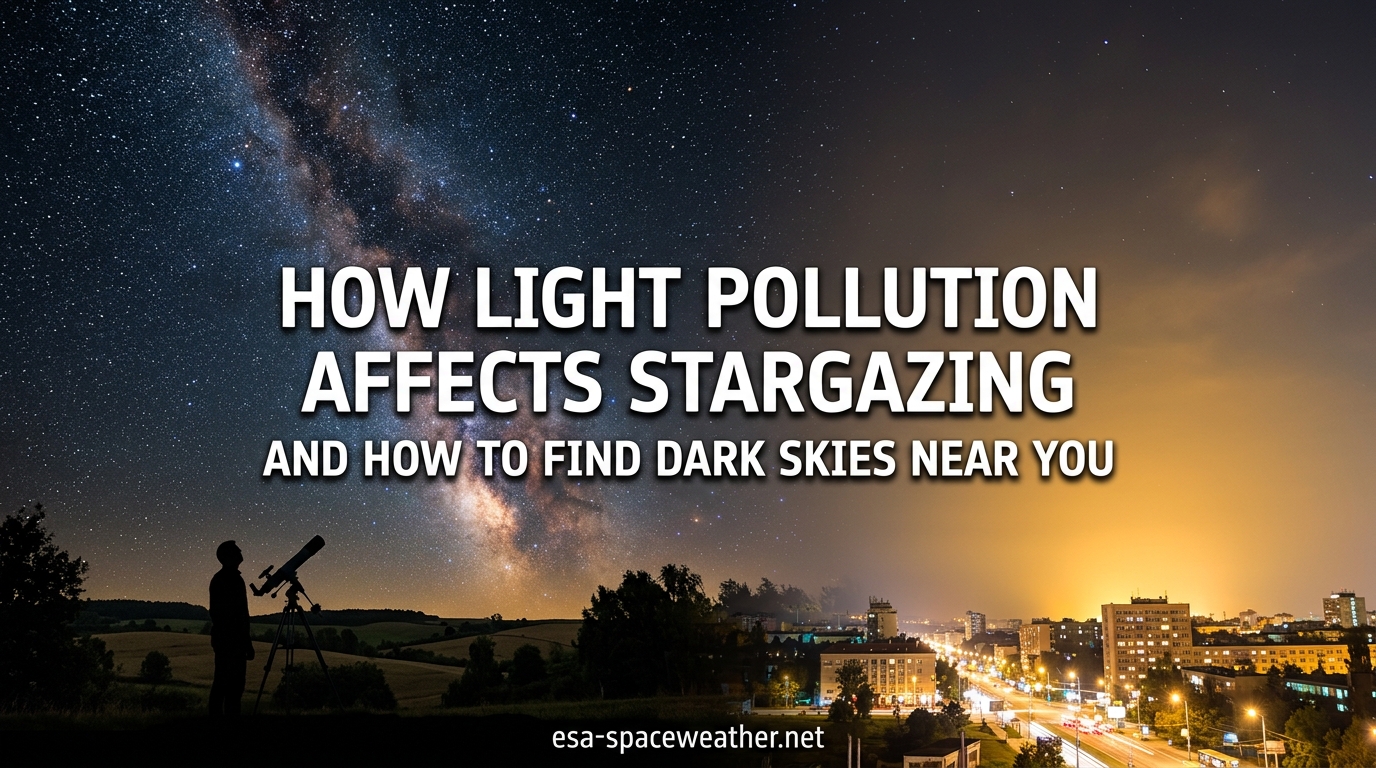
If you have ever looked up at the night sky from a city or suburb and wondered where all the stars went, light pollution is the answer. Light pollution is the excess or inappropriate artificial light outdoors that brightens the night sky, making stars, planets, and deep sky objects harder or impossible to see. It occurs through three main mechanisms: glare (direct, uncomfortable light), light trespass (unwanted light spilling into spaces where it does not belong), and skyglow (the collective scattering of artificial light through the atmosphere that creates a bright sky dome over populated areas).
Understanding how light pollution affects stargazing matters more than ever. A 2023 citizen science study published in Science found that the night sky is brightening by about 9.6% per year, doubling sky brightness roughly every 8 years. That means the stars you could see as a child may already be invisible from the same location today. According to the National Park Service, global sky brightness has been increasing at roughly 2.2% per year based on satellite data, and the problem is accelerating as cities switch to brighter LED lighting.
Our team has spent years observing the night sky from locations ranging from Bortle 9 inner-city skies to Bortle 1 wilderness areas. The difference is staggering. At a true dark sky site, you can see over 2,000 individual stars with the naked eye. From a typical city center, you might count 20 to 50. In this guide, we will break down exactly how light pollution robs you of the night sky, how to measure it using the Bortle scale, and how to find the best dark sky locations near you for stargazing.
Whether you are a backyard astronomer frustrated by washed-out skies, an astrophotographer chasing the Milky Way, or a family planning a stargazing camping trip, this guide will give you the tools and knowledge you need. We will cover the science behind light pollution, practical steps for finding dark skies, the best dark sky parks in the United States, and tips for making the most of whatever sky conditions you have.
Table of Contents
What Is Light Pollution?
Light pollution is any artificial light that alters the natural darkness of the night environment. It is different from other forms of pollution because it is completely reversible. Turn off the lights, and the darkness returns instantly. But while the lights stay on, they create multiple forms of interference that degrade the night sky for everyone within their reach.
The U.S. National Park Service and DarkSky International recognize three primary types of light pollution. Each one affects stargazing differently, and understanding them helps you figure out what you can do about your local conditions.
Skyglow: The Bright Sky Dome
Skyglow is the most damaging form of light pollution for stargazing. It happens when artificial light from cities, towns, and roadways shines upward and scatters through atmospheric molecules and aerosols. This scattered light creates a diffuse glow that sits over populated areas like a dome, washing out the faint light from distant stars and deep sky objects.
If you have ever noticed the horizon glowing orange or pink as you approach a city at night, that is skyglow. The larger the city, the farther the glow extends. A major metropolitan area can create a visible sky dome that stretches 50 to 100 miles in every direction. Even small towns produce localized skyglow that affects nearby observing sites.
The problem has gotten worse with the widespread adoption of LED streetlights. Older sodium vapor lamps emitted most of their light in specific wavelengths that were easier to filter out. Modern white LEDs emit a broad spectrum of light, including large amounts of blue light, which scatters more efficiently in the atmosphere. More scattering means more skyglow, which means fewer visible stars.
Glare: Direct Light Disruption
Glare is the harsh, uncomfortable brightness from unshielded or overly intense light fixtures. Think of a bare bulb on a porch, a floodlight aimed sideways across a yard, or a streetlight with no shield directing light where it is needed. Glare does not directly wash out the sky, but it has a devastating secondary effect on stargazing: it prevents your eyes from achieving full dark adaptation.
Even a single unshielded light nearby can keep your pupils from fully dilating. When that happens, your eyes never reach the sensitivity needed to see faint celestial objects. We have observed at dark sky sites where a single car’s headlights or a neighbor’s porch light reduced visible stars from thousands to dozens within seconds.
Light Trespass: Unwanted Spill
Light trespass occurs when light from one property spills onto another where it is not wanted. This is the classic “my neighbor’s floodlight is ruining my backyard astronomy” scenario. It is also the most directly fixable form of light pollution because it involves individual fixtures that can be shielded, redirected, or turned off.
For backyard stargazers, light trespass is often the most frustrating problem. You might live in an area with decent natural darkness, but a single bright security light next door can make telescope observing nearly impossible. Forum users on Reddit’s r/telescopes frequently share stories about new LED security lights installed by neighbors completely destroying previously usable observing conditions.
How the LED Revolution Changed Everything
The shift from sodium vapor and mercury vapor streetlights to white LED fixtures has fundamentally altered the light pollution landscape. White LEDs are energy efficient and long lasting, which has made them attractive to cities looking to cut costs. But they emit a broad spectrum of light that includes significant amounts of blue wavelengths.
Blue light scatters far more efficiently in the atmosphere than red or yellow light. This is why the sky is blue during the day. At night, blue-rich LED light creates significantly more skyglow per lumen than the older sodium lights it replaced. A city that retrofits its entire streetlight network with white LEDs can see a measurable increase in skyglow even if the total light output stays the same.
Some cities have started using amber or warm-color temperature LEDs (3000K or lower) to reduce this effect. But the rapid pace of LED conversion means that many previously acceptable stargazing locations near suburban areas have gotten noticeably worse over the past decade.
How Light Pollution Affects Stargazing
Light pollution degrades the stargazing experience through several distinct mechanisms. Understanding each one helps you appreciate why a dark sky location matters so much, and why no amount of equipment can compensate for a bright sky.
The fundamental issue is contrast. Stargazing is about seeing faint points of light against a dark background. When light pollution brightens that background, the contrast between stars and sky drops. Faint stars disappear first. Then fainter constellations fade. Eventually, only the brightest stars and planets remain visible.
Reduced Sky Contrast and Star Visibility
In a truly dark sky (Bortle class 1 or 2), the background sky is so dark that stars of magnitude 6.5 and fainter are visible to the naked eye. That translates to roughly 2,000 to 3,000 individual stars visible at any given time. The Milky Way stretches across the sky as a bright, structured band of light with visible dark lanes.
Under a Bortle 5 suburban sky, that number drops to about 250 to 500 stars. The Milky Way is barely visible or completely invisible. Under a Bortle 8 city sky, you might see 20 to 50 of the brightest stars, plus the Moon and bright planets like Venus, Jupiter, and Saturn.
This is not a matter of telescope quality or observer skill. The stars are still there. But the brightened sky background overwhelms their faint light. No telescope, no matter how large, can show you what light pollution has hidden.
The Magnitude Limit Problem
Astronomers use the magnitude scale to measure star brightness. Lower numbers are brighter. The Sun is magnitude -26.7. Sirius, the brightest star, is magnitude -1.46. The faintest stars visible to the naked eye under perfect conditions are around magnitude 6.5 to 7.0.
Light pollution raises the naked-eye magnitude limit. Under a Bortle 6 sky, you might only see stars to magnitude 5.0. Under Bortle 8, the limit might be magnitude 4.0 or worse. Each whole magnitude step represents a difference of about 2.5 times in brightness, so losing 2 magnitudes means the faintest stars you can see are over 6 times brighter than what a dark sky would reveal.
This directly limits what you can observe. Many beautiful deep sky objects, including galaxies, nebulae, and star clusters, have surface brightnesses that fall below typical urban magnitude limits. They simply vanish into the skyglow.
How Light Pollution Kills Dark Adaptation
Dark adaptation is the process by which your eyes become sensitive to faint light. It takes 20 to 30 minutes for your eyes to reach near-full sensitivity in darkness, and up to 45 minutes for complete adaptation. During this time, your pupils dilate and your retinal rod cells build up a light-sensitive chemical called rhodopsin.
Any exposure to white light resets this process. A single glance at a white flashlight, a phone screen, or a car headlight can wipe out 20 minutes of dark adaptation. Light pollution creates a constant low-level exposure that prevents your eyes from ever reaching full sensitivity in the first place.
This is why experienced astronomers use only red light at observing sites. Red wavelengths (above about 620 nanometers) do not trigger the breakdown of rhodopsin. Using a red flashlight, red screen filter, or red headlamp allows you to see your equipment and charts without sacrificing your night vision.
Deep Sky Objects vs. Planets: Different Vulnerabilities
Not all celestial targets are equally affected by light pollution. Planets like Jupiter, Saturn, Mars, and Venus are bright enough to observe even from heavily light-polluted areas. Their light is concentrated into tiny, intense points that stand out against skyglow. Double stars and bright star clusters are also relatively tolerant of light pollution.
Deep sky objects are a different story. Galaxies, nebulae, and diffuse star clusters have low surface brightness, meaning their light is spread across a large area. The Andromeda Galaxy (M31) provides a perfect example. Under a Bortle 3 sky, it appears as a striking elongated smudge with visible spiral structure through a moderate telescope. Under a Bortle 8 sky, it is barely visible as a faint gray smudge even in the same instrument.
This is why experienced observers at light-polluted sites focus on planets, the Moon, double stars, and bright globular clusters. Deep sky observing really requires darker skies, ideally Bortle class 4 or better.
The Milky Way Visibility Threshold
One of the most common questions we hear is: “What Bortle class do I need to see the Milky Way?” The answer depends on what you mean by “see.”
The Milky Way becomes faintly visible to the naked eye at around Bortle class 4. At this level, you can see a dim, diffuse band across the sky, but without much structure. At Bortle class 3, the Milky Way becomes clearly visible with some structural detail. At Bortle class 2, it is bright enough to cast faint shadows on the ground. At Bortle class 1, it is so detailed and structured that first-time observers often have trouble identifying familiar constellations because the sky is filled with so many stars.
If seeing the Milky Way is a priority, you need to find a location rated Bortle 4 or better. Most suburban areas in the United States are Bortle 5 or 6, where the Milky Way is invisible to the naked eye.
How Weather and Atmospheric Conditions Amplify Light Pollution
Light pollution does not exist in a vacuum. Atmospheric conditions can dramatically amplify or reduce its effects. Many stargazers are surprised to learn that the same location can go from decent to terrible overnight based on weather conditions alone.
Clouds: The Worst Enemy of Urban Stargazers
You might think clouds would block light pollution and make the sky darker. The opposite happens near populated areas. Low clouds act as reflectors, bouncing city light back down toward the ground. This creates a phenomenon known as “cloud light pollution” that can make the sky dramatically brighter than on a clear night.
High-altitude thin clouds are particularly insidious. They may not be visible to the naked eye, but they reflect a significant amount of city light back down while partially blocking the sky above. Forum users on Cloudy Nights frequently report that seemingly clear nights with high thin haze produce surprisingly poor observing conditions near cities.
In truly dark sky locations, clouds actually do make the sky darker because there is no artificial light for them to reflect. The contrast between the effect of clouds on urban versus rural skies is a stark reminder of how much light pollution surrounds us.
Snow: The Forgotten Reflector
Snow cover is an underappreciated amplifier of light pollution. Fresh snow reflects up to 90% of incident light, meaning that ground-based light sources effectively get a second chance to scatter into the sky. A snowy field near a city can reflect streetlight glow upward, significantly increasing local skyglow.
We have seen observing sites that perform at Bortle class 4 in summer degrade to Bortle class 5 or 6 in winter after snowfall. If you are planning a winter observing session near populated areas, check snow conditions along with cloud forecasts.
Humidity and Aerosols
Atmospheric moisture and aerosol particles scatter light more effectively than clean, dry air. High humidity increases the amount of water vapor in the air, which enhances the scattering of artificial light. This is why skyglow often appears worse on humid summer nights compared to crisp winter nights at the same location.
Air pollution and dust particles have the same effect. A site downwind of industrial areas or in a valley that traps haze will experience worse light pollution than a clean-air site at the same distance from city centers. High-altitude desert locations are prized by astronomers precisely because their thin, dry, clean air minimizes light scattering.
Walker’s Law: How Far City Light Reaches
Walker’s Law is a formula developed by astronomer Merle Walker that estimates the contribution of a city’s population to sky brightness at a given distance. The simplified version states that sky brightness from a city is proportional to its population divided by the distance raised to the 2.5th power.
In practical terms, this means light pollution does not decrease linearly with distance. A city of 100,000 people produces noticeable skyglow at 30 to 50 miles. A city of 1 million people can affect skies 80 to 100 miles away. Major metropolitan areas like Los Angeles, New York, and Chicago create light domes that extend well over 100 miles into surrounding rural areas.
This is why finding truly dark skies in the eastern United States is so challenging. The density of population centers means their light domes overlap, leaving few gaps of genuine darkness.
The Bortle Scale: Understanding Sky Brightness
The Bortle scale is a nine-class system developed by astronomer John E. Bortle in 2001 to rate the darkness of the night sky. It is the most widely used standard for describing light pollution conditions at observing sites. Understanding your local Bortle class tells you what you can expect to see and helps you plan trips to darker locations.
The scale runs from Class 1 (the darkest skies on Earth) to Class 9 (the brightest inner-city skies). Each class corresponds to a range of sky brightness measurements, naked-eye magnitude limits, and observable phenomena. Here is what you can expect at each level.
Bortle Classes 1-2: True Dark Skies
Bortle Class 1 represents the darkest skies accessible to observers. These are found in remote wilderness areas, far from any significant population centers. Examples include parts of Death Valley National Park, the interior of Big Bend National Park, and remote areas of the Nevada desert. The naked-eye magnitude limit reaches 7.6 to 8.0, and over 2,500 stars are visible.
At Bortle 1, the Milky Way casts faint shadows. The zodiacal light (sunlight reflected off interplanetary dust) is visible as a cone of light along the ecliptic. Airglow, a natural faint emission from the upper atmosphere, may be visible. Constellations can be difficult to identify because the sheer number of stars overwhelms familiar patterns.
Bortle Class 2 is still considered a truly dark sky. The Milky Way is bright and highly structured with visible dark lanes. The magnitude limit is around 7.1 to 7.5. M33 (the Triangulum Galaxy) is visible to the naked eye. These skies are found at designated International Dark Sky Parks and remote rural locations.
Bortle Classes 3-4: Rural and Rural-Suburban
Bortle Class 3 represents rural skies with some light pollution visible on the horizon. The Milky Way is still prominent and shows structure. The naked-eye magnitude limit is around 6.6 to 7.0. Some light domes from distant cities may be visible near the horizon, but the zenith (directly overhead) sky remains quite dark.
Bortle Class 4 is a rural-suburban transition zone. The Milky Way is visible overhead but lacks the structure and detail seen at darker sites. Several light domes are visible on the horizon. The magnitude limit drops to around 6.1 to 6.5. M33 is no longer visible to the naked eye but can be seen with averted vision. This is the typical quality of sky at many state parks and rural observing sites within an hour or two of major cities.
Bortle Classes 5-6: Suburban Skies
Bortle Class 5 is a suburban sky. The Milky Way is faint or only visible directly overhead. Light domes are obvious in several directions. The magnitude limit is about 5.6 to 6.0. Only the brightest deep sky objects are visible to the naked eye, and telescope views of fainter objects are significantly degraded.
Bortle Class 6 is a bright suburban sky. The Milky Way is visible only as a faint smudge directly overhead, or not at all. The magnitude limit is around 5.1 to 5.5. The sky has a noticeable gray or whitish background at all elevations. Telescope observing is limited to bright planets, the Moon, double stars, and the brightest clusters and nebulae.
Bortle Classes 7-9: Urban and City Skies
Bortle Class 7 represents a full suburban sky transitioning to urban. The entire sky has a grayish glow. The magnitude limit is around 4.6 to 5.0. Only the brightest constellations are recognizable. The Milky Way is completely invisible.
Bortle Class 8 is a city sky. The sky is bright and glows orange or gray. Stars brighter than magnitude 4.0 may be visible. Only the most prominent constellations like Orion, the Big Dipper, and Cassiopeia are identifiable. Stargazing is essentially limited to the Moon, bright planets, and the brightest stars.
Bortle Class 9 is an inner-city sky. The sky is brightly lit, with only the very brightest stars (magnitude 3.5 or brighter) and planets visible. The night sky may appear more like a twilight sky than true darkness. This is the typical condition in downtown areas of major cities.
SQM: The Scientific Measurement
While the Bortle scale is descriptive, the Sky Quality Meter (SQM) provides a quantitative measurement of sky brightness. SQM measures brightness in magnitudes per square arcsecond at the zenith. The scale is inverse: higher numbers mean darker skies.
A Bortle 1 sky typically reads 21.7 to 22.0 mag/arcsec squared. A Bortle 5 suburban sky reads around 19.1 to 20.4. A Bortle 9 inner-city sky might read 16.0 or lower. Many astronomy clubs and dark sky parks publish SQM readings for their sites, giving you a precise baseline for comparison.
If you are serious about finding and comparing dark sky sites, consider purchasing a handheld SQM device. They cost around $120 to $150 and let you measure sky brightness at any location. Some smartphone apps also estimate sky brightness using GPS and pollution databases, though these are less accurate than a dedicated meter.
How to Find Dark Skies Near You
Finding dark skies near you is easier than ever thanks to online light pollution maps and stargazing apps. The key is knowing which tools to use and how to interpret the data they provide. Here is a step-by-step process we use when planning observing trips.
Step 1: Check a Light Pollution Map
Start with an interactive light pollution map. These maps use satellite data and sky brightness models to show light pollution levels worldwide. The most popular and comprehensive option is lightpollutionmap.info, which uses NASA VIIRS satellite data and the 2015 New World Atlas of Artificial Night Sky Brightness.
On the map, look for your home location first to establish a baseline. Note the color and Bortle class at your location. Then search outward in all directions for areas with darker colors. Dark gray, black, and deep blue areas represent the darkest skies, while green, yellow, orange, and red indicate progressively worse light pollution.
When evaluating a potential site on the map, look for areas that are dark in all directions, not just directly overhead. A site that appears dark on the map but is surrounded by bright areas on one side will still suffer from skyglow from nearby light domes.
Step 2: Verify the Bortle Class of Your Target Location
Light pollution maps give you a Bortle class estimate, but these are not always perfectly accurate. The underlying data is based on satellite measurements that may not capture local conditions like new LED installations, seasonal snow cover, or nearby construction lighting.
Cross-reference the map data with local astronomy club websites, dark sky park certifications, and SQM readings from community databases. Clear Outside, an app popular among UK astronomers, also provides Bortle class estimates along with cloud cover and transparency forecasts.
If possible, visit the site at night before committing to a major observing trip. Sometimes a site that looks perfect on the map has a nearby source of localized light pollution, like a sports field with stadium lighting or a newly developed commercial area.
Step 3: Consider Drive Time and Accessibility
The closest dark sky area on the map is not always the best choice. Consider drive time, road conditions, elevation, and site safety. A Bortle 3 site that is a 90-minute drive on good roads is often more practical than a Bortle 2 site that requires a three-hour drive on rough dirt roads.
Elevation matters too. Higher-altitude sites typically have darker skies because you are looking through less atmosphere, and they are often above the inversion layer that traps haze and aerosols near populated valleys. A Bortle 3 site at 7,000 feet elevation may offer better transparency than a Bortle 2 site at sea level.
Check whether the site is accessible at night. Some parks and recreation areas close at dusk. Others require permits or have gated access. Call ahead or check the managing agency’s website to confirm nighttime access before you make the drive.
Best Light Pollution Maps and Tools Compared
Several light pollution maps and tools are available, each with different strengths. Here is how the main options compare.
Lightpollutionmap.info is the most comprehensive and widely used tool. It offers multiple data layers including NASA VIIRS satellite imagery, the 2015 New World Atlas sky brightness model, and overlay options for clouds, aurora predictions, and observatory locations. You can click any point to see its Bortle class, SQM estimate, and sky brightness value. It is free to use with optional premium features.
Dark Site Finder (darksitefinder.com) offers a simpler, color-coded map focused on finding dark observing locations. It is less detailed than lightpollutionmap.info but easier to read at a glance. The site also includes a directory of recommended dark sky sites organized by region.
Clear Outside is a weather and sky conditions app that includes Bortle class data along with cloud cover, transparency, seeing, and wind forecasts. It is particularly useful for UK and European observers and is available as both a website and mobile app.
The DarkSky International map shows certified International Dark Sky Places worldwide. This is the best tool for finding officially recognized dark sky parks, reserves, and sanctuaries that have been verified for their sky quality and lighting management practices.
Best Stargazing Apps for Dark Sky Planning
In addition to light pollution maps, several stargazing apps help you plan and navigate observing sessions. Here are the ones we recommend.
Stellarium is a free, open-source planetarium program available for desktop and mobile. It shows a realistic sky from any location and time, including light pollution simulation. It is excellent for planning what will be visible from your chosen site.
Star Walk 2 (iOS and Android) provides an interactive sky map with point-and-identify functionality. It is great for learning constellations and identifying objects at the eyepiece.
Sky Map (Android) and Night Sky (iOS) are free augmented reality apps that let you point your phone at the sky to identify stars, planets, and constellations in real time.
PhotoPills is a planning app popular among astrophotographers. It includes dark sky mapping, Milky Way position planning, moon phase tracking, and augmented reality views of the galactic center.
Best Dark Sky Parks and Preserves in the United States
The International Dark Sky Places program, administered by DarkSky International (formerly the International Dark-Sky Association), certifies locations that meet strict standards for sky quality and light pollution management. These certified parks and reserves are the best guaranteed dark sky destinations for stargazing in the United States.
Western US Dark Sky Parks
The western United States has the highest concentration of genuinely dark skies in the country, thanks to vast public lands, low population density, and high-elevation deserts.
Death Valley National Park, California (Bortle 1-2) is one of the darkest places in North America. The park hosts annual Dark Sky Festivals and has dedicated observing areas at Mesquite Flat Sand Dunes and Badwater Basin. It is a 2-hour drive from Las Vegas.
Big Bend National Park, Texas (Bortle 1-2) offers some of the darkest skies in the lower 48 states. Its remote location in southwest Texas places it far from any major light domes. The park has an official Dark Sky Park designation and hosts star parties.
Great Basin National Park, Nevada (Bortle 1-2) combines high elevation (above 10,000 feet at some viewpoints) with extreme remoteness. The park offers seasonal astronomy programs and has a research-grade observatory open to the public.
Grand Canyon National Park, Arizona (Bortle 2-3) earned its Dark Sky Park designation in 2016. The North Rim is significantly darker than the more accessible South Rim. The park hosts a major annual Star Party in June.
Craters of the Moon National Monument, Idaho (Bortle 1-2) is a surreal volcanic landscape with extremely dark skies. Its high elevation and remote location in central Idaho make it a hidden gem for stargazing.
Bryce Canyon National Park, Utah (Bortle 2) is renowned for its astronomy programs. The park offers telescope viewing sessions multiple nights per week during summer months and hosts an annual Astronomy Festival.
Eastern US Dark Sky Parks
Finding dark skies in the eastern United States is more challenging due to population density, but several certified parks provide genuine dark sky experiences.
Cherry Springs State Park, Pennsylvania (Bortle 2-3) is the premier dark sky destination in the eastern US. Located in north-central Pennsylvania, it features a dedicated Astronomy Field and draws observers from across the mid-Atlantic and Northeast. It is about a 4-hour drive from New York City or Philadelphia.
Acadia National Park, Maine (Bortle 3-4) offers the best dark skies on the eastern seaboard. The summit of Cadillac Mountain provides panoramic dark sky views, though light domes from Bangor and other coastal towns are visible on the horizon.
Kissimmee Prairie Preserve State Park, Florida (Bortle 3-4) is Florida’s first certified Dark Sky Park. Its remote location in central Florida provides surprisingly dark skies and a dedicated astronomy pad for overnight visitors.
Headlands International Dark Sky Park, Michigan (Bortle 3-4) is located at the tip of Michigan’s Lower Peninsula. It is one of the few Dark Sky Parks accessible without a long drive from major population centers in the Great Lakes region.
Central US Dark Sky Parks
Black Canyon of the Gunnison National Park, Colorado (Bortle 2-3) combines dramatic canyon scenery with dark skies. The South Rim offers excellent horizon-to-horizon viewing.
Enchanted Rock State Natural Area, Texas (Bortle 3-4) is a Hill Country park with Dark Sky Park certification. It is within reasonable driving distance of Austin and San Antonio.
Talimena National Scenic Byway, Oklahoma/Arkansas (Bortle 3-4) runs along the ridge of the Ouachita Mountains and offers several pullouts with dark sky views away from city light domes.
International Dark Sky Reserves and Sanctuaries
Beyond individual parks, DarkSky International certifies larger areas as Dark Sky Reserves (with a dark core surrounded by a populated buffer zone) and Dark Sky Sanctuaries (extremely remote areas with exceptional darkness).
Notable international destinations include the Aoraki Mackenzie Dark Sky Reserve in New Zealand (Bortle 1), the NamibRand Nature Reserve in Namibia (Bortle 1), and the Pic du Midi Dark Sky Reserve in the French Pyrenees (Bortle 1-2). In North America, the Boundary Waters Canoe Area Wilderness in Minnesota is certified as a Dark Sky Sanctuary, offering pristine skies accessible only by canoe.
Tips for Stargazing in Light-Polluted Areas
Not everyone can drive hours to a dark sky park every weekend. If you are stuck observing from a light-polluted backyard or suburban location, these tips will help you get the most out of your sky conditions.
Master Dark Adaptation
Even under light-polluted skies, proper dark adaptation makes a noticeable difference. Start by spending at least 20 to 30 minutes in darkness before serious observing. Avoid all white light sources, including phone screens, car headlights, and porch lights.
Use a red flashlight or red headlamp for all illumination needs. Many astronomy apps have a built-in red night mode. If yours does not, tape red cellophane over your phone screen or use a dedicated red screen filter app. Some observers even wear an eyepatch over their observing eye when not at the eyepiece, allowing that eye to maintain dark adaptation while they move around using the other eye.
A dew shield on your telescope serves double duty. Its primary purpose is preventing dew formation on the optics, but it also blocks stray light from entering the side of the telescope tube. This simple accessory can noticeably improve contrast under light-polluted conditions.
Timing Your Observing Sessions
The time of night matters even under light-polluted skies. After midnight, many businesses turn off their lights and traffic decreases, which can slightly reduce local light pollution. Observing after 1:00 AM is often better than observing right after sunset.
The Moon is effectively a source of natural light pollution. A bright Moon washes out faint objects just as effectively as artificial skyglow. Plan deep sky observing sessions around the new Moon period, when the Moon is not visible in the evening sky. The five-day window centered on new Moon is ideal.
Season also plays a role. Winter skies are typically darker than summer skies because cold air holds less moisture, reducing atmospheric scattering. Winter also brings longer nights, giving you more observing time. However, winter observing requires proper cold-weather gear and introduces the complication of snow reflection.
Choosing the Right Targets for Your Bortle Class
Matching your observing targets to your sky conditions is key to avoiding frustration. Here is what works best at each Bortle class range.
At Bortle 7-9 (city skies), focus on the Moon, bright planets (Jupiter, Saturn, Venus, Mars), double stars, and variable stars. These targets are bright enough to punch through skyglow. Bright globular clusters like M13 and M3 may be visible in moderate telescopes.
At Bortle 5-6 (suburban skies), add bright nebulae like the Orion Nebula (M42) and the Ring Nebula (M57). Bright galaxies like M81/M82 and bright open clusters become accessible with a telescope. The Milky Way may be faintly visible overhead.
At Bortle 3-4 (rural skies), most Messier objects become visible. Galaxies show more detail. Nebulae are striking. The Milky Way is clearly visible. This is where serious deep sky observing becomes rewarding.
At Bortle 1-2 (dark skies), everything is on the table. Faint galaxies, dark nebulae, low surface brightness objects, and the full structure of the Milky Way are visible. This is where astronomy becomes truly magical.
Do Light Pollution Filters Actually Work?
This is one of the most frequently debated topics on astronomy forums. The honest answer is: it depends on your light source, and the answer has changed dramatically with the LED revolution.
Traditional light pollution filters (broadband filters like the Astronomik CLS or Orion SkyGlow) work by blocking specific wavelengths associated with sodium and mercury vapor streetlights while transmitting the wavelengths emitted by nebulae. Under sodium-vapor-dominated light pollution, these filters could meaningfully improve contrast on emission nebulae.
The problem is that modern white LED streetlights emit a broad, continuous spectrum. There is no specific wavelength band to block without also blocking the light from your target. Filters designed for sodium lights are increasingly ineffective as cities convert to LEDs. Many experienced observers have stopped using broadband filters entirely.
Narrowband filters (like the Orion UltraBlock or Astronomik UHC) still work for specific emission nebulae even under LED light pollution, because they only transmit the specific wavelengths that those nebulae emit. But they do not help with galaxies, star clusters, or reflection nebulae, which emit across a broad spectrum.
The bottom line: filters are not a substitute for dark skies. They may help marginally with specific targets under specific conditions, but they cannot overcome the fundamental contrast loss caused by skyglow. Save your filter budget and put it toward gas for a road trip to darker skies.
Equipment Tips for Light-Polluted Sites
If you observe primarily from light-polluted locations, certain equipment choices help. A telescope with good contrast is more important than raw aperture. Refractors and Schmidt-Cassegrain designs tend to handle stray light well due to their long focal ratios and internal baffling.
Binoculars remain one of the best tools for light-polluted stargazing. A 10×50 or 7×50 pair is inexpensive, easy to use, and capable of showing many bright clusters, double stars, and nebulae even from suburban skies. They are also far more portable than a telescope, making it easier to take them to darker locations.
For astrophotographers, light pollution presents both a challenge and an opportunity. Modern CMOS cameras and image processing techniques can extract surprising detail from light-polluted skies, especially when combined with narrowband filters that isolate specific emission wavelengths. However, the best results still come from darker sites, and the processing effort required under heavy light pollution can be substantial.
Taking Action: Reducing Light Pollution in Your Community
One of the most encouraging things about light pollution is that it is entirely reversible. Unlike chemical pollution that persists for decades, light pollution disappears the instant lights are turned off or properly shielded. Here are practical ways to reduce light pollution in your area.
Use Dark Sky-Friendly Lighting at Home
The most impactful action you can take starts at your own home. Replace unshielded light fixtures with fully shielded fixtures that direct light downward where it is needed. Use warm color temperature bulbs (3000K or lower) instead of cool white LEDs. Install motion sensors or timers so lights are only on when needed.
A properly shielded fixture puts all its light on the ground, uses less energy, and provides better visibility than an unshielded fixture that wastes light upward. DarkSky International maintains a list of dark sky-friendly lighting fixtures and manufacturers.
Advocate for Better Lighting Ordinances
Many cities and counties have lighting ordinances that regulate the type, intensity, and shielding of outdoor lighting. If your community does not have one, advocate for adoption. If it does, make sure it is being enforced.
Effective lighting ordinances typically require fully shielded fixtures for all outdoor lighting, limit color temperature to 3000K or lower, restrict lighting intensity, and prohibit uplighting. DarkSky International provides model lighting ordinance templates that communities can adopt.
Schools, sports fields, and commercial properties are often the worst offenders. A single unshielded sports field light can produce as much skyglow as hundreds of residential fixtures. Working with local government to address these large sources can make a measurable difference.
Support DarkSky International
DarkSky International (darksky.org) is the leading nonprofit organization working to combat light pollution worldwide. They administer the International Dark Sky Places certification program, advocate for dark sky legislation, and provide educational resources. Supporting their work through membership, donations, or volunteering helps protect dark skies for future generations.
You can also get involved with local astronomy clubs, many of which actively advocate for dark sky preservation and host public star parties that help build awareness about light pollution issues.
FAQs
How does light pollution affect stargazing?
Light pollution affects stargazing by brightening the night sky through atmospheric scattering of artificial light (skyglow), which reduces the contrast between stars and the background sky. This makes faint stars and deep sky objects invisible, reduces the naked-eye magnitude limit from 7.0 in dark skies to 4.0 or worse in cities, and prevents the eyes from achieving full dark adaptation. Under heavy light pollution, only 20 to 50 stars may be visible compared to over 2,000 under a truly dark sky.
What is light pollution?
Light pollution is excess or inappropriate artificial light outdoors that brightens the night sky. It occurs in three forms: skyglow (the bright haze over cities caused by scattered artificial light), glare (harsh direct light from unshielded fixtures), and light trespass (light spilling into areas where it is not wanted). Light pollution reduces star visibility, disrupts wildlife, wastes energy, and interferes with human circadian rhythms.
Where can I go to see stars without light pollution?
The best places to see stars without light pollution are certified International Dark Sky Parks and Preserves. In the western US, Death Valley National Park, Big Bend National Park, Great Basin National Park, and Bryce Canyon offer Bortle 1-2 skies. In the eastern US, Cherry Springs State Park in Pennsylvania and Acadia National Park in Maine are top choices. Use lightpollutionmap.info to find dark sky areas within driving distance of your location.
How can I find dark skies near me?
To find dark skies near you, use an interactive light pollution map like lightpollutionmap.info. Enter your location, then look outward for areas colored dark gray, black, or deep blue, which indicate Bortle class 1-3 skies. Cross-reference with the DarkSky International map to find certified Dark Sky Parks. Consider drive time, elevation, and nighttime accessibility when choosing a site. Astronomy clubs in your area can also recommend good local observing spots.
How can I reduce light pollution in my area?
You can reduce light pollution by using fully shielded light fixtures at home, switching to warm color temperature bulbs (3000K or lower), installing motion sensors and timers, and turning off unnecessary outdoor lights. You can also advocate for local lighting ordinances that require shielded fixtures and limit light intensity, and support organizations like DarkSky International that work to protect dark skies through certification programs and legislation.
How can I see the Milky Way near me?
To see the Milky Way, you need a location rated Bortle class 4 or darker. At Bortle 4, the Milky Way is faintly visible directly overhead. At Bortle 3, it shows clear structure and detail. At Bortle 1-2, it is bright enough to cast faint shadows. Use lightpollutionmap.info to find the nearest Bortle 4 or better location, then plan your trip during a new Moon period when moonlight will not wash out the sky. Summer months offer the best views of the bright galactic center.
What is the best time to go stargazing?
The best time for stargazing is during a new Moon, when the Moon is not visible and its light does not wash out the sky. Within each night, the hours after midnight are often best because many businesses turn off lights and atmospheric conditions may improve. Winter typically offers darker skies than summer due to lower humidity and less atmospheric moisture. Check cloud forecasts and avoid nights with high thin clouds, which reflect light pollution.
Do light pollution filters work with modern LED streetlights?
Traditional broadband light pollution filters are increasingly ineffective against modern white LED streetlights because LEDs emit a broad continuous spectrum with no specific wavelength to block. Narrowband filters can still improve contrast on specific emission nebulae, but they do not help with galaxies, star clusters, or other broadband targets. Filters are not a substitute for dark skies. If your area has converted to LEDs, the best solution is to travel to a darker observing location.
Conclusion
Light pollution is one of the most solvable environmental problems we face, yet it continues to worsen at an alarming rate. The night sky is brightening by nearly 10% per year, and the widespread adoption of blue-rich LED lighting has accelerated the problem. Each year, fewer people can experience the wonder of a truly dark sky filled with thousands of stars and the glowing band of the Milky Way.
Understanding how light pollution affects stargazing gives you the knowledge to work around it. By checking a light pollution map, finding your Bortle class, and planning a trip to a certified Dark Sky Park, you can experience the night sky as our ancestors saw it for thousands of years. The first time you stand under a Bortle 1 sky, you will understand why so many people describe it as life-changing.
But finding dark skies is only half the battle. Reducing light pollution at its source is what will preserve the night sky for future generations. Simple actions like shielding your light fixtures, using warm bulbs, and supporting dark sky legislation make a real difference. Every light turned off or properly aimed is a step toward restoring the stars.
We encourage you to take action this week. Open a light pollution map and find the nearest dark sky site within driving distance. Plan a trip during the next new Moon. And take a look at your own outdoor lighting to see if it is sky-friendly. The stars are still up there, waiting. You just need to know how to find them.