
You step outside on a clear night, look up, and a bright streak flashes across the sky. Was that part of a meteor shower, or just a random shooting star? Knowing how to tell a shower meteor from a random sporadic meteor is one of the most practical skills an amateur astronomer can develop, and it comes down to a few clues anyone can learn.
The distinction matters more than you might think. If you are watching during a predicted shower peak and cannot tell which meteors belong to the shower, your counts and your enthusiasm will suffer. Conversely, on a quiet night with no shower active, understanding that you are seeing sporadic meteors helps you set realistic expectations.
I have spent years watching the night sky from suburban backyards and dark-sky sites, and the single biggest question beginners ask is exactly this one: how do I know which meteors count as shower meteors? The good news is that with a little background knowledge and a simple step-by-step method, you can reliably sort them out in real time while you observe.
Table of Contents
The Quick Answer
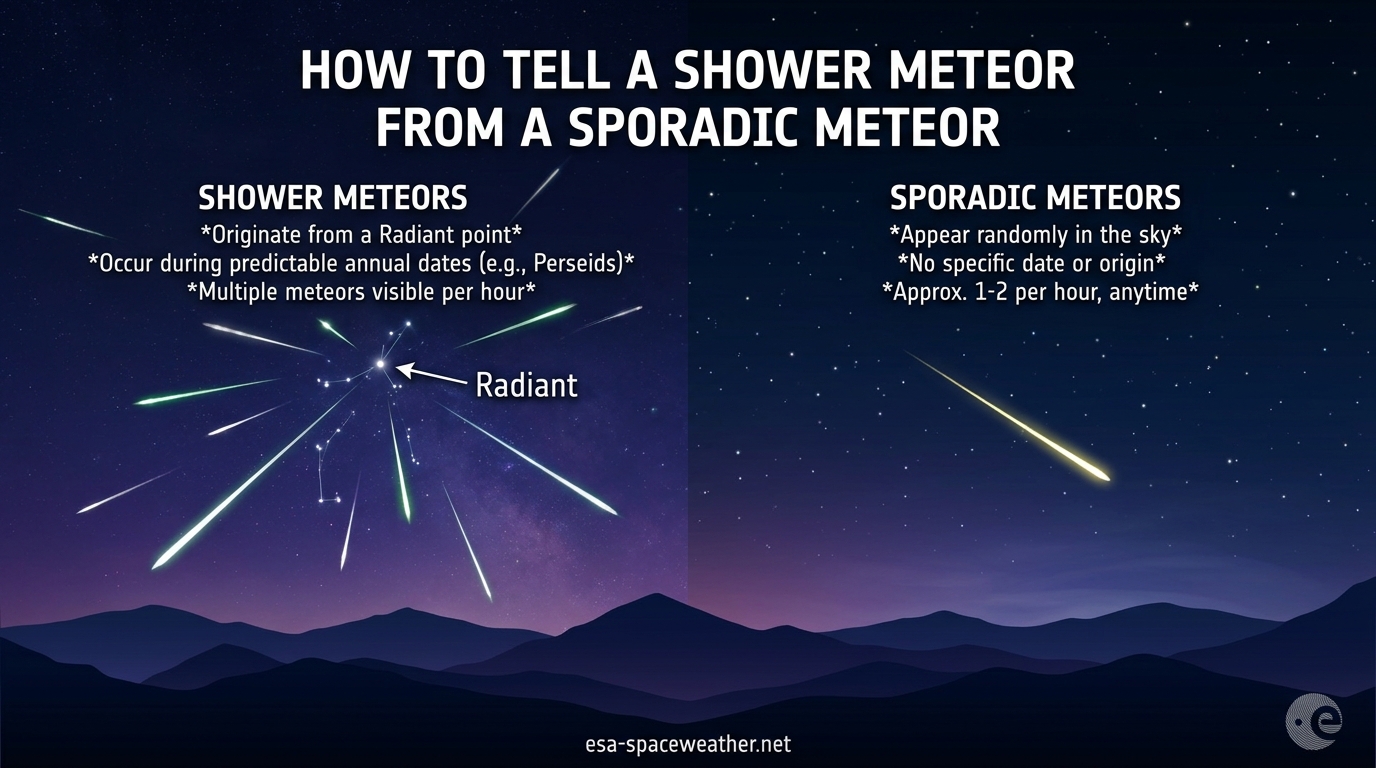
To tell a shower meteor from a random sporadic meteor, trace the meteor’s path backward in your mind. If several meteors you see over an hour all appear to originate from the same small region of sky (the radiant point), they are shower meteors. If a meteor comes from a totally different direction and does not point back to that shared origin, it is a sporadic meteor.
Here is the short version of the identification checklist:
- Direction of origin: Shower meteors trace back to a single radiant point; sporadics come from random directions.
- Rate: Shower nights produce noticeably more meteors per hour than the baseline of roughly 2 to 6 sporadics per hour under dark skies.
- Speed and appearance: Shower meteors all enter the atmosphere at the same velocity, so they share a characteristic speed; sporadics vary widely.
- Timing: If a known shower is active and peaks that night, most meteors you see are likely shower members.
- Trail length near the radiant: Shower meteors close to the radiant appear as short streaks; sporadics near the same area look longer and cross at odd angles.
That is the core idea. Now let me walk you through the details so you can apply this confidently on your next night out.
Meteor Basics: Meteoroid, Meteor, and Meteorite
Before we get into identification, let me clear up the terminology because confusion here trips up a lot of beginners. The same basic object gets three different names depending on where it is.
A meteoroid is the small rocky or metallic body while it is still floating through space. Most are no bigger than a grain of sand, though some reach the size of pebbles or small rocks.
A meteor is the streak of light that the meteoroid produces when it hits Earth’s atmosphere and vaporizes. This is what people commonly call a shooting star, even though it has nothing to do with actual stars. Meteors typically appear at altitudes between 80 and 120 kilometers above the ground.
A meteorite is what remains if part of the object survives the atmospheric flight and lands on the ground. Most meteors never produce a meteorite because the meteoroid completely burns up.
A meteor shower happens when Earth passes through a stream of debris left behind by a comet (or occasionally an asteroid). Because all the particles in that stream are traveling in roughly the same direction at roughly the same speed, they produce meteors that share a common origin point in the sky. A sporadic meteor is simply a meteor that does not belong to any recognized shower stream.
How to Tell a Shower Meteor From a Sporadic Meteor: Step-by-Step
This is the practical field guide that I wish someone had handed me when I started observing. Follow these steps in order while you are out under the sky.
Step 1: Find Out Which Showers Are Active
Before you go outside, check a reliable meteor shower calendar for tonight’s date. The American Meteor Society, the International Meteor Organization, and NASA all publish shower calendars listing active showers, their peak dates, and their radiant positions. If a shower is active, write down which constellation its radiant sits in and roughly where that constellation will be at your observing time.
This step alone saves you from the most common mistake: assuming every meteor you see belongs to one shower when in reality multiple minor showers and sporadic background are all in play.
Step 2: Note the Meteor’s Path and Direction
When a meteor appears, immediately note two things: where it started and where it ended. You do not need precision. Just mentally mark the beginning and end of the streak against the background stars or familiar constellations.
Now mentally extend that streak backward beyond its starting point. Where would the line go if you traced it in reverse? Does it point back toward the radiant of the active shower, or does it come from a completely different part of the sky?
If it points back to the radiant, it is almost certainly a shower meteor. If it comes from somewhere totally different, it is a sporadic.
Step 3: Look for the Radial Pattern Over Time
One meteor is not enough to judge. Watch for at least 20 to 30 minutes. As you accumulate sightings, look for a pattern.
Shower meteors create a radial pattern. Imagine an umbrella: all the ribs spread outward from a single point at the top. Shower meteors behave the same way, fanning outward from the radiant. You will see short streaks near the radiant itself and longer streaks farther away from it because of perspective. This shortening effect near the radiant is called fore-shortening, and it is a dead giveaway that you are looking at shower activity.
Sporadic meteors show no such pattern. They cross the sky in random directions, and tracing them backward leads to no common point.
Step 4: Compare the Rate to the Sporadic Baseline
Under a reasonably dark sky with no major shower active, you can expect to see roughly 2 to 6 sporadic meteors per hour, depending on the season and time of night. If you are seeing significantly more than that, and the extra meteors all trace back to the same radiant, you are watching a meteor shower.
If you only see one or two meteors in an hour, and they come from different directions, those are sporadics. This is completely normal on a non-shower night, and I want to emphasize that it is still a rewarding experience.
Step 5: Factor in Speed and Brightness
Each shower has a characteristic entry velocity determined by the orbital geometry of its parent comet. The Perseids, for example, are fast and often bright because their particles hit the atmosphere at about 59 kilometers per second. The Taurids are slow and dim, entering at around 27 kilometers per second.
If the meteors you see all share a consistent speed and brightness profile, that supports the shower identification. Sporadics vary widely because they come from random directions with random velocities.
Step 6: Where to Look for the Best View
Many beginners make the mistake of staring directly at the radiant. Resist that urge. The meteors near the radiant appear as short, stubby streaks due to fore-shortening, and they are easy to miss.
Instead, look about 40 to 50 degrees away from the radiant. At that distance, shower meteors produce longer, more visible trails while still being clearly identifiable as shower members when you trace them back. This is advice I see repeated constantly on observer forums, and it genuinely works.
Shower Meteor vs Sporadic Meteor: Key Differences
Here is a side-by-side comparison of the characteristics that separate the two categories. Use this as a quick reference while you observe.
| Characteristic | Shower Meteor | Sporadic Meteor |
|---|---|---|
| Origin direction | Single radiant point | Random directions |
| Rate | Varies by shower (10 to 100+ per hour at peak) | 2 to 6 per hour baseline |
| Speed | Consistent for the shower | Highly variable |
| Path pattern | Radial, fanning from radiant | No pattern |
| Trail length near radiant | Short due to fore-shortening | No relationship to any radiant |
| Source | Comet or asteroid debris stream | Random meteoroids from various sources |
| Seasonal variation | Tied to Earth’s orbital position | Higher in autumn, lower in spring |
| Predictability | Predicted annually on calendars | Unpredictable |
The more of these characteristics you can check off for a given meteor, the more confident your identification becomes. A single clue is suggestive; multiple matching clues make the identification reliable.
Understanding Sporadic Meteors
Sporadic meteors get far less attention than shower meteors, but they are the backbone of nightly meteor activity. In fact, on most nights of the year, every meteor you see is a sporadic.
A sporadic meteor is simply a meteor that does not belong to any recognized shower. The meteoroid that produced it was wandering through space on its own independent orbit until it happened to cross Earth’s path. Because these particles come from random directions, sporadic meteors show none of the organized radial pattern that defines a shower.
The Six Sporadic Sources
Although sporadics appear random, they are not entirely without structure. Meteor researchers have identified six broad source regions in the sky that tend to produce sporadic meteors throughout the year.
The Helion source produces meteors that appear to come from the direction of the Sun. These are best observed in the morning hours when the Sun is below the horizon but its general direction is still up.
The Antihelion source sits roughly opposite the Sun in the sky, along the ecliptic. Meteors from this source are visible throughout the night, especially near midnight when the Antihelion point is highest.
The Northern Apex and Southern Apex sources radiate from near the direction Earth is moving through space (the apex of Earth’s way). These particles tend to be fast because they meet Earth head-on, and they are best seen in the pre-dawn hours.
The Northern Toroidal and Southern Toroidal sources produce slower meteors from high-inclination orbits. They are generally fainter and contribute a smaller share of total sporadic activity.
You do not need to memorize all six sources to enjoy meteor watching. But knowing that sporadics have underlying structure helps explain why you might notice more meteors from certain parts of the sky at certain times of night, even when no shower is active.
Seasonal Variations in Sporadic Rates
Sporadic meteor rates are not constant year-round. They follow a predictable pattern that mirrors Earth’s position in its orbit.
Rates are generally highest in the autumn months (September through November in the Northern Hemisphere) and lowest in the spring (February through April). The difference can be significant: a September night might deliver 6 to 8 sporadics per hour under dark skies, while a March night of similar quality might only produce 2 to 3.
This seasonal variation is one reason why autumn feels like meteor season even outside of major shower peaks. The sporadic background is simply higher, which means more random meteors to enjoy regardless of what showers are active.
Observing Conditions: Getting It Right
Identification skill only matters if you can actually see meteors in the first place. Here are the practical factors that determine your observing success.
Dark Skies Matter More Than Anything
Light pollution is the single biggest factor limiting meteor visibility. Under a typical suburban sky, you might only see the brightest 10 percent of meteors that are actually occurring. Under a truly dark sky (Bortle Class 1 to 3), you can see everything down to the visual limit of your eyes.
If you can, drive 20 to 30 minutes away from city lights to a darker location. The difference is dramatic and immediate. I have personally gone from seeing 3 meteors per hour in my backyard to 30 or more per hour during a Perseid peak simply by relocating to a darker site.
Give Your Eyes Time to Adapt
Your eyes need about 20 to 30 minutes in darkness to reach full sensitivity. During this time, avoid looking at your phone, your car headlights, or any white light. Use a red flashlight if you need to read star charts or check your notes, because red light does not reset your dark adaptation the way white light does.
This dark adaptation period is non-negotiable. If you keep checking your phone, you will never see faint meteors, and your counts will be a fraction of what they should be.
The Midnight Effect: Why Pre-Dawn Is Best
The time of night dramatically affects how many meteors you see. Think of Earth as a car driving through space. After midnight, your location on Earth has rotated to the leading edge of the planet, the side that plows into the oncoming stream of meteoroids.
Before midnight, you are on the trailing edge, the back windshield. Meteors have to catch up to Earth from behind to be visible, which means fewer of them and slower apparent speeds.
For most showers, the best viewing is from about 2 AM until dawn. This is when the radiant is highest in the sky and your location is facing directly into the meteor stream. Evening observing can still be rewarding, especially for showers with radiants that rise early, but expect lower rates.
Moon Phase: The Silent Rate Killer
A bright Moon washes out faint meteors just as effectively as city lights. A full Moon can reduce your meteor count by 70 percent or more compared to a moonless night.
Check the Moon phase before you plan your observing session. The ideal conditions are a New Moon or a thin crescent that sets early. If the Moon is going to be up all night, focus your observing on the hours after moonset or before moonrise, or target the portion of the sky farthest from the Moon.
No Telescope Required
This is worth stating clearly because it comes up constantly on forums. You do not need a telescope, binoculars, or any equipment to watch meteors. In fact, telescopes and binoculars are counterproductive for meteor watching because they restrict your field of view.
Meteors are best observed with the naked eye, using your full wide-angle vision to take in as much sky as possible. A comfortable reclining chair or blanket, warm clothing, and patience are the only equipment that truly matters.
Common Mistakes and Misconceptions
Over years of helping beginners, I have seen the same handful of mistakes repeated constantly. Here are the ones that most often derail a meteor observing session.
Mistake 1: Confusing Satellites and Airplanes With Meteors
Satellites move steadily across the sky and take several seconds to cross from horizon to horizon. They do not streak or fade quickly. The International Space Station is especially bright and regularly gets reported as a meteor by first-time observers.
Airplanes have blinking lights and move at a consistent pace. Meteors, by contrast, flash in under a second and never have blinking lights. If you see a light moving steadily for more than two seconds, it is almost certainly not a meteor.
Mistake 2: Expecting Published ZHR Rates Under Suburban Skies
The Zenithal Hourly Rate (ZHR) is the theoretical maximum rate a shower could produce under perfect conditions: dark sky, radiant directly overhead, no Moon. Real-world rates are almost always lower, often dramatically so.
A shower listed with a ZHR of 100 might deliver 20 to 30 meteors per hour under a good dark sky, and only 5 to 10 under a suburban sky. This is not a failure of the shower or a broken forecast. It is simply the reality of observing through light pollution and atmospheric extinction near the horizon.
Mistake 3: Calling It a Shower After Seeing Three Random Meteors
This is the most common question on meteor observing forums: I saw 5 meteors in an hour, was that a shower? The answer is usually no. Five meteors per hour is well within the normal sporadic range, especially during autumn when sporadic rates are higher.
A true shower produces a clear excess above the sporadic background, and the excess meteors all trace back to the same radiant. If your five meteors came from five different directions, they were sporadics, and that is perfectly fine.
Mistake 4: Staring at the Radiant
As I mentioned in the step-by-step guide, looking directly at the radiant is counterproductive because of fore-shortening. The most visible meteors appear 40 to 50 degrees away from the radiant, where the trails are longest.
Mistake 5: Assuming Minor Showers Are Easy to Identify
Major showers like the Perseids, Geminids, and Quadrantids are easy to identify because they produce high rates and obvious radial patterns. Minor showers that produce only 2 to 3 meteors per hour are nearly impossible to distinguish from sporadic background without careful plotting and experience.
If you are a beginner, focus on identifying meteors during major shower peaks. Do not worry about minor shower attribution until you have built up experience with the obvious cases.
FAQs
What are sporadic meteor showers?
Sporadic meteors are random meteors not associated with any recognized meteor shower. They originate from several known source regions including the Helion, Antihelion, Northern Apex, Southern Apex, and Toroidal sources. Roughly 75 percent of meteors observed on a typical non-shower night are sporadics, appearing randomly across the sky without converging toward a single radiant point.
How rare is it to see a fireball meteor?
Fireballs are not as rare as most people think. If you watch the dark sky regularly for a few hours at a time, you will probably see a fireball about twice per year. A fireball is defined as a meteor brighter than the planet Venus. Daylight fireballs, however, are genuinely rare.
How to tell if there is a meteor shower?
To tell if a meteor shower is occurring, look for meteors that share a common origin point (the radiant). Trace each meteor backward and see if the paths converge. Also note the rate: a true shower produces significantly more meteors than the baseline of 2 to 6 sporadics per hour. Checking a meteor shower calendar for active showers on your date confirms what you are seeing.
Why shouldn’t you touch a meteorite?
You should not touch a meteorite with bare hands because the oils and acids from human skin can corrode the surface and destroy valuable scientific information. Freshly fallen meteorites often have a fragile fusion crust that can be damaged or contaminated by handling.
Conclusion
Learning how to tell a shower meteor from a random sporadic meteor comes down to one central skill: tracing each meteor’s path backward and checking whether it points to a shared radiant. Combine that with attention to rate, speed, and timing, and you can confidently sort what you see on any given night.
The best way to develop this skill is simply to get outside and observe. Pick the next major shower peak, find a dark spot, let your eyes adapt, and spend an hour watching the sky. After a few sessions, the radiant pattern becomes obvious and the sporadics stand out clearly against it. Clear skies, and happy meteor watching.