
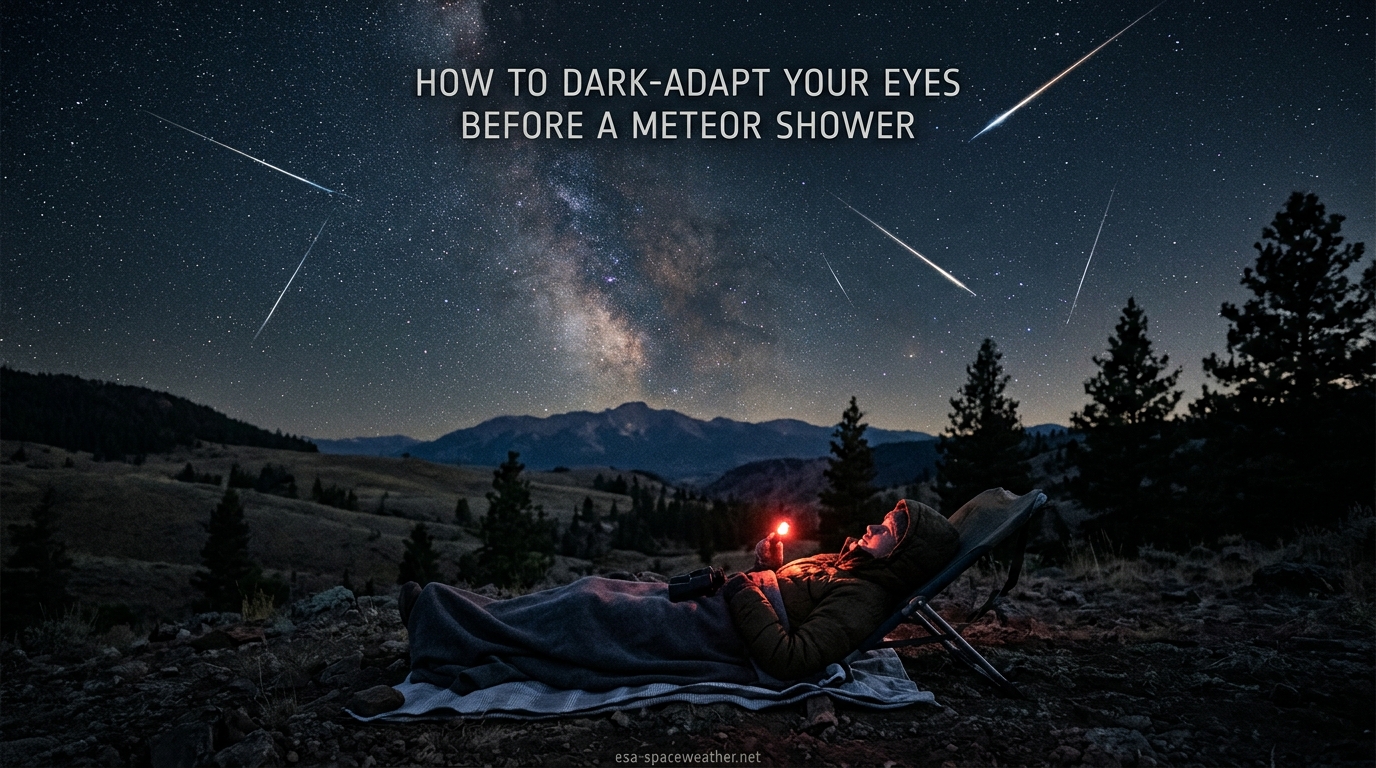
There is nothing quite like lying back under a truly dark sky and watching streaks of light tear across the stars during a meteor shower. But if you walk outside straight from a brightly lit living room, you will miss most of the show. Learning how to dark-adapt your eyes before a meteor shower is the single biggest difference between seeing a handful of meteors and seeing dozens per hour.
I have spent years attending star parties and meteor shower watch events, and the same mistake happens every single time. People arrive, look up, and complain that nothing is happening. Give it 30 minutes, and those same people are gasping at fireballs they never could have seen before. Your eyes need time to physically change before they can detect the faint light of meteors.
In this guide, we will walk through the science of dark adaptation, the exact steps to prepare your eyes, and the practical techniques that experienced stargazers use to maximize every meteor shower. Whether you are heading out for the Perseids, Geminids, or Quadrantids, these tips will help you see more shooting stars than ever before.
The best part is that none of this requires expensive equipment. Your eyes are the only optical instruments you need for meteor watching. The difference between a disappointing night and an unforgettable one comes down to preparation and understanding how your vision actually works in the dark.
Table of Contents
What Is Dark Adaptation? The Science Made Simple
Dark adaptation is the process your eyes go through to increase their sensitivity in low-light conditions. It is not just your pupils getting wider, though that is part of it. The real magic happens at the cellular level inside your retina.
Your retina contains two main types of light-detecting cells: rods and cones. Cone cells handle color vision and work best in bright light. Rod cells are responsible for low-light vision and motion detection, which makes them your best friends during a meteor shower.
When you are in bright light, a light-sensitive protein called rhodopsin (also known as visual purple) inside your rod cells gets broken down and bleached. Rhodopsin is what allows rods to detect faint light. In darkness, your body regenerates rhodopsin, and your rods become thousands of times more sensitive than they are in daylight.
This regeneration takes time. Your pupils dilate within seconds, but rhodopsin production is a slow chemical process. That is why you cannot rush dark adaptation. Your eyes are literally rebuilding their light-detecting chemistry from scratch.
To put the sensitivity gain in perspective, fully dark-adapted rod cells can detect a single photon of light. That is the smallest possible unit of light energy. When you hear astronomers talk about seeing incredibly faint objects, this is the biology that makes it possible. Your eyes, given enough time in darkness, become extraordinarily sensitive instruments.
There is a tradeoff, however. Rod cells do not detect color, which is why everything looks gray and black at night. The world loses its color palette in darkness because your cones shut down and your rods take over. This is normal and expected, and it is a sign that your dark adaptation is working.
How Long Does It Take Your Eyes to Fully Adapt to Darkness?
It takes approximately 20 to 30 minutes for your eyes to reach significant dark adaptation, and 40 to 45 minutes for full adaptation. This is the answer most people are looking for when they ask about preparing for meteor shower viewing.
Here is how the timeline breaks down. In the first 5 to 7 minutes, your cone cells adapt and you start noticing improvement. Between 7 and 15 minutes, your rod cells begin taking over as rhodopsin starts regenerating. By the 20 to 30 minute mark, your rods are operating at high sensitivity and you will see dramatically more meteors. From 30 to 45 minutes, you reach near-maximum sensitivity.
The exact timing varies from person to person. Age plays a role, with older observers sometimes needing slightly longer to fully adapt. Your overall health, fatigue levels, and even recent diet can affect how quickly your eyes respond. But the 30-minute mark is a reliable benchmark for anyone planning a meteor shower session.
Studies of dark adaptation curves show a characteristic two-phase response. The first phase is fast and corresponds to cone adaptation. The second phase is slower and represents rod adaptation. The transition point between the two phases, called the rod-cone break, typically occurs around 7 to 10 minutes in total darkness.
One important note: a single flash of bright white light can reset this entire process. That is why preserving your dark adaptation matters just as much as achieving it in the first place. We will cover this in detail later, but the short version is this: protect your adaptation like it is precious, because it took you half an hour to build.
Why Meteor Showers Specifically Need Dark-Adapted Eyes
You might wonder why dark adaptation matters so much for meteor showers compared to other types of night sky observation. The answer comes down to how meteors behave and how your eyes detect them.
Meteors are brief. A typical shooting star lasts less than a second, and many of the most rewarding ones are faint streaks that are only slightly brighter than the surrounding sky. Without dark-adapted eyes, your rods simply cannot register these quick, dim flashes of light.
Rod cells are also clustered more densely in the peripheral areas of your retina rather than at the center of your vision. This is why meteors often appear at the edges of your field of view, and why dark-adapted peripheral vision is so important for meteor watching.
During major showers like the Perseids or Geminids, the difference between adapted and non-adapted eyes can mean seeing 10 meteors per hour versus 60 or more. The sky has not changed. Your eyes have.
Light pollution compounds the problem. If you are observing from a suburban or rural location, your eyes need every advantage they can get to pick out faint meteors against any residual sky glow. Full dark adaptation is what lets you push to the absolute limit of what your eyes can detect.
Telescopes and binoculars are actually counterproductive for meteor showers. Meteors cross huge swaths of sky in fractions of a second, far too fast and too wide for any magnified instrument to track. Naked-eye viewing with dark-adapted vision is the only way to watch a meteor shower properly. This makes dark adaptation not just helpful but essential.
The radiant point of a meteor shower, where meteors appear to originate, also matters. Meteors can appear anywhere in the sky, but they tend to radiate outward from a specific constellation. Knowing where the radiant is helps you orient your gaze, but your eyes should still cover a wide area rather than staring at one point.
How to Dark-Adapt Your Eyes Before a Meteor Shower: Step by Step
The 30-30-30 rule is a framework I use for pre-observation preparation. It breaks down into three phases that take roughly 30 minutes each, though you can compress the process if needed. The goal is to arrive at your observing site with eyes that are already partially adapted and ready to go.
Here is the step-by-step process I recommend for dark-adapting your eyes before a meteor shower:
Step 1: Start dimming your environment 30 minutes before observing. Turn off overhead lights, switch to low-level lamps, and avoid screens. If you must use your phone, install a red light filter app and keep brightness at the absolute minimum. This begins the rhodopsin regeneration process before you even step outside.
Step 2: Transition to red light only. Replace white lights in your home with red bulbs or use a red flashlight for any tasks that require light. Red light at the right wavelength does not break down rhodopsin the way white light does, so your eyes keep adapting while still letting you see your surroundings.
Step 3: Arrive at your observing location 30 minutes before peak activity. Give yourself time to set up your chair or blanket, lay out your supplies, and settle in. Avoid turning on your car headlights or interior dome lights during this transition. Park facing away from your observing spot if possible.
Step 4: Spend the final 30 minutes in near-total darkness. Sit or lie down comfortably, close your eyes periodically, and let your rods reach maximum sensitivity. Keep your eyes on the sky and resist the temptation to check your phone.
Step 5: Position yourself for maximum sky coverage. Lie back on a blanket, reclining chair, or air mattress so you can see as much of the sky as possible. A reclining position saves your neck and lets you watch comfortably for hours. The more sky you can see, the more meteors you will catch.
Step 6: Use averted vision once fully adapted. Instead of staring directly at one spot, let your gaze drift and use your peripheral vision to detect motion. We will cover this technique in detail below.
The 30-30-30 rule is not rigid. If you are short on time, even 20 to 30 minutes of darkness before peak activity will make a dramatic improvement. The key is consistency and avoiding bright light exposure during the adaptation period.
I also recommend preparing a small kit before heading out. Bring a red flashlight, a warm blanket or sleeping bag, something comfortable to lie on, warm drinks in a thermos, and a star chart if you want to identify constellations. Having everything organized means you will not need to fumble with lights once your eyes are adapted.
Using Red Light to Preserve Your Night Vision
Red light is the gold standard for preserving dark adaptation during astronomy sessions. The reason comes down to biology: rod cells are relatively insensitive to red wavelengths of light, so dim red light allows you to see your surroundings without breaking down the rhodopsin you have built up.
Astronomers have used red flashlights for decades for reading star charts, navigating observing sites, and checking equipment without ruining their night vision. The key word here is dim. A bright red light can still cause some rhodopsin bleaching, so keep the intensity low.
If you do not have a dedicated red flashlight, you can make one easily. Cover a regular flashlight with red cellophane or red nail polish on the lens. Many headlamps designed for outdoor use now come with a built-in red light mode. Some observers even use red bike lights clipped to their clothing for hands-free navigation.
For phone use, install a red screen filter app that strips out blue and green wavelengths. Even with a red filter, keep brightness at the lowest setting and minimize screen time. Every bit of light exposure works against your adaptation, even red light at high intensity.
One community tip from experienced stargazers: practice navigating your observing setup by touch before it gets dark. If you can find your chair, blanket, snacks, and red light without fumbling, you will not need to break adaptation once it is established.
The wavelength of your red light matters too. Deep red light at around 620 to 700 nanometers is ideal because rod cells are least sensitive in this range. Bright red light that leans toward orange will have more impact on your rhodopsin. If you are buying a dedicated astronomy light, look for one specifically designed for night vision preservation.
The Averted Vision Technique for Meteor Watching
Averted vision is one of the most powerful techniques for any type of night sky observation, and it works exceptionally well for meteor showers. The concept is simple: instead of looking directly at an object, look slightly to the side of it.
This works because of how your retina is structured. The center of your vision, called the fovea, is packed with cone cells but contains almost no rod cells. When you look directly at something at night, you are using the part of your eye that is worst at detecting dim light.
By shifting your gaze slightly off-center, you direct faint light onto the rod-rich areas of your retina. These peripheral rods are far more sensitive and can detect meteors that your central vision would miss entirely.
For meteor showers, the best approach is to pick a broad section of sky and let your eyes relax rather than staring hard at any one point. Keep your gaze soft and let your peripheral vision do the work. You will catch more meteors at the edges of your vision than dead center.
Try this experiment during your next meteor shower. Pick an area of sky roughly 30 to 45 degrees away from the radiant point and let your focus rest there gently. Notice how meteors seem to appear everywhere in your peripheral vision. This is your rod cells doing exactly what they evolved to do: detecting motion and faint light at the edges of your awareness.
Practice makes a real difference. Experienced observers report that their ability to detect faint meteors improves with regular practice over multiple sessions. Your brain learns to interpret the signals from your rod cells more effectively the more you do it. So do not be discouraged if your first meteor shower feels underwhelming. It gets better.
What Ruins Dark Adaptation (and How to Recover)
Knowing what destroys dark adaptation is just as important as knowing how to achieve it. The most common culprits are phone screens, car headlights, porch lights, and campfires. Even a brief flash of bright white light can reset your adaptation back to near zero.
Phone screens are the number one offender at meteor shower events. The blue-rich light from a smartphone screen is devastating to rhodopsin. If you must use your phone, use a red filter app, turn brightness to minimum, and keep sessions under 10 seconds.
The eye patch trick is a popular technique among experienced astronomers. You wear a patch over one eye while moving around in light, keeping that eye fully dark-adapted. When you are ready to observe, you remove the patch and use that eye for viewing. This is especially useful if you need to read star charts or move between light and dark areas during an observing session.
Many observers on forums like Cloudy Nights and Reddit’s r/Astronomy recommend the eye patch technique specifically for situations where you cannot avoid some light exposure. Cover your dominant viewing eye with the patch when you arrive, keep it covered while you set up and navigate with your other eye under dim red light, then remove it when you are ready to observe. Your patched eye stays fully dark-adapted the entire time.
If your eyes do get exposed to bright light, do not panic. You have not permanently lost anything, but you will need to restart the adaptation process. Depending on the intensity of the exposure, recovery typically takes another 15 to 30 minutes. This is why prevention is so much easier than recovery.
Alcohol and caffeine can also negatively affect night vision quality, according to experienced observers. Alcohol in particular can dilate blood vessels in ways that may temporarily reduce visual sensitivity. If you are serious about maximizing your meteor count, save the celebratory drinks for after the shower.
Cold weather deserves a mention here too. Cold, dry air can cause your eyes to tear up, which temporarily blurs vision and makes meteor spotting harder. Bring a hat or hood that shields your face from wind, and use artificial tears before you start observing if you are prone to dry eyes. Comfort directly affects how long you can observe effectively.
Health and Lifestyle Factors That Affect Night Vision
Beyond technique and preparation, your overall health plays a real role in how well your eyes adapt to darkness. Vitamin A is essential for rhodopsin production, and a deficiency can noticeably impair night vision. Most people get enough vitamin A from a normal diet, but if you suspect your night vision is below average, it is worth checking your nutrition.
Fatigue is a major factor that experienced observers frequently mention. Tired eyes simply do not perform as well, and your ability to concentrate on the sky diminishes when you are sleepy. If you are planning a late-night meteor shower session, try to rest earlier in the day so you are alert when the peak arrives.
Age-related changes also affect dark adaptation. As we get older, our pupils tend to let in less light, and rhodopsin regeneration can slow. Some older observers report needing 45 minutes or more to reach the same adaptation level they achieved in 25 minutes when younger. This is normal and does not mean you cannot enjoy excellent meteor viewing. It just means giving yourself more preparation time.
Smoking has been linked to reduced night vision in multiple studies. Nicotine constricts blood vessels, which can reduce blood flow to the retina. If you smoke and notice your night vision is not what it should be, this may be a contributing factor.
Finally, your emotional state matters. Stress and anxiety can affect your visual processing and attention. Meteor watching is meant to be relaxing and enjoyable. Take a few deep breaths, settle into your spot, and let the experience unfold naturally.
FAQs
How to make your eyes adapt to the dark?
To make your eyes adapt to the dark, start by dimming your environment 30 minutes before observing. Switch to red light only, avoid all phone and screen use, and spend at least 20 to 30 minutes in near-total darkness. Your pupils dilate quickly, but full rhodopsin regeneration in your rod cells takes 30 to 45 minutes.
Can I see a meteor shower with my eyes?
Yes, you can absolutely see a meteor shower with your naked eyes. In fact, binoculars and telescopes are counterproductive for meteor watching because meteors streak across large areas of sky too quickly to track. All you need is dark-adapted eyes, a clear sky, and patience. Most major meteor showers are specifically designed for naked-eye viewing.
What is the 30 30 30 rule for eyes?
The 30-30-30 rule for dark adaptation means spending 30 minutes dimming your environment before observing, arriving at your dark observing location 30 minutes before peak activity, and spending the final 30 minutes in near-total darkness to let your rod cells fully adapt. This three-phase approach ensures your eyes reach maximum light sensitivity right when meteor activity peaks.
How long does it take your eyes to fully adapt to darkness?
It takes approximately 20 to 30 minutes for significant dark adaptation and 40 to 45 minutes for full adaptation. Your cone cells adapt within the first 5 to 7 minutes, but the rod cells responsible for detecting faint meteor light need 30 to 45 minutes to regenerate enough rhodopsin for maximum sensitivity.
Conclusion
Learning how to dark-adapt your eyes before a meteor shower is the most important step you can take to transform your viewing experience. The process is simple but requires patience: dim your environment, switch to red light, give yourself 30 to 45 minutes of darkness, and protect your adaptation from stray light.
The science is straightforward once you understand it. Your rod cells need time to regenerate rhodopsin, the light-sensitive protein that lets you detect faint meteors. No gadget or shortcut can replace this biological process. Your eyes need time, and the reward is worth every minute.
Remember the key takeaways: start dimming 30 minutes before, use red light exclusively, avoid phone screens, and practice averted vision once your eyes are adapted. The eye patch trick and the 30-30-30 rule are advanced techniques that experienced stargazers swear by for getting the most out of every session.
Pay attention to your health and comfort too. Rest well before your session, dress warmly, bring a red flashlight, and set up your observing position so you can see as much of the sky as possible. Small details add up to a dramatically better experience.
Next time a meteor shower is on the calendar, plan ahead. Arrive early, embrace the darkness, and let your eyes do what they evolved to do. You will see more shooting stars than you ever thought possible, all because you gave your eyes the time they needed to adjust. Clear skies and happy meteor hunting.