
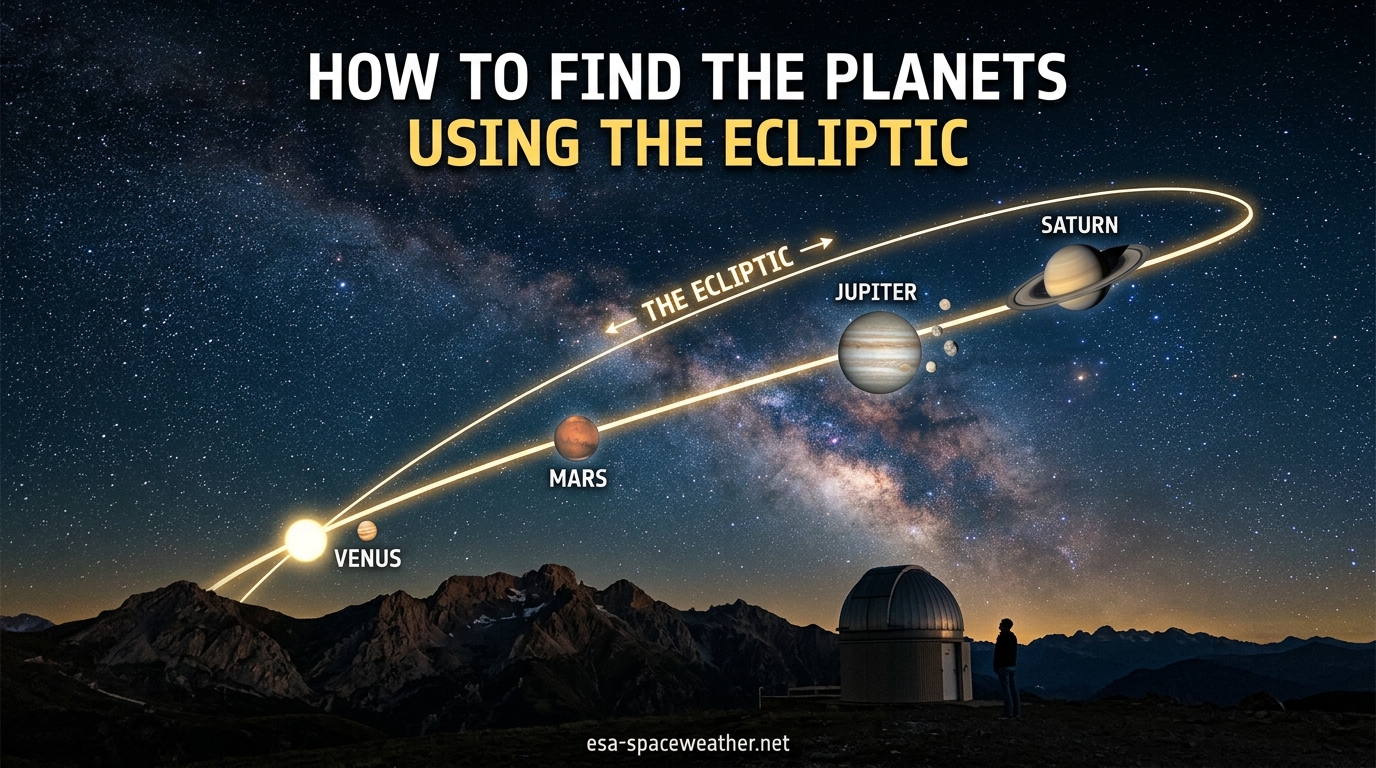
Have you ever looked up at a sky full of stars and wondered which of those bright points might actually be a planet? You are not alone. Thousands of beginner stargazers struggle with this exact challenge, and the solution comes down to a single invisible line in the sky. Learning how to find the planets using the ecliptic as a guide transforms planet hunting from guesswork into a reliable, repeatable skill.
The ecliptic is the path the Sun appears to trace across our sky over the course of a year. Because all the planets in our Solar System orbit the Sun in roughly the same flat plane, they always appear within a narrow band centered on this line. Once you can locate the ecliptic, you have essentially drawn a map that tells you exactly where every visible planet must be.
In this guide, I will walk you through everything you need to know. You will learn what the ecliptic is, how to trace it across the night sky with nothing but your eyes, how to tell planets apart from stars, and where to look for each of the five naked-eye planets. I have spent countless nights under the sky testing these methods, and I will share the practical tips that actually work for beginners.
Table of Contents
Quick Answer: How to Find the Planets Using the Ecliptic as a Guide
You can find planets using the ecliptic by following four simple steps. The ecliptic is the imaginary line the Sun traces across the sky, and all planets travel along or near this band. Here is the quick method:
1. Recall where the Sun set. The ecliptic passes through that point on the western horizon. This is your starting reference for tracing the line across the sky.
2. Find the Moon. The Moon always stays within about 5 degrees of the ecliptic, so it acts as a confirmation marker for where the line runs on any given night.
3. Trace an imaginary arc through the sky. Connect the sunset point and the Moon, then extend that curve overhead and down toward the eastern horizon. That arc is the ecliptic.
4. Scan along this arc for bright, steady points of light. Stars twinkle and shimmer, but planets shine with a calm, steady glow. Any bright, non-twinkling light along the ecliptic is likely a planet.
That is the core technique. Now let us break down each step in detail so you can master this method and start spotting planets on your very next clear night.
What Is the Ecliptic and Why Does It Matter for Finding Planets?
The ecliptic is the apparent path the Sun follows across the celestial sphere over the course of a year. This path exists because Earth orbits the Sun, and from our perspective on Earth, the Sun appears to shift its position slightly each day against the background of distant stars. Over 12 months, it completes a full circle around the sky. That circle is the ecliptic.
Here is the key fact that makes the ecliptic so powerful for planet hunting: all eight planets in our Solar System orbit the Sun in nearly the same flat plane. Astronomers call this the orbital plane, and it is a leftover feature from when the Solar System formed from a spinning disk of gas and dust billions of years ago. Earth’s orbital plane defines the ecliptic, and every other planet stays within a few degrees of this same plane.
What does this mean for you as an observer? It means that no matter where a planet is in its orbit, it will always appear in our sky somewhere close to the ecliptic line. The planets never wander off into the far northern or southern sky. They stay on their highway, and that highway is the ecliptic.
Without knowing where the ecliptic runs, finding a planet in the night sky is like searching for a single house in a city without knowing the street name. The sky contains thousands of visible stars spread across the entire dome above you. The ecliptic narrows your search to a band roughly 16 degrees wide, cutting the problem down to a manageable strip of sky.
The ecliptic also passes through the 12 traditional zodiac constellations plus Ophiuchus. If you can identify any of these constellations, you already have landmarks along the ecliptic. Aries, Taurus, Gemini, Cancer, Leo, Virgo, Libra, Scorpius, Sagittarius, Capricornus, Aquarius, and Pisces all sit on this path. Planets appear to move through these constellations over weeks and months, which is why ancient astronomers called them wandering stars.
How to Find the Ecliptic in the Night Sky
Finding the ecliptic is the first real skill you need, and it is easier than most beginners think. You do not need any equipment. You just need to know what to look for and practice the technique a few times. Here is my step-by-step method that I have refined over years of stargazing.
Step 1: Use the Sunset Point as Your Anchor
The Sun always sits exactly on the ecliptic because the ecliptic is defined by the Sun’s path. So the point where the Sun sets is a guaranteed ecliptic marker. Note the direction the Sun disappears below the horizon. In winter, this is roughly west-southwest. In summer, it shifts toward northwest. That spot on the horizon is the western end of the ecliptic.
If you are observing in the morning, use the sunrise point instead. The principle is the same. The Sun rises somewhere along the ecliptic, so the eastern horizon point where it appears marks the other end of the line.
Step 2: Use the Moon as a Confirmation Marker
The Moon’s orbit is tilted about 5 degrees from the ecliptic, which means the Moon is always within 5 degrees of this line. This is one of the most useful facts in naked-eye astronomy. Whenever the Moon is visible, it serves as a bright, unmistakable confirmation of where the ecliptic runs.
Five degrees is roughly the width of three fingers held at arm’s length. So if you hold up three fingers next to the Moon, the ecliptic passes somewhere within that finger width. This hand measurement technique is what experienced stargazers use constantly, and it works surprisingly well for estimating angular distances in the sky.
Step 3: Trace the Arc Across the Sky
Now connect the dots. You know where the ecliptic touches the western horizon (the sunset point). You have a second marker from the Moon. Imagine a smooth curve connecting these two points, then extend that curve overhead and down toward the eastern horizon. That curve is the ecliptic path across your sky.
The ecliptic never appears as a straight line. It always curves across the sky dome because it represents a great circle on the celestial sphere projected onto our view. Depending on the season and your latitude, this arc may ride high overhead or stay low near the southern horizon. Either way, the shape is always a gentle curve.
Step 4: Use Hand Measurements for Precision
Your hand is a surprisingly accurate angular measurement tool when held at arm’s length. Here are the key measurements to remember. A clenched fist covers about 10 degrees of sky. Three extended fingers span about 5 degrees. The tip of your little finger covers about 1 degree, which is roughly the apparent size of the full Moon.
Planets stay within about 8 degrees of the ecliptic, so if you trace the line and then scan one fist-width on either side, you will cover the entire zone where planets can appear. This technique lets you search systematically instead of randomly scanning the sky.
Step 5: Confirm with Zodiac Constellations
If you can recognize any zodiac constellation, use it as a landmark. For example, if you spot the distinctive backward question mark of Leo, you know the ecliptic passes right through it. Scorpius and Sagittarius mark the ecliptic in the summer southern sky. Taurus and Gemini sit along the winter ecliptic. Every constellation along the ecliptic is a signpost confirming you are looking in the right zone.
Distinguishing Planets from Stars Along the Ecliptic
Once you know where the ecliptic runs, your next challenge is telling planets apart from the many bright stars that also live along this path. Several bright stars sit on or near the ecliptic, including Aldebaran in Taurus, Regulus in Leo, Antares in Scorpius, and Spica in Virgo. You need a reliable system to separate these stars from actual planets.
The Twinkle Test: Stars Twinkle, Planets Don’t
This is the single most useful rule in naked-eye planet identification. Stars twinkle because they are so far away that they appear as infinitesimally small points of light. Earth’s atmosphere bends and distorts those tiny points, causing them to shimmer, flash, and change color. This effect is called scintillation.
Planets, by contrast, are much closer to Earth. They are near enough that we actually see them as tiny disks rather than mathematical points. Even though these disks are too small to resolve as circles with the naked eye, their slightly larger apparent size averages out the atmospheric distortion. Planets shine with a steady, calm glow that does not flicker or change color rapidly.
The twinkle test is not perfect. Very bright stars like Sirius can appear to twinkle so violently that they flash different colors, which confuses beginners who mistake this intense scintillation for a planet. And planets very close to the horizon can twinkle slightly because their light passes through more atmosphere. But as a general rule, steady light means planet and twinkling light means star.
Color Guide for Each Visible Planet
Each planet has a characteristic color that helps you identify it once you have found a steady light along the ecliptic. Mercury appears white or pinkish-white, sometimes with a faint yellow tint. Venus is brilliantly white, brighter than any star in the sky. Mars is distinctly orange-red. Jupiter shines with a warm tan or ivory color. Saturn appears pale yellow or straw-colored.
These colors are subtle and take practice to recognize. Mars is usually the easiest to identify by color because its reddish-orange hue stands out clearly against white or blue-white stars. Jupiter’s tan tone is also fairly distinctive once you know what to look for.
Brightness and Apparent Magnitude
Planets vary enormously in brightness depending on their distance from Earth and their position relative to the Sun. Venus at its brightest reaches magnitude -4.6, making it the third-brightest object in the sky after the Sun and Moon. Jupiter typically shines at magnitude -2 to -3. Mars varies from about -2.5 at opposition to +1.5 when far from Earth. Saturn usually sits around magnitude 0 to +1. Mercury fluctuates between magnitude -2 and +2 depending on its phase and distance.
If you are not familiar with the magnitude scale, just remember that lower numbers and negative numbers mean brighter objects. A planet at magnitude -3 is far brighter than a star at magnitude +1. When you see an exceptionally bright light along the ecliptic that outshines everything else in the area, it is almost certainly Venus or Jupiter.
Planet or Star? A Quick Decision Checklist
When you spot a bright light along the ecliptic, run through this checklist. First, does it twinkle? If yes, it is probably a star. If it shines steadily, it is likely a planet. Second, how bright is it compared to nearby stars? If it clearly outshines surrounding stars, that points toward a planet. Third, what color is it? Orange-red suggests Mars. Brilliant white suggests Venus. Tan or ivory suggests Jupiter. Pale yellow suggests Saturn.
Fourth, observe it over two or three nights. Planets move against the background stars from night to night. Stars stay fixed in their patterns. If that bright light has shifted position relative to nearby stars after 48 hours, you have confirmed a planet. This movement is what the ancient Greeks meant when they called planets wanderers, or planetes, from which we get the word planet.
Finding Each Naked-Eye Planet Along the Ecliptic
Not all planets are visible at the same time or in the same part of the sky. Each planet has its own visibility pattern depending on whether it is closer to the Sun than Earth (an inferior planet) or farther from the Sun than Earth (a superior planet). Understanding these patterns tells you when and where along the ecliptic to look.
Inferior Planets: Mercury and Venus
Mercury and Venus are called inferior planets because their orbits are inside Earth’s orbit. This means they always appear close to the Sun in our sky. You will never see Mercury or Venus high overhead at midnight. They are either evening objects, visible shortly after sunset in the west, or morning objects, visible shortly before sunrise in the east.
Venus is the easier of the two to find. When it appears in the evening sky, it is commonly called the Evening Star. When it appears before dawn, it is the Morning Star. Venus is so bright that it is often the first object you notice after sunset or the last to disappear before sunrise. Look for a dazzling white light low in the western twilight glow or low in the eastern pre-dawn sky. Venus is always within about 47 degrees of the Sun, so it sets within a few hours after sunset or rises within a few hours before dawn.
Mercury is much harder to spot. It never gets more than about 28 degrees from the Sun, which means it is always buried in twilight. The best time to see Mercury is when it reaches greatest elongation, the point in its orbit where it appears farthest from the Sun from our perspective. Even at greatest elongation, Mercury sits low on the horizon during twilight. You need a clear, flat western or eastern horizon with no trees or buildings blocking your view. Light pollution makes Mercury even harder because the twilight sky washes out its modest brightness. Many amateur astronomers go years without ever seeing Mercury, so do not be discouraged if it takes several attempts.
For both Mercury and Venus, the key timing window is the 30 to 60 minutes after sunset for evening viewing or before sunrise for morning viewing. Too early and the sky is too bright. Too late and the planet has set below the horizon.
Superior Planets: Mars, Jupiter, and Saturn
Mars, Jupiter, and Saturn orbit outside Earth’s orbit, so they can appear anywhere along the ecliptic at any time of night. They are not confined to twilight like Mercury and Venus. At their best, these planets can shine high overhead at midnight, making them much easier to observe.
The best time to observe a superior planet is at opposition. Opposition occurs when Earth passes between the planet and the Sun, placing the planet opposite the Sun in our sky. At opposition, the planet rises at sunset, reaches its highest point at midnight, and sets at sunrise. It is also closest to Earth and therefore at its brightest. If you hear that Mars or Jupiter is at opposition, that is your signal to go outside that night.
Jupiter is the brightest of the superior planets and one of the easiest objects for beginners to identify. Its tan-ivory glow is unmistakable along the ecliptic. Jupiter moves slowly through the zodiac constellations, spending about one year in each sign. Even a small pair of binoculars reveals Jupiter’s four largest moons as tiny points of light lined up beside the planet.
Saturn is dimmer than Jupiter but still brighter than most stars. Its pale yellow color helps distinguish it. Saturn also moves slowly through the zodiac. Through a telescope, Saturn’s rings are one of the most memorable sights in all of astronomy, but with the naked eye it simply looks like a steady golden star.
Mars is the trickiest of the three because its brightness varies enormously. When Mars is near opposition, it can rival Jupiter in brightness and its red-orange color makes identification easy. But between oppositions, Mars fades significantly as it moves to the far side of its orbit from Earth. Check a current astronomy calendar to find out if Mars is near opposition or if it is a faint presence this season.
Uranus and Neptune: Beyond Naked-Eye Range for Most
Uranus is technically visible to the naked eye under very dark, pristine skies, but in practice almost no one sees it without optical aid. It appears as a faint star-like point near the ecliptic at about magnitude 5.8, right at the limit of human vision. Neptune at magnitude 7.8 always requires binoculars or a telescope. Both planets follow the ecliptic, so if you have binoculars and a star chart showing their current position, you can track them down along the same path you use for the brighter planets.
Retrograde Motion: Why Planets Appear to Move Backward
As you watch planets over multiple weeks, you may notice something strange. A planet that has been drifting eastward against the background stars suddenly stops, reverses direction for a few weeks, then resumes its eastward drift. This is called retrograde motion, and it is a direct consequence of the ecliptic geometry.
Retrograde motion happens because Earth is also moving along its orbit. When Earth overtakes a slower-moving superior planet like Mars or Jupiter, the planet appears to move backward against the distant stars, just as a car you pass on the highway appears to move backward relative to the distant scenery. This effect is purely an illusion caused by our changing vantage point. No planet actually reverses its orbit.
Retrograde motion is visible to the naked eye over periods of weeks. It is one of the most rewarding observations for intermediate planet hunters because it requires patience and repeated observation. If you sketch the position of Mars or Jupiter relative to nearby stars every few nights, you can capture this backward drift yourself.
How the Ecliptic Changes With the Seasons
The ecliptic does not sit at a fixed angle in our sky. Its height above the horizon changes dramatically throughout the year, and this has a big impact on when and where you can find planets. Understanding seasonal changes prevents the frustration of looking in the wrong part of the sky.
In the Northern Hemisphere, the ecliptic rides high across the southern sky during late winter and spring evenings. This means planets visible at those times appear higher above the horizon, where the air is thinner and steadier and viewing conditions are better. During summer and fall evenings, the ecliptic angle is shallower, keeping planets closer to the horizon where atmospheric turbulence and haze degrade the view.
The seasonal change happens because Earth’s axis is tilted 23.5 degrees relative to the ecliptic plane. In summer, the Northern Hemisphere leans toward the Sun, which means the Sun (and therefore the ecliptic) arcs high overhead during the day but the nighttime portion of the ecliptic runs low along the southern horizon. In winter, the situation reverses. The Sun rides low during the day, but the nighttime ecliptic soars high overhead, giving winter its reputation for crisp, clear planet viewing.
If you learn the ecliptic position in one season and then try to find planets three months later, the sky will look different. The arc you traced in summer will be higher or lower than you remember. Practice identifying the ecliptic in all four seasons so your skill works year-round. The Moon technique helps here because it works regardless of the ecliptic’s seasonal angle.
Seasonal changes also affect which zodiac constellations are visible along the ecliptic, which in turn affects which background stars you see near the planets. Winter evenings feature Taurus, Gemini, and Orion nearby. Summer evenings feature Scorpius and Sagittarius low in the south. These constellation landmarks change monthly, giving you fresh reference points throughout the year.
Practical Tips and Common Beginner Mistakes
Knowing the theory is one thing. Actually walking outside and finding planets is another. Forum discussions on Reddit and stargazing communities reveal the same frustrations over and over. Here are the practical tips and common mistakes that make the difference between success and disappointment.
Start With Jupiter and Saturn
If this is your first time hunting for planets, do not start with Mercury. Many beginners report the most success starting with Jupiter and Saturn, the two brightest and most cooperative superior planets. Once you successfully identify these, you build confidence in your ecliptic-finding skills. Mercury and Venus come later, once you are comfortable tracing the ecliptic line.
Preserve Your Night Vision
Your eyes need 20 to 30 minutes to fully adapt to darkness. During this time, your pupils dilate and your retinal rod cells become far more sensitive to faint light. Looking at your phone or a white flashlight instantly resets this adaptation. Use a red light flashlight or a red screen filter on your phone to preserve your night vision. Many experienced stargazers cover their phone screen with red cellophane or use a dedicated red astronomy light.
Observe Over Multiple Nights
Planets move relative to the stars. If you go out on a single night, you might mistake a bright star for a planet or vice versa. But if you observe the same region of the ecliptic over three or four consecutive nights, you will see the planets shift position against the fixed star patterns. This movement is the definitive proof that you are looking at a planet and not a star. Community advice on stargazing forums strongly emphasizes practicing across multiple nights.
Common Mistake: Confusing Sirius for a Planet
Sirius is the brightest star in the night sky, and it is notorious for fooling beginners. When low on the horizon, Sirius twinkles so intensely that it flashes through multiple colors, which some beginners interpret as a planet. The fix is to remember that Sirius sits well south of the ecliptic in the constellation Canis Major. If the bright flashing light you see is not along your ecliptic arc, it is not a planet.
Common Mistake: Looking at the Wrong Time
Timing matters enormously. If you go outside at 9 PM looking for Mercury, it has already set. If you look for Venus at midnight, it is long gone. Check which planets are visible in the evening versus morning sky before heading out. Free tools like timeanddate.com show exactly which planets are above the horizon for your location at any given time.
Common Mistake: Ignoring the Horizon
Mercury and Venus hug the horizon. If trees, buildings, or hills block your western or eastern horizon, you will miss them entirely. Scout out an observing location with a clear, flat view to the west for evening observing and to the east for morning observing. A local park, hilltop, or rooftop can make a huge difference compared to a backyard surrounded by trees.
Common Mistake: Relying Too Much on Apps
Planet-finding apps are incredibly useful, but many forum users report that relying on apps exclusively prevents you from actually learning the sky. The goal is to use apps as a training tool and then transition to naked-eye finding. Try this progression: use an app to confirm what you see for the first few nights, then start making predictions before you check the app, and eventually leave the app at home.
Light Pollution and Urban Stargazing
If you live in a city or suburb, light pollution will limit what you can see. Bright sky glow washes out fainter planets like Mercury and dim stars that would otherwise help you trace the ecliptic. The good news is that Venus, Jupiter, and Saturn are bright enough to punch through moderate light pollution. You can still find these planets from a suburban backyard. For Mercury and for the full experience of tracing zodiac constellations along the ecliptic, you need to travel to a darker location.
Weather and Planning Your Sessions
Cloud cover is the enemy of planet hunting, and it is unpredictable. Check the weather forecast for clear windows, and be ready to head out when conditions cooperate. Even a partly cloudy night can work if there are enough breaks in the clouds. Patience is part of the hobby. Some of the best planet-hunting nights happen after a cold front passes and leaves behind crisp, transparent air.
Tools and Apps to Help You Find the Ecliptic
While the goal of this guide is to help you find planets using the ecliptic with just your eyes, several tools can accelerate your learning. These are not crutches to depend on forever but training wheels that help you build confidence.
Stellarium: The Free Desktop Planetarium
Stellarium is the most frequently recommended tool across stargazing forums, and it is completely free. This open-source planetarium software shows a realistic 3D sky from any location on Earth at any date and time. You can toggle the ecliptic line on and off, which lets you see exactly where it runs and how planets sit along it. I recommend spending 15 minutes in Stellarium before each observing session to preview what the sky will look like and plan your targets.
SkySafari: The Powerful Mobile Option
SkySafari is a premium mobile app that offers constellation overlays, ecliptic line display, and real-time planet positions. Forum users prefer it over simpler apps because the constellation overlays help you learn star patterns while you hunt for planets. The app can also identify what you are pointing your phone at, which is useful for confirming naked-eye observations.
Night Sky and Other Mobile Apps
Night Sky is an augmented reality app that overlays planet and constellation labels on your phone’s camera view. This is helpful for absolute beginners who need to confirm they are looking at the right part of the sky. Other popular options include Star Walk, SkyView, and Star Chart. All of these apps show planet positions and most can display the ecliptic line.
Timeanddate.com for Visibility Planning
Before going outside, check timeanddate.com’s astronomy section for your location. It shows which planets are visible tonight, their approximate position (altitude and azimuth), and the best viewing times. This takes the guesswork out of knowing whether Jupiter rises at 8 PM or 2 AM on a given date. Combine this information with your ecliptic-finding skills for a complete observation plan.
The Transition from App to Naked Eye
The most rewarding progression in amateur astronomy is moving from app-dependent finding to independent naked-eye observation. Start by using an app to confirm what you find. Then try predicting where a planet will be before checking. Eventually, challenge yourself to find Jupiter or Saturn using only the ecliptic method, and verify with the app afterward. Forum users who have made this transition describe it as the moment astronomy clicked for them.
FAQs
How does the ecliptic help astronomers locate planets?
The ecliptic helps astronomers locate planets because all planets in our Solar System orbit the Sun in nearly the same flat plane. This means every planet always appears close to the ecliptic path in our sky. By finding the ecliptic, astronomers narrow their search from the entire sky to a narrow band where all visible planets must appear.
What planets are in the ecliptic?
All eight planets follow the ecliptic: Mercury, Venus, Earth, Mars, Jupiter, Saturn, Uranus, and Neptune. From Earth, we can see Mercury through Saturn with the naked eye. Uranus is barely visible under excellent dark-sky conditions. Neptune requires binoculars or a telescope.
How do you find the ecliptic at night?
To find the ecliptic at night, recall where the Sun set and use that western horizon point as your anchor. Then find the Moon, which always stays within 5 degrees of the ecliptic. Trace an imaginary arc connecting these markers across the sky. That curve is the ecliptic path where planets appear.
What is the easiest way to find planets?
The easiest way to find planets is to look along the ecliptic for bright, steady points of light. Stars twinkle and shimmer due to atmospheric distortion, while planets shine with a calm, steady glow. Start with Jupiter and Saturn, the brightest and most cooperative planets for beginners.
Why do stars twinkle but planets don’t?
Stars are so far away that they appear as infinitesimally small points of light, which Earth’s turbulent atmosphere easily distorts, causing twinkling. Planets are much closer and appear as tiny disks, even if too small to see as circles. Their larger apparent size averages out the atmospheric distortion, producing a steady glow.
Can you see planets with the naked eye from a city?
Yes, you can see Venus, Jupiter, and Saturn from most cities and suburbs because they are bright enough to overcome moderate light pollution. Mercury and Mars are more challenging under urban skies. For the best experience, find a location with a clear horizon and minimal light pollution.
Conclusion
Learning how to find the planets using the ecliptic as a guide is one of the most rewarding skills in amateur astronomy. It turns a sky full of random points of light into a structured, navigable map where planets have predictable, findable locations. The ecliptic is your highway, and every visible planet travels along it.
Start simple. Recall where the Sun set. Find the Moon. Trace the arc. Look for steady, bright lights along that path. Confirm your findings over multiple nights as the planets shift against the background stars. Begin with Jupiter and Saturn, then work your way toward Mercury and Venus as your skills grow.
The best time to start is the next clear night. Check which planets are visible, grab a red light flashlight, head to a spot with a clear horizon, and put these techniques into practice. Every successful planet identification builds your confidence and deepens your connection to the sky above.