
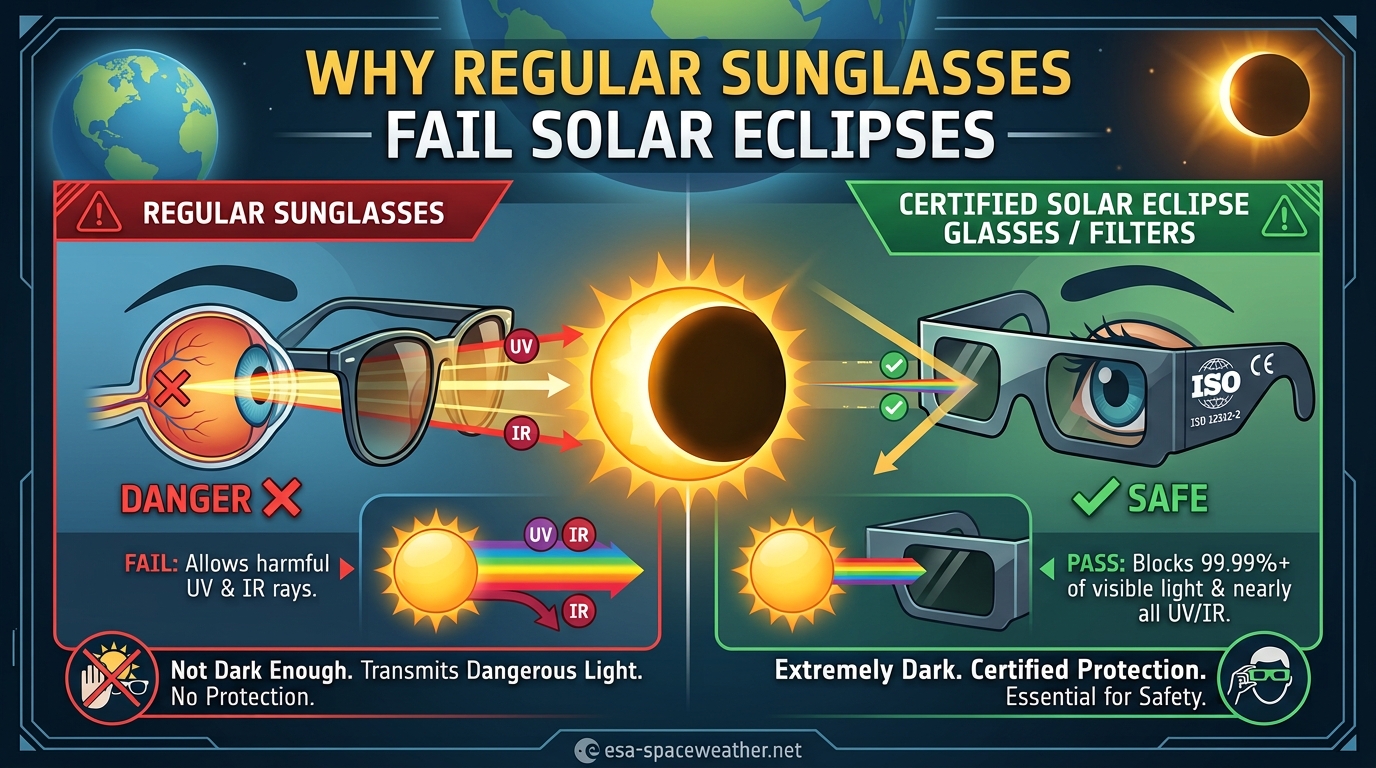
Every time a solar eclipse approaches, emergency rooms and ophthalmologists brace for a wave of preventable eye injuries. People grab their darkest pair of sunglasses, step outside, and stare at the partially eclipsed sun thinking they are protected. They are not. Understanding why regular sunglasses are never safe for eclipse viewing could literally save your vision.
The sun emits three types of harmful radiation that reach your eyes: ultraviolet (UV) radiation, infrared (IR) radiation, and intense visible light. Even the most expensive, darkest sunglasses on the market are designed for everyday ambient sunlight, not for staring directly at a solar disk. Eclipse glasses certified to the ISO 12312-2 standard are thousands of times darker than even the darkest sunglasses.
This guide breaks down the science behind the danger, the specific numbers that matter, and exactly what you should use instead. Whether you are a casual observer, a parent preparing your family, or someone who has stared at the sun before without obvious injury, what follows applies directly to you.
Table of Contents
The Short Answer
Regular sunglasses are never safe for eclipse viewing because they reduce visible light but fail to block the intense UV and infrared radiation that the sun produces. Eclipse glasses that meet the ISO 12312-2 international safety standard are roughly 100,000 times darker than standard sunglasses. That is not a marketing claim. It is a measurable difference in optical density that determines whether your retinal cells survive the experience intact or suffer permanent thermal and photochemical damage.
Why Regular Sunglasses Are Never Safe for Eclipse Viewing
The fundamental problem comes down to optical density, which is the measure of how much light a filter blocks. Standard sunglasses typically have an optical density rating between 0 and 4, with category 4 (the darkest commonly available tint) blocking roughly 92 to 97 percent of visible light. That sounds impressive until you learn that safe solar viewers require an optical density of 5 or greater, meaning they block at least 99.999 percent of visible light.
To put that in perspective, if standard category 4 sunglasses let through roughly 3 to 8 percent of visible light, certified eclipse glasses let through roughly 0.00001 percent. That is a difference of more than four orders of magnitude. NASA, the American Academy of Ophthalmology, and the American Astronomical Society all emphasize that sunglasses, no matter how dark, are not safe for looking directly at the sun.
Sunglasses are engineered for reflected and scattered ambient light. When you walk around on a sunny day, you are not staring at the solar disk. You are encountering light that has bounced off pavement, buildings, water, and atmosphere. That scattered light has been dramatically reduced in intensity compared to direct sunlight. Eclipse viewing requires staring at the source itself, which concentrates enormously more energy onto your retina.
Even during a partial solar eclipse, when the moon covers a significant portion of the sun, the remaining visible sliver of the solar disk is still intensely bright. The sun’s surface temperature exceeds 5,500 degrees Celsius, and the radiation it emits does not become safe simply because part of the disk is obscured. In fact, the reduced overall brightness creates a false sense of security that leads people to stare longer than they ever would under normal conditions.
The Pupil Dilation Paradox: Why Darker Glasses Make It Worse
Here is the part that catches people off guard. When you put on dark sunglasses, your surroundings appear dimmer. In response, your pupils naturally dilate (widen) to let in more light. A normal pupil in bright daylight might be 2 to 3 millimeters across. Behind dark sunglasses, that same pupil can open to 5 or 6 millimeters or wider.
A wider pupil means a larger opening for solar radiation to pass through. While your sunglasses may be blocking some visible light, the wider pupil partially cancels that benefit by allowing more total energy into the eye. More importantly, if your sunglasses do not block UV and infrared radiation effectively (and most do not block it completely), that larger pupil is now funneling concentrated harmful radiation directly onto your macula.
During an eclipse, this paradox intensifies. As the moon progressively covers the sun, the ambient light dims, the sky darkens, and your pupils open even wider. Many people report feeling comfortable looking at the eclipsed sun because it does not feel painfully bright. The absence of pain is deceptive. The retina has no pain receptors, so by the time you notice vision changes, the damage is already done.
This is why even 100 percent UV-blocking sunglasses fall short. A user on Physics Stack Exchange posed the exact question: if my sunglasses block 100 percent of UV, why are they not sufficient? The answer is that UV is only one of three damaging radiation types. Infrared radiation passes through most sunglass lenses and causes thermal damage to retinal tissue. Visible light at solar intensities causes photochemical damage. Blocking UV alone addresses only one third of the threat.
Understanding Solar Retinopathy and Retina Damage
Solar retinopathy is the clinical term for retinal damage caused by staring at the sun. The condition occurs when solar radiation triggers a combination of photochemical injury (from visible blue and near-UV light) and thermal injury (from infrared radiation heating retinal tissue). The macula, which is the small central area of the retina responsible for sharp detailed vision, is typically the most affected region.
Symptoms of solar retinopathy usually do not appear immediately. They develop over the 12 to 48 hours following exposure. Common signs include a central blind spot (scotoma), blurred vision, distorted vision where straight lines appear wavy (metamorphopsia), increased light sensitivity, and color perception changes. Many patients first notice the problem when they try to read or look at faces and discover a persistent dark or blank spot in the center of their vision.
The retina cannot regenerate. Once photoreceptor cells are destroyed, they do not grow back. Some patients experience partial spontaneous improvement in the months following injury as swelling subsides, but the underlying cell loss is permanent. There is no surgical procedure, medication, or therapy that can restore vision lost to solar retinopathy.
Documented cases of eclipse-related eye injury date back well over a century. After the 1999 solar eclipse visible across parts of Europe, studies identified dozens of confirmed solar retinopathy cases in the United Kingdom alone. The 2017 total solar eclipse in North America prompted similar reports. Many of those affected had used inadequate protection, including sunglasses, exposed photographic film, or smoked glass, all of which are dangerous.
What Happens If You Wear Sunglasses During a Solar Eclipse
If you wear regular sunglasses and look at the sun during a solar eclipse, several things happen in rapid succession. First, your pupils dilate because the combined effect of the sunglasses and the dimming sky reduces perceived brightness. Second, unfiltered infrared radiation heats your retinal tissue. Third, intense visible light triggers photochemical reactions that destroy photoreceptor cells.
This can occur in seconds. Studies have shown that retinal damage can begin after as little as a few seconds of direct solar observation. Some sources suggest that staring at the sun for even one second can cause measurable injury, particularly when your pupil is dilated. The darker your sunglasses, the wider your pupils, and the faster the damage accumulates.
Many people on Reddit and other forums report having stared at the sun before with sunglasses and experiencing no obvious problems. This reasoning is dangerous for two reasons. First, solar retinopathy symptoms often do not appear for hours or days. Second, retinal damage can be cumulative and subtle. You may lose a small percentage of photoreceptors without noticing until an eye exam reveals the deficit years later. The absence of immediate symptoms does not mean the absence of injury.
The annular eclipse, sometimes called the ring of fire, is particularly dangerous in this regard. During an annular eclipse, the moon does not fully cover the sun, leaving a bright ring of solar surface visible at all times. There is no safe totality phase. Throughout the entire event, the visible portion of the sun is at full intensity, and wearing sunglasses during this type of eclipse is as dangerous as staring at the sun on any normal day.
Sunglasses vs Eclipse Glasses: A Quantitative Comparison
Understanding the numbers helps clarify why the two are not interchangeable. Here is how standard sunglasses compare to ISO 12312-2 certified eclipse glasses across the metrics that matter.
Visible light transmission: Standard sunglasses transmit between 8 and 43 percent of visible light depending on tint category. Eclipse glasses transmit no more than 0.00032 percent. That means eclipse glasses block over 100,000 times more visible light than the darkest commonly available sunglasses.
UV radiation blocking: Quality sunglasses block most UVB and UVA rays, typically reducing UV transmission to near zero. Eclipse glasses block 100 percent of UV radiation with effectively zero transmission. The difference is that sunglasses may claim 100 percent UV blocking but still allow small percentages through at the edges, while eclipse glasses use dense polymer filters with carbon particle infusion that provide near-absolute blocking.
Infrared radiation blocking: This is where sunglasses fail most critically. Most standard sunglasses do not fully block infrared radiation. Eclipse glasses certified to ISO 12312-2 must block at least 99.999 percent of IR radiation. Since infrared causes thermal damage to the retina, this difference alone makes sunglasses inherently unsafe for direct solar viewing.
Optical density rating: Sunglasses max out around OD 4. Eclipse glasses carry a minimum OD of 5, with most rated at OD 5 to OD 6. Each full point on the optical density scale represents a tenfold reduction in transmitted light, so the gap between OD 4 and OD 5 is a factor of 10, and between OD 3 (typical dark sunglasses) and OD 5, the difference is a factor of 100.
Certification: Sunglasses are tested to general consumer standards for ambient use. Eclipse glasses must pass rigorous testing to the ISO 12312-2 international standard, which includes specifications for visible, UV, and IR transmission as well as structural integrity testing.
What NOT to Use: Common Myths and Dangerous Alternatives
Beyond regular sunglasses, people have tried a remarkable variety of dangerous alternatives over the years. Each of the following materials is unsafe for eclipse viewing and should never be used.
Smoked glass: An old method that provides uneven filtering and does not block infrared radiation. The glass can crack from thermal stress, and the carbon layer degrades quickly.
Exposed photographic film or X-ray film: These materials do not block IR radiation and may contain silver halide residues that produce inconsistent filtering. They are explicitly called out as unsafe by NASA and the AAS.
Floppy disk media or CDs: While they may look dark, the reflective coating provides inconsistent and unreliable filtering. They can also shatter under focused solar energy.
Mylar balloons or food packaging: The metalized film used in balloons and some snack packaging is not engineered for optical safety. Thickness and coating quality vary unpredictably.
Polarized sunglasses, even stacked pairs: Stacking two or three pairs of polarized sunglasses does not achieve sufficient optical density. The polarizing layers reduce visible light but still fail to block infrared radiation adequately. Two pairs of sunglasses are not twice as safe. They are still nowhere near the threshold.
Smartphone or camera viewfinders without solar filters: Looking at the sun through a camera, telescope, or binoculars without a proper solar filter is even more dangerous than looking with the naked eye. Optical instruments concentrate sunlight, meaning eye damage through these devices can occur in a fraction of a second. Sunglasses worn while using optical instruments provide no meaningful protection.
Counterfeit eclipse glasses: A major concern raised repeatedly on Reddit is fake eclipse glasses sold online. Glasses bearing a printed ISO logo but sold by unverified marketplace sellers may not have been actually tested. The American Astronomical Society maintains a vetted list of reputable vendors, and this is the most trusted source for purchasing safe glasses.
The ISO 12312-2 Standard: What Certification Actually Means
The ISO 12312-2 standard is the international specification for filters intended for direct observation of the sun. It was developed by the International Organization for Standardization and is the benchmark referenced by NASA, the AAS, and the American Academy of Ophthalmology. Eclipse glasses that carry legitimate ISO 12312-2 certification have been tested by accredited laboratories to verify they meet strict transmission requirements.
Specifically, the standard requires that solar filters transmit no more than 0.00032 percent of visible light, no more than 0.0032 percent of UV radiation (200 to 380 nanometers), and no more than 0.027 percent of near-infrared radiation (780 to 1400 nanometers). These limits are set well below the thresholds known to cause retinal damage.
The standard also addresses structural requirements. Filters must not develop pinholes, cracks, or delamination under reasonable handling conditions. This is why eclipse glasses are typically constructed with a dense carbon-particle-infused polymer layer sandwiched between protective paper or plastic.
Counterfeit certification is a real problem. The ISO logo on packaging means nothing if the seller fabricated it. To verify authenticity, check the AAS vendor list, inspect the glasses for the ISO reference number (ISO 12312-2), the name and address of the manufacturer, and look for any signs of printing inconsistency. When in doubt, test the glasses indoors. Through legitimate eclipse glasses, you should see nothing except the bare filament of a bright incandescent light bulb or a similarly intense light source. If you can see ordinary room lighting through them, they are not safe.
How to Safely View a Solar Eclipse: Direct and Indirect Methods
There are two broad categories of safe eclipse viewing: direct viewing with certified protection and indirect viewing without looking at the sun at all. Both are valid approaches.
Direct viewing with certified eclipse glasses: This is the most straightforward method. Use only ISO 12312-2 certified eclipse glasses or handheld solar viewers from a reputable vendor listed by the AAS. Inspect the lenses before every use by holding them up to a bright indoor light. If you can see anything other than the filament of an intense bulb, discard them.
Telescopes, binoculars, and cameras: If you want to use optical equipment during an eclipse, you must attach a certified solar filter to the front of the instrument, before any light enters the optics. Never use eclipse glasses as a filter attached to the eyepiece end of a telescope or binoculars. The concentrated light exiting the eyepiece will melt the filter and burn your retina instantly.
Welder’s glass as an alternative: Shade 14 welder’s glass is the only welder’s shade considered safe for solar viewing. Shades below 14 do not provide sufficient protection. If you use welder’s glass, verify the shade number is 14 or higher. Shade 12 is sometimes sold for this purpose but does not meet the ISO 12312-2 equivalent threshold.
During totality: If you are fortunate enough to be in the path of totality during a total solar eclipse, there is a brief window when the sun is completely covered by the moon and only the solar corona is visible. During this period, which lasts from seconds to a few minutes depending on the eclipse, it is safe to view the sun with the naked eye. The instant any part of the solar disk reappears (the diamond ring effect), you must put your eclipse glasses back on immediately. For partial and annular eclipses, there is no totality, and eye protection must be worn at all times.
Rules for Inspecting and Using Eclipse Glasses
Follow these six rules, adapted from NASA and AAO safety guidelines:
- Inspect before every use. Check for scratches, pinholes, tears, or wrinkles in the filter material. If you find any damage, discard the glasses.
- Put the glasses on before looking up at the sun. Turn away from the sun, put the glasses on, then turn toward the sun.
- Turn away from the sun before removing the glasses. Never remove them while still facing the sun.
- Do not use eclipse glasses with binoculars, telescopes, or cameras. They are for direct eye use only.
- Supervise children at all times. Make sure their glasses fit properly and that they understand the rules before the eclipse begins.
- Do not use glasses that are more than three years old or that have scratched or wrinkled lenses, even if they appear intact. Filter materials can degrade over time.
Building a Pinhole Projector at Home
If you cannot obtain certified eclipse glasses, indirect viewing is a completely safe alternative that costs nothing. A pinhole projector projects an image of the eclipsed sun onto a surface, letting you observe the eclipse without ever looking at the sun.
The simplest version requires two pieces of stiff white cardboard. Poke a small pinhole (roughly 2 to 3 millimeters) in the center of one piece. Stand with your back to the sun, hold the pinhole card up so sunlight passes through the hole, and hold the second card behind it as a screen. Move the screen closer or farther until you see a sharp, small image of the sun projected on it. During an eclipse, you will see the moon’s shadow eating into the solar disk.
A kitchen colander or slotted spoon also works. Hold the colander so sunlight passes through the holes and onto the ground or a sheet of paper. Each hole acts as a tiny pinhole projector, producing dozens of small eclipse images simultaneously.
For a more enclosed option, a box projector (similar to a pinhole camera) provides a darker viewing environment and a sharper image. Cut a hole in one end of a cardboard box, cover it with aluminum foil, poke a pinhole in the foil, and cut a viewing hole in the side. Stand with your back to the sun, point the pinhole end toward the sun, and look through the viewing hole to see the projected image on the inside of the box.
FAQs
Can you use normal sunglasses to look at the eclipse?
No. Regular sunglasses, regardless of how dark they are or how much UV they block, are never safe for direct solar viewing during an eclipse. Eclipse glasses certified to the ISO 12312-2 standard are roughly 100,000 times darker and block the infrared radiation that sunglasses allow through.
What happens if you wear sunglasses during a solar eclipse?
Your pupils dilate in the dimmer light, allowing more harmful UV and infrared radiation to reach your retina. This can cause solar retinopathy, which includes permanent central blind spots and vision distortion, often developing 12 to 48 hours after exposure.
What glasses should you wear during solar eclipse?
Use only ISO 12312-2 certified eclipse glasses or handheld solar viewers from a vendor listed on the American Astronomical Society approved list. Shade 14 welder’s glass is also acceptable. For optical instruments, only use front-mounted certified solar filters.
Can we watch a lunar eclipse with sunglasses?
A lunar eclipse is safe to view with the naked eye, sunglasses, or binoculars because you are looking at the moon, not the sun. Lunar eclipses occur at night and involve Earth’s shadow passing over the moon. No special eye protection is needed for lunar eclipse viewing.
Are polarized sunglasses safe for eclipse viewing?
No. Polarized sunglasses reduce glare from reflected light but do not provide the optical density needed to block direct solar radiation. They also fail to adequately block infrared radiation. Even stacking multiple pairs of polarized sunglasses does not reach a safe protection level.
Can you use two pairs of sunglasses for an eclipse?
No. Stacking two or more pairs of sunglasses does not achieve sufficient optical density and still does not block infrared radiation. The combined filtering is nowhere near the level provided by ISO 12312-2 certified eclipse glasses, which are roughly 100,000 times darker than standard sunglasses.
Conclusion
The message is simple and the stakes could not be higher. Regular sunglasses are never safe for eclipse viewing because they are not designed to block the UV, infrared, and intense visible light that the sun produces. Eclipse glasses certified to ISO 12312-2 are roughly 100,000 times darker, and that gap is the difference between a memorable experience and permanent vision loss.
If you cannot obtain certified eclipse glasses, use indirect viewing methods like a pinhole projector. Verify your glasses against the AAS vendor list before trusting them. And remember that the absence of pain does not mean the absence of damage. Protect your eyes the way the science demands, and enjoy the next eclipse knowing you are seeing it safely.