
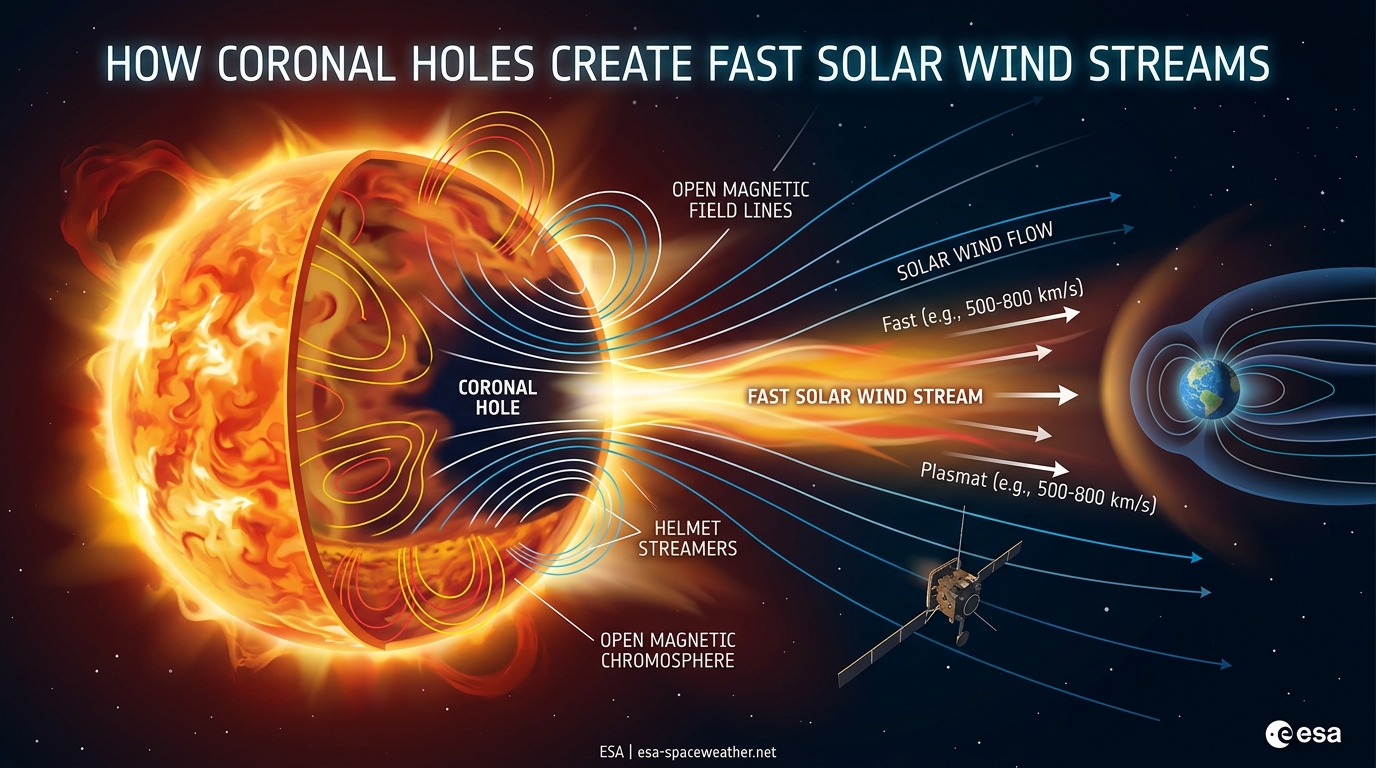
Every few weeks, a patch of the Sun’s outer atmosphere opens up and fires a torrent of charged particles toward Earth at speeds exceeding 700 kilometers per second. These events, known as coronal hole high speed streams, are one of the most reliable drivers of space weather we experience. Understanding how coronal holes create fast solar wind streams matters because these streams trigger geomagnetic storms, push auroras to lower latitudes, and interfere with satellites and radio systems that we depend on daily.
Our team tracks solar activity data from NOAA’s Space Weather Prediction Center and ESA missions regularly, and the physics behind coronal holes is one of the most commonly misunderstood topics in space weather. In this guide, we break down exactly how these dark regions on the Sun produce the fast solar wind that reaches Earth, why their magnetic structure is so unusual, and what happens when those streams arrive at our planet.
Table of Contents
What Are Coronal Holes?
Coronal holes are large, dark regions in the Sun’s corona that appear in extreme-ultraviolet (EUV) and soft X-ray imagery. They look dark because the plasma inside them is significantly cooler and less dense than the surrounding solar atmosphere. While the typical corona sits at temperatures above one million Kelvin, coronal hole regions run cooler, and the reduced density means they emit far less radiation at the wavelengths our instruments monitor.
The Solar Dynamics Observatory (SDO) captures these features prominently in its 193-angstrom and 211-angstrom wavelength channels, where coronal holes stand out as unmistakable dark patches against the brighter, magnetically confined corona. These are the same images that space weather forecasters and hobbyists on Reddit’s r/SolarMax community check daily to spot Earth-facing coronal holes.
There are two main types of coronal holes. Polar coronal holes form near the Sun’s north and south poles and tend to be persistent and large. Equatorial or transequatorial coronal holes form closer to the solar equator, and these are the ones most likely to send fast solar wind directly toward Earth. When an equatorial hole rotates into a geoeffective position, forecasters pay close attention.
The Open Magnetic Field Configuration
The defining characteristic of a coronal hole is its magnetic field structure. Most of the Sun’s surface is covered by closed magnetic field lines, which form loops that connect regions of opposite magnetic polarity. These loops trap hot plasma close to the surface, keeping the corona dense and bright in EUV images.
Coronal holes are different. Their magnetic field lines are open, meaning instead of looping back down to the surface, they extend outward into interplanetary space. This creates what solar physicists call a unipolar magnetic field configuration, where the field lines all point in the same direction, either predominantly outward or predominantly inward.
Think of closed field lines like a lid on a pot. They keep the hot plasma contained, building up heat and density. Open field lines remove that lid entirely. With no magnetic barrier holding them back, charged particles in the corona can flow freely outward along these open lines, escaping the Sun’s gravitational and magnetic grip.
This open configuration is what makes coronal holes fundamentally different from other solar features like active regions or sunspots. Active regions have intense but closed magnetic fields that store energy, occasionally releasing it as solar flares or coronal mass ejections. Coronal holes, by contrast, maintain a steady outward flow, which is a gentler but longer-lasting release of energy and material.
How Coronal Holes Create Fast Solar Wind Streams
This is where the physics gets interesting. The process by which coronal holes generate fast solar wind involves several interconnected mechanisms that solar physicists have studied for decades. Let us walk through it step by step.
Step 1: Plasma Escapes Along Open Field Lines
Inside a coronal hole, the open magnetic field lines act like channels that guide plasma away from the solar surface. Because the field lines are unipolar and do not loop back, there is no magnetic confinement trapping the charged particles. The plasma that would normally be held in the corona is instead free to travel outward.
The reduced density in coronal holes is actually a consequence of this escape. As plasma flows away along the open field lines, the corona above the hole becomes depleted, which is precisely why these regions appear dark in EUV images. The darkness is evidence of the wind already leaving.
Step 2: Acceleration Through the Corona
Once plasma begins flowing along the open field lines, it accelerates rapidly. Several mechanisms contribute to this acceleration. One of the most important involves waves and oscillations in the magnetic field itself. Magnetohydrodynamic waves, which are essentially ripples traveling along the magnetic field lines, transfer energy to the charged particles as they move outward.
This wave-particle interaction is a major reason the solar wind from coronal holes reaches such high speeds. The particles gain energy from the wave action and from the pressure gradient created by the hot corona pushing material outward. As the plasma climbs away from the Sun, it passes through a critical point where its speed exceeds the local sound speed, and from there it continues accelerating into supersonic flow.
The temperature structure within coronal holes also plays a role. Although the plasma is cooler than in the surrounding quiet corona, it is still hot enough, at roughly 800,000 to one million Kelvin, to drive a strong pressure-driven outflow when combined with the open magnetic geometry.
Step 3: Fast Solar Wind Reaches Interplanetary Space
By the time the solar wind from a coronal hole reaches interplanetary space, it is traveling at speeds between 400 and 800 kilometers per second. This is significantly faster than the slow solar wind, which originates from closed field line regions near the equator and travels at roughly 300 to 500 kilometers per second.
The fast wind from coronal holes also has different properties than the slow wind. It has lower particle density, lower temperature at a given distance from the Sun, and a more uniform composition. These differences are what space weather monitors track using spacecraft like the Advanced Composition Explorer (ACE) at the L1 Lagrange point, which sits about 1.5 million kilometers upstream of Earth.
When a coronal hole high speed stream, often abbreviated as CH HSS, arrives at Earth, ACE and similar spacecraft detect a sudden jump in solar wind speed, a shift in the interplanetary magnetic field, and changes in particle density. These measurements give forecasters roughly 30 to 60 minutes of warning before the stream impacts Earth’s magnetosphere.
Co-rotating Interaction Regions: When Fast Meets Slow
One of the most important consequences of coronal hole fast solar wind involves what happens when it catches up to slower wind ahead of it. Because the Sun rotates approximately once every 27 days, the solar wind streams trace out spiral patterns in interplanetary space, similar to water from a rotating sprinkler.
When fast wind from a coronal hole plows into slower wind ahead of it, it creates a compression boundary known as a co-rotating interaction region, or CIR. At this boundary, the plasma gets squeezed and compressed, and the interplanetary magnetic field intensifies. This compressed region is what typically produces the strongest geomagnetic effects when it reaches Earth.
CIRs are especially notable because they recur. Since coronal holes can persist for several solar rotations, the same CIR can sweep past Earth every 27 days. Space weather forecasters watch for these recurring patterns because they provide predictable windows of geomagnetic activity that can last for days at a time, unlike the sudden but brief impacts from coronal mass ejections.
How Coronal Hole Streams Affect Earth
When a coronal hole high speed stream arrives at Earth, the compressed plasma and intensified magnetic field at the CIR boundary interact with our magnetosphere. This interaction drives geomagnetic storms, typically rated G1 (minor) or G2 (moderate) on the NOAA Space Weather Scale.
The effects are real and measurable. We have seen Reddit users on r/SolarMax report coronal hole-driven wind speeds hitting 700 to 800 km/s, producing G2 storm conditions visible in Kp-index readings. These storms can push auroras to lower latitudes than usual, making them visible from parts of the United States and Europe where aurora sightings are rare.
Beyond beautiful auroras, coronal hole streams have practical impacts. They increase drag on satellites in low Earth orbit, which can shift orbital positions and complicate tracking. High-frequency radio communications near the poles can degrade, affecting aviation routes and maritime operations. Power grid operators in high-latitude regions monitor these events closely because induced currents from geomagnetic storms can stress transformers and other infrastructure.
GPS and navigation systems can also experience increased errors during active geomagnetic conditions. The changed ionosphere delays GPS signals slightly differently than models predict, which matters for applications requiring precision positioning.
Solar Cycle and Coronal Hole Behavior
Coronal holes follow patterns tied to the Sun’s approximately 11-year activity cycle. During solar minimum, polar coronal holes are large, well-defined, and persistent. They are the dominant source of fast solar wind during this quiet phase. During solar maximum, the magnetic field structure becomes more complex, and the polar holes shrink or fragment.
This is where confusion often arises. Forum users, including one on r/SolarMax in November 2024, have expressed surprise at how persistent coronal holes remained even as the Sun approached maximum activity. Equatorial coronal holes can and do appear throughout the solar cycle, and large transequatorial holes sometimes persist for multiple rotations even during active periods. Their persistence is not abnormal, it simply reflects the complex magnetic reorganization happening on the Sun.
FAQs
What is a coronal hole high speed stream?
A coronal hole high speed stream (CH HSS) is a stream of fast solar wind, traveling at 400 to 800 km/s, that originates from a coronal hole on the Sun. Because coronal holes have open magnetic field lines, plasma escapes freely and accelerates to high speeds, creating a sustained flow of charged particles that can reach Earth in 2 to 4 days and trigger geomagnetic storms.
Do coronal holes go away?
Coronal holes are transient features but can persist for weeks or even months. Polar coronal holes are most prominent during solar minimum and can last through multiple solar rotations. Equatorial coronal holes form and dissipate more frequently, but large ones sometimes survive several 27-day rotations before finally closing.
What would a CME cause here on Earth?
A coronal mass ejection (CME) can cause significant geomagnetic storms on Earth, often more intense than coronal hole streams. Effects include widespread aurora displays, satellite damage, GPS disruption, HF radio blackouts, and induced currents in power grids capable of damaging transformers. Strong CME-driven storms can reach G3 or higher on the NOAA scale.
How long do coronal holes last?
Coronal holes can last anywhere from a few days to several months. Small equatorial holes may form and close within a single solar rotation, while large polar holes during solar minimum can persist for many rotations. Some long-lived coronal holes have been tracked for over a year, recurring with each 27-day rotation of the Sun.
Conclusion
Understanding how coronal holes create fast solar wind streams comes down to one key concept: open magnetic field lines. When the Sun’s magnetic field opens outward instead of looping back, plasma escapes, accelerates, and travels toward Earth at 400 to 800 km/s. These fast streams compress the solar wind ahead of them, form co-rotating interaction regions, and drive geomagnetic storms that produce auroras, affect satellites, and stress infrastructure.
If you want to track these events yourself, check NOAA’s Space Weather Prediction Center forecasts and SDO imagery from the 193-angstrom channel. When you see a large dark patch rotating toward the center of the solar disk, you will know exactly what is coming and why.