
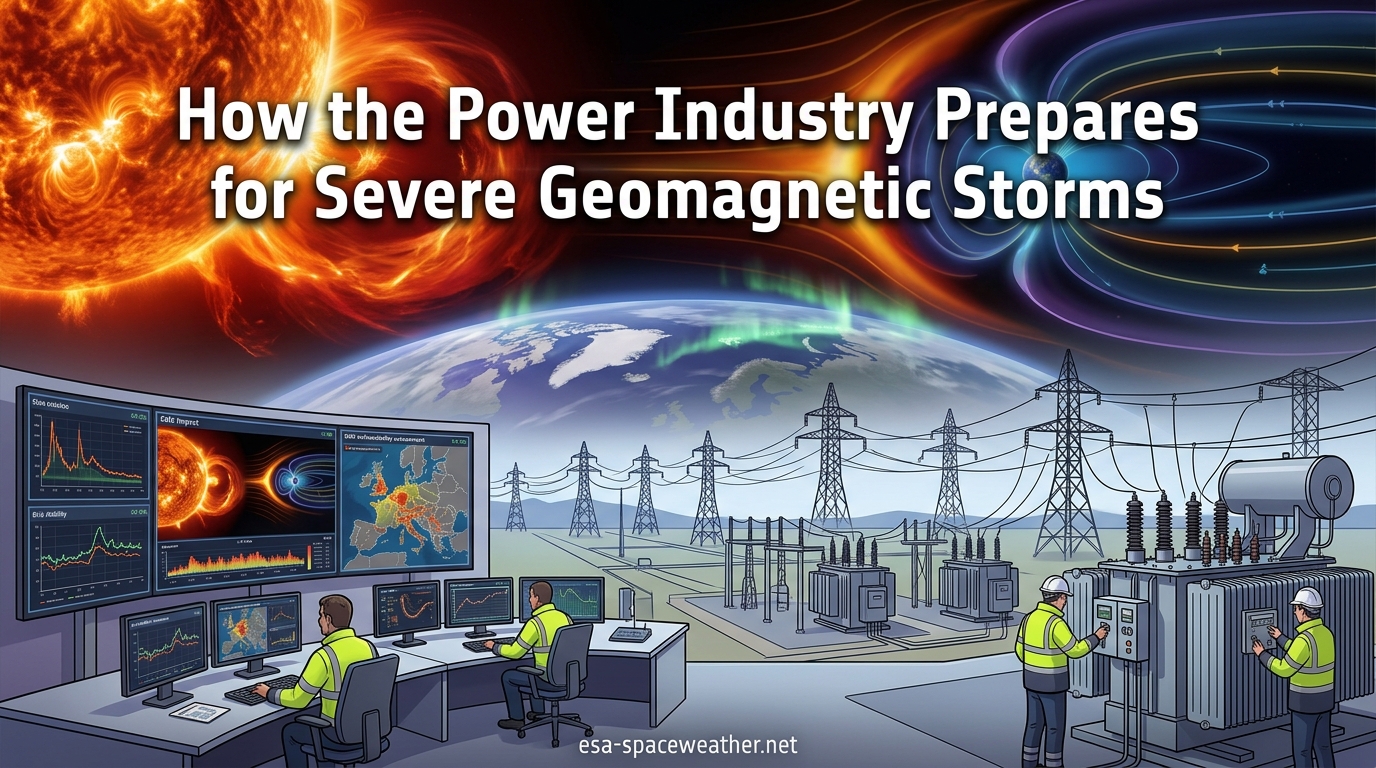
Every so often, the Sun hurls a massive cloud of charged plasma toward Earth. When that cloud arrives, it shakes our planet’s magnetic field and sends unwanted currents surging through the very power lines that keep modern life running. Understanding how the power industry prepares for severe geomagnetic storms matters because a single extreme event could blackout entire regions for weeks or longer.
I have spent years following space weather reporting and grid operations, and one thing stands out: utilities are far more prepared today than they were a decade ago. In this article, we break down exactly what geomagnetic storms do to power infrastructure, how grid operators defend against them, and what the preparation process looks like from the inside.
Here is what you will learn: the science behind coronal mass ejections, the damage mechanism called geomagnetically induced current, the protective measures utilities deploy, the step-by-step storm response process, and the regulatory framework holding it all together. Let us get into how the power industry prepares for severe geomagnetic storms.
Table of Contents
What Is a Geomagnetic Storm?
A geomagnetic storm is a temporary but intense disturbance of Earth’s magnetosphere triggered by solar activity. The most common cause is a coronal mass ejection (CME) — a massive eruption of plasma and magnetic field from the Sun’s surface that travels through space at speeds up to 3,000 kilometers per second.
When a CME reaches Earth, it slams into our magnetic shield and compresses, distorts, and reconfigures it. That magnetic field disturbance is what we experience as a geomagnetic storm. The stronger the CME, the more violent the disturbance.
NOAA’s Space Weather Prediction Center classifies these storms on a G-scale from G1 (minor) to G5 (extreme). A G1 storm might produce faint aurora and minor grid fluctuations. A G5 storm can push aurora as far south as the tropics and inflict serious damage on power infrastructure.
The visible side of these storms is the aurora borealis and aurora australis. During the May 2026 G5 event, aurora was visible as far south as Arizona and Texas — a stunning reminder that space weather reaches all of us.
How Geomagnetic Storms Threaten Power Grid Infrastructure
The core threat to the power grid is a phenomenon called geomagnetically induced current, or GIC. Here is how it works in plain terms.
As Earth’s magnetic field rapidly fluctuates during a storm, it acts like a giant generator. Those fluctuations induce electrical currents in the ground and in any long conductor — including high-voltage transmission lines, pipelines, and railway tracks. These induced currents are quasi-direct current (DC) in nature, which is exactly the type of current that power grid equipment is not designed to handle.
When GICs flow into a power transformer through its grounding system, they push the transformer into a state called half-cycle saturation. The transformer core, normally operating in a balanced AC mode, becomes overwhelmed by the DC offset. This saturation causes several dangerous effects simultaneously.
First, the transformer begins absorbing large amounts of reactive power from the grid rather than transmitting it efficiently. This reactive power absorption causes voltage to drop across the transmission system. If voltage drops too far, protective relays trip offline and the grid can begin cascading toward a blackout.
Second, saturated transformers generate electrical harmonics — distorted waveforms that interfere with protective relays, capacitor banks, and other sensitive equipment. Harmonics can cause relays to misoperate or fail to operate when needed.
Third, the transformer heats up internally. In extreme cases, this heating can damage the transformer permanently. Large power transformers cost millions of dollars each and can take 12 to 24 months to replace. Losing even a handful during a storm could mean prolonged outages for entire communities.
Forum discussions from grid operators on communities like r/Grid_Ops confirm that even moderate G3 storms produce noticeable effects. Operators report voltage swings, unusual transformer behavior, and increased alarm activity during these events. The grid is designed to handle minor upsets, but multiple simultaneous contingencies during a severe storm can overwhelm even well-prepared systems.
Historical Context: Lessons From Past Storms
The power industry learned its geomagnetic storm lessons the hard way. The wake-up call came on March 13, 1989, when a powerful coronal mass ejection struck Earth and plunged 6 million people in Quebec into darkness for nine hours.
The Hydro-Quebec grid collapsed because GICs saturated transformers and tripped protective equipment in rapid succession. The entire province lost power in just 90 seconds. It took 12 hours to restore service fully, and the event cost an estimated 2 billion Canadian dollars.
That same storm damaged a large transformer at the Salem Nuclear Plant in New Jersey. The transformer was scrapped at a cost of roughly 12 million dollars. This was a critical data point for the industry: geomagnetic storms do not just cause temporary outages. They can destroy expensive, hard-to-replace equipment.
Then there is the Carrington Event of 1859 — the strongest geomagnetic storm in recorded history. Telegraph systems sparked, caught fire, and operated even when disconnected from their power supplies. If a storm of that magnitude hit today’s interconnected grid, studies estimate that damage could reach into the trillions of dollars and recovery could take months to years.
These historical events drive every protective measure the industry deploys today. The question is not whether another severe storm will come, but when.
How the Power Industry Prepares for Severe Geomagnetic Storms
Modern grid operators use a layered defense strategy that combines forecasting, monitoring, operational procedures, and hardware protection. Here is how the power industry prepares for severe geomagnetic storms in practice.
1. Space Weather Forecasting and Early Warning
Everything starts with warning time. NOAA’s Space Weather Prediction Center monitors the Sun 24 hours a day using satellites like the Solar Terrestrial Relations Observatory (STEREO) and the Deep Space Climate Observatory (DSCOVR). When a CME erupts, DSCOVR can detect it at the L1 Lagrange point about 30 to 60 minutes before it reaches Earth.
That last-minute warning is valuable, but the real advantage comes from solar observation. CMEs take one to three days to travel from the Sun to Earth. Forecasters use that window to predict storm severity and alert utilities in advance. Grid operators subscribe to NOAA alerts and receive tiered warnings as a storm approaches.
2. Real-Time GIC Monitoring
Many utilities now install dedicated GIC monitoring devices at critical substations. These sensors measure the quasi-DC current flowing through transformer neutrals in real time. When GIC levels rise above threshold values, operators receive immediate alarms.
Some regions also use magnetic field observatories operated by the USGS and international partners to track geomagnetic disturbance intensity as it happens. This real-time situational awareness lets operators make informed decisions rather than guessing.
3. Operational Mitigation Procedures
When a storm warning hits, utilities execute predefined operating procedures. The most common steps include:
Reducing the loading on critical transformers so they have more thermal headroom to absorb GIC-induced heating. Operators may also bring additional generation reserves online to compensate for expected reactive power losses. Some utilities reconfigure their transmission network to reduce the length of exposed circuits or isolate particularly vulnerable equipment.
Operators also cancel scheduled maintenance, recall off-duty staff, and increase situational awareness across the control room. The goal is to keep the grid in a conservative, defensive posture until the storm passes.
4. Transformer Hardening and Neutral Blocking Devices
The most direct hardware defense against GICs is the neutral blocking device (NBD). This is a specialized piece of equipment installed between the transformer neutral and ground. During normal operation, the NBD allows standard AC fault currents to pass through. But when slow, quasi-DC geomagnetic currents try to flow, the NBD blocks them.
The Western Area Power Administration (WAPA) pioneered the first commercially developed NBD in the United States. At the White Substation, WAPA installed an NBD and tested it during the February 2023 G3 geomagnetic storm. The device successfully blocked damaging GICs and protected the transformer from saturation.
NBDs typically use a capacitor bank to block DC while allowing AC to pass. They also include a spark gap or similar bypass mechanism that safely routes lightning and fault currents to ground, protecting both the transformer and the NBD itself.
5. Voltage Support and Reactive Power Management
Because GICs cause transformers to absorb reactive power, utilities prepare by ensuring adequate reactive power reserves. This means having capacitor banks, static VAR compensators, and synchronous condensers ready to inject reactive power and stabilize voltage.
During a storm, operators actively manage voltage across the transmission system, switching in compensation as needed. Without this reactive power support, voltage collapse can cascade rapidly and lead to widespread blackouts.
6. Geographic Vulnerability Assessment
Not all locations face equal risk. The USGS has developed geoelectric hazard maps that show which regions of the country are most vulnerable to GICs. These maps account for both the likelihood of strong geomagnetic field fluctuations and the local ground conductivity.
Regions with igneous rock geology — like much of New England, the upper Midwest, and parts of the Pacific Northwest — are particularly vulnerable because resistive ground forces GICs into power lines rather than dissipating them underground. Utilities in these high-hazard zones prioritize protective investments accordingly.
Step-by-Step Utility Response During a Storm
To make the preparation concrete, here is what happens inside a control room when a severe geomagnetic storm warning is issued.
Step 1: Alert received. NOAA issues a geomagnetic storm watch or warning. The utility’s space weather monitoring system relays the alert to grid operators, typically 24 to 48 hours before impact.
Step 2: Shift briefing. The duty manager briefs all operators on the expected storm severity, timing, and likely impact zones. Predefined GMD operating procedures are activated.
Step 3: Defensive posture. Operators reduce transformer loading, bring on additional generation reserves, and prepare reactive power resources. Scheduled outages and maintenance are postponed.
Step 4: Continuous monitoring. As the storm arrives, GIC monitors and voltage sensors are watched closely. Operators track real-time data from NOAA, USGS magnetometers, and internal SCADA systems.
Step 5: Active response. If voltage drops or transformer heating exceeds thresholds, operators inject reactive power, shed load if necessary, and isolate damaged equipment. Decisions are made in seconds.
Step 6: Recovery. Once the storm subsides, operators restore normal grid configuration, inspect equipment for damage, and document lessons learned for the next event.
Regulatory Standards and Coordination
Grid protection is not just voluntary good practice. In North America, the North American Electric Reliability Corporation (NERC) enforces mandatory reliability standards for geomagnetic disturbance mitigation.
NERC standard TLP-004-3 (and its successors) requires utilities to conduct vulnerability assessments, implement operating procedures, and in some cases install hardened equipment. Bulk electric system owners must identify critical transformers, assess their GIC exposure, and take corrective action if vulnerabilities are found.
Beyond NERC, coordination happens through multiple channels. Regional transmission organizations and independent system operators share real-time data during storms. The Electricity Information Sharing and Analysis Center (E-ISAC) distributes threat intelligence to utilities across the continent. International partners exchange data through forums like the International Space Environment Service.
This coordination matters because the power grid does not respect state or national borders. A severe storm affects everyone simultaneously, and mutual awareness is essential for preventing cascading failures.
Future of Grid Protection Technology
The power industry continues to improve its geomagnetic storm defenses. Several promising technologies and approaches are emerging.
Advanced forecasting models using artificial intelligence and machine learning are improving prediction accuracy and lead time. Researchers are training models on decades of solar data to recognize the patterns that precede the most dangerous CMEs.
Next-generation neutral blocking devices are becoming smaller, cheaper, and easier to retrofit into existing substations. As more utilities install NBDs, the collective resilience of the grid improves.
Some researchers are exploring solid-state transformer designs that are inherently immune to GIC-induced saturation. While still in the early stages, these technologies could eventually eliminate the GIC threat entirely.
On the monitoring side, new satellite missions are providing unprecedented views of solar activity. The Parker Solar Probe and Solar Orbiter are giving scientists their closest-ever look at the Sun’s corona, improving our understanding of how and when dangerous CMEs form.
International research programs, including collaboration between the United States, New Zealand, Australia, and European nations, are expanding our understanding of how ground geology influences GIC risk. These partnerships are producing the detailed hazard maps that utilities need to prioritize investments.
FAQs
How can people prepare for a geomagnetic storm?
Individuals can prepare by keeping an emergency kit with flashlights, batteries, a battery-powered radio, and enough food and water for several days. Charge devices in advance, keep some cash on hand, and have a backup power option if possible. Stay informed through NOAA space weather alerts.
Could a solar storm knock out the power grid?
Yes, a severe geomagnetic storm can knock out power over wide areas. The 1989 Quebec blackout knocked out power to 6 million people for nine hours. An extreme event like the 1859 Carrington Event could cause widespread, long-duration outages and damage transformers that take months to replace.
What does a geomagnetic storm do to the human body?
Geomagnetic storms do not directly harm the human body. The magnetic field fluctuations are far too weak to affect human biology. The danger is to technology and infrastructure, not to people physically standing outside during a storm.
What states are affected by geomagnetic storms?
All states can be affected, but high-latitude states like Alaska, Washington, Montana, North Dakota, Minnesota, Wisconsin, Michigan, Vermont, New Hampshire, and Maine face the highest risk. States with resistive ground geology, including much of New England and the upper Midwest, are also especially vulnerable to GICs.
Conclusion
The power industry has come a long way since the 1989 Quebec blackout taught everyone that space weather is a real and present danger. Today, utilities combine 24-hour solar monitoring, real-time GIC sensing, predefined operating procedures, transformer hardening, and mandatory reliability standards into a defense-in-depth strategy.
Understanding how the power industry prepares for severe geomagnetic storms comes down to one principle: you cannot stop the storm, but you can build a grid that survives it. Neutral blocking devices block the damaging currents, forecasting gives operators crucial lead time, and reactive power management keeps voltage stable when transformers are under stress.
The next major geomagnetic storm is not a matter of if but when. The good news is that grid operators are paying attention, the technology keeps improving, and the regulatory framework ensures that preparation is mandatory, not optional. Stay informed through NOAA alerts, and remember that while the grid is more resilient than ever, individual preparedness still plays a role in riding out whatever the Sun sends our way.