
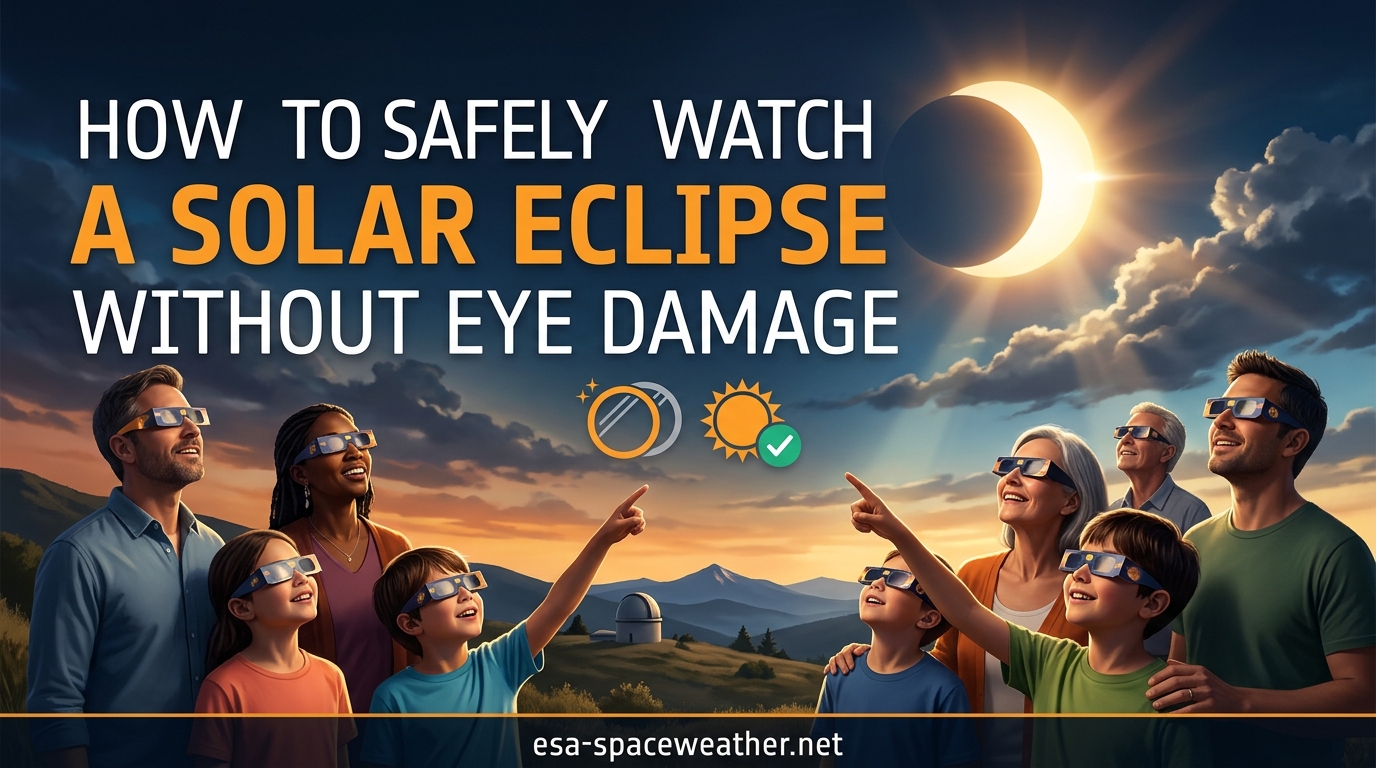
Watching a solar eclipse is one of the most awe-inspiring experiences nature offers. But without the right precautions, it can also cause permanent vision loss in a matter of seconds. If you want to learn how to safely watch a solar eclipse without damaging your eyes, this guide walks you through every method, warning, and piece of equipment you need.
The danger is real and well-documented. The human eye focuses sunlight onto the retina with roughly 5,000 times the intensity of looking at the ground. During an eclipse, the Sun’s reduced brightness tricks your brain into allowing longer exposure than normal. This creates the perfect conditions for a condition called solar retinopathy, where intense light permanently damages retinal cells.
Retinal cells do not regenerate. Once they are burned by concentrated sunlight, the damage is often permanent. This guide covers certified eclipse glasses, indirect viewing methods you can build at home, how to spot counterfeit glasses, the symptoms of solar eye damage, and the specific upcoming eclipses from 2026 through 2028 that you can prepare for.
Whether you are planning for the August 2026 total solar eclipse crossing Greenland, Iceland, and Spain, or just want to understand eclipse safety for future events, the information here comes from NASA, the American Astronomical Society, and major medical institutions.
Table of Contents
Quick Safety Summary: The Golden Rules
The single most important rule of solar eclipse safety comes down to one sentence: except during the brief total phase of a total solar eclipse (called totality), it is never safe to look directly at the Sun without specialized eye protection.
That protection must meet the ISO 12312-2 international safety standard. Regular sunglasses, smoked glass, exposed film, CDs, and every other makeshift filter are completely unsafe. No exceptions.
DO these things:
- Use ISO 12312-2 certified eclipse glasses or handheld solar viewers during all partial phases
- Inspect your glasses for scratches, holes, or tears before every use
- Put your eclipse glasses on before looking up at the Sun
- Turn away from the Sun before removing your glasses
- Use indirect viewing methods like pinhole projectors as a free alternative
- Supervise children closely and make sure their glasses stay on
DO NOT do these things:
- Look at the Sun through sunglasses of any kind, even multiple pairs stacked
- Use cameras, telescopes, or binoculars without proper solar filters attached
- View the eclipse through windows, mirrors, or water reflections
- Use smoked glass, CDs, DVDs, exposed X-ray film, or polarizing filters
- Remove eclipse glasses during partial or annular phases for any reason
- Assume it is safe because the Sun looks dim or partially hidden
Understanding Solar Eclipse Eye Damage
Solar retinopathy is the medical term for retinal damage caused by staring at the Sun. The retina is the light-sensitive tissue lining the back of your eye. When concentrated sunlight hits the retina, it causes a combination of photochemical and thermal injury that destroys retinal cells.
Unlike a sunburn on your skin, retinal damage comes with no pain warning. The retina has no pain receptors. You will not feel anything while the damage is happening. Many people do not realize they have injured their eyes until hours later, when symptoms begin appearing.
The damage mechanism involves two types of energy. Ultraviolet radiation causes photochemical damage to retinal cells, breaking down cellular structures at a molecular level. Infrared radiation causes thermal injury, literally heating and cooking retinal tissue. ISO 12312-2 certified filters block both UV and infrared to safe levels.
Eclipses are uniquely dangerous because of a cruel trick of human psychology. Under normal conditions, the Sun is too bright to stare at comfortably, so people naturally look away. During a partial eclipse, the reduced brightness makes the Sun seem tolerable to look at. This tricks people into staring far longer than they normally would, delivering a massive dose of damaging radiation to the retina.
Even a few seconds of unprotected viewing during a partial eclipse can cause measurable damage. Community reports from Reddit and astronomy forums confirm that brief exposures of just 1 to 2 seconds can produce noticeable visual effects. The risk increases dramatically with longer exposure times.
What Happens at Different Exposure Times
- 1 to 2 seconds: Possible minor damage, temporary afterimages, slight visual distortion
- 5 to 10 seconds: Increased risk of permanent damage, blind spots may develop
- 30 seconds or more: High probability of permanent solar retinopathy with central vision loss
- Extended viewing (minutes): Severe, irreversible central vision damage
Certified Eclipse Glasses: The ISO 12312-2 Standard
ISO 12312-2 is the international safety standard for filters designed for direct solar viewing. This standard was developed by the International Organization for Standardization and specifies exactly how much visible light, ultraviolet radiation, and infrared radiation a solar filter must block.
To meet the standard, eclipse glasses must transmit no more than 0.00032 percent of visible light. They must also block ultraviolet radiation below 380 nanometers and infrared radiation above 780 nanometers to extremely low levels. This is roughly 1,000 times darker than standard sunglasses.
How to Verify Your Glasses Are Genuine
The market for eclipse glasses has a significant counterfeit problem. Fake glasses with printed ISO 12312-2 labels but no actual certification have flooded online marketplaces, especially before major eclipse events. Here is how to protect yourself.
First, check the printed information on the glasses. Genuine eclipse glasses must have the ISO 12312-2 designation printed on them, along with the manufacturer’s name and address. If the manufacturer information is missing or incomplete, the glasses may be counterfeit.
Second, verify the manufacturer against the American Astronomical Society’s list of reputable vendors. The AAS maintains an updated list of verified safe solar filter manufacturers on their website at eclipse.aas.org. If the brand is not on that list, proceed with extreme caution.
Third, do the indoor light test. Put on your eclipse glasses indoors and look around. You should not be able to see anything except extremely bright lights, and even those should be very dim. If you can see furniture, walls, or normal room lighting through the glasses, they are not safe for solar viewing.
Reddit users have confirmed this test is reliable. Multiple threads on r/solareclipse and r/Astronomy report that counterfeit glasses fail this test because they use inadequately dark filtering material that lets too much light through.
Do Eclipse Glasses Expire?
This is one of the most common questions in astronomy forums. The answer depends on the manufacturer and the type of glasses.
According to the American Astronomical Society, eclipse glasses manufactured to the ISO 12312-2 standard do not have a universal expiration date. If the filters are not scratched, punctured, torn, or otherwise damaged, they should remain safe to use. However, you should always inspect them carefully before each use.
Some manufacturers print an expiration date on their products. If your glasses have one, respect it. When in doubt, replace them. Eclipse glasses are inexpensive, and your vision is irreplaceable.
Store your glasses in a clean, dry place between uses. Keep them away from sharp objects that could scratch the filter surface. Some users store them in microfiber pouches or original packaging to prevent damage.
Safe Direct Viewing Methods
Direct viewing means looking straight at the Sun through a certified solar filter. This is the most popular and immersive way to watch an eclipse, but it must be done correctly.
Eclipse Glasses and Handheld Solar Viewers
Eclipse glasses are cardboard or plastic frames fitted with ISO 12312-2 certified solar filter lenses. They look similar to old-fashioned 3D glasses but are vastly darker. Handheld solar viewers are rectangular filters you hold in front of your eyes, which some people find more comfortable for extended viewing.
The proper technique matters as much as the equipment itself. Always put your eclipse glasses on or position your handheld viewer before looking up at the Sun. Turn away from the Sun before removing them. Never remove them while still facing the Sun, even for a moment.
If you wear prescription eyeglasses, you can wear eclipse glasses over them. The eclipse glasses go on the outside. Some handheld viewers are large enough to cover prescription glasses easily. Remove any hats with brims that might cause you to accidentally look over your eclipse glasses.
Sharing glasses in a group is perfectly fine for partial eclipse viewing. The partial phases of an eclipse unfold slowly over an hour or more, so each person can take turns for several minutes at a time. This makes eclipse glasses cost-effective for families and school groups.
Welding Filters as an Alternative
Arc welding filters can be used for safe solar viewing, but only at the correct shade number. Shade 14 provides the best protection and image quality. Shade 12 is the minimum acceptable shade, and shade 13 falls between them.
Shade 12 filters produce a slightly brighter image of the Sun that some people find more detailed. Shade 14 filters produce a dimmer, more comfortable image. Both are safe when genuine.
The key risk with welding filters is ensuring authenticity. Only use filters from reputable welding supply companies. Do not assume a filter is shade 12 or darker just because it looks dark. Verify the shade number printed on the filter itself.
Safe Indirect Viewing Methods
Indirect viewing lets you watch the eclipse safely without any special equipment. These methods project an image of the Sun onto a surface, so you never look directly at the Sun itself. They are free, fun to build, and completely safe.
The Pinhole Projector: Simple Version
The simplest pinhole projector requires just two pieces of stiff white cardboard. Punch a small hole (about 2 to 3 millimeters across) in one piece using a pin or thumbtack. With your back to the Sun, hold the punched cardboard up so sunlight passes through the hole. Hold the second piece of cardboard behind it as a screen. You will see a small, inverted image of the Sun projected onto the screen.
Move the screen farther from the pinhole to make the image larger but dimmer. Move it closer for a smaller, sharper image. During a partial eclipse, the projected image will show the characteristic crescent shape of the partially obscured Sun.
The Box Pinhole Projector: Detailed Step-by-Step
A box pinhole projector produces a larger, clearer image and is easy to build with household materials. NASA recommends this method for the best indirect viewing experience.
Materials you need:
- A long cardboard box (at least 2 feet long, longer is better)
- A piece of aluminum foil about 2 inches square
- A pin or thumbtack
- A sheet of white paper (for the projection screen)
- Tape (transparent tape or duct tape)
- Scissors or a craft knife
- A pencil or pen
Step 1: Cut a rectangular opening about 2 inches tall and 3 inches wide on one end of the box. This will be where you attach the pinhole.
Step 2: Tape the piece of aluminum foil securely over the opening you just cut. Make sure the foil is smooth and covers the entire hole with no gaps around the edges.
Step 3: Use the pin to make a single small hole in the center of the aluminum foil. The hole should be about 2 millimeters in diameter. A smaller hole gives a sharper but dimmer image. A larger hole gives a brighter but blurrier image.
Step 4: Tape the sheet of white paper on the inside of the opposite end of the box. This is your projection screen where the Sun’s image will appear.
Step 5: Cut a second viewing hole in the side of the box near the screen end. This hole should be large enough to look through comfortably. It lets you see the projected image inside the box without letting in too much ambient light.
Step 6: Stand with your back to the Sun. Place the pinhole end of the box pointing toward the Sun, over your shoulder. Look through the viewing hole at the white paper screen inside the box. You will see a clear, projected image of the Sun.
Step 7: Adjust the box angle slightly until the Sun’s image is centered and focused on the screen. During a partial eclipse, you will see a crescent shape. As the eclipse progresses, you can watch the crescent change in real time.
Never look through the pinhole at the Sun. The pinhole is for projection only. You look at the projected image on the white paper screen inside the box.
The Colander Projection Method
A kitchen colander with round holes makes an excellent multi-pinhole projector. Hold the colander with your back to the Sun and let the sunlight pass through the holes onto a sheet of white paper or a light-colored sidewalk. Each hole projects its own tiny image of the Sun.
During a partial eclipse, you will see dozens of tiny crescent Suns projected onto the surface. This creates a striking visual effect and is one of the easiest indirect methods to demonstrate, especially for groups and children.
The Tree Shadow Method
Nature provides its own pinhole projectors. The gaps between leaves on a tree act as natural pinholes, projecting tiny images of the Sun onto the ground. On a normal day, these appear as small round circles of light.
During a partial eclipse, those circles transform into crescents. The effect is beautiful and requires no equipment at all. Just look down at the ground beneath a leafy tree. Multiple Reddit users have shared photos of this phenomenon, and it works best when the Sun is high in the sky.
The Waffle Finger Method
Cross your fingers slightly to create a grid of small gaps between them. Hold your hands about 2 feet above the ground with your back to the Sun. The gaps between your fingers project tiny crescent Suns onto the ground below. The American Astronomical Society features this method on their website with a demonstration animation.
Direct vs Indirect Viewing: Which Should You Choose?
Both direct and indirect methods are safe when done correctly. The best choice depends on your situation, budget, and what you want to experience.
Direct viewing with certified eclipse glasses gives you the most immersive experience. You see the eclipse with your own eyes in real time. This is the method most people choose for major eclipse events. The downside is you need certified equipment, and you must be vigilant about safety.
Indirect viewing is free, requires no certified equipment, and carries zero risk of eye damage. It is perfect for groups, schools, children, and anyone who cannot obtain certified glasses. The projected image is smaller and less immersive, but the methods are engaging and educational.
Here is a side-by-side comparison to help you decide:
- Safety: Both are completely safe when done correctly. Direct viewing requires strict adherence to equipment rules. Indirect viewing is inherently safe because you never look at the Sun.
- Cost: Direct viewing requires purchasing ISO 12312-2 certified glasses or viewers. Indirect methods use items you already have at home.
- Image quality: Direct viewing shows the eclipse in full detail with your own eyes. Indirect methods show a projected image that is smaller and less detailed but still clearly shows the eclipse progress.
- Group suitability: Indirect methods work well for groups since everyone can see the projection at once. Direct viewing requires sharing glasses or buying multiple pairs.
- Child friendliness: Indirect methods are safer for children because there is no risk of them looking at the Sun accidentally.
- Totality experience: Direct viewing with glasses lets you remove them during totality for the full naked-eye experience. Indirect methods do not show the corona during totality.
Many experienced eclipse chasers use both methods. They use eclipse glasses for direct viewing and set up a pinhole projector or colander as a backup and educational demonstration.
Totality: The Only Safe Moment for Bare Eyes
Totality is the single exception to the rule about never looking at the Sun without protection. During a total solar eclipse, the Moon completely covers the Sun’s bright face for a brief period. Only during this exact window is it safe to view the eclipse with bare eyes.
Totality is awe-inspiring. The sky darkens to twilight, temperatures drop, birds go silent, and the Sun’s corona becomes visible as a pearly white halo around the black disk of the Moon. This is the moment every eclipse chaser travels thousands of miles to experience.
But totality has strict rules. It only occurs within a narrow path on Earth called the path of totality. Outside this path, even if the eclipse is 99 percent, the Sun is still too bright to view without protection. Totality also lasts only a few minutes at most, and sometimes less than a minute.
You must know the exact timing for your location. Totality begins at a specific, predictable moment and ends at a specific, predictable moment. Look up the precise start and end times for your location before eclipse day. The community consensus on Reddit and astronomy forums is clear: if you can see even a sliver of the bright Sun, put your glasses back on immediately.
The correct sequence is: during the partial phases leading up to totality, keep your eclipse glasses on at all times. When totality begins and the Sun is completely covered, remove your glasses to view the corona with bare eyes. The moment totality ends and the first sliver of bright Sun reappears, immediately put your eclipse glasses back on.
Do not remove your glasses early hoping to catch a glimpse before totality is complete. The brightness of even a tiny sliver of the Sun’s photosphere can cause damage before your blink reflex kicks in.
What NOT to Do During a Solar Eclipse
Every unsafe viewing method mentioned below has caused real eye damage to real people. None of these methods are safe, regardless of what you may have heard.
Never Use Regular Sunglasses
Regular sunglasses, even the darkest ones available, reduce visible light by only about 70 to 90 percent. Eclipse glasses reduce visible light by 99.999 percent. Stacking multiple pairs of sunglasses does not make them safe. The UV and infrared blocking in sunglasses is not designed for direct solar viewing.
Never Use Smoked Glass, CDs, or Film
Old methods like smoked glass, exposed photographic film, CDs, DVDs, and polarizing filters were never safe for solar viewing. They provide inconsistent filtering, often transmitting dangerous levels of infrared radiation even when they appear dark enough for visible light. These methods have caused countless cases of eye damage over the decades.
Never Look Through Cameras, Phones, Telescopes, or Binoculars Without Filters
Optical devices concentrate sunlight. Looking at the Sun through a camera viewfinder, telescope, or binoculars without a proper solar filter can cause instant, severe eye damage. The focused beam of sunlight can literally burn through tissue in fractions of a second.
If you use eclipse glasses, never look through a camera, telescope, or binoculars while wearing them. The concentrated light exiting the optical device can melt or burn through the eclipse glasses filter. Solar filters must be attached to the front of the optical instrument, never at the eyepiece end.
Never View Through Windows or Water
Window glass does not block UV or infrared radiation sufficiently for solar viewing. Looking at the Sun through a window is not safe. Reflections in water or mirrors are equally dangerous because the reflected sunlight carries the same damaging radiation.
Never Trust Your Phone Camera
Using your phone camera to view the eclipse is fine for the screen, but you should not look at the Sun directly to frame your shot. Also, pointing your phone camera at the Sun for extended periods can potentially damage the camera sensor. Use a solar filter on your phone camera lens for extended photography.
Symptoms of Solar Eye Damage
If you or someone you know looked at the Sun without proper protection during an eclipse, it is important to know the symptoms of solar retinopathy. Early recognition can lead to faster medical evaluation and treatment.
Symptoms typically appear within a few hours of exposure, though they can take up to 12 hours to fully develop. The delayed onset often surprises people who felt fine immediately after viewing.
Common symptoms of solar retinopathy include:
- A blind spot in the center of your vision (scotoma)
- Blurred or distorted vision
- Colors appearing washed out or different than normal (color distortion)
- Difficulty reading or recognizing faces
- Headaches or eye discomfort (though pain is uncommon since the retina has no pain receptors)
- Metamorphopsia, where straight lines appear wavy or bent
- Increased sensitivity to light (photophobia)
If you experience any of these symptoms after an eclipse, see an eye doctor immediately. An ophthalmologist or optometrist can examine your retina for signs of thermal or photochemical damage. While there is no specific cure for solar retinopathy, prompt evaluation can rule out other conditions and help manage symptoms.
Some cases of solar retinopathy show partial improvement over weeks or months as the retina heals. However, many cases result in permanent central vision damage. The best treatment is prevention: never look at the Sun without proper protection.
Solar Filters for Telescopes, Binoculars, and Cameras
Using optical instruments to view an eclipse requires additional safety measures beyond eclipse glasses. The concentrated light through these instruments is far more dangerous than naked-eye viewing.
Solar filters for optical instruments must be mounted on the front (objective) end of the device, never on the eyepiece. Front-mounted filters reduce the sunlight before it enters the optical system. Eyepiece-mounted filters can crack or melt from the concentrated heat inside the instrument.
Baader solar film and Mylar solar filters are popular options for telescopes and binoculars. These materials meet ISO safety standards and produce sharp, high-contrast images of the Sun. They come in sheets that you can cut and mount yourself, or pre-mounted in cells designed for specific telescope models.
For camera lenses, threaded solar filters are available in various sizes. These screw onto the front of the lens like any other filter. Never use a camera viewfinder to look at the Sun during an eclipse without a solar filter on the lens. The viewfinder concentrates sunlight just like a telescope, and can cause instant eye damage.
Tips for Viewing with Children
Children are at higher risk during eclipses because they may not understand the danger and may remove their glasses when adults are not watching. Extra vigilance is essential.
Make sure eclipse glasses fit properly on small faces. Adult glasses may be too loose, allowing children to peek around the edges. Some manufacturers make child-sized eclipse glasses. If those are not available, help children hold handheld solar viewers firmly against their faces.
Explain the rules before eclipse day so children understand what to expect. Practice putting the glasses on and taking them off while looking away from the Sun. Make it a fun activity rather than a scary warning.
Indirect viewing methods are especially good for young children. Pinhole projectors and colander projections let kids participate safely without any risk of accidental direct viewing. The tree shadow method is particularly engaging for kids since it feels like a treasure hunt.
During the entire event, an adult should supervise children actively. Do not assume a child will keep their glasses on just because they were told to. Watch them constantly, especially during the exciting moments of deep partial eclipse.
Upcoming Solar Eclipses 2026 to 2028
Planning ahead is one of the best ways to ensure safe eclipse viewing. Here are the major solar eclipses coming up through 2028, with viewing regions for each event.
August 12, 2026 – Total Solar Eclipse: This eclipse crosses Greenland, Iceland, and northern Spain. The path of totality passes through these regions, with maximum duration of totality reaching about 2 minutes and 18 seconds. Parts of Europe, including Portugal, France, and Italy, will see a deep partial eclipse. This is the next major total solar eclipse after the April 2024 North American eclipse.
February 6, 2027 – Annular Solar Eclipse: An annular eclipse occurs when the Moon is too far from Earth to completely cover the Sun, leaving a ring of bright sunlight visible. This annular eclipse crosses the southern tip of South America, the Atlantic Ocean, and parts of southern Africa. During an annular eclipse, eclipse glasses or solar filters must be worn at all times. There is no safe moment to look with bare eyes.
August 2, 2027 – Total Solar Eclipse: This is one of the longest total eclipses of the century, with totality lasting up to 6 minutes and 23 seconds in optimal locations. The path crosses southern Spain, North Africa (including Egypt and Libya), Saudi Arabia, Yemen, and Somalia. The extended duration of totality makes this one of the most anticipated eclipses of the decade for eclipse chasers.
January 26, 2028 – Annular Solar Eclipse: This annular eclipse crosses parts of South America, including Ecuador, Peru, and Brazil. As with all annular eclipses, protective eyewear is required throughout the entire event with no exceptions.
July 22, 2028 – Total Solar Eclipse: This total solar eclipse crosses Australia, passing directly over Sydney, before continuing across New Zealand and the South Pacific. Maximum totality reaches about 5 minutes and 10 seconds. For Australian observers, this is the most significant eclipse since the 2012 total eclipse visible from Queensland.
For each of these events, obtain certified eclipse glasses well in advance. Demand always spikes in the weeks before major eclipses, and supply shortages and counterfeit sellers become major problems. Planning ahead is the best protection for both your eyes and your wallet.
FAQs
Is it safe to watch a solar eclipse without eye protection?
No. Except during the brief total phase of a total solar eclipse when the Moon completely blocks the Sun’s bright face, it is never safe to look directly at the Sun without specialized eye protection. Looking at any part of the bright Sun without ISO 12312-2 certified solar filters can cause permanent retinal damage called solar retinopathy.
What can I use instead of eclipse glasses?
You can safely view an eclipse using indirect methods that do not require special equipment. A pinhole projector made from a cardboard box, aluminum foil, and a pin projects an image of the Sun onto a white surface. A kitchen colander projects dozens of tiny eclipse images. The gaps between tree leaves project crescent suns onto the ground. Crossed fingers also create small projection holes. With all indirect methods, you never look directly at the Sun.
Can I watch the solar eclipse with my bare eyes?
You can only view a total solar eclipse with bare eyes during totality, when the Moon completely covers the Sun. This lasts only a few minutes and only occurs within the narrow path of totality. The second any part of the bright Sun reappears, put your eclipse glasses back on immediately. During partial or annular eclipses, bare-eye viewing is never safe at any point.
How do I protect my eyes during a solar eclipse?
Use ISO 12312-2 certified eclipse glasses or a handheld solar viewer at all times during partial phases. Inspect glasses for scratches or damage before use. Put glasses on before looking up at the Sun, and turn away before removing them. Never look through cameras, telescopes, or binoculars without proper solar filters. If you do not have glasses, use indirect methods like a pinhole projector. During totality only, you may remove glasses when the Sun is completely covered.
Do eclipse glasses expire?
Eclipse glasses manufactured to the ISO 12312-2 standard do not have a universal expiration date. If the filters are not scratched, punctured, torn, or otherwise damaged, they remain safe to use. However, always inspect glasses carefully before each use. Some manufacturers print expiration dates on their products, which should be respected. When in doubt, replace them.
Can solar eclipse eye damage be reversed?
Solar retinopathy is often permanent because retinal cells do not regenerate. Some cases show partial improvement over weeks or months as swelling decreases, but many result in lasting central vision damage. There is no specific cure or treatment. The best approach is prevention by always using proper solar filters. If you experience vision changes after an eclipse, see an eye doctor immediately.
Conclusion
Knowing how to safely watch a solar eclipse without damaging your eyes comes down to a few simple principles. Use ISO 12312-2 certified eclipse glasses or handheld solar viewers during all partial and annular phases. Build a pinhole projector for free, safe, indirect viewing. Never use sunglasses, smoked glass, or unfiltered optical devices. During totality only, you may remove your glasses to witness one of nature’s most spectacular sights.
The upcoming eclipses from 2026 through 2028 offer incredible viewing opportunities across the globe. Start preparing now by obtaining certified glasses, learning the indirect methods, and marking the dates on your calendar. Your eyes deserve nothing less than proper protection.