
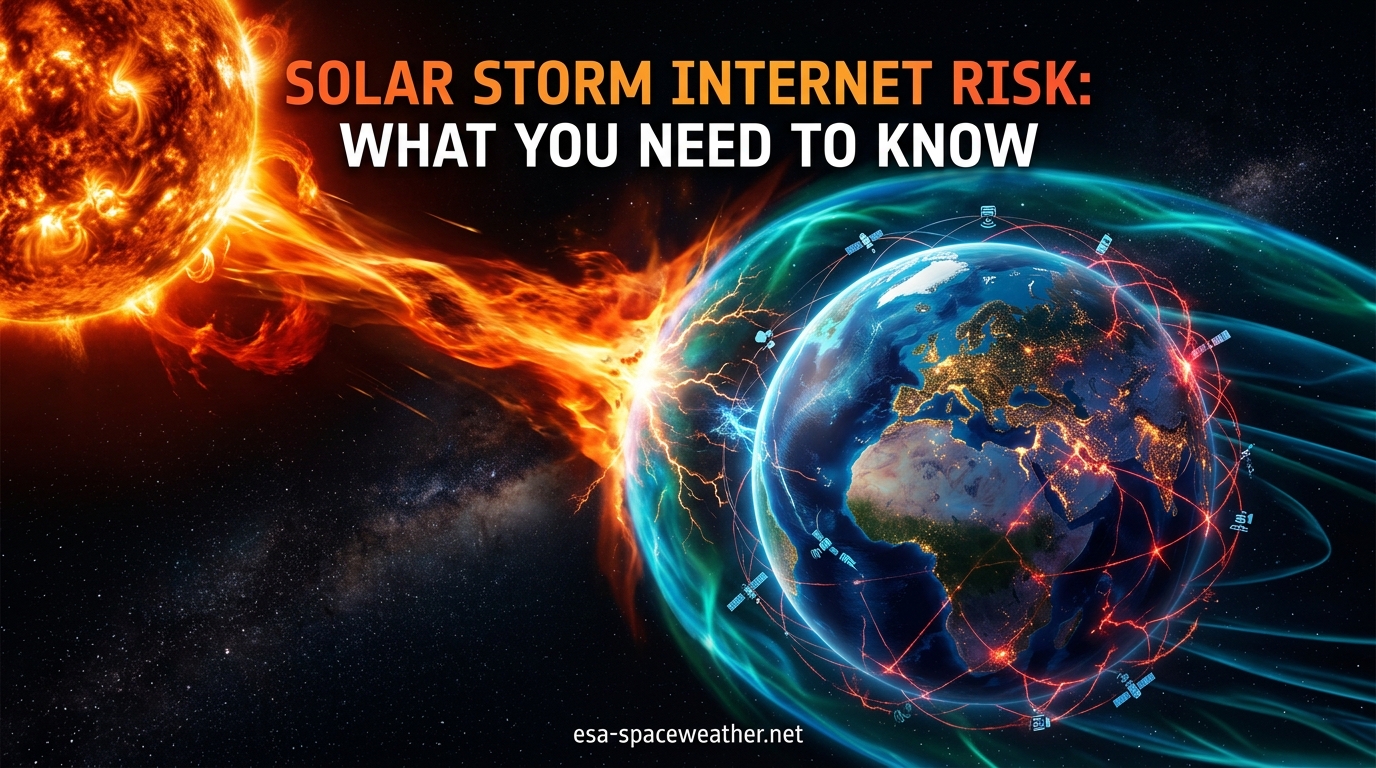
Every second, approximately 750 undersea cables carry 99 percent of all intercontinental internet traffic between continents. These cables, along with thousands of satellites, millions of cell towers, and tens of thousands of data centers, form the backbone of our connected world. But this infrastructure has a vulnerability that most people never consider: it sits in the path of solar storms that could disrupt or disable it.
Understanding how the internet could be affected by an extreme solar storm matters now more than ever. We are in the active phase of Solar Cycle 25, which NASA and NOAA project will reach its peak around 2026. Solar maximum means more frequent and more intense solar flares and coronal mass ejections. The question is not whether a major solar storm will hit Earth again, but when.
In this article, we will break down the science behind solar storms, walk through every layer of internet infrastructure at risk, examine historical events that already proved the danger, and explain what recovery and mitigation look like. Whether you are an IT professional, an emergency planner, or simply someone who wants to understand the risks, this guide covers what you need to know.
Short answer: An extreme solar storm could disrupt the internet by inducing electrical currents in power grids that take down data centers and ISPs, damaging satellites that provide internet connectivity and GPS timing, creating voltage spikes in undersea cables that carry intercontinental data, and degrading the ionosphere that radio and satellite signals pass through. A Carrington Event-level storm today could cause widespread internet outages lasting days to weeks, with some regions facing months of disruption before full restoration.
Table of Contents
What Causes an Extreme Solar Storm: CMEs, Solar Flares, and Geomagnetic Disturbances
An extreme solar storm begins with the Sun, specifically with events that release enormous amounts of energy and matter into space. Two distinct phenomena drive most space weather threats: solar flares and coronal mass ejections (CMEs). Many popular articles conflate these two events, but understanding the difference matters for grasping how the internet could be affected.
Solar Flares: A Flash of Electromagnetic Radiation
A solar flare is a sudden, intense burst of electromagnetic radiation from the Sun’s surface. Flares release energy across the entire electromagnetic spectrum, from radio waves to X-rays and gamma rays. When this radiation reaches Earth, it arrives at the speed of light, taking roughly eight minutes from the Sun.
Solar flares primarily affect the dayside of Earth by increasing ionization in the upper atmosphere. This sudden ionization can absorb high-frequency (HF) radio signals, causing radio blackouts that affect aviation, maritime, and emergency communications. The ionospheric disturbance can also degrade GPS accuracy and disrupt satellite uplinks and downlinks.
However, solar flares alone do not cause the most dangerous geomagnetic effects. A flare is a flash of light and radiation. It does not carry the massive amount of charged particles that creates the prolonged geomagnetic storms most threatening to internet infrastructure.
Coronal Mass Ejections: The Real Internet Threat
A coronal mass ejection (CME) is a massive eruption of magnetized plasma from the Sun’s corona. A single CME can carry billions of tons of solar material, traveling at speeds between 400 and 3,000 kilometers per second. When directed at Earth, a CME typically arrives within 15 to 72 hours, giving forecasters some warning time.
When a CME’s magnetic field interacts with Earth’s magnetosphere, it triggers a geomagnetic storm. The CME’s magnetic field can reconnect with Earth’s field, dumping enormous amounts of energy into the upper atmosphere and inducing electrical currents in the ground. These geomagnetically induced currents (GICs) are what threaten power grids, pipelines, and communication cables.
The most dangerous CMEs carry a magnetic field oriented southward, meaning it opposes Earth’s northward-pointing field. This alignment allows maximum energy transfer into the magnetosphere. A fast CME with a strong southward magnetic field component is the recipe for an extreme geomagnetic storm.
The NOAA Geomagnetic Storm Scale
The NOAA Space Weather Prediction Center categorizes geomagnetic storms on a 1-to-5 scale, similar to hurricane categories:
- G1 (Minor): Minor power grid fluctuations, satellite orientation issues, aurora visible at high latitudes
- G2 (Moderate): HF radio fading at high latitudes, transformer damage possible at extreme latitudes, aurora visible further south
- G3 (Strong): Satellite navigation problems, HF radio disrupted, false alarms on power grid protection systems, aurora visible at mid-latitudes
- G4 (Severe): Widespread voltage control problems, protective systems may trip key grid components, satellite orientation and tracking degraded, HF radio sporadic or blacked out for hours
- G5 (Extreme): Widespread voltage control problems and grid system collapses possible, transformers damaged or destroyed, satellite navigation degraded for days, HF radio blacked out for extended periods, aurora visible at tropical latitudes
A Carrington Event-level storm would register as a G5. The 1989 Quebec blackout was caused by a storm estimated between G4 and G5.
The Solar Cycle: Why Timing Matters
The Sun operates on an approximately 11-year cycle of magnetic activity, swinging from solar minimum (low activity) to solar maximum (peak activity) and back. During solar maximum, the Sun’s magnetic field is most unstable, producing more sunspots, solar flares, and CMEs.
Solar Cycle 25 began in late 2019 and is currently approaching or at its peak. NOAA and NASA predictions place solar maximum in the 2026 timeframe. This means we are currently in the window of highest solar storm probability. However, extreme events can occur at any point in the solar cycle, including during the decline from maximum.
The Chain of Failure: How a Solar Storm Reaches Your Internet
To understand how the internet could be affected by an extreme solar storm, it helps to trace the chain of events step by step:
- Solar eruption: A fast, powerful CME launches from the Sun, directed toward Earth
- Impact on magnetosphere: The CME’s magnetic field interacts with Earth’s magnetosphere 1 to 3 days later, dumping energy into the ionosphere
- Ionospheric disturbance: Auroral electrojets intensify, creating rapidly varying magnetic fields at ground level
- Ground-level induction: The varying magnetic field induces electrical currents (GICs) in any long conductor, including power lines, pipelines, and communication cables
- Infrastructure damage: GICs overload transformers, disrupt cable repeaters, and damage satellite electronics
- Cascading internet failure: Power outages disable data centers and ISPs, satellite disruption breaks GPS timing and internet backhaul, and cable damage severs intercontinental data links
Each step in this chain is well-documented by NASA, NOAA, ESA, and peer-reviewed research. The danger is not theoretical. It has already happened, multiple times.
How Solar Storms Attack the Power Grid (and Why That Kills the Internet)
The power grid is the first domino in the chain of internet failure. Without electricity, data centers go dark, ISPs stop routing traffic, cell towers lose signal, and undersea cable landing stations shut down. Understanding how solar storms damage power infrastructure is essential to understanding the broader internet threat.
Geomagnetically Induced Currents Explained
When a geomagnetic storm disturbs Earth’s magnetic field, the rapid variations induce electrical currents in any long conductor at or below ground level. These geomagnetically induced currents (GICs) flow through power transmission lines, railway tracks, pipelines, and communication cables.
GICs differ from normal alternating current (AC) in one critical way: they are quasi-direct current (DC). Power grid transformers are designed to handle AC power, not DC current. When DC flows through a transformer designed for AC, it pushes the transformer’s magnetic core into saturation.
Transformer Saturation: The Silent Grid Killer
Transformer saturation causes several damaging effects simultaneously. The saturated core draws excessive magnetizing current, generating heat that degrades insulation. Harmonics from saturation can trip protective relays, disconnecting transmission lines. The transformer may also produce audible humming and physical vibration.
In severe cases, the heat buildup can permanently damage or destroy the transformer. Large power transformers, the kind that step voltage up and down between power plants and cities, are custom-built, weighing hundreds of tons and costing millions of dollars each. Replacement units typically have lead times of 12 to 24 months, and the global supply of spare transformers is extremely limited.
This is the crux of the recovery problem. If a severe geomagnetic storm damages hundreds of transformers across a continent, replacement could take months to years.
The 1989 Quebec Blackout: A Real-World Lesson
On March 13, 1989, a powerful geomagnetic storm slammed into Earth’s magnetosphere. The storm induced massive currents in Hydro-Quebec’s transmission system, causing seven static VAR compensators to fail in rapid succession. Within 90 seconds, the entire Quebec power grid collapsed.
Six million people lost electricity for up to nine hours. The storm also damaged transformers in the United States, including a generator step-up transformer at the Salem Nuclear Plant in New Jersey that had to be replaced at significant cost. Auroras from the storm were visible as far south as Texas and Florida.
The Quebec blackout demonstrates what happens when a moderately extreme geomagnetic storm hits an unprepared grid. The storm was not even at Carrington Event intensity. It was estimated at G4 to G5 on the NOAA scale.
Why Data Centers Cannot Survive Without the Grid
Modern data centers, the facilities that host cloud services, websites, and internet applications, rely on the commercial power grid. Most have backup systems: uninterruptible power supply (UPS) batteries that provide seconds to minutes of power, and diesel generators designed to run for 24 to 72 hours.
The problem is fuel. Diesel generators consume fuel continuously, and a typical data center stores only a few days of fuel on-site. Refueling depends on supply chains that themselves depend on electricity for fuel pumping, transportation logistics, and communications. In a widespread, prolonged grid outage, data centers cannot sustain operations indefinitely.
Major cloud providers like Amazon Web Services, Google Cloud, and Microsoft Azure have redundant data center regions designed to survive regional failures. But a continent-scale or global-scale power disruption would overwhelm geographic redundancy. No cloud provider has publicly demonstrated the ability to operate all its data centers independently of the commercial power grid for weeks at a time.
How the Internet Could Be Affected by an Extreme Solar Storm: Infrastructure at Risk
The internet is not a single system. It is a layered network of undersea cables, terrestrial fiber backbones, data centers, internet exchange points, edge nodes, and last-mile access networks. Each layer faces different vulnerabilities during a solar storm. Understanding how the internet could be affected by an extreme solar storm requires examining each component.
Undersea Cables: The Hidden Backbone
Approximately 750 active undersea cable systems carry 99 percent of all intercontinental internet traffic. These cables span oceans, connecting every continent except Antarctica. A single transatlantic cable can carry over 200 terabits per second of data.
Undersea cables are vulnerable to geomagnetically induced currents because of their sheer length. A transatlantic cable spans over 4,000 miles, making it an enormous conductor for GICs. The cables themselves are fiber optic and immune to electromagnetic interference, but they require powered repeaters every 30 to 60 miles to boost the optical signal.
These repeaters are powered by electrical current fed through the cable’s copper conductor from landing stations at each end. During a geomagnetic storm, GICs flowing through the cable can disrupt the power feeding equipment at landing stations. Research published by Sangeetha Abdu Jyothi of the University of California, Irvine, and presented at the ACM SIGCOMM conference, modeled how undersea cable systems could fail during extreme geomagnetic storms.
The study found that cables connecting the United States to Europe and Asia are particularly vulnerable because of their length and the northern latitudes they traverse. If landing station equipment fails, entire cable systems could go offline simultaneously, cutting intercontinental internet traffic.
Terrestrial Fiber Optic Cables: More Resilient but Not Invulnerable
Overland fiber optic cables form the internet backbone within continents. These cables are shorter than undersea systems and typically run along roads and railways between cities. Their repeaters are powered locally rather than through long-distance power feeding systems.
This local powering makes terrestrial fiber more resilient to GICs. A geomagnetic storm would not directly damage the fiber itself. However, terrestrial cables depend on the commercial power grid to power their repeater stations. If grid power fails along a cable route, repeaters lose power, and the cable stops carrying traffic.
Some repeater sites have battery backup, but typically for only hours, not days. A prolonged grid outage would progressively degrade terrestrial fiber backbone capacity as backup systems at repeater stations are exhausted.
Data Centers and Cloud Infrastructure
Data centers face two threats from solar storms: direct power loss and indirect supply chain disruption. As discussed earlier, backup generators provide limited runtime. But even facilities with robust backup face another challenge.
Data centers rely on GPS for network time synchronization. Internet protocols like Network Time Protocol (NTP) and Precision Time Protocol (PTP) depend on GPS signals to maintain microsecond-level clock accuracy across distributed systems. If GPS is degraded or unavailable, time synchronization errors can cascade through financial trading systems, database replication, and network routing protocols.
Modern distributed systems, including those powering AI services and cloud platforms, are particularly sensitive to timing errors. Even small clock drifts can cause database conflicts, authentication failures, and distributed system errors that effectively take services offline.
Network Equipment and Routers
Core internet routers, switches, and servers are electronic devices that could theoretically be damaged by extreme electromagnetic disturbances. However, the direct threat to network equipment from geomagnetic storms is relatively low compared to the indirect threat of power loss.
The more realistic scenario is that network equipment stays intact but loses power. Once grid power is restored, routers and switches would typically come back online. The challenge is the time required to fully restore power and the complexity of reconnecting millions of network devices in a coordinated sequence.
5G Networks and Modern Infrastructure
5G networks introduce both vulnerabilities and advantages compared to previous wireless generations. On the vulnerability side, 5G relies on dense networks of small cells, each requiring its own power source and backhaul connection. A power grid failure would disable small cells just as it disables larger cell towers.
5G also depends heavily on precise GPS timing for synchronization between base stations. Loss of GPS could cause 5G network degradation or failure even if power is available.
On the positive side, 5G’s reliance on fiber backhaul for small cells means that local internet access might persist longer than cellular service in a solar storm scenario, as long as the local fiber network and its power supply remain operational.
Internet Infrastructure Vulnerability Comparison
Here is how different internet infrastructure components compare in their vulnerability to extreme solar storms:
- Undersea cables (High Risk): Long conductors attract GICs, landing stations vulnerable to power loss, repeaters depend on cable power feeding systems that can be disrupted. Recovery: Days to weeks for equipment replacement, longer for cable repair.
- Power grid transformers (High Risk): Directly damaged by GICs, 12-24 month replacement lead times. Recovery: Weeks to months for widespread damage.
- LEO satellites including Starlink (High Risk): Atmospheric drag increases during storms, radiation damages electronics, orbital decay accelerated. Recovery: Months to years for constellation restoration.
- Data centers (Medium-High Risk): Dependent on grid power, limited backup fuel, GPS timing dependency. Recovery: Hours to days once power is restored.
- Terrestrial fiber backbone (Medium Risk): Cables unaffected directly but repeater power dependent on grid. Recovery: Hours to days once grid restored.
- Home and business routers (Low Risk): Minimal direct damage risk, fail only when power fails. Recovery: Immediate once power is restored.
Satellite Communications, GPS, and Starlink Vulnerability
Satellites play a critical role in internet infrastructure, providing connectivity to remote areas, backhaul for mobile networks, and GPS timing signals that synchronize networked systems worldwide. Solar storms threaten satellites through two primary mechanisms: radiation damage and atmospheric drag.
Radiation Damage to Satellite Electronics
During a geomagnetic storm, energetic particles from the Sun and Earth’s radiation belts can penetrate satellite shielding and damage sensitive electronics. Single event upsets, where a high-energy particle flips a bit in a memory chip, can cause system crashes or data corruption. Latch-up events can short-circuit and permanently destroy components.
Satellites in geostationary orbit, approximately 22,000 miles above Earth, sit outside the protective shield of Earth’s atmosphere and are exposed to the full intensity of solar particle events. Satellites in medium Earth orbit (MEO), where GPS satellites operate, pass through the Van Allen radiation belts, which intensify during geomagnetic storms.
Starlink and Low Earth Orbit Satellites: A Growing Concern
The rapid expansion of low Earth orbit (LEO) satellite constellations, particularly SpaceX’s Starlink, has introduced a new dimension to solar storm vulnerability. Starlink operates approximately 6,000-plus satellites at altitudes between 340 and 550 kilometers, with plans for tens of thousands more.
LEO satellites face a unique threat from solar storms: atmospheric expansion. When solar activity heats Earth’s upper atmosphere, the thermosphere expands outward. This expansion increases atmospheric density at satellite altitudes, dramatically increasing drag on LEO spacecraft.
In February 2022, SpaceX lost 40 newly launched Starlink satellites after a moderate geomagnetic storm. The increased atmospheric drag prevented the satellites from reaching their operational orbits, and they burned up in the atmosphere. This event demonstrated that even moderate storms can affect LEO constellations.
During an extreme solar storm, atmospheric expansion could affect operational Starlink satellites, not just newly launched ones. Satellites would need to consume station-keeping fuel to maintain altitude, potentially shortening their operational lifespan. In the worst case, dozens to hundreds of satellites could deorbit prematurely, degrading or disabling the Starlink constellation.
Other LEO constellations, including OneWeb and Amazon’s planned Project Kuiper, face similar risks. The increasing density of LEO satellites means solar storm impacts on this layer of internet infrastructure will only grow in significance.
GPS: The Invisible Dependency
The Global Positioning System consists of approximately 31 satellites in medium Earth orbit at an altitude of about 20,200 kilometers. GPS provides two critical services that internet infrastructure depends on: positioning and precise timing.
GPS timing is embedded in virtually every aspect of modern telecommunications. Cell tower synchronization, financial transaction timestamping, power grid phase synchronization, and internet protocol timing all depend on GPS signals accurate to within nanoseconds.
During a geomagnetic storm, ionospheric disturbances can introduce errors of tens of meters in GPS positioning and microseconds in timing. For most consumer navigation applications, this degradation is inconvenient but not dangerous. For infrastructure that relies on microsecond or nanosecond timing, even small errors can cause system failures.
Pilots have reported GPS accuracy degradation during solar storm events, as noted in discussions among aviation communities. Cell towers may lose synchronization, causing call drops and reduced coverage. Financial trading systems that depend on precise timestamps for transaction ordering could experience errors or halt trading.
HF Radio Disruption
High-frequency (HF) radio communication, used by aviation, maritime, military, and emergency services, depends on the ionosphere to reflect radio signals over long distances. Solar storms disrupt the ionosphere, causing HF radio absorption or blackout.
During the Carrington Event, telegraph operators reported sparks and fires from their equipment. Today, HF radio disruption primarily affects aviation routes over oceans and polar regions, emergency communications, and military operations. While not directly an internet concern, HF radio failure removes a backup communication channel that could be needed during internet outages.
Geographic Vulnerability: Why Your Location Matters
Solar storm impact on internet infrastructure is not uniform across the globe. Where you live and which cable routes your data travels significantly affect your vulnerability. This geographic dimension is often overlooked in discussions about solar storm risks.
Latitude and Geomagnetic Activity
Geomagnetic storm effects are strongest at high latitudes, near the auroral zones. Earth’s magnetic field channels charged particles toward the polar regions, where they create auroras and drive the ionospheric currents that produce GICs. Countries at high northern or southern latitudes, including Canada, Scandinavia, Russia, and New Zealand, face the greatest direct risk.
The 1989 Quebec blackout illustrates this: Quebec’s high-latitude location placed it directly in the path of the storm’s most intense geomagnetic effects. Similarly, Scandinavian power grid operators have experienced GIC-related issues during past storms.
Undersea Cable Routes and Latitude
The vulnerability of undersea cables depends partly on the latitude of their routes. Transatlantic cables connecting North America and Europe traverse high northern latitudes, passing through regions of intense geomagnetic activity. These routes face higher GIC risk than cables running closer to the equator.
Cables connecting the United States to Asia via the Pacific follow routes that can pass through both northern and equatorial regions. Equatorial cable routes, such as those connecting Africa to South America or Southeast Asia, face lower GIC risk because geomagnetic effects are weakest near the equator.
This means that internet connectivity between some regions may be more resilient than others during an extreme solar storm. A country whose international connectivity depends primarily on high-latitude cable routes faces greater risk than one served by equatorial routes.
The North American and European Vulnerability Window
North America and Europe are particularly exposed to solar storm internet disruption for several reasons. First, their high latitudes place them in zones of intense geomagnetic activity. Second, their intercontinental connectivity depends heavily on transatlantic cables that traverse high-latitude routes. Third, their dense, interconnected power grids create large, vulnerable conductor networks for GICs.
Asia’s vulnerability profile is more complex. Japan, with its advanced internet infrastructure, sits at a latitude that experiences significant geomagnetic activity. Connectivity between Asia and North America depends on transpacific cables that may traverse higher-latitude routes near the Aleutian Islands and the North Pacific.
Equatorial Regions: Relatively Safer but Not Immune
Equatorial and tropical regions experience weaker geomagnetic effects during solar storms. Countries in Southeast Asia, Central Africa, and northern South America face lower GIC risk for both power grids and cables. However, these regions are not immune. Satellite disruption affects all latitudes equally, and data centers and ISPs in equatorial regions still depend on power grids that could experience secondary failures from demand redistribution.
Additionally, internet traffic from equatorial regions often routes through higher-latitude hubs. A user in Singapore may have their traffic routed through cables or data centers in Japan or the United States, creating indirect exposure to high-latitude vulnerabilities.
Historical Precedents: From the Carrington Event to the Miyake Event
History provides concrete evidence of what solar storms can do to technology. Each major event offers lessons about what an extreme storm could do to today’s internet infrastructure.
The Carrington Event of 1859
The most famous solar storm in recorded history occurred on September 1 and 2, 1859. British astronomer Richard Carrington observed a brilliant white light flare on the Sun, the first solar flare ever recorded. Approximately 17 hours later, one of the most powerful geomagnetic storms in 500 years struck Earth.
The auroras from the Carrington Event were extraordinary. They were visible as far south as Cuba, Hawaii, and even parts of the Caribbean. Miners in the Rocky Mountains reportedly woke up in the middle of the night, thinking it was morning. Telegraph systems worldwide malfunctioned dramatically.
Telegraph operators reported sparks leaping from their equipment, paper catching fire, and being able to send messages even with their batteries disconnected, powered by the geomagnetically induced currents flowing through the telegraph lines. In some cases, operators received shocks from their equipment.
If the Carrington Event struck Earth today, research suggests the impact would be catastrophic for modern infrastructure. Power grids across the Northern Hemisphere could collapse. Transformers could fail in numbers that overwhelm replacement capacity. Undersea cable systems could fail. Satellites could be damaged or destroyed. Internet outages could last weeks to months.
The Miyake Event of 774 AD: Worse Than Carrington
In 2012, researchers discovered evidence of a solar storm far more powerful than the Carrington Event. By analyzing tree rings for carbon-14 spikes, scientists identified a massive solar proton event that occurred around 774 to 775 AD, known as the Miyake Event.
The Miyake Event is estimated to have been 10 to 100 times more powerful than the Carrington Event. Evidence of this event has been found in tree rings worldwide, confirming it was a global phenomenon. A similar event was identified for the year 993 AD, and another around 660 BC.
If a Miyake Event-level storm occurred today, the consequences for internet infrastructure would be catastrophic on a scale difficult to fully model. Research suggests that such an event could damage or destroy a significant fraction of satellites in orbit, including GPS, Starlink, and communication satellites. Power grid recovery could take years. The internet as we know it could be severely degraded for months to years.
The probability of a Miyake Event occurring in any given year is very low, estimated at less than 1 percent. But over a human lifetime or a century, the cumulative probability becomes non-trivial. These events have happened before and will happen again.
The Halloween Storms of 2003
In late October and early November 2003, a series of powerful solar storms struck Earth during a declining phase of Solar Cycle 23. The Halloween Storms included multiple X-class solar flares, including an X28 flare that was among the most powerful ever recorded.
The storms caused significant technological impacts. The SOHO satellite and NASA’s Mars Odyssey instrument were damaged. Approximately 59 percent of the GPS satellite constellation experienced service degradation. Airlines rerouted flights to avoid radiation exposure on polar routes. The Swedish power grid experienced a one-hour blackout affecting approximately 50,000 customers, attributed to GIC-related transformer issues.
The Halloween Storms demonstrate that even storms significantly below Carrington Event intensity can cause real, measurable damage to satellite and power infrastructure. They also show that multiple powerful storms can occur in rapid succession, compounding recovery challenges.
Recent Events: The May 2024 G5 Storm
In May 2024, Earth experienced its first G5 (Extreme) geomagnetic storm since the Halloween Storms of 2003. The storm, driven by a large and complex sunspot region, produced spectacular auroras visible across all 50 U.S. states and across Europe.
While the storm caused widespread aurora sightings and some satellite communication disruptions, major infrastructure damage was limited. Power grid operators implemented protective measures. Starlink reported degraded service but no satellite losses. The event demonstrated both the reality of extreme space weather and the effectiveness of early warning and mitigation measures when they are properly implemented.
Historical Solar Storm Comparison
- Miyake Event (774 AD): Estimated 10-100x Carrington intensity. Evidence from global tree ring carbon-14. Would cause catastrophic infrastructure damage lasting months to years.
- Carrington Event (1859): The benchmark for extreme storms. Disrupted telegraph systems worldwide. Aurora visible at tropical latitudes. Estimated as a strong G5.
- Halloween Storms (2003): Multiple X-class flares over several days. Damaged satellites, degraded GPS, caused Swedish power outage. G5 peak.
- May 2024 Storm: First G5 since 2003. Widespread aurora, limited major damage thanks to mitigation. Demonstrates current warning system effectiveness.
- Quebec Blackout (1989): G4-G5 storm collapsed Quebec grid in 90 seconds. Six million without power for hours.
How Long Would Internet Outages Last After a Solar Storm?
Recovery time depends heavily on storm severity, geographic extent, and which infrastructure components are damaged. There is no single answer, but we can provide a severity-based framework based on historical data and infrastructure analysis.
Regional Outage: Hours to Days
A moderate to strong geomagnetic storm (G3-G4) that causes regional power grid disruptions would typically result in internet outages lasting hours to a day or two. Grid operators can restore power within hours for most regional events. Once power returns, data centers reboot, ISPs restore routing, and internet service is largely restored.
Some degraded performance may persist for days, particularly for satellite internet users affected by ongoing ionospheric disturbance. GPS accuracy may be reduced during active geomagnetic conditions but typically normalizes within hours to days after the storm subsides.
National Grid Collapse: Days to Weeks
A severe storm (G4-G5) that causes a national-scale grid collapse, as occurred in Quebec in 1989, could result in internet outages lasting days to weeks. The initial grid restoration may take hours to days, but full internet recovery requires restoring power to all data centers, ISPs, cell towers, and cable repeaters.
If some transformers are damaged, local areas may remain without power and internet for weeks while replacements are sourced and installed. Undersea cable landing stations that lost power would need to be restarted and potentially recalibrated.
Carrington-Level Event: Weeks to Months
A Carrington Event-level storm striking today could cause widespread power grid collapse across multiple countries, damage to dozens or hundreds of transformers, satellite failures, and undersea cable system disruptions. Recovery would require months for many areas, with some regions facing extended outages.
Transformer replacement is the bottleneck. With lead times of 12 to 24 months and a limited global manufacturing capacity, damaged transformers cannot be quickly replaced. Some estimates suggest that full grid restoration after a Carrington-level event could take 1 to 2 years in the most severely affected regions.
Internet recovery would follow grid restoration. Once power is available, data centers can restart within hours, ISPs can restore routing within days, and local internet access returns as power reaches neighborhoods. But until the grid is fully restored, internet availability will be sporadic and unreliable.
Miyake-Level Event: Months to Years
A Miyake Event-level storm represents a worst-case scenario that would push infrastructure to and beyond its design limits. Satellite damage could be so extensive that GPS, Starlink, and communication satellite constellations require months to years to rebuild. Power grid damage could be continent-scale.
Full internet restoration after a Miyake-level event could take years. The global supply chain for transformers, cable equipment, and satellites would be overwhelmed. Recovery would depend on international cooperation and prioritized restoration of critical infrastructure.
It is worth emphasizing that Miyake-level events are extremely rare. The probability in any given year is very low. However, the severity warrants awareness, particularly for critical infrastructure planning.
Mitigation Strategies: What Is Being Done and What You Can Do
The threat of solar storms to internet infrastructure is well-recognized by governments, scientific organizations, and industry. Significant mitigation work is underway, though gaps remain.
NOAA Space Weather Prediction Center
The NOAA Space Weather Prediction Center (SWPC) in Boulder, Colorado, provides round-the-clock monitoring and forecasting of space weather. Using data from satellites like the Solar and Heliospheric Observatory (SOHO) and the Deep Space Climate Observatory (DSCOVR), SWPC can provide 15 to 72 hours of advance warning before a CME arrives at Earth.
This warning window is critical for grid operators, satellite companies, and communication providers. With warning, power grid operators can reduce load, disconnect vulnerable transformers, and implement protective configurations. Satellite operators can power down sensitive instruments and reorient spacecraft.
The May 2024 G5 storm demonstrated that warning systems work. SWPC issued alerts days in advance, giving infrastructure operators time to prepare. The limited damage from that storm compared to its intensity validates the effectiveness of these mitigation measures.
Power Grid Hardening
Electric utilities in North America, Europe, and other regions have implemented or are implementing GIC monitoring and mitigation. These measures include installing blocking devices that prevent DC current from entering transformers, upgrading protection systems to handle GIC conditions, and developing operational procedures for geomagnetic storm events.
One operator-level strategy, as noted by power grid engineers in technical discussions, is to enter a “safe shutdown” mode during extreme storms, opening circuit connections to isolate transformer banks from induced currents. This proactive approach can prevent permanent equipment damage at the cost of temporary power interruption.
The U.S. Federal Energy Regulatory Commission (FERC) has mandated grid reliability standards for geomagnetic disturbance mitigation, requiring utilities to assess vulnerability and implement protective measures. Similar frameworks exist in Canada, the United Kingdom, and other countries.
Satellite Operator Preparations
Satellite operators, including SpaceX, Iridium, and GPS operators, monitor space weather and take protective actions during storms. Strategies include powering down non-essential systems, increasing shielding utilization, and adjusting orbits to compensate for increased atmospheric drag.
SpaceX has demonstrated the ability to adjust Starlink satellite operations during high solar activity. However, the February 2022 Starlink loss event showed that even proactive management cannot always prevent losses during moderate storms. For extreme storms, satellite loss is a near-certainty; mitigation can only reduce, not eliminate, damage.
What You Can Do as an Individual
While infrastructure-level mitigation is primarily the responsibility of utilities, satellite operators, and governments, individuals can take practical steps to prepare for potential solar storm-related disruptions.
For home internet and electronics, consider these measures during a solar storm warning: Keep devices charged and maintain backup power sources like portable batteries and power stations. Keep a physical record of important contacts, documents, and information that you normally rely on the internet to access. Have a battery-powered or hand-crank radio for emergency information. Consider a surge protector for valuable electronics.
Unplugging sensitive electronics during an extreme geomagnetic storm warning is a reasonable precaution. Disconnecting devices from wall outlets creates a physical break in the circuit, protecting against voltage spikes from grid fluctuations. Focus on high-value equipment like computers, televisions, and networking equipment.
For businesses and IT professionals, consider maintaining offline copies of critical data, having documented procedures for operating without internet connectivity, and testing backup power systems regularly. Cloud dependency means a prolonged internet outage could halt operations that rely on SaaS applications, cloud storage, or remote authentication.
The Path to Greater Resilience
Building true internet resilience against extreme solar storms requires sustained investment in several areas. Power grid modernization, including GIC monitoring and transformer hardening, is the highest priority since power loss is the primary cascade trigger. Diversifying intercontinental cable routes to include more equatorial paths could reduce geographic vulnerability.
Improving satellite radiation hardening and drag compensation systems would help protect LEO constellations. Developing GPS-independent timing sources for critical infrastructure would reduce dependence on a single vulnerable system.
International cooperation through organizations like the World Meteorological Organization, ESA, and bilateral space weather agreements ensures that monitoring data and warning systems are shared globally. Space weather does not respect national borders, and resilience requires coordinated international response.
FAQs
Can solar storms affect technology?
Yes. Extreme solar storms can affect nearly all modern technology. Coronal mass ejections release magnetized plasma that induces electrical currents in power lines, damages satellite electronics, disrupts GPS signals, and can create voltage spikes in undersea communication cables. A Carrington Event-level storm today could cause widespread power outages and internet disruption lasting days to weeks.
Do solar flares affect wifi?
Directly, solar flares do not affect wifi routers in your home. Wifi uses local radio waves that are not disrupted by solar activity. However, a severe geomagnetic storm could cause widespread power outages that disable your router and modem. Satellite internet services like Starlink are more directly vulnerable to solar activity.
How long would the internet be down after a solar storm?
Recovery time depends on severity. A regional outage from a G3-G4 storm typically resolves in hours to days. A national grid collapse from a G4-G5 storm could mean days to weeks of disruption. A Carrington Event-level storm could cause weeks to months of internet outages, with some areas facing years of recovery if transformers are widely damaged.
Are Starlink satellites vulnerable to solar storms?
Yes. Solar activity increases atmospheric drag on low Earth orbit satellites, causing them to lose altitude. In February 2022, SpaceX lost 40 Starlink satellites after a moderate geomagnetic storm. During an extreme storm, atmospheric expansion could force many operational satellites to burn fuel rapidly for orbit maintenance or face premature re-entry.
Should I unplug electronics during a solar storm?
Unplugging electronics during a solar storm warning is a reasonable precaution against power surges. Disconnecting devices from wall outlets blocks damaging voltage spikes from reaching sensitive equipment like computers, routers, and televisions. Surge protectors provide everyday protection, but physically unplugging is the most reliable safeguard during extreme events.
Would fiber optic cables be affected by a solar storm?
The fiber optic strands themselves are immune to electromagnetic interference from solar storms. However, fiber optic cables require powered repeaters every 30 to 60 miles to boost signals, especially in undersea cables. These repeaters depend on electrical power from landing stations, which are vulnerable to grid outages and GIC-related disruptions.
Is the internet vulnerable to solar storms today?
Yes, the internet has multiple solar storm vulnerabilities. Power grids that supply data centers, undersea cables that carry intercontinental traffic, satellites that provide connectivity and GPS timing, and the ionosphere that affects radio signals are all susceptible. However, moderate solar activity causes only minor, temporary disruptions. Widespread internet failure requires an extreme event.
What is the Carrington Event and could it happen again?
The Carrington Event was an extreme solar storm in September 1859 that disrupted telegraph systems worldwide and produced auroras visible at tropical latitudes. Research suggests a similar event today could cause widespread power grid collapse and internet disruption. Solar storms of this magnitude occur roughly every 100 to 500 years, so another Carrington-level event is not a matter of if, but when.
Conclusion
Understanding how the internet could be affected by an extreme solar storm requires looking at the full chain of dependencies: from the Sun’s eruption, through the magnetosphere and power grid, down to the undersea cables, data centers, and satellites that keep us connected. Each link in this chain has known vulnerabilities backed by historical evidence and peer-reviewed research.
The good news is that the most likely scenario during the current solar maximum is not a catastrophic internet collapse but rather temporary disruptions to satellite communications, GPS accuracy, and potentially regional power grids. Warning systems operated by NOAA, ESA, and other agencies provide advance notice that allows infrastructure operators to take protective action. The May 2024 G5 storm demonstrated that these systems work.
The risk of a truly catastrophic event, on the scale of the Carrington Event or larger, is real but low in any given year. Over decades and centuries, however, the probability accumulates. The more we understand about how the internet could be affected by an extreme solar storm, the better we can prepare, mitigate, and build infrastructure resilient enough to weather whatever the Sun sends our way.
The key takeaway is not fear but preparedness. Grid operators are hardening infrastructure. Satellite companies are adapting operations. Forecasting agencies are improving their models. And as individuals, we can stay informed, keep backup plans, and trust that the scientific community is watching the Sun closely. When the next big storm comes, we will have days of warning to act.