
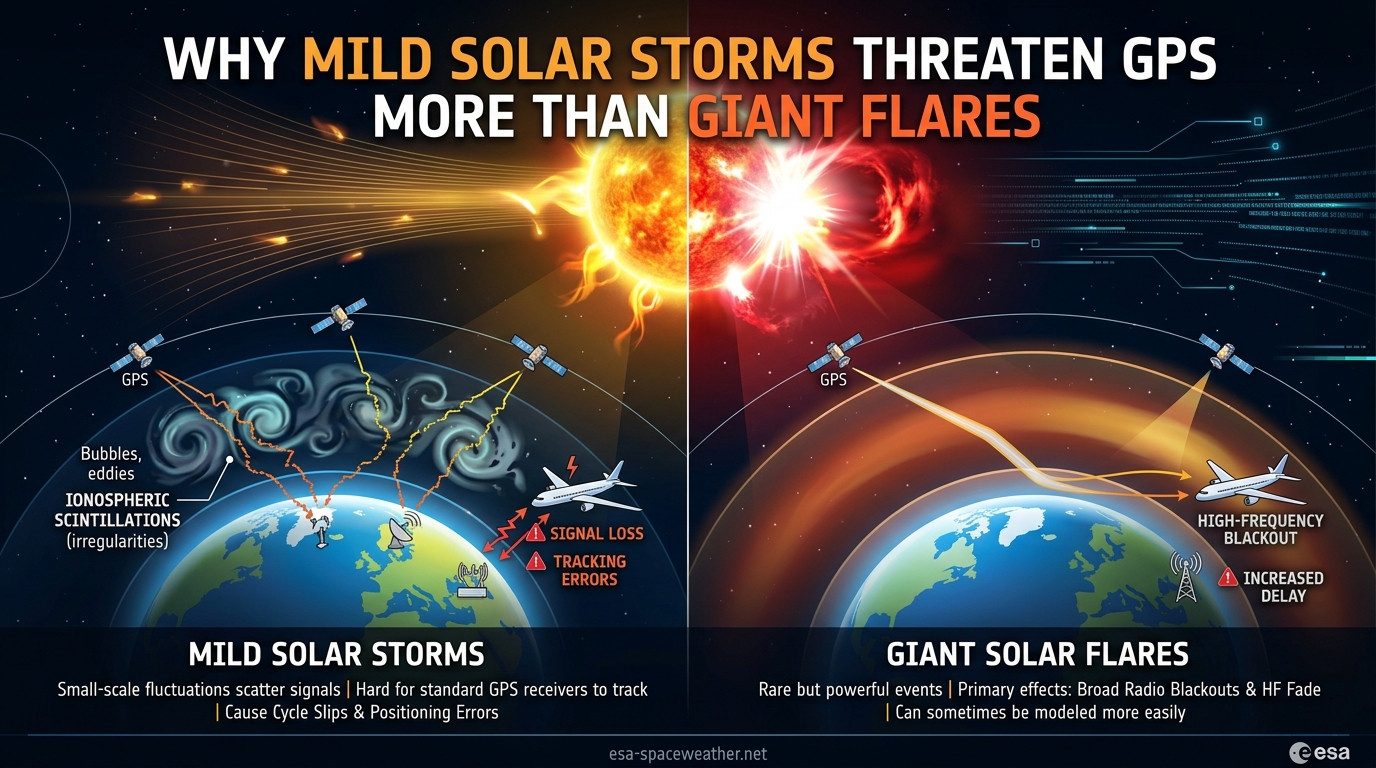
When you think of solar storms threatening technology, you probably picture massive solar flares wiping out power grids and satellites in one dramatic blast. The reality is stranger and more unsettling. Research from the British Antarctic Survey analyzing 20 years of satellite data revealed that moderate, unremarkable solar storms can actually cause more damage to GPS satellites than once-in-a-century mega-storms. The culprit is something called “killer electrons,” and the mechanism behind them turns our assumptions about space weather upside down.
In this guide, we will explain why mild solar storms GPS threats are a bigger practical concern than giant flares, how killer electrons silently damage satellite electronics at GPS orbital altitudes, and what this means for anyone who depends on GPS accuracy in 2026. Whether you are a pilot flying IFR approaches, a surveyor chasing sub-centimeter precision, or simply curious about space weather, understanding this counterintuitive phenomenon could change how you think about satellite navigation.
Table of Contents
Why Mild Solar Storms Can Threaten GPS More Than Giant Flares
The headline finding from the British Antarctic Survey study is simple but shocking. Moderate geomagnetic storms, the kind that barely make the news, create the ideal conditions for energetic electrons to accumulate at GPS orbital altitudes. Severe storms, paradoxically, push those same particles too close to Earth and miss the GPS constellation entirely.
GPS satellites orbit at approximately 12,550 miles (20,200 km) above Earth’s surface, in what scientists call medium Earth orbit. This places them right in the heart of the outer radiation belt, a torus-shaped zone of charged particles trapped by Earth’s magnetic field. When solar activity perturbs this belt, the effects on GPS satellites depend less on the storm’s raw power and more on how the storm’s energy interacts with the magnetosphere at that specific altitude.
A mild solar storm from a coronal hole can accelerate electrons to relativistic speeds and deposit them precisely where GPS satellites fly. A violent coronal mass ejection from a massive solar flare, on the other hand, dumps so much energy into the magnetosphere that the radiation belt gets pushed inward, closer to Earth, and the GPS orbit is left relatively undisturbed. It is the space weather equivalent of a Goldilocks problem: the porridge has to be just right.
The Killer Electrons Mechanism
Killer electrons are highly energetic, relativistic electrons that populate Earth’s outer radiation belt. They travel at nearly the speed of light and carry enough energy to penetrate satellite shielding. The term “killer” is not hyperbole. These particles have caused documented satellite anomalies, temporary outages, and permanent hardware damage over decades of space operations.
The damage mechanism is insidious. When killer electrons slam into a GPS satellite, they embed themselves in the spacecraft’s dielectric materials, the insulators protecting sensitive electronics. These electrons accumulate over days or even weeks, building up electrical charge inside cable insulation, circuit boards, and other non-conductive components. The satellite’s internal shielding was not designed to dissipate this kind of deep-dielectric charging.
Eventually, the accumulated charge reaches a breaking point. The insulator suffers a sudden electrostatic discharge, essentially a miniature lightning strike inside the satellite. This discharge can corrupt memory, reset onboard computers, trigger safe mode operations, or permanently destroy electronic components. The satellite may flicker back to life hours later, or it may never recover.
What makes this especially dangerous is the delayed nature of the damage. A mild storm that accelerates killer electrons today may not cause a satellite failure until weeks later, when the accumulated charge finally discharges. By then, no one connects the failure to a mild solar storm that barely registered on space weather monitors. This latency makes killer electrons a hidden threat that satellite operators struggle to predict.
Why Severe Storms Miss the GPS Orbit
The counterintuitive core of this phenomenon lies in how storms of different intensities redistribute Earth’s radiation belt. A severe geomagnetic storm, like the infamous 2003 Halloween storm that followed a massive X-class solar flare, injects enormous amounts of energy into the magnetosphere. That energy compresses the outer radiation belt and pushes energetic electrons closer to Earth.
During the 2003 Halloween storm, one of the most powerful solar events in recorded history, the outer radiation belt was pushed inward to altitudes well below the GPS constellation. The killer electrons that would normally threaten GPS satellites at 12,550 miles were instead dumped into the upper atmosphere at altitudes around 3,000 to 4,000 miles. GPS satellites sat in a temporary safe zone while the storm raged below them.
Now contrast that with a moderate storm. In 2010, a relatively mild geomagnetic disturbance hit Earth’s magnetosphere with far less energy. There was no dramatic flare, no panicked news coverage. But this moderate perturbation was just strong enough to accelerate electrons to relativistic speeds at GPS orbital altitude without pushing them inward. The British Antarctic Survey data showed that this mild event produced significantly more killer electrons at GPS altitude than the 2003 Halloween mega-storm.
Nigel Meredith, a space weather scientist at the British Antarctic Survey and lead researcher on the study, analyzed two decades of satellite observations to reach this conclusion. His team found that the worst conditions for GPS satellites occur during moderate storms driven by coronal holes, not during the massive solar flares that dominate headlines. The 2010 event was the kind of storm that space weather forecasters classify as minor, yet it delivered a far more potent dose of killer electrons to the GPS constellation than the Halloween storm that made global news.
How Coronal Holes Create the Perfect GPS Disruption Conditions
Coronal holes are the real protagonists in this story. These are regions on the Sun’s surface where the magnetic field opens outward into space, allowing high-speed solar wind to stream toward Earth. They look dark in ultraviolet and X-ray imagery because they are cooler and less dense than the surrounding solar plasma. Unlike dramatic solar flares and coronal mass ejections, coronal holes are quiet, persistent, and easy to overlook.
That low-key nature is exactly what makes them dangerous for GPS. Coronal holes produce a steady, moderate stream of solar wind that buffets Earth’s magnetosphere for days at a time. This prolonged, moderate pressure creates the precise conditions needed to accelerate killer electrons at GPS altitude. The energy input is not strong enough to push the radiation belt inward, as a massive storm would, but it is strong enough to pump electrons up to relativistic speeds right where GPS satellites orbit.
Coronal holes are especially prevalent during the declining phase of the solar cycle, near solar minimum. This means GPS satellites can face their greatest threat during periods when the Sun appears relatively calm and space weather forecasters are less on guard. The assumption that a quiet Sun means safe satellites is one of the most dangerous misconceptions in space weather. As ESA’s Juha-Pekka Luntama has emphasized, the space weather community needs to pay closer attention to these moderate events that fly under the radar but deliver outsized impacts on satellite operations.
Ionospheric Effects on GPS Signals
Killer electrons threaten GPS satellite hardware, but solar storms also degrade GPS signals through a completely different mechanism: ionospheric disturbance. Every GPS signal must pass through the ionosphere, the electrically charged layer of the upper atmosphere stretching from roughly 30 miles to 600 miles above Earth. The ionosphere is dense with free electrons and ions, and solar activity directly controls how many charged particles are there.
During a geomagnetic storm, energy from the solar wind heats and expands the ionosphere, dramatically increasing the Total Electron Count (TEC). GPS signals interact with these free electrons, slowing down as they pass through. Since GPS positioning depends on precisely timing how long signals take to travel from satellite to receiver, any change in signal speed translates directly into positioning errors.
Single-frequency GPS receivers, which include most consumer devices like smartphones and car navigation systems, are especially vulnerable. They apply a basic atmospheric correction model that cannot account for storm-time TEC variations. During a moderate storm, single-frequency GPS accuracy can degrade from a few meters to tens of meters or worse.
Dual-frequency GPS receivers, used in surveying, aviation, and military applications, measure two separate GPS signals and use the difference to calculate and remove ionospheric delay. But even dual-frequency systems cannot fully compensate for ionospheric scintillation, rapid fluctuations in signal phase and amplitude caused by small-scale irregularities in the ionosphere. Scintillation can cause GPS receivers to lose signal lock entirely, resulting in sudden navigation dropouts.
Real-World GPS Disruptions from Solar Storms
The practical consequences of solar-driven GPS disruption are well documented across multiple industries. During a solar storm in 2006, a Canadian oil drilling rig had to suspend operations because GPS positioning became unreliable. Directional drilling for oil and gas depends on sub-meter GPS accuracy to guide drill bits through precise underground paths. When solar activity corrupts that accuracy, continuing to drill risks costly mistakes, including drilling into the wrong geological formation or colliding with existing well infrastructure.
Pilots frequently report GPS degradation during solar events. On aviation forums like r/flying, pilots have shared experiences of losing GPS-based navigation during approach procedures that depend on satellite guidance. Instrument approaches during low-visibility conditions increasingly rely on GPS, and signal degradation during a critical phase of flight can force pilots to abort landings or switch to backup navigation systems.
Surveyors and farmers have also felt the impact. Users on r/Surveying and r/farming have reported that RTK (real-time kinematic) GPS systems, which normally deliver centimeter-level accuracy, suddenly produce meter-level errors during solar disturbances. For precision agriculture, where planting and spraying depend on sub-meter GPS guidance, this level of degradation can ruin an entire day of field operations during critical planting windows.
The confusion factor is significant. When a pilot or surveyor experiences sudden GPS problems, the instinct is to blame equipment failure or intentional jamming. Without awareness that a mild solar storm could be the cause, operators may waste hours troubleshooting hardware when the real issue is space weather hundreds of miles above their heads.
Solar Cycle 25 and Current GPS Vulnerability
Solar Cycle 25 has been more active than early predictions suggested, and we are currently near its peak. This solar maximum, expected in 2026, means more frequent solar flares, coronal mass ejections, and coronal holes aimed at Earth. While the headline-grabbing solar flares get attention, the moderate coronal hole events that pose the greatest GPS threat are also increasing in frequency.
The combination of solar maximum conditions and modern society’s growing dependence on GPS creates an elevated risk profile. More industries than ever rely on GPS timing for financial transaction timestamps, cellular network synchronization, and power grid coordination. A moderate solar storm that accelerates killer electrons at GPS altitude could trigger satellite anomalies that ripple through these interconnected systems with little warning.
Space weather monitoring has improved significantly, with NOAA’s Space Weather Prediction Center and ESA’s Space Weather Service Network providing real-time alerts. But the specific threat of mild-storm killer electron acceleration remains undermonitored compared to the dramatic but less GPS-relevant threat of massive solar flares. The scientific community continues to advocate for better predictive models for the radiation belt conditions that GPS satellites face.
Frequently Asked Questions
Can solar flares disrupt GPS?
Yes, solar flares can disrupt GPS through two mechanisms. Solar radio bursts from flares can directly interfere with GPS signal frequencies, drowning out the weak signals receivers depend on. More significantly, flares trigger geomagnetic storms that disturb the ionosphere, increasing Total Electron Count and causing positioning errors. However, moderate solar storms from coronal holes can actually cause more lasting GPS satellite damage through killer electron accumulation than large flares.
What are killer electrons?
Killer electrons are highly energetic, relativistic electrons in Earth’s outer radiation belt that travel at nearly the speed of light. When they penetrate GPS satellite shielding, they embed in insulating materials, accumulate electrical charge over days or weeks, and eventually cause electrostatic discharges that can damage or destroy satellite electronics. They are the primary reason mild solar storms can threaten GPS more than giant flares.
How do solar storms affect the ionosphere?
Solar storms dump energy into Earth’s magnetosphere, which heats and expands the ionosphere and dramatically increases the Total Electron Count. This denser ionosphere slows GPS signals, causing positioning errors. Storm-driven irregularities in the ionosphere also cause scintillation, rapid signal fluctuations that can make GPS receivers lose signal lock entirely.
Do solar storms affect GPS?
Yes, solar storms affect GPS in two main ways. They degrade GPS signals by disturbing the ionosphere, causing positioning errors that can range from a few extra meters to complete signal loss. They also damage GPS satellites directly by accelerating killer electrons that penetrate satellite electronics. Even moderate solar storms can produce significant GPS disruption, sometimes more than major storms.
Why do mild solar storms threaten GPS more than severe ones?
Mild solar storms create the ideal conditions for killer electrons to accumulate at GPS orbital altitude (12,550 miles). The moderate energy input accelerates electrons to relativistic speeds right where GPS satellites fly, without pushing the radiation belt closer to Earth. Severe storms dump so much energy into the magnetosphere that they compress the radiation belt inward, below GPS orbit, temporarily pushing killer electrons away from the satellite constellation. This creates a Goldilocks effect where moderate storms hit GPS harder than extreme ones.
What is the biggest source of error for GPS?
The ionosphere is the single largest source of GPS positioning error. Free electrons in the ionosphere slow GPS signals, creating delay errors of several meters. During geomagnetic storms, this error can increase dramatically as the Total Electron Count rises. Single-frequency GPS receivers are most affected because they cannot fully correct for ionospheric delay, while dual-frequency receivers perform better but still struggle with storm-induced scintillation.
How can I tell if a solar storm is affecting my GPS?
Signs include sudden positioning errors, loss of signal lock, slower-than-normal satellite acquisition, and unreliable RTK corrections. Check real-time space weather data from NOAA’s Space Weather Prediction Center or ESA’s Space Weather Service Network. If a moderate geomagnetic storm is in progress, especially one driven by a coronal hole, your GPS issues may be caused by space weather rather than equipment failure.
Conclusion
The discovery that mild solar storms can threaten GPS more than giant flares reshapes how we should think about space weather and satellite vulnerability. The British Antarctic Survey’s two-decade analysis proved that moderate geomagnetic disturbances, especially those driven by unremarkable coronal holes, create the perfect conditions for killer electrons to accumulate at GPS orbital altitude and silently damage satellite electronics. Severe storms may grab headlines, but the quiet coronal hole events deliver the most sustained threat to the GPS constellation.
As Solar Cycle 25 reaches its peak in 2026, awareness of this mild solar storms GPS threat matters more than ever. Aviation, precision agriculture, surveying, oil drilling, financial timing, and countless other sectors depend on GPS accuracy that can degrade without warning during moderate space weather events. If you work in any GPS-dependent field, bookmark real-time space weather monitoring resources and remember that a calm-looking Sun can still produce coronal holes that spell trouble for your satellite navigation.