
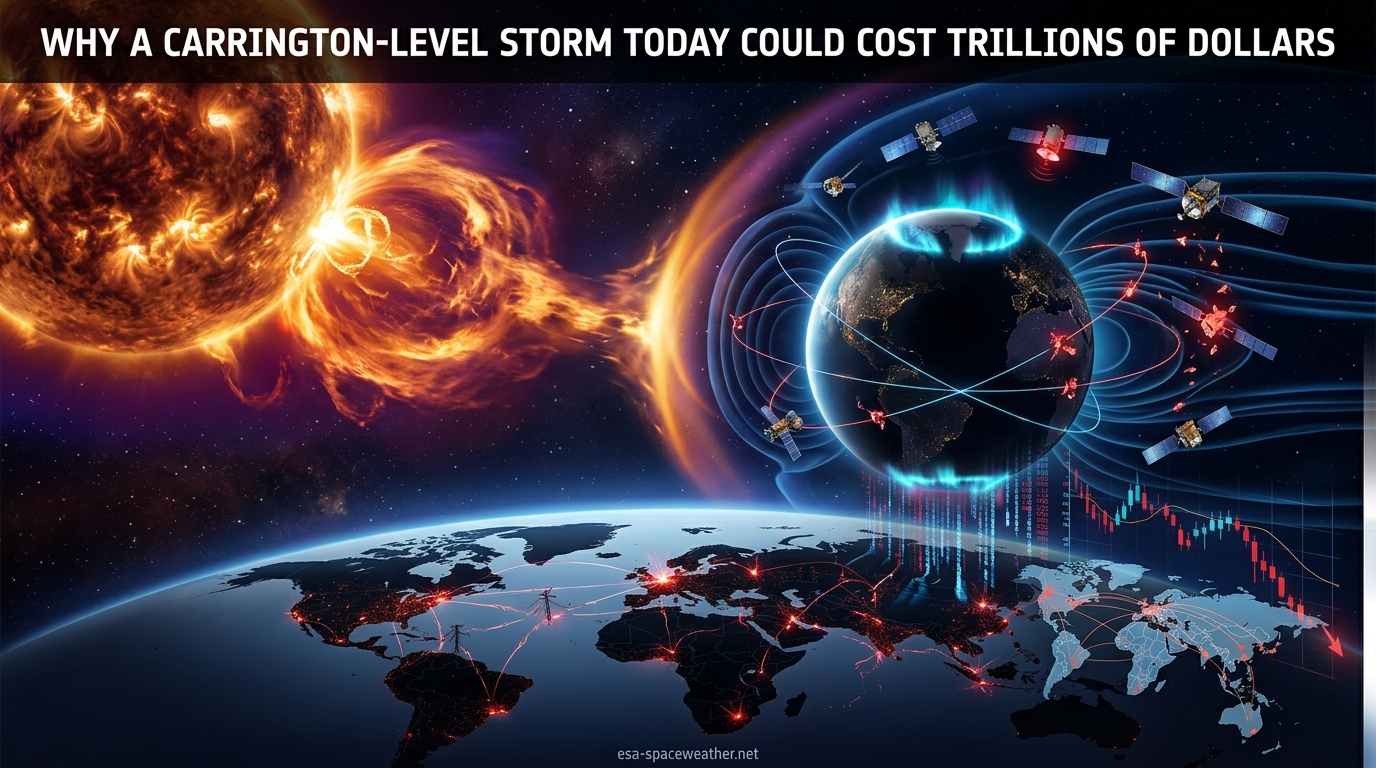
On the morning of September 1, 1859, a British astronomer named Richard Carrington watched something extraordinary through his telescope. Within hours, telegraph operators across the globe were getting electric shocks, their equipment was sparking fires, and the northern lights were visible as far south as Cuba and Hawaii. That event, now called the Carrington Event, remains the most powerful geomagnetic storm ever recorded. If a storm of that magnitude struck Earth today, a Carrington-level storm could cost trillions of dollars, collapse power grids across entire continents, and take years to fully recover from.
I have spent months digging into the scientific literature, government risk assessments, and insurance industry models to understand exactly what would happen if the 1859 storm hit us now. The answer is both fascinating and sobering. Let me walk you through the science, the economics, and what you can actually do about it.
Table of Contents
What Was the Carrington Event of 1859?
The Carrington Event was the most powerful geomagnetic storm in recorded history. Richard Carrington, a 33-year-old brewer-turned-astronomer, was projecting an image of the Sun onto a screen in his private observatory in Redhill, England, when he noticed a brilliant flash of white light on the solar surface.
What he witnessed was a solar flare, but the real damage came roughly 17 hours later. A massive cloud of magnetized plasma called a coronal mass ejection (CME) traveled from the Sun to Earth at unprecedented speed. Most CMEs take two to four days to make that journey. This one arrived in less than a day.
When the CME slammed into Earth’s magnetosphere, it triggered auroras so bright that people in Boston and New York could read newspapers by their glow at 1 a.m. Miners in the Rocky Mountains woke up and started cooking breakfast, thinking the sun was rising.
What the Storm Did to 1859 Technology
The only widespread electrical technology in 1859 was the telegraph system, and the storm absolutely wrecked it. Telegraph operators reported receiving severe electric shocks when they touched their equipment. Telegraph paper literally burst into flames at several stations.
The most startling detail, though, is that operators in Boston and Portland, Maine, were able to send and receive messages for several hours after completely disconnecting their batteries. The geomagnetic storm itself was generating enough current in the telegraph wires to power the system. The aurora was literally running the telegraph network.
This is the key to understanding the danger. The storm induced powerful electric currents in long metal conductors, which in 1859 meant telegraph wires. Today, those same types of currents would flow through something far more critical: the power grid.
How a Coronal Mass Ejection Actually Works
A coronal mass ejection is a massive eruption of magnetized plasma from the Sun’s surface. When a CME is directed at Earth, it carries a magnetic field that interacts violently with our planet’s own magnetic field, compressing it and causing rapid fluctuations.
Those fluctuations, through a process called electromagnetic induction, generate what scientists call geomagnetically induced currents, or GICs. These currents flow through any long conductor connected to the ground, including power transmission lines, pipelines, and railway tracks.
The problem is not the current itself but where it goes. GICs flow into the windings of extra-high-voltage transformers at power substations. These transformers are designed to handle alternating current at very specific frequencies. The GICs are essentially direct current, and they cause the transformer cores to saturate magnetically. That saturation leads to severe overheating, harmonic distortion, and in extreme cases, permanent damage or even fire.
Why a Carrington-Level Storm Today Could Cost Trillions
The most widely cited economic analysis comes from a 2013 study commissioned by Lloyd’s of London and produced by researchers at the Atmospheric and Environmental Research group. Their headline estimate: a Carrington-level storm hitting the United States today would cause between $0.6 trillion and $2.6 trillion in damage.
That figure is staggering, but it is not arbitrary. It reflects the cost of damaged infrastructure, lost economic output, and the cascading effects of prolonged power outages across multiple regions simultaneously.
The core vulnerability is the extra-high-voltage transformer. These massive devices step voltage up for long-distance transmission and step it back down for local distribution. There are roughly 2,000 of them in the United States alone. Each one weighs hundreds of tons, costs between $2 million and $10 million, and has a manufacturing lead time of 12 to 24 months under normal conditions.
Now imagine hundreds of them failing simultaneously across the Atlantic corridor, the region stretching from New York to Washington, D.C. and along the Eastern Seaboard. This area sits on top of a geological formation of ancient, high-resistance rock near the surface. That geology forces geomagnetically induced currents to travel preferentially through the power lines rather than dissipating into the ground. It is the worst possible combination for solar storm vulnerability.
If a Carrington-level storm fried transformers across a multi-state region, replacement would not take weeks. It would take months to years. Some estimates suggest a full recovery could stretch beyond a decade if enough transformers were lost simultaneously.
We already have a real-world preview of what this looks like. In March 1989, a geomagnetic storm much weaker than the Carrington Event struck Quebec. Geomagnetically induced currents overloaded the Hydro-Quebec grid, and the entire province lost power in 90 seconds. Six million people went dark. The Quebec blackout lasted 12 hours and cost hundreds of millions of dollars. That storm was roughly a third the intensity of the Carrington Event.
What Would Actually Happen If It Hit Today
If a Carrington-level storm struck Earth now, the first effects would appear in satellites. Within minutes to hours, the increased atmospheric drag from the storm’s heating effect would shift satellite orbits. Some satellites would lose orientation. GPS signals would degrade or fail entirely, affecting everything from navigation systems to financial transaction timestamps.
On the ground, the power grid would be the primary target. Unlike a thunderstorm that knocks out power to a neighborhood, a geomagnetic storm affects entire grid regions simultaneously. If enough transformers failed, entire states or multi-state regions could lose power for extended periods.
The cascading effects are where the real damage compounds. Without power, water treatment plants shut down within days. Fuel pumps at gas stations stop working. Refrigeration fails, threatening food supplies and medical cold chains. Hospitals switch to backup generators, but diesel deliveries depend on fuel infrastructure that itself needs electricity. Communications systems, including cell towers and internet data centers, run on batteries that last hours, not weeks.
The Smithsonian has reported that experts believe recovery from the most severe solar storm could take a decade and cost trillions of dollars. That timeline reflects the fact that you cannot simply buy replacement transformers off a shelf. Each one is custom-built for its location and voltage requirements.
Near Misses and the Probability Question
If you think this is purely hypothetical, consider what happened in July 2012. NASA’s STEREO-A spacecraft observed a CME of magnitude comparable to the Carrington Event erupting from the Sun. It was one of the fastest and most powerful solar storms ever measured.
The CME missed Earth by about nine days. Our planet was in a different part of its orbit. If the eruption had happened just a week and a half earlier, we would have taken a direct hit.
Researchers at Lloyd’s estimate the probability of a Carrington-level event at roughly 1 to 12 percent per decade. That is a wide range, but even the low end means we are playing a slow game of cosmic roulette. The preppers community on Reddit frequently discusses these numbers, and their concern is backed by published research.
We are currently in the maximum phase of Solar Cycle 25, which means the Sun is at its most active. While solar maximum does not guarantee a Carrington-level event, it does increase the baseline probability of significant geomagnetic storms. NOAA’s Space Weather Prediction Center monitors solar activity around the clock and can provide roughly 30 to 60 minutes of warning before a CME arrives, but that is not much time to protect a continental power grid.
What You Can Actually Do to Prepare
One thing I noticed across every competitor article I reviewed is that none of them tell you what you can do as an individual. Government-level grid hardening is important, but it is not something you control. So here is practical, no-nonsense advice.
First, the basics. A Carrington-level storm is not an EMP weapon. It does not fry small electronics directly. Your phone, laptop, and solar panels would likely survive the storm itself. The danger is the power grid going down for an extended period. So prepare for a long-duration power outage, not for your devices to suddenly stop working.
Here are specific steps that make sense:
- Store at least two weeks of drinking water, roughly one gallon per person per day.
- Keep non-perishable food that does not require cooking.
- Have a battery-powered or hand-crank radio to receive emergency broadcasts.
- Keep cash on hand, since ATMs and card readers depend on electricity and internet.
- Stock extra batteries, flashlights, and a basic first aid kit.
- Have backup power options like a charged power bank or small solar charger for essential devices.
- Fill vehicle gas tanks if you receive a solar storm warning, since pumps need electricity.
Regarding solar panels specifically: your rooftop solar array would not be destroyed by a geomagnetic storm. However, if your panels are grid-tied, they will shut off automatically when the grid goes down. To keep solar power flowing during an outage, you need a battery storage system and an inverter configured for islanding or off-grid operation.
One common question from Reddit’s amateur radio community is whether HF communications would survive. The short answer is that HF radio would be severely disrupted during the storm itself due to ionospheric disturbances, but equipment would likely recover afterward. The bigger concern is the loss of grid power needed to run repeaters and base stations.
Current Preparedness: How Far Have We Come?
The honest answer is that progress has been real but incomplete. The North American Electric Reliability Corporation (NERC) has established standards requiring utilities to assess transformer vulnerability and develop mitigation plans. Some utilities have installed neutral-current-blocking capacitors on critical transformers, devices that block the flow of GICs while allowing normal alternating current to pass.
The cost of these protective measures is estimated at roughly $100 million for widespread deployment. Compare that to the $0.6 to $2.6 trillion in potential losses. The math strongly favors investment in protection, yet deployment has been slow and inconsistent across regions.
NOAA’s Space Weather Prediction Center and NASA operate a fleet of satellites including the Solar Dynamics Observatory and the DSCOVR spacecraft that provide continuous monitoring of the Sun. We would know a major CME was coming. The question is whether grid operators could act quickly enough to protect transformers in the 30 to 60 minute warning window.
FAQs
What would happen if a Carrington Event hit today?
A Carrington-level storm today would likely cause widespread power grid failures across multiple regions, damage or destroy satellites, disrupt GPS and communications, and trigger cascading failures in water systems, healthcare, and food supply chains. The Lloyd’s of London economic model estimates $0.6 to $2.6 trillion in damage to the US alone, with recovery potentially taking months to years depending on transformer damage.
What is the likelihood of another Carrington Event happening?
Researchers estimate the probability of a Carrington-level geomagnetic storm at roughly 1 to 12 percent per decade. We are currently in the maximum phase of Solar Cycle 25, which increases the baseline likelihood of significant solar storms, though a Carrington-level event remains rare in any given year.
Will a Carrington Event destroy solar panels?
No, a geomagnetic storm does not directly destroy solar panels or small electronics. The danger to solar panels is indirect: grid-tied systems automatically shut off when the power grid fails. To maintain solar power during an outage, you need battery storage and an inverter configured for off-grid operation.
Is a solar flare going to hit Earth in 2026?
Solar flares and smaller geomagnetic storms hit Earth regularly during solar maximum, and 2026 falls within the active phase of Solar Cycle 25. However, a Carrington-level event is rare. NOAA and NASA continuously monitor the Sun and can provide warning before a major storm arrives. There is no confirmed prediction of a Carrington-level impact in 2026.
How long would recovery take from a Carrington-level storm?
Recovery depends on the extent of transformer damage. If only a small number of extra-high-voltage transformers were destroyed, recovery could take weeks to months. If hundreds failed across a wide region, replacement could take years, with some estimates suggesting a full recovery timeline of up to a decade due to manufacturing lead times of 12 to 24 months per transformer.
Final Thoughts
The Carrington Event of 1859 is not just a historical curiosity. It is a preview of what a severe geomagnetic storm can do, and our modern infrastructure is far more vulnerable than the telegraph network of the 19th century. The data is clear: a Carrington-level storm today could cost trillions of dollars, and the probability of one occurring in the coming decades is low but not negligible.
The good news is that the fix is relatively affordable. Hardening the power grid against geomagnetically induced currents costs an estimated $100 million, a fraction of the potential losses. Individual preparedness costs even less. The challenge is not technology or cost but awareness and action.
Stay informed about space weather by following NOAA’s Space Weather Prediction Center, prepare your household for extended power outages, and support infrastructure investment in your community. The Sun will eventually send another Carrington-level storm our way. The only question is whether we will be ready when it arrives.