
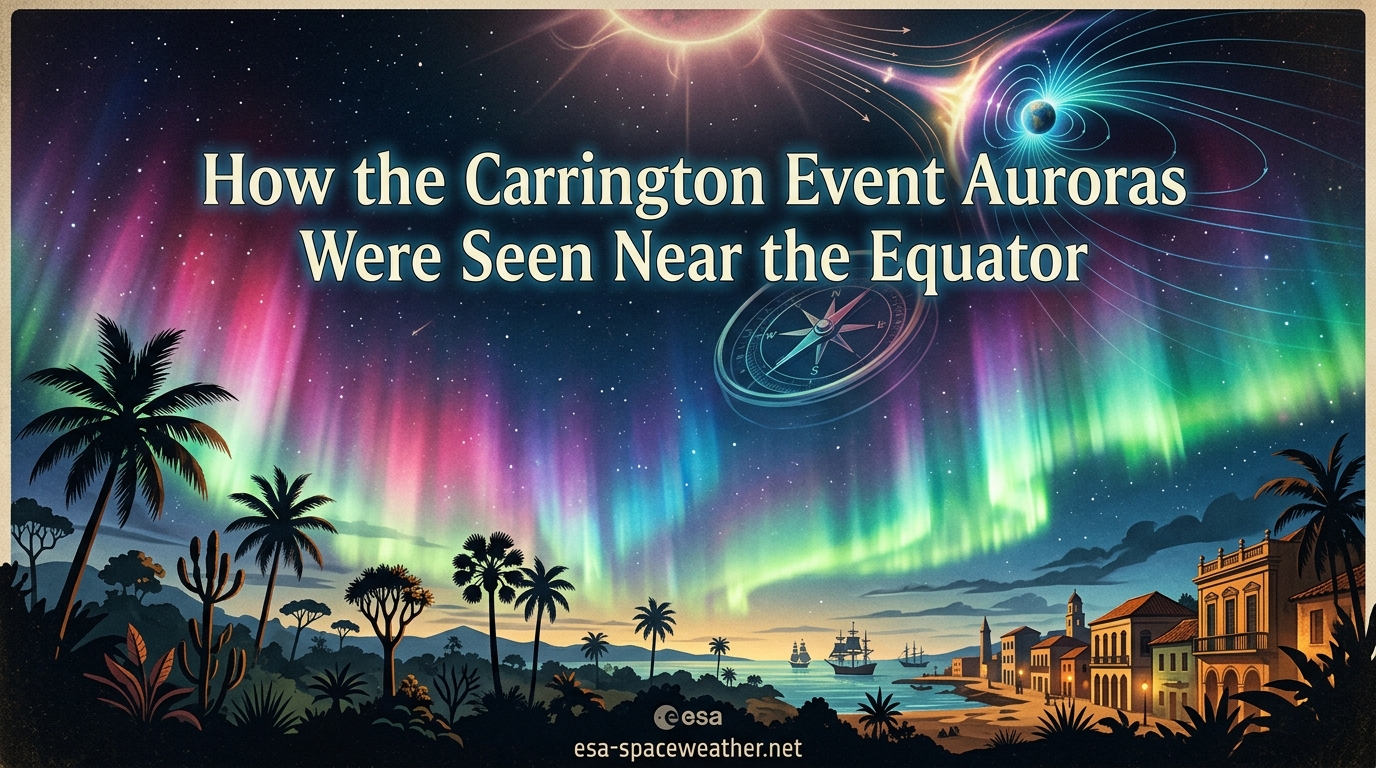
Imagine stepping outside your home in Cuba, Mexico, or Colombia and seeing blood-red and crimson light pouring across the night sky. No electricity, no satellites, no space weather forecast — just ordinary people in 1859 staring up at something they had never seen before in their lives. The Northern Lights, a phenomenon most associated with frozen Arctic landscapes, were dancing over tropical beaches and Caribbean islands.
This actually happened. During the Carrington Event of September 1-2, 1859, the most powerful geomagnetic storm in recorded history pushed auroras so far from the poles that people within 10 to 20 degrees of the equator could see them with their naked eyes. The Carrington Event auroras near the equator remain one of the most extraordinary natural displays ever witnessed by humanity.
Our team has spent months digging through historical newspaper archives, observatory records, and peer-reviewed research to understand exactly how and why this happened. The story involves a British brewer-turned-astronomer, a solar explosion of almost unimaginable scale, and a chain of atmospheric physics that pushed the boundaries of what most people thought possible.
In this article, we will walk through the complete timeline of the 1859 solar storm, identify every known equatorial and low-latitude location where auroras were reported, explain the science behind why the auroral oval expanded so dramatically, and examine what this means for our technology-dependent world today. We will also share eyewitness accounts from people who lived through it — in their own words.
Whether you are a space weather enthusiast, a student, an educator, or simply someone who finds it incredible that the sky over Cuba once glowed red, this deep-dive will give you the most complete picture available of how the Carrington Event auroras were seen near the equator.
Table of Contents
Quick Answer: Why Were Auroras Visible Near the Equator in 1859?
The Carrington Event auroras were visible near the equator because an exceptionally powerful coronal mass ejection (CME) from the Sun slammed into Earth’s magnetic field at extraordinary speed, compressing the magnetosphere and forcing the auroral oval — the ring-shaped zone where auroras form — to expand from its normal position near the Arctic and Antarctic circles to latitudes approaching the equator itself.
Under normal conditions, auroras are confined to geomagnetic latitudes between roughly 65 and 75 degrees. During the Carrington Event, the auroral oval expanded to approximately 20 degrees geomagnetic latitude or lower, bringing aurora visibility to:
- Cuba (approximately 23 degrees north geographic latitude)
- Mexico (sightings reported from multiple central Mexican locations)
- Colombia (northern South America, near the equator)
- The Caribbean (Jamaica, Panama, and broader island reports)
- Hawaii (approximately 20 degrees north)
- Queensland, Australia (approximately 27 degrees south)
- Southern Japan
This expansion happened because the storm’s estimated disturbance storm time (Dst) index reached approximately -900 nanoteslas, meaning Earth’s ring current intensified to a degree that distorted the global magnetic field far beyond its typical configuration.
What Was the Carrington Event?
The Carrington Event was the most intense geomagnetic storm in recorded human history, peaking on September 1 and 2, 1859, during solar cycle 10. It was named after Richard Carrington, the English astronomer who first observed the solar flare that triggered it, though it was also independently observed by Richard Hodgson at the same time.
To understand why this event was so remarkable, we need to look at who Richard Carrington was and what he actually saw through his telescope that morning.
Richard Carrington and the White-Light Flare
Richard Carrington was not a career academic by trade. He was the son of a wealthy brewer, and he used his family fortune to build a private observatory at Redhill in Surrey, England. His passion was studying the Sun, and by 1853 he had begun a systematic program of daily sunspot observations that would last for years.
On the morning of September 1, 1859, Carrington was projecting an image of the Sun onto a screen through his telescope so he could carefully sketch the sunspots visible that day. At approximately 11:18 AM, he saw something nobody had ever recorded before. Two patches of intensely bright white light appeared within a large sunspot group, lasted for about five minutes, and then faded.
Carrington was so startled that he initially thought a stray reflection had entered his telescope. But the bright patches were clearly located within the sunspot group itself. He checked his equipment, confirmed the observation was real, and then rushed to find a witness. By the time he returned, the bright patches had already started moving and dimming.
Richard Hodgson, observing independently from his own observatory in London, saw the same phenomenon at the same time. Hodgson described it as resembling the brilliant flash of a photographic plate being exposed. Both men reported their observations to the Royal Astronomical Society, and both were initially met with skepticism. Nobody had ever seen a solar flare in visible light before.
What Carrington and Hodgson had witnessed is now called a white-light solar flare — one of the rarest and most energetic types of solar flares, bright enough to be seen in visible light rather than only in ultraviolet or X-ray wavelengths. Only a handful of white-light flares have been observed since.
The Magnetic Crochet at Kew Observatory
Here is where the story takes an extraordinary turn. At the Kew Observatory in London, a self-recording magnetograph operated by Balfour Stewart was continuously monitoring Earth’s magnetic field. When Carrington later visited Kew to compare notes, he discovered that the magnetograph had recorded a sudden, sharp disturbance in the magnetic field at almost exactly the same time he had seen the flare.
This disturbance is now known as a magnetic crochet — a small but rapid jump in the ionosphere’s electrical currents caused by the intense X-ray and ultraviolet radiation from the solar flare hitting Earth’s upper atmosphere almost instantly (traveling at the speed of light). The fact that the magnetic crochet coincided precisely with the visible flare confirmed that what Carrington saw on the Sun was directly connected to effects on Earth.
Carrington himself reportedly hesitated to draw a definitive connection between the flare and the magnetic disturbance, famously noting that “one swallow does not make a summer.” But the evidence was already overwhelming. The Sun had erupted, and Earth had felt it.
The Storm That Followed
The magnetic crochet was just the opening act. Roughly 17 hours later, the full force of the coronal mass ejection — the billion-ton cloud of charged plasma that the flare had launched into space — arrived at Earth. What happened next was unlike anything in recorded history.
Magnetometers around the world went off their scales. Auroras appeared across the entire planet, from the polar regions to the tropics. Telegraph systems sparked, caught fire, and in some cases continued operating even after their batteries were disconnected. For two nights, people in locations that had never seen auroras before watched the sky blaze with color.
The storm occurred during solar cycle 10, which was approaching its maximum. Solar maximum is the period of greatest solar activity within the approximately 11-year solar cycle, when sunspots, flares, and CMEs are most frequent. The September 1859 sunspot group that produced the Carrington flare was one of the largest ever recorded, visible to the naked eye through fog or thin cloud.
The Solar Flare and Coronal Mass Ejection: What Actually Hit Earth?
To understand how the Carrington Event auroras reached the equator, we need to look at what the Sun actually threw at us that day. The event involved two distinct phenomena that are often confused but work very differently.
Solar Flare vs. Coronal Mass Ejection
A solar flare is a sudden, intense burst of electromagnetic radiation from the Sun’s surface. It travels at the speed of light and arrives at Earth about eight minutes after it erupts. Flares release energy across the entire electromagnetic spectrum, from radio waves to gamma rays, but they do not carry significant mass or matter. The white-light flare Carrington observed was this radiation component.
A coronal mass ejection, or CME, is different. A CME is a massive eruption of plasma and magnetic field from the Sun’s corona — the outermost layer of the solar atmosphere. A single CME can carry billions of tons of charged particles, primarily protons and electrons, traveling at speeds ranging from about 250 to 3,000 kilometers per second. When a CME reaches Earth, its magnetic field interacts directly with our own.
The Carrington Event involved both. The solar flare produced the magnetic crochet detected at Kew Observatory within minutes. The CME, launched at the same time, took approximately 17.5 hours to reach Earth.
Why 17.5 Hours Is Astonishing
The travel time of the Carrington CME is one of the most extraordinary aspects of the event. A typical CME takes between two and four days to reach Earth, traveling at average speeds of 400 to 800 kilometers per second. The fastest CMEs previously recorded took about a day.
To reach Earth in 17.5 hours, the Carrington CME must have been traveling at an average speed of approximately 2,380 kilometers per second — over five million miles per hour. This means it was not just the most powerful solar eruption on record but also one of the fastest. The combination of enormous mass, extreme speed, and a magnetic field oriented in exactly the wrong direction relative to Earth’s field is what made the event so devastating.
Modern researchers, including Jennifer Green and colleagues in their 2006 analysis for Space Weather journal, have used estimates of the CME travel time, magnetometer recordings, and auroral extent to model the event. Their work suggests the CME carried an exceptionally strong southward-directed magnetic field component. This is critical because Earth’s magnetic field points northward, and when an incoming CME’s field points southward, the two fields reconnect violently, allowing enormous amounts of energy to pour into the magnetosphere.
The Sunspot Group
The sunspot group that produced the Carrington flare was enormous. Carrington’s own drawings show a cluster of dark spots spanning a significant portion of the Sun’s visible disk. Modern estimates suggest the active region may have been comparable in size to some of the largest sunspot groups ever observed, potentially visible to the naked eye under appropriate viewing conditions.
Sunspots are regions of intense magnetic activity on the Sun’s surface, where magnetic field lines are twisted and concentrated. When these magnetic fields become unstable and suddenly reorganize — a process called magnetic reconnection — they release enormous amounts of energy. The more complex and larger the sunspot group, the more likely it is to produce a major flare or CME. The Carrington sunspot group had both size and magnetic complexity in extreme measure.
Auroras Near the Equator: Where Were They Seen?
During the Carrington Event of September 1-2, 1859, auroras were reported from locations spanning the entire globe, including sites within 10 to 20 degrees of the equator. These equatorial and low-latitude sightings represent the southernmost (in the Northern Hemisphere) and northernmost (in the Southern Hemisphere) aurora observations in recorded history.
The American astronomer Elias Loomis of Yale University spent years collecting and publishing aurora reports from around the world following the 1859 event. His 1860-1861 compilation in the American Journal of Science remains one of the most comprehensive records of auroral sightings from the storm. Researchers continue to mine historical archives for additional accounts, and the list of known equatorial observation sites has grown over time.
Here is a detailed breakdown of the key equatorial and low-latitude locations where auroras were reported, organized by region.
The Caribbean: Cuba, Jamaica, and Panama
Cuba was one of the most remarkable locations for auroral sightings during the Carrington Event. At approximately 22 to 23 degrees north latitude, Havana and surrounding areas reported vivid red auroras in the northern sky. For residents of Cuba, who had never witnessed such a display, the crimson glow was terrifying. Some accounts from the period describe people gathering in streets, believing the sky was on fire or that a religious event was unfolding.
Reports from Jamaica and other Caribbean islands confirmed that the auroral display extended across the entire Caribbean basin. The Max Planck Institute for Solar System Research notes that during a comparable storm in 1872, auroras were observed from Tobago at approximately 11 degrees north latitude — even closer to the equator than the Carrington reports. The 1859 event produced similar tropical visibility.
In Panama, then part of Colombia, auroral light was also reported. Panama sits at roughly 9 degrees north latitude, making it one of the closest-to-equator observations from the event if confirmed. These Caribbean and Central American sightings demonstrate that the auroral oval expanded to truly equatorial dimensions.
Mexico: Central American Observations
Multiple locations in Mexico reported auroral displays during the Carrington Event. Elias Loomis’s compilation includes accounts from central Mexico describing red and white light moving across the sky. At latitudes ranging from roughly 16 to 25 degrees north, these observations place auroras well within the tropics.
For indigenous and rural communities in Mexico in 1859, with limited access to scientific information about what they were seeing, the display must have been particularly striking. We can only imagine the explanations people developed for the blood-red sky that appeared without warning and lasted through the night.
South America: Colombia and Beyond
One of the most detailed modern research contributions to our understanding of Carrington Event equatorial auroras comes from a 2020 study published in the journal Earth, Planets and Space by researchers including Hisashi Hayakawa. This paper specifically examined South American auroral reports from the 1859 storm, mining historical archives that had been overlooked by earlier researchers.
The study found auroral observations from Colombia and possibly from locations even closer to the equator. One account from a South American observer, preserved in historical records, described the aurora appearing around 1:00 AM, beginning as a very light pink glow toward the southeast horizon, which gradually gained intensity. The pink and red coloration is characteristic of high-altitude auroral emissions, specifically the 630-nanometer oxygen emission line that dominates at altitudes above 200 kilometers.
This detail matters. Red auroras at low latitudes indicate that the storm was so intense that it excited oxygen atoms at extremely high altitudes, where the thinner atmosphere allows the red emission to dominate. This is consistent with a massively expanded auroral oval reaching equatorial regions.
North America: Florida and Hawaii
In the continental United States, the aurora was visible across virtually the entire country, but reports from Florida stand out. At approximately 25 to 30 degrees north latitude, Florida residents were completely unaccustomed to seeing auroras. The NOAA NESDIS educational account describes the scene vividly: people in Florida who had never seen the Northern Lights were amazed and frightened by what they saw.
Hawaii, at roughly 20 degrees north latitude, also reportedly experienced auroral sightings. If confirmed, this places auroras at an even lower latitude than the Florida reports and provides further evidence of the storm’s extreme equatorial reach.
Across the rest of the United States, from New England to California, the aurora was described as the brightest and most widespread in living memory. Newspapers across the country published accounts, and some reported being able to read printed text by the light of the aurora alone — a staggering claim about the display’s brightness.
The Southern Hemisphere: Queensland, Australia
The aurora australis, or Southern Lights, was equally spectacular during the Carrington Event. In Australia, auroral reports came from Queensland at approximately 27 degrees south latitude and possibly from even lower latitudes. This mirrors the Northern Hemisphere pattern, confirming that the auroral oval expanded toward the equator in both hemispheres simultaneously.
One of the most vivid Southern Hemisphere accounts comes from a letter written by an Australian gold miner named C.F. Herbert, who recalled the event decades later in 1909. He described the aurora as a spectacle of crimson and gold that lit up the entire sky. Herbert noted that the display was so bright that it woke people from their sleep, and that many of the gold miners in the camp gathered outside to watch in awe.
Southern Japan and the Western Pacific
Reports from southern Japan and the western Pacific further confirmed the global nature of the auroral display. Japan sits at roughly 30 to 45 degrees north latitude, with southernmost observations placing auroras well into the subtropics. Historical Japanese records of auroral sightings have been systematically analyzed by researchers such as Hayakawa, who has published extensively on East Asian auroral observations from historical periods.
Additional reports came from China, New Zealand, and ships at sea across the world’s oceans. The global distribution of observations is itself powerful evidence that this was not a localized phenomenon but a truly planetary event.
Why Auroras Normally Stay Near the Poles
To appreciate how extraordinary the Carrington Event auroras were, it helps to understand why auroras are normally only visible from high latitudes. The answer lies in the geometry of Earth’s magnetic field and the behavior of charged particles from the Sun.
Earth is surrounded by a magnetic field generated by the motion of molten iron in the planet’s outer core. This field extends thousands of kilometers into space and forms a protective bubble called the magnetosphere, which shields us from the constant stream of charged particles flowing from the Sun — the solar wind.
Under normal conditions, most of the solar wind slides past Earth’s magnetosphere without penetrating it. The charged particles that do get funneled into the atmosphere are guided along Earth’s magnetic field lines, which converge near the magnetic poles. Think of these field lines like the meridians on a globe: they spread apart at the equator and come together at the poles.
When charged particles follow these converging field lines into the polar atmosphere, they collide with oxygen and nitrogen molecules at altitudes between 100 and 300 kilometers. These collisions excite the atoms, causing them to emit photons of light — the green, red, and violet colors we recognize as aurora. Because the field lines concentrate particles near the poles, auroras form in ring-shaped zones around the magnetic poles called the auroral ovals.
The northern auroral oval typically sits between 65 and 75 degrees geomagnetic latitude, which is why people in Norway, Canada, Alaska, and Siberia see auroras regularly while people in Florida or Cuba never do. During a moderate geomagnetic storm, the oval can expand slightly equatorward, perhaps to 55 or 60 degrees. During a severe storm, it might reach 45 degrees.
The Carrington Event pushed the auroral oval to approximately 20 degrees geomagnetic latitude or lower. That is the equivalent of moving the aurora zone from northern Scandinavia all the way down to central Mexico. No other recorded storm has come close to producing this degree of equatorward expansion.
The Science: How the Auroral Oval Expanded to the Equator
The Carrington Event auroras reached equatorial latitudes because the storm’s extreme intensity compressed Earth’s magnetosphere to a fraction of its normal size and dramatically intensified the ring current, which in turn pushed the auroral oval toward the equator on both hemispheres simultaneously.
This process involves several connected mechanisms that we can break down step by step.
Step 1: Magnetosphere Compression
Earth’s magnetosphere normally extends about 65,000 kilometers (about 10 Earth radii) toward the Sun on the dayside. When the Carrington CME arrived, its enormous pressure compressed this dayside magnetopause to perhaps 25,000 kilometers or less — roughly four Earth radii. Imagine a balloon being squeezed from one side until it deforms and shrinks. That compression forced the magnetic field lines that normally sit far out in space to be pushed closer to Earth, changing the geometry of how and where charged particles could enter the atmosphere.
Step 2: Magnetic Reconnection
Because the CME’s magnetic field was oriented southward — opposite to Earth’s northward field — a process called magnetic reconnection occurred along the dayside magnetopause. Reconnection essentially opens a gate, allowing the solar wind’s magnetic field to merge with Earth’s field and funnel enormous quantities of energy and charged particles into the magnetosphere. The more southward the incoming field, the more efficient the reconnection, and the more energy pours in.
The Carrington CME apparently had an exceptionally strong and prolonged southward field component. This meant that reconnection continued for hours rather than minutes, pumping energy into the magnetosphere at a rate far beyond any normal storm.
Step 3: Ring Current Intensification and the Dst Index
As energy poured into the magnetosphere, a ring of electrical current around the Earth’s equator — the ring current — intensified dramatically. Scientists measure the strength of this current using the Disturbance Storm Time index, or Dst index, which quantifies how much Earth’s magnetic field has been depressed at the equator compared to normal conditions.
A moderate geomagnetic storm might produce a Dst of -50 to -100 nanoteslas. The March 1989 storm that knocked out power across Quebec had a Dst of approximately -589 nanoteslas. Estimates for the Carrington Event place the Dst somewhere between -800 and -1,750 nanoteslas, depending on the reconstruction method used. Most researchers settle on a consensus estimate of approximately -900 nanoteslas.
A Dst of -900 nanoteslas means Earth’s equatorial magnetic field was reduced by nearly a third. This weakening allowed the auroral oval to expand dramatically equatorward, because the field lines that normally confined particle precipitation to polar regions were now distorted enough to deliver charged particles to mid-latitude and even tropical atmospheres.
Step 4: Auroral Oval Expansion
The final result of all this energy input was that both auroral ovals — northern and southern — expanded from their normal 65 to 75 degree latitude positions to approximately 20 degrees or less. This means the aurora zone widened from a ring roughly 4,000 kilometers across to one spanning more than 15,000 kilometers from edge to edge.
The red coloration reported by equatorial observers is consistent with this expansion. At the equatorward edge of the auroral oval, particles enter the atmosphere at higher altitudes (above 200 kilometers) where the thinner air favors the red oxygen emission at 630 nanometers. This is why so many tropical observers described seeing red or pink auroras rather than the green that dominates typical high-latitude displays.
Geomagnetic Latitude vs. Geographic Latitude
One important distinction: the auroral oval is centered on the magnetic poles, not the geographic poles. Earth’s magnetic field is tilted relative to its rotational axis, meaning geomagnetic latitude differs from geographic latitude. A location at 25 degrees geographic north might be at 35 or 40 degrees geomagnetic north, depending on its longitude.
This means the actual equatorward edge of the auroral oval during the Carrington Event would have reached different geographic latitudes in different parts of the world. In regions where the magnetic pole dips farther south — such as North America — auroras could reach lower geographic latitudes than in regions where the magnetic pole is positioned farther north. This helps explain why some of the lowest-latitude sightings came from the Americas rather than from equivalent latitudes in Europe or Asia.
Eyewitness Accounts from 1859
One of the things that makes the Carrington Event so vivid is the wealth of eyewitness testimony that survives from 1859. Because auroras appeared over populated areas where they had never been seen before, newspapers, personal letters, and scientific correspondence captured dozens of detailed descriptions. These primary sources remain our best evidence for understanding what the storm looked like from the ground.
The Baltimore American and Commercial Advertiser
One of the most widely quoted newspaper accounts appeared in the Baltimore American and Commercial Advertiser on September 3, 1859. The report described the aurora in terms that convey both its beauty and the bewilderment of those who witnessed it:
The newspaper reported that the entire sky appeared to be painted with brilliant colors, with streamers of light shooting upward from the horizon. The display was bright enough that ordinary print could be read by auroral light alone — a claim made by multiple independent newspapers across the eastern United States. This tells us the aurora was not just visible but exceptionally bright, producing enough ground-level illumination to read by.
The Baltimore paper went on to note that the display lasted for hours and that crowds gathered on rooftops and in streets to watch. The fact that multiple newspapers across different cities made the same claim about reading by aurora light adds credibility, since it would be difficult for a fabrication to be so consistently reported by independent publications.
The Australian Gold Miner’s Letter
One of the most evocative Southern Hemisphere accounts comes from a letter written in 1909 by a man named C.F. Herbert, who had been working as a gold miner in Victoria, Australia during the 1859 event. Writing five decades later, Herbert recalled the night with extraordinary clarity:
He described being awakened in the middle of the night by what he initially thought was a fire. Stepping outside his tent, he found the entire sky ablaze with crimson and gold light. The display was so vivid that the other miners in the camp abandoned their beds and gathered together, some frightened and others simply awestruck. Herbert noted that nothing in his subsequent life ever matched what he saw that night.
The detail in Herbert’s letter, including specific colors and the behavior of those around him, gives it the ring of genuine recollection. His description of crimson and gold light is consistent with the red-dominated auroral spectrum expected at the equatorward edge of the auroral oval.
Sightings from South America
The Springer-published study of South American auroral reports from the Carrington storm uncovered accounts that had been largely overlooked by English-language researchers. One observer described the aurora beginning around 1:00 AM as a very light pink glow toward the southeast horizon. The pink light gained intensity over time, eventually illuminating a significant portion of the sky.
This account is scientifically valuable because the pink color and southeast directional appearance match what we would expect from the auroral oval expanding equatorward. The timing — around 1:00 AM local time — is also consistent with the peak of the storm arriving during nighttime hours for South American observers.
Reactions: Fear, Wonder, and Confusion
Across all the eyewitness accounts, a common emotional theme emerges: a mixture of wonder and fear. In 1859, most people outside of scientific circles had no framework for understanding what an aurora was, let alone why one would appear in the tropics. Many observers interpreted the display through religious or supernatural lenses.
Some believed the world was ending. Others thought a distant city was burning. In Cuba and Mexico, reports describe people falling to their knees in prayer. In the southern United States, some residents reportedly fled their homes, convinced the light was from an approaching fire. The emotional impact of the event — quite apart from its scientific significance — was profound and lasting.
The Telegraph Disruption: Evidence of the Storm’s Power
The telegraph system in 1859 was the world’s first globe-spanning electrical network. It was also, unintentionally, the world’s largest detector of geomagnetic storms. When the Carrington Event struck, the telegraph network effectively became a giant antenna, picking up the electrical currents generated by the disturbance in Earth’s magnetic field.
Sparks, Shocks, and Fires
Reports from telegraph stations across North America and Europe described a range of alarming effects. Telegraph operators received painful electrical shocks from their equipment. Paper near the telegraph machines caught fire from the sparks. In some offices, the equipment became too dangerous to touch.
The most dramatic reports came from the United States, where the telegraph network was most extensive. Operators in Boston and Portland, Maine, reportedly carried on a conversation for nearly two hours using only aurora-induced currents — their batteries were completely disconnected. The geomagnetically induced currents flowing through the telegraph lines were strong enough to power the system on their own.
What Are Geomagnetically Induced Currents?
Geomagnetically induced currents, or GICs, are electrical currents that flow in conductors on or near Earth’s surface when the planet’s magnetic field changes rapidly. The physics is essentially the same principle that powers an electrical generator: when a magnetic field changes near a conductor, it induces an electrical current in that conductor.
During the Carrington Event, Earth’s magnetic field was changing so rapidly that the ground itself — and any long metal conductor embedded in it, like telegraph wires — experienced enormous induced currents. These currents had nothing to do with the batteries that normally powered the telegraph system. They were generated entirely by the magnetic storm.
Why This Matters for Modern Infrastructure
The telegraph disruption of 1859 is not just a historical curiosity. It is a direct preview of what would happen to modern electrical infrastructure during a comparable storm. Today, long-distance power transmission lines, pipelines, and railway signaling systems are all vulnerable to geomagnetically induced currents. The difference is that modern infrastructure is vastly more extensive, more interconnected, and far more dependent on stable electrical conditions than the telegraph network of 1859.
The March 1989 geomagnetic storm, which was less than half as powerful as the Carrington Event, produced GICs strong enough to collapse the entire Hydro-Quebec power grid in just 90 seconds. Six million people lost electricity for up to nine hours. If a storm roughly half the strength of Carrington can black out an entire province, the implications of a full Carrington-class event are sobering.
Modern Implications: What If It Happened Today?
If a Carrington-class geomagnetic storm struck Earth today, the consequences would be far more severe than they were in 1859 — not because the storm itself would be different, but because our technology and infrastructure are vastly more vulnerable to its effects.
The most concerning area is the electrical power grid. Modern power transformers are designed to operate within narrow electrical parameters. Geomagnetically induced currents from a Carrington-class storm could overload these transformers, causing them to overheat and fail. Unlike telegraph wires, large power transformers cannot be easily or quickly replaced. Many are custom-built, with lead times of 12 to 24 months and costs exceeding one million dollars per unit.
If multiple transformers failed simultaneously across a wide area, restoring power could take months or even years rather than hours or days. The economic impact of such a widespread, prolonged power outage has been estimated at one to two trillion dollars for the United States alone.
Satellites and Space Infrastructure
Satellites in orbit would face their own challenges. A Carrington-class storm would increase atmospheric drag on low-Earth-orbit satellites, potentially altering their orbits. The radiation environment would intensify dramatically, threatening satellite electronics and potentially causing permanent damage to solar panels, memory systems, and communication hardware.
GPS satellites, communication satellites, and Earth-observation platforms would all be at risk. The loss or degradation of even a fraction of these satellites would disrupt everything from navigation and timing systems to weather forecasting and financial transaction processing.
What Would NOT Be Destroyed
One important clarification that frequently comes up in forum discussions: a Carrington-class storm would not instantly destroy all electronic devices. Your phone, laptop, and most consumer electronics would likely survive the storm itself. The primary danger is not to individual devices but to the infrastructure that delivers electricity to them.
The distinction matters because misinformation about extreme space weather often leads to unnecessary fear. A Carrington Event would not send humanity back to the Stone Age. It would, however, cause enormous economic disruption, potentially lasting months, and the recovery would require coordinated international effort and significant investment.
Monitoring and Early Warning
Today, we have something 1859 did not: advance warning. NOAA’s Space Weather Prediction Center continuously monitors the Sun using satellites including the GOES-R series, which carries instruments like the Solar Ultraviolet Imager (SUVI) to track solar activity in real time. When a significant CME is detected, power grid operators can receive up to 24 to 48 hours of advance notice to take protective measures.
This monitoring capability does not eliminate the risk, but it significantly improves our ability to respond. Power companies can reduce load on critical transformers, satellite operators can put spacecraft into safe mode, and communications providers can prepare backup systems. The key is taking the threat seriously and investing in preparedness before, not after, the next extreme storm arrives.
How Do Scientists Know? Reconstructing a Pre-Satellite Storm
A question that comes up frequently in forums and discussions about the Carrington Event is simple: how do we actually know what happened in 1859? After all, there were no satellites, no magnetometers in space, and no real-time solar monitoring. The answer involves a combination of historical detective work and modern scientific analysis.
Historical Records
The foundation of our knowledge about the Carrington Event comes from written records. Richard Carrington published his own account of the solar flare in the Monthly Notices of the Royal Astronomical Society. Balfour Stewart’s magnetograph recordings from Kew Observatory were preserved. And across the world, newspapers from the United States, Europe, Australia, South America, and Asia published thousands of accounts of the auroral displays.
Elias Loomis, the Yale professor mentioned earlier, systematically collected aurora reports from around the world and published them in a series of papers between 1859 and 1861. His work remains one of the most comprehensive compilations of Carrington Event observations ever assembled. Modern researchers continue to mine archives for additional accounts, sometimes finding overlooked reports in obscure regional newspapers or personal correspondence.
Modern Research Efforts
Contemporary researchers have significantly expanded our understanding of the 1859 event. Jennifer Green and colleagues published a detailed analysis in 2006 in the journal Space Weather, using Carrington’s own observations, Kew magnetograph data, and auroral reports to estimate the storm’s parameters. Their estimate of a Dst index of approximately -800 to -900 nanoteslas remains widely cited.
Hisashi Hayakawa and colleagues published groundbreaking work in 2018 and 2020 in journals including the Astrophysical Journal and Earth, Planets and Space. Their research focused on previously underutilized historical sources from South America, East Asia, and elsewhere, expanding the known geographic range of auroral observations and refining estimates of the storm’s intensity.
Ice Cores and Tree Rings
Beyond written records, scientists can detect evidence of extreme solar storms in natural archives. When solar energetic particles bombard the atmosphere, they produce cosmogenic isotopes such as carbon-14 and beryllium-10. These isotopes are incorporated into tree rings and ice layers, where they persist for centuries or millennia.
Analysis of ice cores from Greenland and Antarctica has revealed spikes in beryllium-10 and other isotopes corresponding to known solar events, including 1859. Similar spikes have been found for other extreme events in the more distant past, including events in 774 AD and 993 AD that may have been even more powerful than the Carrington Event. These natural archives provide an independent line of evidence that complements the historical records.
Why Reconstructing Dst Matters
The Dst index for 1859 is an estimate, not a direct measurement, because modern magnetometer networks did not exist. Scientists use a variety of methods to reconstruct it, including comparing the equatorward extent of auroral observations with those of modern storms where direct measurements exist. The relationship between auroral extent and Dst is approximately linear for major storms, allowing reasonable extrapolation.
The uncertainty in the Carrington Dst estimate — ranging from about -800 to -1,750 nanoteslas across different studies — reflects the limitations of this approach. But even the most conservative estimates place the storm far beyond anything measured by modern instruments, and the most extreme estimates suggest it may have been twice as powerful as the 1989 Quebec storm that blacked out an entire province.
FAQs
How far south were the northern lights visible during the Carrington Event?
During the Carrington Event of September 1-2, 1859, auroras were visible as far south as Cuba, Mexico, Colombia, and the Caribbean, which sit between approximately 10 and 25 degrees north latitude. Reports from Hawaii at about 20 degrees north and possibly Panama at 9 degrees north further confirm equatorial visibility. The auroral oval expanded to approximately 20 degrees geomagnetic latitude or lower, making it the most equatorward auroral display in recorded history.
Can you see the aurora borealis from the equator?
Under normal conditions, the aurora borealis cannot be seen from the equator because the auroral oval is confined to geomagnetic latitudes between 65 and 75 degrees. However, during an extreme geomagnetic storm like the Carrington Event of 1859, the auroral oval can expand dramatically toward the equator. During that event, auroras were reported from Cuba, Colombia, and the Caribbean, all located within 10 to 25 degrees of the equator.
What would happen if we have a Carrington Event today?
A Carrington-level solar storm today could cause widespread power blackouts by overloading electrical transformers, severely damage or destroy satellites in orbit including GPS and communication systems, disrupt radio and television networks, and result in economic damage estimated at one to two trillion dollars for the United States alone. Full recovery of the power grid could take months to years. However, individual consumer electronics like phones and laptops would likely survive the storm itself.
What was the strongest geomagnetic storm ever recorded?
The Carrington Event of September 1-2, 1859 is the strongest geomagnetic storm ever recorded. It was caused by a massive solar flare and coronal mass ejection that produced auroras visible from the polar regions to within 10 to 20 degrees of the equator. Modern estimates of its Dst index range from approximately -800 to -1,750 nanoteslas, making it significantly more powerful than any storm measured by modern instruments, including the 1989 Quebec storm.
Conclusion
The Carrington Event auroras seen near the equator in September 1859 remain the most dramatic demonstration of extreme space weather in human history. A solar flare of unprecedented magnitude launched a coronal mass ejection that traveled to Earth in just 17.5 hours, compressed our magnetosphere to a fraction of its normal size, and pushed auroras from their usual Arctic and Antarctic positions all the way to Cuba, Mexico, Colombia, and the Caribbean.
Understanding how and why this happened matters for more than historical curiosity. The Carrington Event defines the upper boundary of what our Sun can do to Earth’s space environment. Every power grid vulnerability assessment, every satellite hardening program, and every space weather forecast model uses 1859 as its worst-case benchmark. The fact that people in tropical locations once read newspapers by the light of the aurora borealis is not just a fascinating story — it is a warning.
As we move through 2026 and into future solar cycles, the question is not whether another Carrington-class storm will strike Earth. It is when. The historical record, combined with modern monitoring from satellites and ground-based observatories, gives us tools that Richard Carrington and Balfour Stewart could never have imagined. But the storm itself, when it comes, will be just as powerful as the one that painted the equatorial sky red in 1859.
If this exploration of the Carrington Event auroras near the equator has deepened your understanding of space weather, we encourage you to continue learning about geomagnetic storms, solar cycles, and the Sun-Earth connection. The more we understand about extreme space weather, the better prepared we will be when the next great solar storm arrives.