
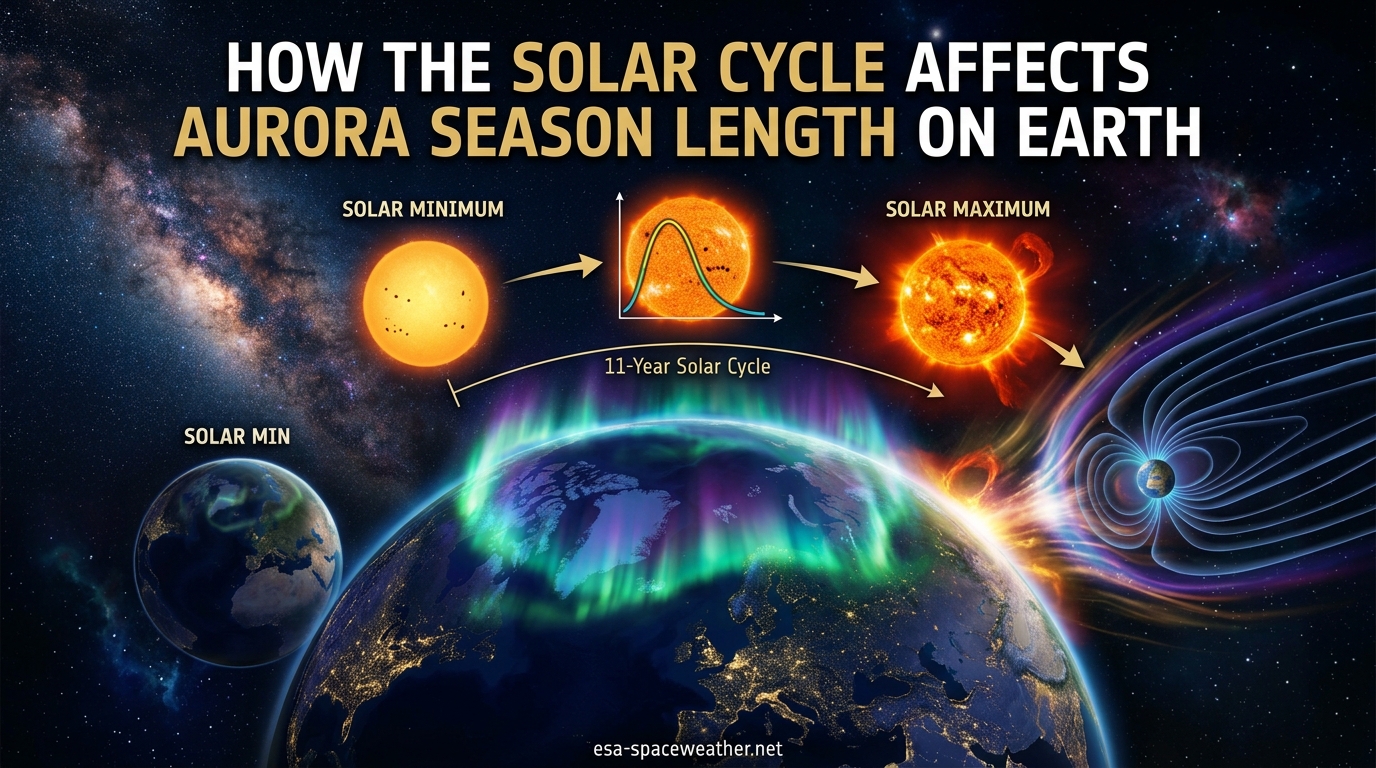
The solar cycle controls aurora season length on Earth by regulating how often coronal mass ejections and high-speed solar wind streams reach our atmosphere. During solar maximum, increased solar activity produces more frequent geomagnetic storms, which extends the effective aurora season and pushes the auroral oval further south. During solar minimum, fewer storms mean the aurora zone contracts and displays become less frequent at lower latitudes.
Our team has tracked space weather data and aurora observations for years, and one question comes up constantly: why do some years deliver jaw-dropping Northern Lights displays every clear night while other years feel quiet? The answer lies in an approximately 11-year rhythm that the Sun follows. This guide breaks down exactly how the solar cycle shapes the length, intensity, and geographic reach of aurora season on Earth.
Whether you are a photographer planning a trip, a space weather enthusiast, or simply curious about why the sky glows green some nights, understanding the solar cycle aurora connection helps you know what to expect and when to look up. We will cover what the solar cycle is, how it changes aurora season length, and what Solar Cycle 25 means for viewing opportunities right now.
Table of Contents
What Is the Solar Cycle?
The solar cycle is the roughly 11-year period during which the Sun’s magnetic field completely flips polarity. Over this cycle, solar activity rises from a quiet minimum to a turbulent maximum, then falls back to minimum again. This rhythm governs everything from sunspot counts to the frequency of solar flares and coronal mass ejections.
During each cycle, the Sun’s north and south magnetic poles swap places. A compass on the Sun’s surface would point in the opposite direction at the end of one full cycle compared to the start. It takes two complete cycles, roughly 22 years, for the magnetic field to return to its original orientation.
While we often describe the solar cycle as an 11-year pattern, the actual length varies. Cycles can last anywhere from 8 to 14 years based on historical records maintained by SILSO, the Sunspot Index and Long-term Solar Observations center. Shorter cycles tend to be more intense, while longer cycles generally produce less solar activity.
This variation matters because it makes long-term solar cycle aurora prediction challenging. Space weather forecasters at NOAA and NASA track daily sunspot numbers, solar wind parameters, and magnetic field measurements to figure out where we are in the current cycle and what to expect next.
Solar Maximum and Solar Minimum Explained
Every solar cycle has two extremes: solar maximum and solar minimum. These phases determine how much solar energy reaches Earth and directly influence aurora behavior.
Solar maximum is the peak of solar activity. The Sun bristles with sunspots, solar flares erupt frequently, and coronal mass ejections launch massive clouds of charged particles into space. This is when aurora displays are most intense and visible across the widest geographic range. During strong solar maxima, people as far south as Texas, Italy, and Japan have reported seeing the aurora borealis.
Solar minimum is the quiet phase. Sunspots may disappear entirely for weeks, and solar flares become rare. The Sun’s magnetic field is calm and organized. During this phase, the auroral oval contracts toward the poles, and displays become less frequent at mid-latitudes.
Between these extremes are the rising phase (from minimum to maximum) and the declining phase (from maximum to minimum). Interestingly, the declining phase can produce some of the best aurora displays. As the magnetic field reorganizes after maximum, coronal holes open up and send persistent high-speed solar wind streams toward Earth.
Understanding where we stand between these phases helps aurora hunters plan. The solar cycle does not switch on and off like a light. Instead, it follows a gradual curve that shifts the probability and intensity of aurora night by night.
Sunspots: The Pulse of Solar Activity
Sunspots are the most visible indicator of where we are in the solar cycle. These dark patches on the Sun’s surface appear darker because they are cooler than surrounding areas, caused by intense magnetic activity that blocks heat from rising.
More sunspots mean more magnetic turmoil on the Sun. And more magnetic turmoil means more frequent solar flares and coronal mass ejections. The daily sunspot number tracked by SILSO gives forecasters a quick read on overall solar activity levels.
The relationship between sunspots and the solar cycle aurora connection is direct. When sunspot counts climb during solar maximum, aurora frequency and intensity increase. The geomagnetic storms that trigger auroras rely on the same magnetic energy that produces sunspots.
Astronomers also track sunspot latitude using the butterfly diagram. Early in a cycle, sunspots appear at higher latitudes near the Sun’s poles. As the cycle progresses, sunspots migrate toward the equator. This pattern helps scientists confirm that a new cycle has begun and estimate how quickly it is developing.
Not every sunspot produces aurora-triggering eruptions. But as a general rule, more sunspots mean more opportunities for geomagnetic storms. That is why aurora watchers pay close attention to daily sunspot reports.
How the Solar Cycle Affects the Length of Aurora Season on Earth
This is the question at the heart of the solar cycle aurora relationship, and it is one that most sources do not address directly. The answer involves two separate concepts: the base aurora season that exists regardless of the solar cycle, and the effective aurora season that the solar cycle expands or contracts.
The base aurora season follows a seasonal pattern tied to Earth’s orbit, not the Sun’s activity cycle. Auroras are more common around the spring and fall equinoxes due to the Russell-McPherron effect. This phenomenon occurs when Earth’s magnetic field aligns favorably with the interplanetary magnetic field carried by solar wind, allowing more charged particles to enter our atmosphere. This is why September through March represents the core viewing window in the Northern Hemisphere, even during solar minimum.
The effective aurora season is where the solar cycle plays its role. During solar maximum, the base season gets extended in both duration and geographic range. More frequent coronal mass ejections mean geomagnetic storms can occur at any time of year, not just during equinoctial months. We have seen displays during summer months at high latitudes and during winter months at unusually low latitudes during peak solar activity.
Specifically, the solar cycle affects aurora season length in three measurable ways:
1. Duration of high-activity windows. During solar maximum, the period of elevated geomagnetic activity stretches beyond the traditional equinoctial peaks. Storms can cluster over weeks or months rather than brief seasonal spikes, effectively lengthening the window when aurora viewing is likely.
2. Geographic range expansion. The auroral oval, the ring-shaped zone where auroras are visible, sits roughly between 65 and 75 degrees latitude during solar minimum. During solar maximum, intense geomagnetic storms push this oval equator-ward. Displays become visible at latitudes as low as 40 degrees or even further south during severe storms. This means more people in more locations can experience aurora season.
3. Frequency of display nights. At solar maximum, the Aurora Zone around 65 to 70 degrees north can see auroras on nearly every clear, dark night. During solar minimum, that frequency drops to perhaps 2 to 3 nights per week even in prime locations. The aurora season does not vanish, but it becomes more selective.
It is important to dispel a common misconception that auroras disappear during solar minimum. They do not. The Sun never completely stops producing solar wind. Even at minimum, the aurora oval persists over the polar regions. What changes is how far south the displays reach and how dramatic they appear. Visitors to places like Tromso, Iceland, or Fairbanks can still see stunning auroras during solar minimum because those locations sit directly under the auroral oval.
Coronal Mass Ejections and Travel Time
Coronal mass ejections, or CMEs, are the primary drivers of major aurora displays. A CME is a massive burst of solar wind and magnetic field that rises from the Sun’s corona and travels through space. When a CME is directed at Earth, it compresses our magnetic field and triggers geomagnetic storms.
The travel time for a CME to reach Earth ranges from 15 hours to 4 days depending on the speed of the eruption. Fast CMEs associated with powerful solar flares can arrive in under a day, while slower ones take 2 to 3 days. This window gives space weather forecasters at NOAA’s Space Weather Prediction Center time to issue alerts before the charged particles arrive.
During solar maximum, CMEs occur frequently. The Sun may produce several per week, and some days see multiple eruptions. This high frequency is what extends the effective aurora season. Even if one CME misses Earth, chances are another will arrive within days.
During solar minimum, CMEs become rare. When they do occur, they tend to be weaker and slower. This reduced frequency is the main reason aurora season contracts during the quiet phase of the solar cycle.
For aurora hunters, monitoring CME predictions is essential. Tools like the NOAA Space Weather Prediction Center’s 3-day forecast and the Aurorasaurus citizen science project help track incoming solar storms and estimate when displays might occur.
Coronal Holes: The Reliable Aurora Source During Solar Minimum
One of the most under-discussed aspects of the solar cycle aurora relationship is coronal holes. These are regions on the Sun where the magnetic field opens outward into space rather than looping back to the surface. Because the magnetic field is open, solar wind escapes at much higher speeds, creating what scientists call high-speed solar wind streams.
Coronal holes are the reason auroras never truly disappear during solar minimum. Even when sunspots vanish and CMEs stop, coronal holes persist. They send steady streams of fast solar wind toward Earth that produce moderate geomagnetic storms and reliable aurora displays.
The most remarkable feature of coronal holes is their recurrence pattern. Because the Sun rotates roughly every 27 days, a coronal hole that faces Earth today will face Earth again in about 27 days. Experienced aurora watchers in the Aurora Zone track these recurring streams and know exactly when to expect heightened activity.
Some coronal holes have persisted for 7 to 8 solar rotations, providing consistent aurora activity for months at a time. This means that even during the depths of solar minimum, there are predictable windows when aurora viewing is likely.
Coronal holes typically produce auroras that are less explosive than CME-driven storms but more dependable. They tend to create substorms that light up the sky for minutes at a time rather than hours-long mega-displays. For dedicated observers in the Arctic, these recurring events form the backbone of aurora season regardless of where we are in the solar cycle.
Solar Cycle 25: Where We Are Now
Solar Cycle 25 began in late 2019 and has defied expectations. Early predictions from NOAA and NASA suggested it would be a weak cycle, similar to the below-average Cycle 24. Instead, Solar Cycle 25 has produced some of the strongest aurora displays in decades.
The peak of Solar Cycle 25, known as solar maximum, was expected around July 2025. As of 2026, we are either at or just past this peak. Sunspot numbers have exceeded initial forecasts, and geomagnetic storm frequency has been higher than predicted. In May 2024, a G5 geomagnetic storm, the strongest category, pushed auroras as far south as Mexico, the Caribbean, and parts of Africa. This was the most powerful storm since 2003.
Many people on community forums like Reddit’s r/AuroraBorealis and r/northernlights have expressed confusion about why auroras are so visible now despite predictions of a weak cycle. The answer is that solar cycle prediction remains an imperfect science. The Sun does not always follow forecasts, and even a modestly predicted cycle can produce spectacular individual events.
For aurora hunters planning trips in 2026 and beyond, the declining phase of Solar Cycle 25 offers excellent opportunities. The years immediately after solar maximum often produce strong aurora displays thanks to persistent coronal holes opening up as the magnetic field reorganizes. This means aurora season may remain longer and more intense than typical post-maximum years.
If history is a guide, the elevated activity we are seeing now should gradually decline over the next 5 to 6 years as we approach the next solar minimum, expected around 2030 or 2031. But the most spectacular displays often occur during the declining phase, so now through 2026 remains a prime viewing window.
Space Weather Effects Beyond Aurora
The solar cycle aurora connection is beautiful, but the same solar activity that creates Northern Lights also poses risks. Geomagnetic storms can disrupt satellites, interfere with GPS navigation, and induce currents in power lines that damage electrical grids.
The most extreme example is the Carrington Event of 1859, when a massive solar storm caused telegraph systems to spark and catch fire. Auroras were reported as far south as Cuba and Hawaii. If a storm of similar magnitude hit today, experts estimate it could cause trillions of dollars in infrastructure damage worldwide.
This is why agencies like ESA, NOAA, and NASA invest heavily in solar monitoring missions. ESA’s Solar Orbiter and the upcoming Vigil mission will provide earlier warning of Earth-directed solar storms, helping protect both our technology and the power grid.
Understanding the solar cycle is not just about chasing auroras. It is about preparing for the real consequences of living next to an active star.
FAQs
How does the solar cycle affect the Northern Lights?
The solar cycle controls the frequency, intensity, and geographic range of Northern Lights displays. During solar maximum, increased sunspots and coronal mass ejections produce more geomagnetic storms, making auroras visible further south and more often. During solar minimum, auroras contract toward the poles and become less frequent at mid-latitudes, though they never disappear entirely.
How long does it take for a solar flare to cause Northern Lights?
A coronal mass ejection triggered by a solar flare takes between 15 hours and 4 days to reach Earth, depending on its speed. Fast CMEs associated with powerful X-class flares can arrive in under 24 hours. Solar flares themselves travel at the speed of light and reach Earth in about 8 minutes, but the aurora-causing particles arrive later with the CME.
How does solar activity affect aurora visibility?
Higher solar activity increases aurora visibility by producing more frequent geomagnetic storms and expanding the auroral oval equator-ward. During solar maximum, auroras can be seen at much lower latitudes than normal. Coronal holes also send high-speed solar wind streams that create reliable aurora displays even during lower activity periods.
How does the solar cycle affect Earth?
The solar cycle affects Earth by varying the amount of solar wind and magnetic energy that reaches our planet. This influences aurora frequency and intensity, disrupts satellite communications during geomagnetic storms, induces electrical currents in power grids, and changes the density of the upper atmosphere. The solar cycle follows an approximately 11-year pattern of rising and falling solar activity.
Conclusion
The solar cycle aurora relationship shapes how long, how often, and how widely visible aurora season becomes on Earth. Solar maximum extends the effective viewing season by increasing storm frequency, expanding the geographic range, and creating more nights of spectacular displays. Solar minimum contracts the range but never eliminates auroras entirely, thanks to reliable coronal hole activity.
If you are planning to see the Northern Lights, now remains an excellent time. Solar Cycle 25 is at or near its peak in 2026, and the declining phase ahead should continue producing strong displays. Monitor NOAA space weather forecasts, track coronal hole activity, and head to the Aurora Zone for the best odds of a memorable night under the lights.