
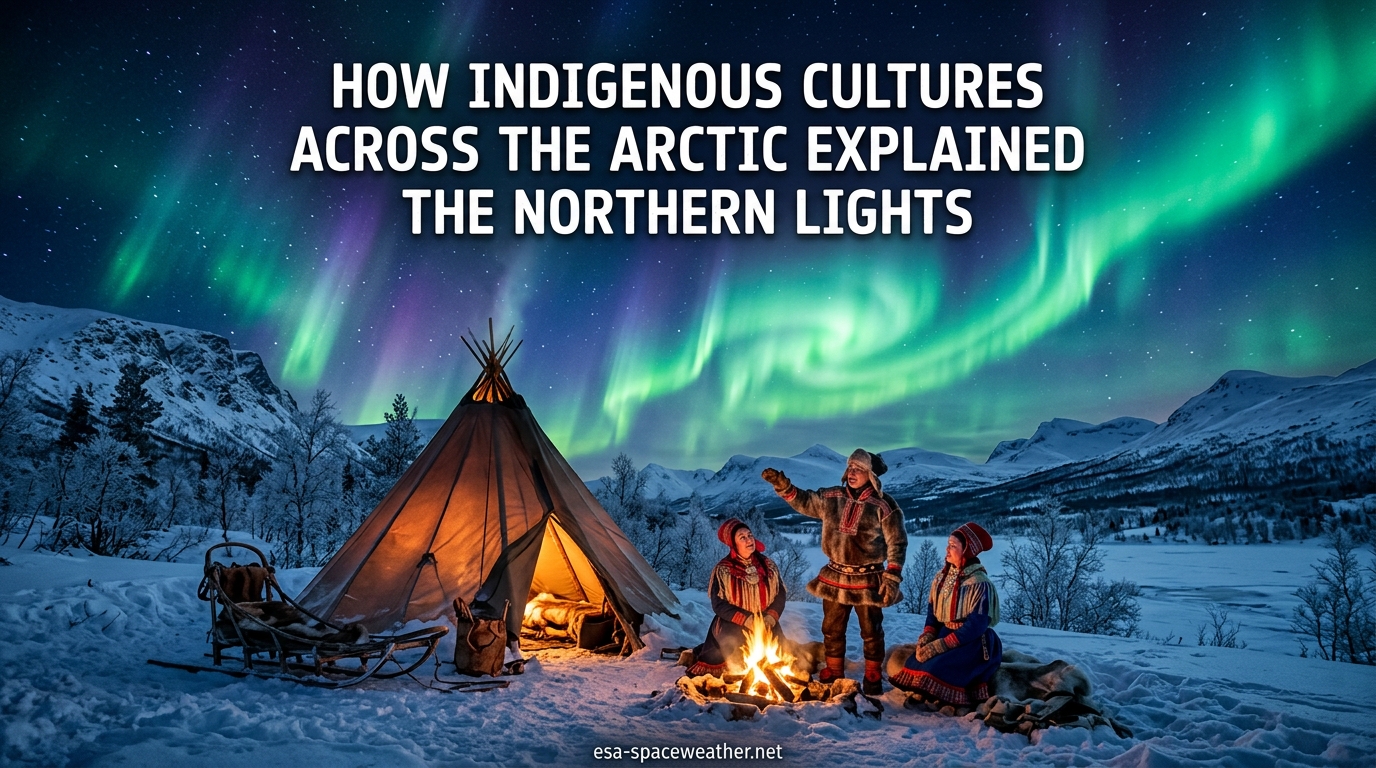
Long before satellites tracked solar storms or physicists mapped the magnetosphere, the people living under the aurora borealis had their own ways of understanding those shimmering green and red ribbons in the polar sky. From the Inuit of the Canadian Arctic to the Sami reindeer herders of Sápmi, from the Cree of the boreal forests to the Norse seafarers of Scandinavia, the night sky was not just weather. It was alive. It was watching back.
For thousands of years, these peoples watched the same lights we chase with cameras today. But they heard stories in them, felt warnings in them, and recognized ancestors dancing overhead. The way Indigenous cultures across the Arctic explained the Northern Lights reveals something remarkable: a deep, layered relationship between human communities and the natural world that science alone cannot fully capture.
In this guide, our team walks through the major cultural traditions that interpreted the aurora. We cover the Sami fear of the lights, the Inuit walrus skull legend, Cree and Anishinaabe ancestor beliefs, Norse Valkyrie mythology, and the Finnish fire fox tale. We also cover the cultural protocols many Arctic peoples still follow today, including the widely known rule: do not whistle at the Northern Lights.
Whether you are planning an aurora-viewing trip, studying Arctic anthropology, or simply curious about how humans made sense of this phenomenon before the word “electromagnetism” existed, these stories offer a window into how people relate to forces larger than themselves.
Table of Contents
How Indigenous Cultures Across the Arctic Explained the Northern Lights
The short answer is that there was no single explanation. Different nations, bands, and communities developed distinct interpretations passed down through oral tradition over centuries. Some saw the lights as benevolent ancestors. Others saw them as dangerous spirits best avoided. A few saw them as bridges between the living world and the realm of the dead.
What unites these beliefs is a shared sense that the aurora was never just a pretty light show. It carried meaning. It demanded behavior. It connected people to something beyond the ordinary. Below, we break down the major traditions region by region.
Sami Traditions: Fear and Respect for the Aurora
The Sami people are the Indigenous reindeer-herding cultures of Sápmi, a region that spans northern Norway, Sweden, Finland, and the Kola Peninsula of Russia. Their relationship with the aurora was one of caution and deep respect, perhaps more than any other Arctic people.
In traditional Sami belief, the aurora borealis was not something to admire. It was alive, aware, and potentially hostile. The lights were thought to be spirits of the dead, and those spirits could reach down from the sky if provoked. Many Sami elders taught that you should never talk about the lights, never wave at them, and never draw attention to yourself while they were visible overhead.
The most common Sami precaution was simple: stay indoors. When the aurora was strong, families would pull their curtains shut and keep children inside. Going out under the lights was considered dangerous because the spirits could swoop down and take a person away. Some traditions held that the lights could sever your head from your body if you disrespected them.
For added protection, Sami people sometimes carried iron objects, especially knives, when they had to be outside during an aurora display. Iron was believed to offer a measure of defense against supernatural forces. This was not superstition in the dismissive sense; it was a practical spiritual technology for navigating a world filled with powerful, unseen beings.
What makes the Sami perspective especially important today is that it is a living tradition. Sami communities in 2026 continue to maintain cultural protocols around the aurora, even as modern science explains the physics. The two are not in conflict for many Sami people. The science describes the mechanism; the tradition describes the meaning.
Inuit Legends: The Walrus Skull Game and Spirit Dancers
Among the most widely recounted Indigenous explanations for the Northern Lights are the legends of the Inuit, who inhabit the Arctic regions of Alaska, Canada, and Greenland. These stories are vivid, specific, and often surprisingly playful despite the awe the lights inspired.
The best-known Inuit legend describes the aurora as the spirits of the dead playing a game in the sky. In this game, they use a walrus skull as a ball, kicking it back and forth across the heavens. The shifting, dancing movements of the aurora were understood as the spirits running and leaping after the skull. The Geophysical Institute at the University of Alaska Fairbanks has documented versions of this story collected from Inuit communities across Alaska and Canada.
Variations of the legend existed between communities. In some versions, the spirits played with a human skull instead of a walrus skull, which made the lights more ominous. In other tellings, the game involved a walrus skull being kicked around by spirits who had been good hunters in life, continuing their favorite activities in the afterlife.
In Greenland, Inuit traditions offered a gentler interpretation. Some Greenlandic Inuit believed the lights were the spirits of children who had died at birth. These children danced in the sky, and the aurora’s movements were their dance. This belief framed the lights as something tender rather than frightening, a sign that those lost too soon were still present, still moving, still part of the community.
A widespread Inuit warning, shared across multiple communities, involved whistling. The belief was that if you whistled at the Northern Lights, you could call their attention. And that attention was dangerous. The spirits might descend and take your head. To protect yourself if you heard the lights making sounds, which sometimes happens during especially intense displays, you were supposed to clap your hands or make noise to drive them away.
These stories were not ancient history treated as fiction. They were active teaching tools. Elders used them to instruct children about respect, about the presence of unseen forces, and about how to behave under a sky full of light. The stories carried practical and spiritual weight simultaneously.
Cree and Anishinaabe Beliefs: Spirits of the Ancestors
The Cree, one of the largest First Nations in Canada, understood the aurora borealis as a direct connection to those who had passed on. In Cree tradition, the Northern Lights were the spirits of the dead, and they were trying to communicate with loved ones still on Earth.
Specifically, many Cree communities in what is now northern Manitoba, Saskatchewan, and Alberta believed that each flicker and movement of the aurora represented a spirit moving in the sky. The lights were not random. They were intentional. Someone you had lost might be up there, signaling to you.
One of the most evocative Cree observations involved dogs. Elders noted that dogs would sometimes bark at the Northern Lights, and the explanation was that the dogs recognized the spirits of people they had known in life. A dog barking at the aurora was not reacting to a visual novelty. It was responding to a familiar soul it could sense but humans could not see clearly.
The Anishinaabe peoples, a cultural grouping that includes the Ojibwe, Odawa, Potawatomi, Oji-Cree, Saulteaux, and Algonquin nations, offer their own rich teachings about the aurora. For the Anishinaabe, the Northern Lights were understood as a pathway between worlds, a doorway connecting the living with the spirit realm.
Anishinaabe teachings describe the lights as fires in the sky, sometimes interpreted as torches carried by spirits or ancestors. The Ojibwe word for the aurora connects it to the concept of dance. The lights were spirits dancing, and that dance carried meaning for those below who knew how to read it.
What distinguishes Anishinaabe perspectives is the emphasis on relationship. The aurora was not a spectacle to observe from a distance. It was a reminder that the boundary between the living and the dead was thinner than people assumed. The lights could be a comfort, a warning, or a message, depending on the context and the person receiving it.
As northernontario.travel documented in their cultural significance guide, Anishinaabe teachings about the Northern Lights remain active in 2026. Elders continue to share these stories, and communities continue to observe protocols of respect around the lights. This is not a dead mythology studied in museums. It is a living framework for understanding the world.
Norse and Scandinavian Mythology: Valkyries and the Bifrost
The Norse peoples of medieval Scandinavia had their own dramatic explanations for the aurora, and these stories have become some of the most globally recognized interpretations of the phenomenon.
In Old Norse tradition, the aurora borealis was often associated with the Valkyries. These were female warrior figures who served Odin, the chief god of the Norse pantheon. The Valkyries’ role was to ride across battlefields and choose which fallen warriors were worthy of entering Valhalla, the great hall of the slain.
The shimmering of the Northern Lights was understood as the glow reflecting off the armor of the Valkyries as they rode through the sky. This was a powerful image: the lights were not just a pretty display but a signal that somewhere, warriors were being chosen, and the passage between life and death was active. For a warrior culture that valued death in battle above nearly all else, the aurora carried enormous spiritual weight.
Another major Norse interpretation connected the aurora to the Bifrost Bridge, the burning rainbow bridge that linked Midgard, the world of humans, with Asgard, the realm of the gods. The Bifrost was described as glowing with shifting colors, which matches the visual reality of the aurora remarkably well. Some scholars of Norse mythology have argued that descriptions of the Bifrost were directly inspired by observations of the Northern Lights.
The Finnish tradition offers a completely different but equally vivid explanation. In Finnish, the Northern Lights are called revontulet, which translates to “fox fires.” The legend tells of a magical fox running across the snow-covered fells of Lapland. As it ran, its tail swept up sparks of snow and moonlight, sending them spiraling into the sky. Those sparks became the aurora.
This story gives the aurora an animal origin that is both charming and distinctly Finnish. The fire fox, or tulikettu, was a creature of myth whose fur was said to glow. The connection between the fox, the snowy landscape, and the lights overhead ties the entire Arctic environment together into one coherent story. The sky was not separate from the land. The fox that ran on the ground was the same creature whose tail painted the heavens.
Estonian folklore offered yet another variation. Some Estonian traditions described the aurora as a celestial sleigh ride, with spirits or frost beings driving sleds across the sky, their paths marked by glowing trails. This connected the lights to the winter activities of daily life, making the extraordinary feel familiar.
Other Arctic and Subarctic Cultural Beliefs
Beyond the major traditions already covered, numerous other peoples across the Arctic and subarctic developed their own interpretations of the Northern Lights. These stories add texture to the broader picture and show how widespread and varied these beliefs were.
The Algonquin peoples of eastern Canada understood the aurora as a reflection of fires lit by their creator, Nanabozho, a cultural hero and trickster figure. Nanabozho was said to have made the fires as a signal to his people, reminding them that he was still watching over them. The lights were a message of care and continuity from a powerful being.
The Menominee people of present-day Wisconsin believed the aurora marked the location of torches carried by torch-fishermen, spirits who were the manitou, or spiritual essence, of those who had died. These spirit fishermen were out on a celestial river, and their torches lit the sky. This interpretation tied the aurora to a specific subsistence activity that was central to Menominee life.
In the Mackenzie Delta region of Canada’s Northwest Territories, some Indigenous traditions held that the lights were the spirits of animals, particularly whales and seals, that had been hunted. The animals’ spirits returned to the sky, and their movement was the aurora. This belief reinforced the sacred relationship between hunter and prey, reminding people that the animals they depended on were not just resources but beings with spiritual lives.
In medieval Europe, outside the Indigenous Arctic entirely, the aurora was often seen as an omen of blood and war. The red hues that sometimes appear in powerful auroral displays were interpreted as the glow of distant battles or the blood of the slain rising into the sky. In the Hebrides off the coast of Scotland, the lights were called the “Merry Dancers,” a more playful name, but red auroral displays were associated with bloodstones and ill fortune.
These European traditions differ from Indigenous Arctic beliefs in important ways. Indigenous interpretations generally located the aurora within an existing framework of relationship: the lights were ancestors, animals, or known spirits. European medieval beliefs tended to treat the aurora as a generic omen, a sign of trouble from an unnamed source. The difference reflects broader distinctions in how these cultures understood humanity’s place in the natural order.
Cultural Protocols: Why You Should Not Whistle at the Aurora
One of the most consistent elements across multiple Arctic Indigenous traditions is the prohibition against whistling at the Northern Lights. This rule appears in Inuit, Sami, and some First Nations teachings, and it is one of the most specific cultural protocols that outsiders frequently misunderstand.
The reasoning behind the whistling taboo varies by community, but the core idea is the same: sound can attract attention, and the attention of the spirits in the aurora is dangerous. In Inuit traditions, whistling was believed to call the spirits closer. If they came close enough, they could cut off your head or carry you away. The response, if you accidentally attracted their notice, was to make loud noise, clap your hands, or rustle objects together to drive the spirits back.
In Sami traditions, the protocol extended beyond whistling. You should not speak about the lights while they were visible. You should not wave at them. You should not laugh at them. Drawing any form of attention, verbal or physical, toward yourself while the aurora was overhead was considered an invitation for the spirits to take notice of you specifically. And once they noticed you, the outcome was not in your control.
Among some Cree and Anishinaabe communities, the protocols were less about danger and more about respect. The lights were the spirits of ancestors. You did not point at them or speak disrespectfully about them. You observed them with the same courtesy you would show an elder who had come to visit. The relationship was one of mutual recognition.
For aurora tourists and photographers visiting Indigenous territories in 2026, understanding these protocols matters. It is not about adopting a belief system that is not yours. It is about behaving with respect in someone else’s cultural landscape. Just as you would remove your shoes when entering a temple or lower your voice in a cathedral, observing aurora protocols in the Arctic is a matter of basic cultural courtesy.
The northernontario.travel cultural guide emphasizes this point directly, noting that sharing Indigenous knowledge about the Northern Lights comes with a responsibility to also share the protocols of respect. If you learn about what the lights mean to a people, you should also learn how that people asks you to behave when the lights appear.
The Science Behind the Stories
Modern science explains the aurora borealis as the result of charged particles from the sun colliding with gases in Earth’s upper atmosphere. When solar wind, a stream of electrons and protons flowing outward from the sun, reaches Earth, the planet’s magnetic field channels those particles toward the polar regions.
As the particles enter the upper atmosphere, typically between 60 and 150 miles above the surface, they collide with oxygen and nitrogen molecules. These collisions transfer energy to the gas molecules, exciting their electrons. When the electrons settle back to their normal state, they release photons of light. Oxygen at high altitudes produces red light. Oxygen at lower altitudes produces green light, the most common auroral color. Nitrogen produces blue and purple hues.
This scientific explanation is well established and has been confirmed by decades of observation, satellite data, and laboratory experiments. But understanding the mechanism does not necessarily invalidate the cultural meanings attached to the phenomenon. Many Indigenous people see no conflict between science and tradition.
Science answers the question of how the lights work. Culture answers the question of what the lights mean. These are different questions, and both are valid. A Sami elder might know perfectly well that the aurora is caused by solar particles while still maintaining the traditional protocols of respect. The physics does not erase the ancestors.
This is an important point that many competitors miss when they tack a science section onto the end of an article about mythology. The scientific explanation is not a refutation of Indigenous beliefs. It is a different framework for a different set of questions. Treating science as the “truth” that replaces “mythology” is a framing that many Indigenous scholars have pushed back against, arguing that it dismisses the intellectual traditions of peoples who developed sophisticated observational knowledge systems long before European science arrived.
At our site, esa-spaceweather.net, we cover the physics of space weather in detail. But we also recognize that the cultural dimensions of the aurora are equally worthy of attention. The stories people told about the lights were not random. They were based on careful observation of real phenomena, filtered through spiritual and communal frameworks that gave those observations meaning.
Living Traditions: Modern Indigenous Perspectives on the Aurora
One of the most important things to understand about these beliefs is that they are not relics. They are not artifacts in a museum display. They are living traditions, actively taught, practiced, and maintained by Indigenous communities across the Arctic in 2026.
Sami families in Norway, Sweden, and Finland still teach their children about the protocols around the aurora. Inuit elders in Canada and Greenland still share the walrus skull legend. Anishinaabe teachers in Ontario still explain the pathway between worlds. These stories continue to be told around kitchen tables, in language classrooms, and at community gatherings.
The survival of these traditions despite centuries of colonization, forced assimilation, and cultural suppression is itself remarkable. Residential schools in Canada and assimilation policies in Scandinavia actively targeted Indigenous knowledge systems. That these stories survived and are being revitalized is a testament to the resilience of the communities that carried them.
For non-Indigenous people interested in the Northern Lights, this living dimension matters. It means that when you learn about these beliefs, you are not studying ancient history. You are engaging with active, contemporary cultural practices. The appropriate response is not fascination from a distance but respect for a living system of knowledge.
It also means that the best sources for learning more about these traditions are the communities themselves. Many Indigenous cultural centers, museums, and educational organizations across the Arctic offer programs, books, and workshops where elders and knowledge keepers share these stories on their own terms. Seeking out these sources is a more respectful approach than relying solely on secondhand accounts.
Reddit discussions on r/AskAnthropology and community groups like the Manitoba Aurora and Astronomy Facebook group regularly surface questions about Indigenous aurora beliefs. The consistent message from Indigenous participants in these spaces is clear: these are our stories, they are still alive, and we ask that you engage with them respectfully.
FAQs
What is the indigenous perspective of the Northern Lights?
Indigenous Arctic cultures generally understood the Northern Lights as living spiritual phenomena rather than passive weather. Depending on the nation, they were seen as spirits of ancestors, souls of animals, dancers in the sky, or dangerous beings requiring respect and caution. The common thread was that the lights carried meaning and demanded specific behaviors from people on the ground.
How do different cultures explain the Northern Lights?
Cultures across the Arctic offered distinct explanations. The Inuit described spirits playing ball with a walrus skull. The Sami feared the lights as potentially dangerous spirits and stayed indoors. The Cree saw ancestors trying to communicate. The Norse saw Valkyries riding to collect fallen warriors. The Finns described a magical fox whose tail sparks created the lights. Each interpretation reflected the values and environment of the culture that produced it.
What does the Inuit myth say about the aurora borealis?
The most widely known Inuit legend says the aurora is caused by spirits of the dead playing a ball game in the sky using a walrus skull. The shifting lights are the spirits running and kicking the skull across the heavens. In Greenlandic Inuit traditions, the lights were also interpreted as the spirits of children who died at birth dancing in the sky.
What do most Eskimos believe about the Northern Lights?
The term Eskimo is considered outdated by many Arctic Indigenous peoples, who generally prefer Inuit or their specific nation name. Inuit beliefs about the Northern Lights varied by community but commonly involved spirits of the dead active in the sky. A widespread belief was that whistling at the lights could attract dangerous attention, and that making noise could drive the spirits away.
Why shouldn’t you whistle at the Northern Lights?
Multiple Arctic Indigenous traditions, including Inuit and Sami, teach that whistling at the aurora attracts the attention of the spirits within the lights. This attention was considered dangerous. In some Inuit traditions, the spirits could come down and cut off your head. The protocol was to stay quiet or, if you had already attracted notice, make loud clapping noises to drive the spirits away.
Are these beliefs still held today?
Yes. These are living traditions actively maintained by Indigenous communities across the Arctic. Sami families still observe aurora protocols, Inuit elders still share the walrus skull legend, and Anishinaabe teachers still explain the pathway between worlds. While modern science is widely understood, cultural meaning and scientific explanation are not seen as contradictory by many Indigenous people.
Conclusion
Understanding how Indigenous cultures across the Arctic explained the Northern Lights opens a window into some of the richest oral traditions on Earth. From the Inuit walrus skull game to the Sami protocols of silence, from the Cree ancestors reaching out through the sky to the Finnish fire fox painting the heavens with its tail, each story reflects a community’s deep engagement with the world around and above them.
What stands out across all these traditions is that none of them treated the aurora as mere decoration. The lights meant something. They connected the living to the dead, the human world to the spirit world, the ground to the sky. They demanded respect, and they rewarded it with meaning.
If you are planning to see the Northern Lights for yourself, we encourage you to carry this knowledge with you. Learn whose traditional territory you are visiting. Understand the protocols they observe. Listen to their stories, preferably from sources within their own communities. The aurora is more beautiful when you know what it has meant to the people who have lived under it for millennia.
And the next time someone tells you the Northern Lights are just charged particles hitting atmospheric gases, you can agree with the physics while remembering the walrus skull, the fire fox, the dancing children, and the ancestors who are still, according to living tradition, moving across the sky.