
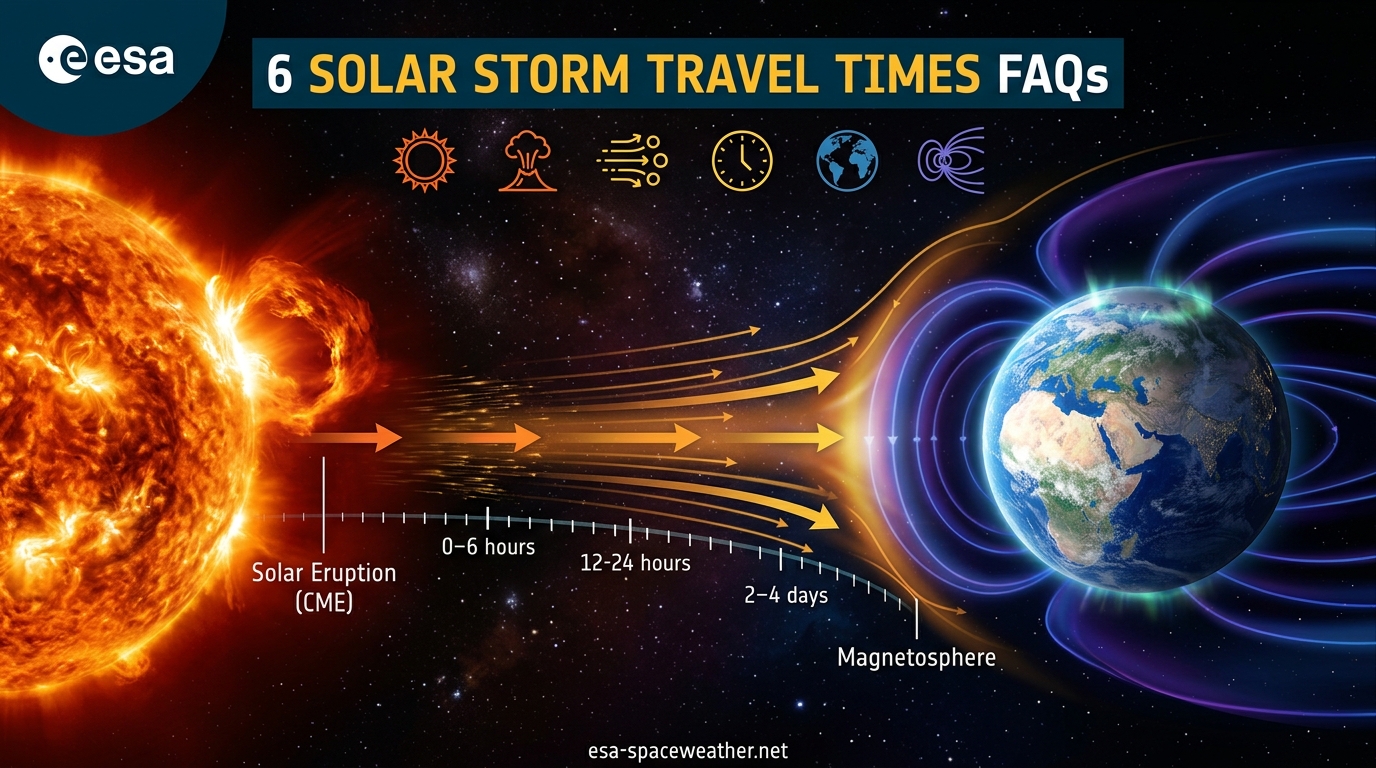
The Sun sits about 93 million miles (150 million kilometers) from Earth, and when it erupts, different types of solar storms take wildly different amounts of time to cover that distance. If you have ever wondered how long does it take solar storms to reach earth, the short answer is anywhere from 8 minutes to several days, depending entirely on what kind of storm we are talking about.
Solar flares, which are bursts of electromagnetic radiation, travel at the speed of light and arrive in about 8 minutes. Solar radiation storms, made up of charged particles, reach Earth in roughly 10 minutes to a few hours. Coronal mass ejections (CMEs), which are massive clouds of plasma and magnetic fields, take anywhere from 15 hours to 3 to 5 days to arrive.
Understanding these travel times matters for more than just curiosity. Power grid operators, satellite teams, astronauts on the International Space Station, and airline flight planners all rely on accurate solar storm arrival predictions to protect equipment and people. Aurora watchers use the same data to plan their viewing nights. Knowing how long each type of solar storm takes to reach Earth gives you a practical window for preparation.
Table of Contents
Quick Answer: Solar Storm Travel Times at a Glance
The time a solar storm takes to reach Earth depends entirely on the type of event:
- Solar flares (electromagnetic radiation): 8 minutes and 20 seconds. Travels at the speed of light.
- Solar radiation storms (charged particles): 10 minutes to several hours. Speed varies based on particle energy.
- Coronal mass ejections (CME plasma clouds): 15 to 18 hours for the fastest ones, and 1 to 5 days for typical events.
- Solar energetic particle (SEP) events: 10 minutes to a few hours, often arriving alongside radiation storms.
A good rule of thumb is that radiation arrives almost instantly, but the stuff that causes the most dramatic effects (auroras, power grid disruptions, satellite damage) takes much longer. That delay is what gives us any warning at all.
Solar Flares: How Long It Takes Solar Flares to Reach Earth
A solar flare reaches Earth in approximately 8 minutes and 20 seconds. That is because solar flares are explosions of electromagnetic radiation, which includes X-rays, ultraviolet light, and radio waves. All electromagnetic radiation travels at the speed of light, roughly 186,000 miles per second (300,000 km per second).
When a solar flare erupts on the Sun, the radiation begins affecting Earth almost immediately. The X-rays and UV light hit the day side of our planet in just over 8 minutes. This causes sudden ionospheric disturbances that can black out high-frequency radio communications on the sunlit side of Earth. Radio operators, especially in aviation and maritime settings, may notice signal degradation within minutes of a strong flare.
It is important to understand that a solar flare carries no physical material. There are no particles, no plasma, and no mass. It is pure energy moving at the speed of light. That is why there is effectively zero warning time for solar flare effects. By the time we detect the flare with our solar observatories, the radiation has already arrived.
Reddit users on r/SolarMax frequently note this distinction as a point of confusion. Many people mix up solar flares (instant radiation) with CMEs (delayed plasma). Remembering that flares travel at light speed while CMEs travel far slower is the single most important distinction in understanding solar storm timing.
Solar Radiation Storms: How Long They Take to Reach Earth
Solar radiation storms, also called solar energetic particle (SEP) events, take approximately 10 minutes to several hours to reach Earth. Unlike solar flares, which are pure energy, radiation storms consist of charged particles, primarily protons and electrons that have been accelerated to enormous speeds by solar eruptions.
The fastest particles in a radiation storm travel at a significant fraction of the speed of light, reaching Earth in as little as 10 to 15 minutes. However, not all particles in the storm move at the same speed. The lower-energy particles arrive later, sometimes taking several hours to reach our planet. This means a radiation storm is not a single moment but an evolving event that can last for hours or even days.
Radiation storms are a serious concern for astronauts in space and for satellite electronics. The Earth’s atmosphere and magnetic field protect those of us on the surface, but high-altitude polar flights can expose passengers and crew to elevated radiation levels. Airlines sometimes reroute polar flights when a significant solar radiation storm is in progress.
Radiation storms are rated on the NOAA S-scale, from S1 (minor) to S5 (extreme). An S3 or higher event can prompt satellite operators to put spacecraft into safe mode and trigger flight rerouting decisions. According to UCAR’s educational resources, roughly 2,000 radio blackouts occur per solar cycle, many tied to these radiation events.
Coronal Mass Ejections: How Long a CME Takes to Reach Earth
Coronal mass ejections are the heavy hitters of solar storms, and they take the longest to arrive. A CME takes anywhere from 15 to 18 hours for the fastest events to 1 to 5 days for typical ones. The exact travel time depends on the speed of the CME when it leaves the Sun and what it encounters on its journey.
NOAA’s Space Weather Prediction Center reports that CMEs travel outward from the Sun at speeds ranging from slower than 250 km/s to near 3,000 km/s. That is a massive range. A slow CME moving at 250 km/s might take 4 to 5 days to reach Earth. A fast CME blasting out at 3,000 km/s can arrive in as little as 15 hours.
Most Earth-directed CMEs fall somewhere in the middle, arriving 1 to 3 days after eruption. This is the window that space weather forecasters work with. Wikipedia and multiple government sources confirm that the typical CME arrival time is 1 to 5 days, with the fastest recorded events clocking in around 15 to 18 hours.
The reason CMEs take so much longer than flares comes down to physics. A CME is a physical cloud of plasma, billions of tons of charged material embedded with magnetic fields. That material has mass, and it cannot travel at the speed of light. It plows through the solar wind and interplanetary medium, which creates drag. As a CME travels, it can decelerate if it runs into slower solar wind ahead of it, or it can be accelerated by conditions behind it.
Forum discussions on r/askscience frequently bring up this exact question: why do CMEs take about 3 days when the distance is 93 million miles? The answer is that the average CME speed of around 500 km/s results in a travel time of roughly 3 to 4 days across that enormous distance.
The Fastest CMEs Ever Recorded
The fastest CMEs can reach Earth in just 15 to 18 hours. These extreme events are rare but tend to occur during solar maximum, the peak of the Sun’s 11-year activity cycle. A CME traveling at 3,000 km/s covers the 93 million mile distance in less than a day.
The Carrington Event of 1859, the most powerful solar storm in recorded history, is estimated to have arrived in approximately 14 to 17 hours. That extraordinarily short travel time indicates an extremely fast, extremely powerful CME. The event caused telegraph systems to spark, catch fire, and even operate without batteries. If a similar event hit today, the effects on our technology-dependent society would be far more severe.
The Slowest CMEs
On the other end of the spectrum, slow CMEs traveling at 250 km/s or less can take up to 5 days to reach Earth. These events are generally less geoeffective because their slower speed means less energy delivery upon arrival. However, they can still cause moderate geomagnetic storms if their magnetic field orientation aligns properly with Earth’s magnetosphere.
What makes a CME effective at causing geomagnetic storms is not just speed. The interplanetary magnetic field (IMF) orientation matters enormously. If the IMF carried by the CME has a strong southward component, it can connect with Earth’s magnetic field through a process called magnetic reconnection. That connection allows solar energy to pour into our magnetosphere, generating geomagnetic storms and auroras.
Factors That Affect How Long It Takes Solar Storms to Reach Earth
Several variables influence solar storm travel time, particularly for CMEs. Understanding these factors helps explain why predictions are not always precise.
Launch speed: The speed at which a CME leaves the Sun is the single biggest factor. A CME that departs at 2,000 km/s will arrive much sooner than one departing at 400 km/s. Solar observatories like SOHO and STEREO use coronagraphs to measure this initial speed.
Direction and aim: Not all CMEs are aimed at Earth. A CME erupting from the center of the Sun’s disk as seen from Earth is called a halo CME and has the best chance of a direct hit. CMEs erupting from the edges of the Sun may miss Earth entirely. Only about 1 in 5 CMEs is Earth-directed.
Solar wind conditions: The space between the Sun and Earth is not empty. It is filled with the ambient solar wind, a constant stream of particles flowing at roughly 400 km/s. When a fast CME plows into slower solar wind, it creates a shock wave and decelerates. When it rides along a fast solar wind stream, it can maintain its speed or even accelerate.
Magnetic field structure: The internal magnetic configuration of a CME affects how it interacts with the interplanetary medium. CMEs with complex flux rope structures can behave unpredictably, which is one reason arrival time predictions sometimes get revised.
Effects on Earth: What Happens When Solar Storms Arrive
Each type of solar storm produces different effects when it reaches Earth. The timing of these effects follows the arrival sequence of the storms themselves.
Minutes after eruption (solar flare): Radio blackouts on the day side of Earth. High-frequency communications can be completely disrupted for minutes to hours. This affects aviation, maritime, and emergency communications.
10 minutes to hours (radiation storm): Elevated radiation levels in space and at high altitudes. Satellites may experience single-event upsets. Polar flight routes may need adjustment. Astronauts on the ISS may need to shelter in shielded areas.
15 hours to several days (CME arrival): This is when geomagnetic storms occur. The CME’s magnetic field interacts with Earth’s magnetosphere, injecting energy that powers auroras, induces electrical currents in power lines, and can damage transformers. The famous Saint Patrick’s Day Storm of 2015 and the Halloween Storms of 2003 were both CME-driven geomagnetic events.
Contrary to common misconception, solar storms cannot directly harm humans on the ground. Earth’s atmosphere provides effective shielding. The concern is technological: power grids, GPS systems, satellite communications, and aviation operations are all vulnerable to space weather effects.
How Scientists Track and Predict Solar Storm Arrival
Tracking solar storms from the Sun to Earth is a multi-stage process that involves several spacecraft and predictive models. The system works like a relay, with each observation narrowing down the arrival time estimate.
Stage 1: Detection on the Sun. Satellites like SOHO (Solar and Heliospheric Observatory) and SDO (Solar Dynamics Observatory) monitor the Sun continuously. SOHO’s LASCO coronagraph blocks out the Sun’s bright disk so we can see CMEs erupting. The twin STEREO spacecraft provide a side view, helping determine whether a CME is aimed at Earth. Detection happens within minutes of eruption.
Stage 2: Arrival prediction. Once a CME is detected, forecasters feed the data into models like WSA-Enlil. This model simulates how the CME will propagate through the solar wind to Earth and other planets. It provides an estimated arrival time, typically accurate to within plus or minus 6 hours. Forum users on r/SolarMax and r/spaceweather frequently compare WSA-Enlil predictions to actual arrival times and note that the model is getting better but still struggles with complex multi-CME events.
Stage 3: Confirmation at L1. The DSCOVR satellite, along with the older ACE spacecraft, sits at the L1 Lagrange point, about 1 million miles upstream of Earth in the direction of the Sun. When a CME reaches L1, these spacecraft measure the actual solar wind speed, density, and magnetic field. This gives us a final 15 to 60 minute warning before the CME hits Earth’s magnetosphere.
That 15 to 60 minute window is the last line of defense. Power grid operators use it to take protective actions. It is short, but it is enough to disconnect transformers and shed load in vulnerable areas. The DSCOVR data is streamed in real time and available to anyone through NOAA’s Space Weather Prediction Center website.
NASA’s Parker Solar Probe, which literally flies through the Sun’s corona, is helping improve our understanding of how solar wind and CMEs accelerate and evolve. Data from this mission should eventually lead to better arrival time predictions, closing some of the gap between estimated and actual CME arrival.
Historical Events: What Past Solar Storms Teach Us About Timing
Studying historical solar storms provides real-world examples of how travel times play out and why they matter.
The Carrington Event (September 1859): The most powerful solar storm in recorded history. British astronomer Richard Carrington observed a brilliant white-light solar flare on September 1, 1859. The associated CME reached Earth an estimated 14 to 17 hours later, an extraordinarily short travel time that indicates a CME speed approaching 2,400 km/s. When it arrived, it triggered the most intense geomagnetic storm in 500 years. Auroras were seen as far south as Cuba and Hawaii. Telegraph systems sparked and caught fire across the world.
The 2012 Near-Miss (July 2012): A massive CME erupted from the Sun with a speed exceeding 2,500 km/s. It would have produced a geomagnetic storm comparable to the Carrington Event. But it erupted from a part of the Sun that was rotating away from Earth. The CME missed our planet by about 9 days in solar rotation. Had it erupted just one week earlier, Earth would have been directly in its path. NASA scientists estimated the damage could have exceeded $2 trillion in modern infrastructure costs.
The Halloween Storms (October to November 2003): A series of powerful solar flares and CMEs produced some of the most intense space weather of the modern satellite era. CMEs arrived in timeframes ranging from about 19 hours to 2 days. The events disrupted satellites, forced airline reroutes, and knocked out power in Sweden. The SAFER satellite’s imaging instrument was permanently damaged.
Solar Cycle 25 (ongoing): We are currently in Solar Cycle 25, which has been more active than predicted. Solar maximum conditions increase the frequency of both flares and CMEs. Aurora watchers have reported spectacular displays at lower latitudes than usual, a direct result of more frequent and faster CME arrivals during this active period.
Solar Prominences: A Fourth Type of Solar Activity
No major competitor covers solar prominences in the context of travel time. A solar prominence is a massive loop of plasma suspended above the Sun’s surface by magnetic fields. When a prominence destabilizes and erupts, it can produce a CME, in which case the travel time follows CME rules (15 hours to several days).
However, prominences that do not erupt can linger for weeks, slowly releasing material that joins the ambient solar wind. This material reaches Earth in the normal solar wind timeframe of 2 to 4 days at typical speeds of 400 to 700 km/s. The distinction matters because erupting prominences are one of the main sources of slow-to-moderate CMEs that can still produce beautiful aurora displays.
Practical Guide: Using Solar Storm Timing for Aurora Watching
If you want to see auroras, understanding solar storm travel times is your most valuable tool. Here is a practical timeline for aurora chasers:
Day 0, eruption detected: Check NOAA’s SWPC or sites like SpaceWeatherLive.com when a strong solar flare is reported. If a CME is associated with it, note the predicted arrival time.
1 to 3 days before arrival: Monitor the WSA-Enlil model prediction. This will give you an estimated arrival window. Plan your viewing location during this window, away from city lights with a clear view of the northern or southern horizon.
Hours before arrival: Watch the DSCOVR data feed. When you see a sudden jump in solar wind speed and density at L1, the geomagnetic storm is 15 to 60 minutes away. This is when you should be heading to your viewing spot.
During the storm: Monitor the Kp index, which measures geomagnetic activity on a scale of 0 to 9. A Kp of 5 or higher means a geomagnetic storm is in progress. Kp 7 or higher means auroras may be visible from mid-latitudes.
Reddit’s aurora communities frequently emphasize that patience and preparation matter. CME arrival predictions can be off by several hours, so plan for a long night of watching.
FAQ: Common Questions About Solar Storm Travel Times
How long until the solar flare hits Earth?
A solar flare reaches Earth in about 8 minutes and 20 seconds because it travels at the speed of light. The electromagnetic radiation from a flare, including X-rays and ultraviolet light, arrives almost instantly. By the time instruments on Earth detect the flare, the radiation has already hit the planet.
How long does it take a CME to reach Earth?
A coronal mass ejection takes anywhere from 15 to 18 hours for the fastest events to 1 to 5 days for typical ones. The speed depends on how fast the CME was traveling when it left the Sun. CMEs travel at 250 to 3,000 km/s, with the average event arriving in about 1 to 3 days.
How close was the 2012 solar storm to hitting Earth?
The July 2012 CME missed Earth by about 9 days of solar rotation. The Sun was rotating, and the active region that produced the storm had already rotated past the Earth-facing position. Had the eruption happened about one week earlier, Earth would have been directly in the path of a Carrington-level event.
What would happen if Earth got hit by a solar flare?
A direct hit from a powerful solar storm would cause radio blackouts, disrupt GPS and satellite communications, and potentially damage power grids. The 1859 Carrington Event caused telegraph systems to spark and catch fire. A similar event today could cause widespread power outages, satellite damage, and communication disruptions lasting days to weeks.
Could humanity survive a solar flare?
Yes, humanity would survive even the most powerful solar flare. Earth’s atmosphere protects humans on the surface from direct radiation. The danger is to technology and infrastructure, not to human life. Astronauts in space would need shelter, and power grids could be damaged, but the species would not be threatened.
How much warning time do we get before a solar storm hits Earth?
Solar flares give zero warning because they travel at light speed. Radiation storms give 10 to 30 minutes of warning. CMEs give 1 to 5 days of advance notice from model predictions, with a final 15 to 60 minute confirmation from the DSCOVR satellite at the L1 Lagrange point.
Conclusion: Key Takeaways on Solar Storm Travel Times
Understanding how long it takes solar storms to reach earth comes down to knowing what type of event you are dealing with. Solar flares arrive in 8 minutes because they travel at the speed of light. Solar radiation storms take 10 minutes to several hours as charged particles race toward our planet. Coronal mass ejections, the events that cause the most dramatic impacts, take 15 hours to 5 days depending on their launch speed and the conditions they encounter in interplanetary space.
That range of travel times is what makes our early warning system possible. We cannot predict or prevent solar flares, but the 1 to 5 day lead time on CMEs gives grid operators, satellite teams, and aurora chasers the opportunity to prepare. The DSCOVR satellite at L1 provides a final 15 to 60 minute confirmation, which is the last checkpoint before the storm hits.
As Solar Cycle 25 continues through its active phase, we can expect more frequent and faster CMEs. The 2012 near-miss is a reminder that we have been lucky so far. Understanding the timing of these events, from the 8-minute flare to the multi-day CME journey, is the first step toward being prepared for whatever the Sun sends our way. Whether you are a casual aurora watcher or a serious space weather enthusiast, knowing those travel times gives you a practical advantage.