
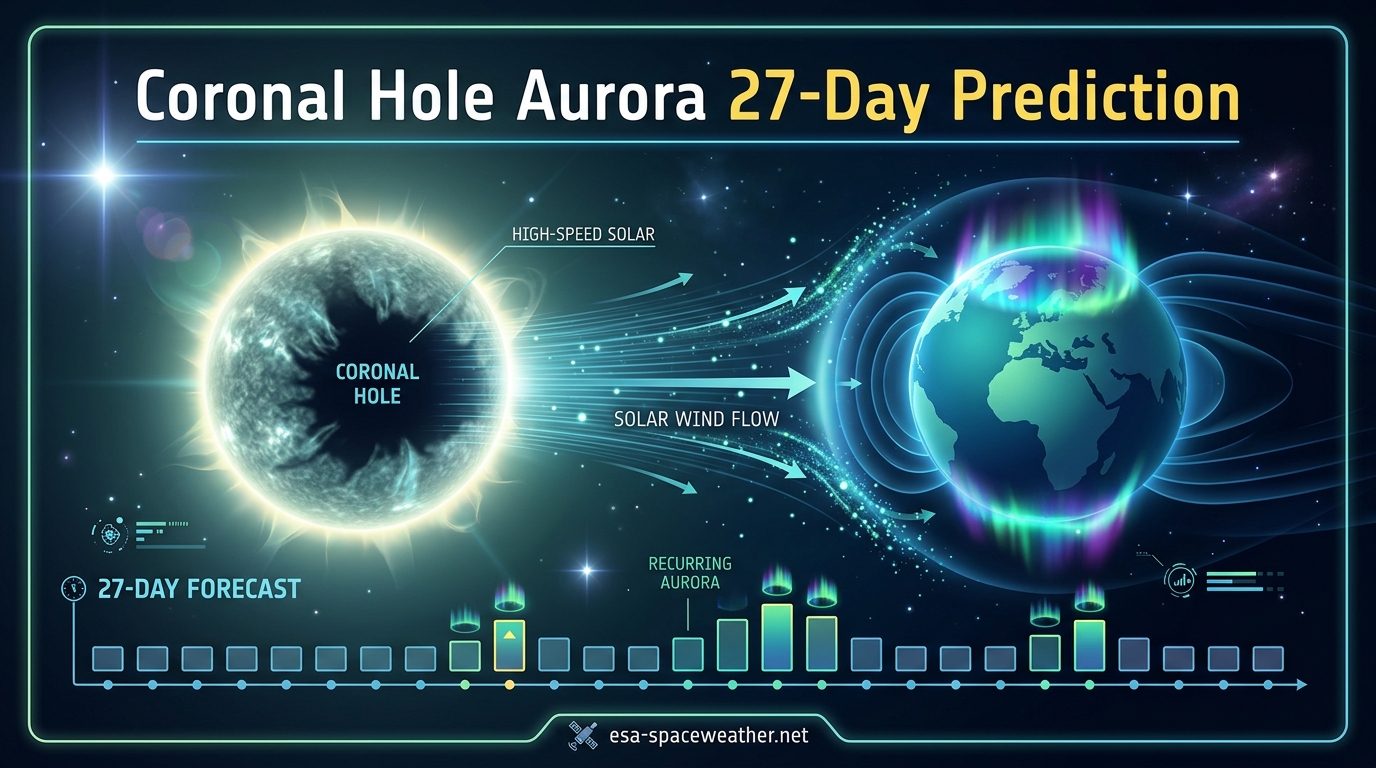
One of the most satisfying moments in aurora chasing is predicting a display before anyone else sees it coming. The secret behind many of those predictions is a feature on the Sun called a coronal hole. Understanding coronal hole aurora prediction over 27 days gives you a powerful forecasting tool that most casual skywatchers never use.
Coronal holes are dark patches on the Sun that release streams of high-speed solar wind. Because the Sun rotates roughly every 27 days, these holes can face Earth again and again in a predictable cycle. If you learn to spot them and track their return, you can anticipate aurora displays weeks in advance.
In this guide, we will walk through the science behind coronal holes, the 27-day solar rotation cycle, and a step-by-step method you can use to predict when the northern lights will return. Whether you are a beginner aurora hunter or an experienced space weather watcher, this methodology will sharpen your forecasting skills for 2026.
Table of Contents
What Are Coronal Holes and Why They Matter
A coronal hole is a region in the Sun’s outer atmosphere, the corona, where the magnetic field opens outward instead of looping back to the surface. These open field lines allow solar wind plasma to escape freely into space at much higher speeds than normal. The result is a concentrated stream of charged particles racing through the solar system.
When you look at solar images in extreme ultraviolet wavelengths, coronal holes appear as large, dark areas on the solar disk. They look dark because they contain less hot plasma than the surrounding regions. The darker and larger the hole, the more material it is venting into space.
[solar_image_shortcode type=”coronal_hole” wavelength=”193″ source=”SDO AIA” caption=”A large coronal hole visible as a dark region on the solar disk in extreme ultraviolet imagery from NASA SDO.”]
Coronal holes matter for aurora prediction because they are remarkably persistent. Unlike solar flares or coronal mass ejections that happen in minutes, coronal holes can last for weeks or even months. This stability is what makes the 27-day prediction method possible in the first place.
During Solar Cycle 25, which remains active through 2026, coronal holes have been frequent and sometimes large enough to trigger geomagnetic storms visible at mid-latitudes. Polar coronal holes are especially stable, while mid-latitude holes tend to be the ones that rotate directly into Earth-facing positions.
The 27-Day Solar Rotation Cycle Explained
The Sun does not rotate like a solid body. Its equator spins faster (about 25 days) than its poles (closer to 35 days). From the perspective of Earth, the average rotation period for the latitudes where most Earth-facing coronal holes appear is roughly 27 days. This means a coronal hole that faces us today will rotate back around to face us again in about 27 days.
This 27-day recurrence is the foundation of long-range aurora forecasting. When you spot a coronal hole aimed at Earth, you can mark your calendar for roughly four weeks later. If the hole still exists, it will sweep its high-speed solar wind stream across Earth’s magnetosphere once again.
Aurora chasers in communities like Reddit’s r/SolarMax refer to this pattern as the “coronal hole carousel.” The same holes come around again and again, sometimes for three, four, or even five solar rotations. Each pass brings another chance for aurora displays.
Not every rotation produces the same result, though. The coronal hole may have grown, shrunk, shifted position, or disappeared entirely during those 27 days. That uncertainty is why the 27-day method works best as a planning tool rather than a guarantee.
Space weather agencies like the NOAA Space Weather Prediction Center and the Canadian Space Weather Centre publish official 27-day geomagnetic outlooks based on this recurrence principle. These forecasts estimate which days are likely to see elevated geomagnetic activity based on when known coronal holes will return to Earth-facing positions.
How Coronal Holes Create Aurora (High-Speed Solar Wind Streams)
The normal solar wind flows at about 300 to 500 kilometers per second. When a coronal hole faces Earth, it sends out a high-speed solar wind stream traveling at 600 to 800 kilometers per second or more. This fast stream plows into the slower solar wind ahead of it, creating a compression region called a co-rotating interaction region.
When this compressed, fast-moving stream arrives at Earth, it slams into the magnetosphere. The impact compresses the magnetic field on the dayside and stretches the magnetotail on the nightside. This process, called magnetic reconnection, releases energy that drives charged particles down into the polar atmosphere.
Those particles collide with oxygen and nitrogen atoms in the upper atmosphere, exciting them and producing the glowing light we see as the aurora borealis. Green light comes from oxygen at lower altitudes, while red and purple come from higher or different atmospheric constituents.
Coronal hole aurora tends to be different from CME-driven aurora in character. Coronal mass ejections produce sudden, intense geomagnetic storms that can create spectacular but brief displays. Coronal hole high-speed streams produce longer-lasting but generally milder geomagnetic activity that can persist for several days.
For aurora chasers, this means coronal hole events offer a wider viewing window. Instead of a single explosive night, you might get two or three consecutive nights of moderate to strong aurora activity as the high-speed stream washes over Earth.
Visual Signs: How to Identify Coronal Holes in Solar Images
Learning to read solar images is one of the most valuable skills for aurora prediction. NASA’s Solar Dynamics Observatory, or SDO, provides free real-time images of the Sun in multiple wavelengths. The 193 angstrom wavelength is particularly useful because coronal holes show up clearly as dark patches against the brighter solar surface.
[solar_image_shortcode type=”coronal_hole_earth_facing” wavelength=”211″ source=”SDO AIA” caption=”Earth-facing coronal hole appears as a dark area in SDO AIA 211 angstrom imagery, indicating potential geomagnetic activity in 2 to 4 days.”]
Here is what to look for when scanning solar images for coronal holes:
Dark, irregular regions: Coronal holes look like dark blotches on the Sun. They are not perfectly round and often have jagged or elongated shapes.
Location on the disk: For aurora impact, the coronal hole needs to be facing Earth. Holes near the center of the solar disk are the most geoeffective. Holes near the edges may still have an effect as they rotate toward center.
Size matters: Larger coronal holes generally produce stronger high-speed streams. A small hole may cause only minor geomagnetic activity, while a massive polar hole extension can trigger significant storms.
Persistence across days: Check images from consecutive days to confirm the feature is stable. If it appears in the same spot for multiple days, it is likely a genuine coronal hole rather than a transient feature.
You can access these images through the SDO website, SpaceWeatherLive, or various aurora tracking apps. The key is checking them regularly so you develop an eye for what normal solar activity looks like versus when a coronal hole is present.
The Time Lag: Why Aurora Arrives 2 to 4 Days Later
One of the most common questions from new aurora chasers is how many days after a coronal hole faces Earth will the aurora appear. The answer is typically 2 to 4 days, depending on the speed of the solar wind stream.
Even though high-speed solar wind travels at 600 to 800 kilometers per second, the Sun is about 150 million kilometers away. The solar wind stream from a coronal hole needs time to traverse that distance and reach Earth’s magnetosphere. Faster streams arrive sooner, while slower ones take longer.
[kp_index_chart_shortcode style=”scale” title=”Kp Index and Aurora Visibility Scale” description=”The Kp index measures geomagnetic activity on a scale of 0 to 9. Higher values indicate stronger geomagnetic storms and aurora visible at lower latitudes.”]
This time lag is actually useful for prediction. When you spot a coronal hole facing Earth on a Monday, you know to watch for geomagnetic activity starting Wednesday through Friday. You can use that window to check the Kp index forecast, set up your camera gear, and plan your viewing location.
The Kp index is the standard measure of geomagnetic disturbance. Kp 3 or below means quiet conditions. Kp 4 to 5 indicates active geomagnetic conditions with aurora visible from high latitudes. Kp 6 and above can push the aurora oval into mid-latitudes, making displays visible from much of northern Europe, Canada, and the northern United States.
How to Tell When a Coronal Hole Will Bring the Aurora Back: Step-by-Step Prediction Methodology
Now let us put everything together into a practical workflow you can follow each week. This is the same basic process that experienced aurora chasers and space weather forecasters use.
[step_by_step_infographic_shortcode title=”Coronal Hole Aurora Prediction Workflow” steps=”7″ style=”vertical” description=”A visual guide showing the seven steps from spotting a coronal hole to confirming aurora arrival.”]
Step 1: Check current solar images. Open the SDO AIA 193 angstrom image or visit SpaceWeatherLive for the latest solar disk view. Look for any dark, irregular patches on the Earth-facing side of the Sun.
Step 2: Identify and assess coronal holes. If you see a dark region, note its size and position. Is it large enough to produce a significant high-speed stream? Is it near the center of the disk where it will have maximum impact?
Step 3: Mark the expected arrival window. Add 2 to 4 days to today’s date. This is your predicted window for geomagnetic activity. Write it down or set a reminder.
Step 4: Monitor the 27-day recurrence. If you are tracking a coronal hole you have seen before, add 27 days to the last date it faced Earth. This gives you the next expected return of its high-speed stream.
Step 5: Watch the Kp index forecast. As your predicted window approaches, check the 3-day Kp forecast from NOAA or SpaceWeatherLive. Rising Kp values confirm the high-speed stream is arriving as expected.
Step 6: Check the interplanetary magnetic field Bz component. The Bz tells you whether the magnetic field embedded in the solar wind is pointing south (negative) or north (positive). A strongly negative Bz allows more energy to couple with Earth’s magnetosphere, producing stronger aurora. This data is available from NOAA’s real-time solar wind page.
Step 7: Confirm with the aurora forecast map. Use a real-time aurora oval map to see if the display has reached your latitude. These maps update every few minutes and show exactly where the aurora is visible right now.
[aurora_forecast_embed_shortcode source=”NOAA OVATION” type=”real_time” title=”Real-Time Aurora Forecast Map” description=”Live aurora oval forecast showing current geomagnetic activity and predicted aurora visibility by latitude.”]
By following these seven steps, you build a complete picture from solar observation to aurora confirmation. The more you practice this workflow, the better your predictions will become.
Tools and Resources for Tracking Coronal Holes
You do not need expensive equipment to track coronal holes. All the tools below are free and publicly available. The key is knowing where to look and how to interpret the data.
NASA SDO (Solar Dynamics Observatory): The gold standard for solar imagery. SDO provides near-real-time images of the Sun in multiple EUV wavelengths. The 193, 211, and 304 angstrom channels are best for spotting coronal holes.
NOAA Space Weather Prediction Center: Offers the official 3-day geomagnetic forecast, 27-day outlook, and real-time solar wind data from the DSCOVR satellite. This is the primary source for space weather forecasts in the United States.
SpaceWeatherLive.com: A user-friendly site that aggregates data from multiple sources. It shows current coronal hole positions, solar wind speed, Kp index, and Bz values in a clean interface. Many aurora chasers use this as their daily dashboard.
Canadian Space Weather Centre: Publishes a detailed 27-day magnetic activity forecast that is particularly useful for long-range planning. The forecast uses the DRX index to estimate daily geomagnetic activity levels.
Dr. Tamitha Skov (Space Weather Woman): A space weather physicist who produces weekly video forecasts on YouTube. She explains current solar conditions and predicts aurora activity in an accessible, engaging format.
Aurora alert apps: Several free and paid apps send push notifications when geomagnetic activity rises above your chosen threshold. Popular options include My Aurora Forecast, Aurora Pro, and SpaceWeatherLive mobile app.
The best approach is to combine several of these tools. Use SDO images to spot coronal holes, the NOAA 27-day outlook for long-range planning, and SpaceWeatherLive for real-time monitoring as the predicted window arrives.
Limitations and Accuracy Factors
The 27-day coronal hole prediction method is powerful, but it has real limitations. Understanding these will save you from disappointment and help you calibrate your expectations.
Coronal holes evolve. A large coronal hole on one rotation may shrink, fragment, or disappear entirely by the next. The coronal hole carousel is not a precise clock. Some holes persist for many rotations, while others vanish after just one pass.
The Bz component is unpredictable. Even if a high-speed stream arrives on schedule, the embedded magnetic field orientation determines how strongly it couples with Earth’s magnetosphere. A stream with a northward Bz will glance off with minimal effect, while the same stream with a southward Bz can trigger a significant storm. Current forecasting cannot predict Bz orientation more than about an hour in advance.
Not all coronal holes face Earth effectively. A coronal hole at a high solar latitude may not send its stream directly toward Earth. The most geoeffective holes are those positioned near the solar equator or mid-latitudes on the Earth-facing disk.
Prediction accuracy decreases with time. A 2 to 4 day prediction based on a currently Earth-facing coronal hole is fairly reliable. A 27-day prediction based on recurrence is useful for planning but has a lower success rate, perhaps 50 to 70 percent depending on the hole’s persistence.
Common beginner mistakes to avoid:
Do not assume every dark patch on the Sun is a coronal hole. Filaments and other features can also appear dark. Check multiple wavelengths to confirm. Do not ignore the Bz component. A perfectly timed high-speed stream with a northward Bz will produce little to no aurora. And do not expect the 27-day forecast to be exact to the day. The actual arrival can vary by a day or more.
Despite these limitations, the coronal hole method remains one of the most practical tools in an aurora chaser’s toolkit. It gives you something no other prediction method offers: a heads-up weeks in advance that a display might be coming.
FAQs
How long do coronal holes last?
Polar coronal holes are large, stable features that can persist for months or even years, dominating during solar minimum. Mid-latitude coronal holes typically last from weeks to a few months and can recur every 27 days as the Sun rotates. Their lifespan depends on the solar cycle phase and magnetic activity at that latitude.
How far in advance can the northern lights be predicted?
Aurora can be predicted with varying accuracy at different timescales. One to three days ahead is the most reliable window, based on confirmed coronal hole positions and real-time solar wind data. Twenty-seven days ahead is possible when tracking recurring coronal holes, though with lower accuracy. Solar cycle patterns can hint at general activity levels months in advance.
Will aurora be strong in 2026?
Solar Cycle 25 remains active through 2026, providing regular coronal hole activity and occasional CME events. The cycle peak is expected around 2025 to 2026, meaning continued strong aurora displays at high and mid-latitudes. Coronal holes remain a reliable source of geomagnetic activity even as the cycle gradually transitions past its maximum.
Will the northern lights still be strong in 2027?
Aurora activity should remain above average through 2027 as Solar Cycle 25 slowly declines from its maximum. While the frequency of major storms may decrease compared to 2025 to 2026, coronal hole high-speed streams will continue producing regular aurora displays. Mid-latitude visibility will become less frequent as the cycle trends toward solar minimum.
What is the difference between a coronal hole and a coronal mass ejection?
A coronal hole is a persistent region of open magnetic field that releases a steady high-speed solar wind stream over days or weeks. A coronal mass ejection, or CME, is a sudden explosion that launches a massive blob of plasma and magnetic field into space in hours. Coronal holes produce longer-lasting but milder geomagnetic activity, while CMEs produce shorter, more intense storms.
Can coronal holes disappear during the 27-day rotation?
Yes. Coronal holes are dynamic features that can shrink, fragment, or close entirely during the 27-day solar rotation. This is the main source of uncertainty in 27-day aurora predictions. A coronal hole that produced a strong display on one rotation may be significantly weaker or absent on the next pass.
Conclusion: Putting It All Together for Better Aurora Forecasting
Predicting when a coronal hole will bring the aurora back in 27 days is one of the most rewarding skills an aurora chaser can develop. It transforms you from someone who waits for alerts into someone who sees the displays coming weeks ahead of time.
The method comes down to a few core principles. Spot the dark coronal hole regions on SDO solar images. Calculate the 2 to 4 day arrival window for the high-speed stream. Track the 27-day recurrence for long-range planning. Monitor the Kp index and Bz component for real-time confirmation.
No prediction method is perfect, and coronal holes can surprise you by vanishing or weakening between rotations. But the 27-day cycle gives you a structured, science-based approach that outperforms guesswork every time.
Start practicing today. Open a solar image, look for dark patches, and mark your calendar. The next time a coronal hole sweeps its stream across Earth, you will be ready and waiting under a sky full of light.