
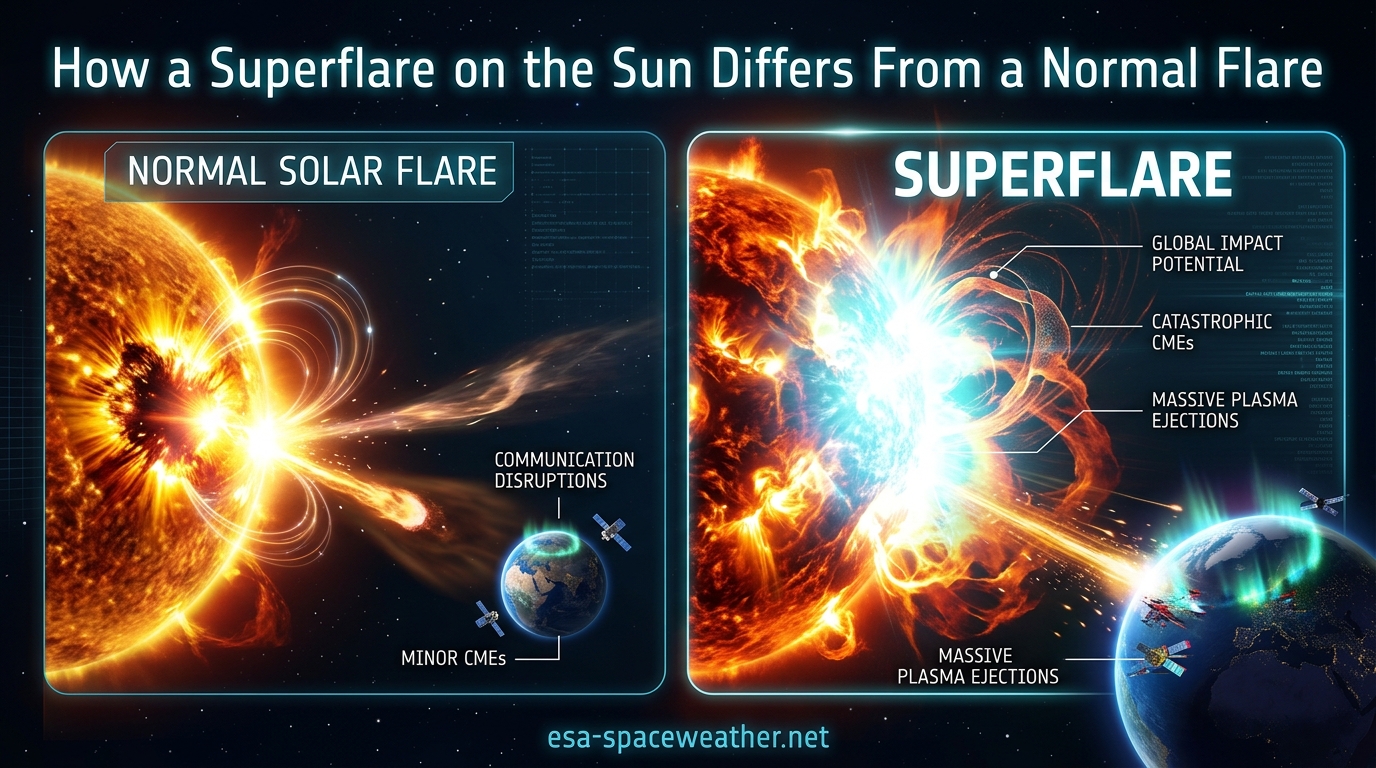
Every second, the Sun converts about 600 million tons of hydrogen into helium, releasing energy that has sustained life on Earth for billions of years. But occasionally, our star hiccups. Solar flares erupt from its surface in brilliant flashes of electromagnetic radiation, and most of the time, we barely notice. Then there are superflares, explosions so vast they make the largest solar flare ever recorded look like a spark from a campfire. Understanding how a superflare on the Sun would differ from a normal flare matters more than ever in 2026, as our civilization grows increasingly dependent on satellites, power grids, and wireless technology that a severe space weather event could cripple.
A superflare is a stellar explosion that releases up to ten thousand times more energy than a typical solar flare. While normal solar flares occur frequently and range from harmless to disruptive, a true superflare would be a civilization-altering event. The difference is not just one of degree but of consequence. Our team has dug into the latest research, including the December 2026 Science study that analyzed 56,450 sun-like stars, to break down exactly what separates these two phenomena.
In this guide, we cover how normal solar flares work, what makes a superflare fundamentally different, what historical evidence tells us about past events, and what ESA missions like Solar Orbiter and the upcoming Vigil spacecraft are doing to help us prepare. We also address the questions people ask most often, including whether a superflare could destroy Earth (it would not) and whether we are overdue for one.
Table of Contents
Quick Answer: How a Superflare Differs From a Normal Flare
A superflare differs from a normal solar flare in five major ways. First, energy output: a superflare releases up to 10,000 times more energy than the largest solar flare ever directly observed. Second, duration: superflares can last several hours, compared to minutes for typical flares. Third, particle acceleration: superflares generate far more intense streams of solar energetic particles. Fourth, magnetic footprint: superflares require enormously larger sunspot regions with far more complex magnetic fields. Fifth, frequency: while the Sun produces thousands of normal flares per solar cycle, evidence suggests it may produce a superflare roughly once per century.
If you want the one-sentence version: a superflare is the same physical process as a solar flare, specifically magnetic reconnection, but operating on a scale so vast that the resulting explosion could overwhelm technology and infrastructure across entire continents.
What Is a Solar Flare? The Baseline
A solar flare is a sudden, intense burst of electromagnetic radiation from the Sun’s surface, typically occurring in or around active regions known as sunspots. These explosions happen when magnetic energy that has built up in the solar atmosphere is suddenly released in a process called magnetic reconnection. Think of it as the Sun snapping a rubber band that has been twisted too tight.
Magnetic reconnection occurs when oppositely directed magnetic field lines come together, break, and reconnect into a lower-energy configuration. The energy difference is released as radiation across the entire electromagnetic spectrum: radio waves, visible light, ultraviolet, X-rays, and gamma rays. This entire process takes place in the solar corona, the Sun’s outer atmosphere, where temperatures already exceed one million degrees.
Solar Flare Classification: From A to X
Scientists classify solar flares by their X-ray brightness using a letter-based scale: A, B, C, M, and X. Each letter represents a tenfold increase in energy over the one before it, and a number after the letter provides finer detail.
A-class and B-class flares are the most common and have essentially no impact on Earth. C-class flares are minor events with few noticeable consequences. M-class flares (M for “medium”) can cause brief radio blackouts near the poles and minor radiation storms. X-class flares are the big ones, the classification reserved for the most powerful solar flares our Sun routinely produces.
Within the X-class, the scale continues linearly. An X2 flare is twice as powerful as an X1, an X3 is three times as powerful, and so on. The largest directly measured solar flare, which occurred on November 4, 2003, overloaded the sensors and was estimated at about X45. This is the ceiling of what modern instruments have captured from our Sun.
Understanding this classification scale matters because it contextualizes the superflare energy difference. The most powerful X-class flares top out around 10^26 joules of energy. A superflare starts where the X-class ends and can reach 10^30 joules or more. The gap between the largest recorded solar flare and a modest superflare is like the gap between a firecracker and a stick of dynamite.
Solar Flare vs Coronal Mass Ejection: A Common Confusion
One of the most persistent sources of confusion in space weather is the difference between a solar flare and a coronal mass ejection, or CME. They are related phenomena, but they are not the same thing, and understanding the distinction is critical for understanding what a superflare would do.
A solar flare is a flash of light and electromagnetic radiation. It travels at the speed of light and reaches Earth in about eight minutes. Flares cause radio blackouts on the sunlit side of Earth almost immediately because they ionize the upper atmosphere.
A coronal mass ejection is an eruption of plasma and magnetic field from the Sun. CMEs travel much slower, taking one to three days to reach Earth. When a CME arrives and its magnetic orientation is opposite to Earth’s protective magnetosphere, it triggers a geomagnetic storm. These storms are what cause auroras, power grid failures, and satellite damage.
Flares and CMEs often occur together, and the most dangerous solar events involve both. A superflare would almost certainly be accompanied by a massive CME, making it a combined electromagnetic and physical threat.
What Is a Superflare?
A superflare is an extremely powerful stellar explosion, first identified on other stars, that releases energies between roughly 10^32 and 10^36 ergs (10^25 to 10^29 joules). For comparison, the largest recorded solar flare released about 5 x 10^25 joules. A superflare on the lower end of the scale would be roughly a hundred times more powerful. The most extreme superflares observed on sun-like stars have been a thousand to ten thousand times stronger.
The term “superflare” was coined in 1989 by astrophysicist Bradley Schaefer, who identified nine candidate stars that had produced enormous optical flares. But the concept remained somewhat obscure until the Kepler space telescope began observing stars with unprecedented sensitivity in 2009. What Kepler found stunned the astronomy community.
Over its mission, Kepler observed thousands of sun-like stars and documented that many of them produce superflares regularly. Some stars flared every few days with energies far exceeding anything ever recorded from our Sun. The initial reaction from many solar physicists was skepticism. If sun-like stars produce superflares, why have we never seen one from our own Sun?
Starspot Coverage and the Superflare Connection
Research using Kepler data revealed a key pattern: stars that produce superflares tend to have larger starspot coverage than the Sun. Sunspots are dark regions of intense magnetic activity, and the more magnetic area a star has on its surface, the more magnetic energy it can store and release. Some superflare stars have starspot coverage exceeding 1% of their surface, compared to the Sun’s typical 0.01% to 0.1%.
This does not mean the Sun is incapable of superflares. It means the Sun is usually calmer than most stars in the Kepler sample. But it also raises a question that scientists are still working to answer: could the Sun, under the right conditions during an active solar maximum, produce a much larger starspot region than anything we have observed in the modern era?
The Visual Impact of a Superflare
Normal solar flares are usually invisible to the naked eye because they are brightest in X-ray and ultraviolet wavelengths that human eyes cannot detect. A superflare would be different. Some superflares observed by Kepler produced visible-light brightening so significant that the star’s brightness increased by detectable percentages for hours.
If a superflare occurred on the Sun, it would likely be visible as a brilliant flash of white light on the solar surface. These “white-light flares” have been observed during the very strongest solar flares, including some during the Carrington Event of 1859. A full superflare would make those look modest by comparison.
How a Superflare on the Sun Would Differ From a Normal Flare
This is the central question, and the answer spans multiple dimensions. A superflare and a normal solar flare share the same fundamental mechanism, magnetic reconnection, but the scale and consequences diverge dramatically. Here is how they differ across every meaningful dimension.
1. Energy Release
The energy difference is the most striking and fundamental distinction. A typical X-class solar flare releases about 10^25 to 10^26 joules. The Carrington Event of 1859, the most powerful solar storm in recorded history, released roughly 5 x 10^25 joules. A superflare would release 10^27 to 10^29 joules, putting it 100 to 10,000 times above even the Carrington Event.
To put that in perspective, the total energy the Sun radiates in one second is about 3.8 x 10^26 joules. A superflare would release a significant fraction of a second’s worth of the Sun’s total output, concentrated in a single explosive event lasting minutes to hours.
2. Duration
Normal solar flares typically last from a few minutes to about an hour. The impulsive phase, when most energy is released, often lasts only seconds to minutes. The gradual decay phase can extend for a few hours.
Superflares last significantly longer. Observations from Kepler show superflare events lasting several hours, with some extending for most of a day. The longer duration means sustained radiation exposure and prolonged effects on Earth’s upper atmosphere.
3. Frequency and Probability
The Sun produces thousands of C-class flares, hundreds of M-class flares, and several X-class flares during each 11-year solar cycle. X-class flares can occur multiple times per week during solar maximum.
Superflares are far rarer on the Sun, but the December 2026 study from the Max Planck Institute analyzed 56,450 sun-like stars and concluded that stars like ours produce superflares roughly once per century. This estimate is significantly more frequent than earlier studies suggested, which placed the interval at 500 to 1,000 years. If this once-per-century estimate holds, the Sun is more capable of extreme outbursts than we have assumed.
4. Particle Acceleration
Solar flares accelerate charged particles to high energies, producing solar energetic particle events. These particles are what pose radiation risks to astronauts and can damage satellite electronics.
A superflare would produce a vastly more intense solar energetic particle storm. The radiation environment in near-Earth space would be far more dangerous for satellites, spacecraft, and any astronauts outside Earth’s protective magnetosphere, such as those on a mission to the Moon or Mars.
5. Magnetic Field Requirements
Normal solar flares occur in active regions with sunspot areas ranging from a few hundred millionths to a few thousand millionths of the Sun’s visible hemisphere. A superflare would require an enormously larger active region, potentially covering 1% or more of the Sun’s surface with intense, complex magnetic fields.
The largest sunspot region observed in the satellite era, AR 12192 from October 2014, covered about 0.3% of the solar hemisphere. A superflare-producing region would need to be substantially larger, something the Sun may be capable of producing but has not done in the modern instrumental record.
6. Coronal Mass Ejection Scale
The CME associated with a normal X-class flare can contain 10^15 to 10^16 grams of plasma traveling at 2,000 to 3,000 kilometers per second. A superflare-associated CME would be orders of magnitude more massive and potentially faster, delivering a much stronger geomagnetic impact when it reaches Earth.
Comparison at a Glance
| Characteristic | Normal Solar Flare (X-class) | Superflare |
|---|---|---|
| Energy released | 10^25 to 10^26 joules | 10^27 to 10^29 joules |
| Comparison to Carrington Event | Similar or up to 10x stronger | 100x to 10,000x stronger |
| Duration | Minutes to 1 hour | Several hours |
| Frequency on the Sun | Several per solar cycle | Estimated once per century |
| Sunspot region size | Moderate to large | Enormous (1%+ of surface) |
| Visible to naked eye? | Rarely (white-light only) | Yes, likely brilliant flash |
| Earth impact severity | Regional disruptions | Continental to global |
| Extinction risk? | No | No (technology risk only) |
The key takeaway is that a superflare is not a different type of event from a solar flare. It is the same mechanism operating on a vastly larger scale. The physics does not change, but the consequences scale up enormously.
How Scientists Detect Past Superflares
We have never directly observed a superflare on the Sun with modern instruments. But scientists have found compelling evidence that the Sun has produced superflare-level events in the past. This evidence comes from an unexpected source: the natural archives preserved in tree rings and polar ice.
Cosmogenic Isotopes: Nature’s Solar Event Recorders
When a powerful solar flare or superflare occurs, it accelerates cosmic ray particles that collide with atoms in Earth’s atmosphere. These collisions produce radioactive isotopes, most notably carbon-14 (C-14) and beryllium-10 (Be-10), that do not normally exist in such high concentrations. These isotopes settle into tree rings, ice cores, and sediment layers, preserving a record of extreme solar activity spanning thousands of years.
By measuring isotope concentrations in ancient tree rings and ice core samples, scientists can identify years when solar activity spiked dramatically. These spikes, called Miyake events after the researcher Fusa Miyake who discovered them, represent the strongest candidates for past solar superflares.
The AD 774/775 Miyake Event
The most famous and well-studied Miyake event occurred in AD 774 or 775. Tree rings from around the world show a sudden, sharp increase in carbon-14 that year, roughly 20 times larger than normal annual variation. Beryllium-10 spikes in Antarctic and Greenland ice cores from the same period confirm that this was a global event.
Scientists estimate that whatever caused the AD 774 event released roughly 10 times more energy than the Carrington Event. Some analyses suggest it could have been even larger. While not all researchers agree on whether this was a true superflare or a very large solar energetic particle event, it demonstrates that the Sun is capable of far more extreme behavior than we have witnessed in modern times.
The AD 993/994 Event
A second, smaller but still significant carbon-14 spike was identified in AD 993 or 994. While less intense than the AD 774 event, it still represents solar activity well beyond anything in the instrumental record. Together, these two events within a 220-year span suggest that extreme solar outbursts may be more frequent than the historical record of observed auroras and flares would indicate.
The Superflare Quandary
Here is the puzzle that solar physicists are still working to solve. Kepler observations show sun-like stars producing superflares roughly once per century. But tree ring and ice core records only show two major events in the past 2,000 years, and neither was definitively a full-scale superflare.
There are several possible explanations for this discrepancy. The Sun might be genuinely less active than the average sun-like star. Kepler might have misidentified some stars as sun-like when they are actually younger or more rapidly rotating. Or the terrestrial isotope record may underrepresent solar events because not every flare produces a detectable isotope spike.
The December 2026 study from the Max Planck Institute addressed this quandary by analyzing 56,450 sun-like stars with carefully selected properties matching the Sun. Their finding that superflares occur about once per century on such stars suggests the discrepancy may narrow as we refine both stellar and terrestrial data.
Could a Superflare Happen on Our Sun?
The short answer is yes, the Sun is capable of producing a superflare. The evidence comes from two independent lines of research: observations of sun-like stars and terrestrial isotope records. Both point to the same conclusion that our star is not as calm as its recent behavior suggests.
The Max Planck team’s 2026 study, published in the journal Science, was the largest statistical analysis of superflares on sun-like stars ever conducted. By examining 56,450 stars with surface temperatures, surface gravities, and rotation periods similar to the Sun, they found that such stars produce superflares with energies of 10^33 ergs or more approximately once per century. Their estimate is a hundred times more frequent than what earlier, smaller studies had suggested.
This does not mean a superflare will happen tomorrow, or even in our lifetimes. It means the Sun has the physical capacity to produce one, and the probability is higher than many scientists previously assumed. The Sun’s magnetic dynamo, which generates the magnetic fields that ultimately power flares, is the same basic mechanism operating in those superflare-producing stars.
Some researchers argue that the Sun may be in a particularly quiet phase. The Sun spent an unusually long solar minimum from 2008 to 2010, and the current solar cycle has been moderate by historical standards. But the geological record shows that quiet periods do not last forever, and the Sun’s long-term behavior includes episodes of far greater activity.
Solar Maximum and Superflare Timing
Solar flares of all sizes are more frequent during solar maximum, the peak of the 11-year solar cycle when the Sun’s magnetic field is most disordered. We are currently in the maximum phase of Solar Cycle 25, which began in late 2019. While this cycle has produced several impressive X-class flares, nothing approaching superflare energy has been detected.
However, the fact that we have not seen one does not mean one could not develop rapidly. A superflare would require a sunspot region significantly larger than any in recent memory, and the Sun could in principle build one during any particularly active period.
The Carrington Event: Our Best Historical Benchmark
Any discussion of extreme solar activity eventually arrives at the Carrington Event of September 1 and 2, 1859. It remains the most powerful solar storm in recorded history and our best benchmark for understanding what a large solar flare can do to Earth.
British astronomer Richard Carrington was observing sunspots when he noticed a brilliant flash of white light on the Sun’s surface. The flash was a white-light flare, one strong enough to be seen in visible light without specialized equipment. What followed, about 17 to 18 hours later, was a massive geomagnetic storm.
Auroras were reported as far south as Cuba, Hawaii, and even parts of the Caribbean. People in the northeastern United States reportedly could read newspapers by the light of the aurora at night. Telegraph systems, the high technology of the era, malfunctioned dramatically. Operators received electric shocks, telegraph paper caught fire, and some systems continued operating even after being disconnected from their power sources, powered by currents induced in the wires by the geomagnetic storm.
The Carrington Event released an estimated 5 x 10^25 joules of energy. It was an X-class flare of exceptional size, possibly X40 or larger. But it was still a solar flare, not a superflare. A true superflare would be at minimum 100 times more energetic. If the Carrington Event caused telegraph wires to spark and catch fire, a superflare could cause similar effects across modern power grids on a continental scale.
More recently, the March 1989 geomagnetic storm, caused by an X-class flare and CME, collapsed the Hydro-Quebec power grid in just 90 seconds, leaving six million people without electricity for nine hours. That event was far smaller than Carrington, which was itself far smaller than a superflare. The scaling gives pause.
What Would Happen If a Solar Superflare Hit Earth?
The effects of a solar superflare striking Earth would be severe but not apocalyptic. Let us be clear about one thing first: a superflare would not destroy the planet, would not cause mass extinction, and would not directly harm humans on the ground. Earth’s atmosphere and magnetic field provide effective shielding against radiation for everyone on the surface. The real danger is to technology and infrastructure.
Here is what would unfold, roughly in order of timing.
Minutes After the Flare: Electromagnetic Pulse
The flare’s electromagnetic radiation, primarily X-rays and ultraviolet, would reach Earth in about eight minutes, traveling at the speed of light. This burst would ionize the upper atmosphere on the sunlit side of Earth, causing sudden ionospheric disturbances. High-frequency radio communications would be immediately disrupted or blacked out, affecting aviation, maritime operations, and emergency services on the dayside of the planet.
Minutes to Hours: Radiation Storm
Solar energetic particles accelerated by the flare would arrive within 15 minutes to a few hours. These particles pose a radiation hazard to astronauts in space and to high-altitude flight crews on polar routes. Satellites would be exposed to intense radiation that could damage solar panels, corrupt electronics, and in extreme cases destroy spacecraft entirely.
One to Three Days: Geomagnetic Storm
The associated coronal mass ejection would reach Earth in one to three days, depending on its speed. When it arrives, the massive cloud of charged plasma would interact with Earth’s magnetosphere, producing an extreme geomagnetic storm.
The most consequential effect would be on power grids. Geomagnetically induced currents would flow through long-distance transmission lines, overwhelming transformers and potentially causing widespread, cascading blackouts. Unlike a local outage, transformer damage can take weeks or months to repair. A superflare-scale event could leave large regions without power for extended periods.
GPS and satellite navigation systems would degrade or fail as the ionosphere becomes disturbed. Communication satellites could be damaged or destroyed. The increased atmospheric drag from the heated upper atmosphere could alter the orbits of low-Earth-orbit satellites, including parts of mega-constellations like Starlink.
Would Anyone Be Directly Harmed?
People on Earth’s surface would not be directly harmed by the radiation. The atmosphere blocks the harmful particles. The danger is entirely from secondary effects: loss of power, loss of communications, disruption of supply chains, and potential water and food distribution disruptions if power outages are prolonged.
Astronauts on the International Space Station would need to shelter in shielded areas. Crews on future lunar or Mars missions would face more serious radiation risks because they would be outside Earth’s protective magnetosphere.
Reassurance: Not the End of the World
Despite sensationalist media coverage and disaster movies, a superflare is not an extinction-level event. The biosphere has weathered superflares before, as the tree ring and ice core records demonstrate. The AD 774 event, which was likely a near-superflare, occurred during the medieval period with no recorded catastrophic effects on life. The challenge is entirely about protecting our technology-dependent civilization.
How Scientists Monitor Solar Activity Today
Monitoring the Sun for potentially dangerous flares is a 24/7 operation involving ground-based observatories and a fleet of spacecraft. The data from these instruments feeds into space weather forecasting systems that provide early warning for satellite operators, power grid managers, and aviation authorities.
Current Monitoring Missions
NASA’s Solar Dynamics Observatory, or SDO, launched in 2010, watches the Sun continuously in multiple wavelengths. It provides real-time imagery of solar activity and is a primary tool for detecting sunspot regions that could produce flares.
The Solar and Heliospheric Observatory, SOHO, a joint NASA-ESA mission operating since 1995, provides continuous monitoring of the Sun and its corona. SOHO’s LASCO instrument is the workhorse for detecting coronal mass ejections as they erupt from the Sun.
ESA’s Solar Orbiter, launched in 2020, is providing the closest-ever images of the Sun’s polar regions and surface. Solar Orbiter’s unique orbit takes it inside the orbit of Mercury, giving it an unprecedented view of solar processes. Its data is helping scientists understand the magnetic mechanisms that drive flares and CMEs, knowledge that is directly relevant to predicting superflare conditions.
The ESA Vigil Mission: Future Space Weather Forecasting
ESA’s upcoming Vigil mission, planned for the late 2020s, will be the first dedicated space weather monitoring mission. Vigil will be positioned at the L5 Lagrange point, a gravitationally stable location that allows it to view the Sun from a different angle than Earth-orbiting spacecraft. This side-view perspective will let scientists see developing sunspot regions before they rotate to face Earth, potentially providing several extra days of warning for major eruptions.
Vigil represents a shift from reactive monitoring to predictive forecasting. By giving forecasters advance notice of dangerous active regions on the far side of the Sun, Vigil could provide the critical lead time needed to protect power grids, satellites, and astronauts from a potential superflare.
Can Solar Flares Be Predicted?
Short-term flare prediction is improving but remains challenging. Scientists can identify magnetically complex sunspot regions that are likely to produce flares within hours to days. However, predicting exactly when a flare will occur and how large it will be is still beyond current capabilities.
For superflare prediction specifically, the challenge is even greater. We have never observed a superflare developing on the Sun, so we do not fully understand the precursor signals. Solar Orbiter and Vigil data will help close this knowledge gap by providing better observations of the magnetic configurations that could lead to extreme events.
What we can predict is the travel time of a CME once it has erupted. Instruments like SOHO’s LASCO can detect a CME within minutes of its launch, and models can estimate when it will arrive at Earth. This gives satellite operators and power grid managers 1 to 3 days to prepare. For the flare’s electromagnetic pulse, which travels at light speed, there is essentially no warning.
Practical Preparedness: What You Can Do
A common question on space weather forums is what ordinary people can do to prepare for a severe solar event. The good news is that the preparedness steps are similar to those for any natural disaster that could disrupt power and communications.
Stay Informed About Space Weather
The first step is knowing when solar activity is elevated. NOAA’s Space Weather Prediction Center provides real-time forecasts and alerts for solar flares, radiation storms, and geomagnetic activity. ESA’s Space Weather Service Network offers similar information for European users. Following these resources during solar maximum can give you advance notice of potential disruptions.
Basic Preparedness Steps
Keep a basic emergency kit with several days of non-perishable food, water, battery-powered or hand-crank radios, flashlights, and spare batteries. A backup power source, such as a charged power bank or generator, can keep essential devices running during an extended outage.
Keep printed copies of important information, including emergency contacts and local maps. GPS and online maps may be unreliable if satellite navigation is disrupted.
Understanding the Warning Timeline
If a major flare occurs, you would experience radio and communication disruptions within minutes. The geomagnetic storm from an accompanying CME would arrive one to three days later. This window is when the most significant infrastructure impacts would occur. Power grid operators use this time to take protective measures, such as adjusting loads and disconnecting vulnerable transformers.
For most people, the practical impact of a superflare would be similar to a prolonged, widespread power outage. Being prepared for that scenario covers most of the practical risks.
Do Not Panic
The most important thing to understand is that a superflare is a known, studied phenomenon with a low probability in any given year. The probability is higher than scientists thought a decade ago, but it is still not something to live in fear of. Earth has experienced these events before and will again. The goal of preparedness is resilience, not anxiety.
Could the Sun have a superflare?
Yes, the Sun is capable of producing a superflare. A 2026 study analyzing 56,450 sun-like stars found that stars with properties matching our Sun produce superflares roughly once per century. While the Sun has not produced a superflare in the modern instrumental era, cosmogenic isotope evidence from tree rings and ice cores shows it has produced near-superflare events in the past, such as the AD 774 Miyake event. The same magnetic dynamo that powers normal solar flares can, under the right conditions, generate vastly more powerful explosions.
What is a solar flare and how is it different from CME?
A solar flare is a sudden burst of electromagnetic radiation, including X-rays and ultraviolet light, released when magnetic field lines in the solar corona reconnect. It travels at the speed of light and reaches Earth in about eight minutes. A coronal mass ejection (CME) is a separate but related event: an eruption of plasma and magnetic field that travels much slower, taking one to three days to reach Earth. Flares cause immediate radio blackouts, while CMEs cause geomagnetic storms that produce auroras, disrupt power grids, and damage satellites.
What would happen if a super solar flare hit Earth?
A superflare hitting Earth would cause severe but not extinction-level effects. Within minutes, radio communications would be disrupted on the sunlit side of Earth. Solar energetic particles would arrive within hours, posing radiation risks to astronauts and damaging satellites. Within one to three days, a massive CME would trigger an extreme geomagnetic storm capable of crippling power grids across continents, disrupting GPS and satellite navigation, and causing widespread technological disruptions. People on Earth’s surface would not be directly harmed by radiation thanks to atmospheric shielding. The primary risk is prolonged infrastructure failure, not direct physical danger.
When was the last solar superflare?
No confirmed superflare has been directly observed from our Sun in the modern era. However, the AD 774/775 Miyake event, detected in tree rings and ice cores worldwide, is the strongest candidate for a near-superflare in the past 2,000 years. It produced a carbon-14 spike roughly 20 times larger than normal variation and released an estimated 10 times more energy than the Carrington Event of 1859. The AD 993/994 event was a smaller but still significant similar occurrence. Whether either event qualifies as a true superflare depends on the definition, but both demonstrate the Sun is capable of far more extreme behavior than we have witnessed directly.
Conclusion
Understanding how a superflare on the Sun would differ from a normal flare comes down to scale, not substance. Both are driven by magnetic reconnection, both produce electromagnetic radiation and particle storms, and both can trigger geomagnetic effects on Earth. The difference is that a superflare operates at energies 100 to 10,000 times greater, lasts longer, requires vastly larger magnetic structures, and would produce consequences spanning continents rather than regions.
The December 2026 finding that sun-like stars produce superflares roughly once per century has shifted the conversation. The Sun is more capable of extreme behavior than its recent calm might suggest. But this is not cause for alarm. Earth has survived these events before, and our growing fleet of monitoring spacecraft, from SDO and SOHO to ESA’s Solar Orbiter and the upcoming Vigil mission, is giving us better tools than ever to detect, predict, and prepare for severe space weather.
The most important thing you can do is stay informed. Follow space weather forecasts during solar maximum, maintain basic emergency preparedness, and remember that while a superflare would be a serious technological challenge, it is not an existential threat. Our star has been producing flares of all sizes for 4.6 billion years. The better we understand its capabilities, the better we can protect the civilization that orbits alongside it.