
Every day, solar flares and geomagnetic storms silently shape the conditions of radio communications across the globe. If you have ever experienced sudden HF radio signal loss or mysterious GPS drift during what seemed like clear weather, space weather was likely the cause. The NOAA Space Weather Scales for Radio exist to make these invisible forces understandable, predictable, and actionable.
In this guide, I will walk you through how the NOAA Space Weather Scales for Radio work, what each level means for your communications, and how you can use this information whether you are an amateur radio operator, a pilot, a maritime navigator, or simply curious about how solar activity shapes our wireless world.
Our team has spent months tracking real-time SWPC data, monitoring forum discussions from the amateur radio and shortwave communities, and correlating NOAA scale alerts with actual radio propagation conditions. The result is a practical, plain-language resource that bridges the gap between NOAA’s technical data and real-world radio operating decisions.
Table of Contents
What Are the NOAA Space Weather Scales?
The NOAA Space Weather Scales are a standardized rating system developed by the National Oceanic and Atmospheric Administration’s Space Weather Prediction Center (SWPC). They communicate the severity of space weather events using a simple 1-to-5 numbering system across three categories.
Each scale corresponds to a different type of space weather disturbance. The R-scale covers radio blackouts caused by solar flares. The S-scale rates solar radiation storms driven by energetic particles. The G-scale measures geomagnetic storms that shake Earth’s magnetic field.
NOAA introduced these scales because space weather events were becoming increasingly disruptive to critical infrastructure. Aviation, maritime operations, satellite communications, power grids, and emergency services all needed a common language to understand and prepare for solar disturbances.
The 1-to-5 format mirrors other familiar severity scales. Level 1 is minor, level 2 is moderate, level 3 is strong, level 4 is severe, and level 5 is extreme. This simplicity lets anyone quickly assess the situation without needing a physics degree.
What makes the NOAA Space Weather Scales for Radio particularly useful is that each level comes with specific, observable effects. An R3 rating does not just say “things are bad.” It tells you that HF radio will experience a wide-area blackout on the sunlit side of Earth for approximately one hour.
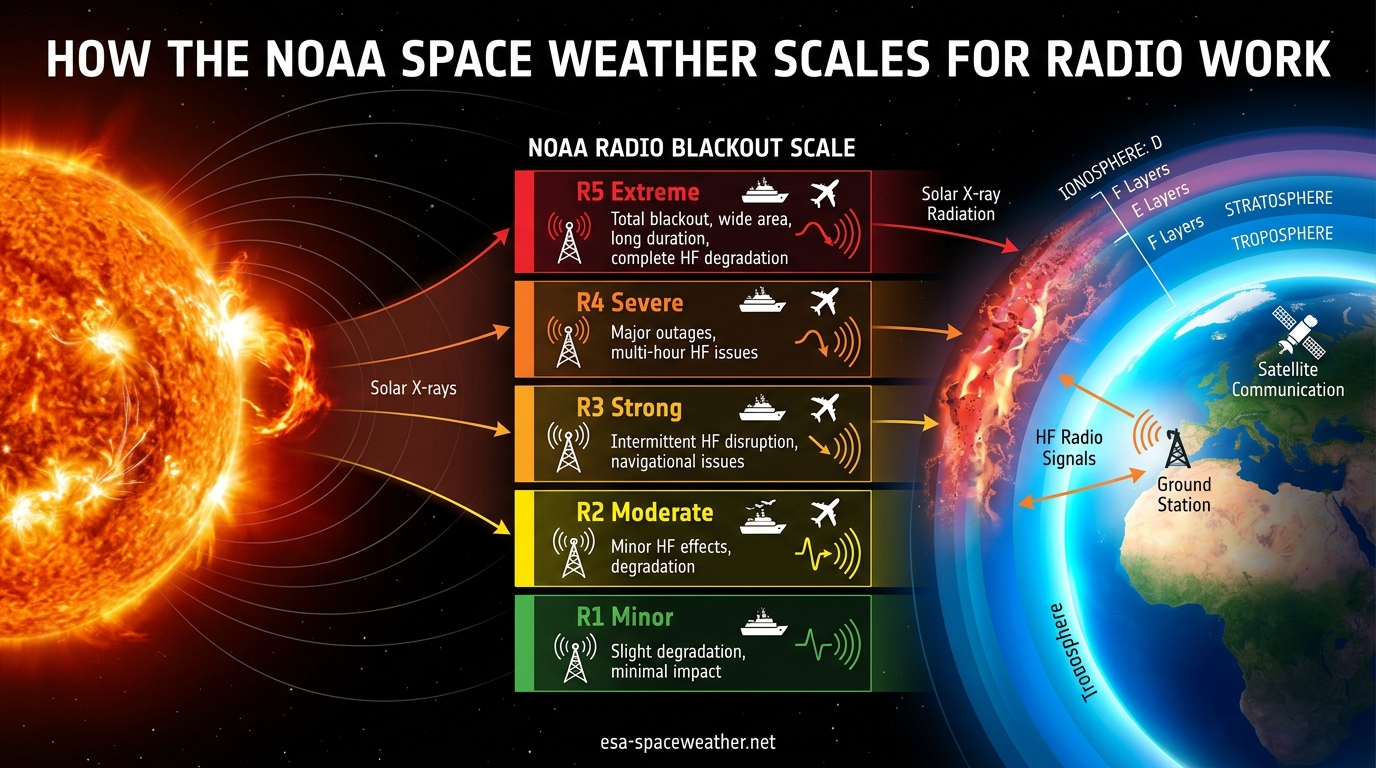
The Radio Blackout Scale (R-Scale) Explained: R1 Through R5
The R-scale is the most directly relevant NOAA Space Weather Scale for radio operators. It measures the severity of radio blackouts caused by X-ray radiation from solar flares, using data from the GOES satellite’s X-ray sensors.
When a solar flare erupts on the sun, it releases a burst of X-ray energy that reaches Earth in about eight minutes. That radiation hits the upper atmosphere and ionizes the D-layer of the ionosphere, which absorbs HF radio signals instead of reflecting them. The result is a sudden blackout of high-frequency radio communication on the sunlit side of the planet.
R1 – Minor Radio Blackout
An R1 event is the most common radio blackout level. It corresponds to an M1-class X-ray flare as measured by the GOES satellite. The physical threshold is an X-ray flux of 1×10⁻⁵ Watts per square meter.
At R1, HF radio users on the sunlit side of Earth experience weak or minor degradation of radio signals. Shortwave listeners may notice signal fading or what operators call “solar flutter” on paths crossing the daylight hemisphere. Navigation signals using low frequencies see minor degradation.
R1 events occur roughly 2,000 times per solar cycle (about 11 years). During solar maximum, you might see several R1 events per week. Most casual radio users will barely notice an R1 event.
R2 – Moderate Radio Blackout
R2 blackouts are associated with M5-class solar flares, meaning the X-ray flux reaches 5×10⁻⁵ Watts per square meter. At this level, the effects on radio become more noticeable.
During an R2 event, HF radio communication suffers limited blackout on the sunlit side of Earth for tens of minutes. Operators may experience signal loss or significant fading on affected paths. Low-frequency navigation signals can experience intermittent disruptions.
R2 events happen approximately 350 times per solar cycle. Amateur radio operators actively tracking propagation conditions will definitely notice an R2 event, as HF bands may become unusable for brief periods during daylight hours.
R3 – Strong Radio Blackout
An R3 rating indicates a strong radio blackout triggered by an X1-class solar flare. The GOES X-ray flux at this level reaches 1×10⁻⁴ Watts per square meter. This is where radio impacts become genuinely disruptive.
At R3, HF radio experiences a wide-area blackout on the sunlit side of Earth lasting about one hour. This means all HF communication paths through the daylight hemisphere can be lost. Low-frequency navigation signals experience outage for approximately one hour as well.
R3 events occur roughly 175 times per solar cycle. Aviation communications over oceanic routes that rely on HF voice are significantly impacted. Maritime operators may lose contact with shore stations. Amateur radio operators on the sunlit side will see bands go quiet almost instantly.
Reddit users in the r/shortwave community frequently report R3 events as the threshold where shortwave listening becomes frustratingly difficult. Signals from transmitters on the sunlit side of Earth simply vanish for the duration of the event.
R4 – Severe Radio Blackout
R4 events are associated with X10-class solar flares. The GOES X-ray flux reaches 1×10⁻³ Watts per square meter at this level. These are serious events that cause major communication disruptions.
During an R4 blackout, HF radio communication experiences an outage on most of the sunlit side of Earth lasting one to two hours. Low-frequency navigation signals are disrupted for one to two hours as well. The affected area is much larger than at R3.
R4 events are relatively rare, occurring about 8 times per solar cycle. When they happen, aviation authorities may need to reroute flights that depend on HF communication. Emergency communication systems relying on HF can be severely impacted. Many radio operators describe R4 events as the level where you simply shut down operations and wait.
R5 – Extreme Radio Blackout
An R5 rating represents the most extreme radio blackout level, triggered by X20-class or larger solar flares. The GOES X-ray flux exceeds 2×10⁻³ Watts per square meter. R5 events are extraordinarily rare.
At R5, HF radio experiences a complete blackout on the entire sunlit side of Earth lasting for several hours. All HF communication paths through the daylight hemisphere are completely absorbed. Low-frequency navigation signals experience a complete outage that can last many hours.
R5 events occur fewer than 1 time per solar cycle. The Carrington Event of 1859 and the 2003 Halloween storms are examples of events that would likely have reached R5 levels had the scale existed. During an R5 event, HF radio communication is simply impossible on the sunlit side of Earth.
The physical basis for the R-scale is straightforward. GOES satellites continuously monitor the sun’s X-ray output. When the X-ray flux exceeds specific thresholds and persists for more than a few minutes, NOAA assigns the corresponding R-scale rating. The scale is purely based on X-ray intensity, not on the coronal mass ejection that may accompany the flare.
The Solar Radiation Storm Scale (S-Scale) – S1 Through S5
The S-scale measures solar radiation storms caused by energetic protons accelerated during solar eruptions. While the R-scale is based on X-ray measurements, the S-scale uses particle flux data measured by GOES satellites at geosynchronous orbit.
The key measurement is the flux of protons with energies greater than 10 MeV (mega-electron volts), expressed in particles per second per steradian per square centimeter. When these proton levels exceed specific thresholds, NOAA assigns an S-scale rating.
For radio operators, the S-scale matters because of a phenomenon called polar cap absorption (PCA). Energetic protons spiral along Earth’s magnetic field lines and enter the atmosphere near the polar regions. There, they ionize the D-layer and absorb HF radio signals that pass through polar paths.
S1 – Minor Solar Radiation Storm
An S1 event corresponds to a proton flux of 10 particles per second per steradian per square centimeter at energies above 10 MeV. Effects are minor for most radio operations.
S1 storms may cause minor impacts on HF radio communication through polar regions. Passengers and crew on high-altitude flights at high latitudes face slightly elevated radiation exposure. Satellite operations experience minor effects.
S2 and S3 – Moderate to Strong Radiation Storms
S2 events (100 pfu) and S3 events (1,000 pfu) represent increasing proton flux levels. At S3, HF radio communication in polar regions experiences degraded performance. Airlines begin rerouting polar flights to avoid communication blackout risks and radiation exposure.
Pilots on Reddit report that during S3+ radiation storms, polar route flights are diverted to lower latitudes. This adds flight time and fuel costs but avoids the risk of losing HF communication in remote Arctic regions where satellite coverage may also be limited.
S4 and S5 – Severe to Extreme Radiation Storms
S4 events (10,000 pfu) and S5 events (100,000 pfu) are severe to extreme radiation storms. At these levels, HF radio communication through polar regions is completely blacked out for extended periods. Satellite operations face significant charging hazards. Astronaut safety becomes a concern, and EVAs (spacewalks) would be prohibited.
The critical difference between the R-scale and S-scale is their origin and duration. R-scale events are caused by electromagnetic X-ray radiation that arrives at light speed and typically resolves within hours. S-scale events are caused by physical particles that arrive 15 minutes to hours after the solar eruption and can persist for days.
The Geomagnetic Storm Scale (G-Scale) – G1 Through G5
The G-scale measures geomagnetic storms, which are disturbances of Earth’s magnetic field caused by coronal mass ejections and high-speed solar wind streams. The measurement basis is the planetary K-index (Kp), a global magnetic activity indicator.
While the R-scale and S-scale directly impact radio signal propagation, the G-scale affects radio more indirectly. Geomagnetic storms alter the ionosphere in ways that can both help and harm radio propagation. They also produce aurora that can affect signals at certain frequencies.
G1 – Minor Geomagnetic Storm
A G1 storm corresponds to a Kp index of 5. Effects include weak power grid fluctuations, minor impacts on satellite operations, and aurora visible at high latitudes. For radio operators, G1 events can actually enhance HF propagation on some paths while degrading others.
The r/northernlights community on Reddit tracks G1 events because they signal the first aurora visibility from high-latitude locations. Amateur radio operators often report improved contacts on certain bands during G1 conditions.
G3 – Strong Geomagnetic Storm
G3 storms correspond to a Kp index of 7. At this level, HF radio communication becomes intermittent. Low-frequency navigation signals are degraded. Aurora can be visible as far south as mid-latitudes. Power systems may experience voltage irregularities.
For radio operators, G3 events create unpredictable propagation. Some paths may open dramatically while others close. Satellite drag increases, affecting orbital tracking. The 24-hour period following a G3 event can be chaotic for HF propagation planning.
G5 – Extreme Geomagnetic Storm
G5 storms correspond to a Kp index of 9, the maximum on the scale. These events cause widespread voltage control problems in power grids, potential transformer damage, and pipeline currents that can cause corrosion. HF radio propagation becomes severely disrupted across all latitudes.
During a G5 event, the ionosphere undergoes massive restructuring. Some HF frequencies may propagate in unusual ways, creating surprising long-distance contacts. Others become completely unusable. GPS accuracy degrades significantly across the affected hemisphere.
The G-scale matters for radio operators primarily because of its effect on the F-layer of the ionosphere. While R-scale events hit the D-layer (absorbing signals), G-scale events disturb the F-layer (which reflects signals). This means geomagnetic storms can alter, enhance, or destroy the very mechanism that makes long-distance HF communication possible.
All Three NOAA Space Weather Scales Compared
Understanding how the three scales relate to each other is essential for any radio operator. Each scale measures a different physical phenomenon, arrives on a different timescale, and affects different aspects of radio communication.
The R-scale measures X-ray bursts from solar flares. These travel at the speed of light and arrive in about eight minutes. They affect the D-layer of the ionosphere on the sunlit side of Earth, causing absorption of HF signals. R-scale events typically last minutes to a few hours.
The S-scale measures energetic proton particles. These arrive 15 minutes to several hours after a solar eruption. They funnel into the polar regions along magnetic field lines, causing polar cap absorption that blocks HF radio paths through high latitudes. S-scale events can persist for days.
The G-scale measures magnetic disturbances from coronal mass ejections. These arrive one to three days after the solar event. They restructure the F-layer of the ionosphere, affecting how HF signals reflect and propagate globally. G-scale effects can last from hours to several days.
For radio operators, the R-scale is the most immediately impactful because it strikes with virtually no warning. The S-scale matters most for polar routes and high-latitude operations. The G-scale creates the most complex propagation changes and requires the most strategic planning to work around.
A major solar eruption can trigger all three scales simultaneously. An X-class solar flare can produce an immediate R-scale blackout, launch energetic protons causing S-scale radiation storms hours later, and send a coronal mass ejection that triggers G-scale geomagnetic storms one to three days afterward.
Effects on Radio Communications: What Each Scale Means for Operators
The NOAA Space Weather Scales for Radio translate abstract solar physics into concrete radio impacts. Understanding these effects frequency by frequency helps operators make informed decisions about their communications.
HF radio (3-30 MHz) is the most vulnerable band to space weather. HF signals rely on the ionosphere to reflect them over the horizon, and space weather directly disturbs the ionosphere. During R3+ events, HF communication on the sunlit side of Earth can be completely lost. During S3+ events, polar HF paths are absorbed. During G3+ events, HF propagation becomes erratic and unpredictable.
VHF and UHF radio (30 MHz and above) are generally unaffected by space weather. These frequencies propagate by line-of-sight and do not depend on the ionosphere for normal communication. However, during severe geomagnetic storms, VHF signals may occasionally experience unusual long-distance propagation due to ionospheric changes. This is a curiosity rather than a reliability concern.
Navigation signals face significant space weather risks. GPS signals pass through the ionosphere, and ionospheric disturbances introduce ranging errors. During G3+ geomagnetic storms, GPS accuracy can degrade by several meters or more. Low-frequency navigation systems like LORAN (historically) and submarine communication systems are even more susceptible.
Amateur radio operators in the r/shortwave and spaceweather communities report that tracking NOAA scales daily has become standard practice for propagation planning. Many operators use the R-scale to decide whether to attempt daytime HF contacts and the G-scale to predict evening propagation conditions.
Aviation HF communication is particularly sensitive to space weather. Oceanic routes that depend on HF voice communication can lose contact during R3+ events. Polar routes face additional challenges during S3+ radiation storms. Airlines actively monitor NOAA space weather alerts and reroute flights when conditions warrant.
Maritime operations rely heavily on HF radio for long-distance communication. Ships at sea beyond VHF range of shore stations depend on HF for safety communications, weather broadcasts, and coordination. R3+ events can interrupt these critical communications for hours at a time.
How NOAA Monitors and Issues Space Weather Alerts
The NOAA Space Weather Prediction Center operates around the clock to monitor solar activity and issue alerts. The primary monitoring platform is the GOES (Geostationary Operational Environmental Satellite) system, which carries X-ray and particle sensors pointed continuously at the sun.
When GOES detects a solar flare, the X-ray flux data is automatically processed and compared against R-scale thresholds. If the flux crosses an R1 threshold, an alert is generated. As the flux rises and crosses higher thresholds, the alert is upgraded. This process happens in near real-time, meaning radio operators can receive alerts within minutes of a flare occurring.
For the S-scale, GOES particle detectors monitor proton flux at geosynchronous orbit. When proton levels exceed the 10 MeV threshold, S-scale alerts are issued. Because particles take time to arrive at Earth after a solar eruption, there is often some warning before S-scale events reach their peak.
The G-scale is monitored using magnetometers on the ground and in space that measure Earth’s magnetic field. The planetary K-index (Kp) is calculated from a network of ground stations every three hours. When Kp reaches 5, a G1 alert is issued. Because coronal mass ejections take one to three days to reach Earth, NOAA can often provide advance warning of geomagnetic storms.
SWPC offers multiple ways to access space weather alerts. Their website at spaceweather.gov provides a live dashboard showing current R, S, and G scale levels along with the 24-hour observed maximums. Email alert subscriptions are available for users who need immediate notification of threshold crossings. An RSS feed and API are also provided for automated systems.
For radio operators, the most useful SWPC product is the 3-day forecast, which predicts expected R, S, and G scale levels. This allows operators to plan activities around expected space weather conditions rather than just reacting to alerts after the fact.
Historical Space Weather Events and Scale Ratings
Historical space weather events provide context for understanding what each scale level looks like in practice. While the NOAA scales were formalized in the late 1990s, scientists have retroactively assigned scale ratings to major historical events.
The Carrington Event of September 1859 was the most powerful solar storm in recorded history. It would likely have rated R5 for radio blackout, S5 for solar radiation, and G5 for geomagnetic disturbance. Telegraph operators reported their equipment sparking and operating even when disconnected from power. If a similar event occurred today, HF radio would be completely blacked out for hours and power grids could face cascading failures.
The March 1989 geomagnetic storm that collapsed the Hydro-Quebec power grid would have rated G5 on the NOAA scale. This event also caused significant HF radio disruptions for days afterward. It demonstrated how a single coronal mass ejection can disrupt both infrastructure and communications simultaneously.
The Halloween storms of October and November 2003 produced multiple X-class solar flares including an X28 event, the most powerful ever recorded by instruments. This event series triggered R3 to R5 radio blackouts, S3 to S4 radiation storms, and G5 geomagnetic storms over a two-week period. Numerous satellite and communication anomalies were reported.
The Bastille Day event of July 2000 produced an X5.7 solar flare that caused an R4 radio blackout. HF communication was disrupted for hours on the sunlit side of Earth. The associated coronal mass ejection arrived at Earth and triggered a G4 geomagnetic storm two days later.
During solar maximum periods, R2 and R3 events become almost routine. Reddit operators report tracking multiple R2+ events per week during peak solar activity. The solar cycle, which lasts approximately 11 years, profoundly affects the frequency and intensity of events on all three NOAA scales.
A Practical Guide: What Radio Operators Should Do at Each Scale Level
Understanding the scales is only useful if you know what actions to take. Based on forum discussions, operator experiences, and NOAA guidance, here is a practical guide for radio operators at each scale level.
At R1, most operators need not change their plans. Expect minor signal degradation on sunlit paths. Shortwave listeners may notice some fading. No action is required beyond normal operating procedures.
At R2, be prepared for limited HF blackouts lasting tens of minutes on the sunlit side. If you are running a scheduled contact or net, have a backup plan. Monitor SWPC alerts for potential upgrades to R3. Amateur radio contest operators should expect brief propagation drops.
At R3, HF radio will experience a wide-area blackout for about one hour on the sunlit side. Postpone non-essential HF contacts. If operating on oceanic or polar routes, ensure backup communication methods are available. Maritime and aviation operators should follow established space weather contingency procedures.
At R4, plan for an HF outage lasting one to two hours affecting most of the sunlit hemisphere. Cancel non-critical HF operations. Emergency management personnel should activate backup communication systems. Satellite phone or VHF/UHF systems become the primary fallback for affected regions.
At R5, HF radio is completely blacked out on the sunlit side for hours. Do not attempt HF communication. Rely entirely on VHF, UHF, satellite phone, and landline communications. Wait for SWPC to issue an all-clear before resuming HF operations.
For the S-scale, the key action is avoiding polar HF paths during S3+ events. If you operate on routes crossing the Arctic or Antarctic, switch to alternative paths or frequencies. Pilots should follow airline space weather protocols for polar diversion.
For the G-scale, expect unpredictable propagation changes during G3+ events. Some bands may open dramatically while others close. Experiment with different frequencies. GPS users should expect reduced accuracy and avoid precision operations during G4+ events.
The best practice for all radio operators is to check the NOAA space weather forecast before beginning operations. The 3-day forecast provides advance notice of expected conditions. Real-time monitoring through the SWPC dashboard lets you track developing situations. Setting up email or SMS alerts ensures you receive immediate notification when conditions change.
Amateur radio operators in online communities recommend integrating space weather monitoring into your daily routine. Many operators check the R, S, and G scales at the start of each operating session, much like checking terrestrial weather. This habit transforms space weather from a surprise disruption into a manageable planning factor.
FAQs
What is the NOAA scale for radio blackouts?
The NOAA radio blackout scale (R-scale) ranges from R1 (minor) to R5 (extreme), measuring the severity of HF radio degradation caused by solar flares using GOES satellite X-ray peak brightness data.
How does the NOAA space weather scale work?
NOAA uses three scales rated 1 to 5: the R-scale for radio blackouts (based on X-ray flux), the S-scale for solar radiation storms (based on proton flux above 10 MeV), and the G-scale for geomagnetic storms (based on the planetary K-index). Each level describes specific effects on radio, navigation, and infrastructure systems.
What causes a radio blackout on the NOAA scale?
Radio blackouts on the NOAA R-scale are caused by solar flares that emit intense X-ray radiation. This radiation ionizes the D-layer of Earth’s ionosphere on the sunlit side, absorbing HF radio signals and causing communication blackout.
How does space weather affect HF radio?
Space weather affects HF radio by disturbing the ionosphere, the atmospheric layer that reflects HF signals for long-distance communication. Solar flares cause sudden ionospheric disturbances that absorb HF signals, while solar radiation storms cause polar cap absorption events that block HF paths through polar regions.
What is the difference between R1 and R5 radio blackout?
An R1 blackout causes minor HF radio degradation on the sunlit side lasting about 10 minutes, associated with M1-class flares. An R5 extreme blackout causes complete HF radio loss for hours on the entire sunlit half of Earth, associated with X20-class or larger solar flares.
How often do radio blackouts occur?
R1 and R2 radio blackouts occur frequently during solar maximum, sometimes several times per week. R3 events happen roughly 175 times per solar cycle, R4 about 8 times per cycle, and R5 events are extremely rare with fewer than 1 per solar cycle.
Conclusion: Making Sense of the NOAA Space Weather Scales for Radio
The NOAA Space Weather Scales for Radio provide a clear, actionable framework for understanding how solar activity affects radio communications. The R-scale tells you when flares will black out HF signals, the S-scale warns of polar absorption from radiation storms, and the G-scale predicts geomagnetic disruptions to global propagation.
By checking these scales before every operating session, you transform unpredictable solar disruptions into manageable planning factors. The SWPC dashboard, email alerts, and 3-day forecasts give you the tools to stay ahead of space weather rather than being caught off guard.
Whether you are an amateur radio operator chasing contacts, a pilot managing polar routes, or a shortwave listener tracking distant signals, the NOAA Space Weather Scales for Radio are your essential guide to understanding what the sun is doing to your signals right now.