
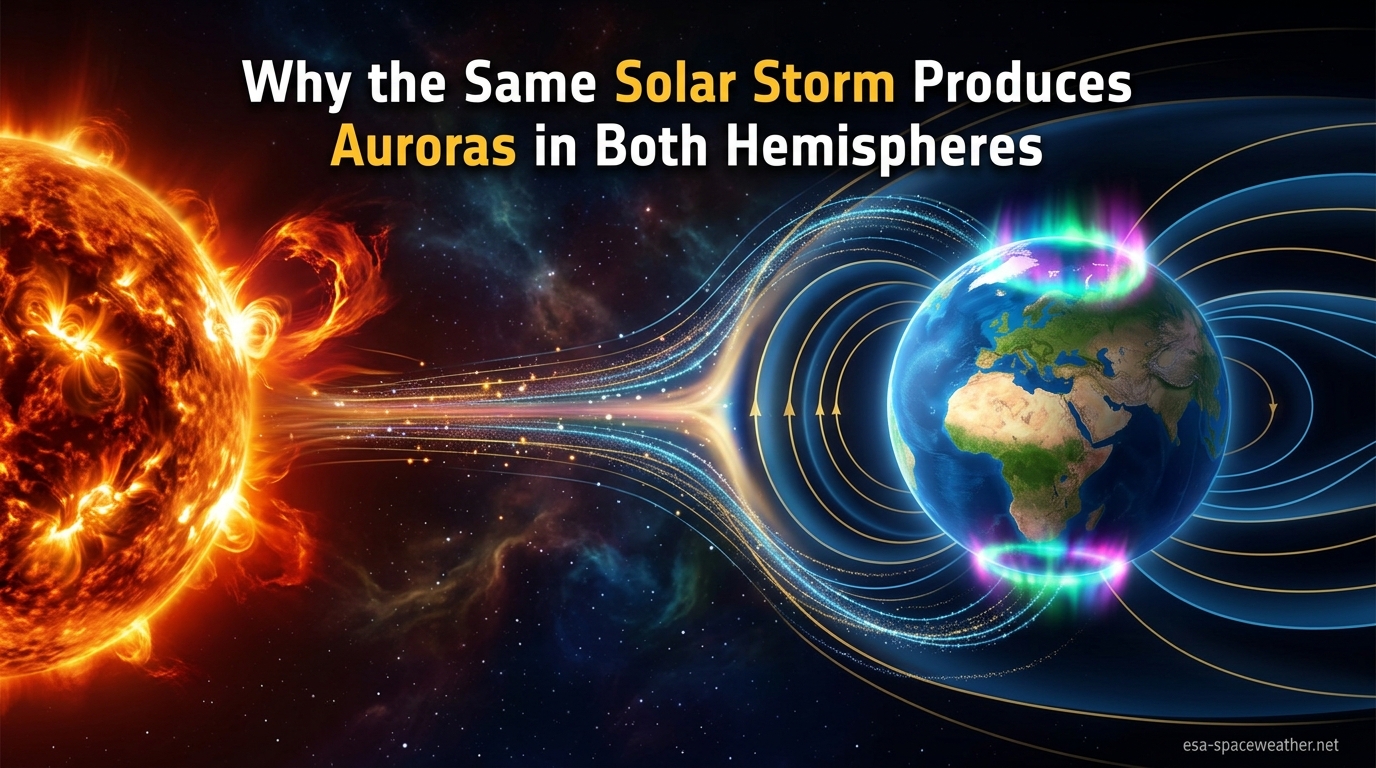
When a solar storm slams into Earth, charged particles get funneled along our planet’s magnetic field lines toward both the North and South Poles at the same time, creating aurora borealis and aurora australis simultaneously. This happens because Earth’s magnetic field acts like a giant bar magnet with field lines connecting one pole to the other, so whatever enters at one end also reaches the other.
If you have ever wondered why the same solar storm produces auroras in both hemispheres, the answer comes down to the symmetric shape of our magnetosphere. Solar wind particles do not pick a single pole. They get distributed across both halves of the planet’s magnetic shield.
In this guide, we break down exactly how solar plasma travels from the Sun to both polar regions, why the auroral ovals at both poles respond together, and what makes the northern and southern lights mirror each other during major geomagnetic storms.
Table of Contents
The Short Answer: Magnetic Field Lines Connect Both Poles
Earth’s magnetic field lines are the reason auroras appear in both hemispheres during a single solar event. Think of these invisible lines as curved highways that arch from one magnetic pole to the other, passing through the space around our planet.
When charged particles from a solar storm enter the magnetosphere, they do not scatter randomly. They get trapped and guided along these field lines. A single stream of solar wind can split, with electrons spiraling toward the north and others curving toward the south.
This is why aurora borealis and aurora australis are essentially two ends of the same process. The particles that create the northern lights have counterpart particles riding the connected field lines down to the southern polar region.
The key concept here is magnetic symmetry. Because Earth’s field is roughly shaped like a dipole (a two-pole magnet), whatever happens at one pole has a near-identical counterpart at the other. The same burst of solar energy that lights up the skies over Norway can simultaneously paint the heavens over Antarctica.
How Earth’s Magnetic Field Creates a Mirror System
To understand why auroras mirror across hemispheres, you need to picture Earth’s magnetic field structure. Our planet has a core of molten iron and nickel that generates a magnetic field extending thousands of miles into space. This field is what we call the magnetosphere.
Magnetic Poles vs Geographic Poles
One common point of confusion is the difference between magnetic poles and geographic poles. The geographic North and South Poles are fixed points where Earth’s rotational axis meets the surface. The magnetic poles, however, are where the magnetic field lines converge, and they shift over time.
Currently, the north magnetic pole is near the geographic North Pole but drifting toward Siberia. The south magnetic pole sits off the coast of Antarctica. What matters for aurora formation is the magnetic poles, not the geographic ones, because charged particles follow magnetic field lines to wherever those lines converge.
The Dipole Structure
Earth’s magnetic field is approximately a dipole, meaning it has two ends where all the field lines converge. Every field line that exits the north magnetic pole curves through space and re-enters at the south magnetic pole. This closed-loop structure is what makes the system behave like a mirror.
Because the field is roughly symmetric, a solar storm hitting the magnetosphere affects both halves nearly equally. The same compression of the magnetic shield, the same injection of particles, and the same atmospheric interactions happen at both poles.
This symmetry is not perfect. Earth’s magnetic field has non-dipole components that cause slight variations. But at a fundamental level, the two-pole structure guarantees that both hemispheres receive particles from the same solar event.
The Auroral Oval: Where Particles Enter Both Atmospheres
Auroras do not appear exactly at the magnetic poles. They form in ring-shaped zones called auroral ovals, which circle each pole at roughly 60 to 75 degrees magnetic latitude. These ovals are the regions where field lines dip into the upper atmosphere and deliver charged particles.
Northern Auroral Oval
The northern auroral oval covers parts of Alaska, Canada, Iceland, Scandinavia, and northern Russia. When solar wind particles spiral down field lines into this zone, they collide with oxygen and nitrogen atoms in the thermosphere, releasing photons of light. This is the aurora borealis.
Southern Auroral Oval
The southern auroral oval passes over Antarctica and the surrounding Southern Ocean. It produces the aurora australis, the southern lights. Because the southern oval covers mostly ocean and ice, far fewer people witness these displays compared to the northern lights. But the physics is identical.
Both ovals exist because field lines at these latitudes connect to the magnetotail, the stretched-out part of the magnetosphere on the night side of Earth. This is where solar storm energy gets stored and then released into the polar regions.
When the Ovals Expand
During a strong geomagnetic storm, both auroral ovals expand toward the equator. A storm that normally keeps auroras at 65 degrees latitude might push them down to 50 degrees or even lower. This expansion happens simultaneously at both poles because the increased energy inflates the entire magnetospheric system.
During the May 2024 geomagnetic storm, people as far south as Florida and Mexico saw the northern lights, while observers in New Zealand and southern Australia reported the southern lights. Both ovals expanded at the same time, driven by the same coronal mass ejection.
What Happens When a Solar Storm Hits Earth
A solar storm is a general term that covers several types of solar activity. To understand how one event creates auroras in both hemispheres, it helps to walk through the sequence step by step.
Step 1: Solar Eruption
The process begins on the Sun. A coronal mass ejection (CME) launches a massive cloud of charged particles and magnetic field into space. CMEs are the most powerful drivers of geomagnetic storms. Regular solar wind flows continuously, but a CME delivers a concentrated pulse of energy.
Step 2: Travel to Earth
The CME cloud travels outward at speeds ranging from 400 to 3,000 kilometers per second. Depending on speed, it takes anywhere from 15 hours to 3 days to reach Earth. When it arrives, it slams into the magnetosphere like a shockwave.
Step 3: Magnetic Reconnection
This is where the critical physics happens. The CME carries its own magnetic field. When this field meets Earth’s magnetic field and the orientations are opposite, they connect in a process called magnetic reconnection. This merging opens up Earth’s field lines and allows solar plasma to pour into the magnetotail.
Reconnection is the trigger that converts stored magnetic energy into kinetic energy. It loads the magnetotail with energized particles, building up tension like a coiled spring.
Step 4: Particle Injection Into Both Hemispheres
When the tension releases, particles accelerate along field lines toward both polar regions. This release is called a geomagnetic substorm. Electrons spiral down the field lines at significant fractions of the speed of light, striking the atmosphere at both auroral ovals simultaneously.
Because the field lines connect both poles, a single substorm event injects particles into the north and south at nearly the same moment. This is the physical mechanism that links aurora borealis and aurora australis as mirror images.
Step 5: Light Emission
When these fast-moving electrons hit oxygen and nitrogen atoms in the upper atmosphere, they transfer energy to those atoms. The atoms release this energy as light. The result is the glowing curtains, arcs, and rays of the aurora, appearing at both poles from the same injection event.
Why Both Hemispheres Light Up at the Same Time
The simultaneity of northern and southern auroras comes down to one fact: the field lines that deliver particles to the north are the same lines that deliver particles to the south. There is no delay between the two hemispheres because the particles are riding connected paths.
A useful analogy is a string pulled through a tube with beads at both ends. If you push energy into the middle of the string, both beads move at once. Earth’s magnetic field lines work the same way. Energy injected into the magnetotail travels along both halves of each field line, reaching both polar atmospheres together.
As one Reddit user explained in a popular ELI5 thread about this exact phenomenon: due to the magnetic nature, both the northern and southern lights will be of about equal strength with the same angle and distance to the Sun. This community insight matches the physics described by NASA and NOAA.
During the May 2024 solar storm, observers across both hemispheres shared photographs of simultaneous aurora displays. People in Europe, North America, and Asia captured the northern lights, while observers in Tasmania, New Zealand, and Antarctica documented the southern lights, all from the same CME impact.
Space weather monitoring by NOAA and ESA confirms this symmetry using satellites that observe both auroral ovals from orbit. Images from the Defense Meteorological Satellite Program (DMSP) and other spacecraft routinely show both poles glowing within minutes of each other during active periods.
Aurora Colors Explained: What Each Color Means
Aurora colors depend on which gas the particles hit and at what altitude. Because both hemispheres have the same atmospheric composition, the color spectrum is identical for aurora borealis and aurora australis.
Green is the most common aurora color. It comes from atomic oxygen glowing at altitudes around 100 to 300 kilometers. Most photographs of auroras show this vivid green curtain effect.
Red auroras come from atomic oxygen at higher altitudes, typically above 300 kilometers. These are rarer and often appear during intense solar storms that inject particles deeper into the atmosphere. Red auroras were widely reported during the May 2024 event.
Blue and purple colors come from molecular nitrogen at lower altitudes, around 90 to 100 kilometers. These colors often appear at the lower edges of auroral curtains or during very energetic particle impacts.
Yellow and pink can appear when red and green light mix at certain altitudes. These are less common and tend to show up during major geomagnetic storms.
Both the northern and southern auroral ovals produce this same range of colors. The gas composition of Earth’s atmosphere is symmetric, so the same particle energies produce the same light show at both poles.
When Auroras Are Not Symmetric: Asymmetry and Exceptions
While both hemispheres usually receive similar aurora displays, the symmetry is not perfect. Several factors can cause one hemisphere to experience a stronger or more visible aurora than the other during the same storm.
The Interplanetary Magnetic Field Direction
The orientation of the interplanetary magnetic field (IMF) plays a major role. The IMF has a component called Bz. When Bz points south (opposite to Earth’s field), reconnection is strong and auroras intensify. Fluctuations in Bz during a storm can cause one hemisphere to receive more energy than the other at any given moment.
Seasonal Differences
Auroras require dark skies to be visible. During northern summer, the Arctic is bathed in continuous daylight, making aurora borealis impossible to see even when it is happening. Meanwhile, Antarctica experiences its winter darkness, so aurora australis displays are fully visible. Six months later, the situation reverses.
This seasonal effect means that even when both auroral ovals are equally active, observers on the ground may only see one side. The auroras are still there in both hemispheres, but visibility depends on the sunlit side of the planet.
Non-Dipole Field Components
Earth’s magnetic field is not a perfect dipole. There are regional variations caused by the movement of molten iron in the outer core. The South Atlantic Anomaly, for example, is a region where the field is weaker than expected. These irregularities can cause slight asymmetries in how particles reach each hemisphere.
Ground-based research and satellite observations have documented cases where the northern auroral oval expanded more than the southern one, or vice versa, during specific geomagnetic storm phases. These differences are usually temporary and modest compared to the overall symmetry.
Asymmetric Substorms
Individual substorms can also be asymmetric. A substorm might dump more energy into one hemisphere if the field line geometry at that moment favors one side. However, over the course of a multi-hour geomagnetic storm, both hemispheres tend to average out to similar total energy deposition.
Can geomagnetic storms make auroras more?
Yes. Stronger geomagnetic storms inject more energy into the magnetosphere, which pushes particles deeper into the atmosphere and expands the auroral ovals toward the equator. A G5 storm can make auroras visible at latitudes where they are never normally seen, while weaker storms keep them confined to high latitudes near the poles.
Why is there no aurora at the equator?
Earth’s magnetic field lines converge near the poles and run nearly parallel to the surface at the equator. Charged particles follow field lines, so they are directed toward the polar regions, not the equator. The auroral ovals sit at 60 to 75 degrees magnetic latitude, far from equatorial regions.
What is the rarest color of aurora?
White auroras are considered the rarest. They occur when very low-energy particles excite atmospheric gases at altitudes where multiple emissions blend together, producing a faint white or grayish glow. Deep red auroras from high-altitude oxygen are also uncommon and typically appear only during the most intense geomagnetic storms.
Does the Bible mention the aurora borealis?
Some scholars interpret passages in the Book of Ezekiel, particularly the vision of glowing lights in the sky, as possible descriptions of auroral displays. However, there is no definitive scientific confirmation that these biblical references describe auroras, and interpretations remain speculative.
How fast do solar storm particles travel to Earth?
Particles from a coronal mass ejection travel at speeds between 400 and 3,000 kilometers per second. Fast CMEs can reach Earth in as little as 15 to 18 hours, while slower ones take 2 to 3 days. The speed determines how quickly auroras appear after the solar eruption is detected.
Conclusion: One Storm, Two Light Shows
Understanding why the same solar storm produces auroras in both hemispheres comes down to a single elegant mechanism: Earth’s magnetic field lines connect both poles, creating a pathway that delivers charged particles to the northern and southern auroral ovals at the same time.
The same coronal mass ejection that triggers magnetic reconnection in the magnetotail sends electrons racing along these field lines to both atmospheres. The result is aurora borealis and aurora australis acting as mirror images of each other, powered by the same burst of solar energy.
While factors like seasonal darkness, interplanetary magnetic field orientation, and non-dipole field variations can create temporary asymmetries, the fundamental physics guarantees that both hemispheres participate in every major auroral event.
If you want to experience this phenomenon yourself, monitor space weather forecasts from NOAA and ESA during solar maximum periods. The next major geomagnetic storm could light up skies near you, whether you live in the northern or southern hemisphere.