
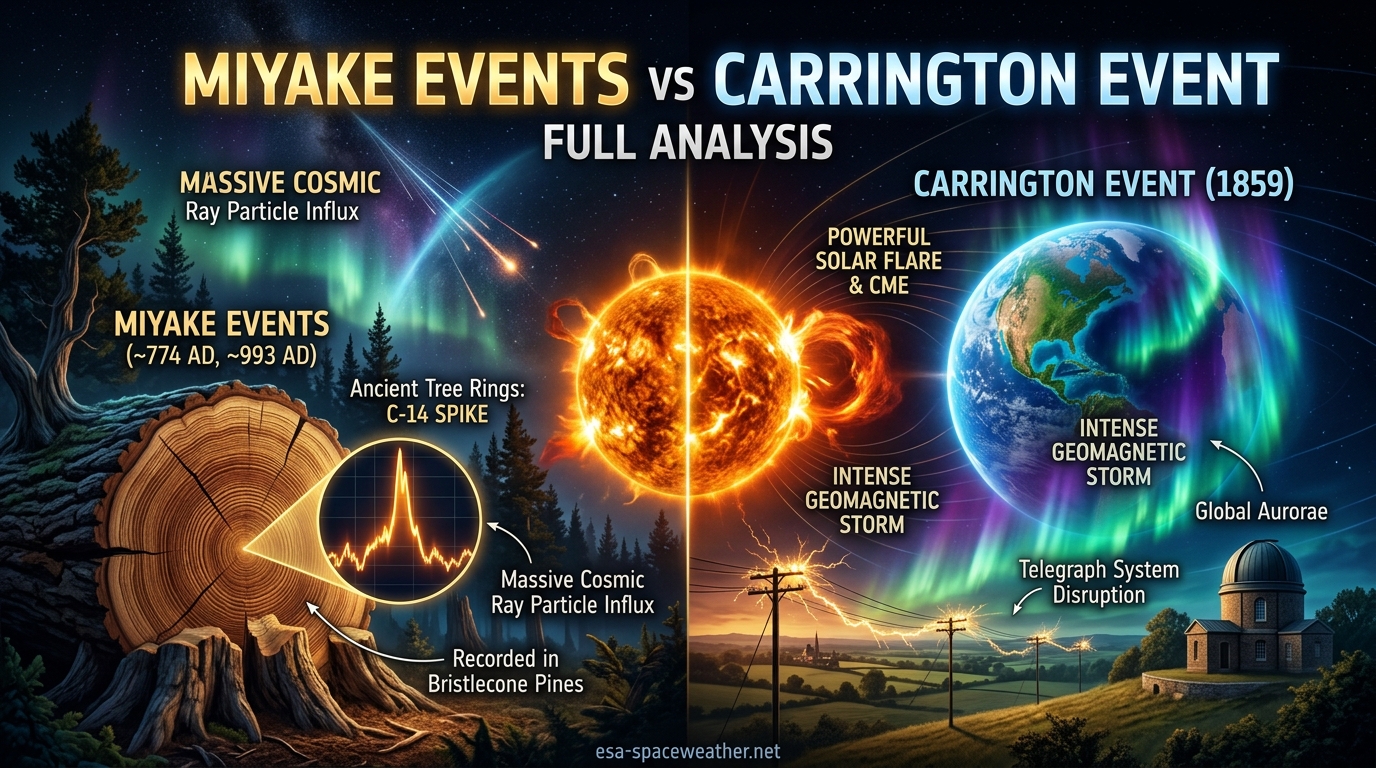
When most people think about the worst solar storm in recorded history, the Carrington Event of 1859 immediately comes to mind. It is the benchmark, the measuring stick against which every other geomagnetic storm is compared. But what if I told you that the Carrington Event was not even close to the strongest solar storm Earth has experienced?
In 2012, a Japanese researcher named Fusa Miyake discovered something startling hidden inside ancient tree rings. Spikes in radioactive carbon-14 pointed to solar storms so massive that they made the Carrington Event look like a minor disturbance. Scientists now call these Miyake Events, and the evidence suggests they were at least 10 times stronger than anything witnessed in modern human history.
This article explores why the Miyake Events may have dwarfed the Carrington Event, what the carbon-14 evidence actually tells us, and what a repeat performance would mean for our technology-dependent civilization. Understanding the difference between these events is the first step toward appreciating just how vulnerable our modern infrastructure really is.
Table of Contents
The Short Answer: How Much Stronger Were the Miyake Events?
The Miyake Events produced carbon-14 spikes of approximately 12% above normal background levels in tree rings. The Carrington Event, by contrast, left a carbon-14 signature of less than 1%. That is the single most important metric in this comparison, and it tells us that the Miyake Events were at least an order of magnitude more powerful than the 1859 storm.
To put that in perspective, imagine the Carrington Event as a severe hurricane. The Miyake Events would be a storm so large and intense that it would rewrite every category we use to measure hurricanes. The energy gap between them is not incremental. It is transformational.
Scientists have identified at least four confirmed Miyake Events in the past 14,000 years: around 774 AD, 993 AD, 660 BC, and approximately 14,300 years ago. Each one tells the same story. Earth has been hit by solar storms far more extreme than the one Richard Carrington observed through his telescope in 1859.
The Carrington Event of 1859: The Benchmark Solar Storm
On the morning of September 1, 1859, English astronomer Richard Carrington was projecting an image of the Sun onto a screen to sketch sunspots. Suddenly, he witnessed two brilliant flashes of white light erupting from a large sunspot cluster. What he had observed was one of the most powerful solar flares ever recorded with human instruments.
Within hours, a massive coronal mass ejection slammed into Earth’s magnetic field. The resulting geomagnetic storm produced aurora borealis so bright that people in the northeastern United States could read newspapers by their glow at night. The northern lights were visible as far south as Cuba, Jamaica, and Hawaii, regions that had never seen anything like it before.
The most dramatic impact fell on the telegraph system, which was the high-tech communication backbone of the era. Telegraph operators reported sparks flying from their equipment. Some operators received electric shocks. Papers on their desks caught fire. In several cases, operators disconnected their batteries entirely and found that the aurora-induced currents were powerful enough to transmit messages on their own.
The Carrington Event became the gold standard for solar storms because it was the first one ever observed and documented in scientific detail. It was classified as a G5 storm on the NOAA geomagnetic storm scale, the highest possible rating. For over 150 years, it has served as the worst-case scenario for space weather planners and power grid operators.
But here is the problem. The Carrington Event was only the worst storm we have directly observed. It was not the worst storm Earth has ever experienced. Not even close.
What Are Miyake Events? Discovery Through Tree Rings
The story of the Miyake Events begins with a question that puzzled scientists for decades. How can we know about solar storms that happened thousands of years ago, long before anyone had a telescope or even a written record?
The answer lies in a radioactive isotope called carbon-14, also known as radiocarbon. Carbon-14 is produced when cosmic rays and high-energy solar particles bombard Earth’s upper atmosphere. These particles collide with nitrogen atoms and convert them into carbon-14. The newly formed radiocarbon combines with oxygen to form carbon dioxide, which is then absorbed by trees during photosynthesis and locked into their annual growth rings.
Every year, a tree adds a new ring. Each ring captures a chemical snapshot of the atmosphere during that growing season. Under normal conditions, carbon-14 levels in tree rings stay relatively stable. But when an extreme solar proton event occurs, the massive influx of high-energy particles causes a sudden, sharp spike in atmospheric carbon-14 that gets recorded in that year’s tree ring.
In 2012, Fusa Miyake and her team at Nagoya University in Japan were measuring carbon-14 concentrations in ancient cedar tree rings when they discovered an anomaly. The tree rings from the year 774 AD showed a carbon-14 increase of approximately 12% above normal levels. That spike was enormous, far beyond anything that ordinary solar activity could explain.
This discovery was revolutionary. No known solar storm in the instrumental record, including the Carrington Event, had ever produced a carbon-14 spike of that magnitude. Miyake’s team ruled out other explanations like nearby supernovae or gamma-ray bursts. The only mechanism that fit the data was an extreme solar proton event, a storm far more powerful than anything in recorded history.
Subsequent research confirmed the finding using Antarctic ice cores, which contain beryllium-10 and chlorine-36, two other isotopes produced by the same atmospheric particle bombardment. The ice core data matched the tree ring data perfectly, providing independent confirmation that the 774 AD event was real and global in scale.
Scientists named these extreme events after their discoverer. Miyake Events are now defined as extreme solar proton events that produce detectable radiocarbon spikes in tree rings, far exceeding any solar storm observed during the era of scientific instrumentation.
Carrington Event vs Miyake Events: The Carbon-14 Evidence
The core of the comparison comes down to one question. How much carbon-14 did each event produce? This is the metric that allows scientists to directly compare storms separated by centuries or millennia, using a consistent measurement framework.
The Carrington Event of 1859 left a carbon-14 signature of less than 1% above normal background levels. That is barely detectable in tree ring analysis. The 774 AD Miyake Event produced a spike of approximately 12%. The event from roughly 14,300 years ago was even larger, producing a carbon-14 increase estimated at 18% to 20% above background.
| Metric | Carrington Event (1859) | Miyake Event (774 AD) | Oldest Miyake Event (~14,300 years ago) |
|---|---|---|---|
| Carbon-14 increase | Less than 1% | Approximately 12% | Approximately 18-20% |
| Estimated strength relative to Carrington | 1x (baseline) | At least 10x stronger | Possibly 15-20x stronger |
| Detection method | Direct observation (telescope, magnetometers) | Tree ring carbon-14, ice core beryllium-10 | Tree ring carbon-14, ice core data |
| NOAA storm classification | G5 (Extreme) | Beyond G5 scale | Far beyond G5 scale |
| Recorded human impact | Telegraph fires, global aurora | No written records of impact | Prehistoric era, no records |
| Known frequency | Estimated every 100-200 years | Estimated every 1,000-3,000 years | Part of ongoing cycle |
What makes this comparison even more striking is that the Carrington Event was not even a proton event in the same way Miyake Events are. The Carrington Event was primarily a geomagnetic storm driven by a coronal mass ejection. The Miyake Events appear to have been extreme solar proton events, where massive quantities of energetic particles directly bombarded Earth’s atmosphere.
This is an important distinction that many articles gloss over. A solar flare is a flash of electromagnetic radiation. A coronal mass ejection is a cloud of magnetized plasma hurled into space. A solar proton event is a flood of high-energy charged particles. All three can happen together, but the particle bombardment is what produces the carbon-14 signature in tree rings. The Carrington Event produced geomagnetic effects but left almost no radiocarbon trace. The Miyake Events produced both.
The confirmed Miyake Events identified so far include the 774 AD event, the 993 AD event, an event around 660 BC, and the massive storm from approximately 14,300 years ago. Researchers have also identified possible additional events at 5259 BC, 5410 BC, and 1052 AD, though these require further confirmation. Each one represents a solar storm that would dwarf the Carrington Event in terms of raw particle energy delivered to Earth’s atmosphere.
Other Historical Solar Storms That Nearly Broke Civilization
Before we look at what a Miyake-level event would do today, it helps to understand how lesser solar storms have already shaped human history. The Carrington Event was dramatic, but it is far from the only time space weather has interfered with human affairs.
In May 1967, during one of the most dangerous periods of the Cold War, a massive solar storm jammed the radar systems at three Ballistic Missile Early Warning System sites in the United States. The radar blackout was so severe that military commanders initially interpreted it as a potential Soviet attack. The United States came dangerously close to launching nuclear-armed aircraft in retaliation.
What prevented catastrophe was the work of solar forecasters at the North American Aerospace Defense Command, or NORAD. Solar weather scientists had been monitoring a massive sunspot region and recognized that a solar storm, not a Soviet jamming attack, was responsible for the radar disruption. Their quick thinking was reported to military leaders in time to stand down the nuclear bombers. The full details of this incident remained classified until 2016, when the involved scientists finally shared their story publicly.
In March 1989, a geomagnetic storm triggered by a coronal mass ejection slammed into Quebec, Canada. The storm induced massive electrical currents in power lines, overloading transformers and collapsing the entire Hydro-Quebec power grid in just 90 seconds. Six million people lost electricity for up to nine hours in the middle of a Canadian winter. The same storm caused aurora visible as far south as Texas and Florida, and damaged transformers as far away as New Jersey and Great Britain.
The 1989 event was estimated to be less than half the intensity of the Carrington Event. Yet it still managed to cripple an entire provincial power grid. If that storm could cause that level of damage, the implications for a Carrington-scale or Miyake-scale event become deeply concerning.
In July 2012, Earth experienced one of its closest calls in modern history. A massive coronal mass ejection erupted from the Sun with a trajectory that would have delivered a direct hit to Earth. The storm was estimated to be at least as powerful as the Carrington Event. By sheer luck, the eruption occurred on the side of the Sun facing away from Earth’s orbital position. Had it happened just one week earlier, the planet would have taken a direct hit.
Researchers at the University of Colorado Boulder estimated that the 2012 near-miss would have caused widespread damage to satellites, power grids, and communication systems, with economic impacts potentially exceeding $2 trillion. The event served as a wake-up call for space weather researchers and government agencies worldwide.
More recently, in May 2024, a powerful series of solar storms produced spectacular aurora visible across much of the Northern Hemisphere and as far south as Florida and Mexico. While the storm did not cause catastrophic damage, it did disrupt GPS systems, degrade satellite communications, and force some farmers to pause planting operations due to GPS-guided tractor malfunctions. The May 2024 storm was the strongest since the Carrington Event by some measures, though still well below Miyake-level intensity.
What Would a Miyake-Level Event Do Today?
This is the question that keeps space weather scientists, power grid operators, and government emergency planners awake at night. Our modern civilization is exponentially more dependent on technology than the telegraph operators of 1859. A Miyake-level solar storm would test every system we rely on.
The most immediate and devastating impact would be on the electrical power grid. A Miyake-scale event would induce massive currents in transmission lines, overwhelming transformers across entire continents. Large power transformers, the kind that step voltage up and down between power plants and homes, are custom-built, cost millions of dollars each, and can take 12 to 24 months to manufacture and install. There are no spare transformers sitting in warehouses waiting for a crisis.
During a Miyake-level geomagnetic storm, dozens or hundreds of these transformers could fail simultaneously across North America, Europe, and Asia. Replacing them would take years. In the meantime, entire regions could face prolonged blackouts lasting months or longer. Without electricity, water treatment plants stop functioning, fuel pumps stop working, refrigeration fails, and supply chains collapse.
Satellites would be equally vulnerable. A Miyake-scale proton event would deliver a massive dose of radiation to satellites in orbit, potentially damaging or destroying their solar panels, electronics, and guidance systems. The GPS constellation, communications satellites, weather satellites, and military surveillance systems could all be degraded or destroyed. The loss of GPS alone would affect everything from airline navigation to financial transaction timestamps to precision agriculture.
The internet backbone faces a less obvious but equally serious threat. Submarine fiber-optic cables, which carry over 95% of international data traffic, contain repeater amplifiers powered by electrical cables running along the ocean floor. These copper power cables are vulnerable to the same geomagnetically induced currents that damage power grid transformers. A severe storm could damage repeaters across multiple submarine cable systems, severing international internet connectivity between continents.
Communication systems would face widespread disruption. High-frequency radio communications used by aviation, maritime operations, and emergency services would be blacked out by the ionospheric disturbance. Cell phone networks would fail as backup generators at cell towers ran out of fuel. Emergency response coordination would become extremely difficult precisely when it is needed most.
The economic impact is difficult to overstate. A 2017 study by Lloyd’s of London estimated that a Carrington-scale event could cause economic damages of $2.6 trillion in the United States alone. A Miyake-level event, being at least 10 times stronger, could produce cascading failures across every interconnected system. The full economic and human cost is almost impossible to calculate because the effects would compound across every sector simultaneously.
How Often Do Extreme Solar Storms Happen?
Understanding the frequency of extreme solar storms is essential for assessing the actual risk. Scientists use two primary methods to estimate how often these events occur: the tree ring and ice core record of past events, and observations of solar activity on other sun-like stars.
Based on the radiocarbon record, Miyake Events appear to occur roughly once every 1,000 to 3,000 years. That is an estimate based on a small number of identified events over a 14,000-year period, so there is significant uncertainty. Some researchers argue the frequency could be as high as once every 500 to 1,000 years. The truth is, we do not yet have enough data to pin down the exact recurrence interval.
Carrington-scale events, while more frequent, are also less common than most people assume. Estimates range from once every 100 to 200 years, with some studies suggesting the probability of a Carrington-level event in any given decade is between 1% and 12%. That is a wide range, reflecting the difficulty of statistical analysis with limited historical data.
Astronomers have also studied sun-like stars to estimate superflare frequency. Observations from the Kepler Space Telescope and other instruments show that stars similar to our Sun occasionally produce flares thousands of times more powerful than anything observed during the modern era of solar monitoring. These superflare observations are consistent with the Miyake Event record on Earth and suggest that the Sun is capable of far more violent outbursts than we have witnessed in our lifetimes.
Are we due for another extreme solar storm? The honest answer is that solar activity does not follow a strict schedule. The Sun goes through approximately 11-year cycles of higher and lower activity, known as solar maxima and solar minima. Extreme events can occur at any point in the cycle, though they are more likely during solar maximum. We are currently in Solar Cycle 25, which began in 2019 and is expected to reach its peak in the mid-2020s.
The most important thing to understand is that probability is not a countdown timer. The fact that a Miyake Event occurred in 774 AD does not mean we are safe for another thousand years. It also does not mean one is overdue. Each year carries the same statistical probability, and that probability is low but never zero.
Can We Predict or Prepare for Extreme Solar Storms?
The short answer is that we can prepare, but our ability to predict is still limited. Progress is being made on both fronts, but significant gaps remain.
The NOAA Space Weather Prediction Center in Boulder, Colorado, operates 24 hours a day monitoring solar activity. Using a fleet of satellites including the Solar Dynamics Observatory, the Solar and Heliospheric Observatory, and the Deep Space Climate Observatory, NOAA can detect coronal mass ejections and estimate their speed, direction, and likely intensity. This gives power grid operators and satellite companies between 15 and 48 hours of warning before a storm arrives.
The European Space Agency maintains its own space weather monitoring program as part of its Space Safety initiative. ESA operates satellites that study the Sun and the solar wind, contributing data to the global space weather community. ESA’s Lagrange mission concept, currently in development, aims to place spacecraft at the L5 Lagrange point to provide a side view of the Sun, potentially giving earlier warning of Earth-directed eruptions.
Even with advanced monitoring, prediction has serious limitations. Scientists can tell when a coronal mass ejection has erupted and roughly where it is heading. But they cannot yet accurately predict whether the magnetic field embedded in a CME will align with Earth’s magnetic field in the way that produces the most severe geomagnetic effects. That alignment determines whether a storm causes minor disruption or catastrophic damage, and it cannot be determined until the CME is nearly at Earth.
On the preparation side, some progress has been made. Power grid operators in North America, working through the Electric Reliability Corporation, have developed mandatory standards for grid resilience against geomagnetic disturbances. These include requirements for vulnerability assessments, operational procedures during space weather events, and some hardware protections. However, critics argue that these standards fall far short of what would be needed to survive a Carrington-scale or Miyake-scale event.
Practical steps that could significantly reduce vulnerability include installing blocking devices on transformers to prevent geomagnetically induced currents from causing damage, hardening satellite electronics against radiation, building strategic reserves of critical replacement components, and developing operational plans for rapidly shedding load and isolating grid segments during extreme storms. None of these solutions are cheap, and implementation has been uneven across different countries and utility companies.
The fundamental challenge is one of priorities. Preparing for an event that may not happen for centuries is politically and economically difficult. But the cost of not preparing, if a Miyake-level event does occur, would be measured in trillions of dollars and potentially in human lives.
FAQs
Was the Carrington Event a Miyake event?
No, the Carrington Event of 1859 was not a Miyake Event. While it was the most powerful solar storm ever directly observed by humans, its carbon-14 signature was less than 1% above normal background levels. Miyake Events produce carbon-14 spikes of 12% or higher, making them at least 10 times more powerful than the Carrington Event.
What would happen if a Carrington level event happened today?
A Carrington-level event today would likely cause widespread power grid failures, damage to satellites and GPS systems, disruption of radio communications, and potential internet outages. Transformers across multiple continents could be permanently damaged, leading to prolonged blackouts lasting weeks or months in affected regions. Economic impacts could exceed $2 trillion.
Could a Carrington Event happen again?
Yes, a Carrington-scale solar storm could absolutely happen again. These events are estimated to occur roughly once every 100 to 200 years. The 2012 solar storm that narrowly missed Earth was estimated to be of similar intensity, demonstrating that such events are a real and recurring threat.
What are the odds of the Carrington Event happening?
Researchers estimate the probability of a Carrington-level geomagnetic storm occurring in any given decade ranges from roughly 1% to 12%. The wide range reflects the limited historical data available. Some studies suggest the probability could be as high as 10% per decade, meaning the cumulative risk over a human lifetime is significant.
How strong was the Miyake Event compared to Carrington?
The Miyake Events were at least 10 times stronger than the Carrington Event based on carbon-14 evidence. The 774 AD Miyake Event produced a 12% carbon-14 spike compared to less than 1% for the Carrington Event. The oldest known Miyake Event, from approximately 14,300 years ago, may have been 15 to 20 times stronger than the Carrington Event.
Could a solar storm destroy the internet?
A severe solar storm could severely damage the internet by inducing currents in submarine cable repeaters that carry over 95% of international data traffic. While a single event would not permanently destroy all internet infrastructure, it could sever international connectivity for weeks or months and require extensive replacement of damaged repeater systems on the ocean floor.
Conclusion: Why the Miyake Events Changed Everything
The evidence is clear. The Miyake Events may have dwarfed the Carrington Event by at least an order of magnitude, producing carbon-14 spikes of 12% or more compared to less than 1% for the 1859 storm. These extreme solar proton events, detected through tree ring analysis and confirmed by Antarctic ice core data, represent the true upper limit of what the Sun is capable of delivering to Earth.
For over 150 years, the Carrington Event served as our worst-case scenario. It was the storm that every power grid vulnerability assessment, every satellite risk analysis, and every space weather preparedness plan was built around. The discovery of the Miyake Events has fundamentally changed that calculus. We now know that the Carrington Event was not the ceiling. It was barely above the floor.
Our modern civilization is more vulnerable to extreme space weather than any society in human history. Every power line, every satellite, every submarine cable, every GPS-dependent system represents a potential point of failure during a Miyake-level storm. The question is not whether such an event will happen again, but when, and whether we will be ready.
Understanding why the Miyake Events dwarfed the Carrington Event is the first step toward taking space weather seriously as a civilization-scale risk. The data is written in tree rings and ice cores, a permanent record of what the Sun can do. It is up to us to decide what we do with that knowledge.