
Imagine a solar storm so powerful that it makes the famous 1859 Carrington Event look like a flicker. Now imagine that this storm struck Earth over 14,000 years ago, long before satellites or power grids existed. No human instrument recorded it. No telescope detected it. Yet scientists know exactly when it happened, how strong it was, and what caused it.
How? The answer is written in trees and frozen in ice.
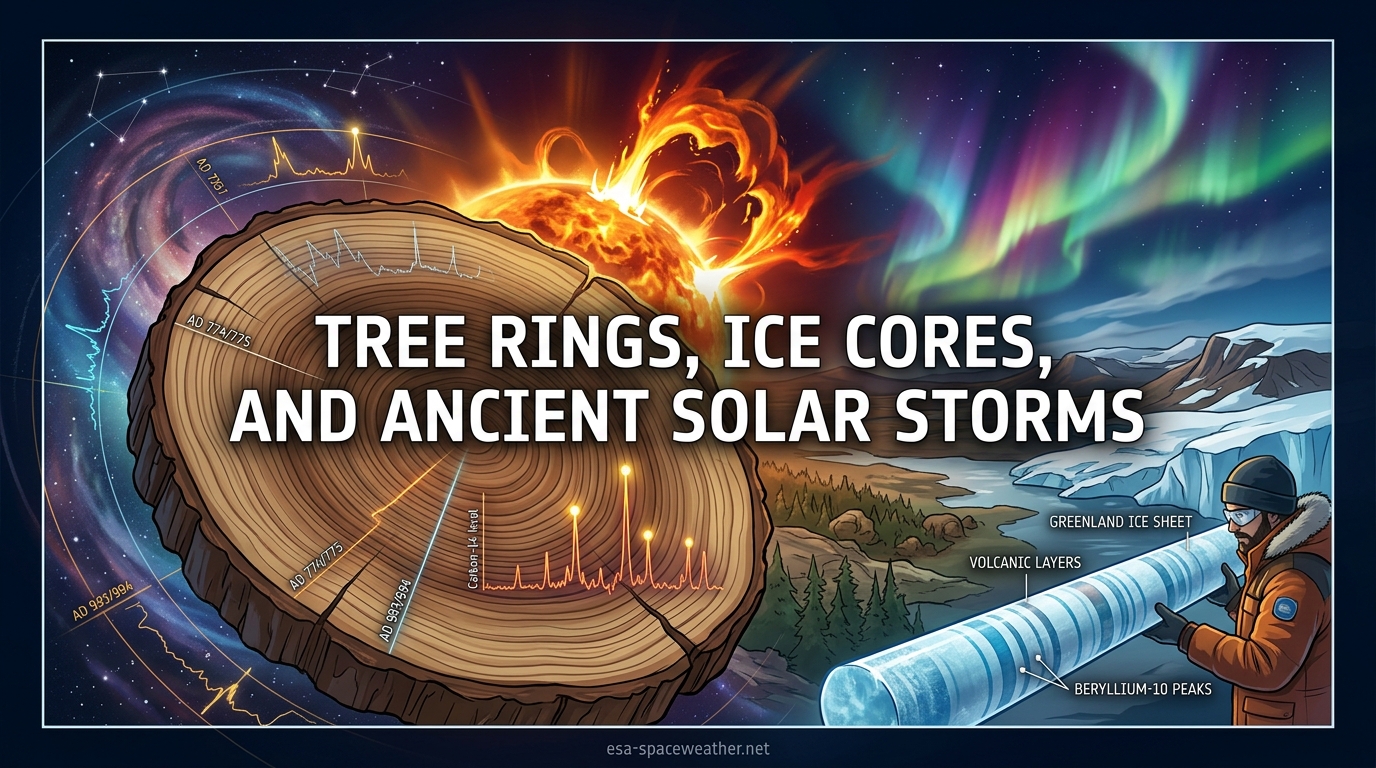
Scientists use tree rings and ice cores to find ancient solar storms by measuring spikes in radiocarbon (carbon-14) trapped inside annual growth rings and layers of polar ice. These spikes, known as Miyake events, are the fingerprints of extreme solar proton events that bombarded Earth’s atmosphere thousands of years ago. By cross-referencing tree ring data with beryllium-10 measurements from Greenland and Antarctic ice cores, researchers can date these ancient storms with remarkable precision, sometimes down to a single year.
In this guide, our team breaks down exactly how this process works. We will walk you through the science of dendrochronology, the chemistry of radiocarbon formation, the mechanics of ice core drilling, and the famous case studies that have reshaped our understanding of solar activity. We will also explore what these ancient storms mean for modern technology and whether another one could strike in our lifetimes.
If you have ever wondered how scientists read the sun’s violent history from the wood of ancient trees and the depths of glaciers, this article is for you.
Table of Contents
What Are Ancient Solar Storms?
Ancient solar storms were extreme bursts of high-energy particles from the sun that struck Earth long before modern recording instruments existed. These events, called solar proton events (SPEs), occur when the sun ejects massive quantities of energetic particles during powerful eruptions on its surface.
Not all solar storms are equal. The sun routinely produces solar flares and coronal mass ejections (CMEs) that cause auroras and minor radio disruptions. But ancient solar storms of the type recorded in tree rings were on an entirely different scale, sometimes dozens of times more powerful than anything observed in the satellite era.
The Carrington Event of 1859 is the most powerful solar storm directly observed by humans. It gave telegraph operators electrical shocks, set papers on fire, and produced auroras visible as far south as Cuba and Hawaii. But compared to the storms scientists have found in tree rings, the Carrington Event was relatively modest. The largest known solar storms, called Miyake events, released energy that dwarfs anything in recorded human history.
These extreme events matter because they tell us what the sun is truly capable of. If a Miyake-level storm hit Earth today, the consequences for satellites, power grids, and global communications would be catastrophic. Understanding how often these events occur is the first step toward preparing for them.
How Tree Rings Record Solar Storms
The process by which tree rings capture evidence of ancient solar storms is one of the most remarkable intersections of biology, chemistry, and astrophysics in modern science. Trees are, in a very real sense, natural radiation detectors that have been running continuously for thousands of years.
Here is how the pathway works, step by step.
Step 1: A Massive Solar Eruption
It begins with the sun. During an extreme solar proton event, the sun blasts an enormous quantity of energetic protons and other charged particles into space. Some of these particles travel toward Earth at nearly the speed of light.
Step 2: Cosmic Particles Hit the Atmosphere
When these solar energetic particles reach Earth’s upper atmosphere, they collide with nitrogen and oxygen atoms. These nuclear reactions produce several cosmogenic nuclides, including radiocarbon (carbon-14 or 14C) and beryllium-10 (10Be). A massive solar storm causes a sudden, sharp increase in atmospheric radiocarbon levels, far above the normal background rate.
Step 3: Radiocarbon Enters the Carbon Cycle
The newly created carbon-14 atoms oxidize to form carbon dioxide. This radioactive CO2 mixes with the existing atmospheric CO2 and becomes part of the normal carbon cycle. Plants cannot distinguish between regular carbon-12 and radioactive carbon-14. They absorb both through photosynthesis.
Step 4: Trees Lock Radiocarbon Into Their Rings
Trees absorb the carbon-14-enhanced CO2 and use it to build cellulose for new growth. Each year, a tree adds a new ring of wood just beneath its bark. That ring permanently records the atmospheric radiocarbon concentration from that specific year. If a massive solar storm occurred in, say, 774 AD, every tree alive on Earth during that growing season would have locked extra carbon-14 into its 774 AD ring.
Step 5: Scientists Measure the Spike
Researchers extract cores from ancient trees, subfossil timbers, and archaeological wood samples. Using accelerator mass spectrometry, they measure the carbon-14 content of individual annual rings. When they find a sharp spike in radiocarbon that is far above normal variation, they know a massive solar proton event occurred that year.
This technique is called dendrochronology combined with radiocarbon dating. Dendrochronology provides the precise year-by-year timeline because each ring corresponds to exactly one year of growth. Radiocarbon measurement reveals the solar storm signature within that timeline.
Tree Biology Matters More Than You Think
The accuracy of this method depends heavily on tree biology. Different species store and use carbon in different ways, which affects how faithfully they record atmospheric radiocarbon.
Trees store nonstructural carbohydrates, essentially sugars, that they can draw on during growth. Some of these carbohydrates were produced months or even years earlier. This means that the carbon in a given ring may not perfectly reflect that single year’s atmosphere. It could include stored carbon from previous seasons.
Species like oaks and bristlecone pines tend to use fresh carbon from the current growing season, making them more accurate recorders of annual radiocarbon changes. Other species that rely more heavily on stored carbohydrates can blur the signal slightly. Understanding these biological differences is critical for interpreting tree ring data accurately.
The process of wood formation, called xylogenesis, also varies by climate and species. In cold regions, growth happens in a compressed window of weeks or months. In tropical regions, some trees do not form clear annual rings at all. This is why scientists prefer trees from temperate and subarctic regions for solar storm research.
Researchers at institutions like the University of Arizona’s TIME Lab use cutting-edge MICADAS (Mini Carbon Dating System) technology to achieve single-year resolution. This means they can measure the radiocarbon content of one individual tree ring at a time, pinpointing the exact year a solar storm struck with extraordinary precision.
The Miyake Event Phenomenon
The sharp radiocarbon spikes caused by extreme solar storms are called Miyake events. They are named after Japanese physicist Fusa Miyake, who in 2012 published the seminal paper identifying the 774 AD radiocarbon spike as evidence of a massive solar proton event.
Before Miyake’s discovery, scientists knew that atmospheric radiocarbon levels fluctuated over time due to changes in Earth’s magnetic field and solar activity. But the 774 AD spike was different. It was too large and too sudden to be explained by normal solar cycle variations. Miyake and her team showed that only an extreme solar energetic particle event could produce such a rapid and dramatic increase in atmospheric carbon-14.
Since 2012, researchers have identified several confirmed Miyake events throughout history. The known events include the 774 AD event, the 993 AD event, and the massive event approximately 14,300 years ago. Additional candidate events have been proposed at 660 BCE, 5259 BCE, and 7176 BCE, among others.
One of the most striking findings is that Miyake events do not appear to follow a predictable pattern. They do not only occur during solar maximum. They do not correlate neatly with the 11-year solar cycle. Some researchers have found tentative periodicity suggesting roughly one event every 1,000 to 3,000 years, but the sample size is still too small for confident prediction.
This unpredictability is what makes Miyake events so concerning for modern civilization. We cannot simply wait for a known cycle to pass. The next extreme solar storm could happen at any point in the solar cycle, and the tree ring record proves that the sun is capable of far more violent outbursts than anything we have witnessed in the modern era.
How Ice Cores Confirm Solar Storms
Tree rings tell one half of the story. Ice cores tell the other. Together, they provide a powerful dual record of ancient solar activity that is far more convincing than either proxy alone.
The Beryllium-10 Pathway
When solar energetic particles bombard Earth’s atmosphere, they produce more than just radiocarbon. They also generate beryllium-10 (10Be), another cosmogenic nuclide. While carbon-14 enters the carbon cycle and gets absorbed by plants, beryllium-10 follows a different path.
Beryllium-10 atoms attach to aerosol particles in the atmosphere. These particles are carried by atmospheric circulation patterns and eventually settle onto the surface through precipitation. In polar regions like Greenland and Antarctica, snowfall continuously buries previous layers of snow, compressing them into ice over thousands of years.
Each layer of polar ice contains a record of the atmospheric conditions at the time it was deposited. A spike in beryllium-10 within a specific ice layer indicates that a burst of cosmic particles reached Earth’s atmosphere during that period. This makes ice cores a completely independent proxy for solar storms, separate from tree rings.
How Ice Cores Are Drilled
Extracting ice cores is an extraordinary feat of engineering. Teams of scientists travel to remote locations in Greenland, Antarctica, and high-altitude glaciers to drill deep into ancient ice.
The drilling process works as follows. A hollow drill, equipped with a cutting head, is lowered into a borehole. As the drill penetrates the ice, it captures a cylindrical core sample, typically about 10 centimeters in diameter. The core is brought to the surface in sections, each a few meters long.
Some ice cores reach staggering depths. The East Greenland Ice-core Project (EGRIP) drilled through nearly 2,700 meters of ice. Antarctic cores from projects like EPICA have exceeded 3,200 meters. These deep cores contain climate and atmospheric records stretching back over 800,000 years.
Once extracted, the ice cores are carefully packaged and shipped to specialized laboratories kept at sub-freezing temperatures. Scientists slice the cores into thin sections, each representing a specific time period, and analyze the chemical composition of each layer.
Analyzing Ice Core Layers
Dating ice core layers is accomplished through multiple methods. Annual layers can be counted visually in shallow cores, similar to counting tree rings. In deeper, older ice, scientists use volcanic ash layers (tephra) of known age as reference points. They also measure oxygen isotope ratios and methane concentrations, which correlate with known climate events.
To measure beryllium-10, researchers melt carefully cleaned sections of the ice core and use accelerator mass spectrometry to count individual beryllium-10 atoms. This is the same type of ultra-sensitive measurement technology used for radiocarbon dating of tree rings.
When scientists find a beryllium-10 spike in an ice core layer that dates to the same period as a radiocarbon spike in tree rings, they have powerful confirmation that a genuine solar proton event occurred. The two proxies are completely independent, driven by different atmospheric chemistry and preserved in entirely different natural archives.
Why Scientists Need Both Tree Rings and Ice Cores
You might wonder why scientists bother with two different methods. If tree rings can pinpoint the year of a solar storm with such precision, why also drill miles into polar ice?
The answer comes down to scientific rigor. In science, a single line of evidence is always weaker than two independent lines of evidence that agree with each other.
Tree rings offer unmatched temporal precision. Because each ring represents exactly one year, scientists can date a radiocarbon spike to a specific calendar year. However, tree rings have limitations. The tree ring record extends back roughly 14,000 years in some regions, and older wood becomes increasingly rare. Additionally, biological factors like stored carbohydrates can slightly blur the radiocarbon signal.
Ice cores extend much further back in time, some reaching over 800,000 years. They capture beryllium-10 from the entire planet’s atmosphere, providing a global signal. However, ice core dating is less precise than tree ring dating. Annual layers become compressed and difficult to distinguish in very old ice, and dating uncertainty can range from decades to centuries in deep cores.
Each proxy also has unique vulnerabilities. Tree ring radiocarbon can theoretically be influenced by changes in the carbon cycle, volcanic eruptions, or local climate effects. Ice core beryllium-10 can be affected by changes in atmospheric circulation patterns, precipitation rates, and geomagnetic field variations.
But when both proxies show a spike at the same time, the likelihood of a false signal drops dramatically. It is extremely improbable that a biological artifact in tree rings and an atmospheric artifact in ice cores would both produce identical false spikes at the same point in time. The agreement between independent proxies is what gives scientists confidence that these signals represent real solar proton events.
This dual-proxy approach is now the gold standard in solar storm research. When the 14,300-year-old event was identified, researchers confirmed it using radiocarbon from subfossil trees in the French Alps and beryllium-10 from Greenland ice cores. The fact that both archives told the same story is what allowed the scientific community to accept the finding with confidence.
Famous Case Studies: The Largest Solar Storms Ever Found
The tree ring and ice core records have revealed several confirmed and candidate extreme solar storms throughout Earth’s history. Each discovery has expanded our understanding of what the sun can do.
The 774 AD Event: The First Miyake Event
The 774 AD solar storm was the first extreme solar proton event identified through tree ring radiocarbon analysis. Fusa Miyake and her team measured carbon-14 levels in Japanese cedar trees and found a spike approximately 20 times larger than normal annual variation in the ring corresponding to 774 AD.
This discovery, published in 2012, revolutionized the field. Before this finding, scientists did not fully appreciate that the sun was capable of producing such extreme events. The 774 AD event was later confirmed in tree rings from Germany, Russia, New Zealand, and the United States, proving it was a global phenomenon. Ice core beryllium-10 data from Antarctica and Greenland independently confirmed the event.
Historical records from Anglo-Saxon England reference a “red crucifix” seen in the sky in 774 AD, which some researchers interpret as a description of aurora borealis at unusually low latitudes caused by the solar storm. Similarly, a Chinese chronicle from 775 AD notes unusual celestial observations.
The 993 AD Event: The Second Confirmed Miyake Event
In 2013, researchers identified a second Miyake event in the year 993 AD. This event produced a radiocarbon spike roughly half the size of the 774 AD event but still far larger than any normal solar variation.
The 993 AD event has been particularly useful for archaeologists. Because it produces a sharp, precisely dated marker in wood, researchers can use it as a reference point to calibrate radiocarbon dating of archaeological samples. Viking Age structures and medieval timbers have been dated more accurately using the 993 AD event as an anchor point.
The 14,300-Year-Old Event: The Largest Ever Identified
In 2023, an international team led by researchers from the University of Leeds announced the discovery of the largest solar storm ever identified. By analyzing subfossil trees excavated from riverbeds in the French Alps, they found a radiocarbon spike approximately 14,300 years ago that was roughly twice the size of the 774 AD event.
This event occurred during a period known as the Younger Dryas, a time of abrupt climate change. The trees used in the study had been buried in sediment and preserved for millennia, providing an exceptional archive of atmospheric conditions from this remote period.
The discovery was confirmed using ice core data from both Greenland and Antarctica. Beryllium-10 spikes in ice layers dating to the same period matched the tree ring radiocarbon spike. This dual confirmation made the finding robust and was published in the Royal Society’s Philosophical Proceedings.
If a storm of this magnitude struck Earth today, the consequences would be devastating. Satellites would be fried, power grids could collapse globally, GPS systems would fail, and the economic damage has been estimated in the trillions of dollars.
Other Notable Events and the 7176 BC Discovery
Beyond the three most famous events, researchers have identified several other candidate Miyake events throughout the geological record. A notable event around 660 BCE has been detected in multiple tree ring sequences. Another around 5259 BCE was identified in subfossil pines from Germany.
The 7176 BCE event is particularly interesting because it was first identified through ice core beryllium-10 data alone, before being corroborated by tree ring findings. This case demonstrated the value of having multiple proxies, as the ice core data provided the initial signal that directed researchers to search for corresponding tree ring evidence.
Researchers have also proposed an extreme event around 12,350 BCE based on ice core data, though the tree ring record from this period is sparse and confirmation has been more challenging. Ongoing work continues to refine the timeline of ancient solar storms and identify new events in both natural archives.
Modern Implications: What a Miyake Event Would Do Today
The discovery of ancient solar storms through tree rings and ice cores is not merely an academic exercise. It has profound implications for modern civilization, which is far more vulnerable to space weather than any previous era in human history.
Threats to Satellites and Communications
A Miyake-level solar storm would devastate satellite infrastructure. Solar energetic particles can penetrate satellite shielding, causing electronic failures, memory corruption, and permanent damage to solar panels. The GPS system, upon which global shipping, aviation, financial transactions, and emergency services depend, would be at severe risk.
Communications satellites would fail, disrupting internet, television, and phone services worldwide. The International Space Station and its crew would face dangerous radiation levels. Even satellites in low Earth orbit, which normally enjoy some protection from Earth’s magnetosphere, could be disabled.
Power Grid Failure
The most catastrophic impact would likely be on electrical power grids. A coronal mass ejection associated with an extreme solar storm would induce massive electrical currents in long-distance power lines. These geomagnetically induced currents can overload and destroy transformers that take months or years to replace.
In 1989, a solar storm much smaller than any Miyake event knocked out power to the entire Canadian province of Quebec for nine hours. A Miyake-level storm could cause widespread, long-duration blackouts across multiple continents simultaneously. Some analyses suggest certain regions could be without power for months.
Economic Impact
The economic cost of a modern Miyake event is difficult to overstate. Estimates range from hundreds of billions to several trillion dollars, depending on the severity of the event and the level of grid preparation. Lost productivity, damaged infrastructure, food spoilage, disrupted supply chains, and emergency response costs would compound rapidly.
The Lloyds of London and the Atmospheric and Environmental Research group published a study estimating that a Carrington-level event (significantly smaller than a Miyake event) could cause between 0.6 and 2.6 trillion dollars in damage in the United States alone. A Miyake event could be several times worse.
Can We Predict the Next One?
This is the question that drives the entire field of solar storm archaeology. Unfortunately, the answer is not yet.
Scientists can monitor the sun in real time using satellites like the Solar Dynamics Observatory and the Parker Solar Probe. They can provide short-term warnings of hours to days when a coronal mass ejection is detected. But predicting when the next Miyake-level event will occur remains beyond current capabilities.
The tree ring and ice core records provide the only long-term data on the frequency of extreme solar storms. Current evidence suggests these events occur roughly every few hundred to few thousand years, but the pattern is irregular. Some researchers have noted clustering, with multiple events occurring within a few centuries, followed by long quiet periods.
This research is critical because it provides the statistical baseline that engineers and policymakers need to justify investments in grid resilience, satellite hardening, and space weather early warning systems. Without knowing how often extreme events occur, it is impossible to calculate the risk-reward ratio of protective investments.
The tree ring record proves one thing with certainty: the sun will produce another extreme solar proton event. The only question is when.
FAQs
How can tree rings and ice cores help scientists learn about climate change?
Tree rings and ice cores serve as natural archives of past climate and atmospheric conditions. Tree rings record annual temperature, precipitation, and carbon dioxide levels through their width, density, and chemical composition. Ice cores trap ancient air bubbles that preserve atmospheric gas concentrations going back over 800,000 years. Together, these proxies allow scientists to reconstruct past climate patterns and compare them with current changes, providing critical context for understanding modern climate change.
How do scientists predict solar storms?
Scientists monitor the sun continuously using satellites like the Solar Dynamics Observatory and the Parker Solar Probe. They can detect solar flares and coronal mass ejections as they happen, providing short-term warnings of hours to a few days. However, predicting extreme Miyake-level events remains beyond current capabilities. Tree ring and ice core data provide the only long-term frequency baseline for these rare events, helping scientists understand the statistical probability of future storms rather than predict specific dates.
What method do scientists use to analyze tree rings and how much damage does it cause the tree?
Scientists use dendrochronology, which involves extracting a pencil-sized core from the trunk using a tool called an increment borer. This method is minimally invasive and does not kill or significantly harm the tree. The small hole naturally seals over within a year as the tree produces new bark and wood. For dead or subfossil trees, scientists can cut cross-sections directly. The extracted cores are sanded smooth so individual rings are visible, then measured under a microscope for width and density analysis.
Did scientists find ancient solar storms could have helped create life on Earth?
A 2025 study by Japanese researchers suggested that powerful coronal mass ejections from the young sun may have played a role in creating the conditions necessary for life on early Earth. The energetic particles from these solar events could have driven chemical reactions in the early atmosphere, producing amino acids and other organic building blocks. This hypothesis, while still being investigated, adds a fascinating dimension to the study of ancient solar storms and suggests that the same phenomena that threaten modern technology may have once helped jumpstart biology.
Conclusion
The story of how scientists use tree rings and ice cores to find ancient solar storms is a testament to human ingenuity. By reading the faint chemical signatures left in wood and ice by cosmic events that occurred thousands or even tens of thousands of years ago, researchers have reconstructed a history of solar violence that no telescope or satellite could ever capture.
This research matters for everyone. The tree ring record proves that the sun is capable of producing storms far more powerful than anything in living memory. A Miyake event today would disrupt satellites, collapse power grids, and cause trillions of dollars in damage. The only way to prepare is to understand the frequency and intensity of these events, and that understanding comes directly from ancient trees and polar ice.
As scientists continue to refine their methods, with advances in accelerator mass spectrometry, new ice core drilling projects, and expanded tree ring databases, our picture of ancient solar activity will only grow sharper. The trees are still growing. The ice is still accumulating. And the next chapter in the sun’s violent history is waiting to be read.