
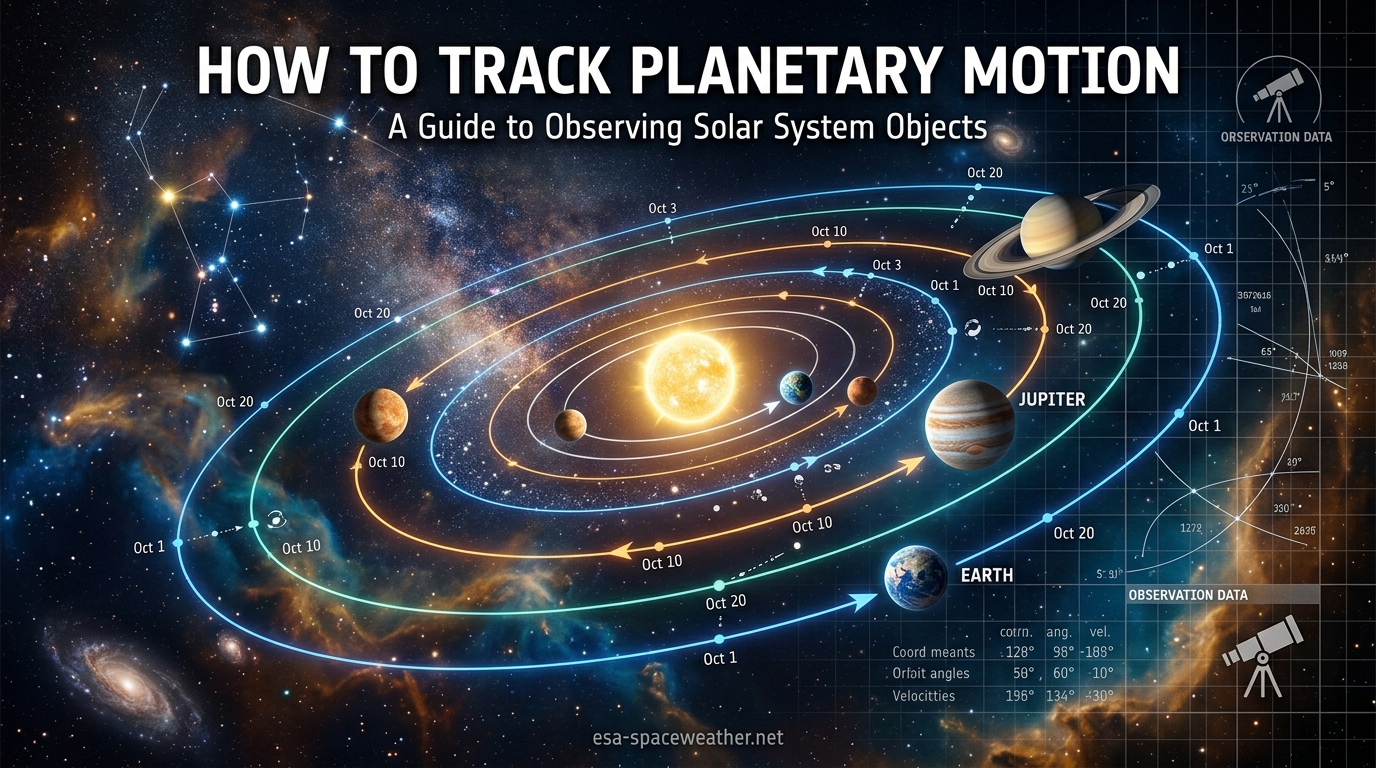
Have you ever looked up at the night sky and noticed a bright object that seemed out of place among the familiar stars? That steady, unblinking light is almost certainly a planet, and unlike the fixed stars around it, that planet is slowly drifting across the sky night after night. Learning how to track a planet’s motion across the sky over several nights is one of the most rewarding projects a beginner astronomer can undertake.
The ancient Greeks called them “wandering stars” (the word “planet” literally comes from the Greek word for wanderer) because these objects refused to stay put. While stars maintain the same relative positions for thousands of years, planets shift their positions noticeably from one night to the next. I have spent years introducing friends and family to this observation, and watching someone realize they can actually see another world moving never gets old.
This guide walks you through everything you need to know about tracking planetary motion without specialized equipment. You will learn why planets wander, how to identify them, and how to run a simple seven-night observation project that lets you witness the same motion that convinced ancient civilizations the Earth was not the center of the universe.
Whether you are a complete beginner with just your eyes or an intermediate observer with binoculars and a smartphone app, the method below will help you document real planetary movement against the backdrop of distant stars.
Table of Contents
The Quick Answer
To track a planet’s motion across the sky over several nights, follow these steps: (1) Identify a bright planet near a recognizable star pattern, (2) note its exact position relative to nearby stars on night one, (3) return to the same spot at the same time each subsequent night, and (4) record how far the planet has shifted. Most visible planets drift about 0.5 to 1.5 degrees eastward per night against the background stars, which means you can see clear movement within just two to three nights of observation.
What You Will Need to Get Started
One of the best things about tracking planetary motion is that you probably already have everything you need. No expensive telescope required. Here is what I recommend at different levels of investment.
The Bare Minimum (Free)
Your eyes, a clear view of the sky, and a way to record what you see. A simple notebook and pencil work perfectly for sketching positions. Add a red flashlight to preserve your night vision, and you are fully equipped for naked eye observation.
You will also need consistency. Pick a specific time (say, 9:00 PM) and commit to stepping outside at that exact time for several consecutive nights. The method only works when you compare positions observed at the same moment each evening, because the entire sky rotates throughout the night due to Earth’s rotation.
The Binocular Upgrade
A standard pair of binoculars (7×50 or 10×50) makes a big difference. Binoculars help you see fainter stars near your target planet, which gives you more reference points for tracking movement. They also let you spot Jupiter’s four Galilean moons and Saturn’s rings as a tiny oval shape.
Community astronomers on forums like Cloudy Nights consistently recommend binoculars on a tripod as the best first equipment purchase. Hand-shake makes precise observation difficult, so even a cheap tripod adapter dramatically improves your ability to judge a planet’s position relative to nearby stars.
The Smartphone Assistant
Several free and low-cost apps transform planetary tracking. Stellarium (free on desktop, small fee on mobile), SkySafari, Star Walk, and NASA’s own app all show real-time planet positions. You can hold your phone up to the sky and the app identifies exactly what you are looking at.
I use Stellarium to verify what I see before recording anything in my log. The app confirms which planet I am observing, shows its magnitude (brightness), and lets me know if any bright stars are nearby for reference points. This eliminates the most common beginner mistake: thinking you are tracking Jupiter when you are actually looking at a bright star like Sirius or Arcturus.
The Observing Log
Whether digital or paper, you need a consistent record. Each entry should include the date, exact observation time, planet name, location (city or latitude and longitude), and a sketch or description of the planet’s position relative to at least two nearby bright stars. Weather conditions and moon phase matter too, since a bright full moon can wash out fainter reference stars.
I keep a dedicated astronomy notebook with a two-page spread per week. The left page has pre-drawn circles representing my field of view, and the right page has notes about conditions, equipment used, and what I observed. This format makes night-to-night comparisons easy to see at a glance.
Why Planets Appear to Wander: The Science Behind the Motion
Stars are so far away that their positions appear fixed on human timescales. The constellation Orion looks essentially the same today as it did to ancient Egyptian astronomers. But planets share our solar system, orbiting the Sun at distances comparable to our own, which means their viewing angles change constantly from our perspective on Earth.
Imagine driving on a highway and watching a nearby car in the lane next to you. If that car is moving at a similar speed, it appears to drift slowly relative to distant mountains on the horizon. Planets work the same way. Distant stars are the mountains, and planets are the neighboring cars, slowly shifting position against the fixed background.
The Ecliptic: Where All the Planets Live
All the planets in our solar system orbit the Sun in roughly the same flat plane, like marbles rolling around on the same tabletop. From our viewpoint on Earth, this plane projects as a line across the sky called the ecliptic. The ecliptic passes through the twelve zodiac constellations: Aries, Taurus, Gemini, Cancer, Leo, Virgo, Libra, Scorpius, Sagittarius, Capricornus, Aquarius, and Pisces.
This is why you will never find a planet in the Big Dipper or Orion. Those constellations sit well away from the ecliptic plane. If you want to find a planet, scan along the zodiac constellations that trace the ecliptic path across your sky. The ecliptic also represents the apparent path the Sun follows throughout the year, so planets are always found near where the Sun travels during the day.
How Fast Do Planets Actually Move?
The drift rate depends on the planet. Mercury and Venus, being closer to the Sun than Earth, can appear to move quite rapidly when they are visible. Mars shifts about 0.5 degrees per night against the background stars on average. Jupiter crawls along at roughly 0.2 degrees per night. Saturn is even slower, drifting about 0.1 degrees per night.
To put that in perspective, the full Moon spans about 0.5 degrees of sky. So Mars moves roughly one Moon-width each night, while Jupiter takes two to three nights to cover the same distance. Saturn barely shifts one Moon-width over an entire week, which makes it a patience-testing target for multi-night tracking.
These eastward drift rates are averages. The actual apparent speed changes depending on where Earth and the target planet are in their respective orbits, which leads to some fascinating behavior including retrograde motion, which we will cover shortly.
Inner Planets vs Outer Planets: Different Motion Patterns
Not all planets behave the same way in our sky. Astronomers divide them into two groups: inferior planets (those closer to the Sun than Earth) and superior planets (those farther from the Sun). Each group has distinct observational characteristics that affect how you track them.
Inferior Planets: Mercury and Venus
Mercury and Venus are called inferior planets because their orbits lie inside Earth’s orbit. This geometry means they never appear far from the Sun in our sky. You will always find them either in the western sky shortly after sunset (eastern elongation) or in the eastern sky shortly before sunrise (western elongation).
The maximum angular distance these planets can appear from the Sun is called their elongation. Mercury reaches a maximum elongation of about 28 degrees, while Venus can stretch out to about 47 degrees. This limited range means Mercury and Venus are challenging targets for multi-night tracking because they are often lost in the Sun’s glare.
Venus is the easier of the two to track. When it is well-placed in the evening or morning sky, it is the brightest object after the Sun and Moon, making it impossible to miss. Mercury, on the other hand, is notoriously difficult. It hugs the horizon, requires a very clear view, and is only visible for a few weeks during each apparition.
Both inferior planets go through phases just like the Moon, visible through binoculars or a small telescope. Venus shows a dramatic transition from a thin crescent to a half-lit disk and back, which adds an extra dimension to tracking its motion.
Superior Planets: Mars, Jupiter, and Saturn
Mars, Jupiter, and Saturn orbit outside Earth’s path around the Sun. These superior planets can appear anywhere along the ecliptic and are visible at various times throughout the night depending on their position relative to Earth.
The key moment for any superior planet is opposition, when Earth passes directly between the planet and the Sun. At opposition, the planet rises at sunset, is visible all night, and appears at its brightest and largest. This is the ideal time to begin a multi-night tracking project because the planet is well-placed for observation for weeks on either side of opposition.
Mars at opposition can brighten dramatically, outshining even Jupiter. The red planet is also the best target for observing retrograde motion because its relatively close distance makes the effect most pronounced. Jupiter reaches opposition roughly every 13 months, while Saturn does so about every 12.5 months. Mars, with its more eccentric orbit, has oppositions spaced about 26 months apart.
Conjunction: When Planets Meet
A conjunction occurs when two planets appear very close together in the sky, or when a planet passes near the Moon. These events are excellent natural markers for your tracking log because they provide a specific, photographable moment in the planet’s journey across the sky. Conjunctions between Jupiter and Saturn, like the famous great conjunction, are rare and memorable events that happen roughly every 20 years.
How to Identify Planets in the Night Sky
Before you can track a planet’s motion, you need to know you are actually looking at a planet. Beginners frequently confuse bright planets with bright stars, and the confusion is understandable. Here are the most reliable identification methods I use and teach.
The Twinkle Test
The single most reliable quick test is this: stars twinkle, planets shine steadily. The twinkling effect, properly called scintillation, happens because starlight is essentially a point source (a single pinpoint of light) that gets distorted by Earth’s turbulent atmosphere. Planets, being closer, appear as tiny disks rather than points, so their light averages out and stays relatively steady.
Venus and Jupiter shine with such steady, brilliant light that they are immediately distinguishable from any star. Saturn is a bit fainter but still steady. Mars can sometimes appear to shimmer slightly near the horizon, which is a common source of confusion, but at higher elevations its steady orange-red glow is distinctive.
Color Clues
Each visible planet has a characteristic color that helps with identification. Venus appears brilliant white or slightly yellowish, brighter than any star. Jupiter shines with a steady creamy white or pale yellow light. Mars glows distinctly orange-red, which is especially obvious when compared to a nearby white star. Saturn has a subtle pale gold or buttery yellow tint.
Mercury is harder to identify by color because it is always near the horizon and appears pinkish or reddish due to atmospheric absorption. If you see a moderately bright object hugging the horizon shortly after sunset or before sunrise, Mercury is a real possibility.
Position Along the Ecliptic
If you see a bright, steady light and it is located along the zodiac band, you are almost certainly looking at a planet. Learn to recognize a few zodiac constellations. If you spot a bright object in Leo or Virgo that was not there last month, it is a planet passing through. Planets are the only objects that appear in new places along the ecliptic from month to month.
Brightness and Magnitude
Astronomers measure brightness using the magnitude scale, where lower numbers mean brighter objects. Sirius, the brightest star, has a magnitude of about negative 1.4. Venus can reach magnitude negative 4.6, making it far brighter than any star. Jupiter typically shines at magnitude negative 2 to negative 3. Mars varies dramatically depending on its distance from Earth, ranging from about magnitude positive 1.5 (faint) at solar conjunction to negative 2.8 at opposition.
If an object is clearly brighter than the brightest stars in the sky and does not twinkle, you are looking at Venus or Jupiter. If it is bright with a reddish tint, it is Mars. A steady golden light somewhat fainter than Jupiter is Saturn.
Understanding Retrograde Motion
One of the most fascinating phenomena you can observe through multi-night tracking is retrograde motion. Normally, planets drift slowly eastward against the background stars. But periodically, they appear to stop, reverse direction, loop backward (westward) for weeks or months, then stop again and resume their normal eastward drift.
What Causes Retrograde Motion?
Retrograde motion is an optical illusion caused by the relative motion of Earth and the other planet as both orbit the Sun. Think of it like passing a slower car on the highway. As you pull alongside and pass, the other car appears to move backward relative to distant scenery for a brief moment. Earth does the same thing to Mars, Jupiter, and Saturn when we overtake them on our faster inner orbit.
Mars shows the most dramatic retrograde loop because it is closest to Earth and its orbital speed is most similar to ours. A Mars retrograde loop can span 10 to 20 degrees of sky and last for about two to three months. This makes Mars the best planet for observing retrograde motion over an extended period.
When to Observe Retrograde Motion
Retrograde motion always happens around opposition for superior planets. The planet begins moving normally (prograde, or eastward), then slows and stops (called a station), reverses to westward motion (retrograde), slows and stops again (second station), then resumes eastward drift.
To catch retrograde motion, you need to track a planet for several weeks or months around its opposition date. Mars retrogrades roughly every 26 months. Jupiter and Saturn retrograde annually. Check astronomy resources like In-The-Sky.org or Sky and Telescope’s weekly sky calendar to find exact dates for upcoming retrograde periods.
For a beginner project, you do not need to capture the full retrograde loop. Even documenting the station points, where the planet appears to pause before changing direction, is a satisfying achievement that demonstrates the dynamic nature of our solar system.
Tools for Tracking: From Naked Eye to Apps
Different tools serve different purposes in planetary tracking. Here is how each one fits into the process, from simplest to most advanced.
Naked Eye Observation
Your eyes are surprisingly capable tools for tracking planetary motion. The key is identifying a planet near a recognizable pattern of bright stars and noting how its position changes relative to those stars over several nights. Venus near a crescent Moon, Jupiter among the stars of Taurus, or Mars moving through Gemini are all excellent naked-eye targets.
The limitation of naked-eye observation is precision. You can tell that a planet has moved, but you cannot easily measure how far or in exactly what direction. This is where sketching becomes valuable. Draw what you see each night, including the planet and surrounding stars, and the motion becomes visually obvious when you compare drawings.
Binoculars for Precision
Binoculars reveal fainter stars around your target planet, giving you a denser grid of reference points. With a 7×50 or 10×50 pair, you can see stars down to about magnitude 8 or 9, depending on sky conditions. This denser star field makes it much easier to judge exactly where a planet sits relative to its stellar backdrop.
Forum astronomers consistently recommend binoculars as the step up from naked-eye observation. They are affordable, portable, and wide enough in field of view to show the planet in context with surrounding stars. The Moon spans about 0.5 degrees, and typical binoculars show 5 to 8 degrees of sky, so you get a generous slice of the ecliptic in each view.
Star Charts and Sky Maps
A printed star chart provides a permanent reference that does not need batteries. You can mark the planet’s position with a pencil dot each night and connect the dots over a week to see the motion path. The classic technique involves using a detailed star atlas (like the Pocket Sky Atlas or Sky and Telescope’s charts) and plotting the planet’s position relative to stars shown on the map.
This method connects you directly to how astronomers worked for centuries. There is something deeply satisfying about penciling in a planet’s nightly position and watching the track emerge on paper over a week of observations.
Astronomy Apps and Software
Modern apps have made planet identification and tracking accessible to everyone. Here are the most recommended options from community forums and my own experience:
Stellarium (free desktop, paid mobile): Open-source planetarium software that shows the sky from any location and time. Excellent for planning observations and verifying what you saw.
SkySafari (paid, various tiers): Powerful mobile app with extensive features including telescope control. Shows planet positions, magnitudes, and orbital data.
Star Walk 2 (paid): User-friendly mobile app ideal for beginners. Point your phone at the sky and it identifies planets, stars, and constellations in real time.
NASA App (free): Includes skywatching tips, current planet visibility information, and monthly skywatching videos that highlight upcoming events.
TheSkyLive.com (free, web-based): Real-time planet positions with interactive sky maps, 3D solar system viewer, and detailed data tables including right ascension, declination, and magnitude for every planet.
Telescope Considerations
A telescope is not necessary for tracking planetary motion across the sky, and for multi-night drift tracking it can actually be a hindrance because the narrow field of view limits your reference stars. However, a telescope adds detail: Jupiter’s cloud bands and moons, Saturn’s rings, Mars’s surface features. Use a telescope for detail, but use binoculars or naked eye for the actual motion tracking.
If you do use a telescope, a low-power eyepiece (25mm or longer) gives the widest field of view. Telescope users on Cloudy Nights note that manually nudging the scope to follow a planet as it drifts through the field of view is a common technique for planetary observation sessions.
Recording Your Observations: Drawing and Logging
Documentation is what separates casual skywatching from actual planetary tracking. Without records, you have no way to measure or appreciate the motion you are witnessing. Here are the most effective recording methods.
Sketching Planetary Positions
Drawing is the oldest and most effective method for recording planetary motion. You do not need artistic talent. Start with a circle about 3 inches in diameter representing your field of view. Draw the brightest stars you can see near the planet as dots of various sizes (bigger dots for brighter stars). Then place the planet as a dot with a small circle around it to distinguish it from stars.
Each night, draw the same field of view. Use the same bright reference stars as your anchor points. The planet will be in a slightly different position each time, and the accumulated sketches will show a clear path across the sky.
This technique is how astronomers like Tycho Brahe recorded planetary positions before the invention of photography. It still works beautifully today and costs nothing.
Smartphone Photography
Modern smartphones can capture bright planets and surrounding stars, especially in dark sky locations. While you will not get Hubble-quality images, you can photograph the planet among its reference stars each night and compare the photos. Use a tripod or prop your phone against something stable for long exposures.
Several phone apps specialize in night sky photography, allowing manual control of exposure and ISO. Even basic phone cameras in night mode can capture Venus, Jupiter, and bright stars if the sky is dark enough.
The Observing Log Template
Here is a simple log template you can copy into a notebook. For each night of observation, record:
Date and exact time of observation. Your observing location (city or coordinates). Weather conditions and cloud cover percentage. Moon phase (bright moonlight washes out faint stars). Planet name and which constellation it is in. Position description relative to two nearby bright stars. Estimated angular distance moved since last observation. Equipment used (naked eye, binoculars, telescope). Any notable features observed (phases, moons, color).
This structured log becomes a scientific record of your observations. Over weeks and months, you can chart the planet’s path, calculate its average drift rate, and predict where it will be on future nights.
Step-by-Step: Track a Planet’s Motion Across the Sky Over Several Nights
Now let me walk you through a complete seven-night observation project. This is a practical exercise you can start tonight if skies are clear. I have run this project with beginners dozens of times, and the moment someone sees the motion for themselves is always memorable.
Step 1: Choose Your Target Planet
Pick a planet that is currently well-placed for observation. Check an astronomy app or NASA’s skywatching page to see which planets are visible this month. Jupiter is my top recommendation for beginners because it is bright, easy to find, and moves at a noticeable rate. Mars is excellent near opposition. Venus works well if it is in its evening or morning apparition.
Saturn is trackable but slow, requiring more patience for visible results. Mercury is too difficult for a first project. If Jupiter or Mars is visible, start there.
Step 2: Find a Fixed Reference Point
Identify at least two bright stars near your target planet that you can easily recognize. These are your reference stars. Ideally, choose stars that form a recognizable pattern with the planet, like a triangle or a line. The planet should be within 5 to 10 degrees of these reference stars.
If you are tracking Jupiter in Taurus, for example, you might use Aldebaran (the bright red eye of the bull) and the stars of the nearby Pleiades cluster as reference points. Sketch the arrangement on your first night so you have a baseline for comparison.
Step 3: Record the Initial Position
On night one, go outside at your chosen time (I recommend between 9 PM and 10 PM, when skies are dark but you are not fighting midnight fatigue). Allow ten minutes for your eyes to adapt to the darkness. Then sketch what you see.
Draw your reference stars as dots and the planet as a circled dot. Note the angular distances as best you can estimate. Your outstretched hand is a useful measuring tool: your pinky finger at arm’s length covers about 1 degree, three fingers cover about 5 degrees, and a closed fist covers about 10 degrees of sky.
Write down everything: the date, exact time, weather conditions, and a verbal description of the planet’s position. Something like “Jupiter sits about 3 degrees to the east of Aldebaran, forming a triangle with Aldebaran and the star Elnath.”
Step 4: Return at the Same Time Each Night
This is the critical step. You must observe at the same clock time each night. If you observed at 9:00 PM on night one, observe at 9:00 PM on night two, three, and beyond. The reason is that Earth’s rotation causes the entire sky to shift about 15 degrees per hour. If you observe at different times, the sky itself has moved, and you cannot isolate the planet’s own motion.
If daylight saving time changes during your project, adjust your observation time accordingly so you are always observing at the same solar time.
Step 5: Measure the Drift
On night two, compare the planet’s position to your reference stars. Most planets will have shifted slightly eastward. Use your hand measurements to estimate how far. Record this in your log.
For Jupiter, expect about 0.2 degrees of shift per night, which is less than half your pinky finger width at arm’s length. It sounds tiny, but against fixed reference stars, even this small shift is noticeable. For Mars, expect about 0.5 degrees, roughly one full Moon diameter per night.
By night three or four, the accumulated motion becomes obvious in your sketches. The planet has clearly moved from its original position, and you can draw an arrow showing the direction and approximate distance of drift.
Step 6: Account for Weather Gaps
Real astronomy means dealing with weather. If clouds block your view for two nights, do not abandon the project. Simply resume when skies clear and note the gap in your log. The planet continued moving during the cloudy nights, so when you next observe it, the shift will be larger and more dramatic.
In fact, weather gaps can make the motion more obvious. A planet that moved 1 degree over two cloudy nights plus one clear night will show a three-degree total shift when you resume observation, which is much easier to detect than the smaller nightly increments.
Light pollution is another factor. If you live in a city, bright reference stars may be fewer, but Venus, Jupiter, and Mars are bright enough to track even under urban skies. For fainter planets or denser reference star fields, a short drive to a darker location dramatically improves your ability to judge positions.
Step 7: Build Your Motion Map
After seven nights (or however many clear nights you managed within your project window), lay out all your sketches side by side. Connect the planet’s position from night one to night seven with a line or arrow. You have just tracked a planet’s motion across the sky.
This motion map is a personal record of planetary movement that connects you to the same observations made by ancient Babylonian, Greek, and Mayan astronomers. The direction of the arrow shows whether the planet is in prograde (normal eastward) or retrograde (westward) motion. The length of the arrow over your observation period reveals the planet’s apparent speed.
From here, you can extend the project. Continue tracking for another week, or switch to a different planet and compare drift rates. Try photographing the field each night instead of sketching. Challenge yourself to predict where the planet will be on a future date based on your measured drift rate, then check your prediction against reality.
Common Mistakes to Avoid
After helping many beginners with planetary tracking, here are the errors I see most often:
Observing at different times each night. This is the number one mistake. The sky rotates 15 degrees per hour, so observing at 8 PM one night and 10 PM the next makes the entire sky appear to shift, masking the planet’s own motion. Stick to a consistent time.
Confusing a planet with a bright star. Use the twinkle test and an app to confirm your target before starting. Nothing is more frustrating than tracking a star’s non-motion for a week.
Not recording reference stars. Without fixed reference points, you cannot measure motion. Always include at least two identifiable stars in your sketches.
Choosing a planet too close to the Sun. If your target sets within an hour of sunset or rises within an hour of sunrise, you will struggle to get consistent observations. Pick a planet that is well above the horizon at your observation time.
Expecting too much motion too fast. Saturn barely moves 1 degree per week. If you chose Saturn and cannot see night-to-night change, that is normal. Switch to Jupiter or Mars for more satisfying short-term results.
Best Planets for Beginners to Track by Season
Planet visibility changes throughout the year as Earth and the target planets orbit the Sun. Here is a quick guide to which planets are typically easiest to track in each season, though specific visibility varies year to year and should be checked with an astronomy app.
Spring: This is often an excellent time for galaxy season deep-sky observing, but planet visibility varies. Check if Jupiter or Mars is well-placed in the evening sky.
Summer: Saturn often reaches opposition in summer months, making it visible all night. The warm weather and later sunset times can make summer observing pleasant, though shorter nights reduce observing windows.
Autumn: Jupiter frequently reaches opposition in autumn, making it a bright, prominent evening target for weeks. Mars oppositions occasionally fall in autumn as well.
Winter: Long nights provide maximum observing time. Bright winter constellations like Orion, Taurus, and Gemini provide rich reference star fields along the ecliptic. Venus may be prominent as an evening or morning star depending on its apparition cycle.
Always verify current planet positions with Stellarium, SkySafari, or NASA’s monthly skywatching guide before planning your project. Planet visibility cycles repeat but specific dates shift from year to year.
Glossary of Key Terms
Opposition: When a superior planet (Mars, Jupiter, Saturn) is directly opposite the Sun in the sky as seen from Earth. The planet rises at sunset and is visible all night at its brightest.
Conjunction: When a planet appears very close to another planet, the Moon, or the Sun in the sky. A conjunction with the Sun means the planet is invisible or very difficult to observe.
Elongation: The angular distance between a planet and the Sun as seen from Earth. Greatest elongation is the best time to observe Mercury and Venus.
Retrograde motion: The apparent westward (backward) motion of a planet against the background stars, caused by Earth overtaking the planet in its orbit. Occurs around opposition for superior planets.
Synodic period: The time between successive oppositions (or successive identical configurations) of a planet. For Mars it is about 780 days, for Jupiter about 399 days, for Saturn about 378 days.
Ecliptic: The apparent path the Sun traces across the sky over the course of a year, which also defines the plane of the solar system where all planets are found.
Apparition: The period during which a planet is observable, from when it first emerges from the Sun’s glare after conjunction to when it disappears again. Each planet has one primary apparition per synodic period.
Magnitude: The brightness scale used in astronomy. Lower or negative numbers indicate brighter objects. Venus can reach magnitude minus 4.6, while the faintest stars visible to the naked eye are around magnitude 6.
FAQs
Can you see a planet move in a single night?
No, planets do not show noticeable motion against the background stars in a single night to the naked eye. You need to compare positions night to night at the same time to detect planetary wandering. The fastest visible planet, Mars, moves only about 0.5 degrees per night, which is roughly the width of the full Moon.
Which planet is easiest to track for beginners?
Jupiter is the easiest planet for beginners to track. It is extremely bright, easy to identify by its steady creamy-white light, and moves at a noticeable rate of about 0.2 degrees per night. Mars is also a good choice near opposition when it is bright and shows approximately 0.5 degrees of nightly drift.
How fast do planets move across the sky?
Planets drift eastward against the background stars at different rates. Mars moves about 0.5 degrees per night, Jupiter about 0.2 degrees, and Saturn about 0.1 degrees. Mercury and Venus can move faster but are harder to observe due to their proximity to the Sun. The full Moon spans about 0.5 degrees for comparison.
What is retrograde motion and when can I see it?
Retrograde motion is the apparent backward (westward) movement of a planet against the stars, caused by Earth overtaking it in orbit. It happens around opposition for superior planets. Mars shows the most dramatic retrograde loop every 26 months, lasting about two to three months. Jupiter and Saturn retrograde annually.
How do I know if I am looking at a planet or a star?
The simplest test is that stars twinkle and planets shine steadily. Planets also sit along the ecliptic path near zodiac constellations, while stars can appear anywhere. Each planet has a characteristic color: Venus is brilliant white, Jupiter is creamy white, Mars is orange-red, and Saturn is pale gold. An astronomy app can confirm any identification.
Do I need a telescope to track planetary motion?
No, you can track planetary motion entirely with your naked eye or binoculars. A telescope is not necessary and its narrow field of view can actually make motion tracking harder by limiting reference stars. Binoculars or even just your eyes combined with a notebook are the best tools for multi-night planetary tracking.
How can we see planets that are so far away?
Planets are visible despite their distance because they reflect sunlight directly, unlike stars which generate their own own light. Venus, Jupiter, and Mars can appear brighter than any star because they are large, relatively close to Earth, and highly reflective. Their proximity within our own solar system means they appear as bright, steady points of reflected sunlight rather than faint pinpoints.
Wrapping Up: Your Next Steps as a Planet Tracker
Learning how to track a planet’s motion across the sky over several nights connects you to an ancient tradition of skywatching that stretches back thousands of years. With nothing more than your eyes, a notebook, and a few clear nights, you can witness the same wandering motion that inspired the word “planet” and eventually overturned the geocentric model of the universe.
Start simple. Pick Jupiter or Mars as your first target, find two reference stars, and commit to stepping outside at the same time for one week. Sketch what you see each night. By night three, the motion will be visible in your drawings. By night seven, you will have a personal record of another world drifting through space.
From there, the possibilities expand. Try observing retrograde motion over several months. Track multiple planets simultaneously and compare their drift rates. Attempt smartphone astrophotography to document positions digitally. Join a local astronomy club or an online community like Cloudy Nights or Reddit’s r/Astronomy to share your observations and learn from experienced observers.
The sky is always moving. The planets are always wandering. All you have to do is look up, take note, and come back tomorrow night to see what changed.