
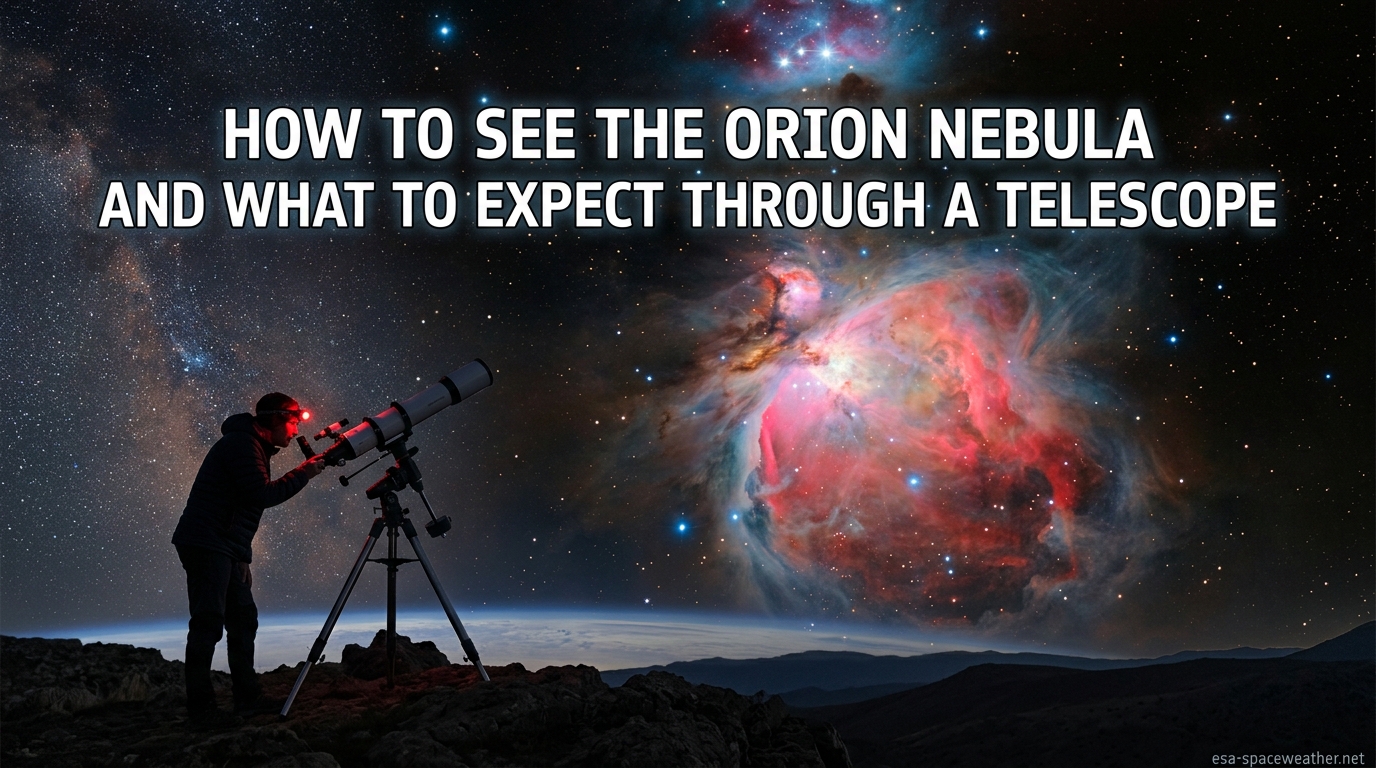
To see the Orion Nebula through a telescope, locate Orion’s Belt in the winter sky, look below it for the three stars of Orion’s Sword, and point your scope at the middle fuzzy star. Any telescope with at least 70mm of aperture will reveal the nebula as a glowing gray-green cloud with four tightly packed stars (the Trapezium Cluster) at its core. Use low magnification (40-75x) first, then increase power once the nebula is centered.
That quick answer is what most beginners need. But the full story is far more exciting, and understanding what you will actually see at the eyepiece makes the difference between a magical first experience and a disappointing one.
I have spent countless winter nights observing M42 from backyards, dark-sky sites, and everything in between. In this guide, I will walk you through exactly how to find it, what to expect through different telescope sizes, and how to get the best possible view of the most spectacular deep-sky object visible from the northern hemisphere.
The Orion Nebula is not just another fuzzy patch in the sky. It is a stellar nursery where new stars are being born right now, glowing at magnitude 4.0 and sitting roughly 1,344 light-years from Earth. Whether you have a small refractor or a large Dobsonian, this is the one object that will keep you coming back to the eyepiece all winter long.
Table of Contents
What Is the Orion Nebula?
The Orion Nebula, also known as M42 or Messier 42, is a massive cloud of gas and dust in the constellation Orion where new stars are actively forming. It is classified as an emission nebula, meaning it glows because ultraviolet radiation from hot young stars at its center energizes the surrounding hydrogen gas, causing it to fluoresce like a cosmic neon sign.
At approximately 1,344 light-years away, M42 is the closest major star-forming region to Earth. That proximity makes it bright enough to see with the naked eye under dark skies and one of the most rewarding targets for any telescope. The nebula spans about 24 light-years across, though you will see only the brightest central portion through a telescope.
Charles Messier cataloged it in 1774, but it has been visible to skywatchers since ancient times. At its heart sits the Trapezium Cluster, a tight group of four young stars (Theta-1 Orionis) that pump out the energy lighting up the entire nebula. These stars are less than 300,000 years old, making them infants by stellar standards.
Finding Orion in the Night Sky
Before you can point a telescope at the Orion Nebula, you need to find the constellation Orion. The good news is that Orion is one of the most recognizable patterns in the entire sky, and it is visible from virtually anywhere on Earth during the right season.
When Can You See the Orion Nebula?
The Orion Nebula is a winter target for northern hemisphere observers. It becomes visible in the eastern sky around November, reaches its highest point overhead during January and February, and sinks into the western sky by April. For southern hemisphere observers, Orion appears during summer months and rides high overhead.
The best viewing window runs from late November through early March. During December and January, Orion crosses the meridian (its highest point) between roughly 9 PM and 2 AM local time. February brings it to ideal viewing position earlier in the evening, around 8 PM to midnight.
Identifying Orion’s Belt
The key to finding Orion is locating Orion’s Belt, three bright stars in a nearly straight line spaced evenly apart. These three stars are Alnitak, Alnilam, and Mintaka. They are among the most distinctive asterisms in the night sky because no other group of three similarly bright stars lines up so perfectly.
Once you spot the Belt, you will notice two very bright stars flanking it. Betelgeuse, a distinctive orange-red star, sits above the Belt marking Orion’s shoulder. Rigel, a brilliant blue-white star, sits below the Belt marking Orion’s foot. Together with the Belt, these stars form the hourglass or bowtie shape that defines the constellation.
Finding the Sword and the Nebula
Below Orion’s Belt (on the same side as Rigel), you will see a vertical line of fainter stars hanging down. This is Orion’s Sword. The Orion Nebula is not a single star but appears as the middle object in this Sword, looking slightly fuzzy compared to the stars around it.
That fuzzy appearance is your first clue that you are looking at M42. Under a dark sky with no moonlight, it clearly looks different from the point-like stars flanking it. In light-polluted areas, you may only see it as a slightly brighter patch among the Sword stars.
Using Apps and Tools to Locate Orion
If you are having trouble spotting the constellation, a planetarium app makes the process effortless. Stellarium (free on desktop), SkySafari, Star Walk, and Starry Night all display real-time sky maps that show exactly where Orion is from your location. Just hold your phone up to the sky and follow the on-screen guidance.
A Telrad finder or a red-dot finder on your telescope also helps bridge the gap between what you see in the app and where to point your scope. These zero-magnification finders project a bullseye or dot onto the sky, making it simple to slew from Orion’s Belt down to the Sword.
Can You See the Orion Nebula Without a Telescope?
Yes, you can absolutely see the Orion Nebula without a telescope. Under a dark sky (Bortle Class 1-4), M42 is visible to the naked eye as a fuzzy, gray-white patch in the middle of Orion’s Sword. It looks like a star that refuses to focus into a sharp point, which is exactly what drew ancient observers to it long before telescopes existed.
From suburban skies (Bortle Class 5-6), the nebula becomes harder to pick up with the naked eye but is still detectable if you know where to look. Use averted vision, looking slightly to the side of the Sword rather than directly at it, to bring the faint glow into view. Your peripheral vision is more sensitive to faint light than your central vision.
Orion Nebula Through Binoculars
Binoculars are the ideal first instrument for viewing the Orion Nebula, and they will show you far more than your eyes alone. A standard pair of 7×50 or 10×50 binoculars reveals the nebula as a clear, glowing cloud surrounding a group of stars. You can see the brightest part of the nebula, the Trapezium stars (though separating all four requires steady hands), and hints of the surrounding nebulosity.
I always recommend that beginners start with binoculars before moving to a telescope. The wide field of view lets you see the entire Sword region in context, and the setup time is zero. Just walk outside, look up, and focus. The view through 10×50 binoculars from a decent dark-sky location is genuinely beautiful and gives you a preview of what a telescope will reveal in greater detail.
How to See the Orion Nebula Through a Telescope: Step by Step
Once you have located Orion’s Sword with your eyes or binoculars, it is time to point your telescope at the nebula. Follow these steps for the best results.
Step 1: Set Up and Let Your Telescope Cool Down
Bring your telescope outside at least 20 to 30 minutes before you plan to observe. The optics need to reach the same temperature as the outside air. If your scope is warm from inside the house, air currents inside the tube will blur the view and make it impossible to get a sharp focus on the nebula.
If you have a reflector or Dobsonian telescope, check the collimation before you start. Even a slightly misaligned mirror will soften the view and hide faint nebular detail. A quick collimation check with a Cheshire eyepiece or laser collimator takes five minutes and pays off enormously.
Step 2: Align Your Finder Scope
Make sure your finder scope or red-dot finder is aligned with your main telescope. Point your scope at a bright star (Betelgeuse or Rigel work well) and center it in a low-power eyepiece. Then adjust your finder until the same star is centered in its crosshairs. This step saves enormous frustration when you are trying to track down faint objects.
Step 3: Point at the Sword Using Low Power
Insert your lowest-power, widest-field eyepiece (typically a 25mm or 32mm) into the focuser. This gives you approximately 30-50x magnification and a large field of view, making it easy to find your target. Point your finder scope at the middle of Orion’s Sword, where the nebula glows.
Take a look through the eyepiece. You should see a bright, glowing cloud surrounding several stars. If you see only stars, nudge the scope slightly. The nebula is large enough (about 65 arcminutes across) that it should fill a significant portion of your low-power field of view.
Step 4: Center and Increase Magnification
Once the nebula is in view, center it and swap to a medium-power eyepiece (10mm to 15mm, giving roughly 75-120x). This magnification is the sweet spot for M42 viewing. It reveals more detail in the nebula’s structure while keeping the brightest portion comfortably in the field.
Resist the temptation to immediately jump to high power. The Orion Nebula is a large, diffuse object, and too much magnification pushes the faint outer wisps out of view while spreading out the light so thinly that detail actually disappears.
Step 5: Use Averted Vision
This is the single most important technique for observing any faint deep-sky object, and many beginners never learn it. Do not look directly at the nebula. Instead, look slightly to the side of it, toward the edge of your field of view.
Your retina has two types of light receptors. Cones handle color and central vision but are poor at detecting faint light. Rods handle dim light and peripheral vision but do not detect color. By looking slightly away from the nebula, you direct its faint light onto your rod cells, which are far more sensitive. The nebula will appear brighter and more detailed when you are not staring straight at it.
It takes practice. The moment you look directly at the nebula, it dims. But once you train yourself to use averted vision, the detail that appears is remarkable. You will see extensions, wings, and dark lanes that were invisible before.
Step 6: Focus Carefully
Focus on one of the bright Trapezium stars at the center of the nebula. Get them as sharp as possible. A precise focus makes a bigger difference for nebula viewing than most people realize. An out-of-focus image spreads the nebula’s light into a blur that hides all the detail you are trying to see.
What Does the Orion Nebula Look Like Through a Telescope?
This is the question every beginner asks, and it is where most people experience disappointment if they are not prepared. Here is the honest truth about what you will actually see at the eyepiece.
The Gray-Scale Reality
Through a visual telescope, the Orion Nebula appears primarily in shades of gray and white, not the vivid reds, pinks, and blues you see in astrophotography. This is not a problem with your telescope or your eyes. It is a fundamental limitation of human vision.
Your eyes have two types of light receptors. Cones detect color but require substantial light to function. Rods detect dim light but only in black and white. The Orion Nebula, while bright for a deep-sky object, is far too faint to trigger your color-seeing cone cells. Your rod cells pick it up easily, but they render it in monochrome.
Some observers with large telescopes (8 inches or more) and dark skies report detecting faint hints of green or yellow-green in the brightest central regions. This is caused by oxygen emission at a wavelength to which our eyes are moderately sensitive. But for most observers with typical telescopes, the nebula will look gray.
What You Will Actually See
Through a 4-inch or larger telescope under a reasonably dark sky, here is what to expect. The central region glows brightly around the Trapezium stars, forming a fan-shaped or rectangular cloud of light. Extending outward from this core are wing-like extensions of nebulosity that fade gradually into the darkness. The overall shape has been described as a bat’s wings, a gull in flight, or sheets of silk.
At the edge of the bright central region, you may see a dark indentation known as the Fish’s Mouth, a lane of dust that appears to bite into the luminous cloud. This feature becomes increasingly visible with larger apertures and darker skies.
The Trapezium Cluster
At the heart of the nebula sits the Trapezium, a tight group of four stars arranged in a small trapezoid shape. These stars are easy to split in any telescope with 3 inches or more of aperture at moderate magnification. They appear as four brilliant white points embedded in the brightest part of the nebulosity.
Larger telescopes (6 inches and above) may reveal additional Trapezium stars. The E and F components are fainter and require steady seeing and dark skies to detect, but spotting them is a fun challenge for experienced observers.
M43: The Companion Nebula
Just north of the main Orion Nebula, separated by a dark dust lane, sits M43 (also called De Mairan’s Nebula). This smaller, rounder cloud of glowing gas surrounds a single star. It is part of the same overall nebular complex but appears as a distinct circular glow. Most telescope views of M42 will include M43 in the same low-power field.
Real Observer Descriptions
I have collected descriptions from astronomy forums and observing communities that capture what the Orion Nebula actually looks like through different instruments. These real-world accounts are far more useful than glamorous astrophotos for setting your expectations.
Owners of 4-inch telescopes describe it as sheets of the finest, almost transparent silk studded with bright stars. The nebula glows softly with visible structure and the Trapezium is clearly split into four components.
Owners of 10-inch Dobsonians report seeing the gossamer gull shape with wispy wings extending outward. Dark lanes and the Fish’s Mouth are obvious, and the fainter outer nebulosity becomes visible with averted vision.
Owners of 70mm refractors describe a faint but clearly visible glowing patch surrounding the Trapezium stars. The nebula is unmistakable but lacks the extended structure visible in larger scopes.
The common thread across all descriptions is that the first view is often underwhelming until observers learn what to look for. Once you know about averted vision, the Fish’s Mouth, and the wing extensions, the nebula transforms from a fuzzy blob into a detailed celestial landscape.
Telescope Aperture Guide: What Different Sizes Reveal
No competitor guide I found includes a detailed aperture comparison, but this is one of the most common questions beginners ask. Here is exactly what you can expect from different telescope sizes when viewing the Orion Nebula.
A 60mm to 70mm telescope (2.4 to 2.8 inches) is the minimum practical size for a satisfying view. You will see the central glow clearly, the Trapezium stars will be visible (though splitting all four may be challenging), and the overall shape of the nebula will be apparent. This is a great starting point, and the view through a quality 70mm refractor is surprisingly good.
A 4-inch telescope (100mm) is where the Orion Nebula starts to show real character. The wing-like extensions become visible. The Fish’s Mouth dark lane begins to appear. The Trapezium is cleanly split into four stars. Structure within the bright central region starts to emerge. From a dark-sky site, this aperture delivers a genuinely beautiful view.
A 6-inch telescope (150mm) reveals significantly more nebulosity, especially in the outer regions. The wings extend further than in a 4-inch. More dark lanes and fine detail become visible with averted vision. This is the aperture where most observers start having those wow moments.
An 8-inch to 10-inch telescope (200-250mm) transforms the Orion Nebula into a spectacular sight. The full gossamer gull shape is visible. Wings of nebulosity sweep outward across the field of view. The Fish’s Mouth is a prominent dark feature. Faint extensions visible only with averted vision in smaller scopes become obvious. Some observers detect hints of green in the central region.
A 12-inch or larger telescope pulls out every bit of detail the Orion Nebula has to offer. Enormous sweeping wings of nebulosity fill the eyepiece. Dark lanes cut through the glowing gas like rivers. The Trapezium shows five or six stars. Faint streamers of nebulosity extend far beyond what smaller instruments reveal.
The most important takeaway is this: the Orion Nebula is rewarding at every aperture level. Do not wait until you have a bigger telescope to observe it. A 70mm scope will show it clearly, and each step up in aperture adds detail and drama to the view.
Recommended Magnification for the Orion Nebula
Low magnification (30-50x) is ideal for finding the nebula and taking in the full view including M43 and surrounding stars. Use a 25mm or 32mm eyepiece.
Medium magnification (75-120x) is the sweet spot for detailed viewing. Use a 10mm to 15mm eyepiece. This range shows the wing structure, dark lanes, and Trapezium stars at their best.
High magnification (150-200x) is useful for splitting all four Trapezium stars and examining the central region closely. Use a 5mm to 8mm eyepiece, but only attempt this when the atmosphere is steady.
Avoid going above 200x for nebula viewing. The Orion Nebula is large and diffuse, and excessive magnification spreads its light too thinly to see detail.
Best Time and Conditions for Viewing the Orion Nebula
Timing and conditions matter enormously for deep-sky observing. The Orion Nebula is bright enough to tolerate some light pollution, but the difference between a mediocre view and a spectacular one comes down to when and where you observe.
Best Months for Northern Hemisphere Observers
November: Orion rises in the east by mid-evening. The nebula is visible but low on the horizon, which means more atmospheric turbulence and a less steady view.
December and January: Orion reaches its highest point in the sky between 9 PM and 2 AM. This is the prime viewing window. The nebula is well above the horizon haze, and the atmosphere is more stable.
February: Orion is high in the sky right after dark, making it the most convenient month for evening observation. The nebula transits around 9 PM, perfect for a late-winter observing session.
March and April: Orion sinks toward the western horizon. The nebula is still visible but increasingly affected by atmospheric extinction as it drops lower.
Moon Phase Matters Enormously
The single biggest enemy of nebula viewing is moonlight. Even a quarter moon washes out faint nebulosity and dramatically reduces the detail visible through any telescope. Plan your observing sessions around the new moon for the best possible view.
The five days before and after new moon are ideal. During this window, the sky is at its darkest and the faint outer regions of the Orion Nebula are at their most visible. A full moon makes the nebula look flat and washed out, stripping away all the delicate detail.
Understanding the Bortle Scale
The Bortle Scale is a nine-class system that rates sky darkness, from Class 1 (pristine dark sky) to Class 9 (inner-city sky). Understanding your Bortle class helps you set realistic expectations for what you will see.
Bortle Class 1-2 (truly dark rural skies): The Orion Nebula is visible to the naked eye as an obvious fuzzy patch. Through a telescope, the full wing structure, dark lanes, and extensive nebulosity are all visible. This is where M42 looks truly spectacular.
Bortle Class 3-4 (rural to suburban transition): Naked eye visibility is still possible. The nebula shows excellent detail through a telescope, though the faintest outer extensions may require averted vision.
Bortle Class 5-6 (suburban skies): Naked eye visibility is difficult but the nebula is easily found with binoculars or a finder scope. Through a telescope, the central region and Trapezium are bright and detailed, but the outer nebulosity is significantly reduced.
Bortle Class 7-8 (city skies): The nebula is still visible through a telescope but appears as a smaller, dimmer glow with less structure. Use a nebula filter to improve contrast and pull out more detail.
Urban vs Suburban vs Rural Viewing
From a city backyard (Bortle 7-8), expect to see the bright core of the nebula and the Trapezium stars. The outer wings and faint detail will be largely invisible without a filter. Even so, the view is still rewarding because M42 is so intrinsically bright.
From a suburban location (Bortle 5-6), you get most of the nebula. The central fan shape, wing extensions, and Fish’s Mouth are all visible. You miss only the faintest outer wisps that dark-sky observers enjoy.
From a dark rural site (Bortle 1-3), the Orion Nebula becomes one of the most spectacular sights in amateur astronomy. The wings sweep across the eyepiece. Dark lanes carve through the gas. The entire region glows with an almost three-dimensional quality that no photograph can capture, because you are seeing it live with your own eyes.
If you can make even one trip to a dark-sky site during Orion season, do it. The difference is not incremental. It is transformative.
Common Beginner Mistakes to Avoid
After reading hundreds of forum posts from frustrated beginners, I have identified the most common mistakes that ruin first-time views of the Orion Nebula. Avoid these and your experience will be dramatically better.
Using too much magnification is the number one error. Beginners assume higher power equals a better view, but for large diffuse objects like M42, the opposite is true. Too much magnification pushes the faint nebulosity out of the field of view and spreads the light so thin that detail vanishes. Start at low power, then increase gradually only to the sweet spot of 75-120x.
Not using averted vision is the second most common mistake. If you stare directly at the nebula, you are using the least sensitive part of your eye. Look slightly to the side, and the nebula will brighten and reveal detail that was invisible a moment before. This technique alone transforms the experience.
Skip the cool-down period and you will wonder why your telescope shows a blurry blob. Warm optics create air currents inside the tube that distort the image. Give your scope at least 20 minutes to acclimate before observing.
Ignoring the moon phase is a guaranteed way to underwhelm yourself. A bright moon acts like natural light pollution, washing out the faint details that make the Orion Nebula special. Check the moon phase before you plan your session.
Using the wrong eyepiece is another frequent issue. A narrow-field eyepiece at high power makes it hard to find the nebula and impossible to see the full structure. Start with a wide-field, low-power eyepiece, then work your way up to medium power once the nebula is centered.
Other Objects to See in Orion
Once you have had your fill of the Orion Nebula, the constellation offers several other worthwhile targets that are easy to find from the same area of sky.
M43 (De Mairan’s Nebula) sits just north of M42 in the same eyepiece field. This smaller, rounder cloud of glowing gas surrounds a single star and is part of the same nebular complex. It is visible in any telescope that can show M42.
Iota Orionis is the brightest star at the tip of Orion’s Sword, just south of the nebula. It is a tight double star that splits nicely in a small telescope. The surrounding region also contains fainter reflection nebulosity that shows up in larger instruments.
NGC 1981 is an open star cluster just above M42 in the Sword. It is a loose group of about 20 stars visible in binoculars and small telescopes. A nice bonus target while you are in the area.
Rigel (Beta Orionis) at Orion’s foot is a brilliant blue-white supergiant and a challenging double star. Its companion is faint and close, requiring steady seeing and at least 4 inches of aperture to split.
Betelgeuse (Alpha Orionis) at Orion’s shoulder is a massive red supergiant star. While not a double or cluster, its deep orange color makes it a striking sight in any telescope, and it serves as a beautiful color contrast to Rigel’s blue-white brilliance.
Frequently Asked Questions
How to see the Orion Nebula with a telescope?
Find Orion’s Belt (three stars in a line), look below it for Orion’s Sword, and point your telescope at the middle fuzzy patch. Use your lowest-power eyepiece first (25mm or 32mm) to locate the nebula, then switch to medium power (10-15mm) for detail. The nebula is large and bright, making it one of the easiest deep-sky objects to find.
Can you see the Orion Nebula without a telescope?
Yes. Under a dark sky (Bortle Class 4 or better), the Orion Nebula is visible to the naked eye as a fuzzy, gray-white patch in the middle of Orion’s Sword. Standard 7×50 or 10×50 binoculars reveal it clearly as a glowing cloud from suburban locations as well.
What does the Orion Nebula look like through a telescope?
Through a telescope, the Orion Nebula appears as a glowing gray-green cloud with visible structure: bright central fan-shaped regions, wing-like extensions of nebulosity, a dark lane called the Fish’s Mouth, and four tightly grouped stars (the Trapezium Cluster) at its core. It does not show the vivid colors seen in photographs because human eyes cannot detect color in such faint light.
What size telescope do I need to view the Orion Nebula?
A 70mm (2.8-inch) telescope is the minimum practical size for a satisfying view, showing the central glow and Trapezium stars clearly. A 4-inch (100mm) telescope reveals wing structure and the Fish’s Mouth dark lane. An 8-inch or 10-inch telescope shows the full gossamer gull shape with extensive detail. Larger apertures always show more, but even small scopes deliver a rewarding view of M42.
Conclusion: Your First Look at the Orion Nebula
Learning how to see the Orion Nebula through a telescope is a rite of passage for every amateur astronomer. It is the object that hooks people on the hobby, keeps them outside on freezing winter nights, and reminds them why they bought a telescope in the first place.
The key points to remember: find Orion’s Belt, look for the Sword, start with low power, use averted vision, and set your expectations for a gray-green cloud rather than a colorful photograph. Any telescope from 70mm on up will show you something worthwhile, and darker skies make a bigger difference than a bigger telescope.
Grab your scope, wait for a moonless winter night, and spend some real time at the eyepiece. The Orion Nebula has been inspiring observers for centuries, and once you see those glowing wings of gas with the brilliant Trapezium stars shining at their core, you will understand why.