
Every August, the night sky lights up with dozens of shooting stars streaking across the darkness. Every December, it happens again from a different direction. These reliable celestial displays are not random. They are the result of a precise cosmic mechanism that repeats year after year, driven by the invisible trails left behind by some of the most ancient objects in our solar system.
Understanding how comet debris creates the annual meteor showers connects a grain of dust smaller than a grain of sand to one of the most spectacular naked-eye events available to any skywatcher. The story involves icy travelers from the outer solar system, the physics of solar heating, the geometry of orbital mechanics, and the fiery moment when a tiny particle meets our atmosphere at tens of thousands of miles per hour.
In this guide, we walk through the entire process step by step, from the moment a comet sheds its first particles to the instant a streak of light appears above your head. Whether you are an amateur astronomer preparing for the next Perseid peak or a student trying to understand the science behind shooting stars, this breakdown covers everything you need to know about how comet debris creates the annual meteor showers.
Table of Contents
How Comet Debris Creates the Annual Meteor Showers: The Quick Answer
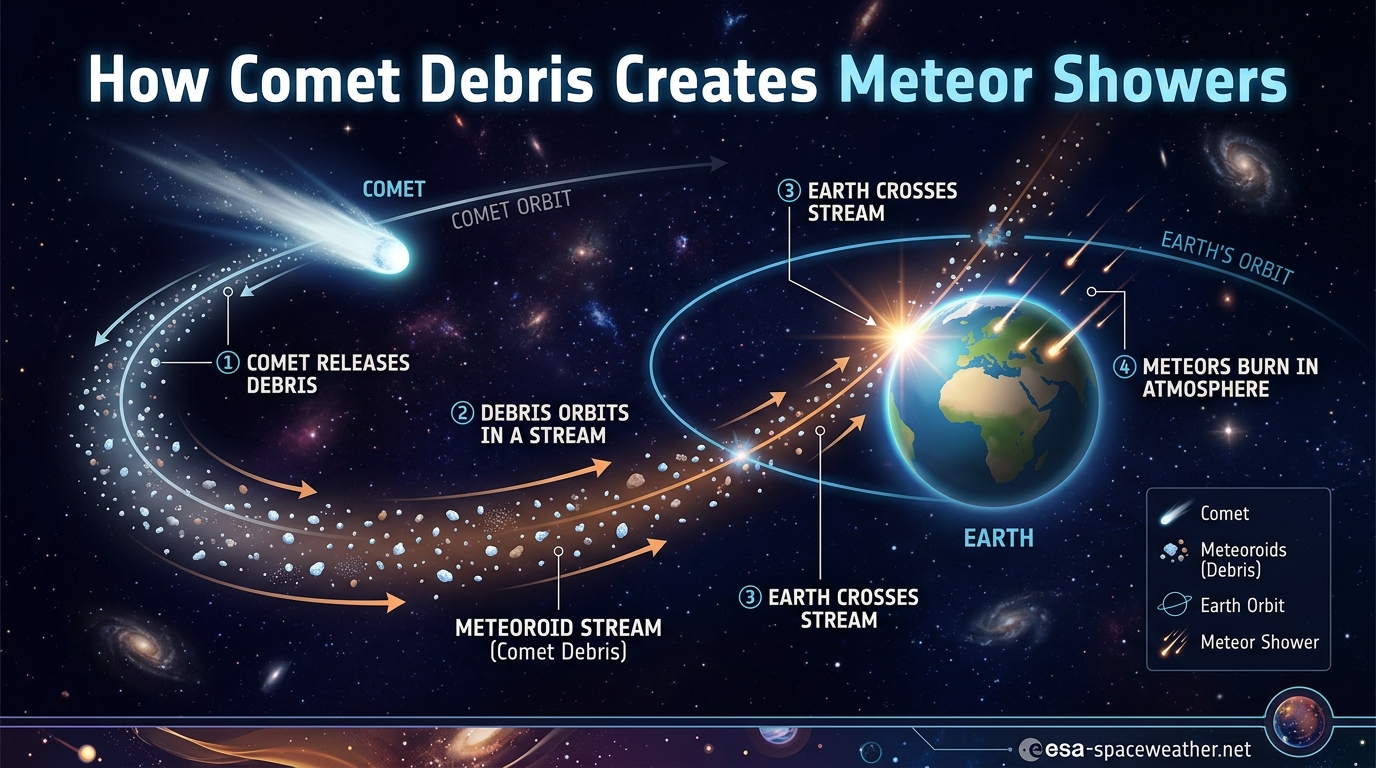
Annual meteor showers occur because comets shed particles of dust and rock as they orbit the Sun, and those particles spread out along the comet’s orbital path to form a persistent debris stream. Earth crosses that same stream at the same point in its orbit every year, so the resulting meteor shower repeats on a predictable annual schedule.
Here is the process in four steps:
- A comet approaches the Sun. Solar heat causes its icy surface to turn directly from solid to gas, a process called sublimation.
- Debris is released. As the ice vaporizes, embedded dust and rock particles are freed and pushed outward by solar radiation pressure.
- A debris stream forms. Over many orbits, these particles spread along the entire orbital path of the comet, creating a ring of dusty debris.
- Earth plows through the stream. Particles enter the atmosphere at high speed, vaporize from friction, and produce the streaks of light we call meteors.
The Comet’s Icy Journey: How Comets Shed Debris
Comets are often described as dirty snowballs, and that analogy is remarkably accurate. A comet nucleus is a fragile, porous body made of ice, frozen gases, dust, and rocky material left over from the formation of the solar system roughly 4.6 billion years ago. Most comets spend the vast majority of their lives in the cold outer reaches of the solar system, far beyond the orbit of Neptune, where their icy composition remains frozen and stable.
Everything changes when a comet enters the inner solar system and approaches perihelion, its closest point to the Sun. As solar intensity increases, the surface ice begins to sublimate, transitioning directly from solid to gas without passing through a liquid phase. This sublimation is the engine that drives the entire meteor shower cycle.
The gas escaping from the comet nucleus carries dust and rocky particles with it. This process, called outgassing, can be incredibly dramatic. A single close pass by the Sun can release millions of kilograms of material. The particles range in size from microscopic grains smaller than a human cell to pebble-sized fragments, though the vast majority are no larger than a grain of sand.
Solar radiation pressure then pushes the lightest particles away from the comet, forming the distinctive dust tail that can stretch for millions of kilometers. Heavier particles are not pushed as far and tend to stay closer to the comet’s orbital path, but all of them are now traveling independently, no longer bound to the nucleus that created them.
This is a critical point that many explanations skip. The debris does not simply trail behind the comet like exhaust behind a car. Instead, each particle enters its own independent orbit around the Sun, governed by the same gravitational and radiative forces that control the comet itself. Over hundreds or thousands of orbital passes, these particles spread out to fill the entire orbital path.
Building the Debris Stream
Understanding how comet debris creates the annual meteor showers requires understanding why the shed particles stay in a coherent stream rather than dispersing randomly into interplanetary space. The answer lies in orbital mechanics and the remarkable regularity of gravitational physics.
When a particle is released from a comet nucleus during outgassing, it inherits the comet’s orbital velocity. The ejection velocity from sublimation is relatively small compared to the comet’s orbital speed, which can be tens of kilometers per second. This means the particle follows an orbit very similar to the comet’s own path around the Sun.
The particles do not all follow identical orbits, though. Tiny differences in their release velocity, direction, and timing mean each particle’s orbit is slightly different. Some travel slightly faster and drift ahead of the comet along the orbital path. Others travel slightly slower and fall behind. Over many revolutions, this spreading effect distributes particles along the entire length of the comet’s orbit.
The result is a meteoroid stream, a diffuse tube of particles encircling the Sun along the same elliptical path as the parent comet. This stream can persist for thousands of years, even after the comet itself has lost most of its volatile material and gone dormant or disintegrated entirely. The Orionid and Eta Aquariid showers, for example, are produced by debris from Halley’s Comet, which has been circling the Sun for millennia.
The density of the stream is not uniform. Particles tend to cluster more densely near the comet’s current position, while the oldest debris, shed many orbits ago, has had more time to spread out. This non-uniform distribution explains why meteor shower intensity can vary from year to year, a topic we explore in a later section.
Earth’s Annual Crossing of the Debris Stream
The reason meteor showers are annual and predictable comes down to a simple geometric fact. Earth follows a fixed orbit around the Sun, and many comet orbits cross or come very close to Earth’s orbital path at specific points. When Earth reaches one of these intersection points, it plows through the debris stream at its full orbital velocity of about 30 kilometers per second.
This intersection happens at the same point in Earth’s orbit every year, which translates to the same calendar date, give or take a day. That is why the Perseids always peak around August 12, the Geminids around December 14, and the Leonids around November 17. Earth arrives at the same orbital position and encounters the same stream of particles left behind by the same comet.
The timing is not perfectly identical every single year because gravitational perturbations from planets, primarily Jupiter, slowly shift the orbits of both the comet and its debris stream. Over decades, this can cause slight shifts in peak timing or intensity. But for practical purposes, the annual recurrence is remarkably reliable, which is why astronomers can publish meteor shower calendars years in advance.
One important detail: Earth does not cross every comet’s debris stream. Only comets whose orbits intersect or closely approach Earth’s orbital path produce observable meteor showers. There are many comets in the solar system whose debris streams Earth never encounters, and we simply never see a shower from them.
From Debris to Shooting Star: Atmospheric Entry Physics
The moment a meteoroid particle enters Earth’s atmosphere is where cosmic mechanics become visible spectacle. When a particle traveling at 11 to 72 kilometers per second collides with atmospheric gas molecules, the kinetic energy converts to intense heat through a process called ablation.
The particle does not burn in the way a log burns in a fireplace. Instead, the extreme velocity causes the surface of the particle to vaporize layer by layer. The vaporized material becomes a glowing trail of hot gas and ionized atoms at altitudes between 80 and 120 kilometers above the ground, in the mesosphere and lower thermosphere.
This glowing trail is what we see as a meteor, and the light is produced primarily by ionization rather than combustion. As atoms in the vaporized particle collide with atmospheric molecules at extreme speeds, electrons are stripped away, and the resulting ions emit light as they recombine. This is why meteors can appear in different colors. Sodium produces a yellow-orange glow, magnesium gives off blue-green, and iron radiates in the yellow part of the spectrum.
Almost all meteoroid particles vaporize completely before reaching the ground. A particle the size of a grain of sand produces a meteor bright enough to be easily seen with the naked eye. Larger fragments, perhaps the size of a marble, can produce spectacular fireballs that light up the entire sky. Only the rare, dense fragments that survive atmospheric ablation and reach the ground earn the name meteorite.
Here is a useful terminology distinction that clears up a common source of confusion for many first-time observers:
- Meteoroid: the small particle traveling through space, before it enters the atmosphere.
- Meteor: the streak of light produced when the particle vaporizes in the atmosphere, also called a shooting star.
- Meteorite: the remnant of a larger body that survives atmospheric entry and lands on the ground.
The Radiant Point: Why Meteors Appear to Come from One Spot
If you watch a meteor shower long enough, you will notice that all the meteors seem to radiate outward from a single point in the sky. This point is called the radiant, and it is a direct consequence of the geometry of Earth’s motion through the debris stream.
The particles in a meteoroid stream are traveling on roughly parallel trajectories because they share the same orbital direction. Think of them like cars on a multi-lane highway, all moving in the same direction. When Earth drives through this highway, the particles enter the atmosphere from the same direction, like rain hitting your windshield as you drive through a storm.
The perspective effect makes these parallel paths appear to diverge from a single point, just as the rails of a train track appear to converge in the distance. That point of apparent origin is the radiant, and each meteor shower is named after the constellation where its radiant appears. The Perseids radiate from Perseus, the Leonids from Leo, the Orionids from Orion, and the Geminids from Gemini.
The radiant is typically only visible after it has risen above the horizon. This is why most meteor showers are best observed after midnight, when Earth’s rotation has turned your location to face the direction of orbital motion, effectively putting you on the front windshield as Earth plows through the debris stream.
Famous Meteor Showers and Their Parent Comets
Dozens of meteor showers occur each year, but a handful are consistently the most active and the most rewarding for observers. Here are eight of the most prominent annual meteor showers, the parent bodies responsible for their debris streams, and what to expect from each.
Quadrantids (early January): This shower peaks around January 3 to 4 with a Zenithal Hourly Rate of approximately 60 to 100 meteors per hour. Its parent body is the asteroid 2003 EH1, which may be an extinct comet. The peak is unusually narrow, lasting only a few hours.
Lyrids (late April): Peaking around April 22, the Lyrids are produced by Comet Thatcher, a long-period comet with an orbit of roughly 415 years. Expect about 10 to 20 meteors per hour under dark skies, with occasional bright fireballs.
Eta Aquariids (early May): This shower comes from none other than Halley’s Comet. Peaking around May 5 to 6, it produces 30 to 50 meteors per hour and is best viewed from the Southern Hemisphere. The meteors are known for their speed and long persistent trains.
Perseids (mid-August): The most popular meteor shower in the Northern Hemisphere, the Perseids peak around August 12 to 13 with a ZHR of 80 to 100 meteors per hour. Their parent comet is 109P/Swift-Tuttle, which orbits the Sun every 133 years. The warm August nights make this shower particularly accessible for casual observers.
Orionids (late October): The second shower produced by Halley’s Comet debris, peaking around October 21 with 15 to 25 meteors per hour. The Orionids are fast meteors that often leave glowing trails lasting several seconds.
Leonids (mid-November): Produced by Comet 55P/Tempel-Tuttle, the Leonids peak around November 17 with a typical rate of 10 to 20 meteors per hour. However, this shower is famous for occasional meteor storms, including the legendary 1833 outburst that produced an estimated 100,000 meteors per hour and helped establish the science of meteor astronomy.
Geminids (mid-December): Often the strongest shower of the year, the Geminids peak around December 13 to 14 with rates exceeding 120 meteors per hour. Their parent body is the asteroid 3200 Phaethon, making them the most prominent exception to the cometary origin rule.
Ursids (late December): A modest shower peaking around December 22 with about 10 meteors per hour, produced by Comet 8P/Tutte. It is best observed from northern latitudes.
Cometary vs Asteroidal Debris: The Geminids Exception
Most meteor showers are produced by cometary debris, which is typically described by astronomers as fluffy or friable material. These particles are porous, fragile conglomerates of dust and ice that break apart easily during atmospheric entry, producing bright meteors with a tendency to fragment.
The Geminids are different because their parent body, 3200 Phaethon, is classified as an asteroid rather than a comet. Phaethon has a highly eccentric orbit that brings it closer to the Sun than any other named asteroid, and this extreme solar heating may be cracking its rocky surface and releasing denser, more solid particles.
This difference in particle composition may explain why the Geminids are such a consistently strong shower. Denser asteroidal fragments survive atmospheric entry longer and produce brighter, more sustained meteors than the fragile cometary dustballs that produce most other showers. It is also why the Geminids have been intensifying over recent decades, as the debris stream continues to be replenished by Phaethon’s close solar passes.
Why Some Showers Are Better Than Others
If you have ever been disappointed by a meteor shower that promised 80 meteors per hour but delivered only a handful, you are not alone. This is one of the most common frustrations shared on amateur astronomy forums, and the explanation comes down to the Zenithal Hourly Rate, or ZHR.
ZHR is a theoretical number that represents the meteor count you would see under ideal conditions: a perfectly dark sky, clear horizon, and the radiant positioned directly overhead. Real-world conditions almost never match this ideal. Light pollution typically cuts visible rates by 50 percent or more. A bright Moon can wash out all but the brightest meteors. And if the radiant is low on the horizon, you will see far fewer meteors than the ZHR suggests.
Debris density also varies from year to year. Some showers produce outbursts when Earth crosses a particularly dense filament of debris, often freshly deposited by a recent comet pass. The Leonids are notorious for this behavior, with most years producing modest rates but occasional years producing spectacular storms. When a comet’s orbit brings it close to Earth’s orbital path shortly before Earth crosses the debris stream, the fresh material can produce a dramatic spike in activity.
For the best experience, find the darkest sky available to you, allow at least 30 minutes for your eyes to fully dark-adapt, avoid looking at your phone, and be patient. Most showers deliver their best rates in the hours after midnight and before dawn.
FAQs
How do we have annual meteor showers?
Annual meteor showers happen because comets leave behind trails of dust and rock particles along their orbital paths as they circle the Sun. Earth’s orbit crosses these debris trails at specific points each year. When Earth passes through a trail, the particles enter the atmosphere at high speed and vaporize, creating the streaks of light we call meteors. Because Earth returns to the same point in its orbit at the same time every year, the shower repeats annually.
Why do meteor showers happen yearly?
Meteor showers happen yearly because both Earth and the comet debris streams follow fixed, repeating orbits around the Sun. Earth reaches the intersection point with a given debris stream at the same time each year, producing a predictable shower. The comet that created the stream does not need to be nearby. The debris can persist for thousands of years, continuing to produce showers long after the comet has moved elsewhere in its orbit.
How are meteor showers linked to comets?
Meteor showers are linked to comets because comets shed the particles that create them. When a comet approaches the Sun, solar heat causes its icy surface to sublimate, releasing dust and rocky debris. This debris spreads along the comet’s orbital path, forming a meteoroid stream. Most major meteor showers, including the Perseids and Orionids, are directly tied to specific comets such as Swift-Tuttle and Halley’s Comet.
What causes predictable yearly meteor showers?
Predictable yearly meteor showers are caused by the regular orbital intersection between Earth and persistent comet debris streams. The comet sheds particles that spread along its orbital path, and Earth crosses that path at the same point each year. The gravitational stability of both orbits ensures the crossing happens at approximately the same calendar date annually, making the showers highly predictable.
Conclusion
Understanding how comet debris creates the annual meteor showers reveals a beautiful chain of physical processes spanning billions of years. Ancient ice and dust from the outer solar system, heated by the Sun, spread along a comet’s orbital path, and encountered by Earth at the same moment each year, produce the shooting stars that have captivated humans for millennia. The next time you watch a meteor streak across the sky, you will know exactly where that tiny particle came from and why it arrived at precisely that moment.
For the best viewing experience in 2026, find a dark sky location, check the Moon phase, and look up after midnight during any of the major shower peaks listed above. The sky is always delivering these tiny cosmic encounters. You just need to know when and where to look.