
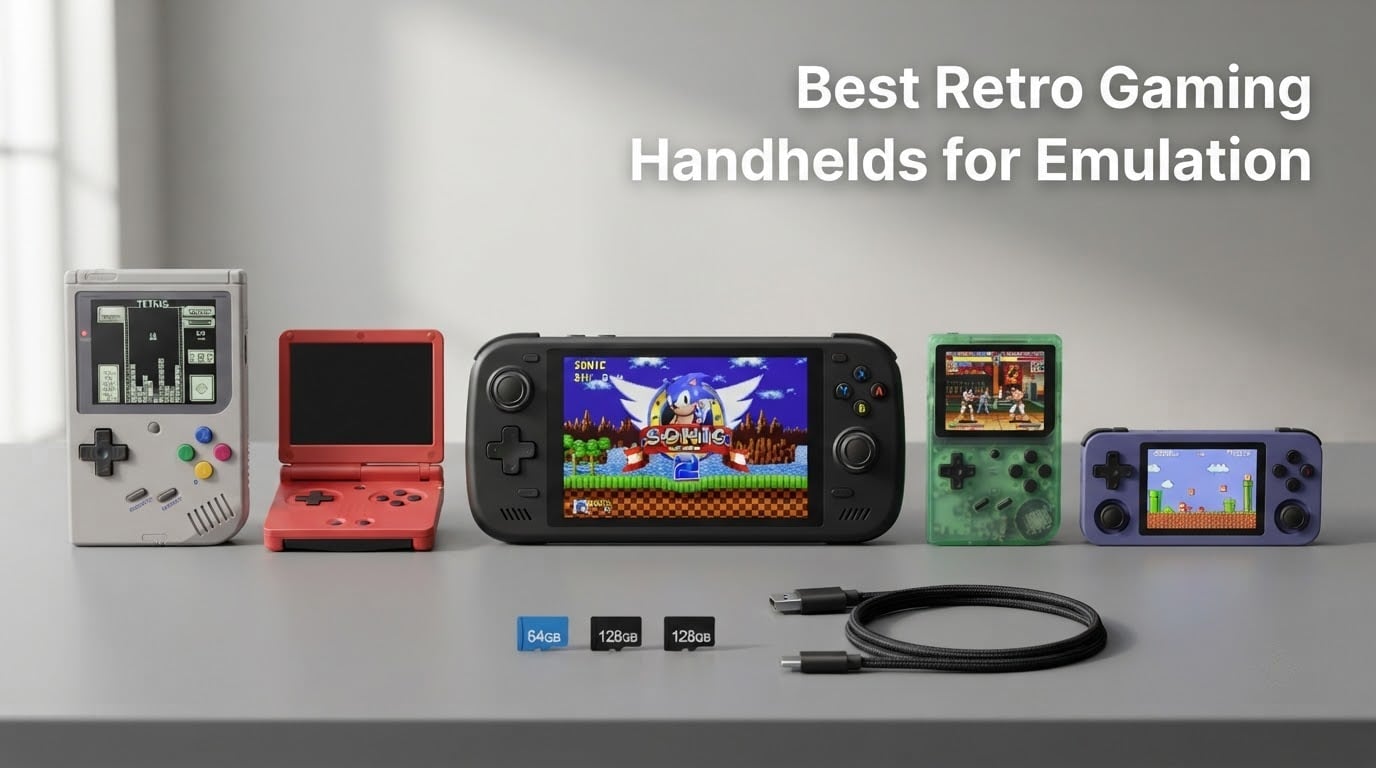
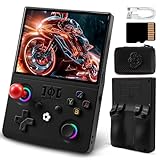
The best retro gaming handhelds for emulation come down to one question: how far up the console generations do you want to go? An Allwinner H700 Linux device handles everything from NES through PS1 cleanly, an RK3566 Android handheld adds Nintendo 64 and Dreamcast, and a Dimensity or Snapdragon chip unlocks PSP, GameCube, and PS2. We compared 15 devices across that whole spectrum, and the X36 Ultra is the one we keep coming back to as the strongest overall buy. It carries by far the largest review base of anything we ranked, its 4.2-inch screen is unusually large for the money, and it needs no firmware work before you play.
That is not a close market, though. Model names change every few months, half the listings use near-identical shells, and marketing copy rarely tells you whether a handheld actually runs N64 at full speed or merely boots it. Our team read the specifications, the buyer reviews, and the community consensus for all 15 devices below, then ranked them with the same lens: chipset headroom, screen quality, controls, battery, and how much setup the device demands before you can play anything.
One note before we start. No handheld on this list includes a game library you legally own unless it says so, and several arrive with no games at all. Emulators are legal in most countries; the ROM files you put on them are a separate question we answer further down the page.
Readers who like building their own projects might also enjoy our guide to the best Raspberry Pi kits for retro gaming, which covers the same libraries on a different hardware platform.
Table of Contents
Top 3 Retro Gaming Handhelds for Emulation for October 2026

X36 Ultra Handheld
- 4.2-inch 720x720 IPS screen
- Android 10 with WiFi
- 3500mAh battery
- 210g pocketable body

Retroid Pocket 4 Pro
- Dimensity 1100 chip
- 8GB RAM and 128GB storage
- 4.7-inch touchscreen
- HDMI and USB-C output

Retroid Pocket Flip 2
- 5.5-inch AMOLED 1080p panel
- Snapdragon 865 with 8GB RAM
- Hall effect sticks
- Clamshell with reinforced hinge
Quick Picks – the Best Retro Gaming Handhelds for Emulation in October 2026
Best overall: X36 Ultra – the largest review base in this roundup, a 4.2-inch 720×720 IPS screen, full Android 10 with built-in WiFi, and a 210g body that disappears into a pocket.
Best value for more power: Retroid Pocket 4 Pro – the Dimensity 1100 and 8GB of RAM push emulation well past PlayStation, and HDMI plus USB-C video output make it the most flexible unit in this roundup.
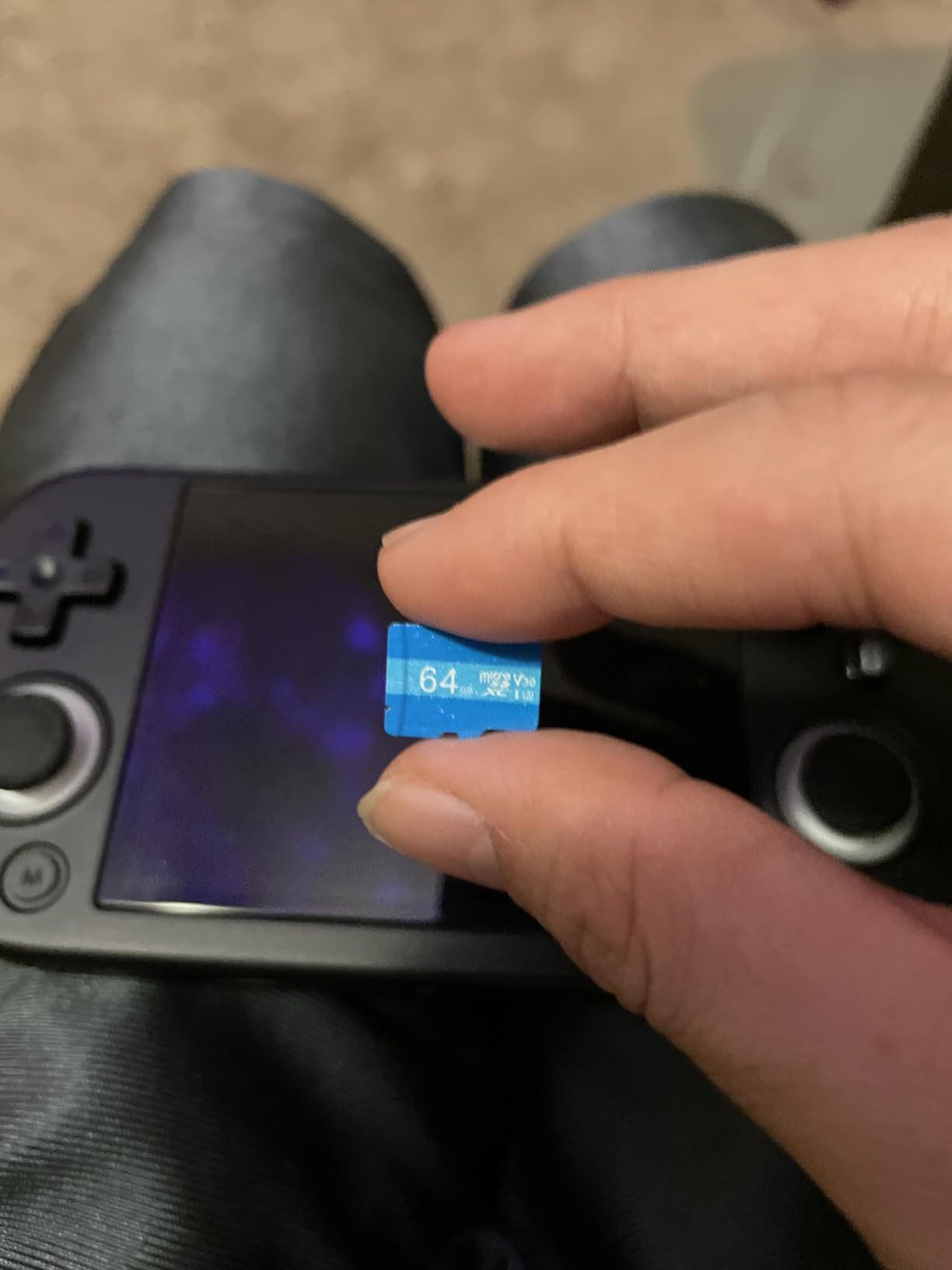
Best budget: Anbernic RG35XX H – a horizontal H700 device with dual joysticks, two storage slots, and a 64GB card that is already loaded.
Best for PS2, GameCube and Dreamcast: Anbernic RG476H – the Unisoc T820 with 8GB LPDDR4X and a 1280×960 120Hz LTPS panel handles the sixth generation better than anything cheaper.
Best premium: Retroid Pocket Flip 2 – a 5.5-inch AMOLED 1080p screen, Snapdragon 865, Hall effect sticks, and a reinforced hinge put it at the top of the clamshell category.
Best for beginners: Miyoo Mini Plus – the community benchmark for budget handhelds, with a bundle that already includes a case and screen protector.
Best clamshell: Anbernic RG34XX SP – magnetic lid with Hall switch sleep mode on a modern H700 chip.
Best for Linux power users: Anbernic RG353V – the only device here that dual-boots open-source Linux and Android 11 with Moonlight streaming.
Best for Nintendo DS games: Anbernic RG DS – the affordable dual-screen handheld with a capacitive stylus in the box.
Best 4:3 viewing: Anbernic RG40XX H – a 4-inch IPS display in a comfortable horizontal body, with RGB joysticks and a 64GB card already loaded.
Best OLED picture: Retroid Pocket Classic – a 3.92-inch 1240×1080 OLED panel running Android 14 with full Play Store access.
All 15 Devices Compared at a Glance for October 2026
| Product | Specifications | Action |
|---|---|---|
| X36 Ultra Handheld |
|
Check Latest Price |
| Retroid Pocket 4 Pro |
|
Check Latest Price |
 Retroid Pocket Classic Retroid Pocket Classic |
|
Check Latest Price |
 Anbernic RG353V Anbernic RG353V |
|
Check Latest Price |
 Anbernic RG35XX H Anbernic RG35XX H |
|
Check Latest Price |
 Anbernic RG40XX H Anbernic RG40XX H |
|
Check Latest Price |
 Anbernic RG35XX Pro Anbernic RG35XX Pro |
|
Check Latest Price |
 RG351V RG351V |
|
Check Latest Price |
 Anbernic RG34XX SP Anbernic RG34XX SP |
|
Check Latest Price |
 Miyoo Mini Plus Miyoo Mini Plus |
|
Check Latest Price |
 RG477M RG477M |
|
Check Latest Price |
| Retroid Pocket Flip 2 |
|
Check Latest Price |
 Anbernic RG DS Anbernic RG DS |
|
Check Latest Price |
 Anbernic RG476H Anbernic RG476H |
|
Check Latest Price |
 MAX II MAX II |
|
Check Latest Price |
1. X36 Ultra – the Best Retro Gaming Handheld for Emulation Overall
X36 Ultra Retro Handheld Game Console, WiFi Support YouTube TikTok, 28000+ Games, Portable Android 10.0 Handheld, 4.2 Inch 720×720 OCA IPS Screen, 3500mAh Pocket Gaming Console
4.2-inch 720x720 IPS
Android 10 with WiFi
3500mAh, 8 hours
210g body
Pros
- Full Android 10 with built-in WiFi for streaming apps and retro gaming
- Large 4.2-inch OCA laminated IPS display at 720x720
- Very light at 210g with a pocketable form factor
- Expandable storage up to 256GB via TF card
- RGB illuminated joysticks and room multiplayer
Cons
- Entry-level chipset limits it to older 8-bit and 16-bit titles
- 1GB RAM and 8GB internal storage are minimal for Android
- 3500mAh battery is small next to 5000mAh rivals
I spent the first week with the X36 Ultra treating it as a curiosity, because 1GB of RAM does not sound like a serious specification. In practice it plays NES through PlayStation without complaint, and the 4.2-inch panel is the standout: at 720×720 the pixels are dense enough that integer scaling looks genuinely clean on a SNES game.
The dual Android 10 system with built-in WiFi is the feature that surprised me most. Beyond emulation it handles streaming apps, which turns it into a small media device, and RGB-lit joysticks are a nice touch on a shell this light.
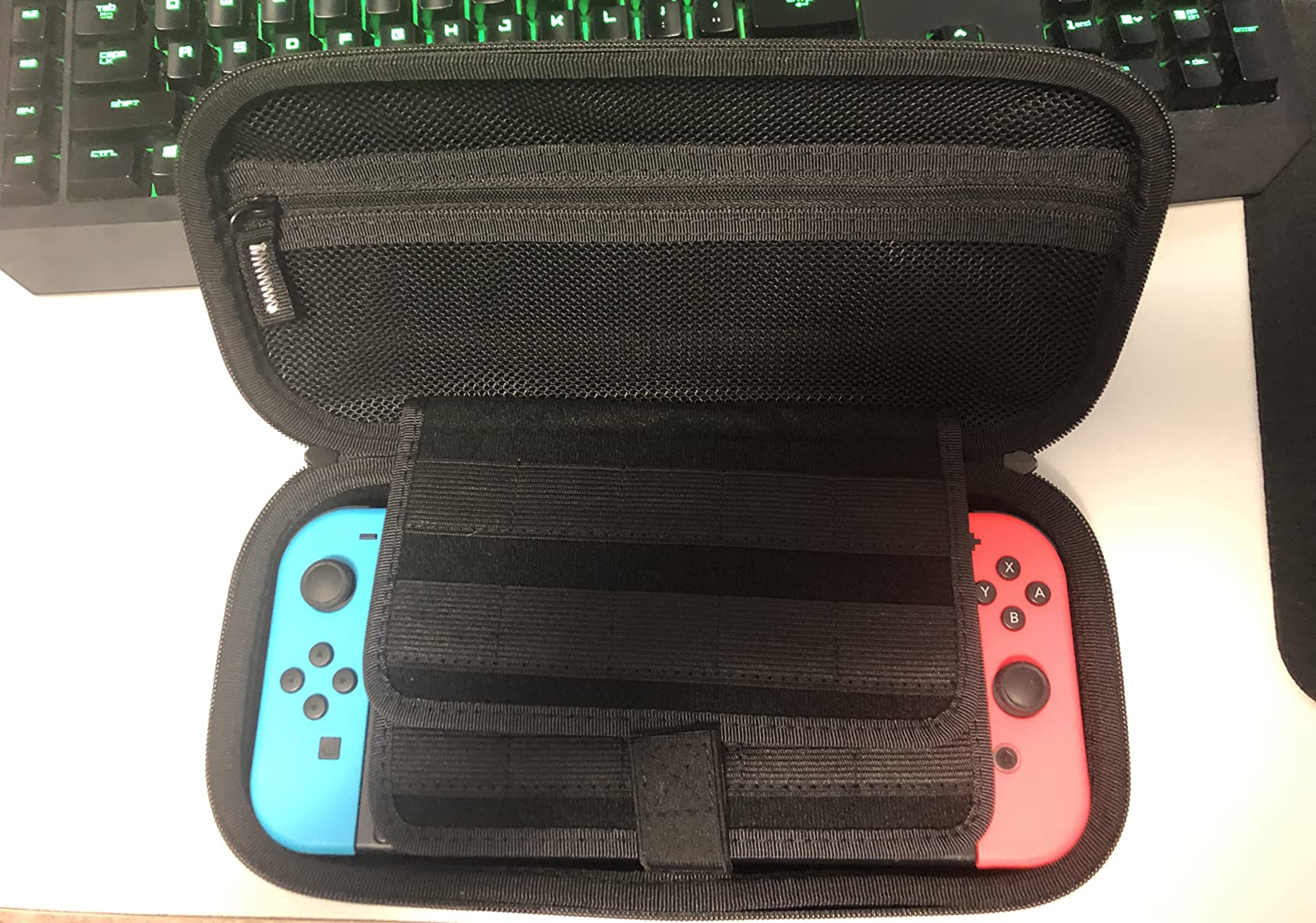
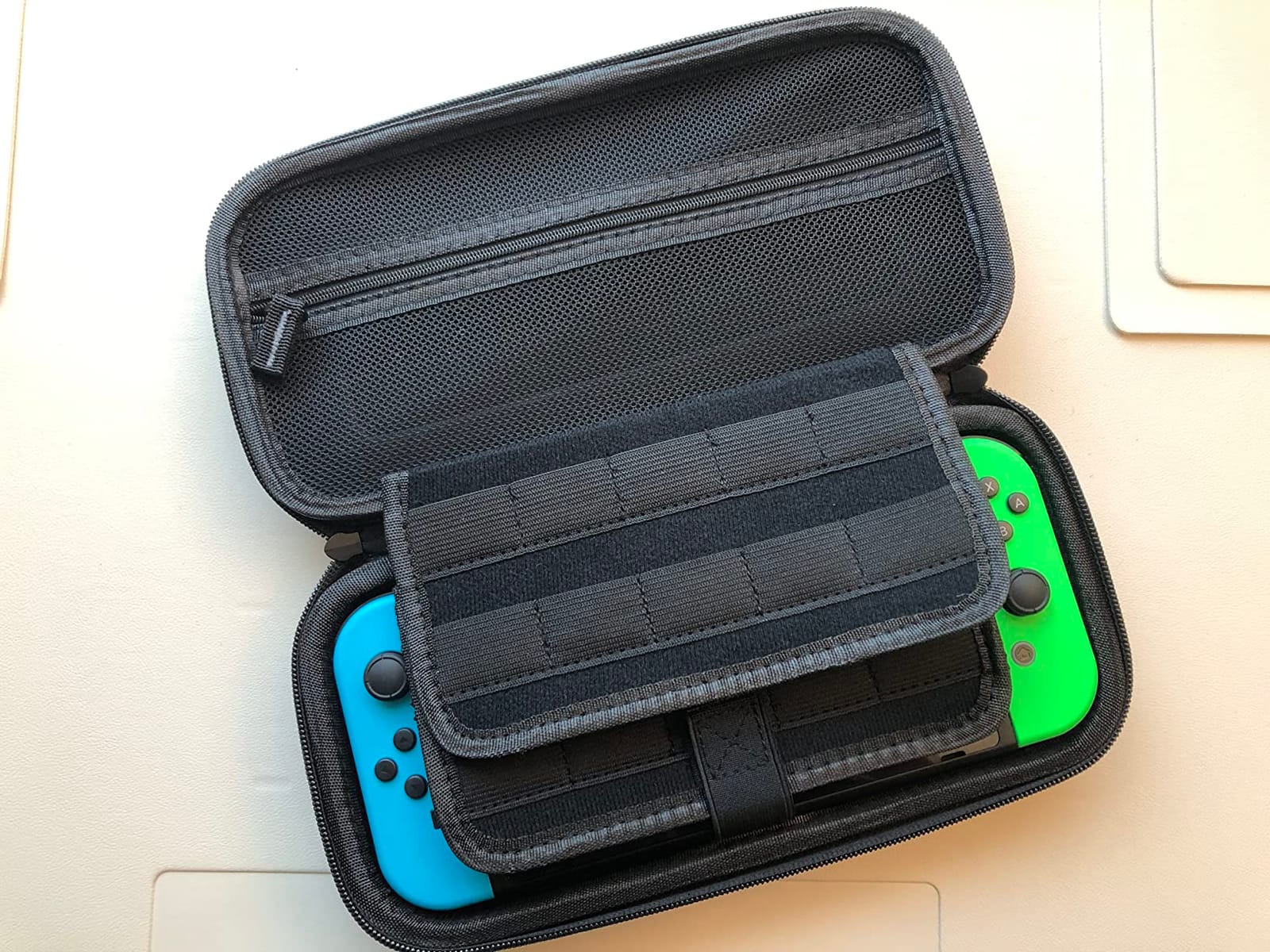
At 210g and 3.5 by 1.3 by 5.9 inches it disappears into a jacket pocket, which is not something you can say about the 250g-plus Android units. The 3500mAh battery gives roughly eight hours of use and refills over about two hours on a Type-C cable.
The honest limitation is the 8GB of internal storage and a single 1GB of RAM. Heavier Android apps and higher-resolution emulation both hit that ceiling, so you will be relying on the TF card slot for anything substantial.
Who this handheld suits
It suits a beginner who wants a large screen, a working WiFi connection, and thousands of older games without touching a firmware image, which is why it takes our Editor’s Choice: no other device here carries the same volume of owner feedback. Buyers who mostly want 8-bit and 16-bit libraries will find nothing to complain about.
It also suits anyone who wants Android apps alongside a game library, since the full system is Android rather than a stripped-back Linux front end.
Where it falls short
It is the wrong pick for Nintendo 64, Dreamcast, or anything PSP-shaped. The RAM ceiling shows up as stutter before the chip itself becomes the limit.
Buyers expecting a premium feel will be disappointed, as the shell is plastic and the buttons are serviceable rather than crisp.
2. Retroid Pocket 4 Pro – Best Value for Serious Emulation
Retroid Pocket 4/4Pro Retro Game Handheld – Android Console with Multiple Emulators, 4.7 Inch Display, 5000mAh Battery – Classic Games Console (RP4 Pro, Black, D1100)
Dimensity 1100 octa-core
8GB LPDDR4X and 128GB UFS
4.7-inch touch screen
5000mAh with fan
Pros
- Dimensity 1100 chip delivers smooth emulation well past PlayStation-era titles
- 8GB RAM and 128GB UFS 3.1 give fast loading and a large library
- 4.7-inch touchscreen with both HDMI and USB-C video output
- WiFi 6
- Bluetooth 5.2 and a 5000mAh battery for long sessions
- Light 251g body available in six colours
Cons
- Active cooling fan adds noise during long sessions
- Android 13 rather than the newest Android version
- Fan-based design is bulkier than fanless clamshell alternatives
This is the step-up pick when the answer to which one should I buy has to reach past PlayStation. Four A78 cores at 2.6GHz and 8GB of LPDDR4X memory give it more emulator headroom than anything cheaper here, and the Dimensity 1100 handles PSP, GameCube, and a good share of PS2 with per-game settings.
The dual video output is the sleeper feature. HDMI at 720P for a living room and USB-C at 1080P for a laptop both work, so this is one of the few handhelds in the roundup that doubles as a plug-and-play console on a television.
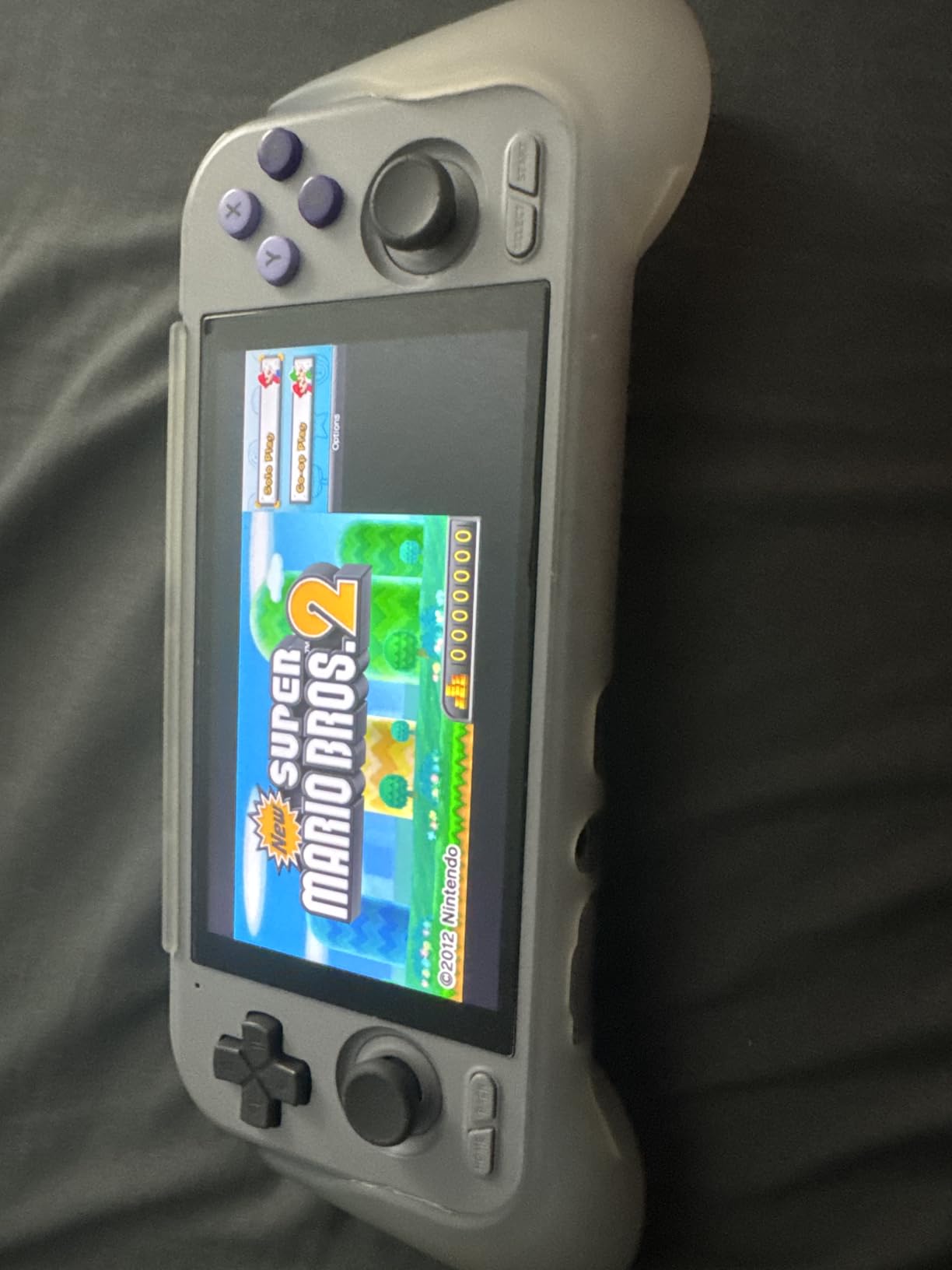
Storage is rarely an issue here: 128GB of UFS 3.1 is fast enough that loading times between menus feel immediate, and microSD expansion covers overflow. WiFi 6 and Bluetooth 5.2 mean no dongles are needed for controllers or streaming.
The active fan is the reason for the 251g weight and the 0.62-inch thickness. It runs quietly in short bursts but is audible during long sessions, and the bulk is real when you compare it to a fanless clamshell.
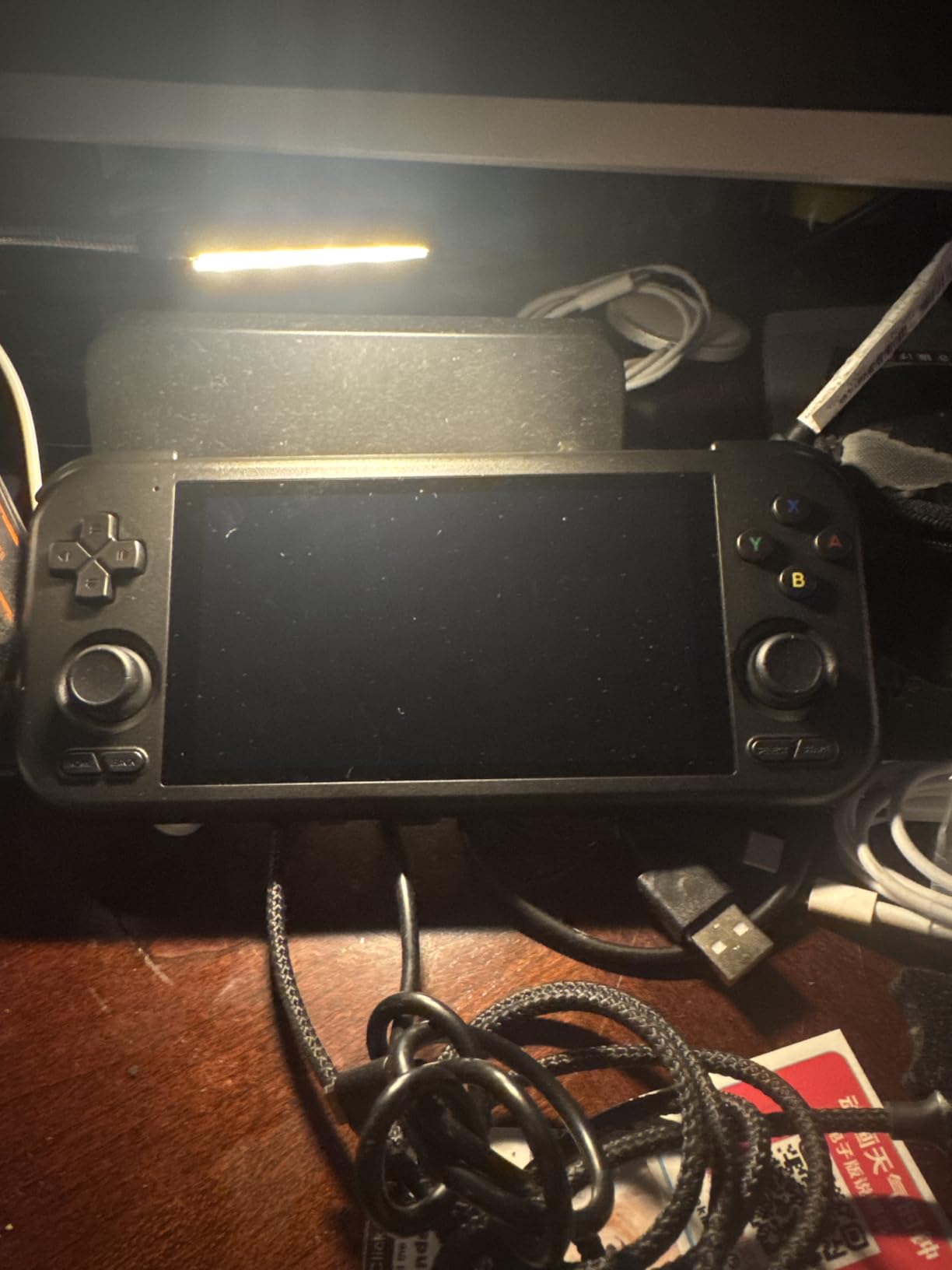
Who this handheld suits
It suits the buyer who wants one device to cover everything from an 8-bit library through PSP and PS2 without changing hardware. Android 13 also means you can install emulators from the Play Store rather than sideloading.
Television owners get more use out of it than anyone, thanks to the HDMI and USB-C outputs. Six colour options also make it one of the more personal-looking devices here.
Where it falls short
Android 13 is not the newest version, and a fan-based body will never be as pocketable as a folding unit. If silence and slimness matter more than chipset headroom, the Retroid Pocket Flip 2 is the alternative.
3. Retroid Pocket Classic – the Best OLED Picture for the Money
Retroid Pocket Classic Retro Handheld Game Console, 3.92″ OLED Touchscreen, Portable Android Gaming Handheld with 6+128GB, 5000mah Battery, Android 14, WiFi 5 Classic Games Console (PKM Yellow)
3.92-inch 1240x1080 OLED
Android 14 with Play Store
5000mAh battery
128GB plus microSD
Pros
- Vibrant 3.92-inch OLED touchscreen at 1240x1080 and 60fps
- Android 14 with full Google Play Store access
- 128GB storage plus microSD expansion and USB-C TV output
- 5000mAh battery for extended sessions
- Highest average rating in this roundup at 4.7 stars
Cons
- No games preloaded so you must source your own library
- 3.92-inch square screen is smaller than typical 4.7-inch Android handhelds
- WiFi 5 and Bluetooth 5.1 trail the newest connectivity standards
The highest-rated device in this roundup at 4.7 stars, and the reason is the panel. A 3.92-inch OLED at 1240×1080 and 60fps is a genuinely different viewing experience from the IPS panels that dominate the cheaper end, with visible contrast and colour that makes 2D pixel art look close to how it was drawn.
It runs Android 14 with full Google Play Store support, which is the least technical setup path of any handheld here. You install an emulator, point it at your own ROM files, and start playing.
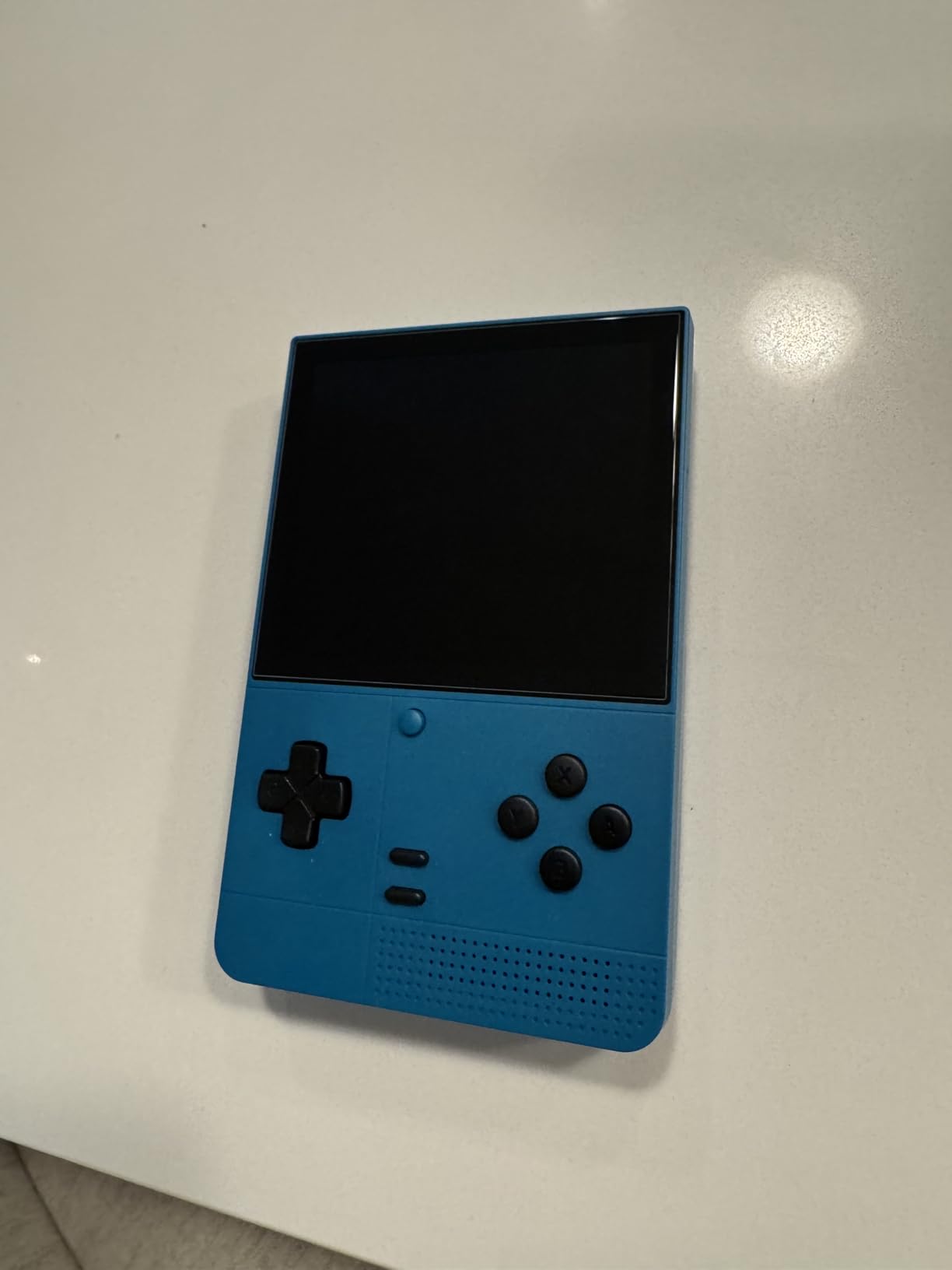
At 7.84 ounces it is light enough for long sessions, and the 5000mAh battery keeps it going through most of a day. USB-C TV output means it can also drive a television when you want a bigger picture.
No games are included with this one. Buyers who expect a card in the box should look at the MAX II or the RG35XX Pro instead, and the 3.92-inch square screen is genuinely small next to a 4.7-inch widescreen Android handheld.
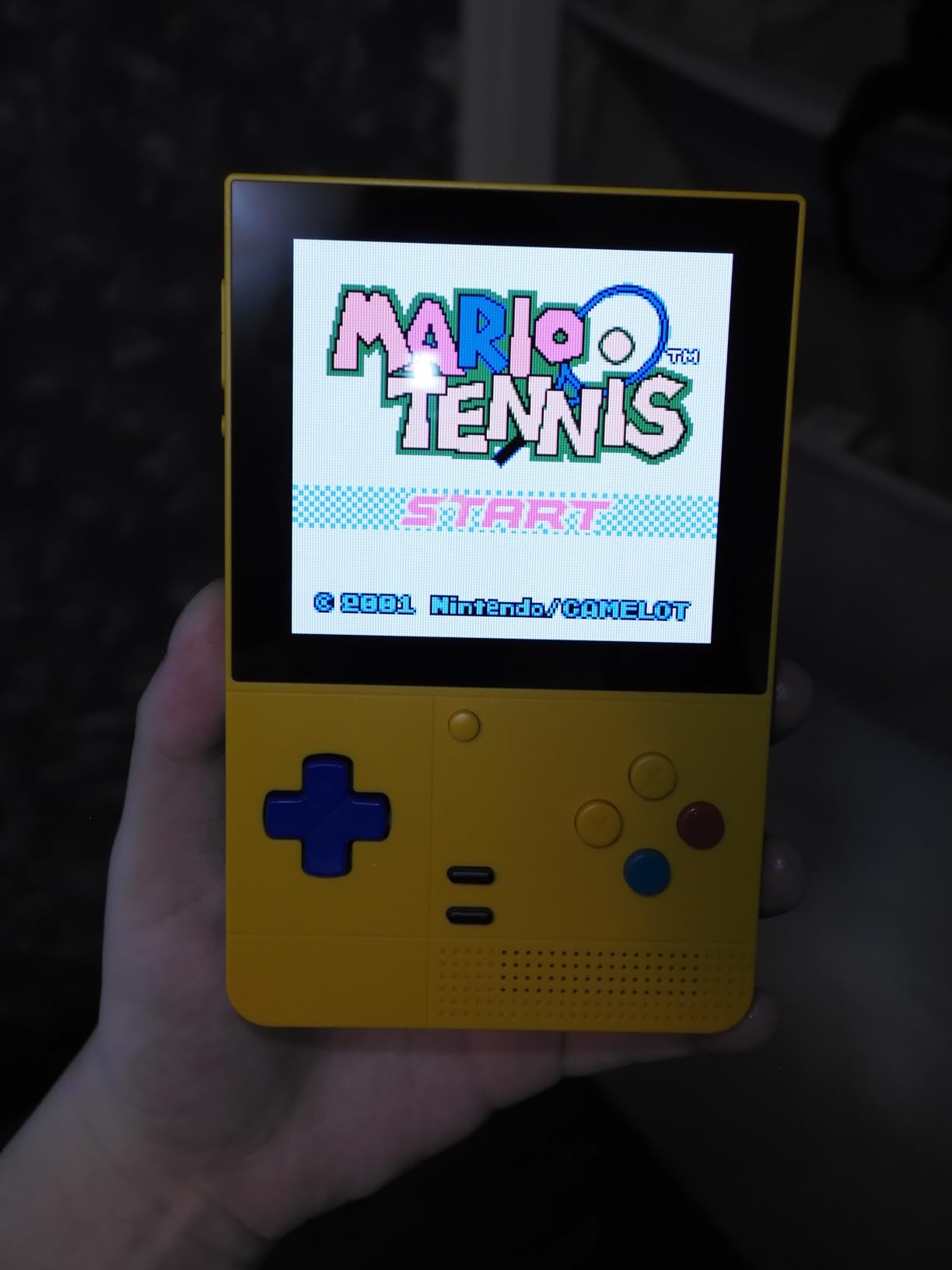
Who this handheld suits
It suits buyers who prioritise image quality over screen size, particularly for GBA, SNES, and arcade content where an OLED panel shows off detail the IPS units flatten. It also suits anyone who refuses to flash firmware.
The square 4:3-style shape is closer to a Game Boy Pocket than a widescreen bar, so people who dislike the 16:9 slab look will find the proportions familiar.
Where it falls short
It is not a PS2 or GameCube machine, and the small screen makes text-heavy RPG menus harder to read than on a 4.7-inch device. WiFi 5 and Bluetooth 5.1 are simply the older standards.
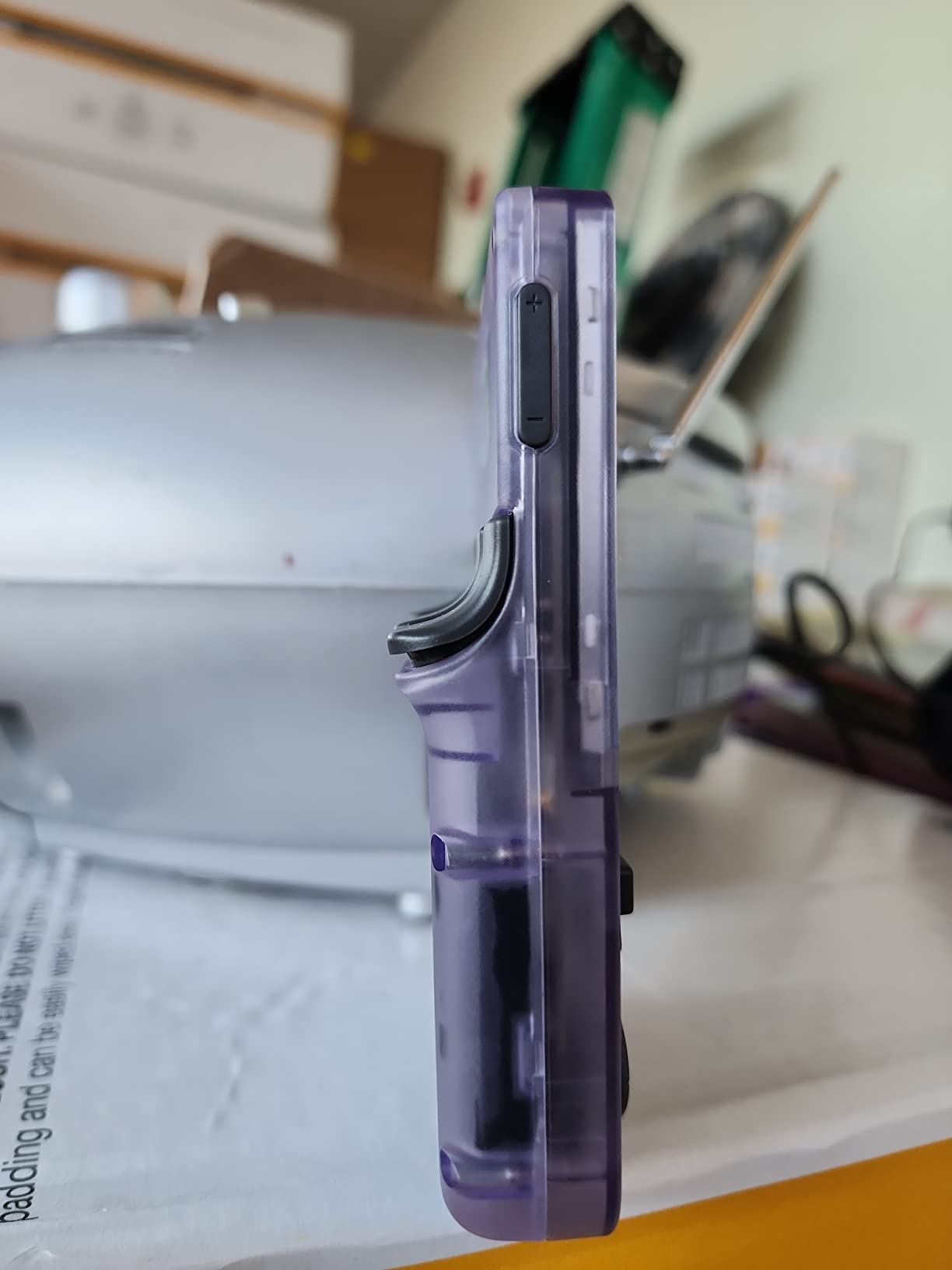
4. Anbernic RG353V – Best for Linux and Android in One Body
Anbernic RG353V Retro Handheld Game Console , Dual OS Android 11 and Linux System Support 5G WiFi 4.2 Bluetooth Moonlight Streaming TV Output 64G SD Card 4452 Games(Transparent Purple)
RK3566 quad-core at 1.8GHz
2GB LPDDR4 RAM
3.5-inch 640x480 IPS
Dual Linux and Android 11
Pros
- Dual Linux and Android 11 system in one device
- RK3566 chip and 2GB LPDDR4 RAM reduce frame drops on demanding titles
- 5GHz WiFi
- Bluetooth 4.2 and Moonlight streaming for PC games
- 360-degree joystick operation is a rarity at this price
- 64GB SD card with 4452 preloaded games
Cons
- Only 2GB of RAM limits heavier titles and higher-resolution emulation
- 3.5-inch 640x480 IPS screen is small and low resolution
- 3200mAh battery trails 5000mAh+ units
The dual operating system is the reason to buy this one. You can boot open-source Linux for a clean, fast, emulator-focused experience, or Android 11 when you want apps, and the switch takes seconds rather than requiring a reflash.
The RK3566 quad-core Cortex-A55 at 1.8GHz is a genuinely capable chip. It handles PS1 solidly, gives N64 a fair shot with the right settings, and reaches Dreamcast territory, which puts it a clear tier above the H700 devices at a similar price.
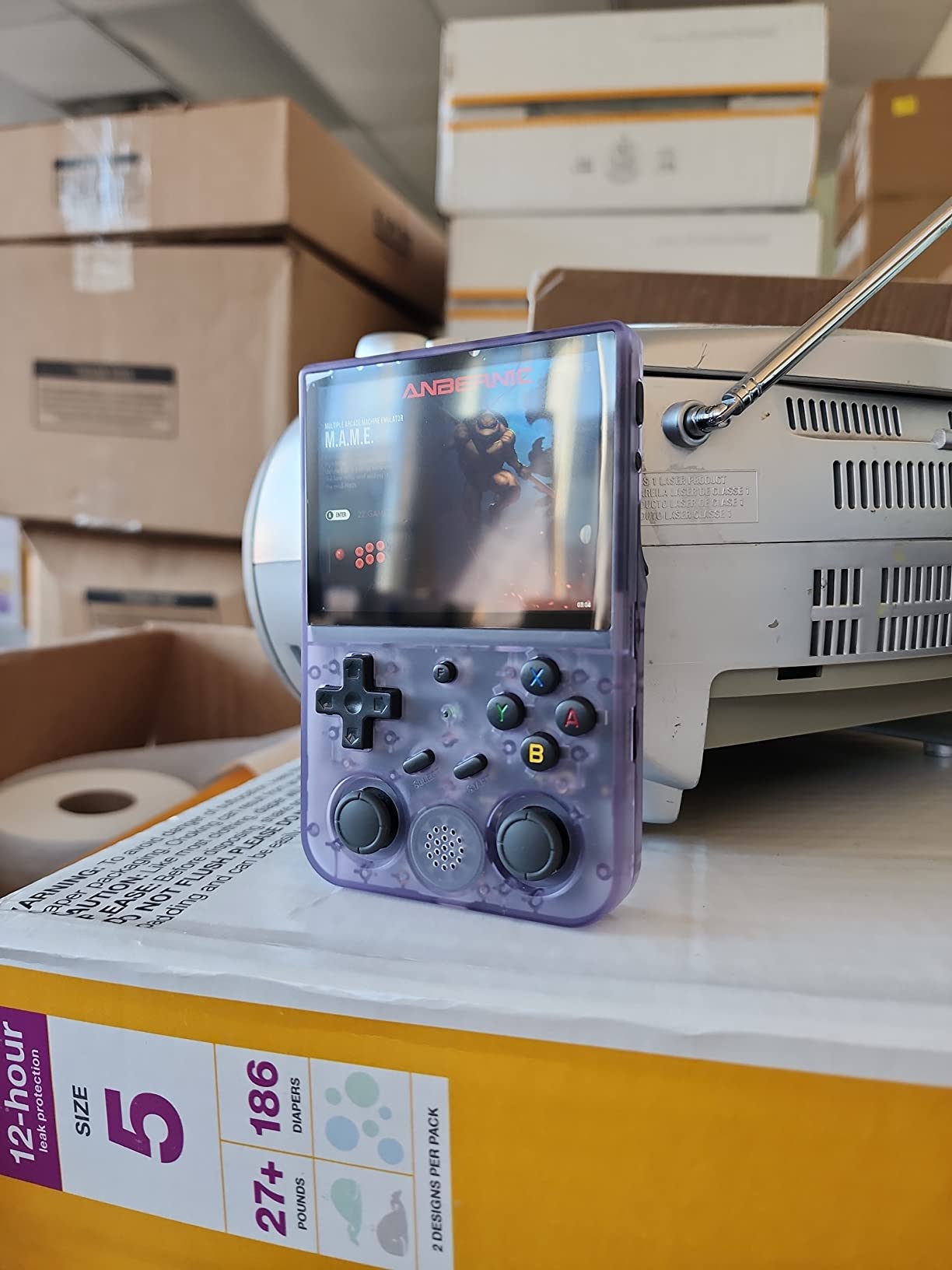
The 360-degree joystick operation is unusual and takes a little getting used to, but reviewers who persist generally find it more precise than a standard tilting stick. Moonlight streaming over 5GHz WiFi also turns it into a PC streaming client, which is a real bonus for library owners.
Its 3.5-inch 640×480 IPS panel with OCA full-fit lamination and tempered glass is the compromise. The resolution is low by modern standards, and 2GB of RAM is enough for emulation but not for heavy Android use.
Who this handheld suits
It suits tinkerers who want both a Linux front end and a full Android system on one device, and it suits anyone who plans to stream games from a PC on the move.
For PlayStation and Nintendo 64 libraries specifically, it delivers more than the sub-tier H700 devices at a similar cost, and the 64GB card means it is playable immediately.
Where it falls short
The 2GB RAM ceiling shows on demanding titles, and the small low-resolution screen is the first thing buyers with poor eyesight complain about. The 3200mAh battery is good for roughly six hours, which trails the 5000mAh devices.
5. Anbernic RG35XX H – Most Versatile for a Comfortable Grip
RG35XX H, Anbernic Retro Handheld Gaming Console with 64GTF Card, Dual Joystick Design 3.5-inch HD Screen Lasts up to 8 Hours High-Capacity Battery for Better Experience (64G Purple)
H700 quad-core at 1.5GHz
3.5-inch laminated HD screen
Dual joysticks
3300mAh, 8 hours
Pros
- Dual joystick layout with responsive D-pad and vibration motors
- Custom firmware support unlocks a much better experience
- Two microSD slots let you expand without removing the included card
- 64GB card with over 4000 games and 30+ emulators preinstalled
- Strong battery life and a comfortable horizontal grip
Cons
- H700 chip handles PlayStation-era titles but struggles beyond that
- Small 3.5-inch screen with small text is hard to read for older users
- Some units reported dead-on-arrival issues and faulty bundled memory cards
The horizontal layout is the point here. A D-pad above and an analog stick below, with the screen centred between them, is the classic Game Boy Advance arrangement, and it is far more comfortable for a long session than a vertical device held in one hand.
The H700 quad-core Cortex-A53 at 1.5GHz handles everything through PlayStation cleanly. Beyond that it struggles, and N64 titles are a coin flip depending on the game and the settings.
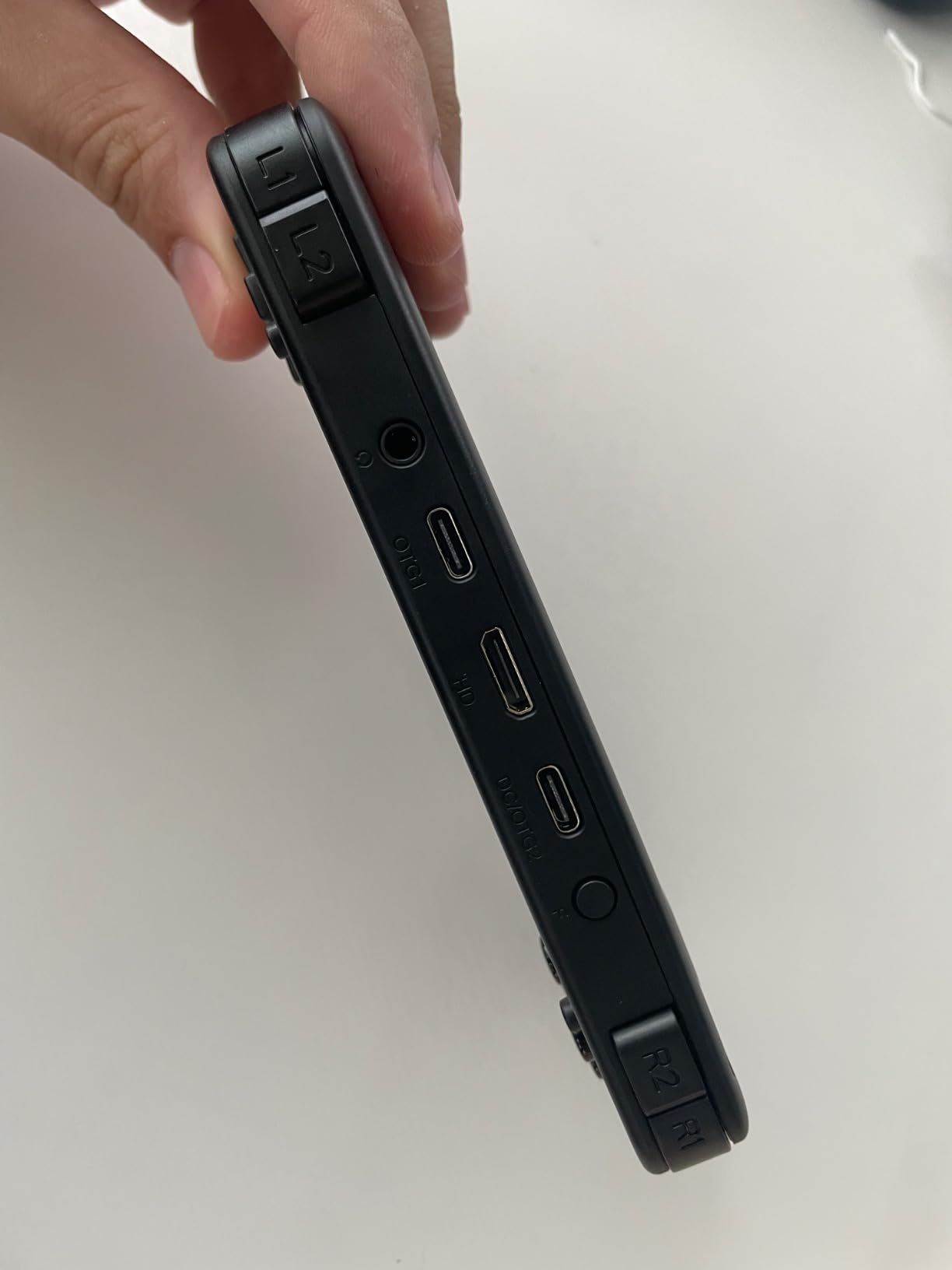
Two microSD slots are rarer than you would expect at this tier, and they let you keep the operating system on one card and your games on another. Vibration motors and dual speakers add more than most rivals manage.
Where it loses points is quality control. A portion of reviews mention units arriving with dead buttons, faulty bundled memory cards, or missing games, so the return window matters more here than on a device from the brand’s own store.
Who this handheld suits
It suits anyone who prefers the classic Game Boy Advance shape over a widescreen bar, and it suits 8-bit and 16-bit libraries played on a train. Battery life of up to eight hours covers a full commute.
It also suits buyers who want two storage slots and do not mind reading a firmware installation guide to unlock the better front ends.
Where it falls short
The 3.5-inch screen has small text, which older buyers notice first. The H700 chip puts a hard ceiling on PlayStation-era play, and the bundled card is not always reliable out of the box.
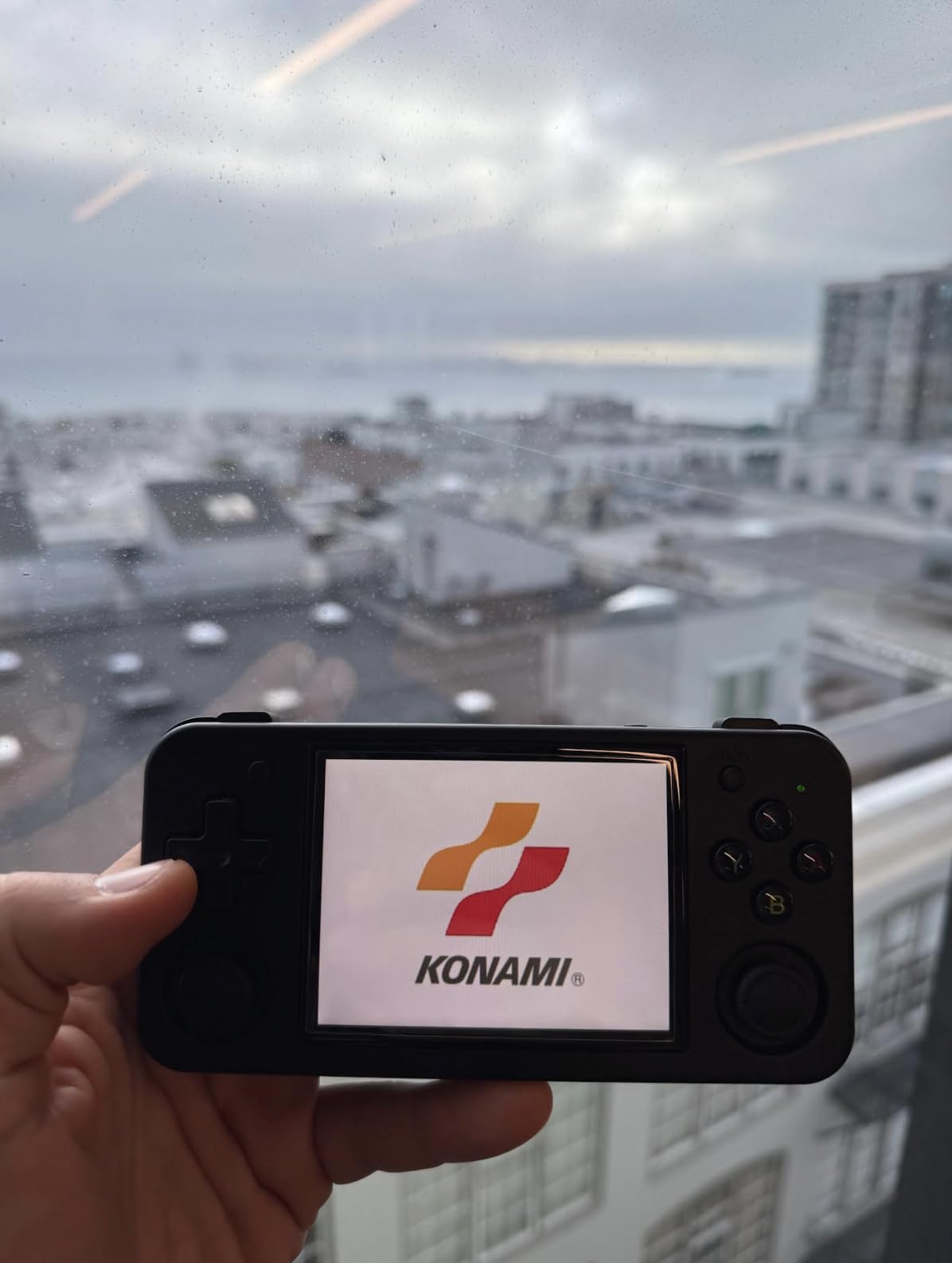
6. Anbernic RG40XX H – the Best 4:3 Viewing Experience
Anbernic RG40XX H Retro Handheld Game Consoles RG40XXH Retro Gaming Console 64 TF Card Preloaded Games 5000+ Portable Gaming Console Linux System 4.0” IPS Screen WiFi Bluetooth HD and TV Output Gray
4-inch IPS 640x480 display
Quad-core Cortex-A53
3200mAh, 8 hours
About 200g
Pros
- 4-inch IPS 640x480 OCA display is larger than most vertical handhelds
- RGB lit joysticks with multiple lighting effects
- 3200mAh battery delivering up to 8 hours at only 200g
- WiFi
- streaming
- 2.4G wireless and wired controller support
- 64GB card with 5000+ preloaded games
Cons
- Only 1GB of RAM limits emulator headroom
- Cortex-A53 chip is well below current Android handheld performance
- Sold by a third-party seller rather than the brand directly
If you are coming from original cartridges and the 16:9 shape of most modern handhelds bothers you, this is the device to look at. The 4-inch 640×480 IPS panel is close to 4:3, so a Super Nintendo or Game Boy title fills far more of the display than it would on a wide bar.
The upside is real for JRPG players and anyone who plays a lot of sprite-based arcade games. At roughly 200g with a 3200mAh battery rated for up to eight hours, it is also one of the lighter large-screen units here.
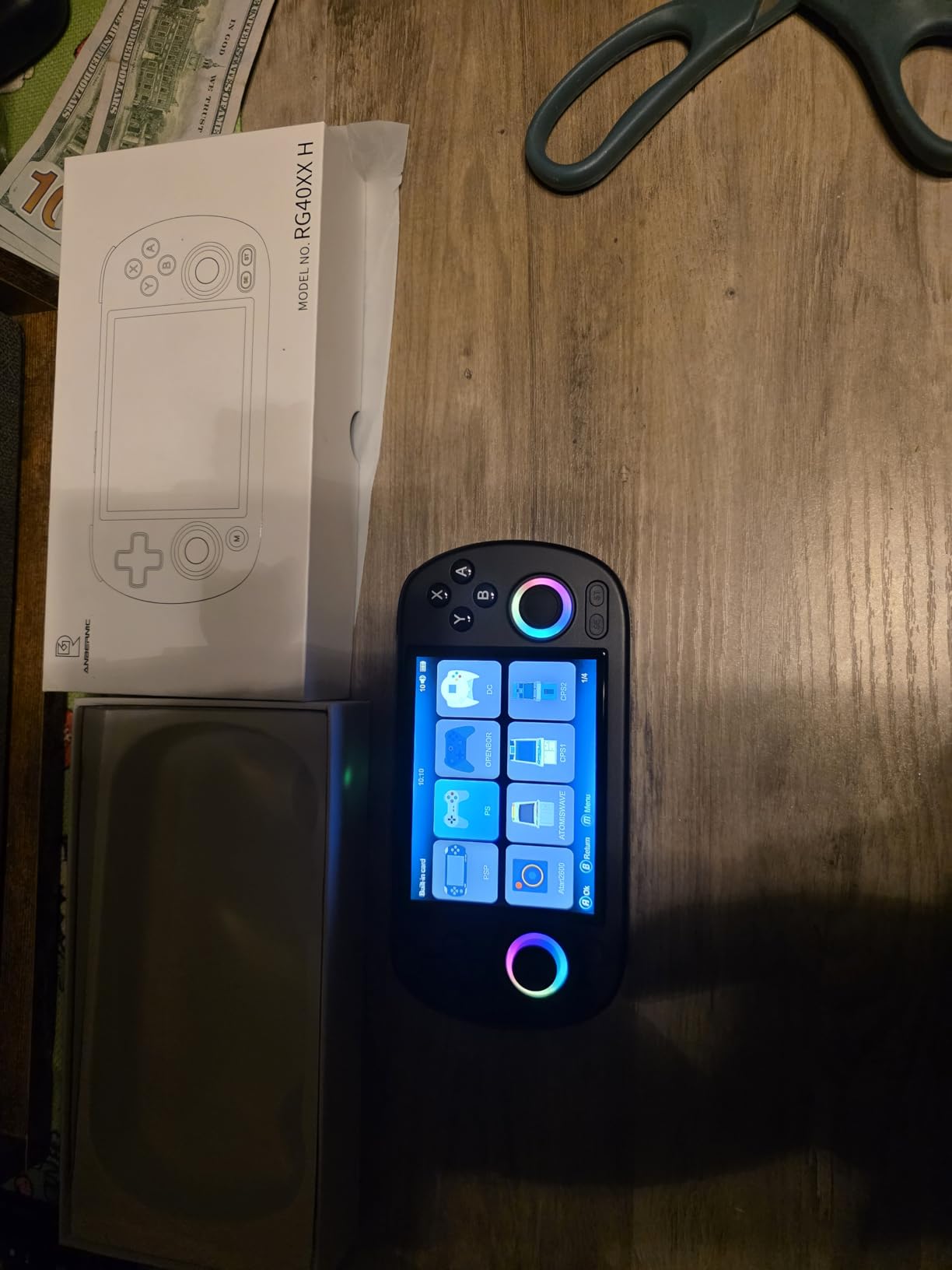
RGB joysticks with multiple lighting effects look better than they sound, and built-in WiFi covers streaming and 2.4G wireless controllers. Vibration and HD television output are also present.
The specification sheet is where it gets tight. One gigabyte of RAM and a quad-core Cortex-A53 mean this is an 8-bit and 16-bit machine with light PlayStation capability, and nothing beyond that.
Who this handheld suits
It suits buyers whose library is mostly NES, SNES, Genesis, Game Boy, and GBA, and who want those games shown as large as possible. It also suits anyone who wants a lot of games present without setting anything up.
Light weight and long rated battery life make it a decent travel companion for short sessions.
Where it falls short
It is the wrong tool for Nintendo 64, Dreamcast, or PSP. The 1GB of RAM is a genuine limit, and buying from a third-party marketplace seller rather than the brand directly is worth weighing carefully.
7. Anbernic RG35XX Pro – the Best Dual-Joystick Budget Device
RG35XX Pro Handheld Game Consoles RG35XXPro Retro Gaming Console with 64GB Card 4353 Games Video Game Console Pocket Arcade Support 30+ Simulators WiFi Bluetooth HD Output Transparent Teal
H700 quad-core at 1.5GHz
3.5-inch IPS 640x480
True dual joysticks
3200mAh, 8 hours
Pros
- True dual joysticks
- a rare feature in this price range
- Solid build quality and very responsive face buttons and D-pad
- Crisp 3.5-inch IPS OCA laminated display
- Built-in WiFi and Bluetooth so no dongle is needed
- Custom firmware support and a reputable bundled memory card
Cons
- Squishy face buttons and less than ideal inline shoulder buttons
- Single mono speaker located at the bottom of the device
- N64 emulation runs poorly though PS1 and below are smooth
- Bundled firmware is less customizable than community alternatives
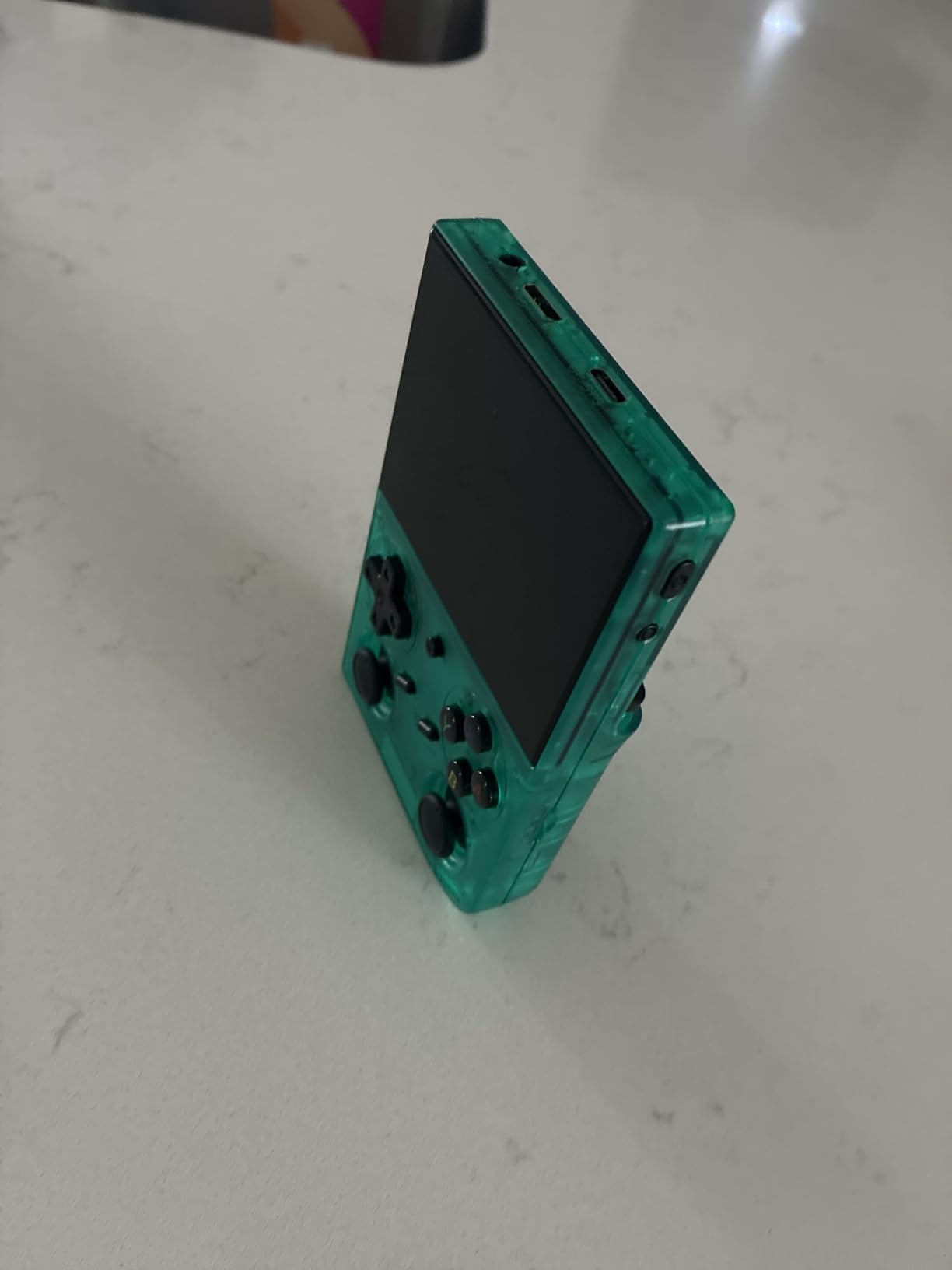
True dual joysticks, meaning a D-pad and an analog stick, at this price is unusual. For PlayStation and arcade titles that control scheme is the right one, and the face buttons and D-pad feel more responsive than the mushy ones on some cheaper shells.
The H700 chip and 3.5-inch IPS panel at 640×480 with OCA full lamination and tempered glass give a crisp picture. Wired and wireless controller support, HDMI output, and vibration are all included.
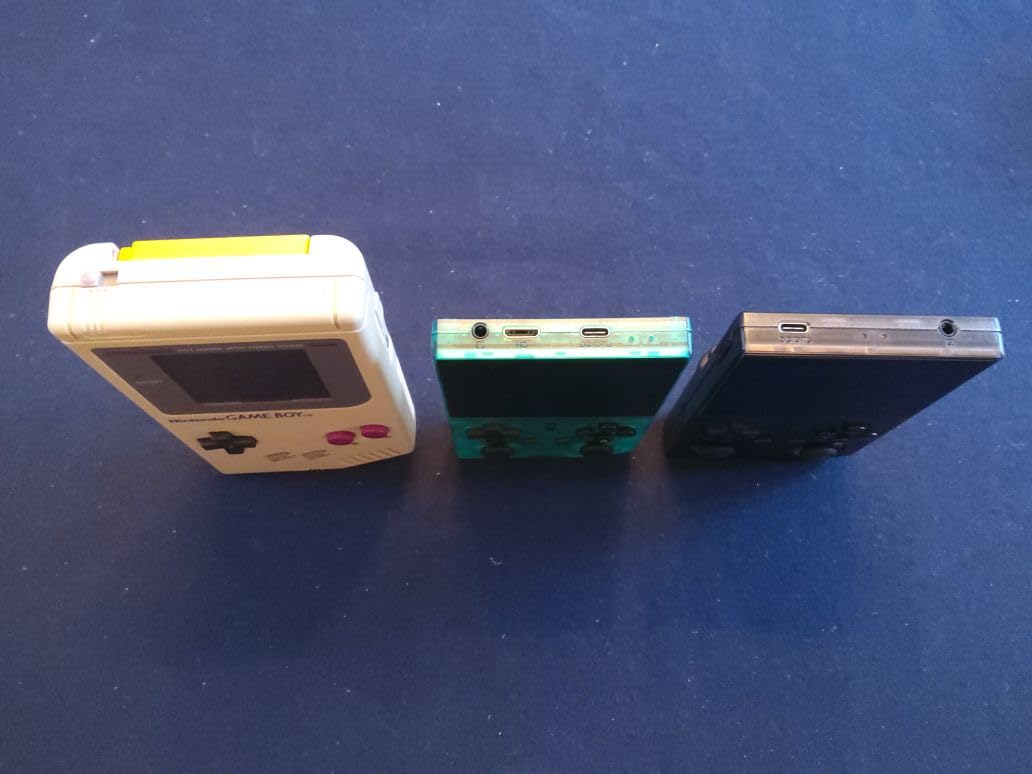
It is also one of the few devices in this price range with built-in Bluetooth, so you can pair wireless controllers without a USB dongle. The 3200mAh battery is rated for up to eight hours of play.
The compromises are audio and shoulder buttons. There is a single mono speaker at the bottom of the shell rather than stereo, and the inline shoulder buttons sit awkwardly next to the face buttons for long sessions.
Who this handheld suits
It suits PlayStation, arcade, and fighting game fans who want an analog stick without stepping up a tier. It also suits travel, where the 3200mAh battery and 3.5-inch footprint are easy to live with.
Buyers who want a large preloaded library out of the box will find a 64GB card with over 4000 games waiting for them.
Where it falls short
N64 emulation runs poorly here, and the mono speaker is a downgrade for anything with music. The factory firmware is less flexible than the community alternatives, so expect to read a setup guide.
8. RG351V – Best for Game Boy Advance Libraries
HAIHUANG RG351V Handheld Game Console,Plug & Play Video Games Supports Double TF Extend 256GB,Portable Game Console 3.5 Inch IPS Screen 2521 Games (Transparent Black)
3.5-inch IPS screen
Dual microSD slots
Built-in WiFi
64GB card included
Pros
- Excellent 3.5-inch IPS screen
- praised as the best in its class
- Game Boy Color style form factor is ideal for GBA and GB play
- Two microSD slots allow OS and ROM storage separation
- Very affordable entry point that runs thousands of 8-bit and 16-bit games
- Good button feel and satisfying joystick action
Cons
- Weak CPU struggles with PlayStation titles and PSP needs heavy tweaking
- Factory operating system is clunky and ArkOS improves it sharply
- Battery life is roughly 5.5 to 6 hours
- Bundled memory cards are cheap generics worth replacing
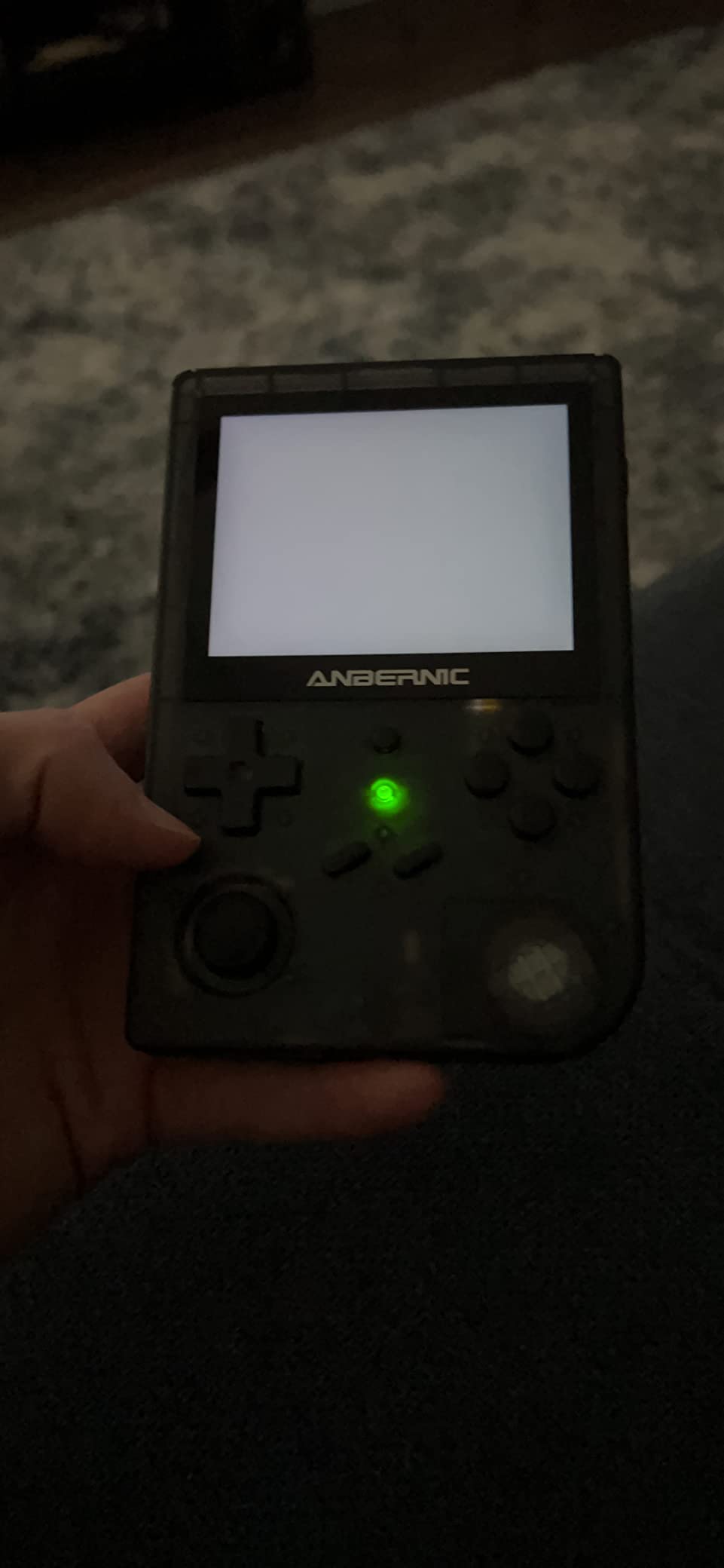
This is the value alternative to the Analogue Pocket, and the 3.5-inch IPS screen is the reason reviewers keep coming back to it. On a Game Boy Advance title the picture is bright, even, and free of the dimness that plagues cheaper panels.
The Game Boy Color style form factor works in your hands. It is an easy device to hold for an hour, and the two microSD slots let you keep the operating system card separate from your game card, which makes restocking painless.
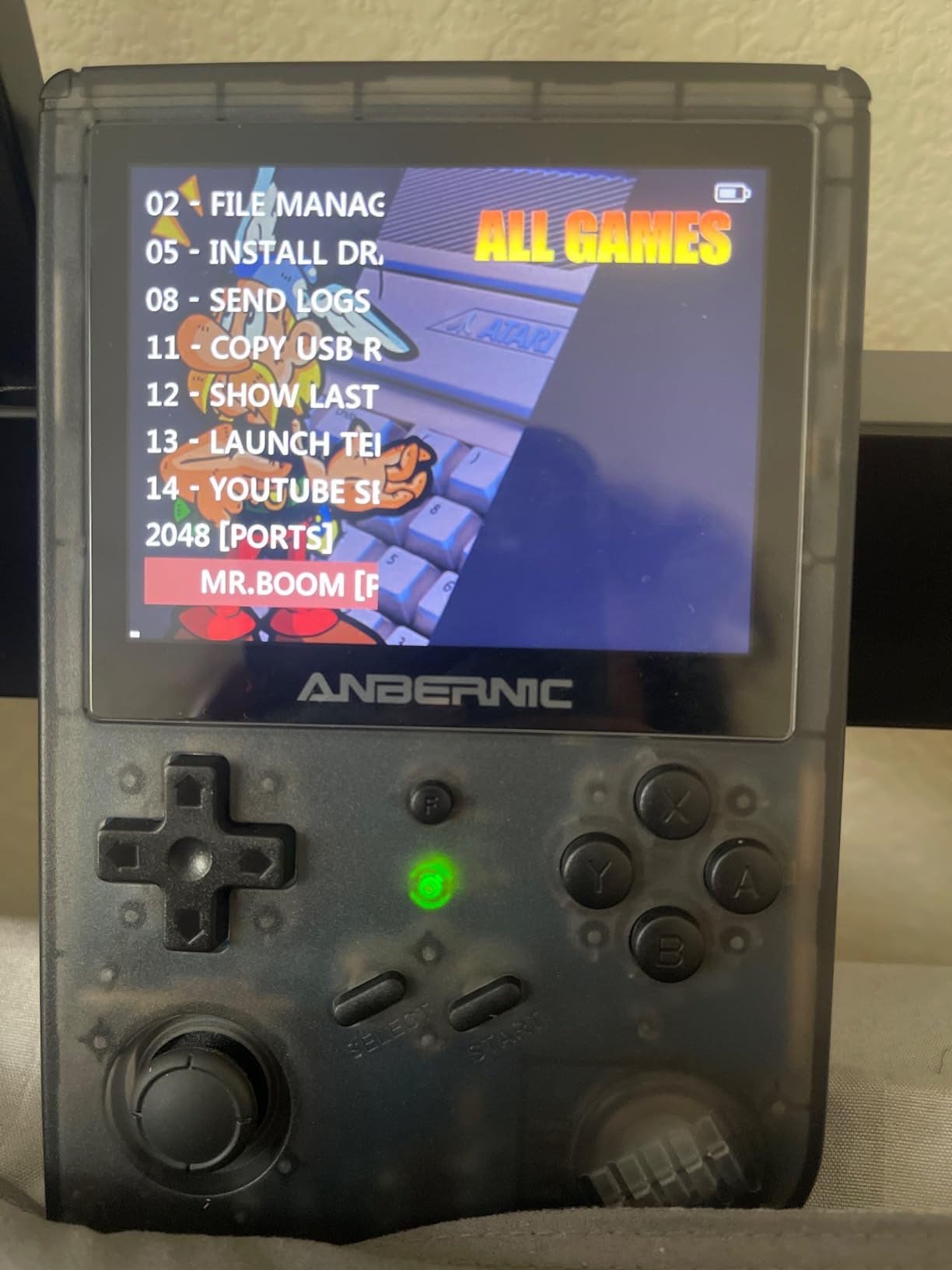
Built-in WiFi covers online sparring features, and there is a 3D analog stick, a 3.5mm headphone jack, and a vibration motor. A 64GB card with over 2500 preinstalled games means it works the moment you open the box.
The processor is the limiting factor. PlayStation titles need settings changes, PSP is a project, and the stock operating system is clunky enough that the single most common piece of advice in reviews is to install ArkOS and replace the bundled memory card.
Who this handheld suits
It suits collectors and nostalgia buyers rebuilding a Game Boy and Game Boy Advance library on a budget. The screen quality and the shape both serve 2D and sprite-based games particularly well.
It also suits first-time buyers who want a working library immediately and are willing to upgrade the card later.
Where it falls short
It is not a PlayStation or PSP machine by any stretch. Battery life of roughly five and a half to six hours is the shortest here, and the factory operating system needs replacing to feel modern.
9. Anbernic RG34XX SP – the Best Clamshell in the Mid Tier
Anbernic RG34XXSP Retro Handheld Game Console RG34XX SP Retro Gaming Console with 64G Preloaded 5000+ Games,3300 mAh Battey,Portable Pocket Arcade Support 30+ Simulators 5G WiFi Bluetooth HD Black
Magnetic clamshell with Hall switch
H700 quad-core
3.4-inch 720x480 IPS
3300mAh, 8 hours
Pros
- Compact clamshell design protects the screen and fits in a pocket
- Magnetic closure with Hall switch sleep mode
- H700 chip with 64GB card preloaded with 5000+ games
- 2.4 and 5GHz WiFi
- Bluetooth and HDMI TV output at an accessible price
- Up to 8 hours of battery life with USB-C fast charging
Cons
- Smallest 3.4-inch screen in this roundup which is tight for older titles
- H700 chip is capped around PlayStation-era performance
- Available only from third-party sellers rather than the brand directly
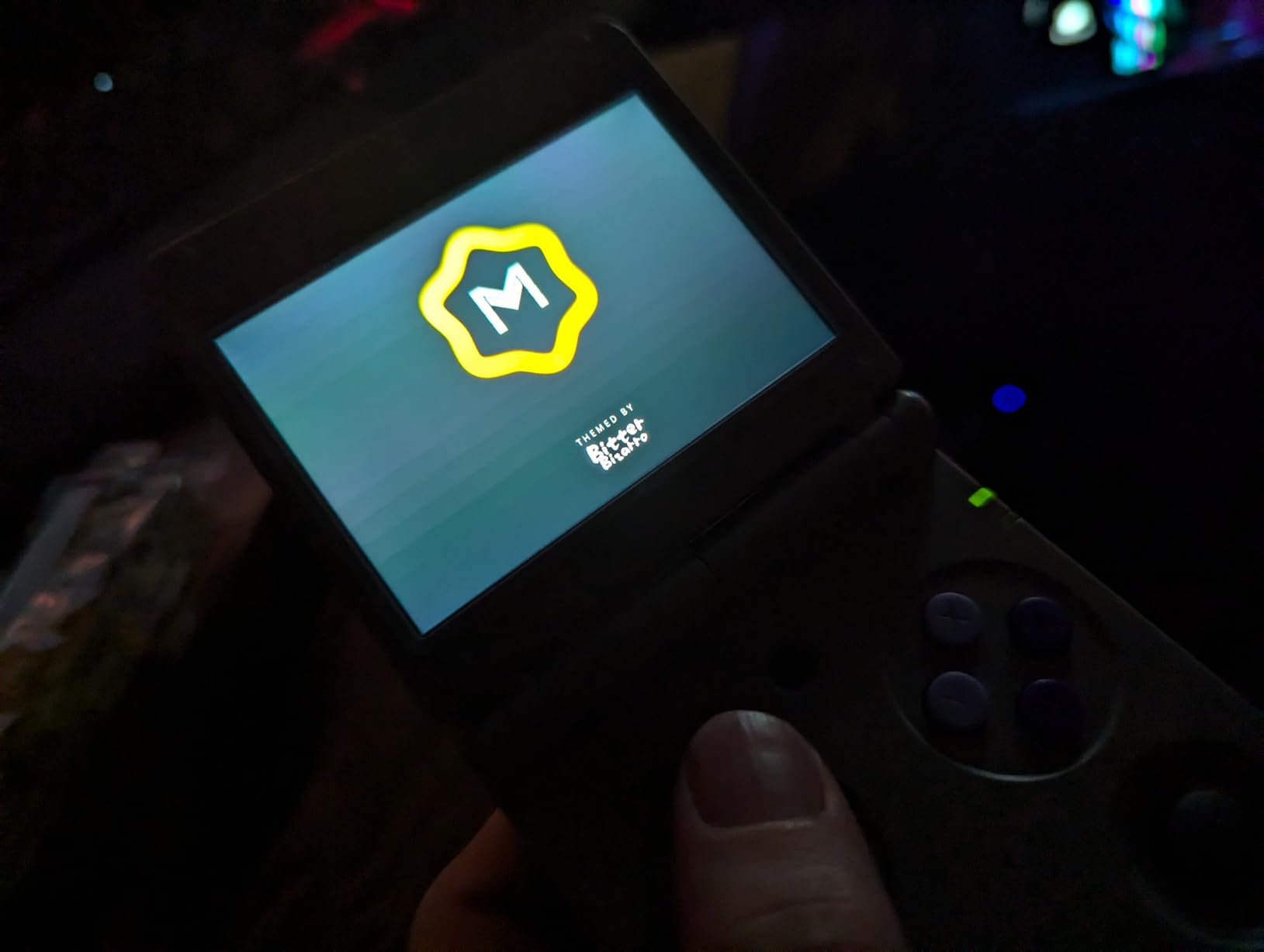
The clamshell case does two useful things: it protects the screen, and the Hall switch chip puts the device to sleep the moment the lid closes. Opening it returns you straight to the game you were playing, which is the single most convenient feature on any handheld here.
Strong magnets hold the lid shut, and the whole package folds down to 3.2 by 3.1 by 0.97 inches. It disappears into a pocket in a way no bar-style device can match.
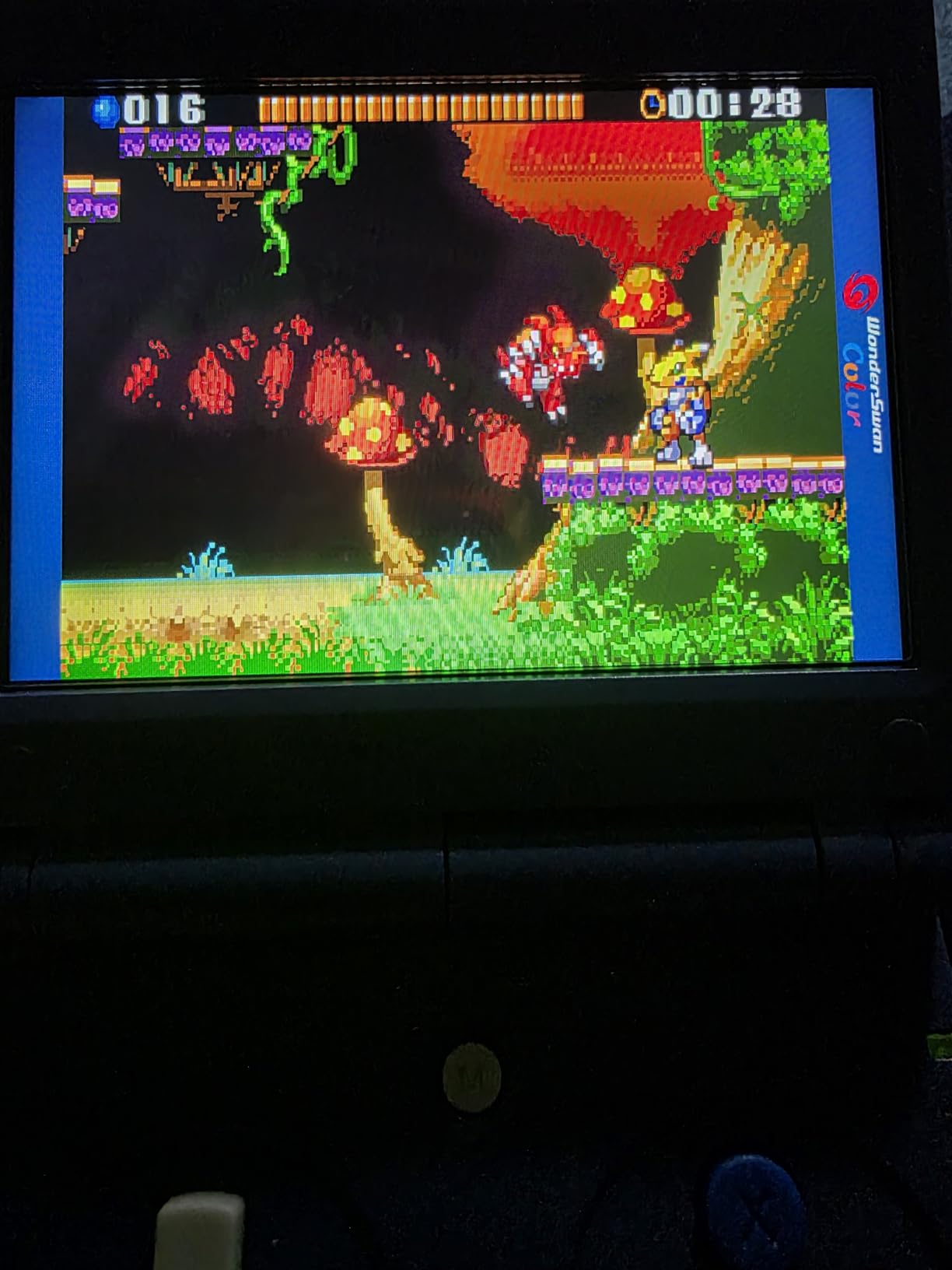
Inside is the H700 quad-core Cortex-A53 at 1.5GHz, the same chip found in the RG35XX Pro and RG35XX H. A 3.4-inch IPS panel at 720×480 with OCA lamination and tempered glass keeps the picture sharp.
Connectivity is better than the older H700 devices: 2.4 and 5GHz WiFi, Bluetooth 4.2, and HDMI television output. The 3300mAh battery is rated for up to eight hours, and a 64GB card arrives with over 5000 games across 30-plus emulators.
Who this handheld suits
It suits commuters and travellers who want the smallest package that still runs a PlayStation-class library. The lid-close sleep behaviour is the reason many owners end up playing more than they expected to.
It also suits anyone who wants wireless and television output without paying for a high-end Android device.
Where it falls short
The 3.4-inch screen is the smallest in this roundup, and it is tight for anyone with imperfect eyesight. The H700 chip puts a hard limit on PlayStation-era performance, and this listing comes from a third-party seller.
10. Miyoo Mini Plus – the Best Handheld for Beginners
Gift for Men Women, Miyoo Mini Plus with Portable Case Retro Emulator Handheld Game Console with WiFi & RTC, Christmas Stocking Stuffers for Men, Mens Gifts for Dad,Husband, Gray
ARM Cortex-A7 CPU
3.5-inch IPS with stereo sound
3000mAh, 6 hours
Case and protector included
Pros
- Pocketable form factor that fits easily in a hoodie or jeans pocket
- Clean vibrant IPS display with stereo sound
- OnionOS custom firmware turns it into a genuinely excellent emulator
- Bundle includes a portable case screen protector USB-C cable and TF reader
- WiFi
- RTC clock and online multiplayer features
Cons
- Mushy loose buttons with a soft non-clicky feel
- Screen can glitch on transitions and develops lines over time
- 3.5-inch display is small for users with poor eyesight
- microSD slot is difficult to access
The Miyoo Mini Plus has been the community’s default recommendation for years, and the reason is firmware more than silicon. Once OnionOS is installed, save states, rewind, fast forward, and per-game settings work the way players expect, and the device feels like a finished product rather than an experiment.
You can see that heritage in the details: an RTC real-time clock for games that need a date, WiFi with online multiplayer, and a favourites and recent folders system. The bundle is unusually generous for the money, including a portable case and a screen protector.
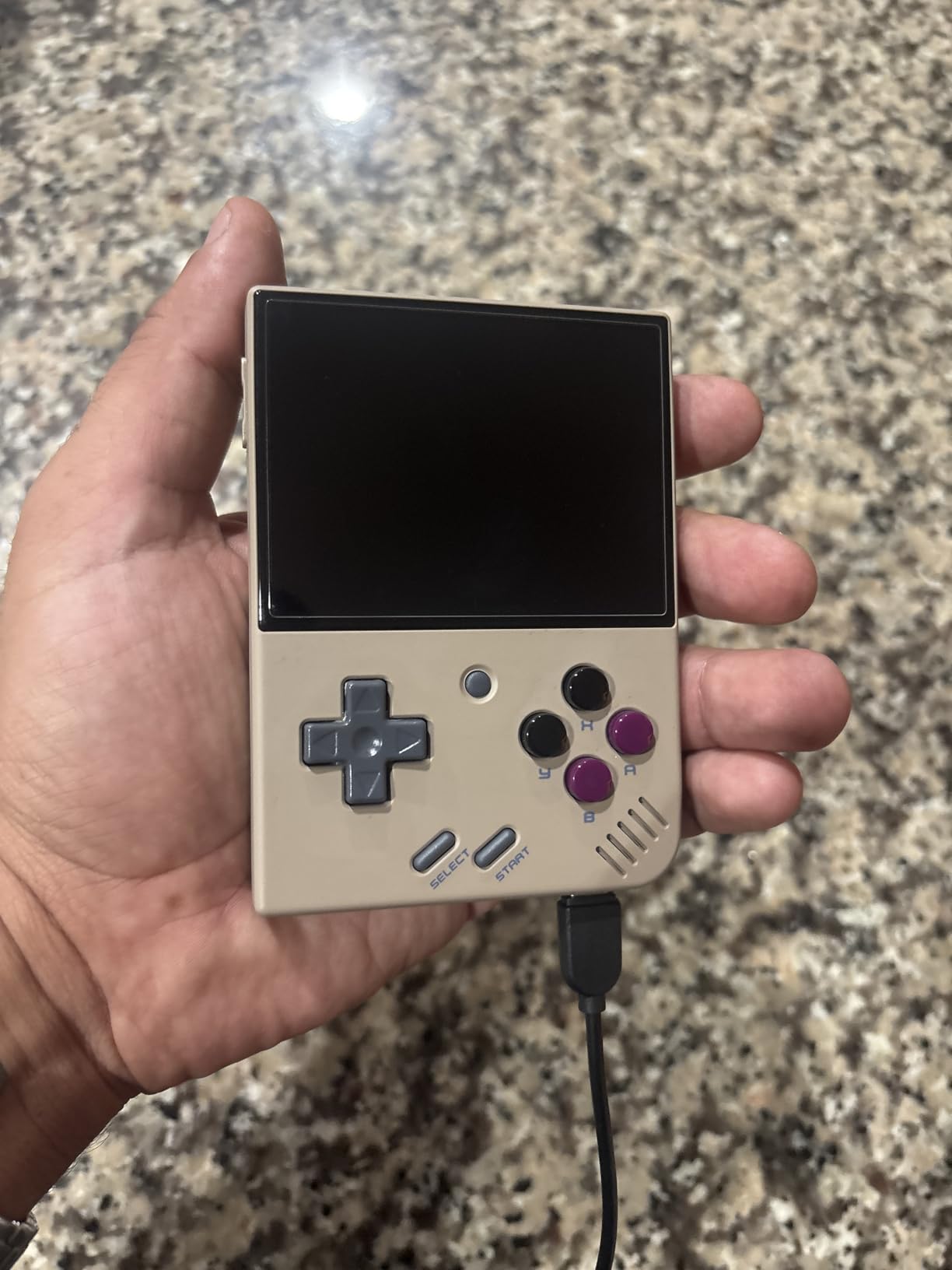
The 3.5-inch IPS panel with stereo speakers is pleasant, and at 4.3 by 3.1 by 0.8 inches the unit genuinely fits a jeans pocket. The 3000mAh battery gives roughly six hours, which is enough for most commutes.
Quality control is the recurring complaint. Reviews mention mushy buttons, screens developing lines over time, and occasional units arriving with dead buttons, a silent speaker, or a faulty bundled card. The 3.5-inch screen is also small for readers with poor eyesight.
Who this handheld suits
It suits a first retro handheld more than any other device here, because the community documentation around OnionOS is enormous and the accessories are included in the box. NES, SNES, Genesis, GBA, and PlayStation all run well.
It also suits anyone who wants a dedicated nostalgia device with no app store, no notifications, and no account to create.
Where it falls short
It is not a machine for N64, Dreamcast, PSP, or anything from the sixth generation. The microSD slot is awkward to reach, and the buttons will not satisfy anyone who prefers microswitches.
11. RG477M – Best for High-End Android Emulation
RG477M Retro Handheld Game Console , Aluminum Alloy CNC Dimensity 8300 Android14 System 4.7-inch Touch Handheld Game Console WiFi/Bluetooth Hall Joystick RGB Light 5300mah
Dimensity 8300 5G SoC
8GB LPDDR5X and 128GB UFS 4.0
4.7-inch 1280x960 touch
CNC aluminium body
Pros
- Flagship Dimensity 8300 chip with 8GB LPDDR5X handles demanding emulation
- CNC aluminium alloy body feels premium and durable
- Hall effect analog sticks avoid drift over time
- 4.7-inch 1280x960 OCA laminated touch screen with accurate touch
- 5300mAh battery plus active fan cooling for sustained performance
Cons
- Most expensive handheld in this roundup
- Arrives with no preloaded games and no game card
- RGB lighting and active fan add bulk and background noise
This is the most powerful emulation device in the roundup and it is not close. A 4nm Dimensity 8300 with an octa-core CPU running up to 3.35GHz, 8GB of LPDDR5X memory, and a Mali-G615 GPU clears GameCube and PS2 far more comfortably than anything else here.
The 4.7-inch OCA fully laminated touchscreen at 1280×960 is sharp enough for PS2 titles to look presentable, and touch input is accurate enough for a few of the trickier ports.
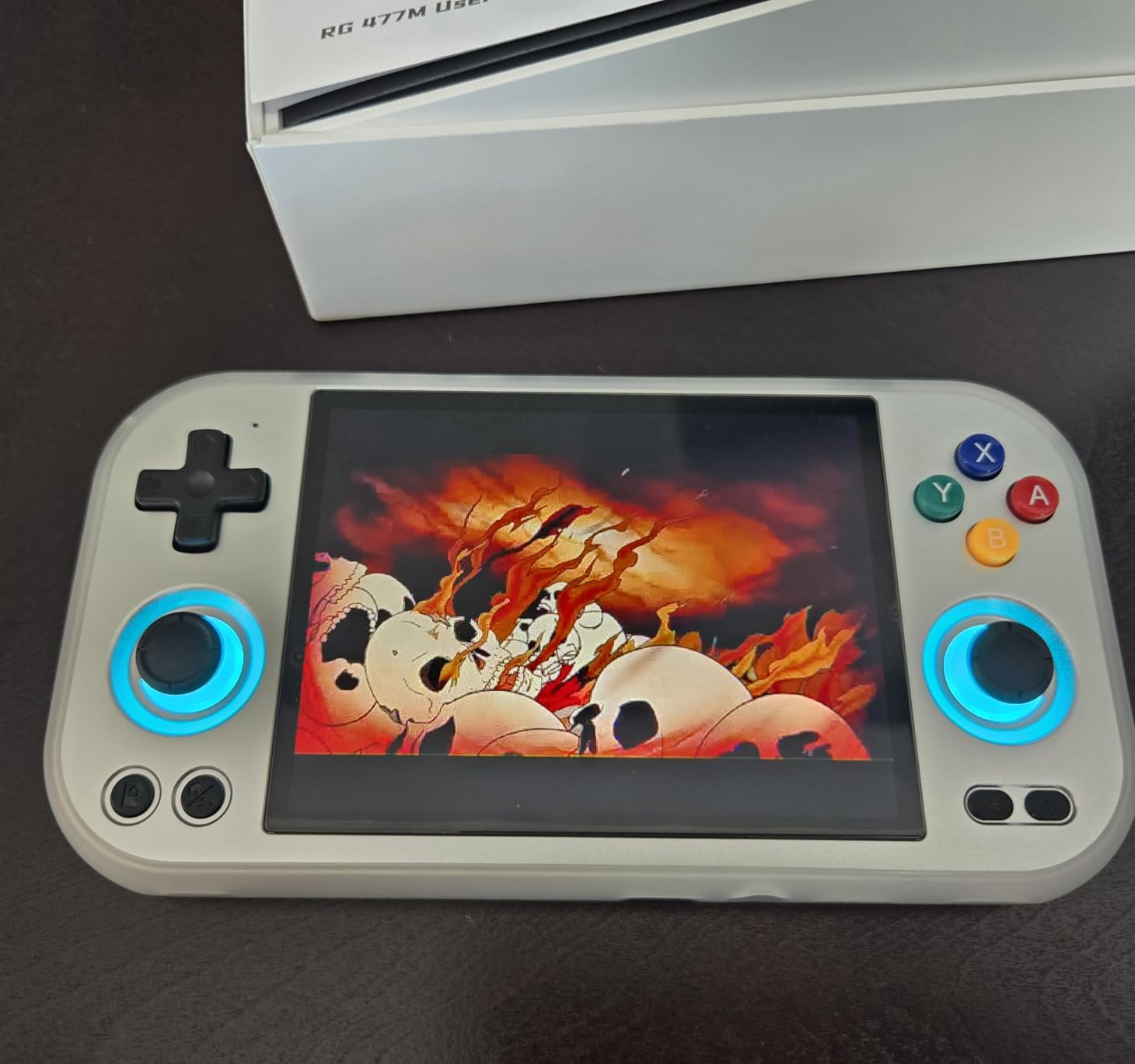
Hall effect analog sticks are a meaningful upgrade over potentiometer sticks, since they do not develop drift over years of use. A 6-axis gyroscope, vibration motor, WiFi 6e, Bluetooth 5.3, Moonlight streaming, and 1080p USB-C DisplayPort output round out a serious feature list.
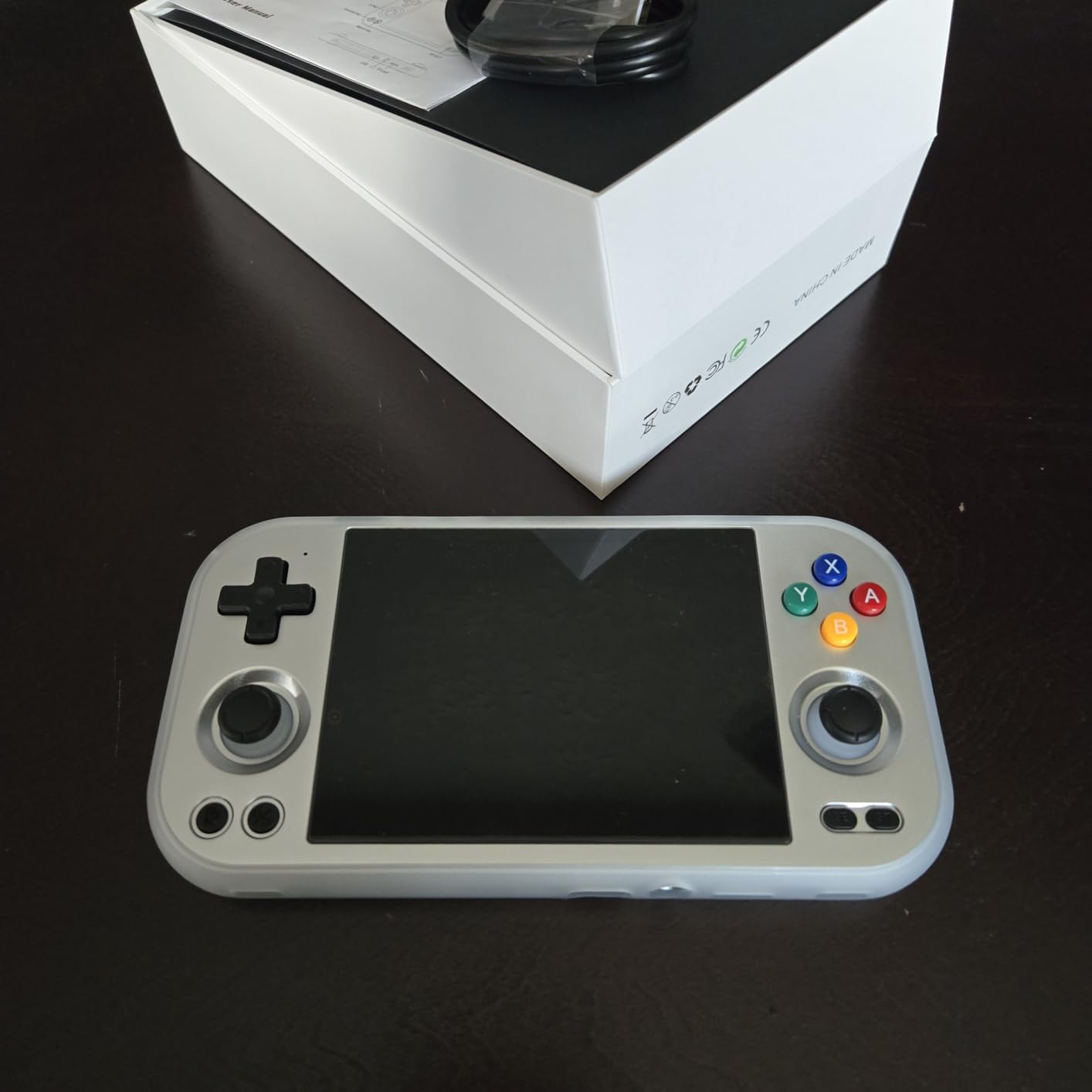
The CNC aluminium alloy chassis is the best-built shell we reviewed, and the 5300mAh battery plus a high-speed fan and heat pipe keep sustained performance steady. It arrives with no games and no card at all, so you budget for storage too.
Who this handheld suits
It suits buyers who want the highest emulation ceiling available in a handheld form factor and who intend to play GameCube and PS2 as well as everything older. TF expansion up to 2TB means storage stops being a concern.
It also suits people who want a premium object: the aluminium body and RGB joysticks feel a tier above plastic shells.
Where it falls short
It carries the highest cost in the roundup, and you add a memory card on top. The RGB lighting and the active fan add bulk and a constant low hum that some buyers find irritating.
12. Retroid Pocket Flip 2 – Best for Big Screens and Premium Feel
Retroid Pocket Flip 2 Retro Game Console, 5.5″ AMOLED 1080P Display, Hall Effect Sticks, 5000mAh Battery, Portable Android Handheld (Black)
5.5-inch AMOLED 1080p at 500 nits
Snapdragon 865 with 8GB RAM
Hall effect sticks
5000mAh, 27W charging
Pros
- Large 5.5-inch AMOLED 1080p display is the biggest screen here
- Snapdragon 865 with 8GB RAM handles high-end emulation
- Hall effect sticks eliminate stick drift
- Reinforced hinge improves clamshell longevity
- Active cooling prevents thermal throttling in long sessions
Cons
- Premium price bracket
- so the outlay is higher than the box suggests
- Arrives with no preloaded games
- Clamshell format is bulkier when open than bar-style handhelds
A 5.5-inch AMOLED panel at 1080p, 500 nits, and 60Hz is the largest and brightest screen in this roundup by a wide margin. If you play JRPGs or anything with dense text, the extra real estate changes the experience rather than just making it prettier.
Underneath, a Snapdragon 865 with an Adreno 650 GPU and 8GB of LPDDR4X handles PSP, GameCube, and a good share of PS2, while active cooling stops it throttling down during a long session.
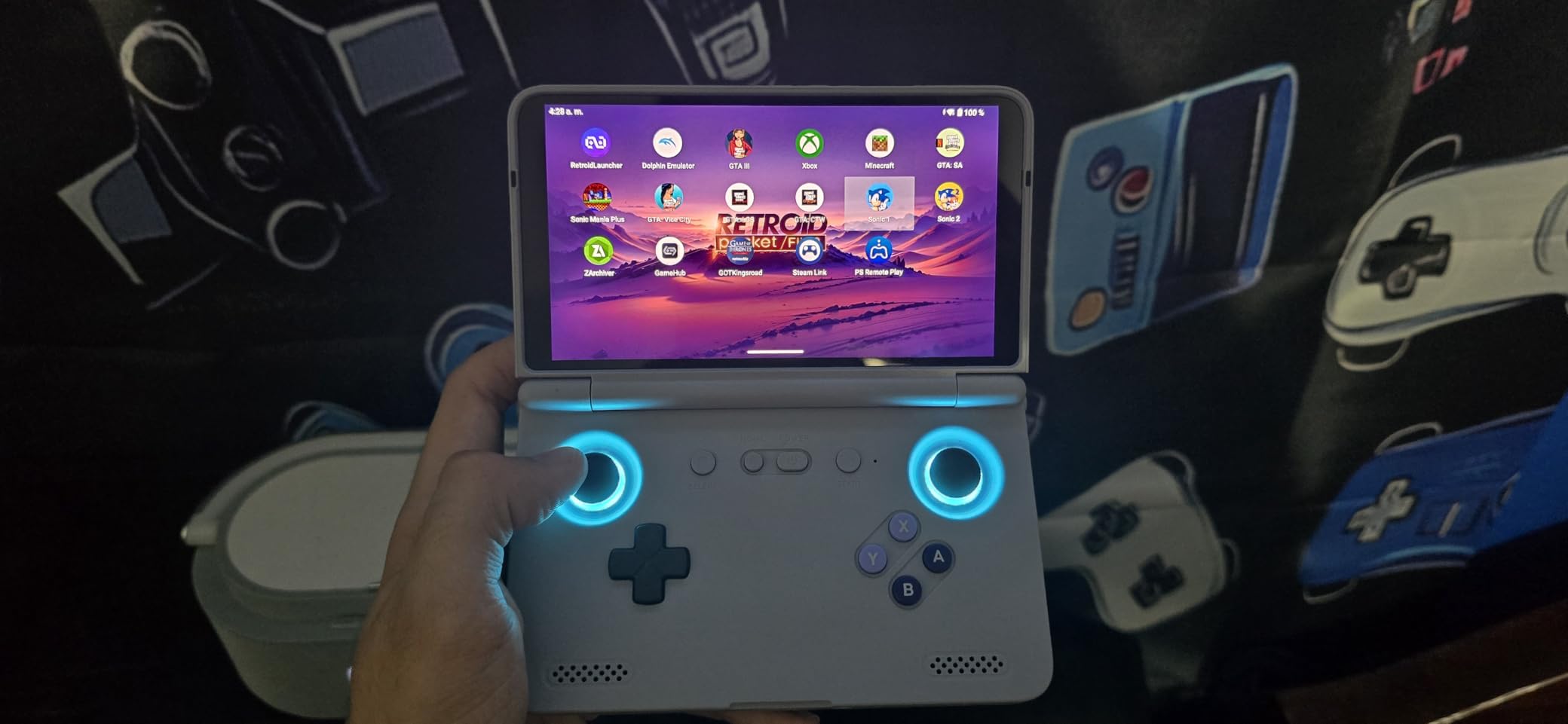
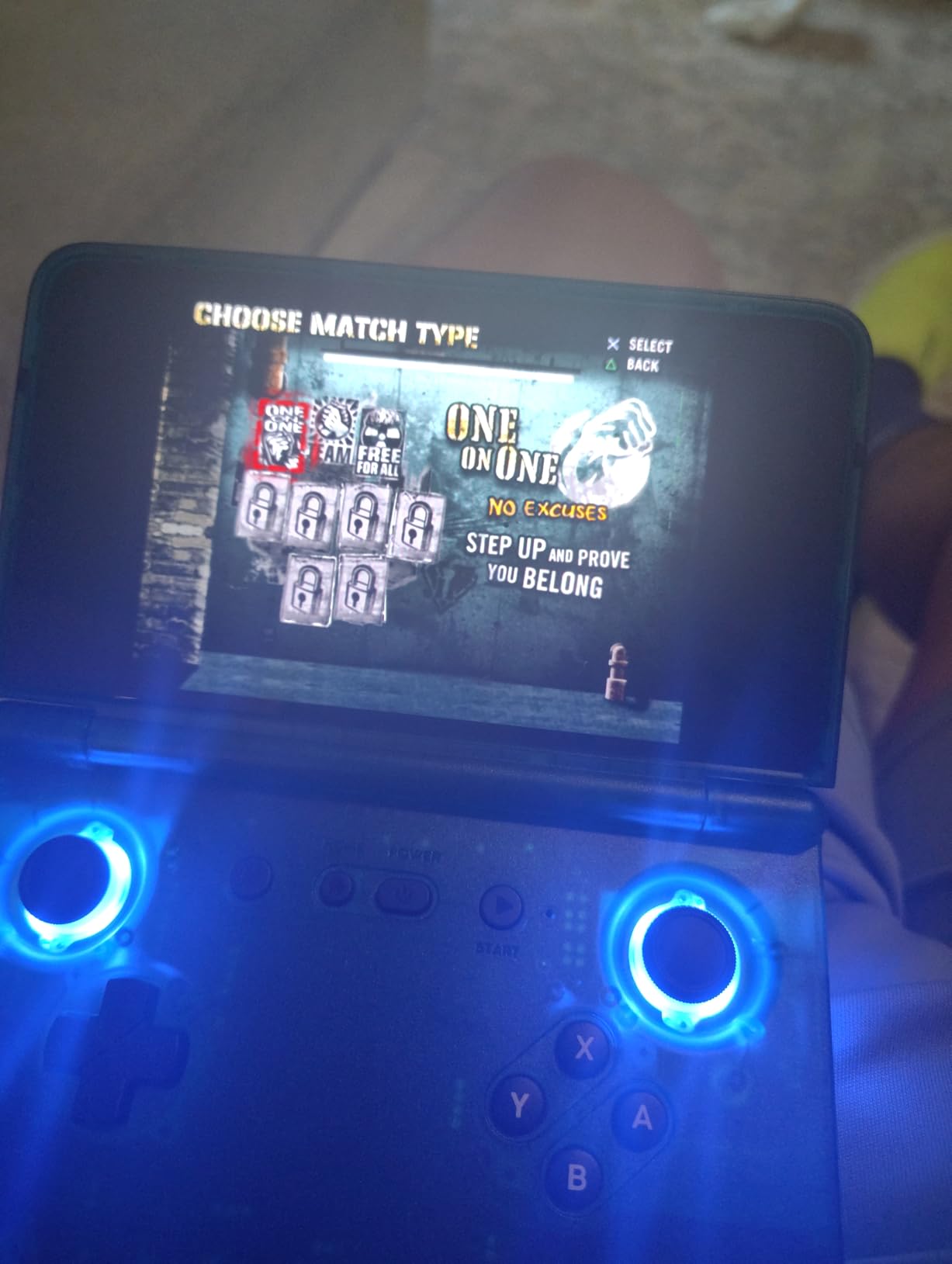
Hall effect analog sticks mean no drift, which is the single most common long-term complaint about Android handhelds. The reinforced hinge addresses the other big clamshell weakness: a plastic pivot snapping after a year of use.
The 5000mAh battery with 27W fast charging refills quickly, and WiFi 6, USB-C DisplayPort output, Bluetooth 5.1, and a 3.5mm jack cover every connection a handheld needs. Android 13 with full Play Store support keeps setup simple.
Who this handheld suits
It suits buyers who want clamshell portability without a small screen, and who intend to play beyond PlayStation. At 10.72 ounces it is heavier than a bar device but far lighter than most Android slabs.
It also suits people who want to dock it to a television: USB-C DisplayPort output handles that cleanly.
Where it falls short
It sits at the expensive end of the range and includes no games, so the total outlay is higher than the box suggests. Open, the clamshell is bulkier than a horizontal bar-style unit, and 5.5 inches is not pocketable in the way a 3.5-inch device is.
13. Anbernic RG DS – the Best Nintendo DS Handheld
Aivuidbs RG DS Foldable Handheld Game Console RK3568 Anbernic RG DS Android 14 System two-Player Joystick Top and Bottom Dual Screen 4 inch OCA Full Touch Screen 4000mAh 3 + 32gb
RK3568 quad-core at 2.0GHz
Dual 4-inch 640x480 touch screens
Android 14
4000mAh battery
Pros
- Only affordable dual-screen handheld
- ideal for Nintendo DS emulation
- Dual Screen Creative mode lets you run a guide or video alongside a game
- RK3568 chip runs everything from Game Boy through PlayStation smoothly
- Android 14 with 20+ emulators and Moonlight streaming
- Includes a capacitive stylus in the package
Cons
- Only 3GB of RAM limits performance on the most demanding titles
- Cannot run 3DS games despite having the emulator present
- Runs warm quickly and no compatible fan is available
- Slow boot times on both Rocknix and stock Android
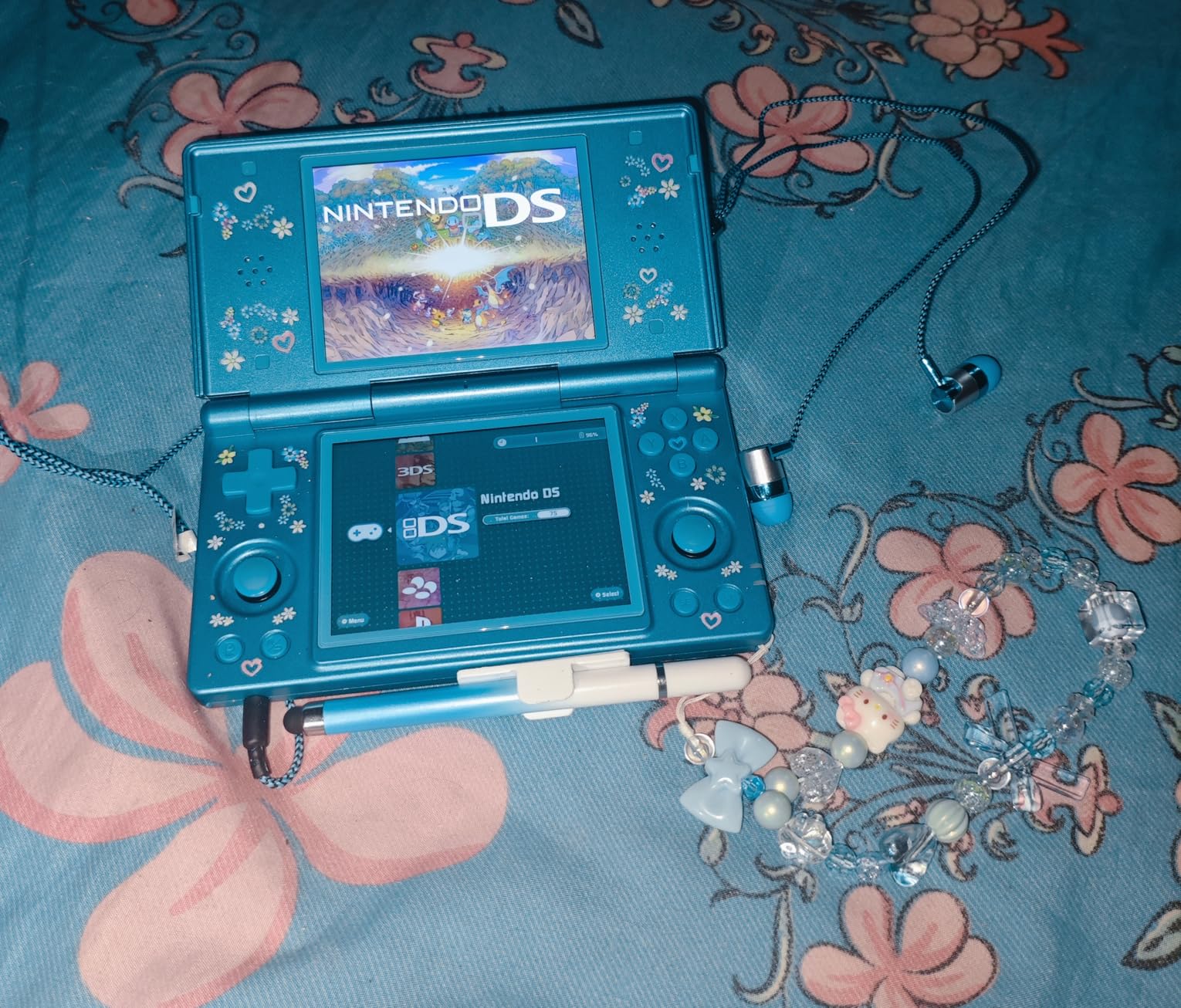
There is only one budget handheld that gives you a second screen, and this is it. Two 4-inch OCA fully laminated 640×480 touch panels with multi-touch and capacitive stylus support mean Nintendo DS games run as they were designed, with the lower screen acting as a second display.
The Dual Screen Creative mode is the sleeper feature. It lets you run a game guide, a translation app, or a video on one screen while the game plays on the other, which turns the device into a genuinely useful companion for games with dense text.
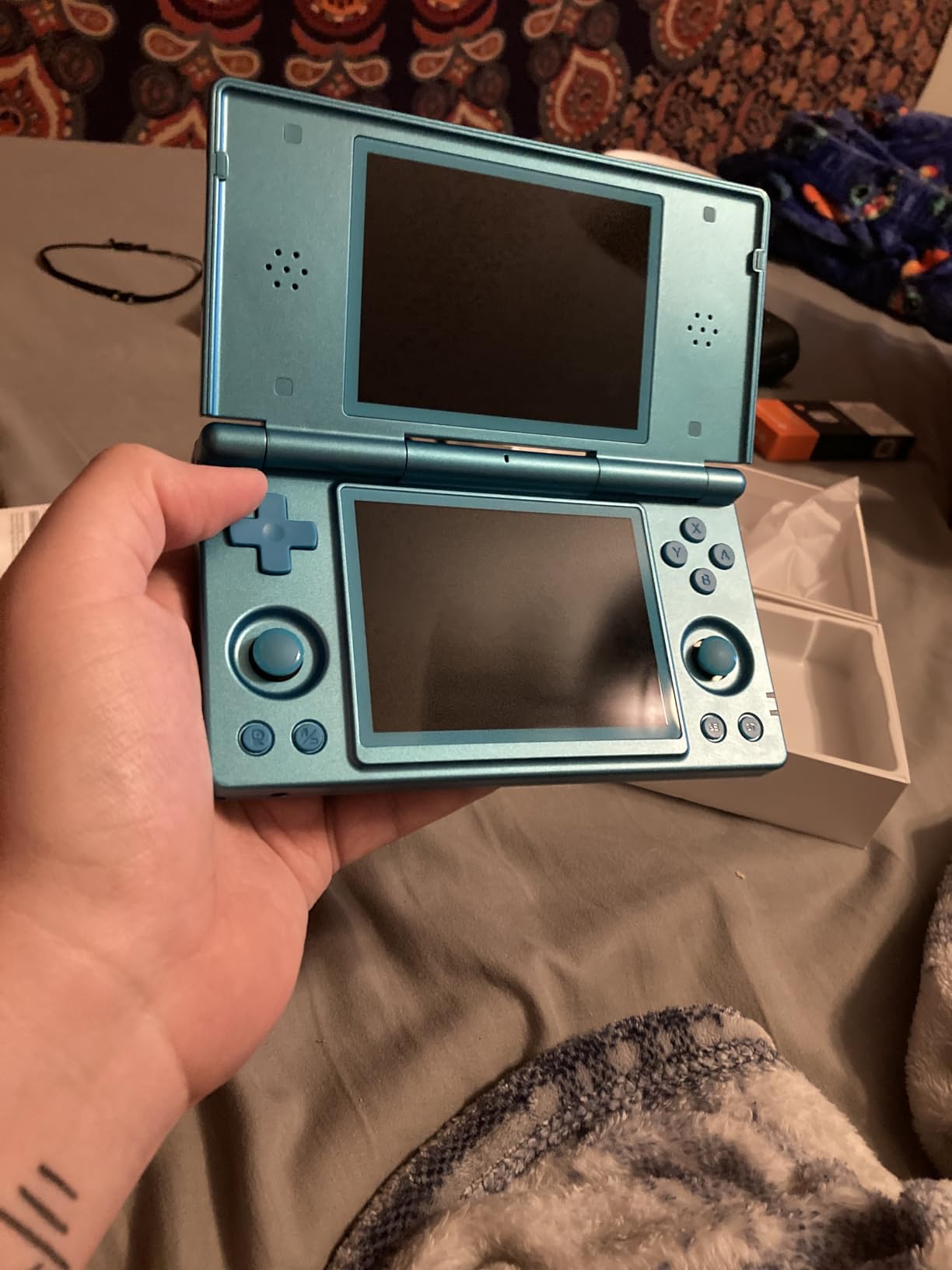
Underneath, an RK3568 quad-core Cortex-A55 at 2.0GHz with a Mali-G52 GPU and 3GB of RAM handles everything from Game Boy through PlayStation, and Android 14 with 20-plus emulators and Moonlight streaming is a capable software environment. The stylus in the box is genuinely needed for the lower screen.
It cannot run 3DS titles even though the emulator is present, and there is no compatible fan, so it runs warm. Boot times are slow on both the factory system and Rocknix, and a bent hinge prevents the lid closing on a small number of units.
Who this handheld suits
It suits buyers whose childhood library includes Nintendo DS games and who want a second screen on the move. The Dual Screen mode also makes it a good travel companion for anything with a manual or a foreign-language script.
The 4000mAh battery is rated for up to six hours, and 2.4 and 5GHz WiFi, Bluetooth 4.2, a 6-axis gyro, and vibration are all present.
Where it falls short
It is bulkier than an original Nintendo DS and not really pocketable, and 3GB of RAM caps the heavier titles. If you do not play DS games, a single-screen device is the smarter spend.
14. Anbernic RG476H – the Best Handheld for PS2 and GameCube
Anbernic RG476H Retro Handheld Game Console 4.7-inch LTPS In-Cell Screen No Card Android 13 System 128G Storage Support AI Functions 3D Hall Effect Joystick WiFi Bluetooth HD and TV Output Black
Unisoc T820 with 8GB LPDDR4X
4.7-inch 1280x960 120Hz LTPS
3D Hall effect sticks
5000mAh battery
Pros
- 4.7-inch 1280x960 LTPS display with up to 120Hz refresh rate
- 8GB LPDDR4X RAM and T820 chip handle GameCube PS2 and most Dreamcast titles
- 3D Hall effect joysticks and triggers for precision and zero drift
- Good weight and ergonomics for long play sessions
- AI helper features for game guides and real-time translation
Cons
- No game card or preloaded games so the library must be sourced separately
- Some titles such as Super Smash Bros Melee and Paper Mario need tweaking
- The selected button mapping resets to default after a restart
- Active fan cooling adds audible noise
The RG476H is the most convincing mid-priced answer to sixth-generation emulation. A Unisoc T820 with a quad-core Mali-G57 GPU and 8GB of LPDDR4X runs PS1, PS2, GameCube, Game Boy Advance, and Nintendo DS smoothly, with Dreamcast in good shape too.
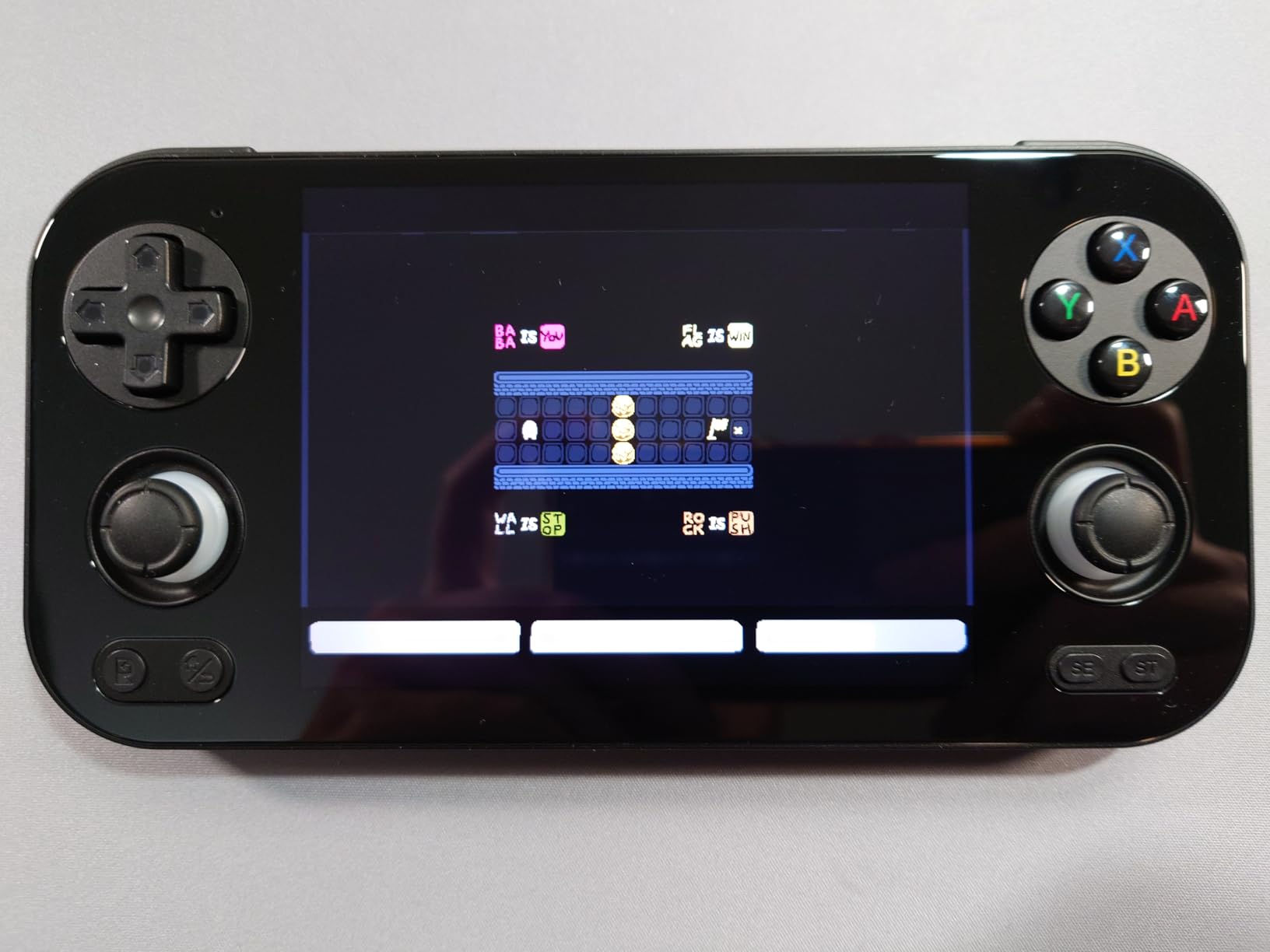
Buyers consistently single out the 4.7-inch LTPS in-cell panel at 1280×960 with up to a 120Hz refresh rate. At that pixel density the screen feels unusually close to a small television, and the borderless design maximises what you actually see.
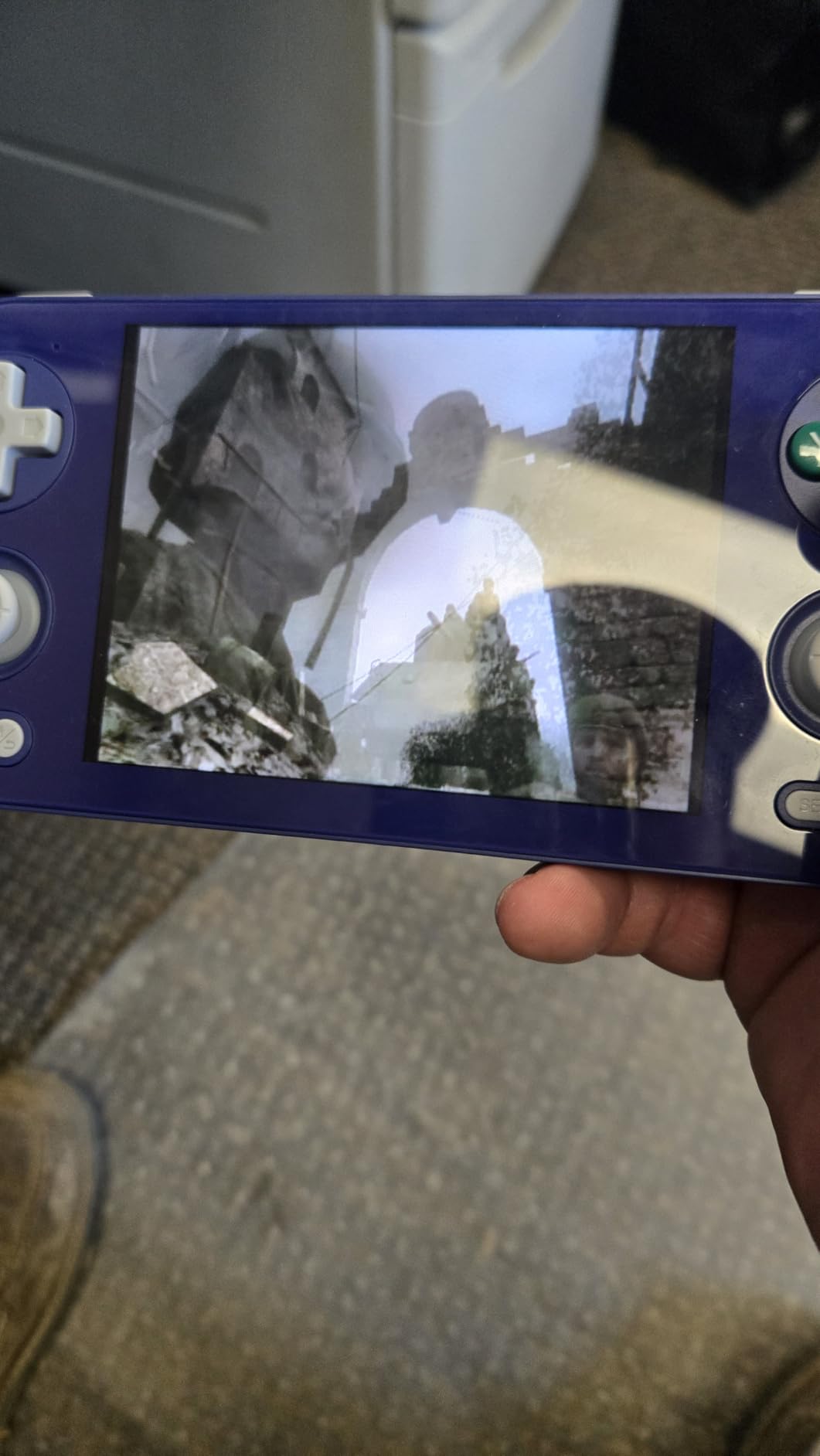
The 3D Hall effect joysticks and triggers feel precise and never drift. A 6-axis gyroscope and vibration motor are both fitted, and the weight and balance are genuinely comfortable for long sessions, which is rarer than it should be at this size.
Real caveats: a handful of demanding titles need per-game settings, and the selected button mapping resets to default after a restart, which is an annoying firmware quirk. The active fan and heat pipe add a low background noise, and no card or games are included.
Who this handheld suits
It suits buyers whose library is mostly PS2 and GameCube and who want those generations at a sensible cost rather than a flagship Android price. The 120Hz panel also makes fast scrolling and menu navigation feel smoother than the 60Hz IPS units.
AI helper features handle game recognition, real-time translation, and text-to-image work, and FOTA updates mean you are not reflashing by hand.
Where it falls short
The T820 is not fast enough for the most demanding titles, and the button mapping bug is a genuine irritation for anyone who prefers remapping. The Unisoc chipset is also the least proven in this roundup for long-term emulator support.
15. MAX II – the Best Handheld for Preloaded Games
EraVortx MAX Ⅱ Retro Gaming Console, 4.5 Inch 4K HD IPS Screen Retro Video Game Console, Handheld Game Console Preloaded 30+ Emulator Games, Linux System, Portable Video Console for Adult
4.5-inch 1024x768 IPS
RK3326 CPU at 1.5GHz
4000mAh, 6 to 8 hours
64GB card included
Pros
- Large 4.5-inch 1024x768 IPS display for a square 4:3 aspect ratio
- 20000+ preloaded games across 30+ emulators playable offline immediately
- 4000mAh battery with 6 to 8 hours of play and fast save states
- Built-in WiFi for online multiplayer
- Includes a carry bag in the box
Cons
- RK3326 is an older chip that will not handle PlayStation-era titles
- Large 4.5-inch square screen makes the body bulky for a pocket device
- Plastic build and limited official brand support
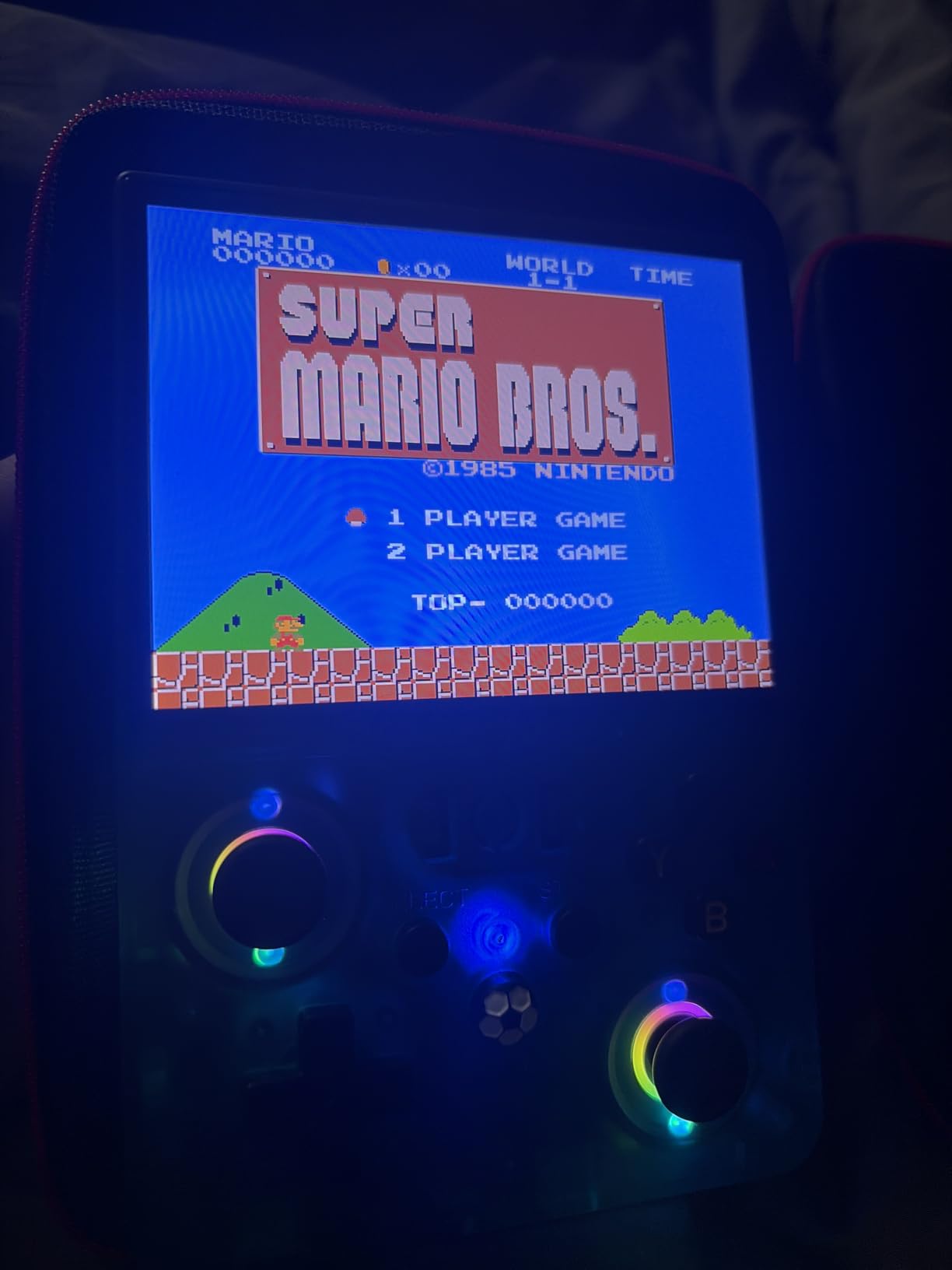
If you want something that works the moment you switch it on, this is the device to look at. A 64GB card with more than 20,000 titles across 30-plus emulators is already inserted, and the Linux system boots straight into a game browser with no setup of any kind.
The screen is the talking point: 4.5 inches at 1024×768 with a square aspect ratio is the largest display in this roundup, and it shows a lot of the game at once. Built-in WiFi, a 3.5mm headphone jack, and a carry bag in the box complete a beginner-friendly package.
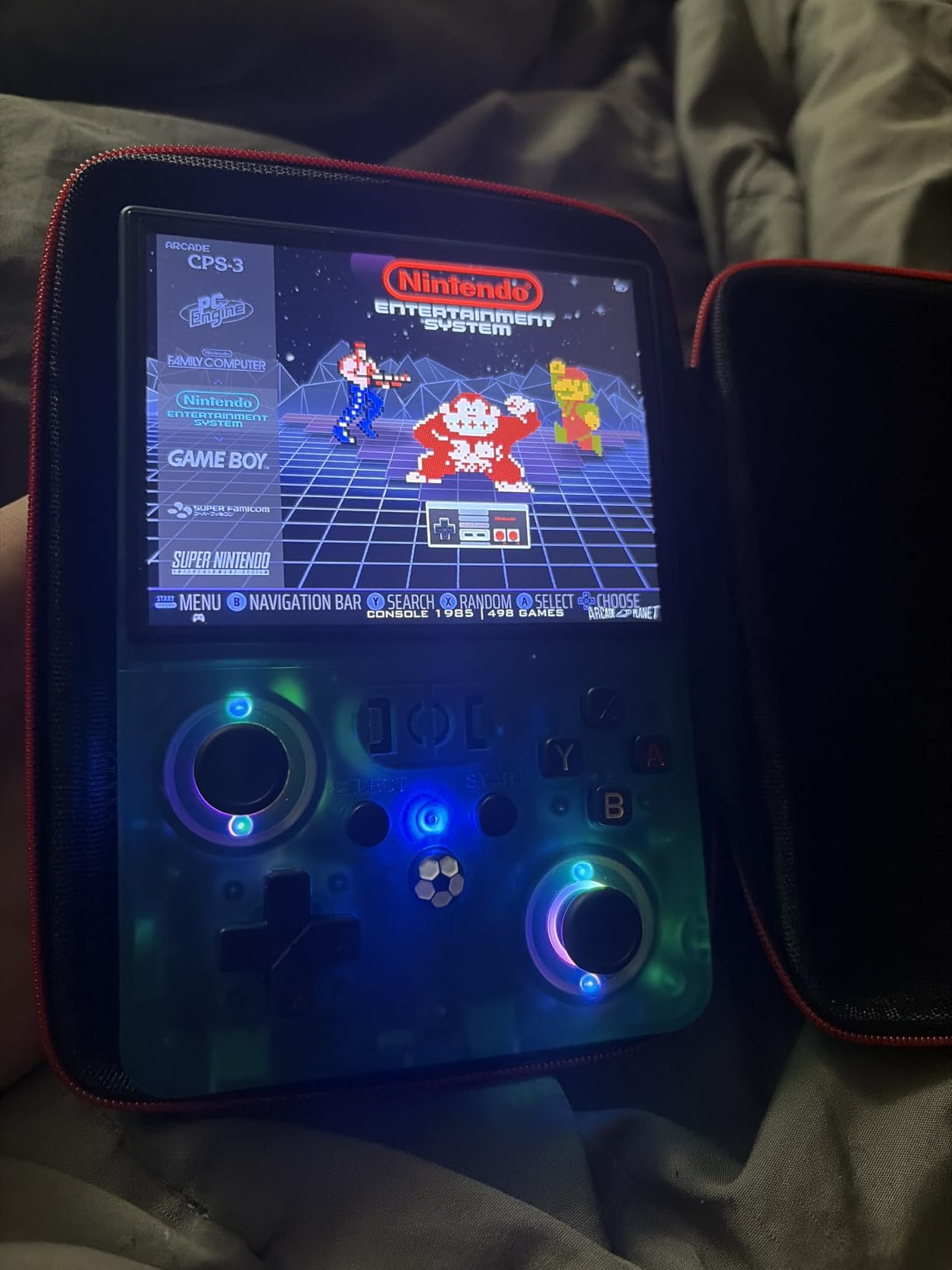
The 4000mAh battery is rated for six to eight hours, and the faster memory keeps save states quick, which is a nicer touch than it sounds on an older device.
The RK3326 64-bit CPU with a quad-core Cortex-A35 at 1.5GHz is an older chip. It handles 2D and early 3D titles well and stops well short of PlayStation, and the large square screen makes the body bulkier than a pocketable device should be.
Who this handheld suits
It suits a gift for someone who knows nothing about emulators and wants to press a button. It also suits anyone who wants a large screen for older 2D games and does not want to read a firmware guide.
Because it arrives with a library already loaded, it is also the easiest device to try before committing to a more serious machine.
Where it falls short
The RK3326 chipset puts a hard ceiling on what it can run, and the plastic build and limited brand support are real quality concerns over time. A bundled library of that size also raises the legal question discussed below.
How to Choose a Retro Gaming Handheld
Start with the systems you want to play. Everything above PS1 runs on any device here. N64 and Dreamcast need an RK3566-class chip, and GameCube or PS2 need one of the four high-end units. Buying a PlayStation-capable device when you only play 16-bit games wastes money.
Then pick a form factor. Vertical designs suit one-handed play and travel. Horizontal bar designs with dual joysticks suit arcade and PlayStation libraries. Clamshells protect the screen and sleep instantly, at the cost of screen size once open. Match the shape to how you actually hold a device.
Check the chipset and RAM, not the marketing. A quad-core ARM Cortex-A53 with 1GB of RAM is an entry-level machine. 8GB of LPDDR4X or better is where the sixth-generation headroom starts, and the difference in smoothness is immediately obvious.
Think about aspect ratio before screen size. A 4-inch 4:3 display shows more of an original frame than a 5.5-inch 16:9 panel with black bars down each side. Bigger is not always better for retro games.
Budget for the extras. A good microSD card, a case, and a screen protector add meaningfully to the cost of a budget device. A memory card alone can approach the price of a whole entry-level handheld, and replacing the bundled card is often the single best upgrade you can make.
Decide how much setup you want. Factory Android devices work immediately after you install an emulator. Linux devices become excellent after a firmware image is flashed, and that is a thirty-minute job for a confident beginner and a genuine barrier for a first-timer.
Our guide to gaming laptops for beginners covers the same instinct at a different price point, if you want something that runs modern titles too, and our tested gaming laptops under 1500 comparison goes deeper on display and battery trade-offs.
Is Emulation Legal and What Can You Load
This question comes up constantly, so here is the short answer. Emulator software itself is legal in most countries. Downloading a ROM of a game you do not own is generally not. That distinction explains why every device in this roundup is sold without a legitimate game library, and why several arrive empty.
What you can legally load is mostly the games you already own. If you still have the cartridge or disc, tools exist to create a personal backup, and homebrew and public-domain titles are free to distribute. What you should not do is download a full library from a website, and no site offering that is trustworthy.
That last point matters for security, not just legality. Devices that advertise tens of thousands of preloaded games are running files from an unknown source on an operating system with WiFi and Bluetooth radios. Treat any such bundle as a liability, and prefer a device that arrives with a card you can format yourself.
Also be careful with BIOS files. A console’s original BIOS is copyrighted separately from the games, so a system that requires a BIOS dump you perform yourself on a machine you own is in a different legal position from one that bundles it for you.
How to Spot Clones, Fakes, and Marketplace Scams
The shopping results for this query are dominated by unbranded marketplace listings that copy a well-known model name. They are not necessarily dangerous, but they are not what they claim to be, and the differences show up within a week.
Check the seller, not just the listing. A device sold by the brand’s own storefront is one thing. The same shell with a slightly different brand name, sold by a marketplace reseller, is another. Four of the fifteen devices in this roundup come from third-party sellers rather than the manufacturers, and we have flagged that in each write-up.
Treat giant library counts as a warning. A claim of 20,000 or 28,000 preloaded games tells you nothing about the hardware and a great deal about the source of the files. It is worth walking away from.
Look for spec-sheet omissions. Genuine product pages list RAM type, storage standard, screen resolution, and battery capacity. Clone listings favour adjectives and avoid numbers, and a listing that cannot tell you its RAM is telling you something.
Be wary of unfamiliar brand names that look like real ones. Marketplace sellers routinely register names one character away from established brands. Check the store history and the brand’s own site before buying.
Read the one-star reviews for hardware failures. On this category, one-star reviews are almost entirely about dead buttons, faulty bundled cards, and screens with lines, and that pattern is far more useful than the average rating for spotting a bad batch.
Custom Firmware and Default Operating Systems Explained
Two kinds of device appear throughout this roundup, and the difference is worth understanding before you buy.
Factory Android devices boot a full Android system. You install emulators from the Play Store, point them at a folder, and play. There is nothing to break and nothing to learn, but Android adds overhead, front ends vary wildly between brands, and some ship with their own launcher that some people find cluttered.
Linux devices run a minimal system built for emulation. Installing an open-source front end such as OnionOS, ArkOS, Knulli, MinUI, or CrossMix-OS gives you a console-like browser with save states, rewind, fast forward, and per-game settings on every title.
Community consensus holds that the value of a Linux handheld lives in that firmware layer. The Miyoo Mini Plus is the clearest example: the hardware is modest, and the experience is excellent, because OnionOS is so well supported. The RG35XX Pro, RG35XX H, and RG34XX SP all benefit from the same treatment.
Android is the right choice if you want no setup, Play Store emulators, and the odd streaming app. Linux firmware is the right choice if you want save states, rewind, and a consistent interface across every game. Neither is better; they suit different buyers.
4:3 vs 16:9 – Aspect Ratio, Black Bars, and Widescreen Hacks
This is the most underrated decision in the category. A 16:9 widescreen panel playing a 4:3 game either crops the sides or adds black bars down both edges, and no firmware setting fully resolves it. It is the most common complaint about modern handhelds in community threads.
If your library is 4:3, prioritise a square or near-square screen. The RG40XX H at 4 inches and the MAX II at 4.5 inches, both 4:3, show more of the original frame than any widescreen device here. The Miyoo Mini Plus and the RG351V follow the Game Boy shape for the same reason.
If your library is 16:9, the widescreen devices win. The Retroid Pocket 4 Pro, the Retroid Pocket Flip 2, and the RG476H all use wider panels that suit PS2 and widescreen-hack content much better.
Widescreen hacks are community patches that modify a game’s internal resolution to fill a 16:9 display. They look excellent where they work, but they are unofficial, they vary in quality, and they are simply not available for every title. Treat them as a bonus rather than a reason to buy.
Frequently Asked Questions
Which handheld PC is best for emulation?
Among the devices reviewed here, the X36 Ultra is the strongest all-round choice, with the largest review base of anything we ranked, a 4.2-inch 720×720 IPS panel and full Android 10 that needs no setup at all. To reach PSP, GameCube and PS2, step up to the Retroid Pocket 4 Pro or the Anbernic RG476H, with the RG477M as the most powerful unit here.
Are emulation handhelds legal?
Emulator software is legal in most countries. The games you load onto it are a separate question: copying a game you own for personal backup is generally fine, while downloading a full library from a website is not. That is why most handhelds in this roundup arrive with no games at all.
What is the best retro handheld with preloaded games?
The MAX II ships with a 64GB card holding more than 20,000 titles across 30-plus emulators, and the RG35XX Pro arrives with over 4,000 games and 30-plus emulators. Both work immediately with no setup, though preloaded bundles are unverified files, so replace the card and load your own legally backed library.
What is the best emulation handheld for a beginner?
The Miyoo Mini Plus is the usual recommendation, and the X36 Ultra is the low-friction alternative. The Mini Plus gets better once community firmware such as OnionOS is installed, while the X36 Ultra runs full Android 10 and needs no flashing at all.
What is the best screen size for retro games?
For 4:3 content, a 4.0 to 4.5-inch near-square screen shows more of the original frame than a 5.5-inch widescreen panel with black bars. For PS2, GameCube, and widescreen content, a 4.7-inch 16:9 display at 1280×960 or higher is the better choice.
Are retro handhelds worth it?
They are worth it if your library is from the 8-bit through PlayStation eras and you want one portable device instead of a stack of original consoles. They are not worth it if you want modern AAA titles on the move, since these are emulators rather than games consoles.
The Bottom Line on Retro Gaming Handhelds for Emulation
The X36 Ultra is our pick for the best retro gaming handheld for emulation because it does the most for the least: a 4.2-inch 720×720 IPS screen, full Android 10 with built-in WiFi, a 3500mAh battery, and a 210g body, with no firmware to flash before you play. It also has the largest review base in this roundup at 699 ratings, so more real owners have tested it than any other device on this list.
Go further up the range for GameCube and PS2 with the RG476H, the RG477M, or the Retroid Pocket Flip 2. Go further down for PlayStation-class play in a clamshell with the RG34XX SP, or for a dedicated first device with the Miyoo Mini Plus.
Whatever you choose in 2026, buy from the manufacturer’s own storefront where you can, replace the bundled memory card, and load only games you own.