
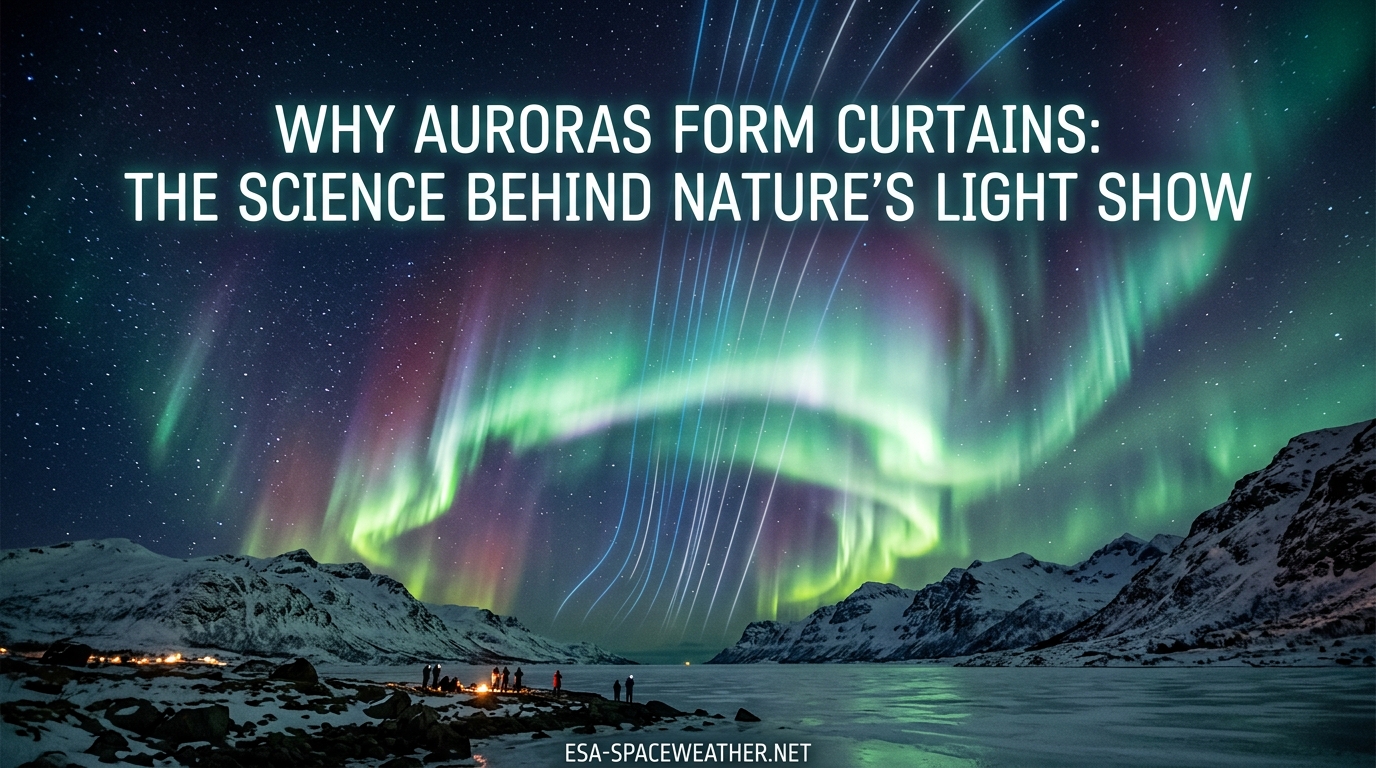
Auroras form curtains because charged particles from the Sun spiral along Earth’s magnetic field lines, creating thin sheets of glowing gas that align vertically in the polar atmosphere. These luminous sheets, observed from below, appear as flowing draperies of light because the particles travel in narrow, parallel paths that are all oriented in the same magnetic direction.
If you have ever stood under a dark northern sky and watched ribbons of green light ripple overhead, you have seen this process in action. The curtain shape is not random. It is a direct consequence of how Earth’s invisible magnetic architecture funnels solar energy into our upper atmosphere.
In this guide, we break down exactly why auroras form curtains, how magnetic field lines create that signature drapery shape, and what makes these light sheets ripple and dance across the sky. Understanding why auroras form curtains connects the dots between solar storms, magnetism, and the glowing displays that have captivated humans for millennia.
Table of Contents
What Creates Auroras in the First Place
Before we can explain why the light organizes itself into curtains, we need to cover the basics of what produces auroras at all. The story starts 93 million miles away, on the Sun.
The Sun constantly ejects a stream of charged particles, primarily electrons and protons, called the solar wind. This plasma travels outward at speeds ranging from 400 to 800 kilometers per second, washing over everything in its path, including Earth.
Fortunately, our planet has a protective shield called the magnetosphere. This invisible magnetic bubble deflects most of the solar wind around Earth, much like a boulder diverts water in a stream. But not all particles are deflected. Some get trapped or funneled along magnetic field lines toward the polar regions.
As these charged particles spiral inward, they enter the ionosphere, the upper layer of Earth’s atmosphere sitting roughly 100 to 300 kilometers above the surface. Here, the particles collide with atmospheric gases. When fast-moving electrons smash into oxygen atoms and nitrogen molecules, they transfer energy to those gas particles, exciting them.
The excited gas particles cannot hold onto that extra energy indefinitely. Within a fraction of a second, they release it as photons, tiny packets of visible light. Billions upon billions of these photon emissions add up to the glowing displays we call aurora borealis near the North Pole and aurora australis near the South Pole.
But this raises a fascinating question. If particles are raining down across a wide area of the polar atmosphere, why do they organize into narrow, sheet-like curtains rather than glowing as a uniform blob or a sphere? The answer lies entirely in magnetism.
Why Auroras Form Curtains: The Magnetic Field Explanation
Understanding why auroras form curtains requires looking at the shape of Earth’s magnetic field lines and how charged particles behave within them. This is the single most important concept for grasping the curtain shape.
Magnetic Field Lines Act Like Invisible Rails
Earth’s magnetic field can be visualized as thousands of curved lines running between the magnetic north and south poles. These field lines emerge from the southern hemisphere, loop through space, and re-enter the northern hemisphere, forming a giant dipole structure around the planet.
Charged particles do not travel in straight lines through a magnetic field. Instead, they spiral around the field lines in tight corkscrew paths. A particle’s trajectory is constrained to follow the direction of the field line itself, like beads sliding along a wire. This is a fundamental principle of plasma physics known as magnetic confinement.
As solar wind particles get injected into the magnetosphere, they are guided along these field lines toward the polar atmosphere. Each field line directs a narrow stream of particles into a specific atmospheric column. Adjacent field lines carry their own separate streams into adjacent columns.
Why This Creates Sheets, Not Blobs
Here is where the curtain shape emerges. Magnetic field lines in the polar regions are oriented roughly vertical relative to the ground, converging as they dip into the atmosphere. Charged particles descending along these parallel lines create thin, vertically oriented glowing columns.
Because field lines near each other tend to share a similar orientation over a given region, the glowing columns cluster together in elongated bands. The result is a thin, vertical sheet of luminous gas stretching across the sky. That sheet is what we see as an aurora curtain.
Think of it like rain falling on a window. Individual raindrops travel straight down along parallel paths, creating the visual impression of vertical streaks. Aurora curtains form the same way, except the streaks are glowing atmospheric gas and the paths are magnetic field lines.
The Magnetospheric Tail Feeds the Sheets
During a geomagnetic storm, the solar wind stretches Earth’s magnetosphere into a long tail on the night side. Magnetic reconnection events in this tail inject enormous amounts of energy into the polar atmosphere, intensifying the field-aligned currents known as Birkeland currents. These currents carry billions of watts of power along magnetic field lines, lighting up the curtain structures with vivid brightness.
The intensity and structure of these Birkeland currents determine how bright and well-defined the aurora curtains become. Stronger currents produce sharper, more dramatic curtains. Weaker currents produce fainter, more diffuse forms.
Why Curtains Look Flat Despite Being Three-Dimensional
One of the most common sources of confusion, raised repeatedly on forums like Reddit’s r/AskScienceDiscussion and r/explainlikeimfive, is why aurora curtains look like flat sheets when the atmosphere itself is volumetric and three-dimensional.
The answer comes down to perspective and the physical thickness of the glowing region.
Each aurora curtain is actually a very thin shell of excited gas, perhaps only a few hundred meters thick, extending vertically for tens or hundreds of kilometers. The glowing sheet is physically narrow in one dimension but elongated in two others, much like a sheet of paper held edge-on.
When you stand directly beneath a curtain, you are looking up through the long dimension of that thin sheet. Your line of sight passes through a deep column of glowing gas, making the curtain appear bright and well-defined. The narrow thickness is perpendicular to your view, so you do not perceive it.
If you could see the same curtain from the side, perhaps from an aircraft at the same altitude, it would look like a glowing wall rather than a flat sheet. The flat appearance is an observational effect, not a physical property. The curtain itself is always a three-dimensional structure with real depth and volume.
This perspective effect also explains why different observers at different locations see the same aurora event differently. Someone standing directly under the auroral oval sees coronas and rays converging overhead. Someone viewing from the side sees long, draping curtains stretching along the horizon.
Why Aurora Curtains Ripple and Move
Anyone who has watched an aurora display knows that curtains do not sit still. They ripple, billow, sway, and sometimes surge dramatically across the sky in what observers call a substorm. This movement has a specific physical cause.
Wave-Particle Interactions Drive the Motion
The particles traveling along magnetic field lines are not evenly distributed. They are affected by electromagnetic waves that propagate through the magnetosphere and ionosphere. These waves, including Alfvén waves and other magnetohydrodynamic disturbances, continuously perturb the particle populations.
As a wave passes through a region of the aurora, it compresses and rarefies the particle stream. More particles mean brighter emission. Fewer particles mean dimmer emission. This creates the visual impression of light moving through the curtain, similar to how wind creates ripples in a physical fabric curtain.
The rippling motion you see is actually a wave of particle intensity traveling along the field lines, not the particles themselves moving sideways. Individual electrons are moving down the field lines at high speed, but the luminous pattern shifts as wave energy redistributes the particle density.
Substorms Cause Dramatic Flaring
During a magnetospheric substorm, a massive release of stored magnetic energy dumps enormous quantities of particles into the ionosphere in a short burst. This causes aurora curtains to suddenly brighten, expand, and surge equatorward. Observers describe these moments as the aurora dancing, exploding, or pulsing.
Substorms typically last 30 minutes to an hour and can transform a quiet, static arc into a wildly active display of billowing, rippling curtains. The Kp index, a measure of geomagnetic activity, helps forecasters predict when these energetic periods are likely to occur.
Why Some Storms Produce Curtains and Others Do Not
Not every aurora display features crisp curtains. The form depends on the energy spectrum of the incoming particles and the structure of the magnetospheric source region. Lower-energy particles and weaker currents tend to produce diffuse glows or homogenous arcs. Higher-energy particles and well-organized Birkeland currents produce the sharp, vertical structure characteristic of curtain auroras.
Strong geomagnetic storms with sustained southward interplanetary magnetic field orientation are the most likely to produce dramatic, well-defined curtains. These conditions allow efficient magnetic reconnection on the dayside magnetopause, feeding the nightside tail and powering intense field-aligned currents.
Different Aurora Forms: Arcs, Rays, Curtains, and Coronas
Aurora curtains are just one of several recognized forms that auroras can take. Each form reflects different underlying physical conditions and particle distributions. Here is how they compare.
Homogeneous Arcs
The quietest aurora form is a homogeneous arc, a smooth, glowing band of light stretching across the sky without internal structure. These typically appear during low geomagnetic activity when particle precipitation is steady but not intense enough to create vertical ray structure.
Rayed Arcs
As activity increases, vertical rays begin to appear within an arc. These rays are individual field-aligned columns of glowing gas. When many rays form along the same arc, the structure begins to resemble a hanging curtain, marking the transition from arc to curtain form.
Curtains and Draperies
Full curtain or drapery forms develop when rayed arcs become active and dynamic. The curtain form is especially photogenic, resembling a billowing sheet or shimmering veil. This is the form most people picture when they think of classic aurora photography. The curtain structure directly reflects the underlying magnetic field geometry, with each vertical ray tracing a separate field line.
Auroral Coronas
When an active curtain passes directly overhead, an observer looking up sees all the vertical rays converging toward a single point, like the ribs of an umbrella meeting at the top. This perspective effect is called a corona. The corona is not a distinct physical structure; it is the same curtain viewed from directly beneath, where the field lines appear to converge due to foreshortening.
Diffuse Glows and Patches
At the lowest activity levels, auroras can appear as uniform, structureless glows or faint, patchy emissions without any organized geometry. These forms result from low-energy particle precipitation spread over wide areas without the field-aligned current structure needed to create curtains.
Spirals and Swirls
During intensely active periods, curtains can twist into spiral and swirl patterns. These forms arise from complex electromagnetic interactions in the ionosphere, including vortices in the auroral electrojet current system. Spirals are short-lived but visually stunning.
What Determines Aurora Curtain Colors
The colors within an aurora curtain tell a story about which atmospheric gases are glowing and at what altitude the particle collisions occur. Different gases emit different wavelengths of light when excited.
Green is the most common aurora color, produced by excited atomic oxygen at altitudes around 100 to 200 kilometers. This color dominates most curtain displays because oxygen is abundant at those heights and the human eye is highly sensitive to green light.
Red auroras come from atomic oxygen at higher altitudes, typically above 200 kilometers. High-altitude red emissions require lower-energy, longer-lasting excitation. Red curtains are less common and usually appear during intense geomagnetic storms.
Pink and magenta hues arise from nitrogen molecules at altitudes around 90 to 100 kilometers. These colors often appear at the lower edges of curtains where high-energy particles penetrate deeper into the atmosphere.
Blue and violet emissions come from molecular nitrogen and ionized nitrogen molecules. These colors typically appear at the base of curtains or during very energetic particle precipitation events.
The altitude of the glowing layer also affects the curtain’s apparent height. Since green emissions peak around 150 kilometers and red emissions can occur above 250 kilometers, a single curtain may display multiple color bands stacked vertically, with green at the bottom and red at the top.
When and Where Aurora Curtains Are Most Visible
Aurora curtains form most frequently within the auroral oval, a ring-shaped zone centered on each magnetic pole. Under quiet conditions, the oval sits near 67 degrees magnetic latitude. During geomagnetic storms, it expands equatorward, bringing curtain auroras to lower latitudes.
The Kp index, ranging from 0 to 9, measures geomagnetic activity. A Kp of 3 or higher typically produces visible curtains from mid-latitude locations. 2026 is an excellent year for aurora viewing because we are near solar maximum in the current solar cycle, which increases the frequency and intensity of geomagnetic storms.
FAQs
Why does the aurora look like curtains?
The aurora looks like curtains because charged solar particles spiral along Earth’s magnetic field lines, which are oriented roughly vertically in the polar atmosphere. Each field line guides a narrow stream of particles into a thin column of glowing gas. Adjacent field lines create adjacent columns, forming an elongated vertical sheet that we perceive as a curtain or drapery.
What is the rarest color of aurora borealis?
The rarest aurora color is red, produced by high-altitude atomic oxygen above 200 kilometers. Red auroras require specific low-energy excitation conditions and typically appear only during intense geomagnetic storms. White auroras, caused by extremely faint emissions that appear colorless to the eye, are even rarer.
Why does 2026 look bright for northern light sightings?
2026 falls near solar maximum in Solar Cycle 25, the period of peak solar activity in the roughly 11-year solar cycle. During solar maximum, the Sun produces more sunspots, solar flares, and coronal mass ejections, which increase geomagnetic storm frequency and make aurora curtains more frequent and visible at lower latitudes.
Can aurora curtains be seen from space?
Yes, astronauts on the International Space Station regularly photograph aurora curtains from above. From orbit, curtains appear as glowing green and red bands hugging Earth’s curved limb. The perspective from space clearly shows the thin, sheet-like structure of the auroral oval that is difficult to appreciate from the ground.
Conclusion
Understanding why auroras form curtains comes down to one core principle: Earth’s magnetic field lines guide charged solar particles into thin, vertically oriented sheets of glowing gas. The curtain shape is a direct visual representation of invisible magnetic architecture, made visible by the light emitted when those particles excite atmospheric oxygen and nitrogen.
The rippling and billowing we see reflects wave-particle interactions and magnetospheric substorms redistributing energy along those field lines. The colors tell us which gases are glowing and at what altitude. And the different forms, from quiet arcs to dramatic coronas, depend on viewing perspective and the intensity of the geomagnetic storm driving the display.
If you want to see aurora curtains for yourself, watch the Kp index and space weather forecasts during the current solar maximum. The next few years offer some of the best viewing opportunities of this decade.