
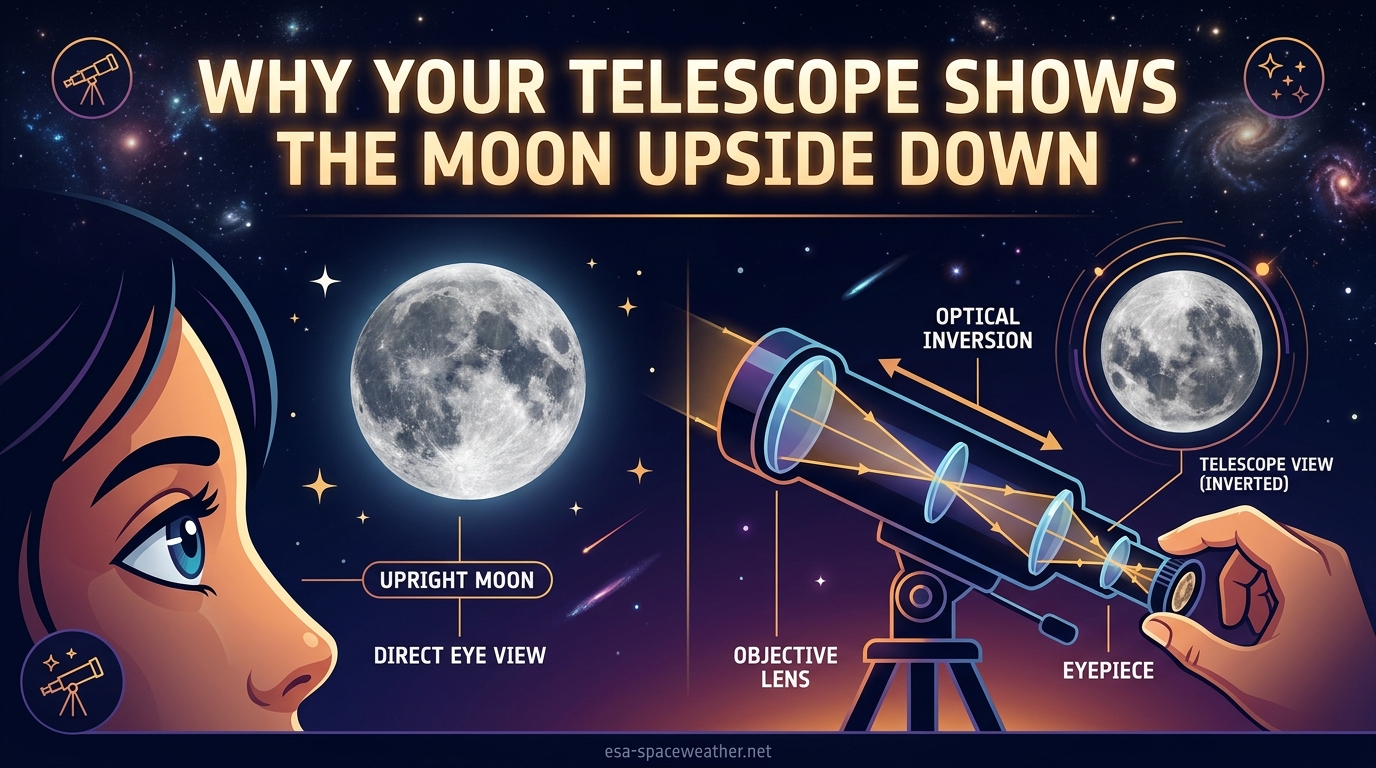
If you just set up your first telescope, pointed it at the Moon, and saw everything flipped upside down, take a breath. Your telescope is not broken. Every beginner astronomer goes through this moment of panic, and I remember it well myself. The inverted view is a completely normal consequence of how telescope optics work.
This article explains exactly why your telescope shows the Moon upside down, how the orientation differs between telescope types, and whether you should do anything about it. By the end, you will understand the light path through your scope and feel confident that what you are seeing is exactly what every astronomer sees.
Table of Contents
Quick Answer: Why Does My Telescope Show the Moon Upside Down?
Astronomical telescopes show the Moon upside down because their optical systems use lenses and mirrors that naturally invert the image as they bring light to focus. Each time light passes through a lens or bounces off a mirror, the image can flip vertically or horizontally. This is a fundamental property of telescope optics, not a defect.
Most astronomical telescopes are designed this way on purpose. Adding extra optical elements to correct the orientation would reduce brightness, introduce aberrations, and add cost. For looking at objects in space, there is no true “up” or “down,” so the inversion simply does not matter to the design.
How Telescope Optics Create the Flip
To understand why the Moon appears upside down, you need to follow the path light takes through your telescope. Every lens and mirror in that path affects the final image orientation. The key principle is simple: each optical element flips the image in some way.
Here is the rule that governs it all. An even number of optical elements in the light path produces an upside-down image (rotated 180 degrees). An odd number of optical elements produces an image that is upright but mirrored left-to-right. This is why different telescope designs show the Moon in different orientations.
Think of it like bouncing a ball between two walls. The first bounce changes the direction. The second bounce changes it again. Lenses and mirrors work the same way with light, and each interaction alters how the final image lands on your eye.
There is also a perspective point worth making early. In space, there is no up or down. The Moon has no preferred orientation, and neither does any other celestial object. The idea that the Moon looks “upside down” is something our Earth-bound brains impose on the view. An astronomer in Australia already sees the Moon differently than someone in the Northern Hemisphere with the naked eye.
Image Orientation by Telescope Type
Different telescope designs produce different image orientations because they use different combinations of mirrors and lenses. Let me walk through the three main types you are likely to encounter.
Refractor Telescopes
A refractor uses a primary lens at the front of the tube to gather and focus light. When you insert an eyepiece directly into the focuser with no diagonal in between, the image you see is both upside down and mirrored left-to-right. This is the classic “everything is backwards” view that alarms beginners.
Most refractor owners use a star diagonal between the focuser and the eyepiece. A star diagonal contains a mirror or prism that bounces the light path 90 degrees. This corrects the vertical flip, so the Moon appears right-side up. However, the horizontal mirror effect remains, meaning the image is still reversed left-to-right.
Newtonian Reflector Telescopes (Including Dobsonians)
A Newtonian reflector uses a primary mirror at the back of the tube and a small secondary mirror near the front to redirect light out the side to the eyepiece. This two-mirror system produces an image that is rotated 180 degrees, meaning the Moon appears upside down but is not mirrored left-to-right.
Newtonian owners, including Dobsonian users, generally cannot add a star diagonal easily because the focuser is already positioned on the side of the tube. This is why so many beginners on astronomy forums ask about correcting their Dobsonian view. The honest answer is that there is no simple, affordable correction for a Newtonian reflector. You learn to adapt.
One thing Newtonian owners notice is that rotating the tube changes the orientation of the image. Because the focuser sits on the side, tilting your head or rotating the telescope shifts what “up” means in the eyepiece. This takes getting used to but becomes second nature after a few sessions.
Cassegrain Telescopes
Cassegrain designs, including Schmidt-Cassegrain and Maksutov-Cassegrain models, use a primary mirror, a secondary mirror, and typically a star diagonal at the eyepiece end. Without a diagonal, the image is upside down and mirrored, similar to a refractor.
With a star diagonal attached, the image becomes upright but still left-to-right reversed. This is the most common configuration for visual observing with Cassegrain scopes, and it is the view most intermediate astronomers use when observing the Moon and planets.
What About Your Finderscope?
Many beginners are confused to find that their finderscope shows a different orientation than their main telescope. Most finderscopes are small refractors without diagonals, so they show an inverted image. If your finderscope image is upside down but your main scope (with a diagonal) shows the Moon right-side up, both are working correctly.
Red dot finders and reflex sights avoid this problem entirely because they project a reticle onto the sky without magnifying the image. If the orientation mismatch bothers you, a red dot finder is a worthwhile upgrade.
Upside Down vs Mirrored: Understanding the Difference
One of the biggest sources of confusion for new astronomers is the difference between an image that is upside down and one that is mirrored. These are two separate flips, and your telescope might apply one, both, or neither depending on its configuration.
There are four possible orientations you can see through a telescope. Normal means the image looks like what you see with your naked eye. Upside down means the image is rotated 180 degrees vertically. Mirrored means the image is upright but flipped left-to-right, like looking in a mirror. Upside down and mirrored means both flips are applied simultaneously.
This distinction matters most when you are trying to navigate with a star chart. A chart shows the sky in its natural orientation. If your telescope shows a mirrored view, moving the telescope to the right moves the object in the eyepiece to the left. This is why star hopping can feel disorienting at first.
The trick experienced astronomers use is to simply rotate the star chart to match what they see in the eyepiece. Some apps even have a mirror mode specifically for telescopes that show left-to-right reversed images.
Why Astronomers Accept Inverted Images
You might wonder why telescope designers do not just build the correction in from the start. The answer comes down to light. Every lens, prism, or mirror you add to the light path steals a small percentage of the photons arriving from distant objects.
For bright targets like the Moon, this light loss is negligible. But for faint deep-sky objects like galaxies and nebulae, every photon matters. Astronomers would rather have a brighter, higher-contrast image than a correctly oriented one. The trade-off favors leaving the optics as simple as possible.
Adding correction optics also introduces potential aberrations. Extra glass surfaces can create scatter, reduce sharpness, and introduce color fringing. Professional astronomers and serious observers prefer the cleanest possible light path, even if it means the image is upside down.
Your brain adapts surprisingly quickly to the inverted view. After a few nights of observing, most people stop noticing the flip entirely. The Moon becomes recognizable regardless of orientation, and muscle memory takes over when navigating the sky.
How to Correct the Image If You Need To
If you want to correct the orientation for terrestrial viewing or just for personal preference, there are accessories that can help. The right choice depends on your telescope type and what you are trying to achieve.
Star diagonal: This is the most common correction accessory. It fits between the focuser and eyepiece of a refractor or Cassegrain and bounces light 90 degrees. It corrects the vertical flip but leaves the image mirrored left-to-right. Most refractor and Cassegrain owners already use one.
Erecting prism: An erecting prism fully corrects the image to a normal, upright, non-mirrored view. These are primarily designed for terrestrial observing with refractor telescopes. They add two prism surfaces to the light path, which slightly reduces brightness and can introduce minor aberrations for astronomical use.
Amici prism: An Amici prism is a specialized erecting prism that corrects both the vertical and horizontal orientation while keeping the light path relatively short. It is a popular choice for observers who want a correct image without the bulk of a standard erecting prism.
Newtonian reflectors and Dobsonians: Unfortunately, there is no simple correction accessory for these designs. The focuser position and two-mirror system mean you cannot easily insert a corrective optic. Newtonian owners learn to work with the inverted view, which is perfectly fine for astronomy.
For terrestrial viewing, binoculars and spotting scopes are far better choices than an astronomical telescope. Binoculars use Porro prisms or roof prisms that automatically correct the image to a normal orientation, which is why you never see upside-down views through them.
Lunar Observation: Does Orientation Matter for the Moon?
Since this article is about the Moon specifically, let me address how image orientation affects lunar observing. The short answer is that it matters less than you might think, but there are a few situations where it can cause confusion.
First, the Moon does not look the same to everyone on Earth. Observers in the Southern Hemisphere see the Moon rotated relative to what Northern Hemisphere observers see. An Australian astronomer looking at the Moon with the naked eye sees it roughly upside down compared to someone in Europe. So when your telescope flips the image, you might actually be seeing something closer to what someone on the other side of the planet sees.
The orientation matters most when you are trying to identify specific lunar features. The Moon’s terminator, the line between day and night, moves across the surface as the lunar phase changes. When the image is inverted, the terminator appears to move in the opposite direction from what you might expect based on a lunar map.
Identifying craters like Tycho, Copernicus, or Plato can also be tricky when the image is flipped. A lunar atlas shows features in their natural orientation. If your telescope shows the Moon upside down, you need to mentally rotate the atlas or physically flip it to match the view.
The practical solution is simple. Print or display your lunar chart upside down, or use an app that supports image inversion. Once the chart matches your eyepiece view, navigating the lunar surface becomes straightforward.
FAQs
Why is the moon upside down in my telescope?
The Moon appears upside down because astronomical telescopes use lenses and mirrors that naturally invert the image as light travels through the optical system. This is normal behavior, not a defect. Each optical element in the light path flips the image, and most telescope designs produce an upside-down or mirrored view by design.
How do I fix an upside down image in a telescope?
To correct an upside-down image, you can add a star diagonal to a refractor or Cassegrain telescope, which corrects the vertical flip. For a fully corrected image suitable for terrestrial viewing, use an erecting prism or Amici prism. Newtonian reflectors and Dobsonians have no simple correction accessory, so observers adapt to the inverted view.
Are all astronomical telescopes upside down?
Yes, all pure astronomical telescopes produce an inverted or mirrored image. Refractors and Cassegrains show upside-down and mirrored views without a diagonal. Newtonian reflectors show a 180-degree rotated image. This is a deliberate design choice that keeps the optical path simple and maximizes light transmission.
Why does my telescope show the moon upside down but my binoculars do not?
Binoculars contain built-in Porro prisms or roof prisms that automatically correct the image to a normal orientation. Astronomical telescopes omit these corrective prisms to maximize brightness and image quality. Adding similar correction optics to a telescope is possible with accessories like erecting prisms, but they reduce light transmission slightly.
Embrace the Inverted View
If there is one thing to take away from this article, it is that an upside-down Moon is a sign your telescope is working exactly as intended. Every astronomer who has ever looked through a scope has seen the same flipped view you are seeing now.
The orientation of the image is a small price to pay for the light-gathering power and sharpness that a simple optical path provides. Whether you are using a refractor with a star diagonal, a Newtonian reflector with no correction, or a Cassegrain with a diagonal, the inverted view is the natural state of astronomical observation.
My advice is to stop worrying about the flip and start exploring. Rotate your star charts to match the eyepiece view, learn to identify lunar features in any orientation, and enjoy the fact that you are seeing the Moon the same way generations of astronomers have seen it before you. The view may be upside down, but the wonder is right side up.