
When you look through a telescope for the first time, you probably do not think about the centuries of optical engineering that went into shaping what you see. But behind every crisp view of Saturn’s rings or the Orion Nebula, there is a careful interplay of glass and geometry. Few telescope designs illustrate this better than the catadioptric telescope, which brings together two fundamentally different ways of bending light into one compact tube.
The word “catadioptric” sounds technical, and it is, but the idea behind it is surprisingly elegant. These telescopes use mirrors to reflect light and lenses to refract it, all working together in the same optical path. This combination solves problems that neither mirrors nor lenses can fix on their own. The result is a telescope that delivers sharp images, stays relatively compact, and handles a wide range of observing targets without breaking a sweat.
If you have ever wondered why some telescopes look like long tubes while others are stubby and compact, the answer often comes down to this mirror-and-lens combination. Catadioptric telescopes fold the light path inside the tube, meaning a telescope with a focal length of 2000 mm can fit in a tube less than half that length. That is not magic, it is clever optics.
In this guide, our team breaks down exactly how catadioptric telescopes combine mirrors and lenses, why this design exists, and what it means for amateur astronomers. We will trace the path of a photon from the moment it enters the front of the telescope to the moment it reaches your eye. We will also compare the major designs, clear up common misconceptions, and help you understand whether a catadioptric telescope is the right choice for your stargazing goals.
Table of Contents
Quick Answer: How Catadioptric Telescopes Combine Mirrors and Lenses
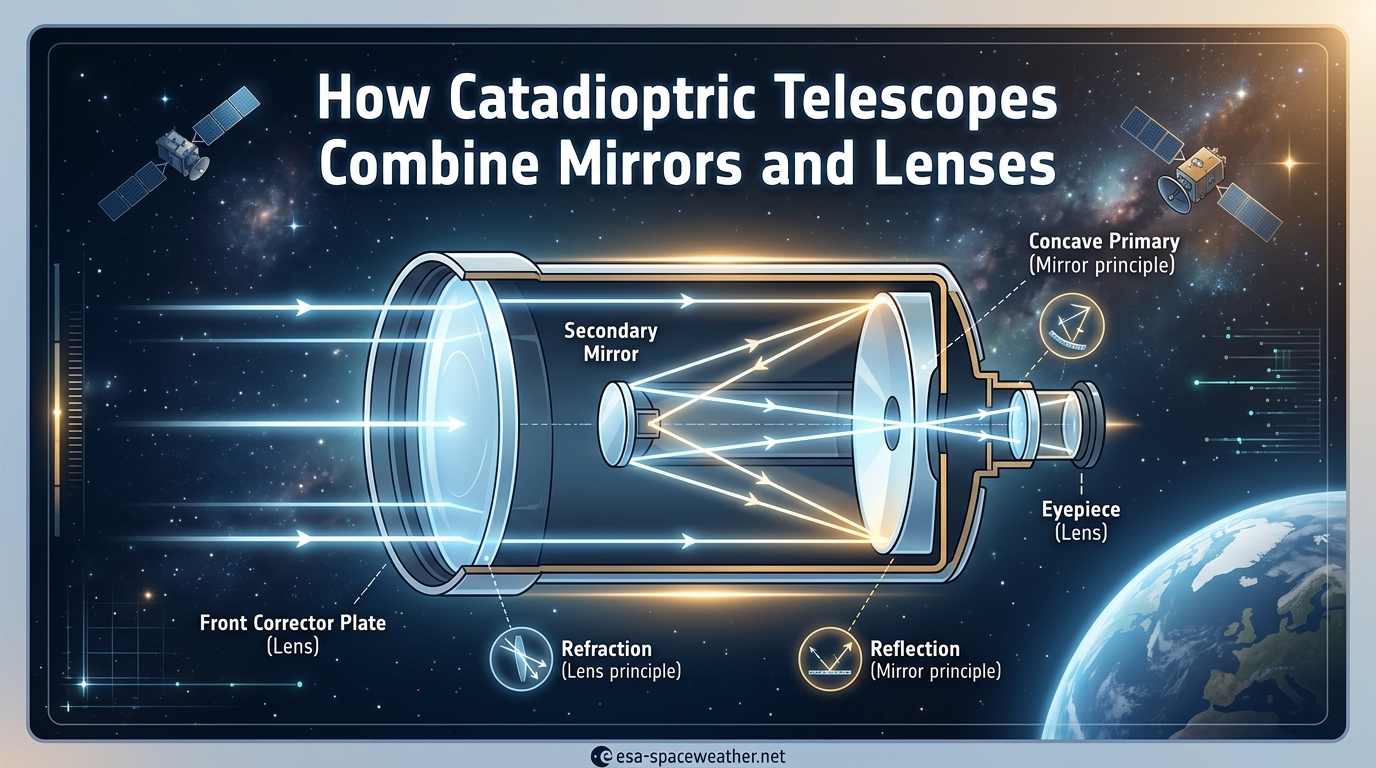
A catadioptric telescope is a compound optical system that uses a specially shaped lens called a corrector plate at the front of the tube to pre-correct incoming light, a concave primary mirror at the back to collect and focus that light, and a convex secondary mirror to reflect the light back through a hole in the primary mirror to the eyepiece or camera. The lens handles refraction while both mirrors handle reflection, and together they produce a sharp, aberration-corrected image in a tube far shorter than a traditional refractor or reflector of the same focal length.
This design exists for a simple reason. Spherical mirrors are cheaper to manufacture than parabolic ones, but they introduce an optical error called spherical aberration that blurs the image. The corrector lens compensates for this error before the light even reaches the mirror. At the same time, the convex secondary mirror magnifies the effective focal length, allowing a long-focal-length telescope to fit in a short, portable tube.
What Does Catadioptric Mean? Breaking Down the Term
Before we go further into how these telescopes work, it helps to understand what the word itself means. The term “catadioptric” comes from two Greek-rooted words that describe the two fundamental ways light interacts with optical surfaces.
“Catoptric” refers to catoptrics, the branch of optics dealing with reflection. When light bounces off a mirror, that is catoptric behavior. “Dioptric” refers to dioptrics, the branch dealing with refraction, which is how light bends as it passes through a transparent medium like glass. Put them together and you get “catadioptric,” a system that uses both reflection and refraction.
If you are wondering how to pronounce it, the most common pronunciation is “cat-uh-die-OP-trik.” Some people say “cat-uh-dip-trik,” but the first version is more widely accepted in astronomy communities. Either way, once you know the roots, the word tells you exactly what the telescope does.
This is an important distinction from other telescope types. A refracting telescope uses only lenses, so it is purely dioptric. A reflecting telescope uses only mirrors, so it is purely catoptric. A catadioptric telescope is the only major design type that brings both optical principles into the same system on purpose.
The Core Optical Principle: Why Combining Mirrors and Lenses Is Necessary
To understand why anyone bothered to combine mirrors and lenses in the first place, you need to understand the problems each component faces on its own. Both pure reflectors and pure refractors have inherent optical limitations that have challenged telescope makers for centuries.
The Problem With Pure Reflectors
A reflecting telescope uses a curved mirror to collect and focus light. The shape of that mirror determines how well the telescope performs. A parabolic mirror, which has a specific curved cross-section, focuses all incoming parallel light rays to a single point. That sounds ideal, but parabolic mirrors are expensive and difficult to manufacture, especially in larger sizes.
The alternative is a spherical mirror, which is much easier and cheaper to make. Spherical mirrors have the same curvature in every direction, so they can be polished using simple, repeatable techniques. But spherical mirrors have a serious flaw. They do not focus all light rays to the same point. Light rays hitting the edges of a spherical mirror focus closer than rays hitting the center. This mismatch is called spherical aberration, and it produces blurry, soft images that no amount of focusing can fix.
This is where the lens comes in. A catadioptric telescope uses a spherical mirror for cost and simplicity but places a corrector lens at the front of the tube to compensate for the spherical aberration before the light reaches the mirror. The lens subtly bends the incoming light so that after it reflects off the spherical mirror, all rays converge to the same focal point. It is like giving the mirror a pair of corrective eyeglasses.
The Problem With Pure Refractors
A refracting telescope uses lenses to gather and focus light. Lenses work by refraction, bending light as it passes through glass. The problem is that different colors of light bend by different amounts. Blue light bends more than red light, which means each color focuses at a slightly different point. This effect is called chromatic aberration, and it shows up as colored fringes around bright objects like the Moon or Jupiter.
Refractor designers fight chromatic aberration by using multiple lens elements made of different types of glass, called apochromatic designs. These work well but are expensive, especially in larger apertures. There is also a practical size problem. A refractor’s tube length roughly equals its focal length, so a refractor with a 1500 mm focal length needs a tube about 1500 mm long. That makes large refractors bulky and heavy.
The Catadioptric Solution
Catadioptric telescopes sidestep both problems. By using mirrors as the primary light-gathering elements, they avoid chromatic aberration entirely. Mirrors reflect all colors of light the same way, so there are no color fringes. By adding a corrector lens, they compensate for the spherical aberration that would otherwise plague the cheaper spherical mirror. And by folding the light path using a secondary mirror, they shrink the tube length dramatically.
This is why catadioptric telescopes are sometimes called compound telescopes. They compound the strengths of both optical approaches while canceling out the weaknesses of each. The mirror handles the heavy lifting of gathering light, the lens fixes the mirror’s optical errors, and the folded design keeps everything portable.
How Catadioptric Telescopes Combine Mirrors and Lenses: The Light Path Step by Step
The best way to understand a catadioptric telescope is to follow a single ray of starlight as it makes its way through the optical system. Here is the step-by-step journey that light takes from the front of the telescope to your eye.
Step 1: Light enters through the corrector lens. Starlight from a distant object arrives at the front of the telescope as parallel rays. The first thing those rays encounter is the corrector plate, a thin lens that spans the full aperture of the telescope. This lens is not there to magnify or focus the light. Its job is to pre-correct the light rays, bending the outer rays slightly so that when they later reflect off the spherical primary mirror, they will all converge to the same focal point instead of suffering from spherical aberration.
Step 2: Light travels down the tube to the primary mirror. After passing through the corrector, the light rays continue traveling down the optical tube toward the primary mirror at the back. This mirror is concave, meaning it curves inward like a bowl. It is the main light-gathering element of the telescope, and its diameter determines the aperture and light-gathering power.
Step 3: The primary mirror reflects light back toward the secondary mirror. When the light hits the concave primary mirror, it reflects back toward the front of the telescope. But before the light can exit the front, it encounters the secondary mirror. This is a small convex mirror mounted on the back of the corrector plate, positioned in the center of the light path.
Step 4: The convex secondary mirror folds the light back through the tube. The secondary mirror reflects the converging light back down the tube again. Because this mirror is convex, it does more than just redirect the light. It effectively multiplies the focal length, meaning the light behaves as if it has traveled a much longer distance than the physical tube length. This is how a catadioptric telescope with a tube only 400 mm long can have an effective focal length of 2000 mm.
Step 5: Light passes through a hole in the primary mirror. The primary mirror has a small hole in its center. The light reflected by the secondary mirror passes through this hole and emerges at the back of the telescope. This is where the eyepiece or camera is attached.
Step 6: The image reaches the focal plane. At the focal plane, behind the primary mirror, all the corrected and folded light rays converge to form a sharp image. Whether you are looking through an eyepiece or capturing the image with a camera sensor, this is where the magic happens. The combination of the corrector lens and two mirrors has produced a focused, aberration-corrected image in a fraction of the space a traditional telescope would require.
The Role of the Corrector Lens: Key to Combining Mirrors and Lenses
The corrector lens is the defining feature of a catadioptric telescope. Without it, you would just have a reflecting telescope with a spherical mirror and all the spherical aberration that comes with it. The corrector is what turns a reflector into a catadioptric system, and its design is where the real optical engineering happens.
There is a terminology point that confuses many newcomers, and it comes up frequently in astronomy forums. People often use “corrector plate” and “corrector lens” interchangeably, but there is a subtle distinction. A corrector plate typically refers to the full-aperture Schmidt-type corrector, which is a thin aspheric element spanning the entire front aperture of the telescope. A corrector lens more broadly refers to any lens element used to correct aberrations, including smaller sub-aperture lenses placed in the converging light beam between the mirrors.
Most popular catadioptric telescopes for amateur astronomers use full-aperture correctors. This means the corrector spans the entire front opening of the telescope tube. Light passes through it before reaching any mirror, so the correction happens before reflection. This approach is used in both Schmidt-Cassegrain and Maksutov-Cassegrain designs, the two most common catadioptric types.
Sub-aperture correctors, by contrast, are smaller lens elements placed in the light path after the primary mirror has already begun focusing the light. These are less common in consumer telescopes but appear in some specialized designs like the Klevtsov-Cassegrain and Argunov-Cassegrain. They can be more cost-effective because the lens is smaller, but they are harder to align and can introduce their own aberrations if not precisely positioned.
The physics of how a corrector plate works is fascinating. In a Schmidt design, the corrector has an aspheric profile, meaning its surface curvature changes from the center to the edge. The center is nearly flat, while the edges have a slight inward curve. This shape is calculated so that the outer portions of the corrector bend incoming light rays slightly inward, causing them to strike the spherical mirror at angles that compensate for the mirror’s natural focusing error. The result is that all light rays, whether they hit the center or the edge of the mirror, converge to the same focal point.
Schmidt-Cassegrain Design: The Most Popular Catadioptric Telescope
The Schmidt-Cassegrain telescope, usually abbreviated as SCT, is the most widely recognized catadioptric design among amateur astronomers. If you have seen a compact telescope on a computerized mount at a star party, chances are it was a Schmidt-Cassegrain. Models like the Celestron NexStar 8SE and the Meade LX200 are staples of the hobby, and for good reason.
Origins of the Schmidt Design
The design traces back to Bernhard Schmidt, an Estonian optical designer who, in 1930, invented the Schmidt camera. Schmidt’s original invention was not a telescope you could look through. It was a wide-field photographic instrument that used a spherical primary mirror paired with a thin aspheric corrector plate. The corrector eliminated spherical aberration, and the result was a camera that could photograph large areas of the sky with sharp stars from edge to edge.
Schmidt’s camera revolutionized astronomical photography. Professional observatories built large Schmidt cameras for sky surveys, including the famous 48-inch Samuel Oschin Schmidt Telescope at Palomar Observatory. But the original Schmidt camera had a limitation for visual observers. Its focal plane was curved and located inside the tube, making it impossible to attach a standard eyepiece.
The solution came by combining the Schmidt corrector with the Cassegrain optical layout. In a Cassegrain design, a secondary mirror reflects light back through a hole in the primary mirror, placing the focal point at a convenient location behind the telescope. By putting a convex secondary mirror on the Schmidt corrector plate and using a perforated spherical primary mirror, designers created the Schmidt-Cassegrain telescope. This gave observers the aberration correction of the Schmidt camera with the usability of a Cassegrain layout.
How the SCT Folds Its Optical Path
The Schmidt-Cassegrain’s compact size is its signature feature. An 8-inch SCT typically has a tube about 430 mm long, yet its effective focal length is 2032 mm. That ratio of focal length to physical tube length is made possible by two folds in the optical path.
First, the primary mirror reflects light forward, but instead of focusing at the front of the tube, the light is intercepted by the secondary mirror attached to the corrector plate. The secondary reflects the light back down the tube. Second, because the secondary is convex rather than flat, it magnifies the light cone, effectively stretching the focal length as if the light had traveled much farther. The light then passes through the hole in the primary mirror and reaches the focal plane at the back of the telescope.
This folded design means the telescope can have a long focal length, which is ideal for high-magnification viewing of planets and the Moon, without requiring a long, unwieldy tube. It is why SCTs are sometimes described as the Swiss Army knife of telescopes. They are versatile enough for planetary observation, deep-sky viewing, and astrophotography, all in a package that one person can carry.
Why SCTs Dominate the Amateur Market
Schmidt-Cassegrains are popular for several practical reasons. They are compact and portable compared to refractors of similar aperture. They use spherical mirrors, which are less expensive to manufacture than parabolic ones. The sealed optical tube keeps dust and moisture out, and the corrector plate protects the mirrors. They also pair well with computerized GoTo mounts, which is why manufacturers like Celestron and Meade build entire product lines around the SCT design.
Reddit users on r/telescopes frequently recommend 8-inch SCTs as do-everything telescopes. The community consensus is that an 8-inch Schmidt-Cassegrain strikes a balance between aperture, portability, and versatility that is hard to beat. Users report years of use without needing to re-collimate, and many appreciate the wide range of accessories available, from focal reducers to off-axis guiders.
Maksutov-Cassegrain Design: The Meniscus Corrector Approach
The Maksutov-Cassegrain telescope, often called a Mak or Mak-Cass, is the second most popular catadioptric design. While it shares the same basic concept of combining mirrors and lenses as the Schmidt-Cassegrain, it uses a completely different type of corrector element. Instead of a thin aspheric corrector plate, the Maksutov uses a thick, deeply curved meniscus lens.
Dmitri Maksutov and the Meniscus Lens
The design was invented in 1941 by Dmitri Maksutov, a Soviet optical engineer working at the State Optical Institute in Leningrad. Maksutov was looking for a simpler corrector design that could be manufactured more easily than the complex aspheric Schmidt plate. His solution was elegant. He discovered that a thick meniscus lens, which is a lens with one convex surface and one concave surface, could correct spherical aberration when placed at the front of the telescope.
The meniscus corrector has several advantages. It uses only spherical surfaces, meaning both sides of the lens can be ground and polished using standard spherical tooling. This makes it easier to manufacture than the Schmidt corrector, which requires a complex aspheric profile. The meniscus shape is also naturally strong and rigid, which helps maintain optical alignment.
One unique feature of the Maksutov design is that the secondary mirror is often not a separate piece of glass. In many Maksutov-Cassegrains, the secondary mirror is simply an aluminized spot deposited directly on the back surface of the meniscus corrector. This eliminates the need for a separate secondary mirror mount and ensures the secondary is perfectly centered with the corrector. This design choice also means the secondary never needs collimation in many Maksutov models, which is a significant practical advantage.
How a Meniscus Corrector Differs From a Schmidt Corrector
The optical principle is similar but the execution differs. Both correctors compensate for the spherical aberration of the primary mirror, but they do it in different ways. The Schmidt corrector uses an aspheric surface profile that varies across its radius. The meniscus corrector uses two spherical surfaces with a specific thickness and curvature that together produce the needed correction.
The meniscus corrector is thicker and heavier than a Schmidt corrector of the same aperture. This is a disadvantage at larger sizes. An 8-inch meniscus corrector is a substantial piece of glass, which is why large Maksutov telescopes become heavy and expensive. For this reason, Maksutov designs are most popular in smaller apertures, typically between 90 mm and 150 mm.
Why Maksutovs Excel at Planetary Viewing
Maksutov-Cassegrains are known for producing exceptionally sharp, high-contrast images. The meniscus corrector introduces very little stray light or scattering, and the optical system typically has a slow focal ratio, around f/12 to f/15. This long focal ratio means high magnification with comfortable eyepieces, which is exactly what planetary observers want.
Experienced telescope users on astronomy forums consistently recommend Maksutovs for lunar and planetary work. The combination of sharp optics, long focal length, and low maintenance makes them ideal for observers who want to study the cloud bands of Jupiter, the rings of Saturn, or the polar ice caps of Mars. They are less ideal for wide-field deep-sky observation because their long focal length produces a narrower field of view compared to faster optical systems.
How the Convex Secondary Mirror Extends Effective Focal Length
One of the most confusing aspects of catadioptric telescopes, and one that no top competitor explains clearly, is how the convex secondary mirror manages to multiply the focal length. This is worth understanding because it is the key to why catadioptric telescopes can be so compact.
Think about what happens when you look at the back of a spoon. The convex surface makes objects appear smaller and farther away. But in a telescope, that same magnifying-in-reverse effect works in your favor. When a convex mirror reflects a converging beam of light, it causes the light rays to diverge slightly, spreading them out. This means the light has to travel farther before it converges to a focus, effectively increasing the focal length.
In a Schmidt-Cassegrain, the primary mirror alone might have a focal length of about 500 mm. But the convex secondary mirror magnifies this by roughly four times, giving the complete system an effective focal length of about 2000 mm. This magnification factor depends on the curvature of the secondary mirror and its distance from the primary. Designers can tune these parameters to achieve different focal ratios for different applications.
This is why the physical tube length of a catadioptric telescope tells you almost nothing about its focal length. A tube that is only 400 mm long can produce images as if the light had traveled through a telescope more than five times that length. The convex secondary mirror is the reason, and it is what makes the entire compact catadioptric concept possible.
The trade-off is that the secondary mirror sits in the middle of the light path, blocking some incoming light. This central obstruction, as it is called, reduces the effective light-gathering area and slightly lowers image contrast. In an 8-inch Schmidt-Cassegrain, the secondary mirror might block about 34% of the aperture diameter, which translates to roughly 10-12% of the total light-gathering area. This is an accepted trade-off for the benefit of the compact, folded design.
Advantages of the Mirror-and-Lens Combination
Now that we understand the mechanics, let us look at why the catadioptric approach is so valuable in practice. The combination of mirrors and lenses brings several distinct advantages that explain why these telescopes are so popular among amateur astronomers.
Compact and portable design. This is the headline advantage. A catadioptric telescope packs a long focal length into a short tube, making it far easier to transport and store than a refractor or reflector of similar specifications. Users on r/telescopes frequently mention driving 100 to 150 km to dark-sky sites, and a compact SCT makes that trip practical.
Affordable large apertures. Because catadioptric telescopes use spherical mirrors, which are much less expensive to manufacture than parabolic mirrors or large lens elements, they offer more aperture per dollar than refractors. An 8-inch catadioptric typically costs significantly less than an 8-inch refractor of comparable quality.
Excellent aberration correction. The corrector lens eliminates spherical aberration, and because mirrors do not split light into colors, there is no chromatic aberration. This means sharp, color-accurate images across the field of view, which is particularly important for astrophotography.
Sealed optical tube. The corrector plate seals the front of the telescope, protecting the mirrors from dust, moisture, and air currents. This keeps the optics cleaner and reduces maintenance compared to open-tube reflectors.
Versatility across observing targets. Schmidt-Cassegrains, in particular, are known as general-purpose telescopes. With the right accessories, they can handle planetary viewing, deep-sky observation, and astrophotography. Some users add focal reducers to widen the field of view, while others use Barlow lenses for high-magnification planetary work.
Stable collimation. Catadioptric telescopes hold their optical alignment well. Many users report going years without needing to re-collimate their SCTs. Maksutovs with integrated secondary mirrors often never need collimation at all. This is a significant advantage over Newtonian reflectors, which frequently require adjustment.
Wide aberration-free field. Professional catadioptric designs like the Schmidt camera can image large areas of the sky with stars remaining sharp all the way to the edges. While consumer catadioptrics have narrower fields than their Schmidt camera ancestors, they still deliver well-corrected images across a useful field of view.
Disadvantages and Trade-offs of Catadioptric Designs
No telescope design is perfect, and catadioptric telescopes come with their own set of trade-offs. Being honest about these limitations is important, and the astronomy community on forums like Reddit consistently values explanations that acknowledge both sides.
Central obstruction reduces contrast. The secondary mirror blocks the center of the light path, which reduces image contrast compared to an unobstructed refractor. This matters most for planetary observation, where fine detail depends on contrast. The effect is real but manageable, and many observers find the convenience of the compact design outweighs this limitation.
Heavier than reflectors at large apertures. While catadioptrics are more compact than refractors, they are denser. The corrector plate, the mirror cell, and the thick optical tube add up. At 10 inches and above, catadioptric telescopes become heavy and require substantial mounts. A 14-inch SCT is a serious piece of equipment that most observers would not consider portable.
Fixed focal ratio. Unlike camera lenses, a catadioptric telescope has a fixed focal ratio determined by its optical design. You cannot stop down the aperture to improve depth of field or reduce aberrations. To change the effective focal ratio, you need to add accessory lenses like focal reducers or Barlow lenses.
Longer cool-down time. The sealed tube and thick glass components mean catadioptric telescopes take longer to reach thermal equilibrium with the surrounding air. An SCT taken from a warm house to a cold backyard might need 30 to 60 minutes before images stop shimmering from thermal currents inside the tube. Some models include cooling vents or fans to address this.
Dew formation on the corrector plate. Because the corrector plate is exposed to the sky, it radiates heat and can collect dew on humid nights. Many catadioptric owners use dew shields, which are simple tube extensions that block some of the sky view and reduce radiative cooling. Electric dew heaters are also common accessories.
Cost compared to Newtonians. Catadioptric telescopes are generally more expensive than Newtonian reflectors of the same aperture. Forum users often debate whether the extra cost of an SCT is worth it over a similarly sized Dobsonian. The answer depends on whether you value portability and versatility over raw aperture per dollar.
Catadioptric vs Refractor vs Reflector: How They Compare
Understanding how catadioptric telescopes stack up against refractors and reflectors helps clarify when each design shines. Let us compare the three main telescope types across the factors that matter most to observers.
Tube length and portability. A 6-inch refractor with a focal length of 1200 mm has a tube about 1200 mm long. A 6-inch Newtonian reflector is similarly long. A 6-inch Schmidt-Cassegrain with a focal length of 1500 mm has a tube only about 430 mm long. This dramatic difference in physical size is the single biggest practical advantage of the catadioptric design. If you need to fit a telescope in a car trunk or a small closet, a catadioptric is hard to beat.
Optical quality. Refractors produce the highest contrast images because they have no central obstruction. They are the gold standard for planetary viewing in apertures up to about 6 inches. Reflectors offer the most aperture per dollar, making them ideal for deep-sky observation where light-gathering power is king. Catadioptrics sit in the middle, offering good optical quality with some contrast loss from the central obstruction but excellent versatility.
Maintenance. Refractors are essentially maintenance-free. The lenses are aligned at the factory and rarely need attention. Newtonian reflectors need regular collimation, which involves adjusting the primary and secondary mirrors to maintain alignment. Catadioptrics fall between these extremes. They hold collimation well but may need occasional adjustment, and the procedure can be more involved because the corrector plate must be removed to access the secondary mirror in some designs.
Cost per inch of aperture. Newtonian reflectors, especially Dobsonian-mounted versions, offer the most aperture for the money. A 10-inch Dobsonian might cost the same as a 6-inch catadioptric or a 4-inch refractor. Catadioptrics are more expensive than reflectors but less expensive than refractors of the same aperture. This is why experienced observers sometimes say that if aperture is your priority and portability is not a concern, get a Dobsonian. If portability matters, consider a catadioptric.
Best use cases. Refractors are ideal for lunar and planetary observation, astrophotography of smaller targets, and situations where contrast is paramount. Reflectors excel at deep-sky observation, where maximum aperture matters most. Catadioptrics are the all-rounders, suitable for a bit of everything. They are the go-to choice for observers who want one telescope that can handle multiple types of viewing without compromise.
A Brief History of Catadioptric Telescopes
The story of catadioptric telescopes spans nearly a century of optical innovation. The concept of combining lenses and mirrors is not new, but the practical designs we use today emerged in the mid-twentieth century.
The journey began in 1930 when Bernhard Schmidt, working at Hamburg Observatory, built the first Schmidt camera. His invention used a spherical mirror paired with an aspheric corrector plate to create a wide-field photographic telescope with no spherical aberration. The astronomical community immediately recognized its value for sky surveys, and within decades, major observatories around the world had built large Schmidt cameras.
In 1941, Dmitri Maksutov independently developed his meniscus corrector design in the Soviet Union. Maksutov’s approach simplified manufacturing by using only spherical surfaces. Around the same time, other optical designers, including Albert Bouwers in the Netherlands, were exploring similar meniscus corrector concepts. The war years slowed development, but by the 1950s, both Schmidt and Maksutov designs had been adapted into Cassegrain configurations suitable for visual observing.
The commercial era began in the 1970s when companies like Celestron started mass-producing Schmidt-Cassegrain telescopes for the consumer market. The introduction of computerized GoTo mounts in the 1990s and 2000s further boosted the popularity of catadioptric designs. Today, Schmidt-Cassegrains and Maksutov-Cassegrains are among the best-selling telescopes for serious amateur astronomers worldwide.
How to Choose the Right Catadioptric Telescope for Your Needs
If you are considering a catadioptric telescope, the choice usually comes down to two designs: Schmidt-Cassegrain or Maksutov-Cassegrain. Each has strengths that make it better suited to specific observing goals.
For planetary and lunar observation: A Maksutov-Cassegrain is often the better choice. Its slow focal ratio and sharp optics deliver the high-contrast, high-magnification views that planetary observers crave. A 127 mm Mak provides excellent views of Jupiter, Saturn, and the Moon in a tube that fits in a backpack. Forum users consistently praise Maksutovs for their “razor-sharp” planetary performance.
For astrophotography: A Schmidt-Cassegrain is generally preferred. The faster focal ratio (typically f/10 compared to f/12 to f/15 for Maksutovs) means shorter exposure times. SCTs also have more accessory options, including focal reducers that bring the focal ratio down to f/6.3 for wider-field imaging. Proprietary designs like the Celestron EdgeHD and Meade ACF further improve the field flatness for astrophotography.
For beginners: Both designs work well, but the choice depends on budget and interests. An entry-level Maksutov like a 90 mm or 102 mm model is affordable, virtually maintenance-free, and excellent for learning the night sky. A Schmidt-Cassegrain like a 6-inch or 8-inch model costs more but offers more aperture and versatility. The community on r/telescopes often recommends that beginners who can afford an 8-inch SCT go for it, as it is a telescope you will not quickly outgrow.
For grab-and-go portability: Small Maksutovs in the 90 mm to 105 mm range are ideal. They are lightweight, cool down reasonably fast, and can be mounted on a simple alt-azimuth mount. Many observers keep a small Mak as a secondary telescope for quick sessions when setting up a larger instrument is not practical.
For deep-sky observation: Catadioptrics work for deep-sky targets, but larger apertures are better. An 8-inch or larger SCT will show galaxies, nebulae, and star clusters well. However, if deep-sky observation is your primary interest and portability is not a concern, a larger Newtonian on a Dobsonian mount will give you more light-gathering power for less money.
Frequently Asked Questions
What type of telescope combines a mirror and a lens?
A catadioptric telescope is the type that combines mirrors and lenses in a single optical system. The two most common designs are the Schmidt-Cassegrain, which uses an aspheric corrector plate, and the Maksutov-Cassegrain, which uses a meniscus corrector lens. Both designs use a concave primary mirror and a convex secondary mirror alongside the corrector lens.
How does a catadioptric telescope work?
Light enters through a corrector lens at the front of the tube that pre-corrects for spherical aberration. The light then reflects off a concave primary mirror at the back, bounces off a convex secondary mirror on the corrector, and passes back through a hole in the primary to reach the eyepiece or camera at the focal plane.
Why do catadioptric telescopes use both concave and convex mirrors?
The concave primary mirror gathers and focuses incoming light, acting as the main light-collecting element. The convex secondary mirror reflects that light back down the tube and, because it is convex, it multiplies the effective focal length. This allows a compact tube to deliver a long focal length for high-magnification viewing.
What are the disadvantages of catadioptric telescopes?
The main disadvantages are central obstruction reducing image contrast, longer cool-down times due to the sealed tube, dew formation on the corrector plate, higher cost than Newtonian reflectors of the same aperture, and a fixed focal ratio that cannot be stopped down. They are also heavier per inch of aperture than open-tube reflectors.
Are catadioptric telescopes good for beginners?
Yes, catadioptric telescopes are excellent for beginners. They are compact, versatile, and hold their optical alignment well. Small Maksutov-Cassegrains in the 90 to 105 mm range are affordable and nearly maintenance-free. Schmidt-Cassegrains in the 6 to 8 inch range offer more aperture and pair well with computerized mounts that help newcomers find objects.
Are catadioptric telescopes easy to maintain?
Catadioptric telescopes generally require less frequent collimation than Newtonian reflectors. Many Maksutov-Cassegrains with integrated secondary mirrors never need collimation. Schmidt-Cassegrains hold alignment well but may need occasional adjustment. The sealed tube protects the optics from dust, though the corrector plate may need occasional cleaning.
What can you see with a catadioptric telescope?
With an 8-inch catadioptric, you can see the rings of Saturn, cloud bands and moons of Jupiter, polar ice caps on Mars, lunar craters, and hundreds of deep-sky objects including galaxies, nebulae, and star clusters. Smaller apertures in the 90 to 127 mm range are excellent for the Moon, planets, and brighter deep-sky targets.
How do catadioptric telescopes correct spherical aberration?
The corrector lens at the front of the telescope pre-bends incoming light rays so that after they reflect off the spherical primary mirror, they all converge to the same focal point. Without the corrector, the spherical mirror would focus edge rays closer than center rays, producing a blurry image.
Wrapping Up: The Elegant Combination of Mirrors and Lenses
Understanding how catadioptric telescopes combine mirrors and lenses gives you a deeper appreciation for one of the most clever solutions in optical design. The corrector lens fixes the spherical mirror’s aberration. The mirrors fold the light path into a compact tube. The convex secondary multiplies the focal length. Every element plays a specific role, and together they create a telescope that is greater than the sum of its parts.
Whether you choose a Schmidt-Cassegrain for its versatility or a Maksutov-Cassegrain for its planetary sharpness, you are benefiting from nearly a century of optical engineering. These designs exist because someone looked at the limitations of pure reflectors and pure refractors and asked a simple question. What if we used both? The answer turned out to be one of the most practical and popular telescope designs ever created.
If you are considering your first serious telescope, a catadioptric model is worth serious consideration. It may not be the cheapest option or the one with the largest aperture for the money, but its combination of portability, optical quality, and all-around versatility makes it a favorite among amateur astronomers for good reason. The night sky has a lot to offer, and a catadioptric telescope is one of the best tools for exploring it.