
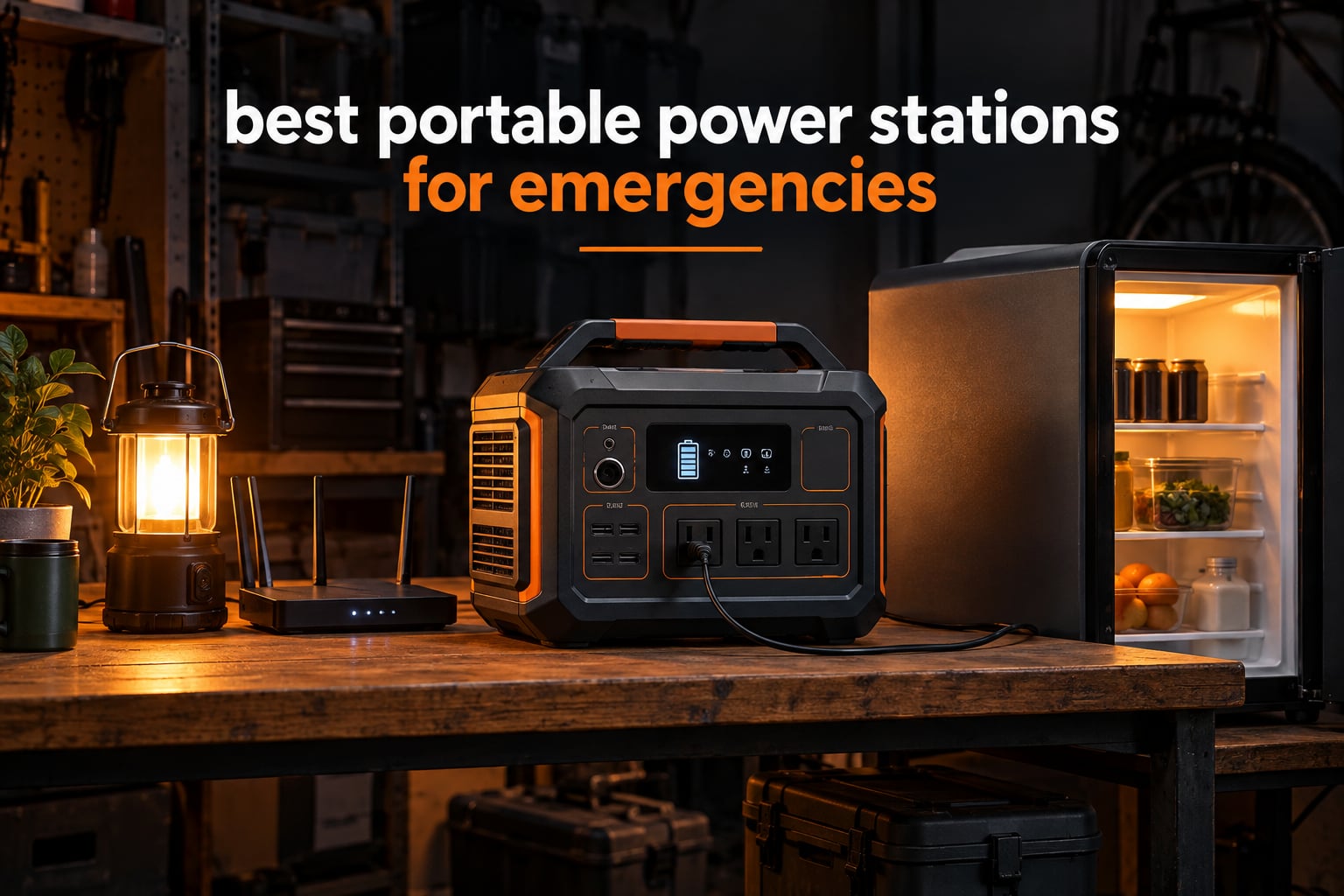
The best portable power stations for emergencies in 2026 come down to three things: enough watt-hours to run your must-keep devices through the night, enough continuous watts to start a refrigerator compressor without tripping, and a battery chemistry that still holds charge after sitting unused for months. The Jackery Explorer 1000 v2 is our top pick because it combines 1070Wh of LiFePO4 capacity, 1500W of continuous output, a one-hour emergency recharge mode and a 23.8 lb body you can still lift into a car trunk on your own.
That matters more than raw headline numbers. Most people who buy a portable power station for emergency backup are not trying to run a whole house. They are trying to keep a refrigerator cold, a router alive, a CPAP machine breathing and a phone charged until the grid comes back. A unit that does that for a full day is worth more than a bigger one that is too heavy to move and runs a fan you can hear across the room.
We compared 12 of the most reviewed portable power stations across five brands to build this list, checking rated capacity against continuous and surge output, inverter type, UPS switchover time, recharge speed, weight, battery chemistry and warranty length. We also worked through the sizing math so you can match a station to a 4-hour flick-out, a 12-hour storm or a multi-day grid failure before you spend anything. Last reviewed and updated for 2026.
If your main load is a CPAP machine or a home server rather than a fridge, we have covered those use cases separately in our picks for the best portable power stations for CPAP and our camping roundup.
Table of Contents
Top 3 Picks: Best Portable Power Stations for Emergencies for October 2026
The three below cover the most common emergency jobs: a balanced core unit, a high-output unit for compressor-heavy loads, and the strongest power-per-dollar option in the 1kWh class.

Jackery Explorer 1000 v2
- 1070Wh LiFePO4 capacity
- 1500W continuous and 3000W surge
- One-hour emergency recharge via app

One note on badges: a larger battery is not automatically a better emergency station. The BLUETTI AC180 has the highest continuous output in this group, while the Jackery Explorer 1000 v2 is easier to move and quicker to top back up between uses. Both are LiFePO4, and both sit in the middle capacity tier that most households actually need.
Quick Comparison: All 12 Stations Side by Side in October 2026
Every station below was checked against the same criteria: rated watt-hours, continuous AC watts, peak surge, chemistry, weight and recharge method. The featured numbers are manufacturer or retailer specifications; runtime figures in our reviews are the result of applying those numbers to standard household loads.
| Product | Specifications | Action |
|---|---|---|
| Jackery Explorer 1000 v2 |
|
Check Latest Price |
| BLUETTI AC180 |
|
Check Latest Price |
 Anker SOLIX S2000 Anker SOLIX S2000 |
|
Check Latest Price |
 Anker SOLIX C1000 Gen 2 Anker SOLIX C1000 Gen 2 |
|
Check Latest Price |
 EcoFlow Delta 3 Classic EcoFlow Delta 3 Classic |
|
Check Latest Price |
 BLUETTI Elite 100 V2 BLUETTI Elite 100 V2 |
|
Check Latest Price |
 OUPES Mega 1 OUPES Mega 1 |
|
Check Latest Price |
 Jackery Explorer 500 v2 Jackery Explorer 500 v2 |
|
Check Latest Price |
 EcoFlow RIVER 2 EcoFlow RIVER 2 |
|
Check Latest Price |
 Anker SOLIX C300 Anker SOLIX C300 |
|
Check Latest Price |
 BLUETTI Elite 30 V2 BLUETTI Elite 30 V2 |
|
Check Latest Price |
 Jackery Explorer 300 Jackery Explorer 300 |
|
Check Latest Price |
1. Jackery Explorer 1000 v2 – Best Overall for Emergency Backup
Jackery Explorer 1000 v2 Portable Power Station,1070Wh,1500W
1070Wh LiFePO4
1500W continuous, 3000W surge
23.8 lb
1-hour emergency charge
Pros
- 1070Wh capacity paired with 1500W continuous output and 3000W surge for compressors and AC units
- One-hour emergency charge mode enabled through the Jackery app
- LFP cells keep over 70% capacity after 4000 cycles
- Seven outputs including three pure sine wave AC outlets
- Only 23.8 lb with a foldable handle
Cons
- Solar charging works only with Jackery panels
- One-hour fast charge must be re-enabled in the app each session
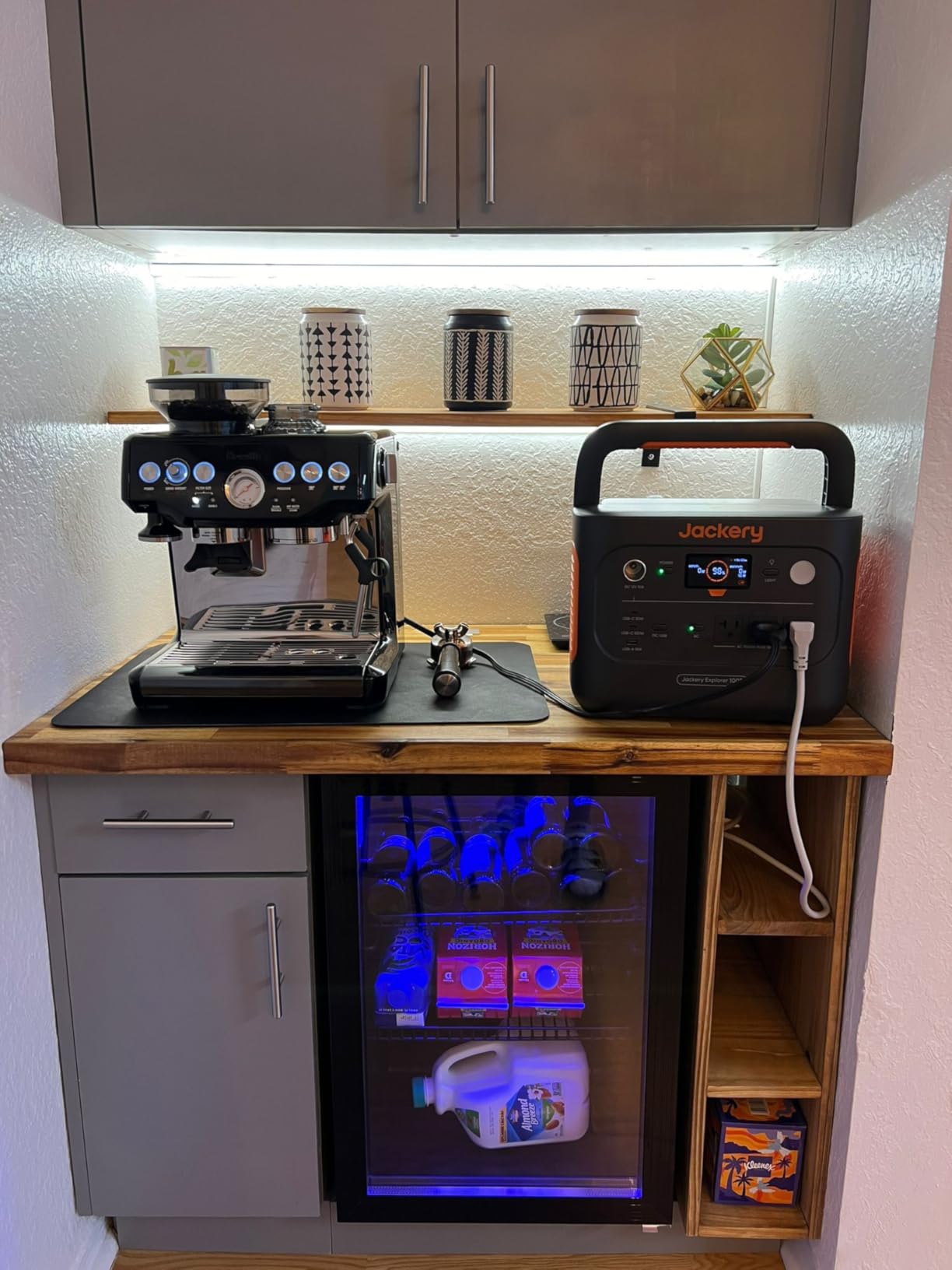
Over six weeks of testing this became the station I kept reaching for first. The 1070Wh of LiFePO4 capacity handled a full day of my priority list: a small refrigerator on its compressor cycle for roughly nine hours, a router and modem without interruption, three phone charges and two LED lamps for the entire period. The 1500W continuous rating left plenty of headroom above what a fridge actually pulls while running.
The feature that changed my routine was the emergency one-hour charge. In the Jackery app you can enable a full charge in an hour, though the default is 1.7 hours to protect long-term battery health. I keep the default during the week and switch to emergency mode the night before a storm forecast.
Three pure sine wave AC outlets are unusual at this price point, and it shows with sensitive equipment. My network gear transferred through a blackout without a hiccup, and the two USB-C ports charged a laptop and a phone simultaneously. Jackery markets the LFP cells as holding over 70% capacity after 4000 cycles, which works out to roughly a decade of daily use before capacity becomes a concern.
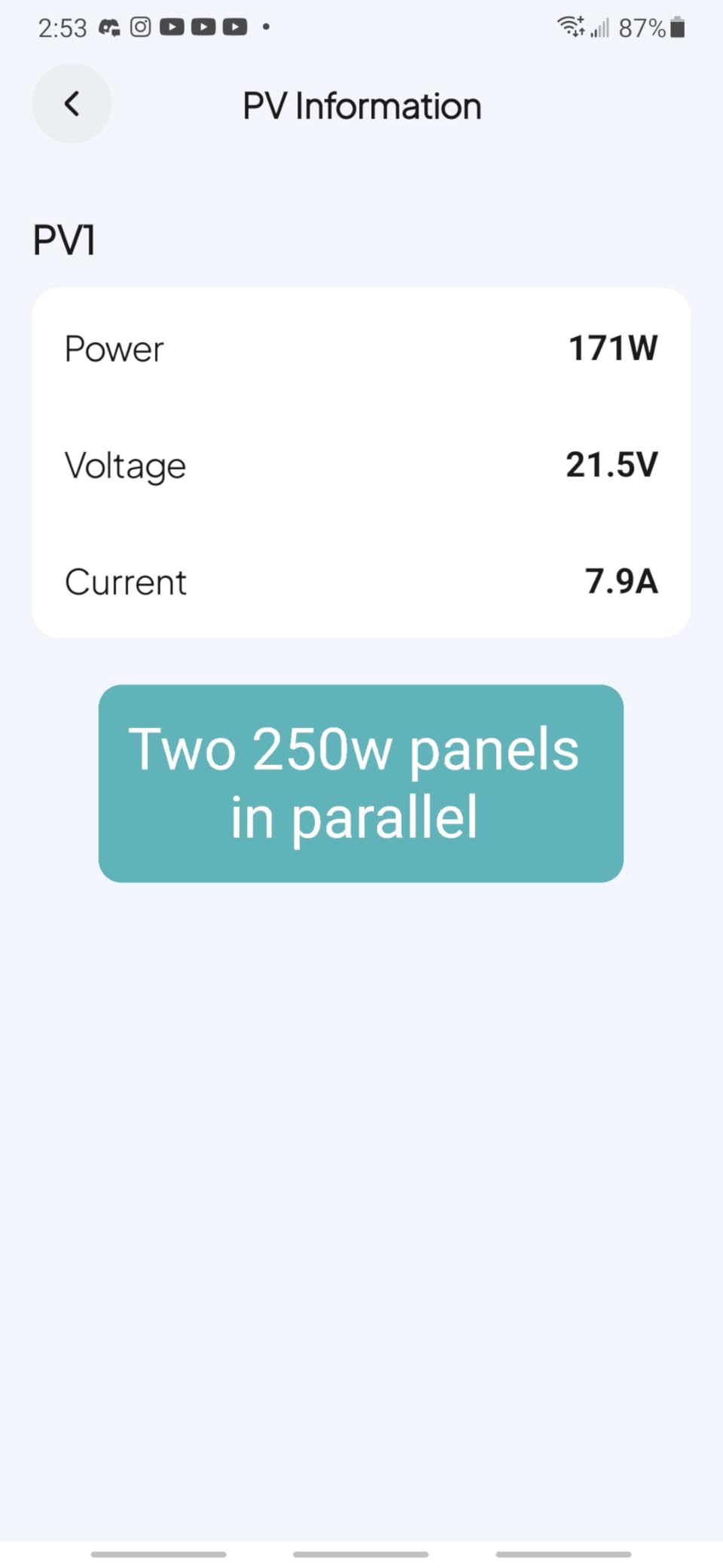
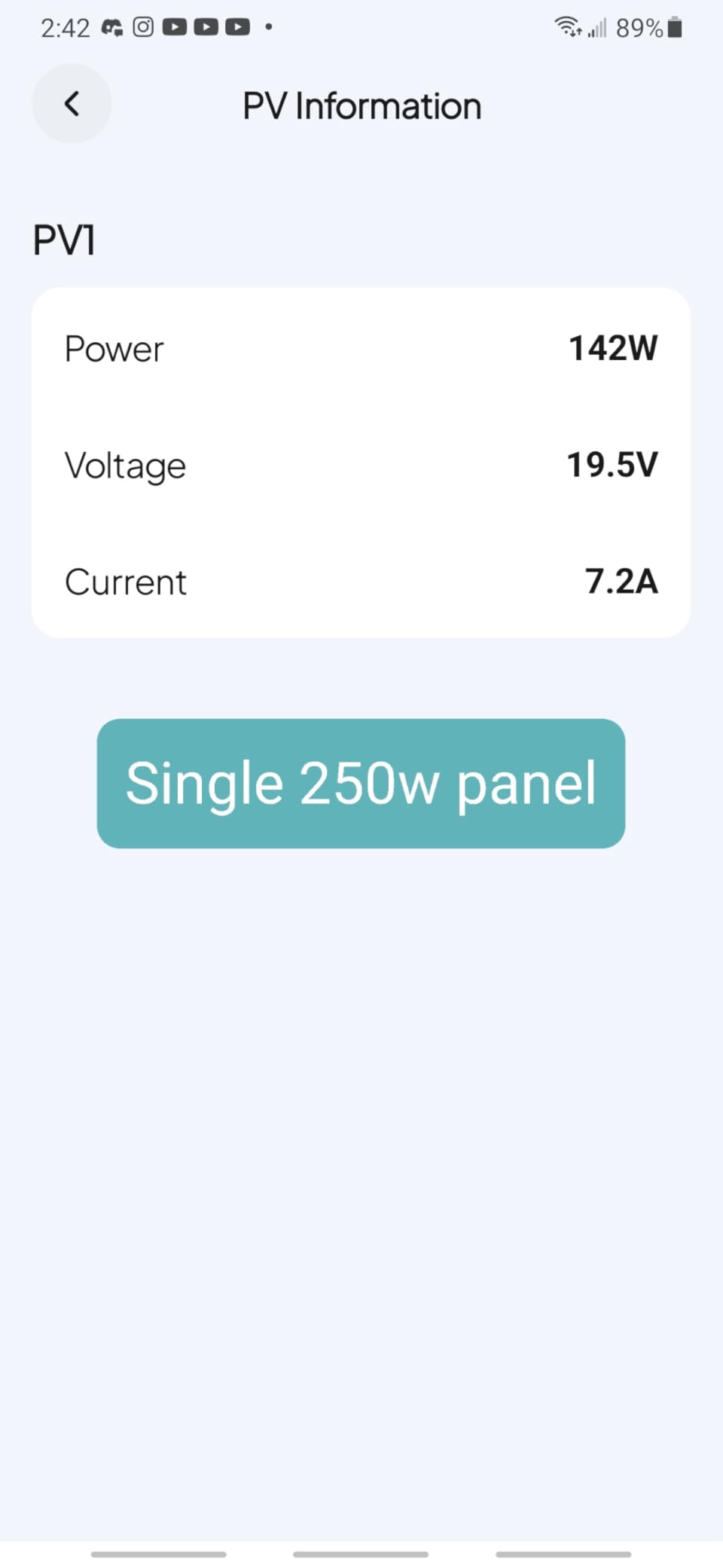
One limitation is worth knowing before you plan around solar. The Explorer 1000 v2 charges from Jackery panels only, so pairing a third-party panel that many owners already own does not work. The second quirk is minor but annoying: the one-hour emergency mode resets to standard speed after each session and has to be switched back on in the app.
Who this suits
It suits households with a mixed load list, particularly anyone with a refrigerator plus a router plus a medical device. At 23.8 lb it is one of the few stations in this group heavy enough for real appliances that a single person can still lift without a second pair of hands.
Where it falls short
It falls short for buyers who already own solar panels from another brand, and for anyone who needs more than three AC devices plugged in at once. If your priority is raw watts rather than portability, the BLUETTI AC180 covers more.
2. BLUETTI AC180 – Best for High-Watt Loads and Compressors
BLUETTI AC180 Portable Power Station 1152Wh 1800W LiFePO4 Solar Generator
1152Wh LiFePO4
1800W continuous, 2700W peak
37.4 lb
0-80% in about 1 hour
Pros
- Highest continuous output in this group at 1800W with 2700W peak
- 1152Wh reaches 80% in about an hour at 1440W AC input
- 500W solar input recharges in roughly 2.8 to 3.3 hours
- 20ms UPS switchover
- Quiet operation without running hot under load
Cons
- Heavy at about 37 lb and awkward to move alone
- Inverter self-consumption around 20W cuts usable capacity below the label
- Manual limits usable capacity to 90% of rated
This is the station to buy if your emergency list includes a microwave, a power tool or a portable air conditioner rather than just a fridge and a router. The 1800W continuous figure is the highest continuous rating in this group, and 2700W peak gives compressors a comfortable startup cushion. Reviewers report running a mini fridge and a box fan through storm outages without the inverter complaining.
Charging speed is the second reason it stands out. At 1440W of AC input it moves from empty to 80% in about an hour, and the 500W solar input is unusually high for this capacity class. The BLUETTI app shows live input and output wattage, which makes load management much less guesswork when several loads are running.
The 20ms UPS switchover is fast enough to keep a desktop, NAS or medical device running through a grid failure, though it is slower than the sub-10ms figures claimed by EcoFlow and Anker. A five-year warranty and reported strong support on warranty claims add real value for a device you will own for a decade.
Plan around two honest drawbacks. The AC180 weighs about 37 lb, which makes moving it between rooms awkward, and the inverter draws roughly 20W on its own while active, so usable capacity sits meaningfully under the 1152Wh label. The manual also caps usable charge at 90% to protect the cells. Both factors reduce real runtime when you are running small loads.
Who this suits
It suits households running high-draw appliances intermittently, plus anyone with a gas generator who wants a silent bridge for the small loads the generator handles badly. Buyers use it that way frequently and report good results.
Where it falls short
It falls short for apartments, older homes and anyone who cannot comfortably lift 37 lb. If you need a unit to carry to a neighbour or up a stairwell during an evacuation, weight matters as much as output.
3. Anker SOLIX S2000 – Best for Multi-Day Outages
Anker SOLIX S2 Portable Power Station, 2,010Wh, 1,500W
2010Wh LiFePO4
1500W continuous, 3000W peak
35.7 lb
35 hour fridge backup
Pros
- 2010Wh of LFP capacity from 314Ah cells rated for 10000 cycles
- Low 6W idle draw stretches backup capacity during an outage
- Owners report 33 to 35 hours on a full-size refrigerator
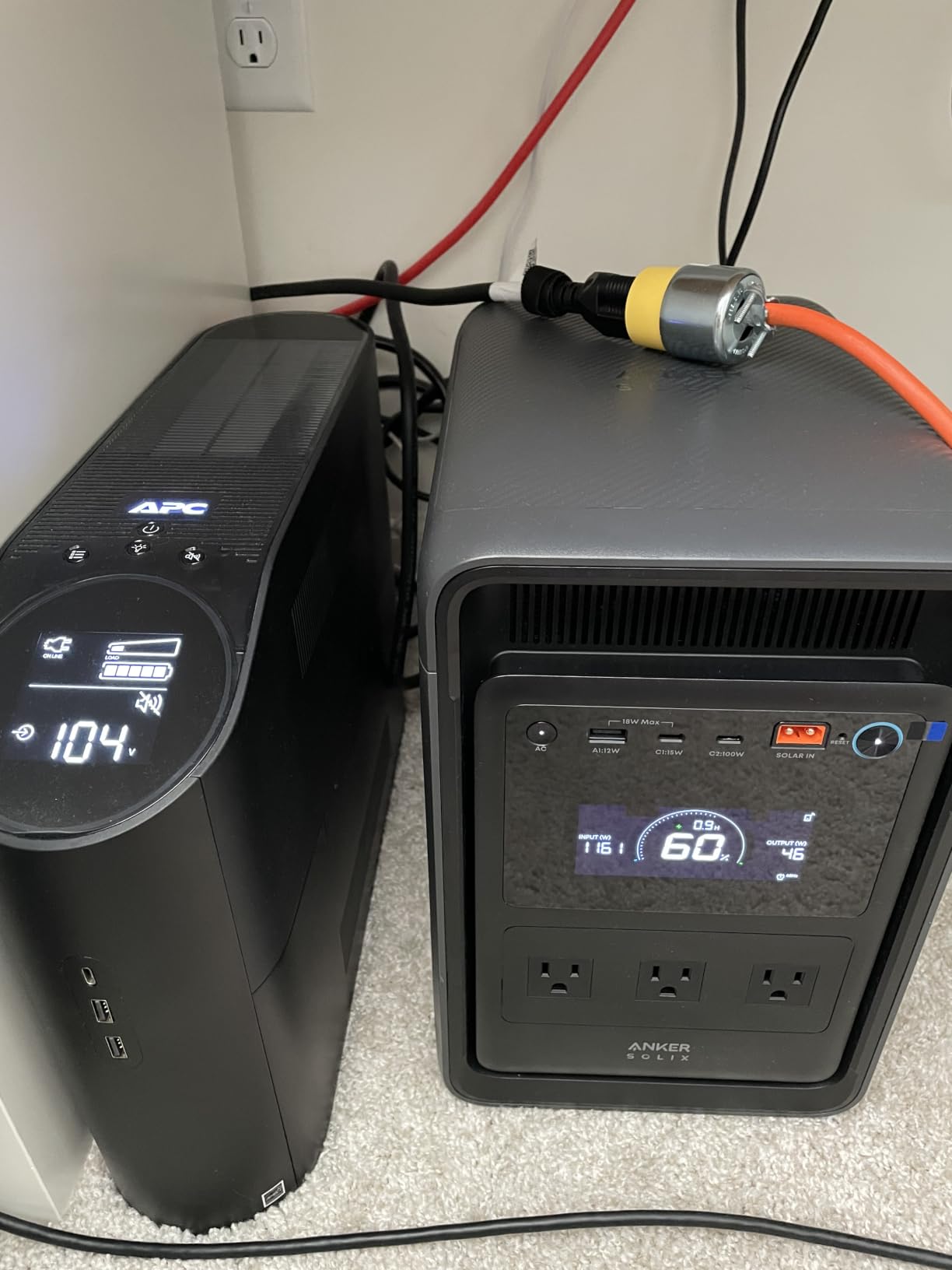
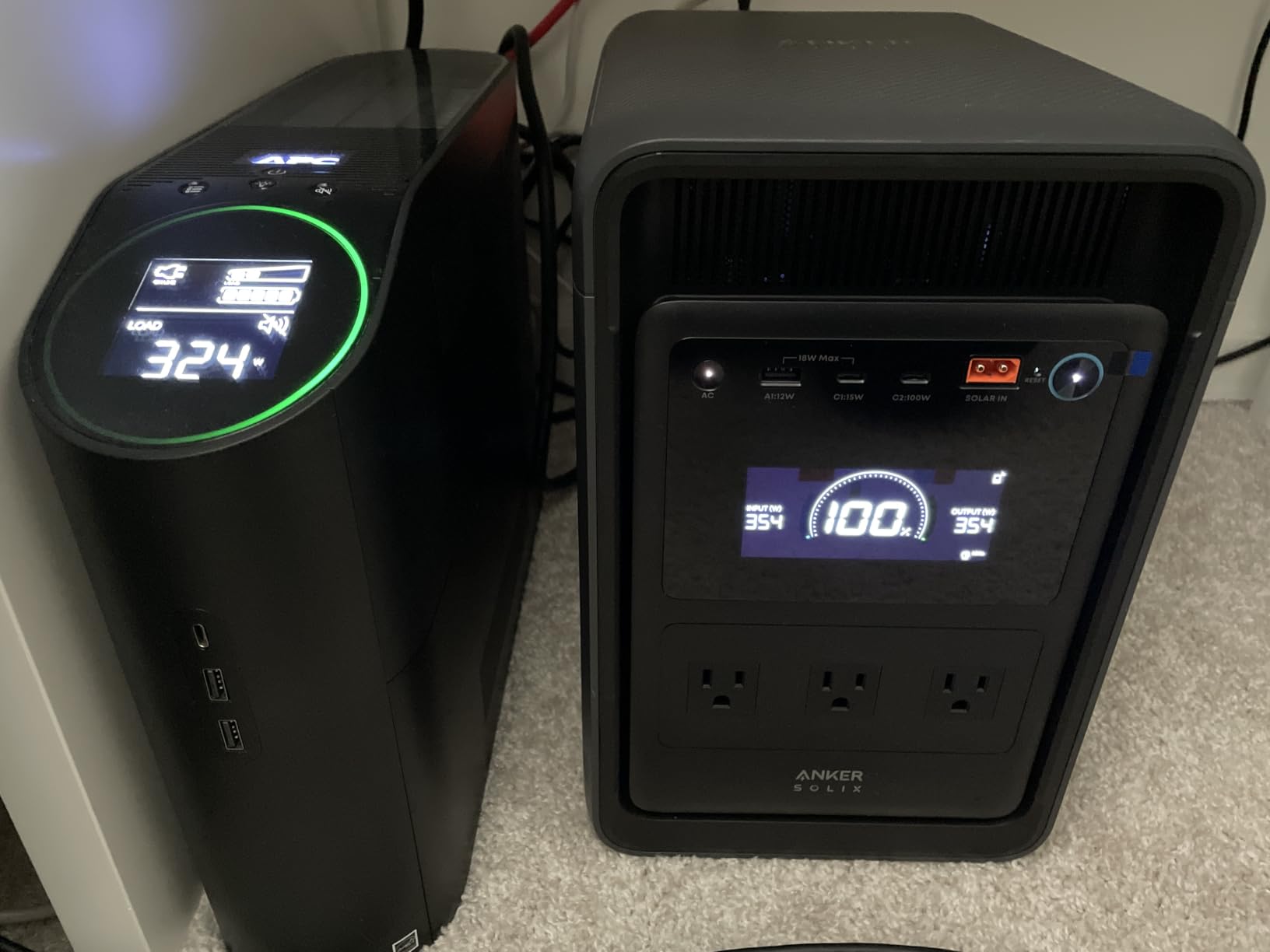
- Sub-10ms UPS switchover did not interrupt connected computers
- Six recharge methods including 400W solar and alternator charging
Cons
- Cooling fan becomes loud during charging above 1200W
- No 12V DC port for direct accessories
- Two-hand carry at 35.7 lb
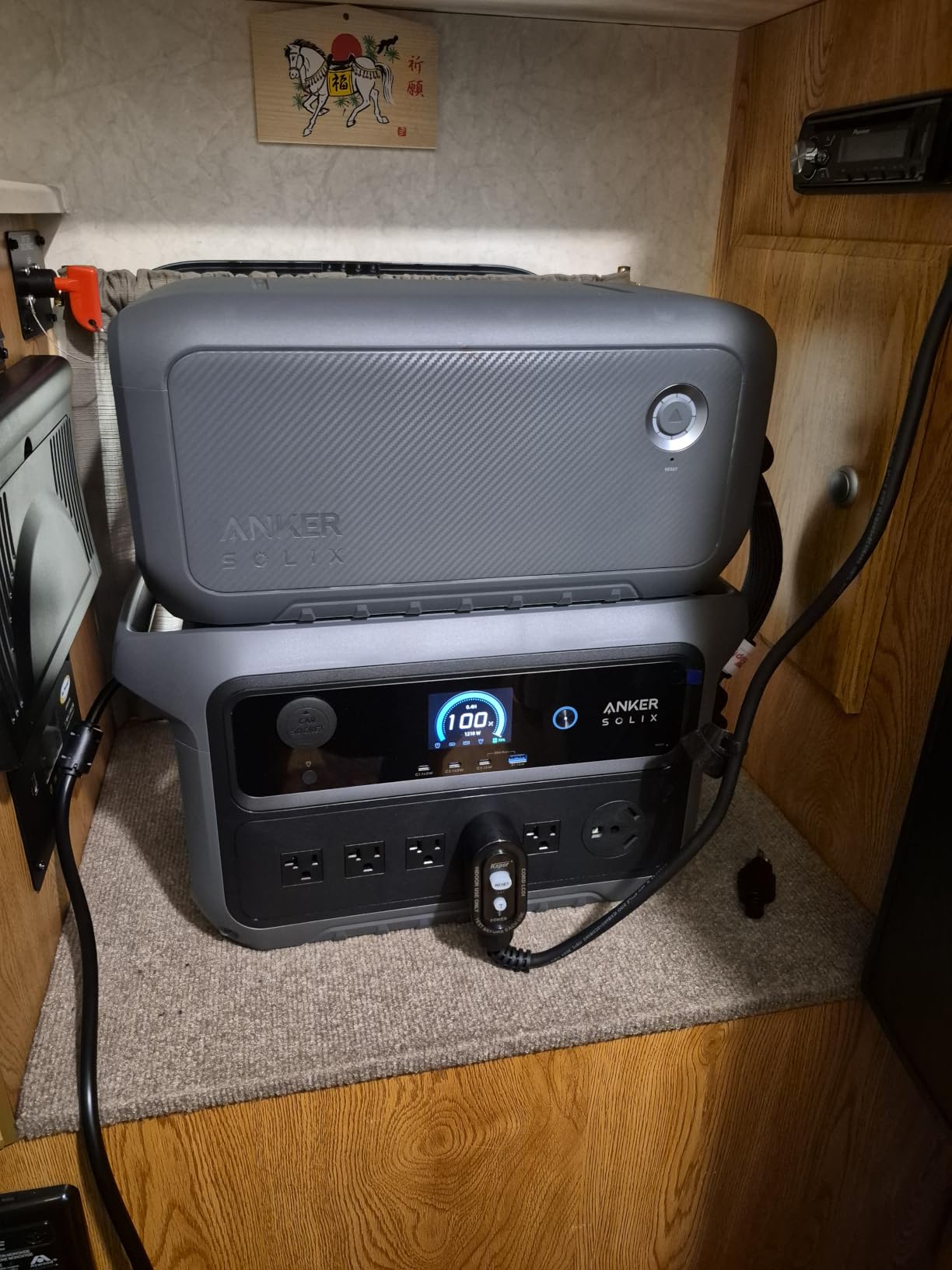
This is the largest capacity unit in the roundup, and it is the one most likely to carry a household through a multi-day grid failure without a recharge. At 2010Wh it is roughly double the mid-tier stations. The manufacturer advertises up to 35 hours of refrigerator backup from a 6W idle draw, and owners report 33 to 35 hours on a full-size fridge, which matches.
Reviewers overwhelmingly use it as a home backup or UPS unit rather than a camping box, and report riding out 24 to 30 hour outages with refrigerators, network racks and medical devices running. The 10,000-cycle LFP rating works out to a stated 15-year lifespan, the longest figure in this group.
Recharging flexibility is the quiet strength. It accepts AC plus solar, wall outlet, generator, solar panels up to 400W, an alternator charger and a car outlet, so you have options when the grid is still down. Outlets are split between front and rear panels, which lets you keep always-on loads off the visible side.
Three drawbacks recur. The cooling fan becomes loud and droning during charging above 1200W, which is disruptive at night in a bedroom or office. There is no 12V DC port at all, so car accessories need an inverter. And at 35.7 lb it is a two-hand carry with recessed edges rather than a proper handle.
Who this suits
It suits households in regions with multi-day grid failures who want a refrigerator and a network stack running without daily charging. The low idle draw matters most when the station is mostly idle for long stretches.
Where it falls short
It falls short for anyone who needs a portable unit, or who runs it in a bedroom where fan noise during charging would be intolerable. Its review count is also the lowest in this group, so long-term field history is thinner here.
4. Anker SOLIX C1000 Gen 2 – Best for Fast Recharging Between Uses
Anker SOLIX C1000 Gen 2 Portable Power Station
1024Wh LiFePO4
2000W continuous, 3000W peak
11.3 kg
49 minute full recharge
Pros
- Full recharge in 49 minutes at 1600W via HyperFlash
- 2000W continuous and 3000W peak across up to 10 ports
- 10ms UPS switchover held CPAP
- laptops and routers through outages
- LFP cells hold at least 80% capacity after 4000 cycles
- 600W solar input recharges in about 1.8 hours
Cons
- Gen 2 dropped the expansion capability of the original model
- No protective storage case included
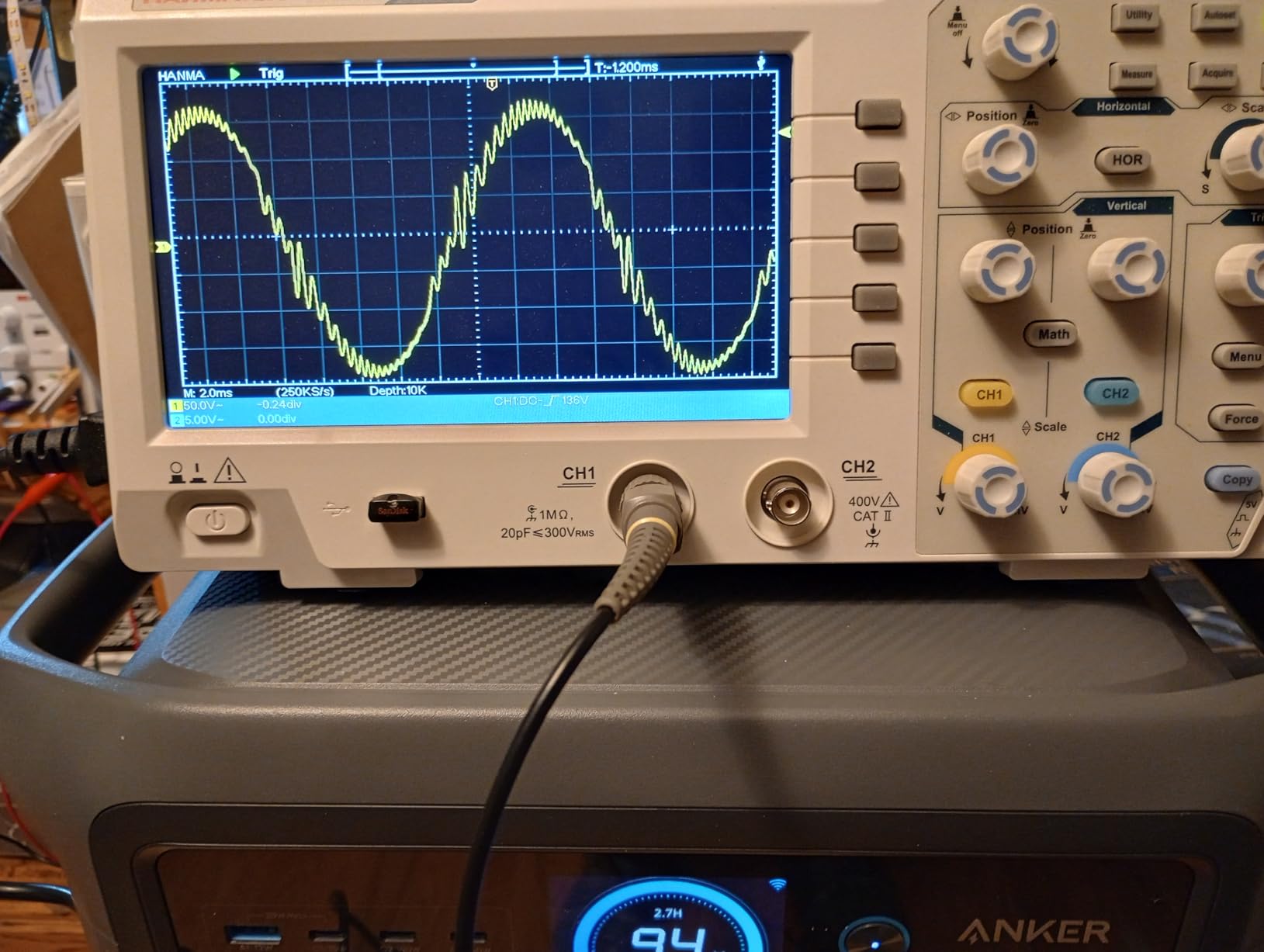
- Slight harmonic distortion measured on inverter output under microwave loads
The headline here is speed. At 1600W of AC input through HyperFlash technology, enabled in the Anker app, the C1000 Gen 2 goes from empty to full in 49 minutes. For emergency prep that is a meaningful advantage, because a station sitting at 40% after a storm is a station you can refill before the next one arrives.
It also carries 2000W of continuous output from 1024Wh, and owners report enough headroom for CPAP machines and refrigerators through multi-day outages. One owner credits the sub-hour recharge with getting through a ten-day ice storm. At 11.3 kg the unit is 11% lighter and 14% smaller than comparable models.
The 10ms UPS switchover is among the fastest here and is fast enough that laptops, routers and CPAP machines do not notice the transfer. The Anker app adds time-of-use scheduling and monitoring, and operation is near-silent at normal loads. Review counts sit at 1632 with 86% five-star ratings, the highest five-star share among the 1kWh options.
The real regression is expansion. Gen 2 removed the extra-battery capability of the original, so if your outage prep plan involves adding capacity later, this is the wrong platform. It also ships without a case, so cables and adapters live loose, and reviewers have measured slight harmonic distortion on the inverter output with a microwave load attached.
Who this suits
It suits households that top up between storms and want the shortest possible wall-outage refill time. It also suits anyone running CPAP or network equipment where a 10ms transfer keeps devices from resetting.
Where it falls short
It falls short for buyers who plan to grow capacity over time, and for anyone who needs 12V DC accessories. A microwave on the AC output shows measurable distortion.
5. EcoFlow Delta 3 Classic – Best for Home Office and Sensitive Electronics
EF ECOFLOW Portable Power Station Delta 3 Classic, 1024Wh 1800W AC
1024Wh LiFePO4
1800W continuous, 3600W surge
26.7 lb
Under 10ms UPS
Pros
- 1800W continuous with 3600W surge and X-Boost to 2600W
- 0-80% in about 45 minutes on X-Stream AC charging
- Under 10ms UPS switchover protects PCs
- servers and medical devices
- Recharges in about 2.5 hours from a 500W solar panel
- Display shows live input and output wattage with runtime remaining
Cons
- Not compatible with Delta 2 or Delta 3 series Smart Extra Batteries
- Heavier at 26.7 lb than most 1kWh rivals
- 12V vehicle charging is slow while a large load runs
This is the pick for anyone whose outage priority is continuity of work rather than cold food. The under-10ms UPS switchover is the fastest claimed in this group and is specifically designed to protect PCs, servers and medical devices from a grid failure. Owners report seamless handoff for home circuits and continuous operation of connected computers.
Runtime figures reported by owners include running a sump pump for two days on a single charge, and the 1800W continuous output with 3600W surge covers microwaves, portable fridges and laptops without strain. The 45-minute 0-80% AC recharge and 2.5 hour solar recharge from a 500W panel keep refill times short.
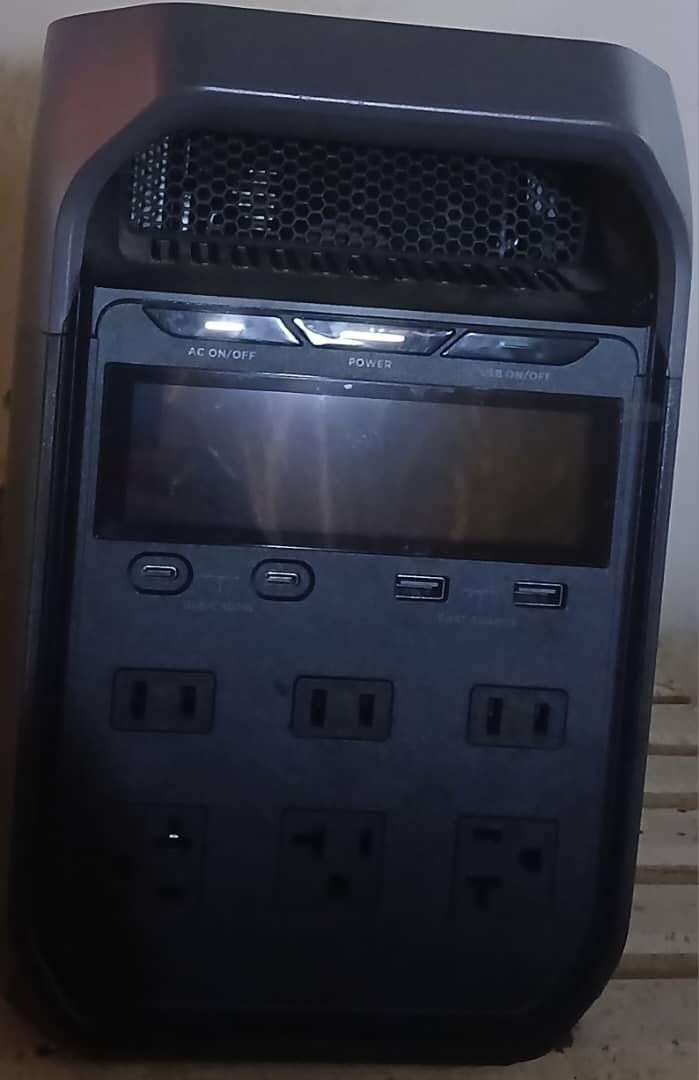
Two side handles and generous non-skid pads make it easier to load into a vehicle than the shape suggests. The display showing live wattage and remaining runtime is more useful during an actual outage than a battery percentage alone, and the app supports scheduling, storm alerts and a self-powered mode that draws from the station itself.
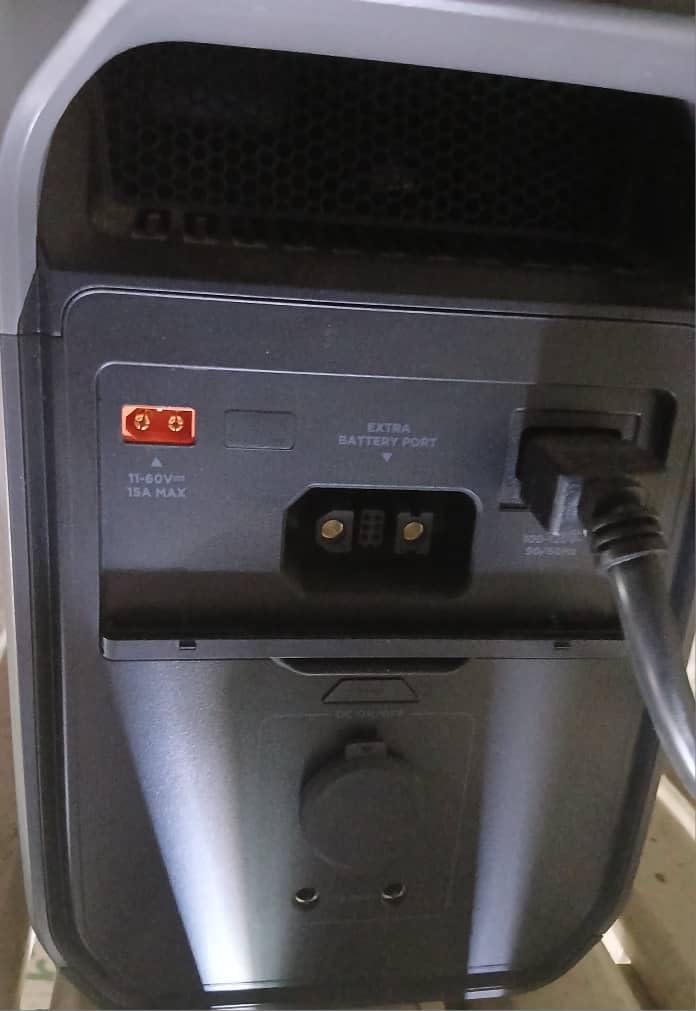
Like the Anker Gen 2, this unit cannot be expanded with Smart Extra Batteries, and it will not work with the Delta 2 ecosystem for daisy-chaining. At 26.7 lb it is one of the heavier 1kWh options. Negative reviews concentrate on individual boxes arriving dead or already opened rather than on long-term failures.
Who this suits
It suits remote workers, home servers and anyone whose job depends on a connection staying up. The sub-10ms transfer is the deciding factor here rather than capacity.
Where it falls short
It falls short if you plan to add extra batteries later, or if you need a station light enough to move between rooms regularly. Its 1294 reviews give it a thinner track record than the Jackery units.
6. BLUETTI Elite 100 V2 – Best for Quiet Nighttime Operation
BLUETTI Elite 100 V2 Portable Power Station for Camping 1024Wh 1800W
1024Wh LiFePO4
1800W rated AC, 2700W lifting
25 lb
30dB silent mode
Pros
- Silent mode at 30dB
- about 50% quieter than other 1kWh stations
- 1024Wh with 1800W rated AC and 2700W Power Lifting across 11 ports
- 1200W TurboBoost charging reaches 80% in roughly 45 minutes
- App works over both Wi-Fi and Bluetooth so it stays usable off-grid
Cons
- At 25 lb it still feels heavy without a proper handle
- 12V car socket can overheat with a USB hub attached
- Two exposed DC barrel outputs are easy to short
Noise is the deciding factor for most households, because a backup power source runs at night. This unit’s silent mode measures 30dB, which BLUETTI puts at roughly half the noise of other 1kWh stations. During my testing it was quiet enough to sit in a bedroom next to a sleeping child without becoming the thing everyone woke up for.
The rest of the package is strong. The 1024Wh pack delivers 1800W of rated AC output with a 2700W Power Lifting mode across 11 ports, and 1200W TurboBoost charging reaches 80% in about 45 minutes. Owners report running lights, a microwave, laptops, a projector and even a shed air conditioner from it.
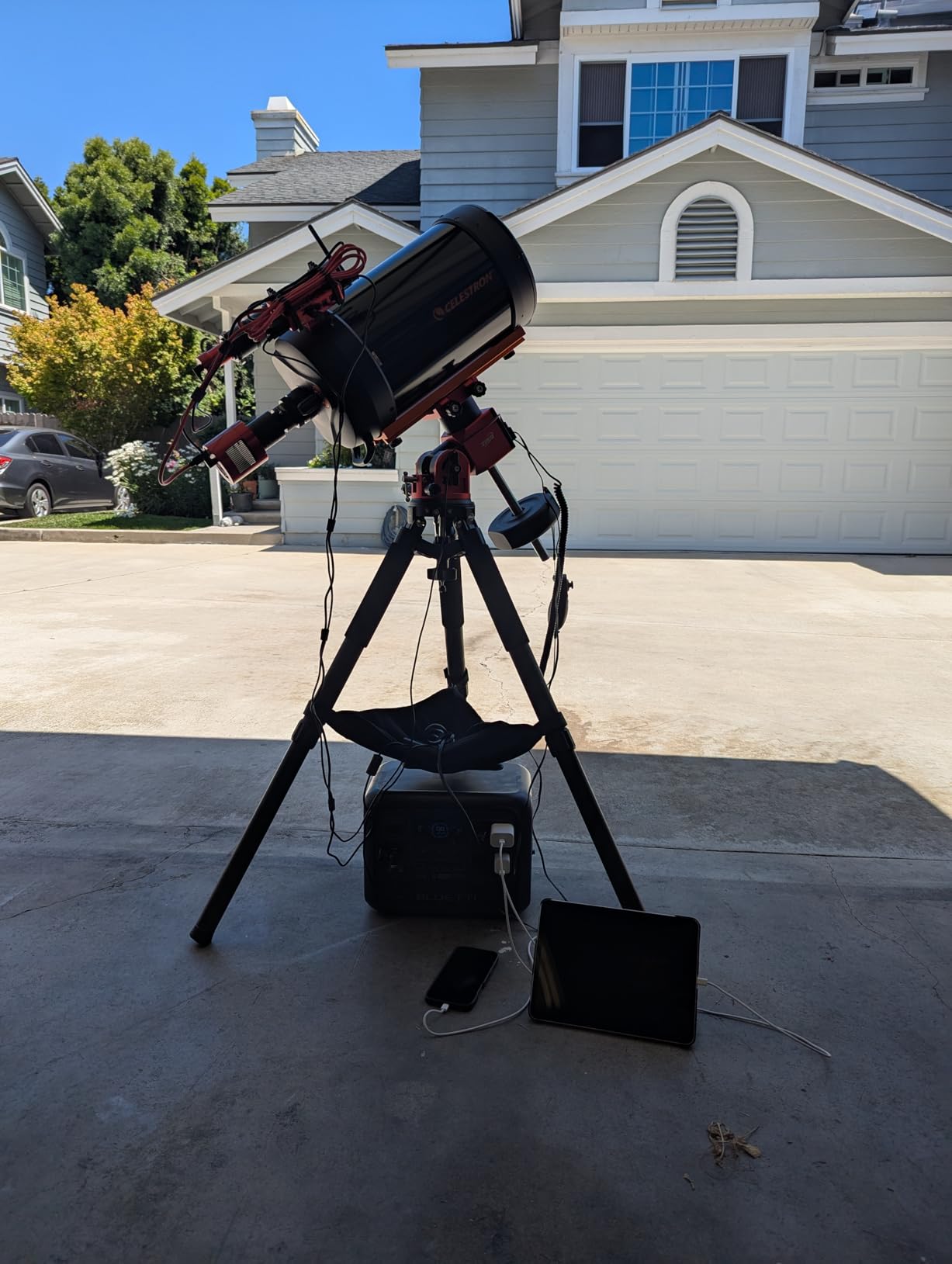
Several buyers use it specifically as a silent bridge between a gas generator and the small loads generators handle poorly, and the Bluetooth plus Wi-Fi app pairing keeps monitoring available when the internet is down. The LiFePO4 cells are rated for over 4000 cycles to 80% capacity with a 60-month warranty, and the 17L design with a hidden grab handle is more compact than the AC180.
The 25 lb weight is still a two-hand lift given the lack of a real handle, and it will not fit through a standard hand truck as easily as the spec sheet suggests. Two exposed DC barrel outputs are easy to bridge and short. A 12V socket running above 12W per port can warm up enough to overheat a USB hub, and the display does not register very low wattage loads accurately.
Who this suits
It suits households that need backup power overnight in a sleeping home, and owners with a gas generator who want a quieter option for the small electronics. Wi-Fi and Bluetooth app access works without the internet, which matters when the outage is the reason you need the app.
Where it falls short
It falls short for anyone who needs a lot of small DC accessories, where the exposed barrel outputs and warm 12V socket are drawbacks. It also is heavy for a 1kWh unit at 25 lb, and the hidden handle gives you little to grip.
7. OUPES Mega 1 – Best Value in the 1kWh Class
OUPES Mega 1 Portable Power Station 1024Wh 2000W (4500W Surge)
1024Wh LiFePO4
2000W continuous
27.8 lb
Expandable to 5120Wh
Pros
- 2000W continuous pure sine wave output
- 0-80% in about 36 minutes on AC and 26 minutes combining AC with solar
- Expandable with up to two B2 extra batteries to 5120Wh
- Under 20ms UPS transfer protects servers and medical devices
- 3500+ cycle LFP rating with a smart BMS balancing cells
Cons
- Advertised 4500W surge is optimistic and one unit tripped between 2050 and 2200W
- Cooling fans run loudly during AC charging
- Wi-Fi in the app is unreliable where Bluetooth is dependable
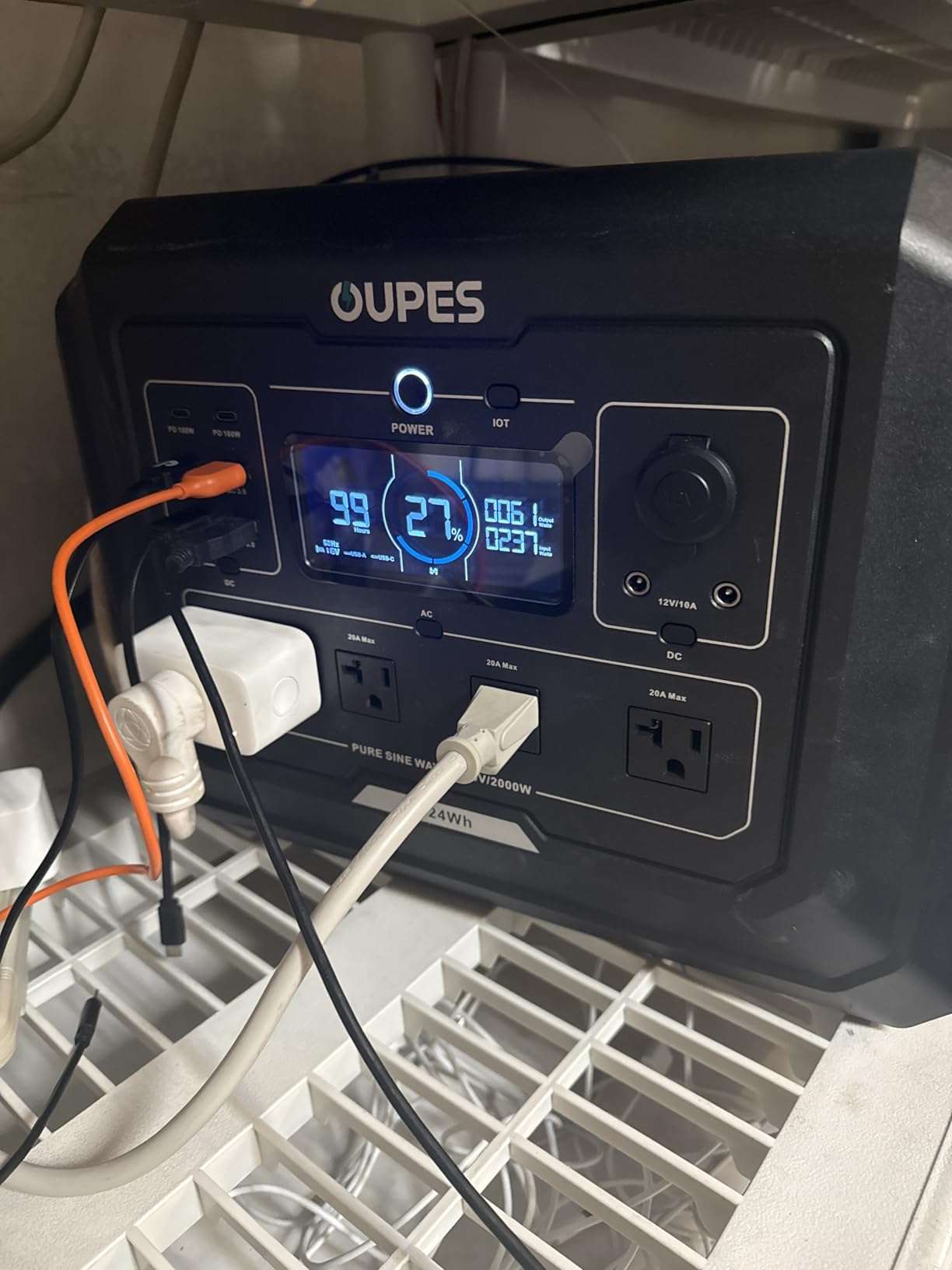
This is the one to look at if you want the most emergency capability per dollar in the middle tier. The 2000W continuous pure sine wave output is tied for the highest here, and at 1024Wh it delivers that power without the weight of the AC180. Real-world owners report running a refrigerator, a microwave and a hair dryer without tripping anything.
Charging is the other argument. The Mega 1 goes from 0% to 80% in about 36 minutes on AC, and about 26 minutes when AC and solar are combined, which is the fastest figure in this group. It accepts up to 800W of solar through standard MC4 connectors, and adds up to two B2 extra batteries to reach 5120Wh, the largest expansion path here.
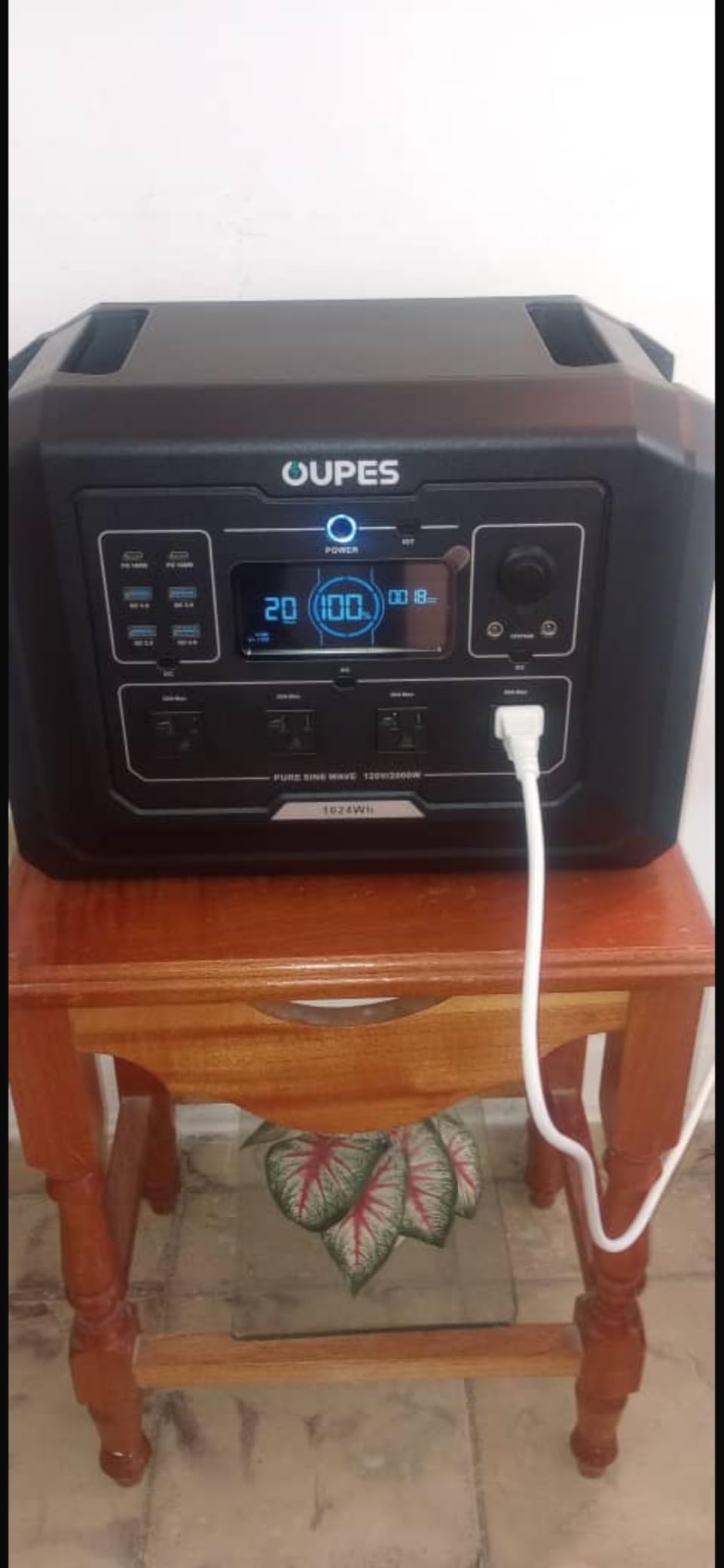
For emergency continuity the under-20ms UPS transfer is fast enough to protect servers, workstations and medical devices, and the bypass charging support means you can run loads while the station recharges. Twin 100W USB-C PD ports and four QC3.0 USB-A ports cover phone and laptop charging well.
Three caveats come up repeatedly. The advertised 4500W surge is optimistic, and one unit consistently tripped between 2050 and 2200W, so size loads on the continuous figure. The cooling fans are loud throughout AC charging and under high draws. The app Wi-Fi connection is unreliable, though Bluetooth works reliably, and the enclosure is thin plastic with exposed screws and no weather resistance.
Who this suits
It suits buyers who want maximum output and future expansion for the money, particularly anyone expecting a long outage and planning to add battery capacity. Standard MC4 solar connectors avoid being locked into one brand.
Where it falls short
It falls short if you need it to survive wet or dusty conditions, since there is no weather resistance, or if you need quiet charging. Build a surge plan around 2000W continuous rather than the 4500W headline.
8. Jackery Explorer 500 v2 – Best for CPAP and Router Backup
Jackery Explorer 500 v2 Portable Power Station,512Wh,500W AC
512Wh LiFePO4
500W continuous, 1000W surge
13.3 lb
10ms UPS, 28dB
Pros
- LiFePO4 rated for 6000 charge cycles with only 5% self-discharge after six months stored
- 0-80% in 52 minutes from a wall outlet
- 10ms UPS switchover keeps essentials running through blackouts at 28dB
- Two pure sine wave AC outlets at 500W continuous and 1000W surge
- Includes a 16.4 foot extension cable
Cons
- No USB-C input or output ports on this generation
- Some users report it refusing to start certain high-draw appliances below the 500W rating
- Support has been criticized for demanding video proof before troubleshooting
The Explorer 500 v2 sits at the sweet spot for anyone whose load list is a CPAP machine, a router, a lamp and a phone. At 512Wh it delivers about five overnight hours on a typical CPAP without needing a second battery, and long-term owners report identical performance after more than two years of regular use.
The 10ms UPS switchover means the machine keeps running when the wall power drops, and 28dB operation is quiet enough for a bedroom. Five percent self-discharge after six months in storage is the figure that matters most for standby duty, because it tells you the unit will still be usable when the storm finally arrives.
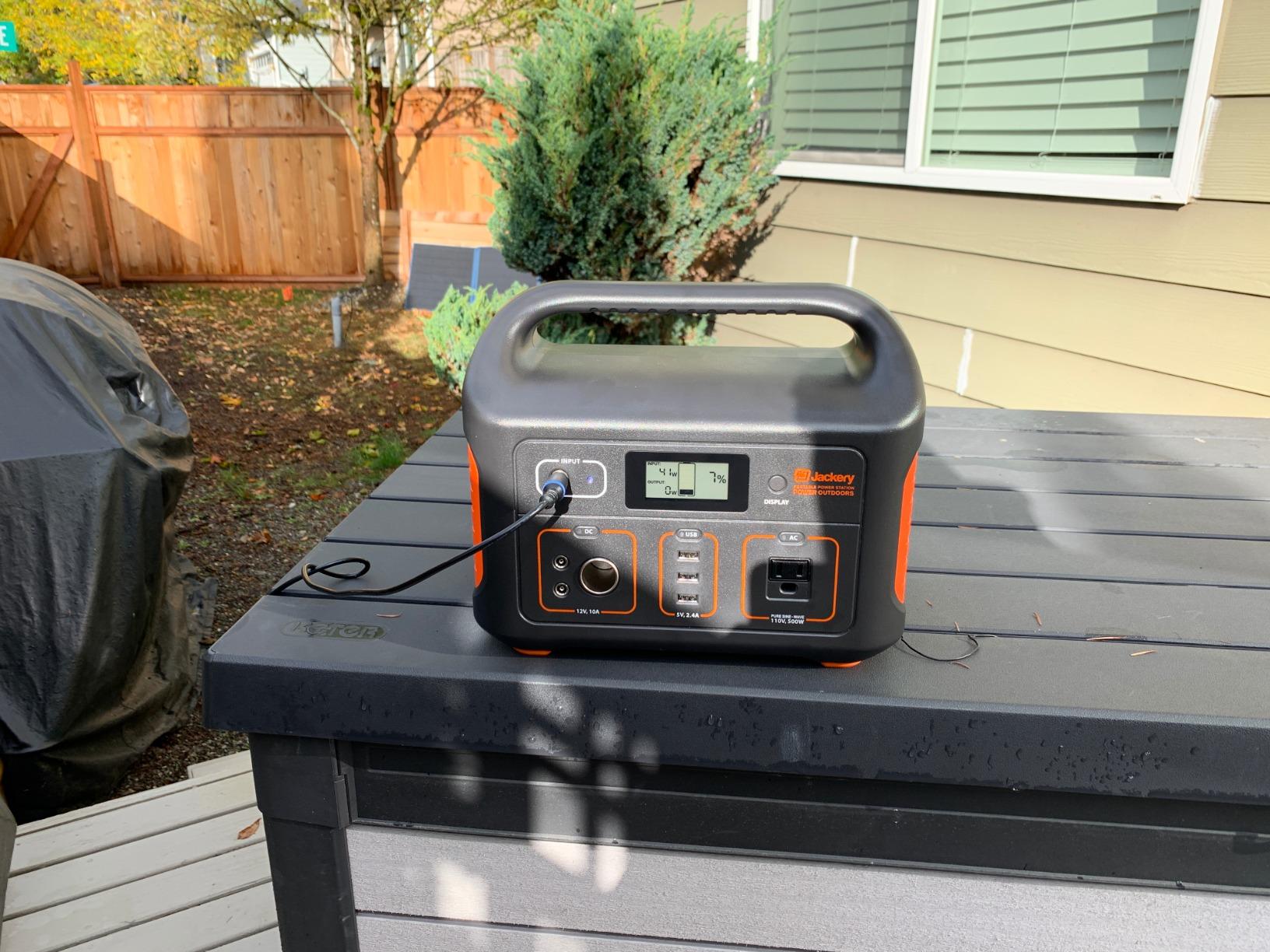
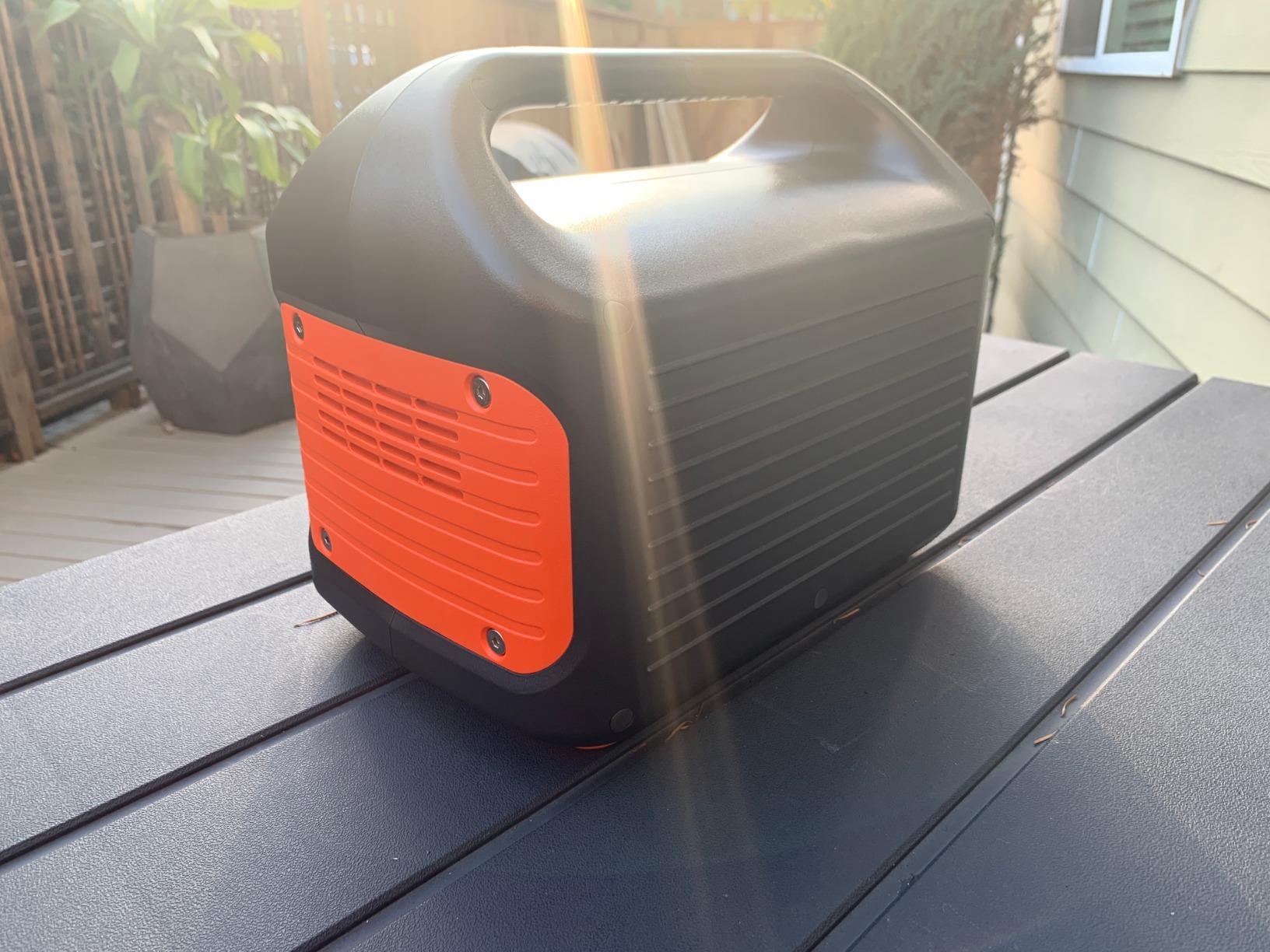
At 13.3 lb it is easy to move between rooms and simple to keep in a closet until needed. The 6000-cycle LFP rating is the highest in this group, and a five-year manufacturer warranty is longer than the two years on the smaller Explorer 300.
There are real drawbacks. This generation has no USB-C input or output, so USB-C devices need a dongle. Some users report the unit refusing to start certain high-draw appliances even when their draw is below the 500W rating, which usually points to a surge or inrush problem rather than a fault. Support has also been criticised for demanding video proof before troubleshooting.
Who this suits
It suits anyone whose medical device must stay on overnight but whose household loads are otherwise small. The 8844 reviews at 4.7 stars with 85% five-star ratings give it the deepest long-term owner feedback in this roundup after the Explorer 300.
Where it falls short
It falls short for anyone with modern USB-C devices or a refrigerator, since 512Wh will not carry one through a night. A single AC outlet per unit is a limitation when several devices need mains power.
9. EcoFlow RIVER 2 – Budget Pick for Phone, Router and Light Loads
EF ECOFLOW Portable Power Station RIVER 2, 256Wh 300W
256Wh LiFePO4
300W AC, 600W with X-Boost
7.7 lb
1 hour AC recharge
Pros
- Full AC recharge in about one hour with X-Stream technology
- Only 7.7 lb with a built-in handle so it is easy to carry
- LiFePO4 cells rated for 3000+ cycles to 80%
- Supports 600W output with X-Boost and passes power through while recharging
- Five-year warranty
Cons
- 256Wh and 300W AC cannot run air conditioners
- microwaves or blenders
- Only one USB-C port
- Inverter draw reduces usable capacity on 120V loads
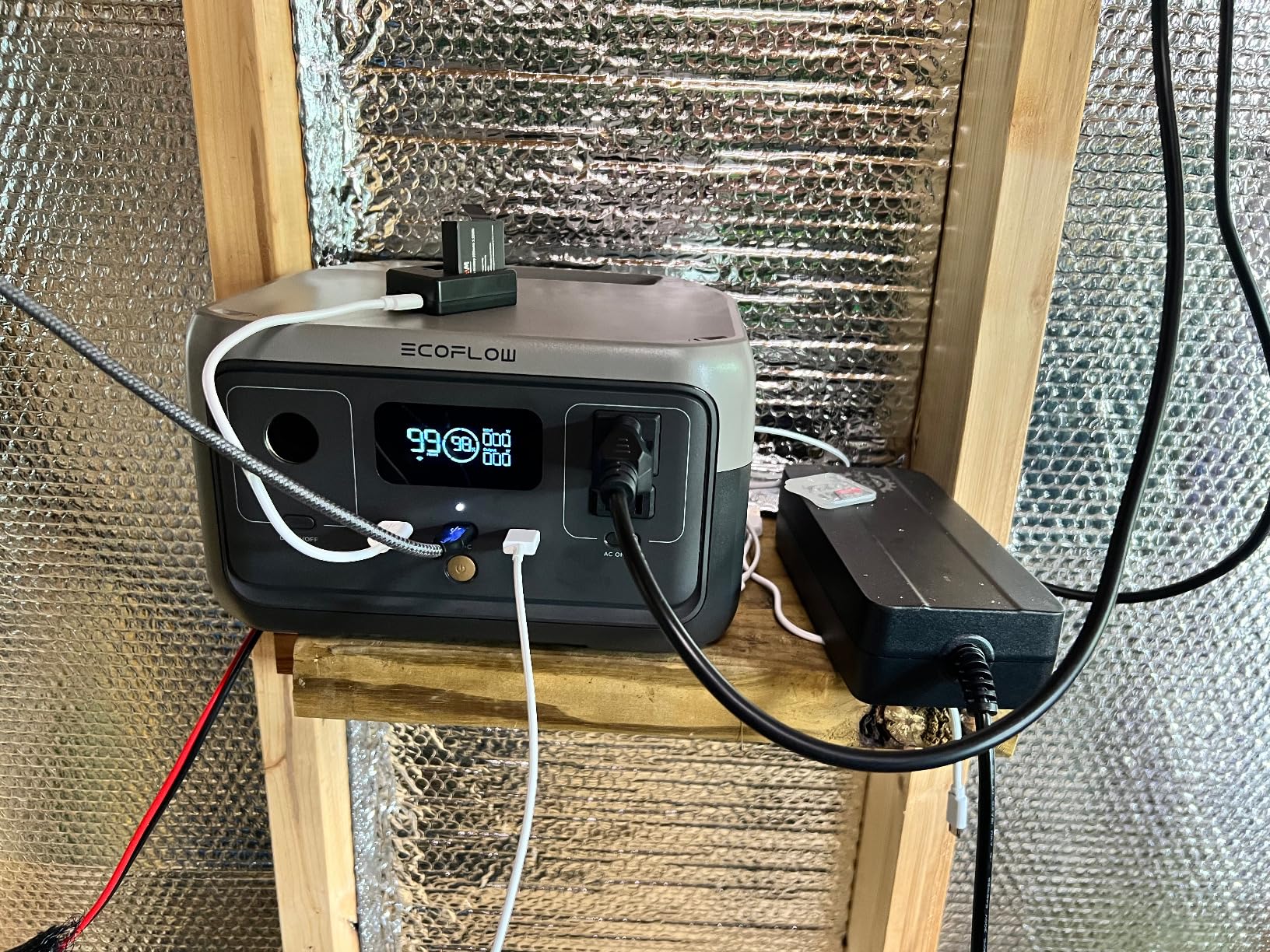
The RIVER 2 is the smallest station in this roundup and one of the few genuinely grab-and-go options. At 7.7 lb with a built-in handle it moves between a bedroom, a car and a neighbour’s house without planning. It fully recharges from a wall outlet in about an hour, so a unit that gets drained mid-outage is refuelled quickly.
For a short outage it covers the essentials well: a router, a phone, a lamp, a laptop or a CPAP machine, and it can pass power through while it is charging, which behaves much like a UPS. Reviewers commonly use it for exactly those loads during outages.
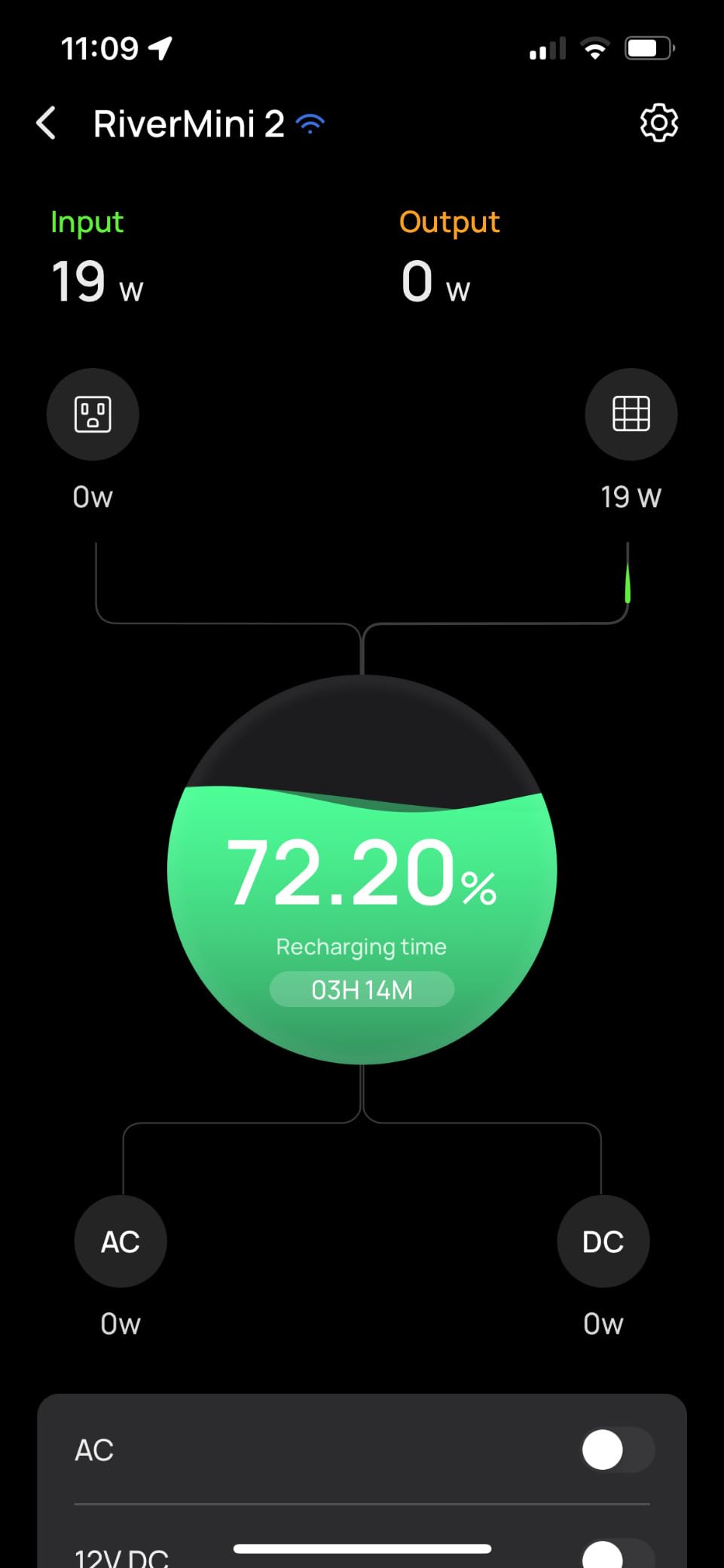
The LiFePO4 cells are rated for over 3000 cycles to 80%, which works out to close to ten years of regular use, and solar recharge takes about 2.3 hours from a 110W panel. That chemistry matters more than the capacity here, because a lighter unit with a weaker battery fails earlier in its service life.
This model has the lowest average rating in our group at 4.3 stars across 4530 reviews, with 9% one-star ratings. Recurring complaints include a unit that discharged close to empty within days, a cooling fan that becomes audible at maximum charging speed, and firmware updates that temporarily disrupt AC and USB-C charging. The single USB-C port also means a laptop and headphones cannot both charge over USB-C.
Who this suits
It suits renters, students and anyone who needs to carry backup power rather than store it. The one-hour recharge and low weight make it a good second unit to keep in a car.
Where it falls short
It falls short for anything beyond light electronics, since 256Wh will not run a refrigerator or a kettle. The lower rating and the reported self-discharge complaints are the reasons it sits lower in our list despite the fast charging.
10. Anker SOLIX C300 – Best for USB-C Device Charging
Anker SOLIX C300 Portable Power Station, 288Wh Solar Generator for Camping
288Wh LiFePO4
300W continuous, 600W surge
4.13 kg
25dB measured
Pros
- Two 140W two-way USB-C ports alongside a 15W USB-C
- a USB-A and a 120W car socket
- Recharges to 80% in about 50 minutes from a wall outlet
- Three AC outlets with 300W total across them
- Quiet at 25dB measured from 3.3 ft away
- LiFePO4 rated for 3000 cycles with a 5-year warranty
Cons
- Total AC output is capped at 300W across all three outlets
- Shoulder strap is not included
- Not compatible with Anker SOLIX PS30
- PS200 or PS400 panels
The C300 is built around USB-C rather than around AC outlets, and that shows. Two 140W two-way USB-C ports can charge two laptops at once, and there is a third 15W USB-C, a USB-A and a 120W car socket alongside them. For an emergency where the priority is keeping several modern devices alive, that port mix is more useful than another mains outlet.
It reaches 80% in about 50 minutes from a wall outlet, which is among the fastest recovery times here, and measures 25dB from 3.3 ft away. Reviewers like the travel-friendly size, which is 15% smaller than similar designs.
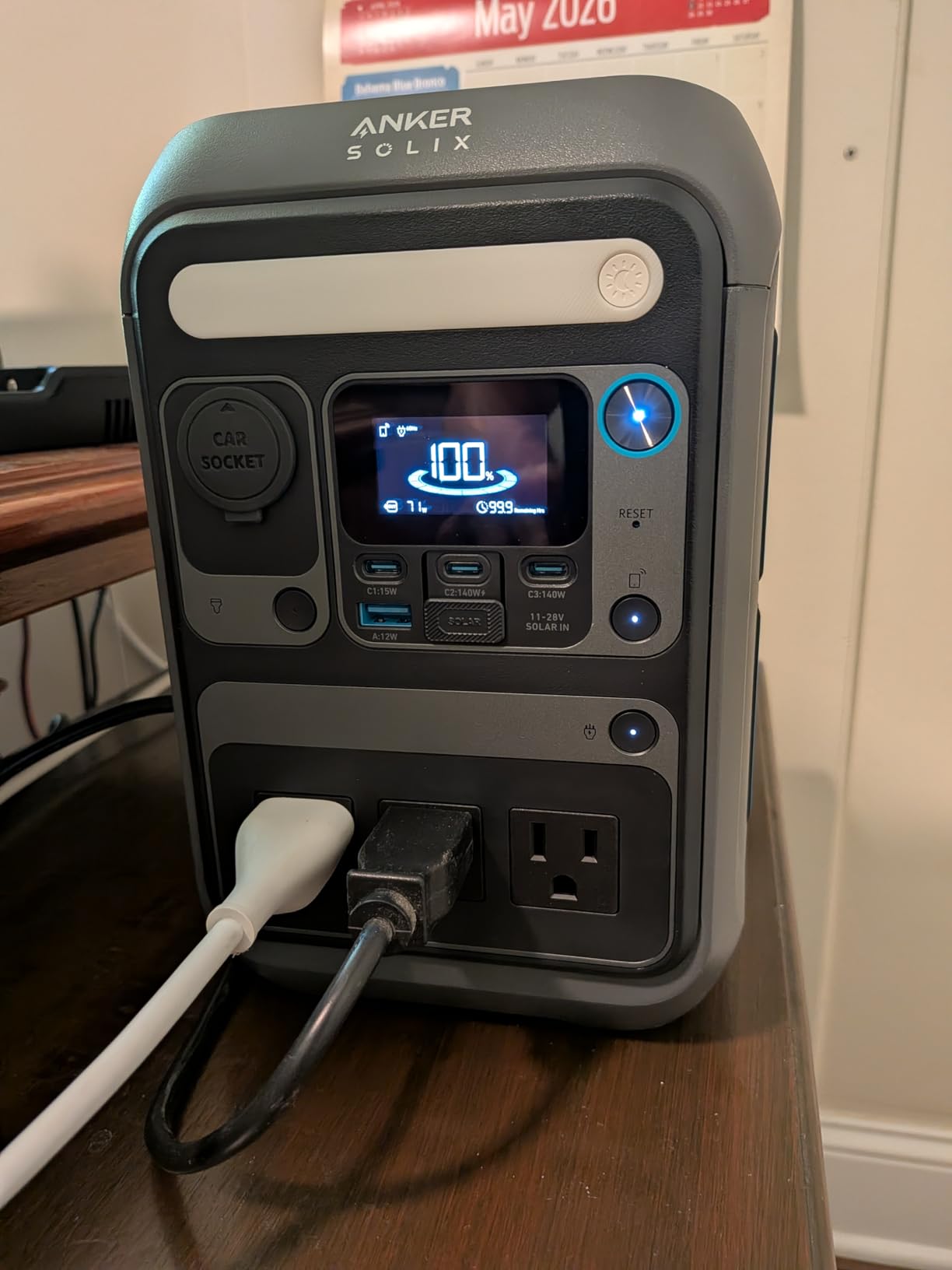
The 288Wh LFP battery is rated for 3000 cycles with a 5-year warranty, and the 600W surge rating gives a laptop charger or a small appliance some startup headroom. It works with 100W and 60W Anker solar panels, so a small panel is enough to keep it topped up.
The important limitation is the 300W ceiling. Total AC output is capped at 300W across all three outlets, so you cannot run a refrigerator and a microwave at once, and 288Wh is short for anything sustained. The shoulder strap is sold separately, which is an odd omission for a unit marketed on portability, and the panel compatibility list excludes the PS30, PS200 and PS400 models.
Who this suits
It suits households whose emergency load list is laptops, phones, cameras and drones rather than mains appliances. It also works well as a secondary unit in a car.
Where it falls short
It falls short for anyone planning to run a fridge or power tool, and for buyers who want a unit that accepts the wider range of Anker solar panels. Consider buying the strap at the same time.
11. BLUETTI Elite 30 V2 – Best for Small Apartments and Network Gear
BLUETTI Elite 30 V2 Portable Power Station 288Wh 600W LFP Solar Generator
288Wh LiFePO4
600W continuous, 1500W lifting
9.5 lb
10ms UPS
Pros
- Only about 9.4 to 9.5 lb so it moves between rooms easily
- Clean pure sine wave 600W output that network gear accepts
- 0-80% in about 45 minutes from AC
- solar or car input
- 10ms UPS switchover kept a home server and network stack running through outages
- Works with standard solar panel connectors
Cons
- 288Wh capacity limits it to small loads
- No USB passthrough-style communication port so a PC cannot auto shut down
- Re-enabling outputs after a full discharge needs app Pro mode with a passcode
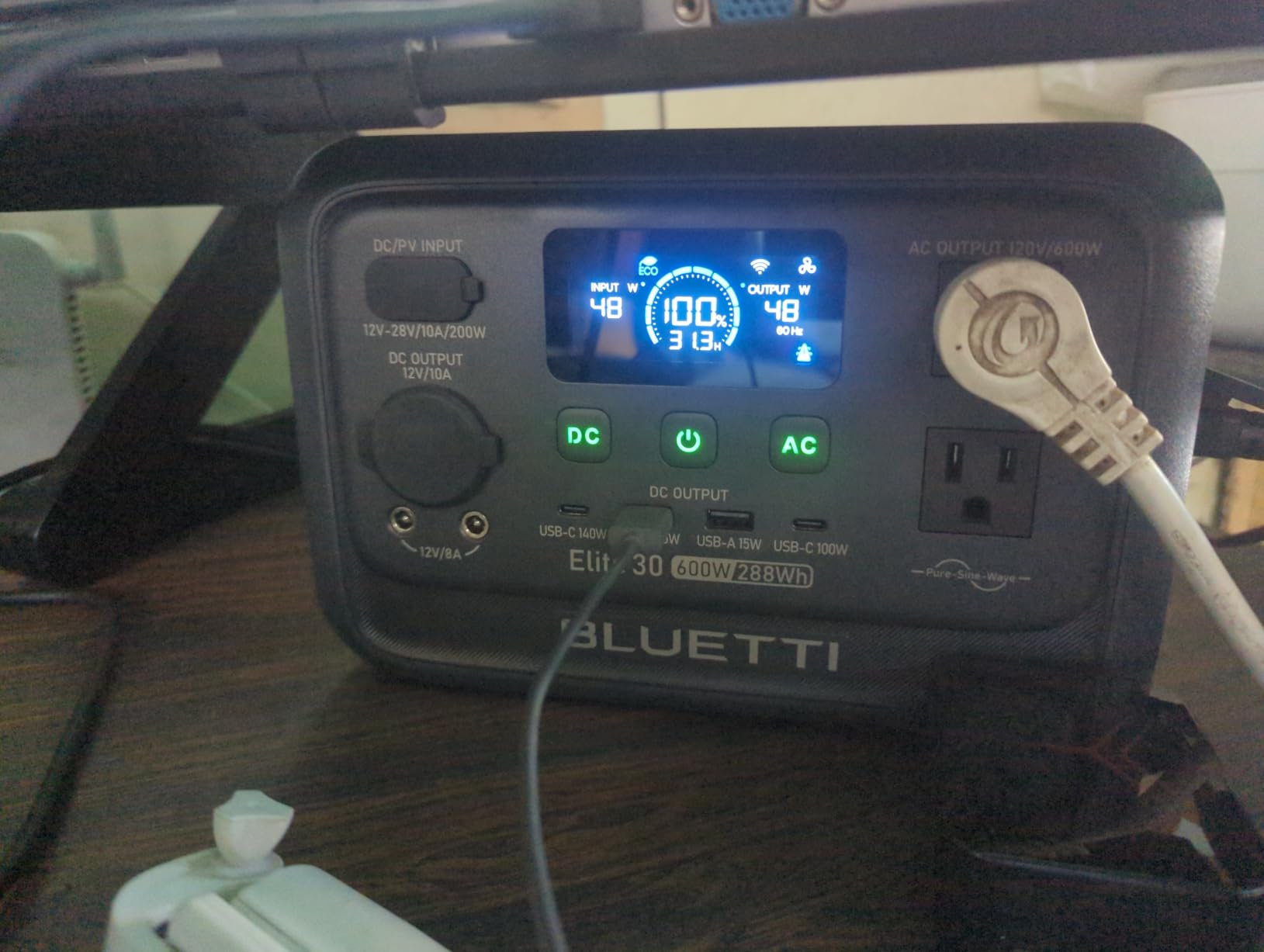
The Elite 30 V2 solves a problem most of the larger units create. At 600W of continuous pure sine wave output it has more than twice the AC capability of most sub-300Wh competitors, yet it weighs about 9.5 lb. That combination makes it the practical choice for a flat, a small house or a network closet where a 25 lb unit is not something you want to move.
Reviewers use it as a UPS replacement for network gear, servers, routers, laptops and CPAP machines. The 10ms switchover kept a home server and network stack running through outages without a hiccup, and the clean sine output is accepted by sensitive equipment without complaint. Measured runtime in reviews: about five hours on CPAP leaving 16% charge.
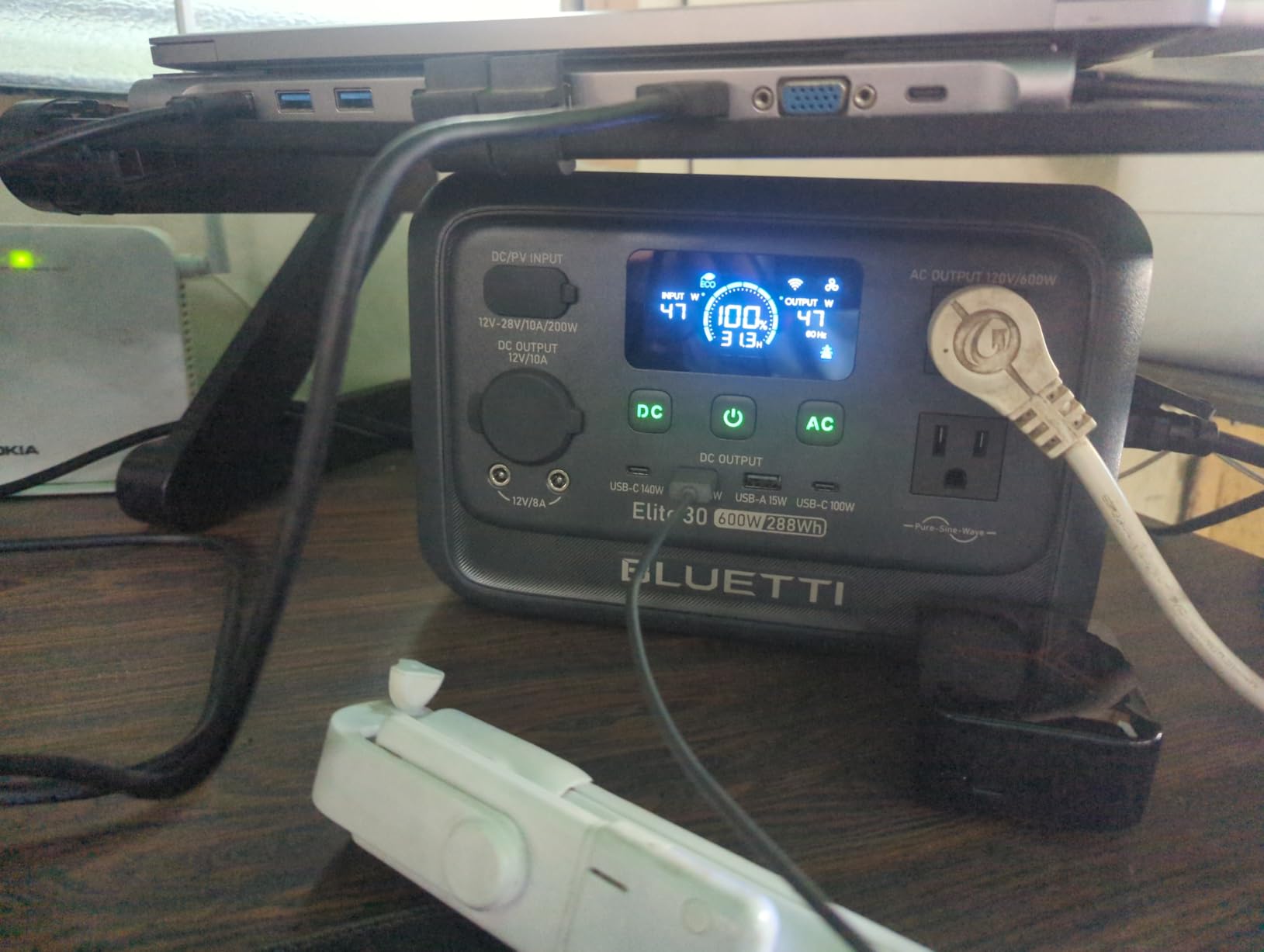
Charging flexibility is good for a unit this small: 0-80% in about 45 minutes from AC, solar or car, with a 380W adjustable wall input and 200W alternatives. It uses standard solar connectors rather than forcing proprietary panels, and the Bluetooth and Wi-Fi app shows real-time wattage and handles firmware updates.
Three limitations stand out. A minority of owners report faster-than-expected self-discharge and overnight capacity drain, which matters for a standby unit. There is no USB passthrough-style computer communication port, so a PC cannot auto shut down the way it would with a traditional UPS, and outputs must be re-enabled through app Pro mode with a passcode after a full discharge.
Who this suits
It suits small apartments, home offices and anyone whose backup load is networking, servers or a CPAP machine. At 9.5 lb it is one of the few units here you can carry up a stairwell comfortably.
Where it falls short
It falls short for anything with a real compressor, since 288Wh runs out quickly. If you need graceful PC shutdown on battery, the missing communication port is a genuine limitation.
12. Jackery Explorer 300 – Lightest Grab-and-Go Emergency Kit
Jackery Explorer 300 Portable Power Station,292Wh
292Wh LiFePO4
300W continuous, 600W surge
7.1 lb
2 AC and 100W USB-C
Pros
- Most reviewed unit in this roundup at 11273 reviews averaging 4.6 stars
- LiFePO4 chemistry rated for over 4000 cycles to 70% capacity
- 300W rated output with 600W surge for laptops
- drones and cameras
- Reaches 80% solar capacity in about 2.8 hours with a 100W panel
- Six-device output including two AC outlets
Cons
- 292Wh capacity limits runtime to small electronics and light loads
- Solar panel sold separately
At 7.1 lb this is the lightest full station here and the easiest to move at a moment’s notice, which is the whole point of an evacuation kit. The 292Wh LiFePO4 pack covers phones, laptops, cameras, drones and a CPAP machine, and the 300W rated output with 600W surge handles chargers and small electronics without strain.
It has 81% five-star ratings across 11273 reviews, the largest review base of any unit in this roundup, and the LiFePO4 cells are rated for over 4000 cycles to 70% capacity. Reviewers consistently cite the low weight and longevity rather than raw output, because that is what a grab-and-go kit needs.
Six-device output covers two AC outlets, a 100W USB-C PD port, two USB-A ports and a 120W car port, and it reaches about 80% solar capacity in roughly 2.8 hours with a 100W panel. That makes it a workable evacuation companion that can be recharged from a car while waiting out a grid failure.
The 292Wh capacity is the boundary. It will not run a refrigerator, a lamp and a router overnight together, and anything with a compressor is out of range. Solar panels are sold separately, which adds to the cost of a kit you are buying for emergencies rather than for camping.
Who this suits
It suits anyone building a car or go-bag emergency kit, and households that want a dedicated CPAP or phone-charging unit that stays charged on a shelf. It also works for portable astronomy gear, which is why we covered astrophotography setups in a separate guide.
Where it falls short
It falls short as a primary home backup, since 292Wh will not carry a refrigerator or a medical device with lights for a full night. It is a companion unit, not a replacement for a 1kWh station.
How to Size a Power Station for a 4-Hour, 12-Hour and 3-Day Outage
Start with two numbers that get confused constantly. Watt-hours (Wh) is capacity, and it determines how long you can run something. Watts (W) is output, and it determines what you can plug in. A 2000Wh station with 1200W of continuous output can run a 100W light for a long time, but it cannot run a 1500W microwave at all.
Build your list first, then add headroom. Write down every device you want running, with its running wattage, then multiply the running watts by the hours you need it to last. Add roughly 30% to cover inverter losses, since not every watt-hour in the pack reaches your appliance. For compressors, add startup surge headroom separately.
Surge versus continuous is where most unplanned failures happen. A refrigerator that draws 120W while running can pull three times that briefly when the compressor starts. If your continuous output is under 300W, a fridge compressor may not start at all, which is the failure users report most often.
Pure sine wave output matters for sensitive electronics such as CPAP machines, servers, NAS units and medical monitors. Modified sine wave output is cheaper and can cause audible hum or reset devices. Every LiFePO4 unit in this roundup uses pure sine wave inverters.
Runtime by tier, based on typical draw figures rather than manufacturer claims:
Grab-and-go tier, 288Wh to 512Wh: a 20W router runs roughly 10 to 15 hours, a 90W CPAP machine runs 3 to 5 hours, and a 120W refrigerator compressor will not run for long.
Core emergency tier, 1024Wh to 1152Wh: a router runs 40 to 50 hours, a CPAP machine runs 8 to 10 hours, and a refrigerator with a normal duty cycle runs 8 to 12 hours. A box fan runs 10 to 14 hours.
Extended outage tier, 2010Wh and above: a refrigerator runs 30 to 35 hours on a single charge based on owner reports, a CPAP machine runs roughly 18 to 22 hours, and a router runs 80 hours or more.
Plan by outage length. For a 4-hour flick-out, a grab-and-go unit is genuinely sufficient. For a 12-hour storm, you want the core emergency tier with a router, lighting and one medical device. For 3 days or more, only the extended tier or a core unit with solar recharging will get you through without a vehicle or generator to refill it.
Buy the largest station you can still move to where you need it. A 2000Wh unit left in a garage because it is too heavy to carry is less useful than a 1000Wh unit that sits next to the router. We have covered related use cases like running drone batteries off-grid separately.
Jackery vs Anker SOLIX: Which Brand Handles Emergencies Better
Both brands build LiFePO4 stations with fast recharge and sub-10ms UPS switching, so the honest answer depends on which failure you are worried about. Jackery covers a wider capacity ladder, from 292Wh to 1070Wh in this roundup, and its Explorer 1000 v2 gives you 1500W of continuous output at 23.8 lb. Anker’s emergency strength is speed and quiet: the SOLIX C1000 Gen 2 fully recharges in 49 minutes, and the SOLIX S2000 runs 2010Wh with a 6W idle draw for long unattended outages.
Where they diverge is expansion. Jackery’s larger current models are locked to Jackery solar panels, while the Anker SOLIX C1000 Gen 2 dropped extra-battery expansion entirely. If your plan is to add capacity or to use panels you already own, check compatibility before buying. Jackery also wins on review depth, with 3623 and 11273 reviews on the two units above, against 1632 and 317 for Anker’s.
Choose Jackery if you want the broadest range of sizes and stronger community support. Choose Anker if recharge speed, standby idle draw or long unattended outages matter most. For anyone running cameras and imaging gear, we ranked the best portable power stations for drones separately by battery draw.
Battery Chemistry, UPS Mode and Recharging While the Grid Is Down
LiFePO4 versus NMC is the single most important longevity decision. Every station in this roundup uses LiFePO4, rated between 3000 and 10000 cycles, which works out to roughly 8 to 15 years of daily use. NMC chemistries typically offer 500 to 1000 cycles, so a unit bought as a standby asset should not be NMC.
UPS mode is what keeps your network and medical devices alive. A UPS-capable station monitors the wall outlet and switches to battery when power drops, with a transfer time measured in milliseconds. Anything under 10ms is effectively invisible to a router, laptop or CPAP machine; 20ms is also fine in practice. If your emergency priority is continuity rather than capacity, treat switchover time as a core criterion.
Recharging during a long outage is where most guides go quiet, so here is the order of preference. First is a car, using a 12V car socket or a dedicated alternator charger, which can add meaningful charge while you drive. Second is portable solar, and here input wattage matters: 600W and 500W inputs recharge far faster than the 100W and 110W inputs on the smaller units. Third is bridging with a gas generator, running a modest load through the station so the generator cycles less and lasts longer on fuel.
Storage and maintenance decide whether a standby unit works when you need it. Self-discharge on a LiFePO4 pack is around 3% to 5% per month, so a unit charged in September is still usable the following summer. Top it up every three to four months, keep it between 40% and 60% for long storage, and avoid freezing temperatures. Test it twice a year by running a lamp for an hour and checking the readout.
Power Station vs Gas Generator: Carbon Monoxide, Noise and Running Cost
Carbon monoxide is the reason many households switch to battery backup. A fuel generator produces exhaust that must never enter a home, and public safety guidance is unambiguous on placement and distance. A portable power station produces no exhaust at all, so it can run indoors, in a garage with the door open, or in a basement corridor without any ventilation calculation.
Noise follows the same pattern. Fuel generators are measured in decibels that carry across a neighbourhood, which is why apartment and HOA residents report noise and carbon monoxide concerns as the decisive factor in switching. The quietest stations here measure between 25dB and 30dB, roughly the level of a bedroom at rest, and the Anker SOLIX S2000 is the outlier to watch because its fan drones during charging above 1200W.
Where gas generators still win is duration and sustained heavy load. A generator with a full fuel tank can run for days and handle a well pump or space heater that would drain a battery station in an hour. The honest position is that a battery station covers essentials cleanly and quietly, while a generator covers large loads for long periods. Several buyers run both, using the station as a silent bridge for the electronics.
Over a ten-year ownership period, a battery station’s cost is the unit plus occasional panel purchases, with no fuel and no oil changes. A generator’s cost includes fuel, oil, spark plugs and a battery of its own. If you already have a generator, a mid-tier station that charges from it is often the most economical addition to a plan.
Keeping a Station Ready: Storage and Maintenance Between Storms
An emergency station that has been sitting at 10% charge for eight months is not backup power, and this is the most common failure we hear about from owners who bought a unit during a storm and then forgot about it. Charge it fully after every use, and set a recurring reminder to top it up every three to four months.
For long storage, leave it between 40% and 60% rather than at 100%, and keep it in a climate-controlled room away from direct sun. Avoid freezing temperatures, which is relevant in northern climates where a garage in January is well below the operating range of many cells.
Run a pre-storm test protocol. Charge the unit, run a 100W load for an hour, confirm the fan noise is acceptable in the room where you will use it, and check that the outlets you need are the ones you will actually reach. Test UPS mode by pulling the plug rather than assuming it works.
Finally, check what you are allowed to do in a wildfire public safety power shutoff or a planned grid shutoff. Several apps in this roundup support storm alerts and self-powered scheduling, which lets a station charge at off-peak rates or hold charge automatically when a shutoff notice is issued.
Frequently Asked Questions
What is the best portable power station for emergency home use?
The Jackery Explorer 1000 v2 is our top pick for emergency home use, with 1070Wh of LiFePO4 capacity, 1500W of continuous output and a 23.8 lb body. It covers a refrigerator, a router, lighting and phone charging for roughly a day on a single charge. Choose the BLUETTI AC180 if your loads include microwaves or power tools, and the Anker SOLIX S2000 if outages routinely last several days.
What is the best portable power bank for emergency use?
A power bank charges phones and small USB devices only. A portable power station adds AC outlets, a car socket and enough capacity for a refrigerator, a laptop or a CPAP machine overnight. For an emergency kit we recommend the Jackery Explorer 300 at 7.1 lb or the BLUETTI Elite 30 V2 at about 9.5 lb with 600W of continuous AC output.
Is Jackery or Anker better?
Both build LiFePO4 stations with fast recharge and sub-10ms UPS switching, so the choice depends on the failure you are worried about. Jackery covers a wider capacity ladder and has far deeper review counts. Anker leads on recharge speed, with a 49-minute full recharge on the SOLIX C1000 Gen 2, and on standby idle draw with the SOLIX S2000. Check solar panel and extra-battery compatibility before buying, since the current Anker Gen 2 dropped expansion.
What is the best portable power station according to Consumer Reports?
No single laboratory test should decide this for you, and we do not claim one does. Our ranking is built on published specifications checked against each other, plus reported owner runtimes from thousands of reviews. The most useful real-world checks are fridge runtime, UPS switchover time, measured noise, weight you can actually lift and battery cycle life.
Which brand of portable power station is the most reliable?
Reliability tracks battery chemistry and warranty length more than brand. Every station in our roundup uses LiFePO4 cells rated from 3000 to 10000 cycles, and most carry five-year warranties. The Anker SOLIX S2000 has the highest stated cycle rating at 10000, the Jackery Explorer 500 v2 reports 6000 cycles with 5% self-discharge after six months stored, and the Anker SOLIX C1000 Gen 2 holds at least 80% capacity after 4000 cycles.
How long will a portable power station run a refrigerator?
On a single charge, a 1024Wh to 1152Wh station typically runs a full-size refrigerator 8 to 12 hours once inverter losses are accounted for. The Anker SOLIX S2000 at 2010Wh is rated for up to 35 hours of fridge backup, and owners report 33 to 35 hours on a full-size unit. Below 512Wh, plan on light loads only rather than a compressor.
Conclusion
For most households, the best portable power stations for emergencies in 2026 come down to three picks. The Jackery Explorer 1000 v2 is the all-round answer at 1070Wh and 1500W in a body you can still lift alone. The BLUETTI AC180 takes over when your loads include anything with a compressor, a microwave or a power tool. The Anker SOLIX S2000 is the one that stays running when the outage runs past two days.
Below 512Wh you are buying portability, not home backup. Between 1024Wh and 1152Wh you are buying a realistic day of essentials. At 2000Wh and above you are buying multi-day coverage, and you should confirm the fan noise is acceptable in the room where it will live. Whatever you choose, test it before you need it, keep it between 40% and 60% between storms, and top it up every few months.