
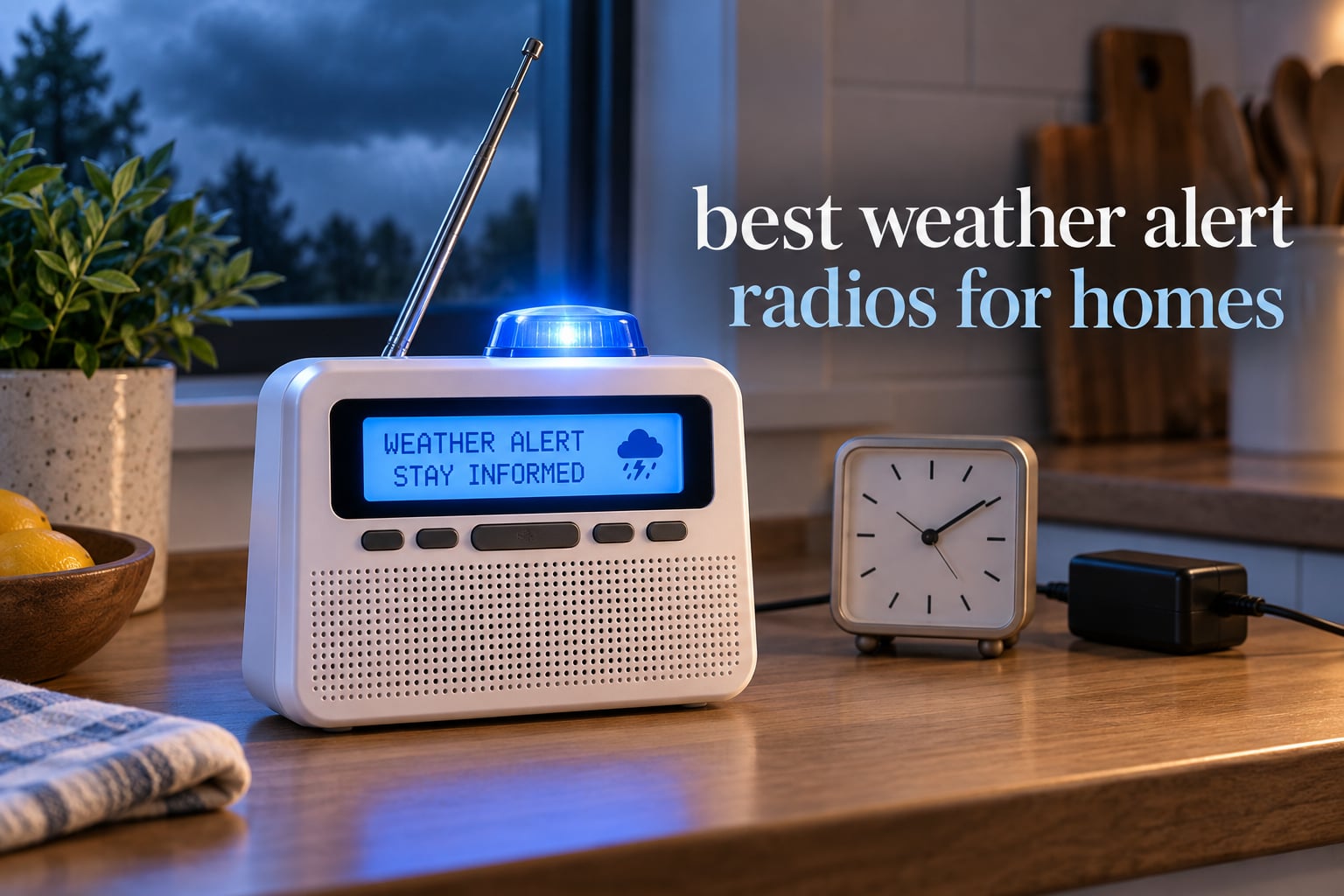
A tornado warning does not wait for your router to come back online. The best weather alert radio for home is the Midland WR120B, a plug-in NOAA receiver that keeps broadcasting county-level warnings from a wall socket and a set of AAA batteries when the grid, the Wi-Fi and the cell towers all go down at once. It is the one pick here with the deepest owner history, and it is the unit I recommend for a bedroom nightstand or a kitchen counter.
That framing matters more than it used to. Wireless Emergency Alerts on your phone are genuinely good, and the National Weather Service app costs nothing. What neither of them does is stand in a dark hallway at 3 a.m. and sound a siren loud enough to wake a heavy sleeper while the power is out and there is no signal to work with. A dedicated radio draws its own power, sits on a frequency that does not depend on a tower, and keeps talking when everything else goes quiet.
This roundup covers eight units side by side, from plug-in desktop consoles to hand-crank multi-power packs, with the differences that actually change how you get warned rather than a wall of near-identical feature lists. We also include a step-by-step walkthrough for S.A.M.E. county programming, because that is where most first-time buyers get stuck, and a short look at the free options that may mean you do not need to buy anything. If you want the wider emergency-kit picture first, our guides to the best emergency weather radios for preppers and best NOAA weather radios for emergencies cover the go-bag side in more depth.
One note on what follows: we earn a commission when you buy through the links on this page, and it does not change which units we recommend or the order they appear in.
Table of Contents
Top 3 Picks for Home Weather Alert Radios in October 2026
Three units cover most households. The Midland WR120B is the one to buy if you just want a dependable nightstand siren, the FosPower A1 is the budget entry that still charges a phone, and the Eoxsmile 12000mAh model is the pick when the power may be gone for days rather than hours.

Midland WR120B
- S.A.M.E. up to 25 counties
- 60+ alert types
- AC adapter plus AAA backup
- built-in alarm clock

FosPower A1
- 7400mWh phone charging bank
- solar hand crank and AAA power
- AM FM and NOAA bands
- 1W flashlight plus reading light

Eoxsmile 12000mAh NOAA
- 12000mAh cell with 50+ hours of FM
- six power sources including AC adapter
- auto NOAA scan with siren and strobe
- 3W flashlight
Weather Alert Radios for Homes in October 2026
All eight radios below receive the National Weather Service broadcast network continuously. The real differences are county filtering, how much warning volume you get, and what happens when the wall socket stops delivering.
| Product | Specifications | Action |
|---|---|---|
| Midland WR120B NOAA Alert Radio |
|
Check Latest Price |
| FosPower A1 Solar Hand Crank Radio |
|
Check Latest Price |
| Eoxsmile 12000mAh NOAA Radio |
|
Check Latest Price |
 Raynic CR1009Pro Emergency Radio Raynic CR1009Pro Emergency Radio |
|
Check Latest Price |
 Leaton 10000mAh NOAA Radio Leaton 10000mAh NOAA Radio |
|
Check Latest Price |
 Mesqool CR1030 Emergency Radio Mesqool CR1030 Emergency Radio |
|
Check Latest Price |
 RunningSnail MD329 NOAA Radio RunningSnail MD329 NOAA Radio |
|
Check Latest Price |
 DreamSky DS6227 NOAA Alert Radio DreamSky DS6227 NOAA Alert Radio |
|
Check Latest Price |
1. Midland WR120B: Best Overall Home Alert Radio
Midland – WR120B – NOAA Emergency Weather Alert Radio
S.A.M.E. for 25 counties
60+ alert types
AC power with AAA backup
16 oz, alarm clock
Pros
- Very loud siren that wakes light sleepers
- S.A.M.E. setup takes about 25 minutes
- Strong NOAA reception indoors
- Runs on mains or AAA backup during outages
Cons
- Max volume not enough in very large homes
- Short AAA backup runtime
- Plasticky feel and a weak power cord
This is the radio I keep on the kitchen counter, and it is the one I hand to friends who ask a single question: which one should I buy. With more than 24000 ratings at 4.5 stars, it has the deepest owner history in this roundup by a wide margin, and that history is unusually consistent. Owners describe a siren that wakes light sleepers, reception that holds up indoors, and a S.A.M.E. setup that takes about 25 minutes from box to working county code.
The specification set is exactly what a home unit should carry. It scans 60 or more emergency hazard and weather alert types, accepts S.A.M.E. codes for up to 25 counties including partial-county codes, and colour-codes the alert type and severity on the display so you can tell an advisory from a warning at a glance. The alert override switches the radio out of whatever it is doing when danger is impending, and a continuous backlight option keeps the LCD readable in a dark room.
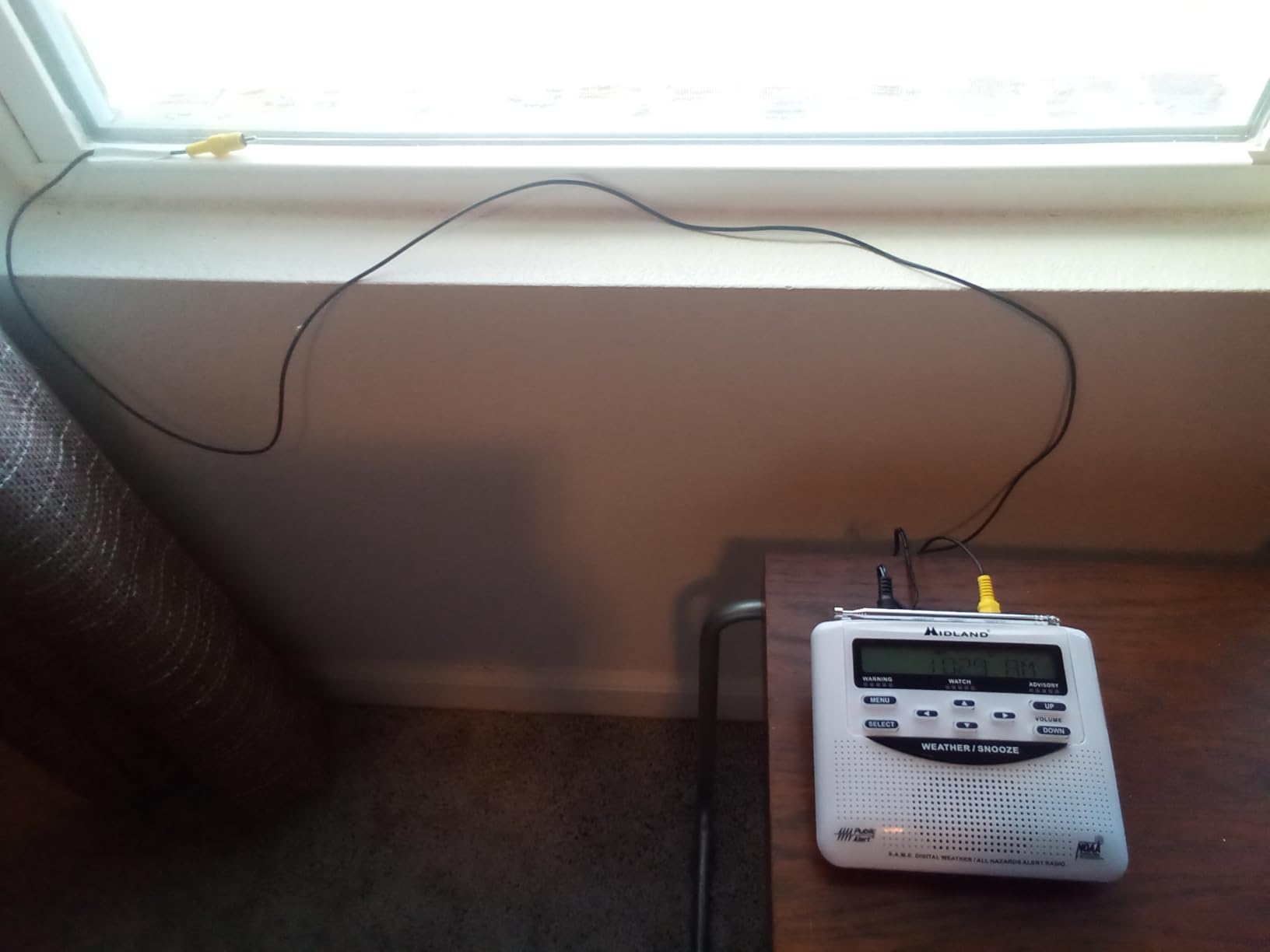
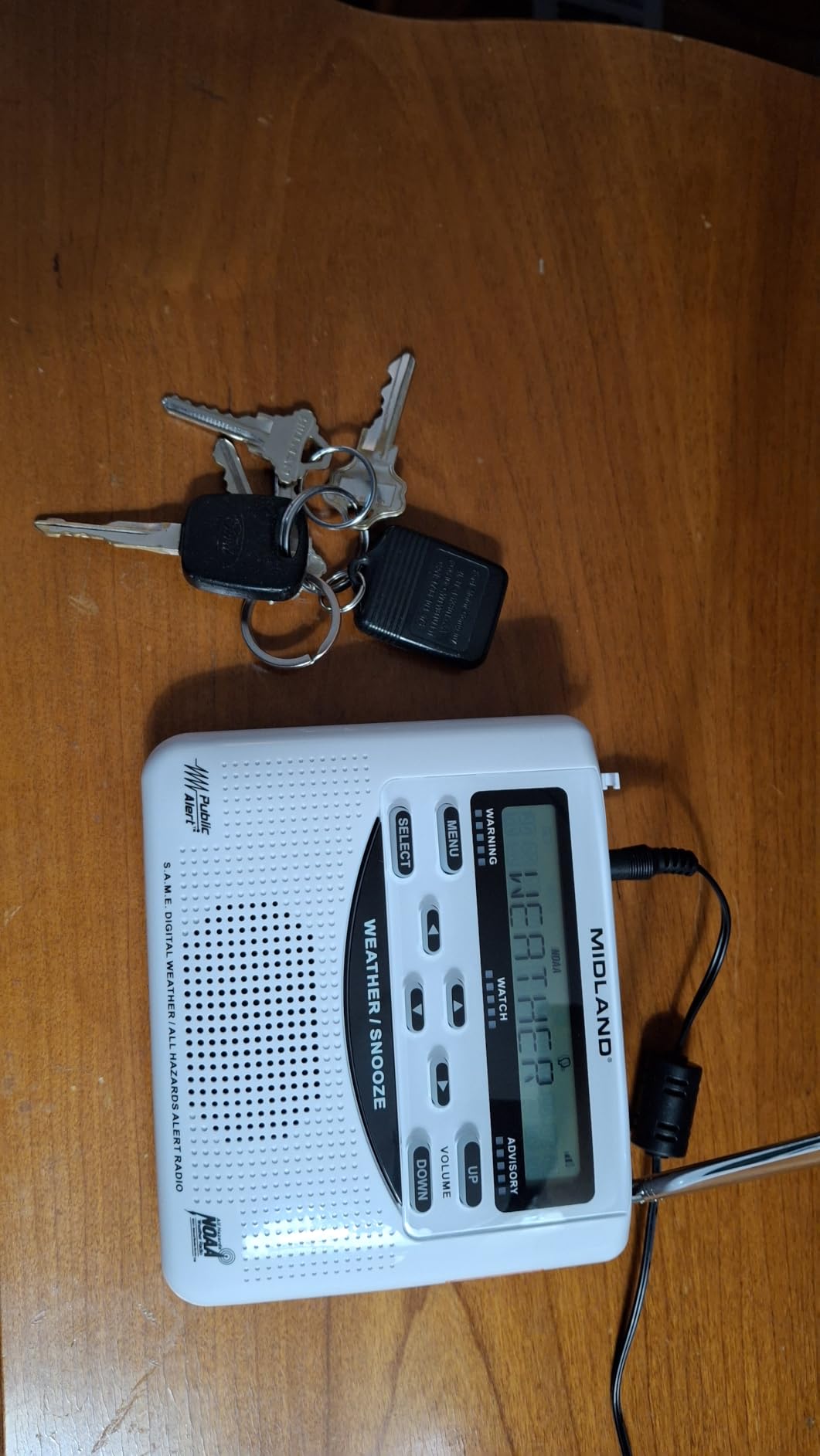
Power comes from an AC adapter with a 6 AAA battery backup, and there is a built-in clock with an alarm, which turns the unit into a nightstand device instead of a box you tolerate. At 16 ounces and 2 by 5.3 by 6.1 inches it is small enough to sit where you will actually see it, and the 2.5W speaker with a telescoping antenna covers a house better than its footprint suggests.
The honest complaints are consistent too. Maximum volume does not satisfy people in very large or noisy homes, the battery backup is a bridge rather than a multi-day reserve, and reviewers with long ownership histories describe the plastic and the included power cord as the weak points. S.A.M.E. codes only cover the US and Canada, so it does no good abroad.
Will the alarm actually wake you at night?
Yes, based on what owners report. The most common praise is about a siren that reliably wakes light sleepers during overnight alerts, and one owner describes holding reception inside a steel-plate tornado shelter where cell service had failed entirely. That is the failure mode a nightstand radio is bought for.
The practical answer is to test it before you need it. Press the siren test control, stand in the room you sleep in, and if you cannot hear it from the pillow, either move the unit closer to the bedroom door or add a second radio elsewhere in the house.
Where it falls short in a real home
The volume ceiling is the deciding factor for some households. People in large open-plan homes, or those with a lot of street noise, report that the top of the volume range still leaves them unsatisfied, and there is no line-out or speaker output to fix that.
Display visibility is a smaller issue. Reviewers note the screen is hard to read at certain angles, and the unit cannot be wall-mounted in a position where it stays readable, so it needs a flat surface near you rather than mounted high on a wall.
2. FosPower A1: Budget Pick Multi-Power Radio
FosPower NOAA Emergency Weather Radio A1 7400mWh Solar Hand Crank (Orange)
7400mWh phone charging bank
Solar hand crank and 4 AAA
AM FM and NOAA bands
Limited lifetime warranty
Pros
- Large review base across every model here
- Covered by the largest number of owner ratings in this roundup
- 7400mWh bank keeps a phone alive
- Three independent power paths
- Flashlight plus 4 LED reading light
Cons
- Small 2000mAh cell for multi-day outages
- Crank and solar are trickle top-ups
- Tuner-style display is less informative
With 37868 ratings at 4.6 stars, the FosPower A1 is the most-reviewed unit here and a consistent chart topper, and the reason is simple value. For a first radio that will live in a go bag, a car, or a spare room, it covers the essentials: NOAA broadcasts plus AM and FM, three ways to keep it alive, and a battery you can borrow from.
That 7400mWh (2000mAh) power bank is the feature that earns its place. It will keep a phone alive long enough to make an emergency call or read a map when the router is down, which is the difference between a radio that informs you and a radio that helps. On top of that sit a hand crank generator, a solar panel, and 4 AAA batteries as a third path, so a dead internal cell does not mean a silent radio.
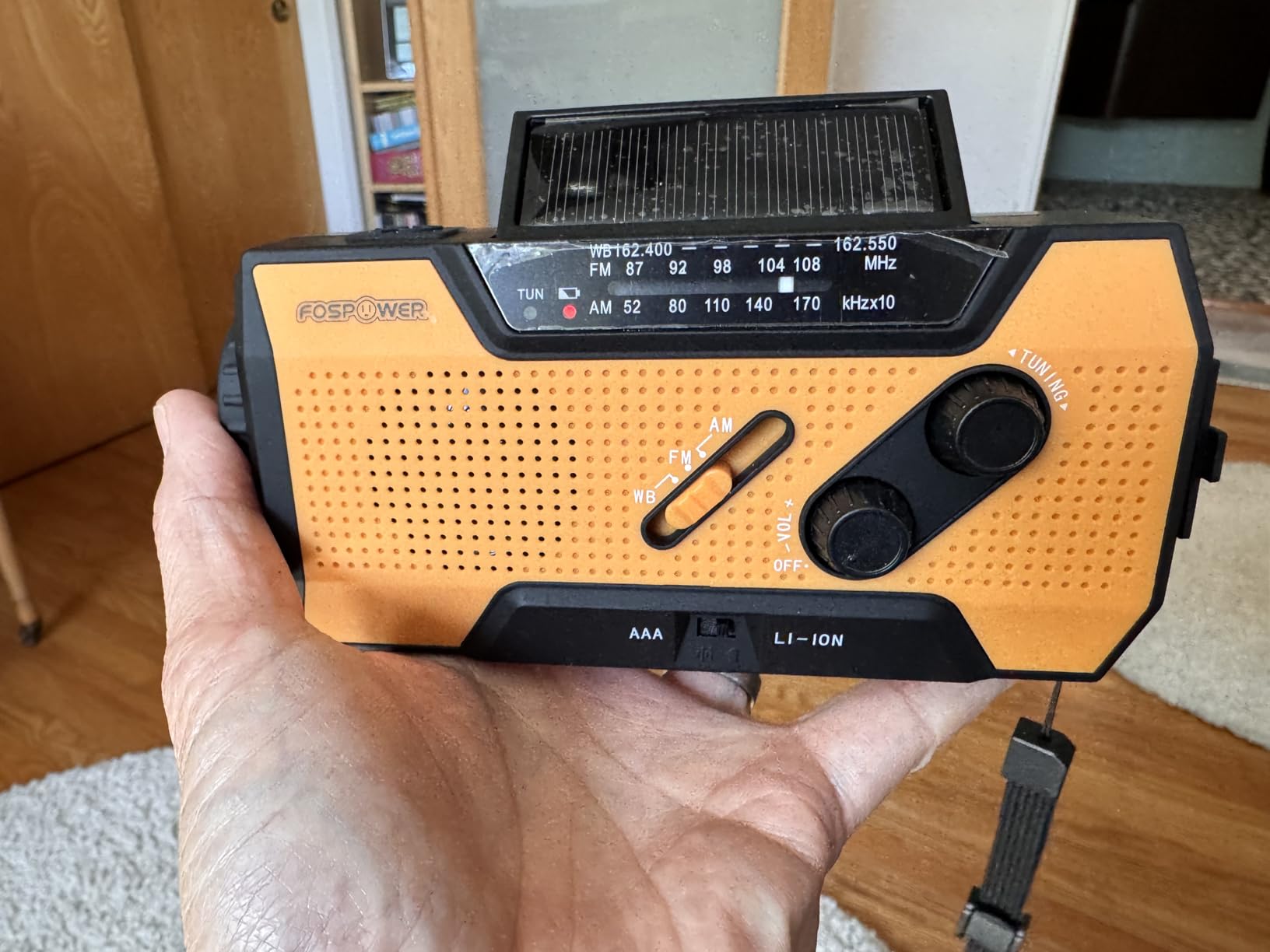
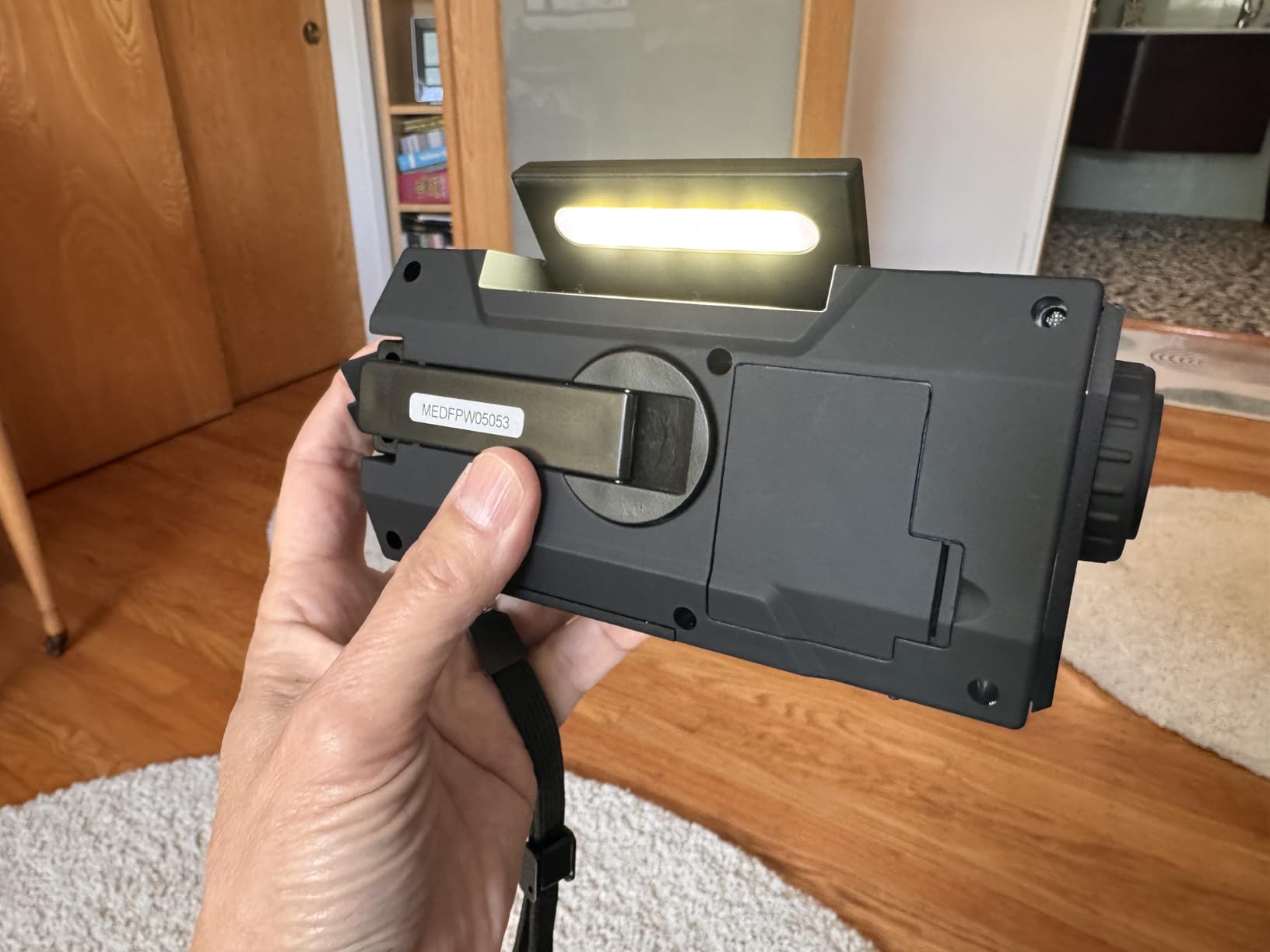
The lighting is genuinely useful rather than decorative: a 1W flashlight plus a 4-LED reading light, and a 2 watt speaker that is loud enough for a room. The housing is water resistant, and the warranty is a limited lifetime one, which is unusual at this level and worth noting given how many budget radios fail early.
What you give up is battery scale. A 2000mAh cell is the smallest here, so owners consistently place it as a short-outage and go-bag radio rather than a home power reserve. The crank and the panel top the cell up rather than fully recharging it, and the tuner-style display tells you far less than an LCD with a battery indicator.
Is it a good first weather radio?
Yes. It is the easiest entry point on this list because there is nothing to configure and nothing to learn, which suits a household buying its first alert device and wanting it in a drawer within minutes.
It suits a second home role too. Because it carries AM and FM alongside NOAA, it doubles as an ordinary radio for a garage or a shed where a dedicated alert unit would just sit silent.
When it is the wrong choice
It cannot be programmed to your county. Every alert on the weather band plays regardless of where you live, so in an active region you will hear warnings for places you do not care about, and that trains people to ignore the unit. A tuner-style readout tells you less than an LCD showing alert type and severity.
3. Eoxsmile 12000mAh NOAA Radio: Best for Multi-Day Power
Eoxsmile NOAA Emergency Weather Radio Hand Crank Solar 12000mAh Battery
12000mAh cell with 50+ hours of FM
AC adapter solar crank and USB-C
Auto NOAA scan with siren and strobe
LCD with battery level readout
Pros
- 12000mAh cell with 50+ hours of FM playback
- Standby mode auto-scans 7 NOAA stations
- Six power sources including AC adapter
- Informative LCD with battery level and status
- 3W flashlight and reading lamp
Cons
- NOAA alerts only monitor in standby mode
- AAA cells drain while the lithium cell is in use
- Internal battery is not user-replaceable
When the forecast says the power could be out for days, battery capacity becomes the deciding feature and this is the unit that wins it. The 12000mAh (44400mWh) cell delivers 50 or more hours of FM playback, and the 12352 ratings at 4.5 stars describe a radio that is consistently clear-sounding and easy for non-technical users to operate.
The standout behaviour is the smart standby mode. The radio scans the 7 NOAA weather stations automatically and triggers a siren plus a red strobe even when it is not actively playing, so you are not relying on sitting near a live broadcast. The LCD is unusually informative for this category, showing time, frequency, battery level and alert status through a digital tuner with 16 volume levels.
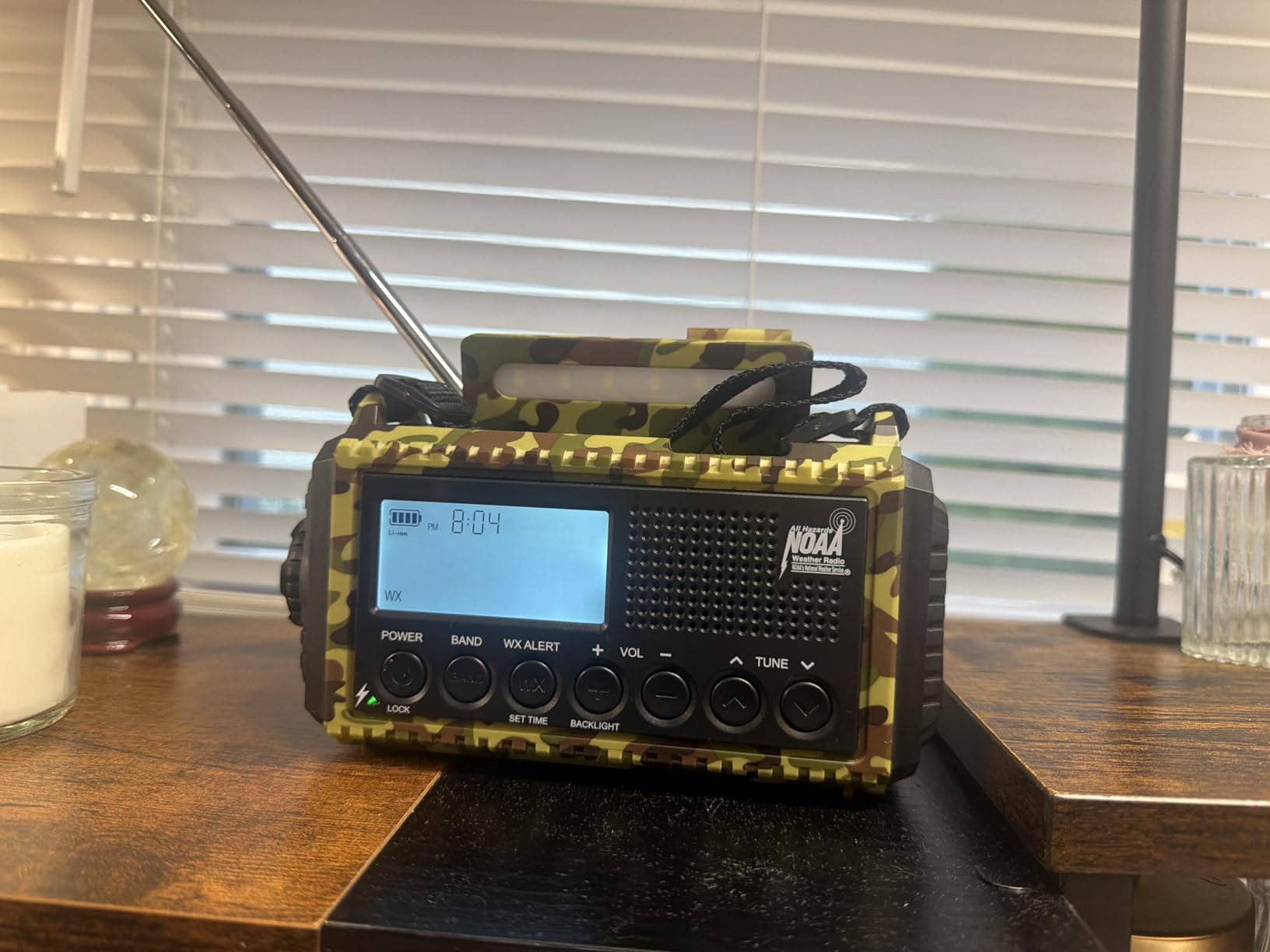
Six power sources is the widest set here: solar, hand crank, USB-C, an AC adapter, the internal cell, and 3 AAA backup. Having the AC adapter matters at home, because you can leave the unit plugged in as a house radio and still have four fallbacks if the wall socket goes dark. A 3W flashlight reaching about 70 metres and a reading lamp cover the outage-night lighting problem, and a 3.5mm headphone jack lets you listen privately.
The catch is one of the most useful warnings in this whole roundup. NOAA alerts are only monitored in standby or when Alert is re-enabled, so listening to AM, FM or shortwave silently disables alerting. If you switch to music and leave it there, the radio will not interrupt you with a warning.
Can it run a whole storm without mains power?
For listening, yes, and by a wide margin. Over 50 hours of FM playback from a single charge is the figure owners quote, and reviewers report running it all night at low volume. The solar panel and crank are top-up methods rather than a full recharge path, so treat the cell as the main reserve.
The AAA backup is the part to understand. Those cells drain while the lithium battery is in use and are not switched to automatically, so they function as a reserve for a dead internal cell rather than as a parallel supply.
What to watch out for
The internal 12000mAh battery is not user-replaceable, so the unit degrades once that cell ages out. On a device meant to sit on a shelf for years, that is a longer-term concern than the headline capacity suggests.
Charging is slow. USB-C recharge takes roughly 16 hours and phone charging runs at about 1 amp, so the charging port is an emergency top-up for a phone, not a fast way to restore the radio. AM reception is also weak for low-power stations with no automatic gain control.
4. Raynic CR1009Pro: Best for Go-Bags and Cars
Raynic Emergency Radio, 5000mAh/18500mWh Weather Radio, Solar Hand Crank Radio with AM/FM/SW/NOAA Alert, Cell Phone Charger, Headphone Jack, Flashlight and SOS Siren
5000mAh cell with USB phone charging
AC adapter solar crank and AAA
IPX3 water resistant
16 oz with carabiner
Pros
- Auto-scans NOAA alerts in standby
- Six charging paths including AC adapter
- Bright 3W flashlight and reading lamp
- Good reception on a small antenna
- Under 15 oz with a carabiner
Cons
- No S.A.M.E. county programming
- Short telescoping antenna with no external option
- Selection buttons are not backlit
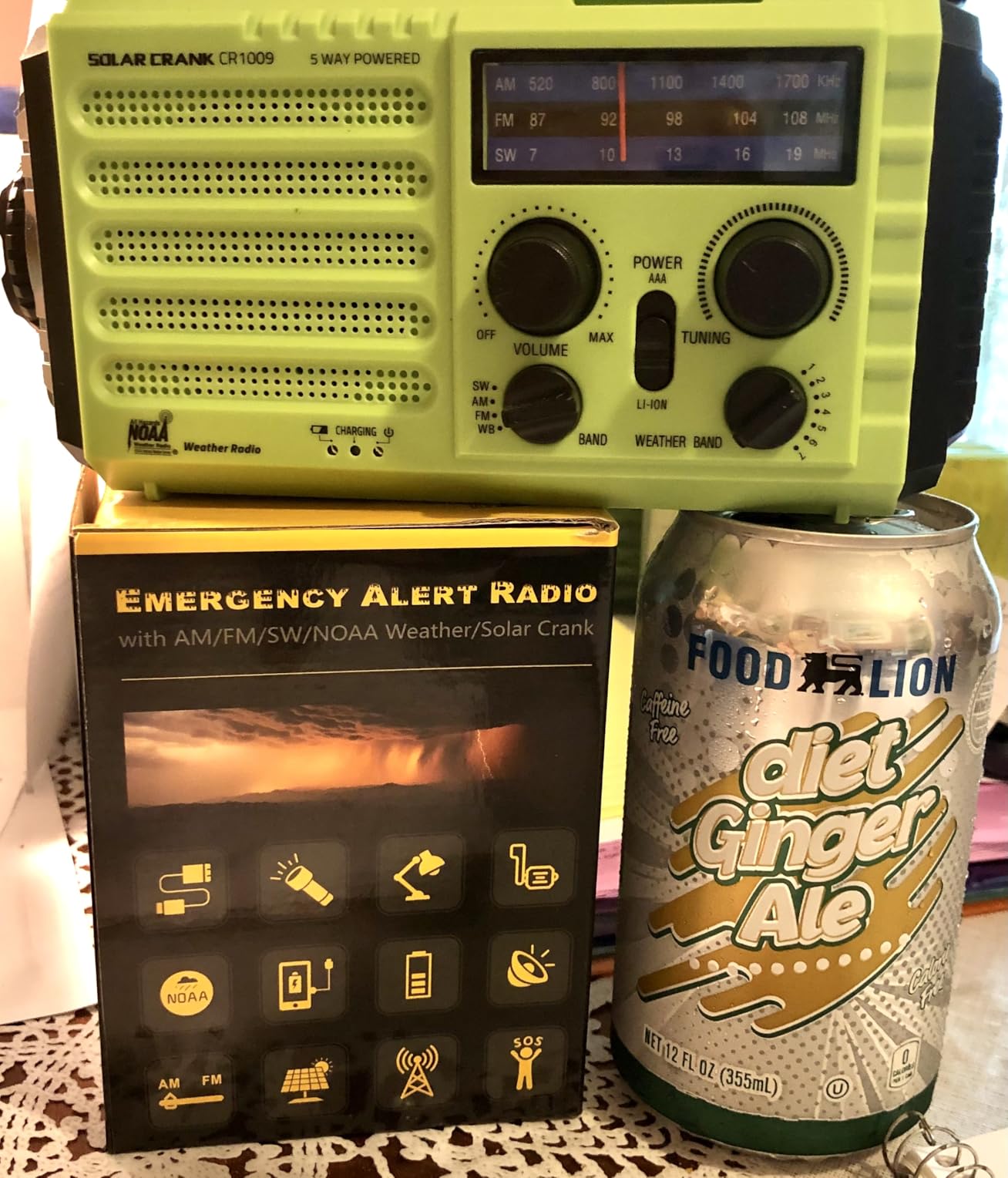
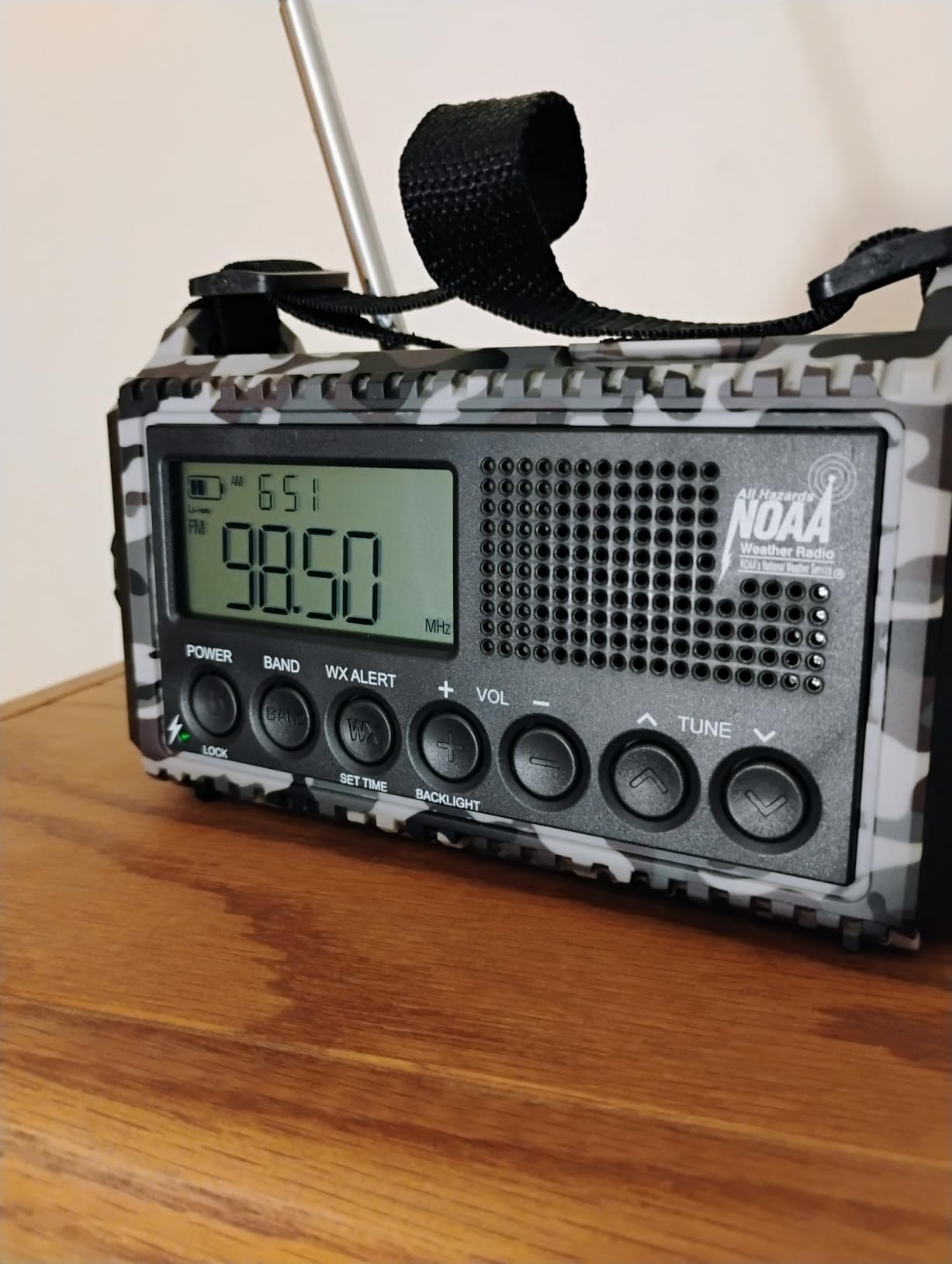
The Raynic CR1009Pro is the one I would put in a car or a go bag, and the 20637 ratings at 4.5 stars back that up as one of the best-regarded multi-power units sold. It auto-scans for emergency and weather alerts at power-on and in standby, so you get warnings without having to sit and listen to a broadcast.
Charging is the other strength. Six paths feed it, including an AC adapter that lets it live plugged in at home as a house unit, plus a 5000mAh (18500mWh) internal cell, DC 5V USB, hand crank, solar panel and 3 AAA. The USB out port charges a phone, and the large HD LCD gives digital tuning, battery level and a frequency readout with auto-scan.
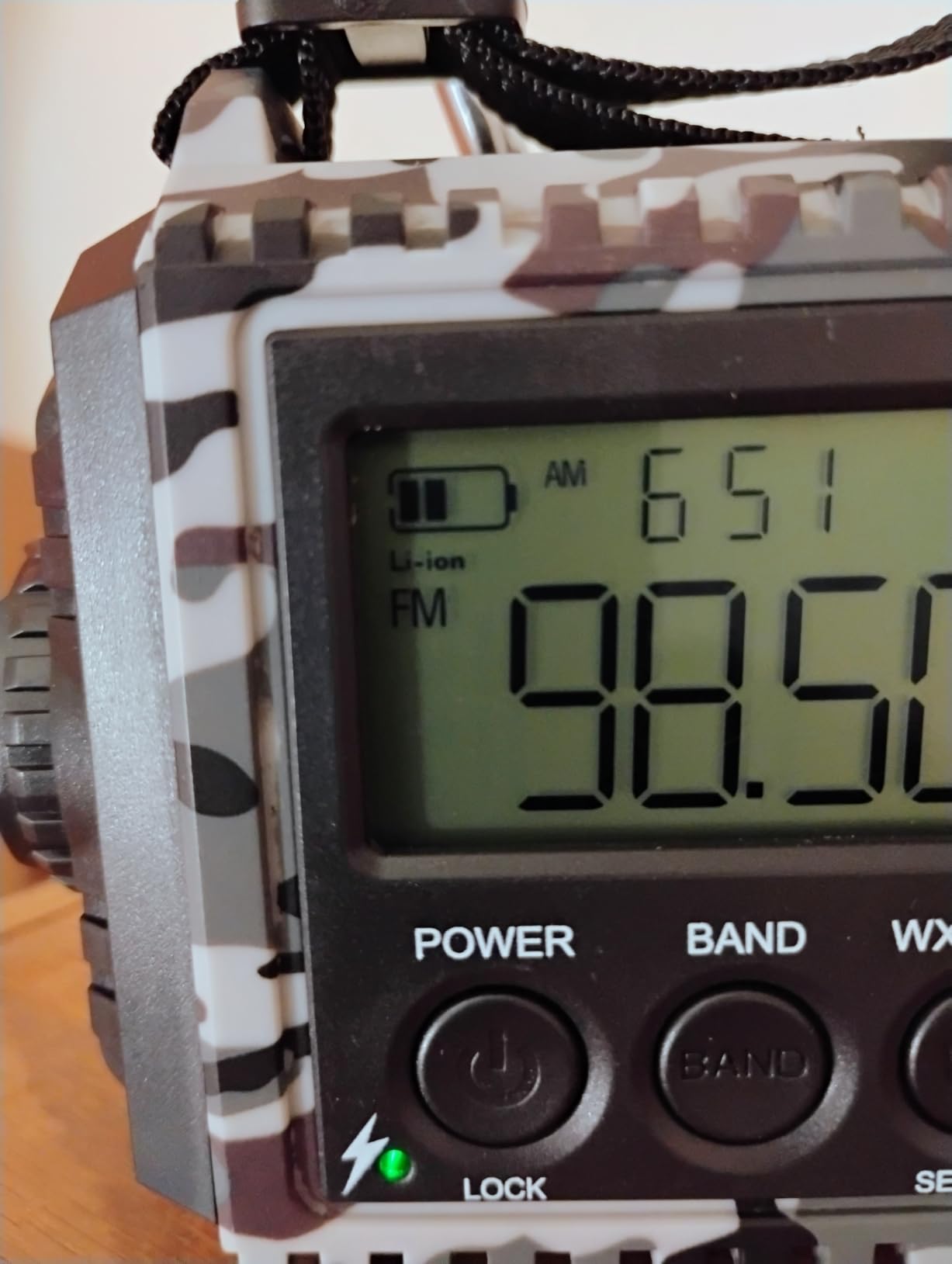
Owners rate the light output for its size, with a 3W flashlight and 2.5W reading lamp that draw little battery, and a dimmer mode for power saving. A 3 watt speaker is loud enough for a house, a 3.5mm jack allows private listening, and at 16 ounces with a carabiner and compass strap it is easy to clip to a pack.
The structural limitation is the same one that matters most for home alerting: there is no S.A.M.E. county programming, so you get every alert in the region. The short telescoping antenna also limits reception with no external option, and the selection buttons are not backlit, which makes night-time operation awkward.
Does it earn a place in a 72-hour kit?
Yes, on power and portability. Six charging paths and a 5000mAh cell mean it does not depend on any single input, and the weight and clip make it easy to actually carry rather than leave in a drawer.
Water resistance is minimal. It carries an IPX3 rating for spray and splashing, and the port cover does not stay closed, so treat it as a radio that should stay out of the rain.
Where it will disappoint a household
It will not wake you selectively. Without county codes, an alert for a neighbouring county sounds exactly like one for yours, and in a busy storm region that means a lot of false alarm training.
The solar panel only maintains a charged battery and will not revive a dead one, and the hand crank is slow. A few units have also shipped without the internal battery fitted, so check it in the box before you rely on it.
5. Leaton 10000mAh NOAA Radio: Best for Outdoor Durability
Leaton Hand Crank Emergency Radio, NOAA Weather Radio AM/FM,10000mAh
10000mAh cell with 5V phone output
IPX6 water resistance
Solar hand crank and USB-C
Manual NOAA tuning only
Pros
- Large 10000mAh cell for the bracket
- IPX6 is the strongest water rating here
- Solar crank and USB-C with use while charging
- Three-mode flashlight plus reading lamp
- Large controls suit older users
Cons
- No automatic NOAA alerts and no S.A.M.E. codes
- Manual tuning means no unattended siren
- No headphone jack or shortwave band
The Leaton is built for people who take their alert kit outside, and the IPX6 rating is the reason. At 5222 ratings and 4.5 stars, the 10000mAh polymer battery is unusually large for the money and outputs 5V at 1A, enough for roughly one to one and a half phone charges. That is real reserve in a device you can drop in a pack.
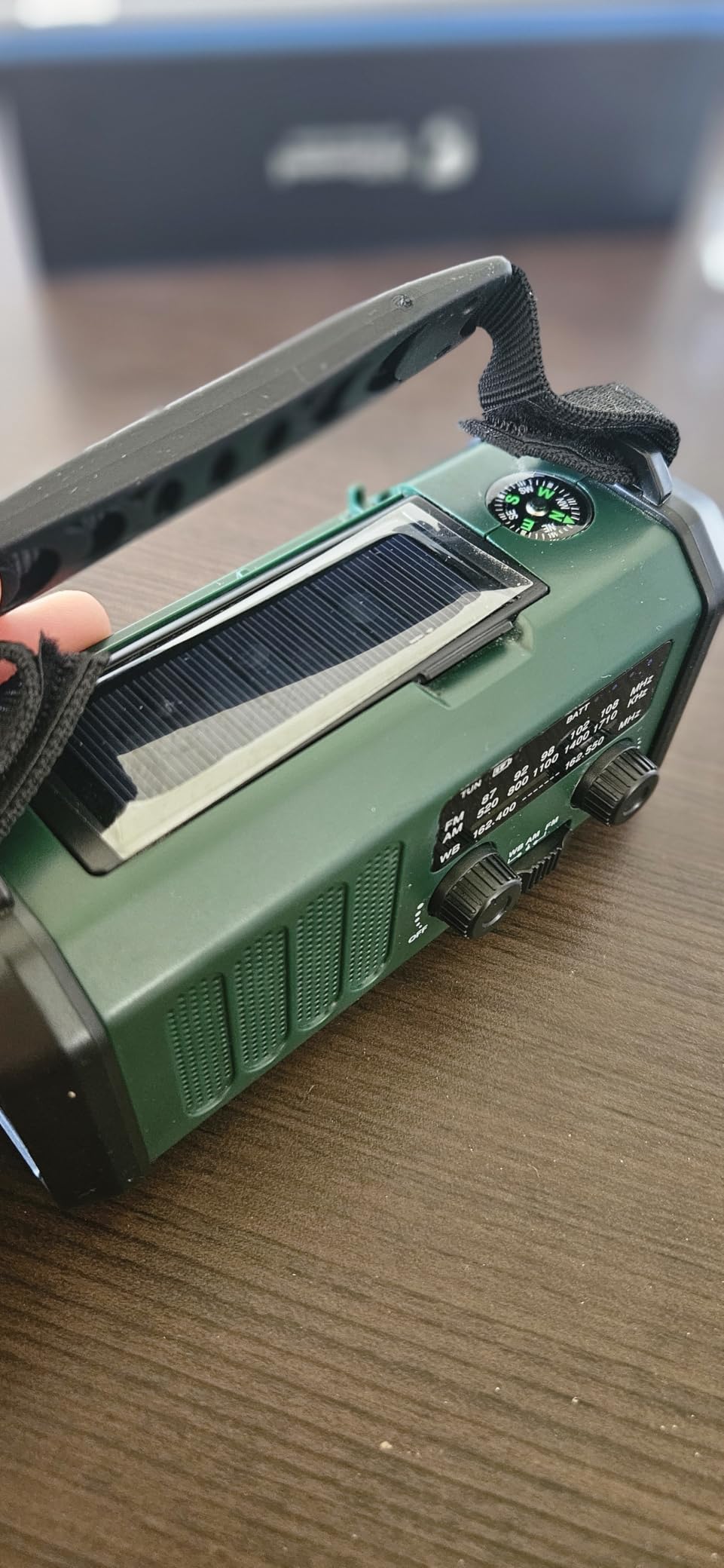
Recharging comes from solar, a hand crank generator and USB-C, and the radio stays usable while it charges, which is more than most crank-only units can say. About a minute of cranking yields 15 to 20 minutes of listening, and the LED flashlight has high, low and SOS modes alongside a 1.3W reading lamp and a built-in compass.
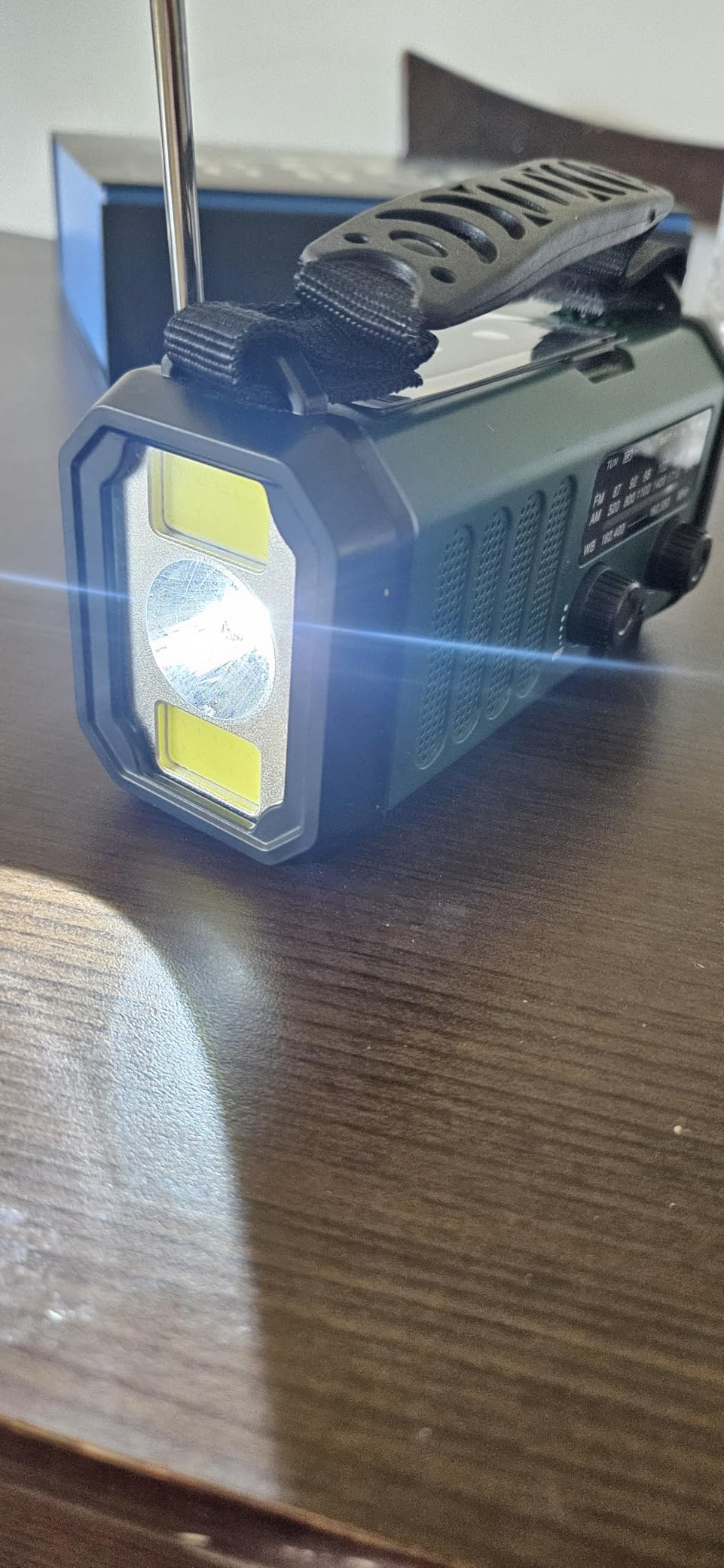
The layout suits older users, with large physical controls, a 3 watt speaker and a simple arrangement that needs no learning curve. The body compacts to roughly 6.3 by 3.5 by 3.1 inches in an ABS housing, and the package includes the radio, a USB-C cable and a manual with a 1-year warranty.
Now the part that changes its role entirely: there is no S.A.M.E. technology and no automatic NOAA alerting. The NOAA 162.400 to 162.550 MHz channels must be tuned manually and monitored by ear, which means no unattended overnight siren.
Is it worth owning alongside a home radio?
Yes, and that is the honest case for it. As a go-bag or shed companion where reception and water matter more than county filtering, the battery and IPX6 rating make it hard to beat at this capacity.
The oversized controls and simple layout also help if the person who will actually grab it in the dark is an older relative rather than you.
Why it will not wake you asleep
Manual tuning is the deal-breaker for a bedroom. You tune a NOAA channel and you listen, and if you are asleep there is no siren going off for your county, so it cannot replace a dedicated alert console on a nightstand.
There is also no headphone jack, so private late-night listening is not possible, and no shortwave band. Solar and crank are top-up methods, and the body is bulkier and heavier than the 5000mAh units it competes with.
6. Mesqool CR1030: Best for Sound and Reception
Mesqool Emergency Weather Radio NOAA Alert with Battery Backup 12000mAh
12000mAh cell with five power paths
8500mm2 monocrystalline solar panel
5 watt speaker
3 year warranty
Pros
- Highest average rating in the set at 4.7
- Reception and sound owners use daily
- Extra-large monocrystalline solar panel
- 12000mAh cell topped up by solar alone
- 3 year replacement warranty
Cons
- Higher cost than similar-capacity multi-power units
- Crank and solar are top-up methods only
- No S.A.M.E. county filtering
The Mesqool CR1030 is the one that gets recommended to people who want to actually listen to it. At 4.7 stars from 1095 ratings with 85 percent five-star and only 2 percent one-star, the review distribution is the strongest in this group, and owners repeatedly describe reception and audio quality good enough to use as a daily kitchen or garage radio.
Reception is handled by a high-sensitivity signal chip with noise reduction and an extended antenna across NOAA, FM and AM, feeding a 5 watt speaker. That is the largest speaker in the roundup, and it is the difference between an alert you can hear from another room and one you cannot.
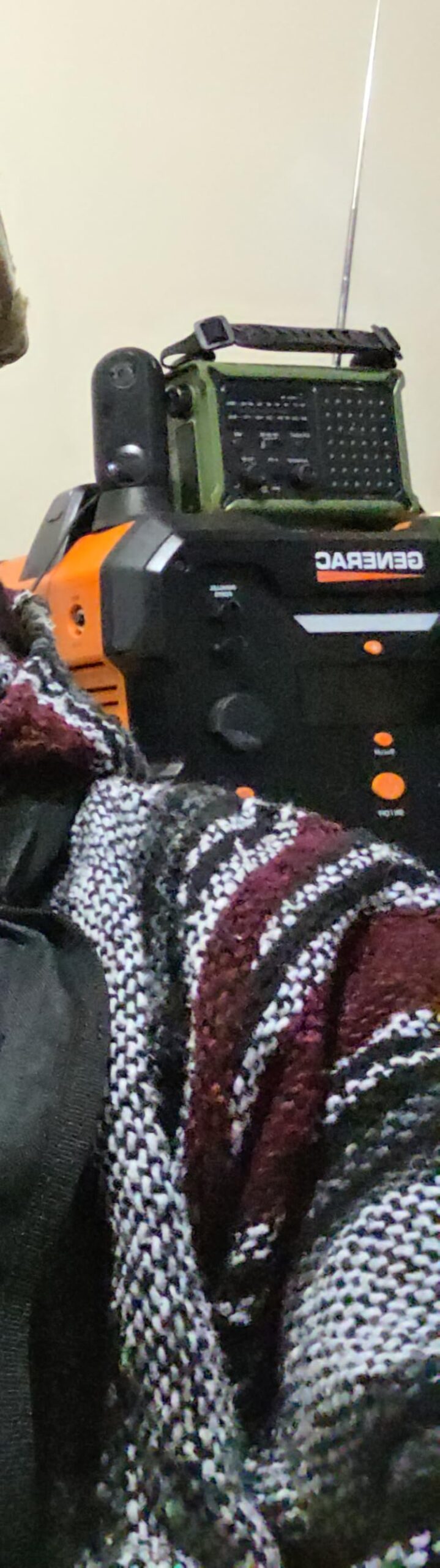
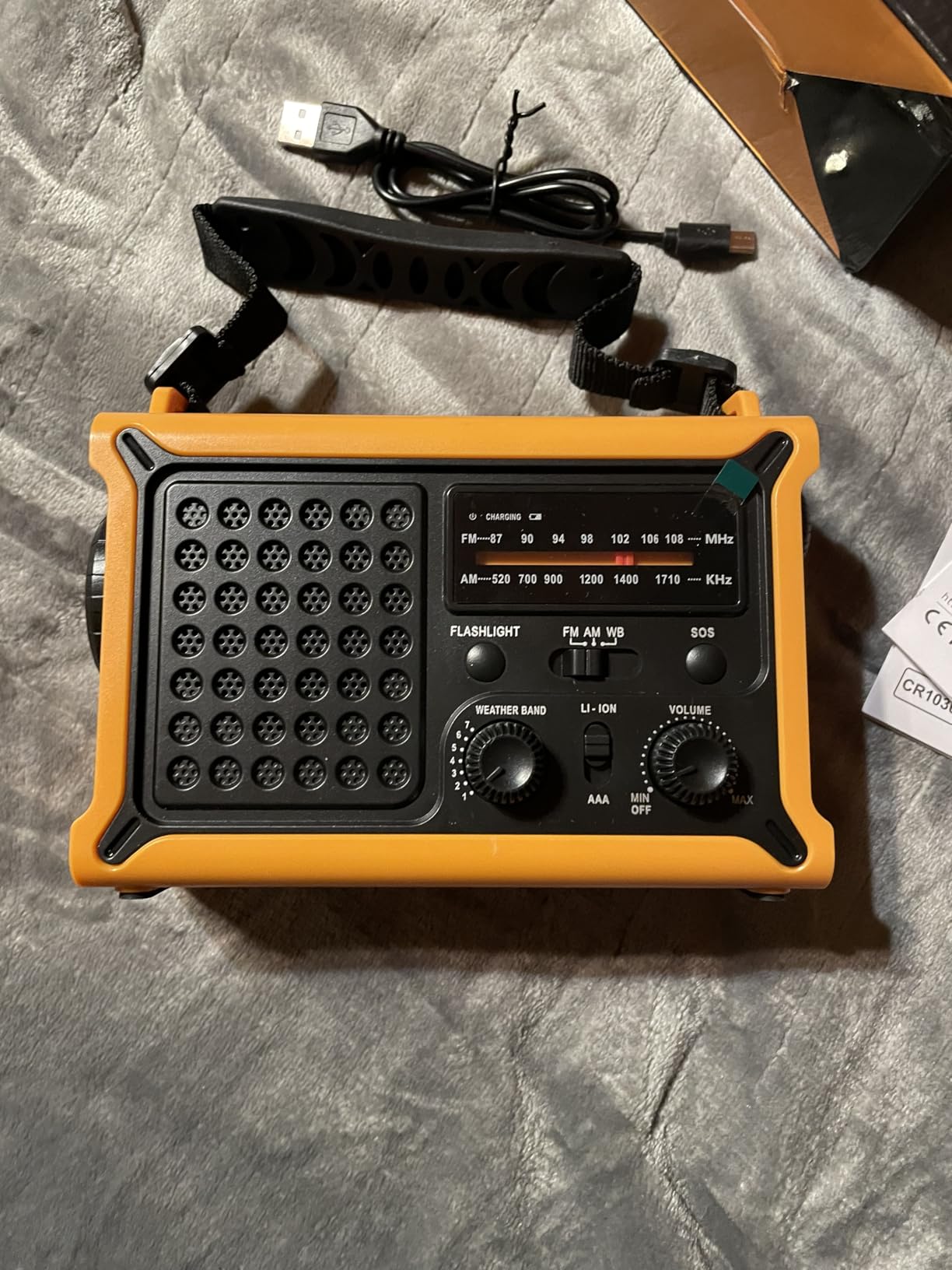
The charging story is unusually well thought through. Alongside the 12000mAh lithium cell there is an 8500mm2 monocrystalline solar panel, described by owners as sturdier and faster than the decorative polysilicon panels on cheaper units, plus an upgraded hand crank with a larger copper coil, Type-C 5V/2A input, and 3 AAA cells. Reviewers report running it all night at low volume and topping it up on solar alone.
Two brightness levels are offered on both the flashlight, with a beam reaching 260 feet, and a flip-up frosted reading lamp. The body is an ergonomic 6.8 by 4.7 by 2.9 inch design with a large tuning knob and a non-slip grip that works in the dark, and the warranty is a 3 year replacement or refund term, the longest fixed coverage in the roundup.
Does the larger solar panel make a real difference?
Reviewers treat it as the standout feature and report it keeping the battery topped up in practice, including through overnight camping where the unit was rained on without stopping playback. It is still a maintain-and-top-up path rather than a way to bring a dead battery back.
The five power paths are the more durable advantage. With AAA cells and Type-C as fallbacks, a worn internal cell does not end alerting, which is the failure mode that retires most multi-power radios.
What it does not do
It has no S.A.M.E. county filtering, so it works like a regional monitor rather than a targeted home console. With analogue-style tuning you also cannot customise which alert types interrupt you.
It also sits above other multi-power units of the same cell capacity on our shortlist, and its 1095 ratings are a thinner base than most of this list, so the long-term picture rests on a smaller sample than the headline rating suggests.
7. RunningSnail MD329: Best for Full Alert Control
RunningSnail NOAA Weather Radio with 80+Emergency Alerts, 23 S.A.M.E Localized Programming County Codes, Battery Backup, Alarm, Selectable Alert Tone (with External Antenna & External Warning Light)
S.A.M.E. for 23 counties
80+ toggleable alert types
110dB siren with voice and visual
54+ hours on 3 AA
Pros
- S.A.M.E. single multiple and all-county modes
- 80+ alert types with individual toggles
- Voice siren and visual alert modes
- 110dB maximum siren output
- 54+ hours of AA backup
Cons
- 4.2 rating with 9% one-star reviews
- NOAA band only with no AM or FM
- AC mains only with no solar or crank
No other radio in this roundup gives you this much control over what wakes you. The RunningSnail MD329 supports S.A.M.E. programming with All, Multiple and Single County modes across up to 23 county codes, and 80 or more pre-set alert types that each get their own on or off toggle. You can silence advisory-level chatter and keep tornado warnings live, which is exactly what first-time buyers ask for.
Loudness is the headline spec. Maximum siren output is 110dB, and there are three presentation modes, voice, siren and visual, so a household member who cannot rely on audio still gets a flashing display. On power it runs from 110V AC mains with a 3 AA battery backup rated at over 54 hours, which covers a multi-day outage.
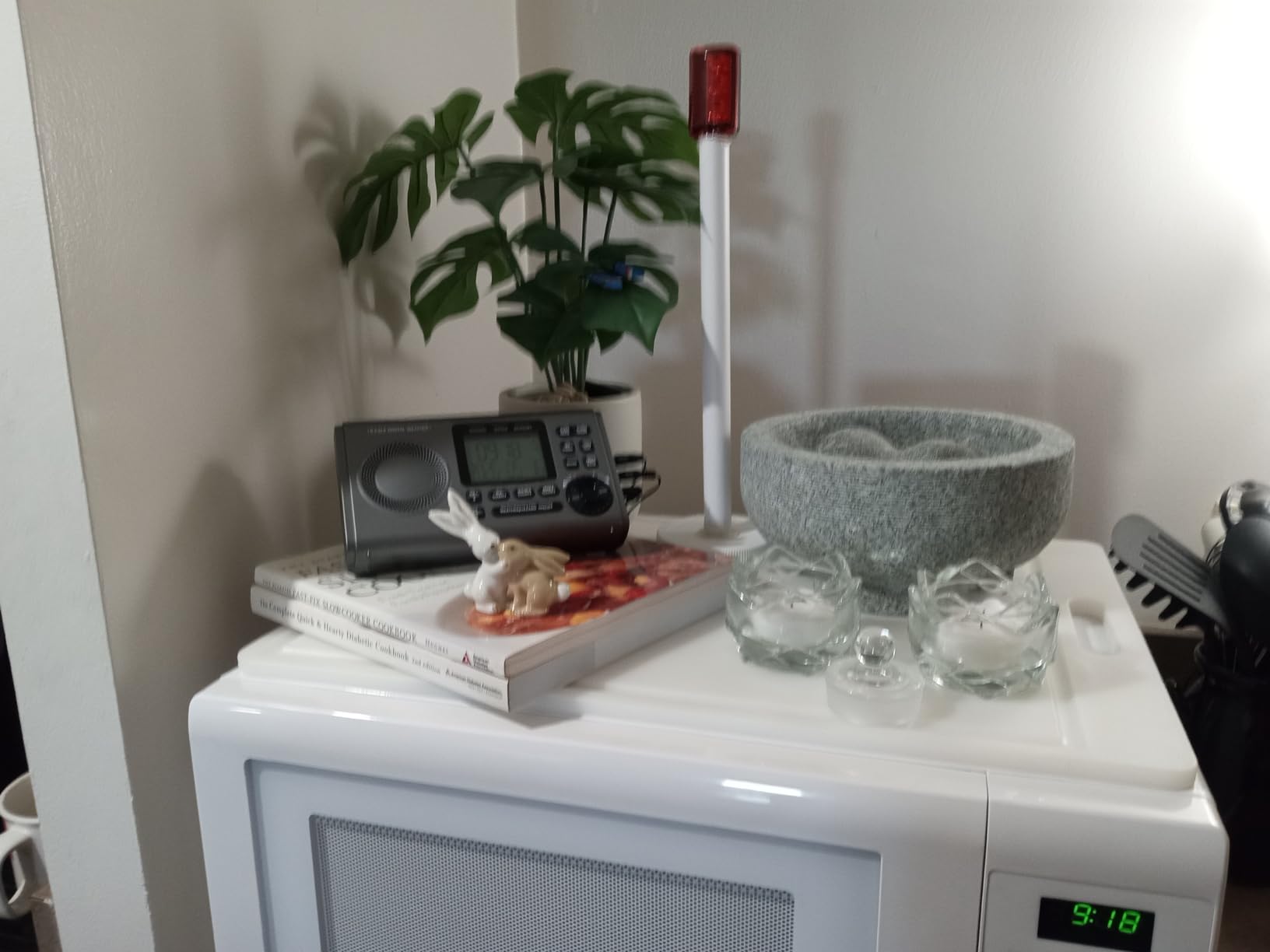
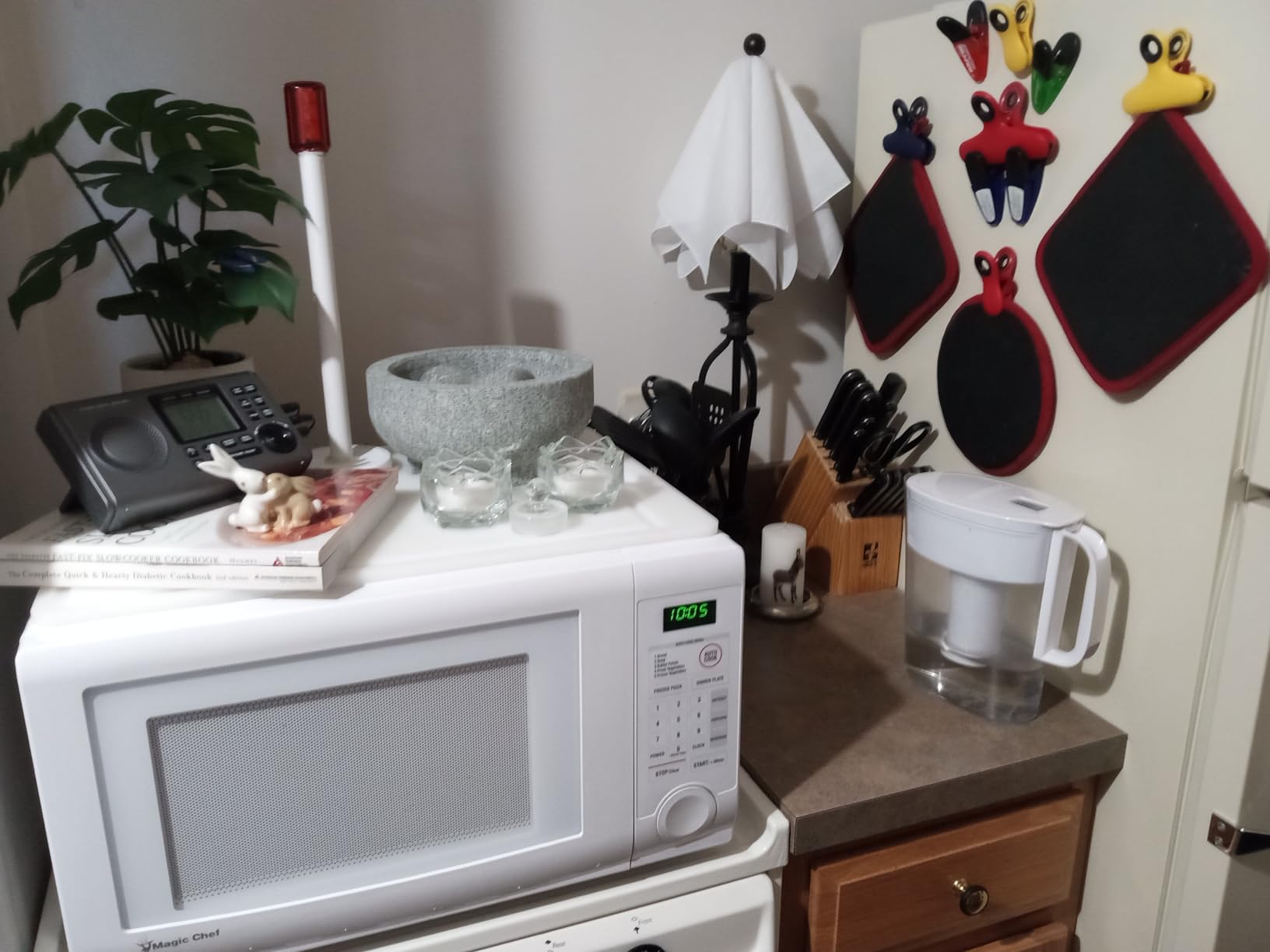
It also works as a bedroom unit. A digital clock with 12 or 24-hour display, the date, a smart alarm and a 9-minute repeatable snooze mean it can replace a nightstand clock, and the backlit display with knob controls for alarm, volume and siren test is easy to operate in the dark. An external antenna and an external warning light are included in the box, which is helpful if the radio is not in the room with you.
Its rating is the lowest in this roundup at 4.2 from 2011 ratings, with 9 percent one-star reviews, though the complaints cluster around build and feel rather than alerting function. Two practical notes: it is the largest tabletop unit here at 9.4 by 5.7 by 2.6 inches, and the AA backup cells are not included.
Can I set it to only alert for tornado warnings?
Yes, and that is the clearest use for it. With 80 or more alert types each individually toggleable, you can switch off the routine ones and leave the serious ones live, which stops the fatigue of being woken for events that never affect you.
The Single County mode is also useful for a second property. A house at the lake or a rental unit can be programmed to a different county on the same radio without carrying two devices.
What you give up
It is NOAA band only, with no AM or FM, so it is a dedicated alert console rather than something you would also use for music or talk radio in the kitchen.
Power is AC mains with AA backup only. There is no hand crank, solar panel or phone charging, so in a long outage the 54 hours of AA runtime is the hard ceiling. The 4.2 rating also means you should expect some build-quality complaints that do not show up in the feature list.
8. DreamSky DS6227: Best Value with S.A.M.E. Coding
DreamSky Weather Radio NOAA Alert with Battery Backup & FM Radio for Home
S.A.M.E. for 23 county codes
80+ alert types in three modes
AC adapter plus 3 AA backup
FM radio and alarm clock
Pros
- S.A.M.E. filtering locks onto your county
- 80+ alert types in voice tone and display modes
- AA backup keeps it alive when mains fail
- FM radio and alarm clock for daily use
- 1 year replacement warranty
Cons
- Thinnest review base at 208 ratings
- Reports of missed tornado warnings
- Alerts can stay latched past expiration
The DreamSky is here because it does the one thing the cheaper multi-power radios cannot. It is NOAA certified with S.A.M.E. county programming across 23 customizable county codes, so it filters out regional broadcasts that do not concern you, and it pairs that with 80 or more official NOAA alert types across voice, tone and display modes with colour-coded severity indicators.
For daily use it is more than an emergency box. A digital FM radio handles everyday news and music, an alarm clock with snooze covers the morning, and the LCD has three backlight modes, always on, always off, or on for 5 seconds, so you can set it for a bedside rather than a workbench. The housing is a compact 5.8 by 5.1 by 1.9 inches and it runs from an AC adapter with 3 AA alkaline backup.
The problem is the evidence base, not the feature list. At 208 ratings and 4.2 stars with 10 percent one-star reviews, this is the thinnest sample and the highest one-star share in the roundup, and the negative reviews focus on two functional issues rather than cosmetics: a unit that failed to sound during real tornado warnings after being programmed correctly, and alerts that stay displayed indefinitely past their expiration time with no clear reset.
Owners also describe plasticky build, and one reviewer frames it as a lighter version of a Midland WR-120 with the same siren as the RunningSnail MD329. There is no hand crank, solar or phone charging, and the AA cells are not included.
Is it fine as a second unit in a spare room?
For a secondary location where you want county filtering on a budget, the feature set is genuinely adequate. Dual power means it can be plugged in and switch to AA automatically when mains fail, and that is the configuration it is best suited to.
Keep it away from the room where you sleep, though. Latched alerts with no reset and reports of missed warnings make it a poor choice to trust as your only warning device.
What to check before you rely on it
Test the siren and confirm a live alert comes through on the day you set it up, using the S.A.M.E. walkthrough below. If your county is right, the alert path works, and you can be reasonably confident it will work again.
Keep spare AA cells on hand before you need them, since they are the entire backup path and none are supplied. If the unit ever latches an expired alert, a power cycle clears the display.
How to Set Up S.A.M.E. County Alerts on Your Radio
S.A.M.E., short for Specific Area Message Encoding, is what turns a radio that shouts at you into a radio that only shouts about your county. It is also the step where most people give up, and it is worth ten minutes because the alternative is a device that cries wolf for neighbouring counties all season.
Before anything else, note that a commenter in r/NOAA put it better than we can: all Midland radios are good, and you can call your local National Weather Service office to see if they will help you set it up. That assistance is free, and the office already knows the codes for its own coverage area. If you are anywhere near your county border, ask them which transmitter actually covers your address, because that determines the channel too.
Find your county code. Search your county name with the term S.A.M.E. code, or ask your local NWS office. The code is a six-digit FIPS number and it is not the same as your area code or ZIP.
Power the radio on the AC adapter first. On units like the Midland WR120B, the county menu is not available in battery mode, which is a common first-day stumble.
Open the S.A.M.E. or County menu. On the Midland WR120B this is a dedicated button; on the RunningSnail MD329 and the DreamSky it sits in the settings menu alongside the channel and alert-type lists.
Select Single County mode. Multiple or All modes are useful for a second property or a travelling radio, but Single is what you want for a fixed home address.
Enter the six-digit code and confirm. If your county has partial coverage, add the neighbouring code too, or you will miss warnings that only affect part of your area.
Set the NOAA channel. Turn the telescoping antenna fully up and extend it before scanning, then let the radio find the strongest station. Skipping this is the second most common reason people get poor reception later.
Filter the alert types. Each model lets you toggle event types individually. Switch off the advisory and statement level events and leave warnings and watches live, which is how you get tornado-only alerting without missing anything serious.
Set the volume and test the siren. Run the siren test, walk into the room you sleep in, and confirm you can hear it. If you cannot, move the radio or add a second one.
Save a second county if needed. If you own a rental, a cabin, or plan to move, programming a second code now saves a future afternoon.
Two maintenance notes for long-term ownership. If your radio uses AA or AAA backup cells, remove them if the unit will sit unused for months, because leakage in a compartment is the most common cause of a radio that fails when you finally need it. And test the backup path twice a year by unplugging the radio and confirming it still receives an alert.
Our guide to building an alert system that actually wakes you up in time covers the same principle for sky-watching alerts, and the same testing discipline applies.
Free NOAA Alternatives: Do You Even Need to Buy a Radio?
Possibly not, and the honest answer is worth stating before you spend anything. Wireless Emergency Alerts on your phone and the National Weather Service app are free, and for tornado warnings, flash flood warnings and severe thunderstorm warnings in a populated area with good coverage, they are often the fastest alert you will get.
They share one failure mode: they need a powered device and a working network. A power outage takes out your Wi-Fi router and often your cellular signal at the same time, and a phone sitting on a depleted battery in a drawer is not an alert system. If you live in a rural area, a valley, or anywhere with known coverage gaps, that gap is permanent rather than storm-related.
There is also a free hardware path. Local National Weather Service offices have run programmes providing alert radios to households in vulnerable areas, and community emergency preparedness groups distribute them during preparedness seasons. If cost is the deciding factor, calling your local NWS office is the first move, since they can also tell you which transmitter serves your address.
Our view: use the phone apps as your primary layer, and add a radio as the layer that works when the power is out. The two together cover far more failure modes than either alone. For the wider kit thinking, see our guide to hand crank weather radios as well.
Troubleshooting Weak NOAA Reception
Intermittent reception is almost always fixable, and the order below is the diagnostic order we would use, because the causes run from cheapest to most expensive.
Extend the telescoping antenna fully and upright. A radio sitting with a collapsed antenna is the single most common cause of poor reception indoors.
Move the unit away from metal. Televisions, computers, metal shelving and appliances mounted near a window will block the signal. An interior wall between the radio and the outside degrades reception sharply.
Raise the radio position. A windowsill or a high shelf close to the roof line usually performs better than a countertop in a closed room.
Confirm your NOAA channel. A specific channel serves specific areas, and a channel that is strong at a neighbour’s address can be weak at yours. Try more than one of the seven channels before concluding the radio is faulty.
Check your county code. A code set to a neighbouring county will leave you waiting for an alert that never names you, which feels exactly like a reception problem.
Check power state. On units with battery backup, a radio running low on AAA cells may receive but fail to sound an alert loudly enough to hear.
Compare digital against analogue. Analogue broadcast radio is sometimes more forgiving in fringe areas than digital receivers, so keep a second reference unit nearby while you test.
If none of that helps, the next question is whether your area has a nearby transmitter. NOAA coverage is good but not uniform, and rural locations can sit between stations. A phone call to your local NWS office resolves this faster than any amount of testing, because they can tell you the expected signal strength at your address and which antenna to use.
Weather Alert Radio Buying Guide for Homes
What NOAA radio access actually gives you
NOAA radio access means the radio receives the National Weather Service broadcast network continuously, including 24-hour rolling forecasts, watches, warnings and emergency messages. Every radio in this roundup has it, so it is a baseline requirement rather than a differentiator, and it is the reason a radio keeps working when internet service does not.
Plug-in desktop or portable multi-power: which fits a home
These solve different problems. A plug-in desktop unit, like the Midland WR120B or the RunningSnail MD329, gives you the best alerting, S.A.M.E. county filtering, a real display and a loud siren, and it is the right choice when mains power is reliable. A portable multi-power unit gives you resilience: crank, solar and internal cells, but usually no county filtering and a less informative display.
Our recommendation is to own one of each. Keep the plug-in console on the nightstand for alerting, and a multi-power unit in the go bag or the car for the scenario where the house itself is the problem. If you can only buy one, buy the plug-in console for most homes.
S.A.M.E. county programming is the feature that matters most
S.A.M.E. limits alerts to the codes you enter. In a region where several counties share a transmitter, a radio without it will wake you for counties you do not live in, and people stop responding to it. Three of the eight radios here have it, and for a home that is the dividing line between a device you will trust and one you will learn to ignore.
Power sources and realistic battery life
Mains power with battery backup is the baseline for a home. Below 4000mAh, treat the cell as a bridge across a short outage rather than a reserve. Between 10000mAh and 12000mAh you get overnight-plus listening and a meaningful phone top-up, which is the range the multi-power units here occupy.
Treat hand cranks and solar panels as top-up methods, not recharge paths, and reviewers across the category make the same point. Panels maintain a charged battery; they rarely revive a dead one. Our broader guide to SDR radios for beginners covers reception options for anyone who wants to go further than broadcast reception.
Loudness, placement and accessibility
Siren output is the specification that decides whether you wake up. The RunningSnail MD329 specifies 110dB at maximum, and the Midland WR120B’s 2.5W speaker is what owners describe as waking light sleepers. Placement is the free part of this: put the radio where the sound has a path to you, keep it out of a metal cabinet, and run the siren test from your bed rather than from the sofa.
For a household with a hard-of-hearing member, prioritise visual alert modes and external warning lights over raw volume, since the RunningSnail’s included external light is usable from another room. For anyone who cannot operate small controls, the Leaton’s oversized buttons are the practical pick.
What to leave off your shopping list
Skip features you will not use in an emergency. A 16-band receiver and a shortwave set do not change whether you are warned about a tornado, and a device carrying everything often does the important parts poorly. What matters is county filtering, a siren that reaches you, and at least two independent power paths.
Frequently Asked Questions
What is the best weather alert radio for home?
The Midland WR120B is the best weather alert radio for most homes. It is a plug-in NOAA receiver with S.A.M.E. county programming for up to 25 counties, 60 or more alert types, an AC adapter with AAA battery backup, a backlit LCD and a built-in alarm clock. With over 24000 ratings it has the deepest owner history in this roundup. If you want finer control over which event types interrupt you and a louder specified siren, the RunningSnail MD329 is the alternative.
Can I limit alerts to just tornado warnings?
On the radios that carry S.A.M.E. with per-event toggles, yes. The Midland WR120B covers 60 or more alert types, and the RunningSnail MD329 and DreamSky DS6227 each cover 80 or more types with individual on and off switches, so you can disable advisory and statement level events and leave warnings and watches live. Radios without S.A.M.E. cannot filter at all and will sound for every county in range.
Why is my NOAA weather radio getting bad reception?
Work through it in order. Extend the telescoping antenna fully and upright, move the radio away from metal and appliances, raise it near a window or high shelf, and try more than one of the seven NOAA channels. Then confirm your county code matches your address, because a neighbouring county code feels exactly like a reception fault. If it still fails, your local National Weather Service office can tell you the expected signal strength at your address.
Can I get a NOAA weather radio for free?
Sometimes. Wireless Emergency Alerts on your phone and the National Weather Service app are free and cover most warnings in populated areas. Local National Weather Service offices have also run programmes providing alert radios to households in vulnerable areas. For setup help, your local office will help program your S.A.M.E. county at no cost, which is worth knowing before you buy the wrong unit.
Do I need a weather radio if my phone has emergency alerts?
Most households benefit from both. Phone alerts are often the first warning you get, but they depend on a powered device and a working network, and a power outage can take out your router and cellular coverage at the same time. A radio draws its own power and keeps receiving, so it is the layer that still works when the house is dark and the signal is gone.
Why is Canada phasing out weather radios?
This roundup focuses on the United States NOAA network, which remains active and is the system every product here is built around. Canada has been moving away from its own broadcast alerting infrastructure, so if you are outside the US, check that your radio’s S.A.M.E. codes are supported in your country before buying. The Midland WR120B codes cover the US and Canada only.
Final Verdict for the Best Weather Alert Radio for Home
For most households the answer is the Midland WR120B, and it wins on evidence rather than novelty: S.A.M.E. programming for up to 25 counties, 60 or more alert types, mains power with AAA backup, and the deepest owner history of any home alert radio we have reviewed.
The rest of the awards are shorter. The FosPower A1 takes the budget slot thanks to its charging bank and three power paths. The Eoxsmile 12000mAh model takes multi-day power with the largest cell in the group. The Raynic CR1009Pro suits a go bag, the Leaton takes outdoor durability on its IPX6 rating, the Mesqool CR1030 wins on sound and reception, the RunningSnail MD329 wins on alert control with 80 or more toggleable types and a 110dB siren, and the DreamSky DS6227 is the value pick that still filters by county.
Whichever you choose, program your S.A.M.E. county before the first storm, extend the antenna, and run the siren test from your bed. If you want a second layer, our picks for the best NOAA weather radios for emergencies cover more of the portable end.