
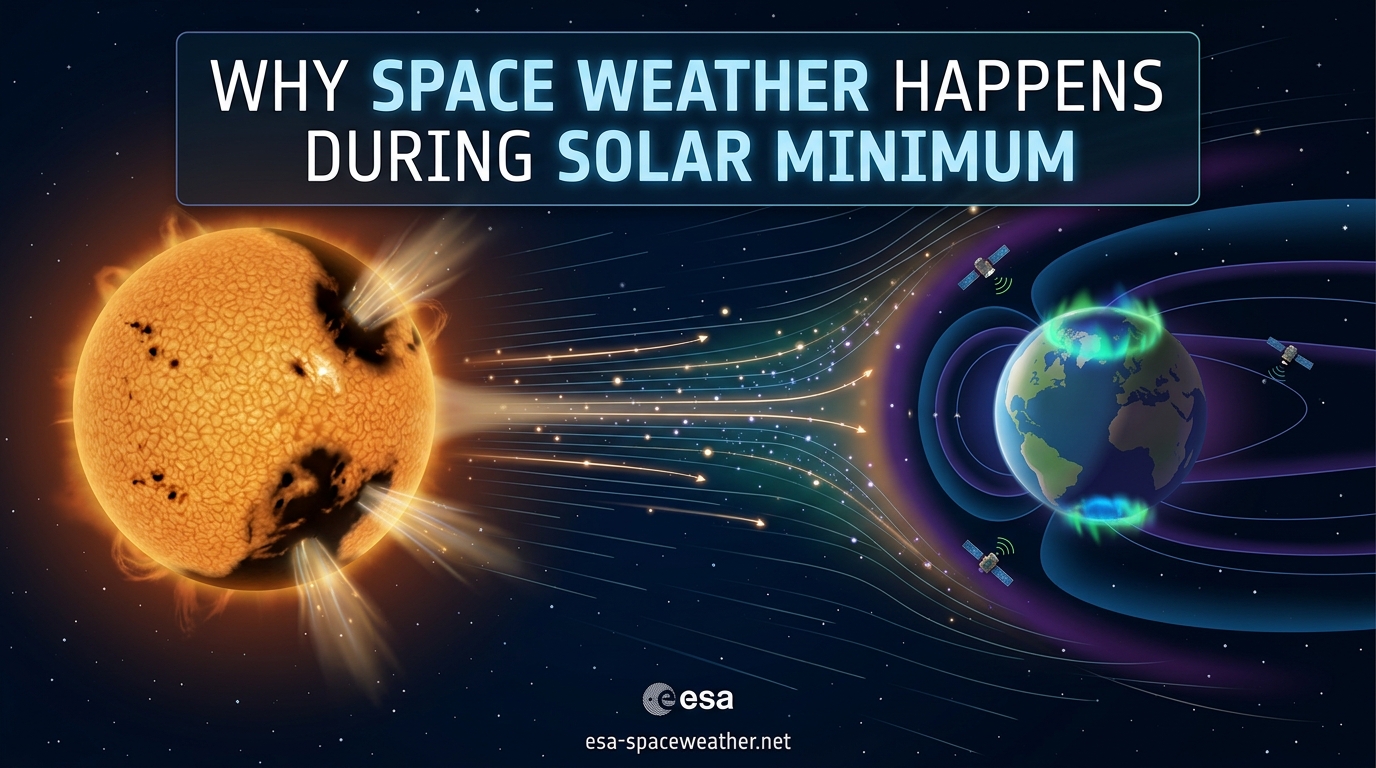
If you have been tracking space weather for any length of time, you have probably noticed something that seems contradictory. The Sun goes quiet during solar minimum, yet auroras still light up the sky, GPS signals still glitch, and radio operators still complain about degraded bands. Why space weather keeps happening even during solar minimum is one of the most commonly misunderstood aspects of the solar cycle, and the answer comes down to a feature of the Sun that most people have never heard of: coronal holes.
Our team has spent years monitoring solar wind conditions, tracking coronal hole positions, and analyzing geomagnetic activity data across multiple solar cycles. The pattern is remarkably consistent. Every time the Sun approaches minimum, observers expect things to calm down, and every time, space weather continues, just in a different form.
The confusion stems from equating “space weather” with “sunspots and solar flares.” Those explosive phenomena do decline dramatically during solar minimum. But space weather is broader than flares and coronal mass ejections. High-speed solar wind streams, cosmic ray surges, and persistent geomagnetic disturbances continue throughout every phase of the 11-year solar cycle, including its quietest stretches.
In this article, we will break down exactly why space weather keeps happening even during solar minimum, what drives it, how the effects differ from solar maximum, and what anyone who relies on satellites, radio, GPS, or aviation systems needs to know about the risks that persist when the Sun appears to be at rest.
Table of Contents
The Short Answer: Coronal Holes Keep Space Weather Alive
Space weather keeps happening even during solar minimum because coronal holes, which are large regions of open magnetic field lines in the Sun’s corona, become more common and more persistent during this phase. These coronal holes allow continuous streams of high-speed solar wind to escape into space and wash over Earth, producing geomagnetic storms, auroras, radio disruptions, and satellite effects even when sunspot counts are near zero. While coronal mass ejections and major solar flares drop off sharply during minimum, coronal hole high-speed streams more than pick up the slack.
That is the core answer, but the full story is richer. To understand why this happens, we need to look at what solar minimum actually is, how coronal holes form, and why the Sun’s magnetic field behaves the way it does at each stage of its cycle.
What Is Solar Minimum?
Solar minimum is the phase of the approximately 11-year solar cycle when the Sun’s magnetic activity is at its lowest. During this period, sunspot counts drop to their lowest levels, solar flares become rare, and coronal mass ejections occur far less frequently. The Sun’s visible disk can go weeks or even months without a single sunspot.
The solar cycle oscillates between two extremes: solar minimum and solar maximum. At solar maximum, the Sun is covered in active regions, sunspots are abundant, and explosive events like X-class flares and Earth-directed CMEs happen regularly. At solar minimum, the Sun looks deceptively calm. But “calm” in terms of visible features does not mean calm in terms of space weather.
The Sun’s magnetic field drives the entire cycle. Every 11 years, the Sun’s magnetic polarity flips, and during the transition, activity rises and falls. Solar minimum marks the point where the magnetic field is in its most reorganized, simplified state, and this specific magnetic configuration is exactly what allows coronal holes to thrive.
Why Space Weather Keeps Happening Even During Solar Minimum: The Coronal Hole Connection
The key to understanding why space weather keeps happening even during solar minimum lies in coronal holes. These are dark, cool regions visible in extreme ultraviolet imagery of the Sun’s corona. They appear dark because they are less dense and cooler than the surrounding plasma, but their visual appearance is not what makes them important. What matters is their magnetic structure.
In most of the Sun’s corona, magnetic field lines form closed loops. Plasma is trapped along these loops, building up until it is released in explosive events like flares and CMEs. Coronal holes are different. Their magnetic field lines are open, meaning they extend far out into interplanetary space rather than looping back to the solar surface. These open magnetic field lines act like channels, allowing solar wind plasma to continuously stream outward at high speeds.
Here is where the solar cycle comes in. During solar maximum, the Sun’s magnetic field is complex and chaotic, with active regions dotting the surface. Closed magnetic loops dominate, and coronal holes are relatively small and short-lived. During solar minimum, the Sun’s magnetic field simplifies. The polar magnetic field becomes more organized and dominant, and large, persistent coronal holes form, especially at the Sun’s poles. These polar coronal holes can last for months or even years, persisting through multiple solar rotations.
Studies from the SETI Institute and NOAA’s Space Weather Prediction Center confirm that coronal holes not only open more frequently during solar minimum but also tend to grow larger and more persistent. Some of these coronal holes extend from the polar regions toward the solar equator, putting them directly in Earth’s line of sight as the Sun rotates.
This is the fundamental reason why space weather during solar minimum does not stop. The explosive, dramatic events like CMEs decline, but the steady, persistent outpouring of high-speed solar wind from coronal holes actually increases. The character of space weather changes, even if the overall level of geomagnetic activity does not drop to zero.
How Coronal Holes Create Geomagnetic Storms
Understanding how coronal holes translate into space weather effects on Earth requires looking at what happens when their high-speed solar wind reaches our planet. Solar wind from coronal holes travels at speeds of 500 to 800 kilometers per second, significantly faster than the typical slow solar wind speed of about 300 to 400 kilometers per second.
When a fast-moving coronal hole solar wind stream overtakes the slower ambient solar wind ahead of it, a compression zone forms. This zone is called a co-rotating interaction region, or CIR. CIRs are the specific mechanism responsible for most geomagnetic storms during solar minimum, yet they are barely discussed outside of technical NOAA briefings.
A CIR is essentially a pile-up of solar wind plasma. As the fast wind plows into the slower wind, plasma gets compressed, creating a region of intensified magnetic fields and denser particle populations. When this compressed region reaches Earth, it slams into the magnetosphere and triggers geomagnetic activity. The interaction between the CIR’s enhanced magnetic field and Earth’s magnetosphere drives charged particles into the upper atmosphere, producing auroras, ionospheric disturbances, and ground-level magnetic fluctuations.
What makes coronal hole space weather particularly notable is its predictability and recurrence. The Sun rotates approximately once every 27 days, and persistent coronal holes that survive multiple rotations will send a high-speed stream toward Earth on each rotation. This means the same coronal hole can produce recurring geomagnetic storms every 27 days, a pattern that space weather forecasters track closely during solar minimum.
This recurrent behavior is very different from the sporadic, unpredictable nature of CME-driven storms during solar maximum. CME storms strike with little warning, while coronal hole streams are visible on the Sun days before they arrive and repeat on a predictable cycle. However, the effects on Earth, including auroras, radio disruptions, and satellite anomalies, can still be significant.
Solar Maximum vs Solar Minimum: How Space Weather Changes
One of the biggest gaps in existing coverage of this topic is a clear, side-by-side comparison of how space weather differs between the two extremes of the solar cycle. The differences are not just about intensity. The entire character of space weather shifts.
During solar maximum, space weather is dominated by explosive, transient events. Solar flares erupt from active regions, releasing intense bursts of X-rays and ultraviolet radiation that can cause radio blackouts on Earth’s sunlit side within minutes. Coronal mass ejections launch billions of tons of plasma into space, and when Earth-directed, they can trigger severe geomagnetic storms within one to three days. These storms can be intense, reaching G4 or G5 on the NOAA space weather scale, and they are unpredictable in both timing and severity.
During solar minimum, the picture changes completely. Solar flares and CMEs become rare, with only occasional small events. Instead, space weather is driven by coronal hole high-speed solar wind streams and the co-rotating interaction regions they produce. These streams are weaker per-event than major CMEs, typically producing G1 to G2 geomagnetic storms, but they are far more persistent and predictable.
Another major difference is the cosmic ray environment. During solar maximum, the Sun’s enhanced magnetic field and stronger solar wind provide shielding throughout the heliosphere, deflecting galactic cosmic rays away from the inner solar system. During solar minimum, this shielding weakens. Researchers have documented a significant surge of cosmic rays penetrating the solar system during solar minimum, as noted in research published by the Journal of Space Weather and Space Climate. This cosmic ray increase has real implications for aviation radiation exposure and satellite electronics.
Satellite drag also changes between the two phases. The thermosphere, Earth’s uppermost atmospheric layer, expands and contracts with solar activity. During solar maximum, increased extreme ultraviolet heating causes the thermosphere to expand, increasing drag on low-Earth orbit satellites. During solar minimum, the thermosphere cools and contracts, reducing satellite drag. This is actually one of the few benefits of solar minimum for satellite operators, though the increased cosmic ray radiation partially offsets this advantage.
In summary, solar maximum brings intense, sporadic, and unpredictable space weather driven by explosions on the Sun. Solar minimum brings milder but persistent and recurrent space weather driven by coronal holes, combined with a unique cosmic ray surge. Neither phase is “safe” from space weather effects.
Effects of Solar Minimum Space Weather on Earth
The practical effects of space weather during solar minimum are wide-ranging and affect multiple sectors. Understanding these impacts is critical for anyone who depends on technology that interacts with the space environment.
Aurora Visibility: Many people assume auroras disappear during solar minimum, but this is not the case. Coronal hole high-speed solar wind streams regularly produce visible auroras at high latitudes, and occasionally push the auroral oval far enough south to be visible from mid-latitudes. Aurora watchers and photographers actively track coronal hole positions to predict display opportunities during minimum, and many report successful sightings even during the quietest periods of the solar cycle.
Radio Communications: Amateur radio operators are among the most affected groups during solar minimum. The higher HF bands, particularly 10 through 20 meters, rely on ionospheric reflection for long-distance propagation. During solar minimum, reduced ionization in the ionosphere means these bands become unreliable or unusable for extended periods. Ham radio operators on Reddit and community forums consistently report that band conditions deteriorate significantly during minimum, making long-distance communication much harder. This is one of the most directly experienced effects of space weather during solar minimum by ordinary people.
GPS and Navigation Systems: Ionospheric disturbances caused by coronal hole geomagnetic storms can introduce errors into GPS positioning. While single-frequency civilian receivers are most affected, even dual-frequency systems can experience degraded accuracy during active geomagnetic periods. These effects do not disappear during solar minimum; they simply occur with different drivers and timing compared to solar maximum.
Power Grid Fluctuations: Geomagnetic storms induce electrical currents in long conductors on Earth, including power transmission lines. During solar minimum, the typically milder G1 to G2 storms from coronal hole streams are less likely to cause widespread grid failures than the major storms of solar maximum. However, they can still produce voltage fluctuations, transformer stress, and pipeline corrosion over time, particularly at high latitudes where geomagnetic activity is most intense.
Satellite Operations: During solar minimum, reduced thermospheric drag is a benefit for satellite operators, as it means less fuel is needed for station-keeping. However, the surge in galactic cosmic rays during minimum introduces a different risk. Cosmic rays can cause single-event upsets in satellite electronics, leading to data corruption or temporary malfunctions. Satellite operators must account for this increased radiation environment even during the Sun’s quietest period.
Aviation Radiation Exposure: The cosmic ray surge during solar minimum has direct implications for aviation. High-altitude flights, particularly polar routes, expose crew and passengers to increased radiation from galactic cosmic rays. The UK Health Security Agency has highlighted this as a serious monitoring concern, noting that radiation exposure for aviation workers can be higher during solar minimum than during maximum. Airlines and regulatory bodies factor this into flight planning and crew scheduling during minimum periods.
Does Solar Minimum Mean Zero Space Weather Risk?
The short answer is no. Solar minimum does not eliminate space weather risk. It changes the nature of the risk, but it does not reduce it to zero, and in some categories, it actually increases specific hazards.
Coronal hole streams continue to produce geomagnetic storms throughout minimum, as we have discussed. These storms tend to be milder per event than CME-driven storms, but they occur more frequently and on a predictable 27-day cycle. The cumulative effect of repeated G1 and G2 storms over weeks and months can stress infrastructure just as much as a single, more intense event.
The cosmic ray surge during minimum is actually a risk that increases compared to solar maximum. With less shielding from the Sun’s magnetic field, more galactic cosmic rays reach Earth and the inner solar system. This raises radiation exposure for astronauts, high-altitude aviation crews, and even electronics in satellites and aircraft.
It is also worth noting that major space weather events can and do occur during solar minimum. While large CMEs are less common, they are not impossible. The Sun can still produce significant eruptions from the few active regions that appear during minimum. Historically, space weather events during what observers thought was a quiet period have surprised scientists and operators alike.
The Carrington Event of 1859, the most powerful geomagnetic storm on record, is sometimes discussed in the context of whether such an event could happen during minimum. While the probability is lower during minimum due to reduced active region activity, experts do not rule it out entirely. The Sun’s magnetic field is complex, and extreme events remain possible at any point in the cycle.
For infrastructure operators, the takeaway is clear. Monitoring and preparedness must continue year-round, regardless of where the Sun is in its cycle. The specific threats to watch for change between maximum and minimum, but the need for vigilance does not.
How Space Weather Is Monitored During Solar Minimum
Space weather monitoring does not pause during solar minimum. In fact, the different character of minimum-period space weather requires different forecasting approaches, and agencies have developed specialized tools and methodologies to track coronal holes and high-speed solar wind streams.
NOAA’s Space Weather Prediction Center (SWPC) is the primary authoritative source for space weather forecasts in the United States. The SWPC provides 3-day and 27-day outlooks that account for coronal hole activity, and their forecasts are widely trusted by both professional operators and amateur space weather enthusiasts. The 27-day outlook is particularly useful during minimum, as it corresponds to the solar rotation period and helps predict when recurring coronal hole streams will arrive.
Several satellites provide the data that makes this forecasting possible. The DSCOVR satellite, positioned at the L1 Lagrange point between Earth and the Sun, provides real-time measurements of solar wind speed, density, and magnetic field orientation. This data gives forecasters 30 to 60 minutes of warning before a solar wind stream reaches Earth. The GOES-R satellite series monitors the Sun in extreme ultraviolet wavelengths, allowing forecasters to identify and track coronal holes as they form, rotate across the solar disk, and evolve. NOAA’s SOLAR-1 mission, launched in 2026, further enhances monitoring capabilities with improved instrumentation for space weather observations.
For the general public and space weather enthusiasts, resources like SpaceWeatherLive.com provide accessible real-time data on solar wind conditions, coronal hole positions, and geomagnetic activity levels. Community forums and Reddit communities dedicated to space weather and amateur radio serve as platforms for observers to share firsthand reports and discuss current conditions.
The consensus among users and professionals alike is that NOAA SWPC remains the most trusted and authoritative source. Having multiple monitoring tools available means that anyone affected by space weather, from satellite operators to ham radio enthusiasts, can stay informed regardless of where the Sun is in its cycle.
FAQs
Do solar flares affect migraines?
There is no established scientific link between solar flares and migraines. Some individuals report headaches during periods of heightened solar or geomagnetic activity, but this has not been confirmed by peer-reviewed research. The primary health concerns associated with space weather involve radiation exposure for high-altitude aviation workers, astronauts, and polar-route passengers, not migraines or other neurological conditions.
Can an astronaut survive a solar storm?
Yes, astronauts can survive solar storms with proper protection. The International Space Station has designated radiation shelter areas with additional shielding, and mission control continuously monitors space weather forecasts. During a significant solar radiation event, crew members can take shelter in these protected zones until the storm passes. The primary risk is to astronauts outside the station on spacewalks, which is why extravehicular activities are carefully scheduled around space weather conditions.
How does the solar minimum affect weather on Earth?
Solar minimum has only a subtle effect on Earth’s climate. Studies suggest that even a grand solar minimum could cool global temperatures by no more than about 0.3 degrees Celsius, which would slightly slow but not reverse human-caused global warming. Earth’s weather patterns are driven primarily by atmospheric and oceanic dynamics, not by solar cycle variations. Claims about solar minimum causing a mini ice age are not supported by current climate science.
Is a solar flare going to hit Earth in 2026?
Solar flares occur regularly throughout the solar cycle, and many are directed toward Earth. Whether a significant flare will occur on any specific date cannot be predicted far in advance. NOAA’s Space Weather Prediction Center provides 3-day forecasts and real-time alerts for solar flare activity. For the most current information, check spaceweather.gov or the SWPC alert system. Solar Cycle 25 has been more active than initially forecast, meaning flare activity has been elevated in recent years.
Can solar flares still happen during solar minimum?
Yes, solar flares can and do occur during solar minimum, though they are far less frequent and generally weaker than during solar maximum. Even a single active region appearing on the Sun during minimum can produce a moderate flare. These events are less common but not impossible, which is part of why space weather monitoring continues year-round regardless of the solar cycle phase.
How long does solar minimum last?
Solar minimum is not a single point in time but a period that can last from several months to a couple of years within the approximately 11-year solar cycle. The transition from minimum to maximum is gradual, with solar activity slowly increasing as the new cycle gains momentum. The deepest part of minimum, when sunspot counts are lowest, typically lasts less than a year, but the extended low-activity period surrounding it can stretch longer.
Conclusion
Space weather does not take a vacation during solar minimum. While the Sun may look quiet and sunspot counts may hover near zero, coronal holes keep the engine of space weather running at full throttle. These regions of open magnetic field lines send continuous high-speed solar wind toward Earth, producing geomagnetic storms, auroras, radio disruptions, and satellite effects throughout every phase of the solar cycle.
The key insight is that space weather changes character between maximum and minimum, not in whether it exists. Explosive, unpredictable CMEs give way to persistent, recurrent coronal hole streams, and the cosmic ray environment actually intensifies during minimum. Whether you are a satellite operator, an amateur radio enthusiast, an aviation professional, or simply someone fascinated by auroras, understanding why space weather keeps happening even during solar minimum helps you stay prepared year-round.