
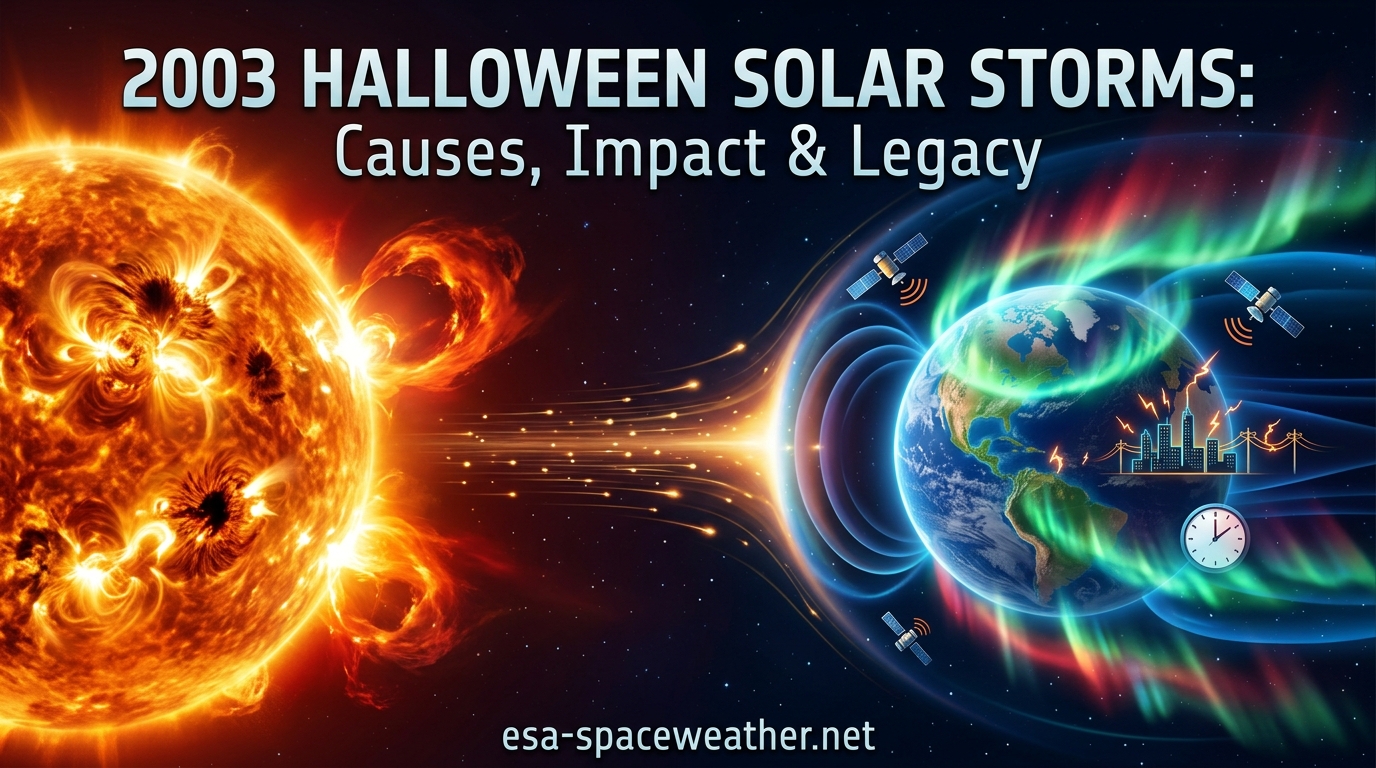
Late October 2003 brought more than just autumn weather. The Sun unleashed one of the most violent sequences of solar storms in recorded history, a barrage of flares and coronal mass ejections that disrupted satellites, power grids, aviation systems, and communications across the planet. These events, now known as the 2003 Halloween solar storms, demonstrated how deeply modern civilization depends on technology that is vulnerable to space weather.
The 2003 Halloween solar storms were a series of intense solar flares and coronal mass ejections that occurred from mid-October to early November 2003, peaking around October 28 and 29. They produced the largest solar flare ever recorded by the GOES satellite system, generated extreme geomagnetic storm conditions rated G5 on the NOAA scale, and forced astronauts on the International Space Station to take shelter from radiation.
In this article, our team walks through exactly what happened during those two weeks of solar chaos. We cover the science behind the storms, a day-by-day timeline of events, the specific satellites and spacecraft that were damaged, how power grids in Sweden and South Africa were affected, why GPS systems and aviation communications failed, and what these storms taught us about space weather preparedness. We also compare the Halloween storms to other legendary solar events like the Carrington Event of 1859 and the Bastille Day storm of 2000.
The Halloween storms of 2003 matter today because our reliance on satellite-based technology has only grown since then. Understanding how these storms disrupted global infrastructure helps us prepare for the next extreme space weather event, which scientists say is not a question of if but when.
Table of Contents
Quick Facts: The 2003 Halloween Solar Storms at a Glance
Here is a summary of the most important facts about the Halloween solar storms before we go into the full story:
- Date range: October 19 to November 7, 2003, with peak activity October 28 to November 4
- Largest flare: X45 (originally estimated at X28, later revised to X45), the most powerful ever recorded by the GOES system
- Peak flare date: November 4, 2003, from Active Region 10486
- Geomagnetic storm level: G5 (extreme) on the NOAA scale, reached on October 29 to 30
- Kp index: Reached 9, the maximum on the scale
- Ap index: Reached 204, one of the highest values ever recorded
- Solar cycle: Occurred during the declining phase of Solar Cycle 23, well after solar maximum
- Sunspot groups: Three massive groups designated 484, 486, and 488, with the largest measuring over 13 times the diameter of Earth
- Satellites affected: Numerous, including ADEOS-2 (lost), Mars Odyssey, SOHO, ACE, DMSP satellites, and others
- Power outages: Approximately 50,000 people lost power in Malmö, Sweden; transformer damage in South Africa
- Aviation impact: Polar flights rerouted for several days; HF radio blackouts lasting over two weeks
- Aurora visibility: Seen as far south as Texas, Florida, the Mediterranean, and parts of Australia
What Caused the Halloween Storms: The Solar Physics
The Halloween storms of 2003 were caused by the eruption of massive, magnetically complex sunspot groups on the Sun’s surface. These sunspots produced X-class solar flares and coronal mass ejections that directed enormous amounts of energy and charged particles toward Earth.
What made the 2003 events unusual was their timing. Solar Cycle 23 had already passed its peak, which occurred around 2000 to 2001. The fact that such extreme activity occurred during the declining phase of the solar cycle surprised many solar physicists and underscored how unpredictable space weather can be.
The Sunspot Groups: Active Regions 484, 486, and 488
Three enormous sunspot groups emerged on the Sun in late October 2003, each capable of producing major eruptions. NASA and ESA designated them Active Region 10484, 10486, and 10488, commonly shortened to regions 484, 486, and 488.
Active Region 10486 was the most active and dangerous of the three. It grew to a size over 13 times the diameter of Earth and possessed a highly complex magnetic field structure that astounded solar physicists. This region alone produced multiple X-class flares, including the record-breaking X45 event on November 4.
Active Region 10484 produced the first major flare of the sequence on October 28, an X17.2 eruption that triggered a severe geomagnetic storm when its coronal mass ejection arrived at Earth. Active Region 10488 emerged later and contributed additional flares as it rotated into view.
The sudden appearance of these three regions with so little warning was itself remarkable. Typically, sunspot groups build gradually and provide forecasters time to assess their potential. In October 2003, the regions grew rapidly, catching space weather monitors off guard.
X-Class Solar Flares Explained
Solar flares are classified by their X-ray brightness using a system that ranks them as A, B, C, M, or X class. Each letter represents a tenfold increase in energy output. Within each class, a number from 1 to 9 provides further granularity. An X2 flare is twice as powerful as an X1.
X-class flares are the most powerful category. They can trigger planet-wide radio blackouts, radiation storms, and long-lasting disturbances in Earth’s upper atmosphere. The Halloween storms produced an extraordinary number of X-class flares in rapid succession.
The flare on November 4, 2003, was so powerful that it saturated the GOES X-ray sensors. Initial estimates placed it at X28, which would have already made it the largest flare ever recorded. Later analysis using various methods revised the estimate upward to X45, meaning it was roughly 45 times more powerful than an X1 flare. Some researchers have suggested it could have been even stronger, but the exact value remains uncertain because the instruments could not measure beyond their saturation point.
Coronal Mass Ejections and Solar Energetic Particles
Solar flares are dramatic, but the coronal mass ejections, or CMEs, that accompanied them caused most of the technological damage. A CME is a massive expulsion of plasma and magnetic field from the Sun’s corona. When a CME is directed at Earth, its magnetic field interacts with our planet’s magnetosphere, triggering geomagnetic storms.
The Halloween storms produced several Earth-directed CMEs that traveled at extraordinary speeds. The CME associated with the October 28 flare reached Earth in just 19 hours, significantly faster than the typical one-to-three-day transit time. This rapid arrival meant satellite operators and power grid managers had almost no time to prepare.
Solar energetic particles, or SEPs, added another layer of damage. These are high-energy protons and electrons accelerated by the flares and CME shocks. They can penetrate satellite shielding, corrupt computer memory, and pose radiation hazards to astronauts. The SEP event during the Halloween storms was among the strongest of Solar Cycle 23, reaching S4 (severe) on the NOAA radiation storm scale.
Timeline of the Halloween Storms: Day by Day
The Halloween storms unfolded over roughly two weeks, from October 19 to November 7, 2003. Here is the day-by-day progression of the most significant events.
October 19 to 27, 2003: Active Region 10484 rotated into view on the Sun’s eastern limb. Solar activity was relatively low, but the region was growing rapidly and showing signs of increasing magnetic complexity.
October 23, 2003: A major X5.4 solar flare erupted from Active Region 10484. This was an early warning of the violence to come, but the associated CME was not directed at Earth.
October 26, 2003: Active Region 10486 appeared on the Sun’s eastern limb, already large and growing. Forecasters at NOAA’s Space Environment Center began tracking it closely.
October 28, 2003: One of the most consequential days of the entire sequence. Active Region 10484 produced an X17.2 solar flare at approximately 11:10 UTC. The associated CME was launched directly toward Earth. A severe solar radiation storm began almost immediately, reaching S3 levels. The CME traveled at extraordinary speed and arrived at Earth just 19 hours later.
October 29, 2003: The October 28 CME struck Earth’s magnetosphere, triggering an extreme G5 geomagnetic storm. The Kp index reached 9. Auroras were reported as far south as Texas, Florida, and the Mediterranean. That same day, Active Region 10486 produced an X10 flare at approximately 20:49 UTC, launching another Earth-directed CME.
October 30, 2003: The second CME arrived, sustaining G5 geomagnetic storm conditions. The Ap index reached 204, one of the highest values in recorded history. Power grid operators in Sweden reported issues, and the Malmö blackout occurred. Satellite operators reported widespread anomalies.
November 2, 2003: Active Region 10486 produced an X8.3 flare. The associated CME was partially Earth-directed and arrived the following day, extending the geomagnetic storm activity.
November 4, 2003: The climax of the entire sequence. Active Region 10486, now near the Sun’s western limb, unleashed the X45 flare. This was the most powerful solar flare ever recorded by the GOES system. Because the region was near the limb, the CME was directed mostly away from Earth, which spared our planet from what could have been even more devastating impacts.
November 5 to 7, 2003: Activity gradually declined as the sunspot groups rotated off the visible disk. Residual geomagnetic storm effects continued for several more days before conditions returned to normal.
Looking at this timeline, it becomes clear how relentless the bombardment was. Earth was hit by back-to-back CMEs over a period of days, leaving no recovery time between impacts. Satellite operators and power grid managers faced a sustained assault unlike anything seen in decades.
How the Storms Disrupted Satellites and Spacecraft
Satellites bore the brunt of the Halloween storms’ technological damage. The combination of solar energetic particles, increased atmospheric drag, and electromagnetic interference caused failures, malfunctions, and permanent damage across numerous spacecraft in orbit and beyond.
In total, an estimated 59 percent of NASA and ESA space missions experienced some form of anomaly during the Halloween storms. The damage ranged from temporary safe-mode entries to complete spacecraft loss.
SOHO and ACE: The Sentinel Satellites
The Solar and Heliospheric Observatory, or SOHO, a joint ESA and NASA mission positioned at the L1 Lagrange point between Earth and the Sun, was directly in the path of the solar onslaught. SOHO’s instruments were overwhelmed by the particle flux. Its LASCO coronagraph, which images CMEs, was essential for tracking the storms but the satellite’s star tracker lost orientation due to particle interference, forcing the spacecraft into safe mode.
The Advanced Composition Explorer, or ACE, also stationed at L1, provides critical real-time solar wind data that space weather forecasters rely on. During the peak of the storms, ACE’s particle detectors saturated, meaning forecasters lost some of their most important real-time data precisely when they needed it most. This data gap made it harder to predict the severity of incoming geomagnetic storms.
Mars Odyssey: Damage on the Way to Mars
NASA’s Mars Odyssey spacecraft, en route to Mars at the time, suffered significant radiation damage. The solar energetic particle event was intense enough at Mars-distance to damage the spacecraft’s Marie radiation experiment, which was designed to measure the radiation environment that future astronauts would face on Mars. The instrument was eventually rendered permanently inoperable.
The loss of the Marie instrument was particularly frustrating for scientists because it was specifically designed to characterize the space radiation hazard. The very phenomenon it was built to study ended up destroying it.
ADEOS-2: The Complete Satellite Loss
The most devastating satellite casualty of the Halloween storms was Japan’s ADEOS-2, also known as Midori-2. This advanced Earth observation satellite was designed to monitor global climate, ocean winds, and atmospheric chemistry. The solar storm damaged its solar panel array, causing a catastrophic power failure. On October 25, 2003, before the worst of the storms even arrived, ADEOS-2 went silent and was declared a total loss.
The loss of ADEOS-2 was estimated at over $600 million and represented a significant setback for Japan’s Earth observation program. It underscored the vulnerability of even well-designed satellites to space weather events.
International Space Station: Astronaut Safety
The crew of Expedition 8 aboard the International Space Station, Commander Michael Foale and Flight Engineer Alexander Kaleri, faced a direct radiation hazard during the storms. When the solar radiation storm peaked, mission control instructed the crew to retreat to the Zvezda service module, which has thicker shielding and provides the best radiation protection on the station.
The astronauts took shelter there for several rotations while the radiation levels remained elevated. The ISS has a designated shelter area for exactly this type of event, and the Halloween storms represented the first time it was used under such serious conditions. The crew was not harmed, but the event highlighted the radiation risks faced by humans in space during extreme solar activity.
DMSP and Other Military Satellites
The Defense Meteorological Satellite Program, or DMSP, satellites experienced multiple anomalies during the storms. These military weather satellites provide critical data for armed forces operations worldwide. Several DMSP spacecraft entered safe mode, temporarily interrupting their data feeds.
Other affected satellites included various commercial communications satellites that experienced single-event upsets, where high-energy particles flip bits in computer memory, causing systems to reboot or malfunction. Satellite operators across the industry reported an unprecedented spike in anomalies during the two-week period.
In low Earth orbit, the increased atmospheric density caused by the geomagnetic storm heated and expanded the upper atmosphere. This created additional drag on satellites, forcing operators to perform orbital adjustments to prevent premature orbital decay. The International Space Station itself lost altitude more rapidly than normal and required additional reboost maneuvers.
Power Grid Disruptions Worldwide
One of the most significant Earth-based impacts of the Halloween storms was on power grids. Geomagnetic storms create geomagnetically induced currents, or GICs, that flow through long conductors like power lines and pipelines. These currents can overload transformers, trip protective systems, and cause widespread power outages.
The Malmö Blackout: Sweden Goes Dark
On October 30, 2003, the extreme geomagnetic storm produced GICs strong enough to overload the Swedish power grid. In the city of Malmö, Sweden’s third-largest city, approximately 50,000 people lost power for about an hour. The outage was directly attributed to the geomagnetic storm.
The Malmö blackout was a wake-up call for European power grid operators. Sweden, located at a relatively high latitude, is particularly vulnerable to GICs because the auroral current systems that drive these currents pass directly overhead during major storms. The Swedish grid operator Sydkraft (now part of E.ON) had to implement emergency procedures to prevent wider cascading failures.
What made the Malmö incident particularly notable was that it occurred despite the storm not being as severe as the Carrington Event. If a G5 storm could cause a blackout in a modern, well-managed European grid, the implications for a truly extreme event were alarming.
South African Transformer Damage
One of the most surprising impacts of the Halloween storms occurred far from the auroral zone. In South Africa, power grid operators discovered that several large power transformers had been damaged by the geomagnetic storm. South Africa’s latitude would normally place it outside the zone of significant GIC activity, but the sheer intensity of the October 2003 storm extended the effects to unusually low latitudes.
Large power transformers are expensive, custom-built components that can take months or years to replace. The damage to South African transformers represented a significant financial cost and demonstrated that even countries far from the poles cannot assume they are safe from the effects of extreme geomagnetic storms.
How Geomagnetically Induced Currents Damage Transformers
Understanding how GICs damage transformers requires a brief explanation of the physics involved. During a geomagnetic storm, rapid variations in Earth’s magnetic field induce electrical currents in the ground. These currents flow through soil and rock, and when they encounter long man-made conductors like power transmission lines, pipelines, and railway tracks, they follow those paths of least resistance.
When GICs enter a power grid through grounded transformers, they produce a direct current component superimposed on the normal alternating current. Transformers are designed to operate with AC power only. DC currents cause the transformer core to saturate magnetically, leading to excessive heating, harmonic distortion, and potentially catastrophic failure.
Transformer damage from GICs can be immediate, as in the case of internal arcing or insulation breakdown, or it can be cumulative, slowly degrading the transformer’s insulation until it fails weeks or months later. This delayed failure mode makes it difficult to assess the full impact of a geomagnetic storm until long after the event has passed.
GPS and Navigation System Failures
The Halloween storms severely degraded GPS accuracy worldwide. The ionosphere, the upper layer of Earth’s atmosphere that GPS signals pass through, was heavily disturbed by the geomagnetic storm. GPS positioning relies on precise timing of signals traveling from satellites to receivers, and ionospheric disturbances introduce errors into those timing calculations.
During the peak of the storms, GPS positioning errors increased dramatically. In some cases, navigational accuracy degraded from a few meters to tens of meters or more. For most consumer applications, this level of error was an inconvenience. For precision applications, it was a serious problem.
Deep-sea drilling operations that rely on dynamic positioning systems, which use GPS to keep a ship stationary over a drilling point, experienced significant difficulties. Several drilling operations in the North Sea and Gulf of Mexico had to suspend activities because their positioning systems could not maintain adequate accuracy during the ionospheric disturbance.
Surveying equipment that depends on differential GPS, a technique that achieves centimeter-level accuracy by combining satellite signals with ground-based reference stations, was similarly affected. Surveying and construction projects around the world experienced data quality issues during the storm period.
The Federal Aviation Administration’s Wide Area Augmentation System, or WAAS, which provides precision GPS guidance for aircraft, was also degraded. The system uses ground reference stations to correct GPS signals, but during the Halloween storms, the ionospheric disturbances were so severe that WAAS could not reliably guarantee the accuracy required for precision approaches. This forced some airports to revert to less precise landing procedures.
Aviation and Communication Disruptions
The aviation industry was hit hard by the Halloween storms, primarily through the disruption of high-frequency, or HF, radio communications. Commercial aircraft flying transpolar routes between North America and Asia rely on HF radio to maintain contact with air traffic control, because conventional VHF and satellite communications are unreliable at high polar latitudes.
The solar flares and radiation storms caused widespread HF radio blackouts. On October 28 and 29, the X-class flares produced strong radio bursts that overwhelmed HF communications on the sunlit side of Earth. Pilots reported complete communication blackouts lasting hours, and in some cases, the disruption persisted intermittently for over two weeks.
Airlines operating polar routes between North America and Asia had to make rapid decisions about flight safety. Several major airlines, including United Airlines and British Airways, rerouted flights away from polar latitudes to maintain reliable communications. These reroutes added flight time, increased fuel consumption, and caused scheduling disruptions across the global aviation network.
Some transpolar flights had to be diverted to more southerly routes, adding hours to journey times and significantly increasing fuel costs. The aviation disruptions from the Halloween storms provided a preview of what would happen during the larger Icelandic volcanic ash closure of European airspace in 2010, though for very different reasons.
The Antarctic Communications Blackout
Perhaps the most isolated victims of the Halloween storms were the scientific research stations in Antarctica. These remote outposts rely on satellite communications for everything from email to medical consultations to data transmission. During the storms, satellite communications to and from Antarctica were severely degraded or completely blacked out for approximately five days.
The research stations were effectively cut off from the rest of the world during this period. While all personnel were safe, the communication blackout demonstrated the vulnerability of even the most remote scientific operations to space weather. The incident prompted reviews of backup communication systems for polar operations.
Satellite Television and Radio Impacts
Satellite television services experienced widespread outages and signal degradation during the storms. The increased particle flux and ionospheric disturbances interfered with the Ku-band and Ka-band signals used by satellite TV providers. Customers across North America and Europe reported pixelation, signal loss, and complete outages lasting hours.
Satellite radio services experienced similar issues. While most disruptions were temporary, the sheer number of affected users highlighted how many everyday services depend on satellite technology that is vulnerable to space weather.
Aurora Displays: When the Sky Lit Up
While the Halloween storms caused extensive technological damage, they also produced one of the most spectacular auroral displays of the modern era. The aurora borealis, or northern lights, was visible from unusually low latitudes, stunning observers who had never seen the phenomenon before.
Auroras were reported as far south as Texas, Florida, and parts of the Mediterranean in the northern hemisphere. In the southern hemisphere, the aurora australis was visible from parts of Australia and New Zealand. For many observers in these locations, it was a once-in-a-lifetime sight.
The auroras occur when charged particles from the solar wind interact with gases in Earth’s upper atmosphere. The particles are funneled toward the polar regions by Earth’s magnetic field, where they excite oxygen and nitrogen atoms, producing the characteristic green, red, and purple colors. During extreme geomagnetic storms, the auroral oval expands dramatically, pushing the lights to much lower latitudes than normal.
During the Halloween storms, the auroral oval expanded so far that it reached the continental United States. Reports came in from Georgia, Alabama, and even the Carolinas. In Europe, the lights were seen over Spain, Italy, and southern France. Observers in the Mediterranean were treated to blood-red auroral glow on the northern horizon, an eerie sight that was particularly fitting for the Halloween season.
From space, astronauts on the ISS observed the auroras from above, watching the green and red curtains of light dance along Earth’s limb. The visual spectacle was a stark reminder that the same solar activity causing technological chaos was also creating breathtaking beauty.
The Halloween Storms vs Other Major Solar Events
The 2003 Halloween solar storms rank among the most significant space weather events of the modern era, but how do they compare to other legendary solar storms? Understanding these comparisons provides important context for assessing their severity and what future events might look like.
Comparison With the Carrington Event of 1859
The Carrington Event of September 1859 is widely considered the most powerful geomagnetic storm in recorded history. Named after British astronomer Richard Carrington, who observed the associated solar flare, the event produced auroras visible as far south as Cuba and Hawaii. Telegraph systems worldwide malfunctioned, with some telegraph operators reporting they could send messages without battery power, powered only by the auroral currents.
Estimates of the Carrington flare’s strength vary, but some models suggest it may have been significantly more powerful than the X45 flare of November 4, 2003. The Dst index, a measure of geomagnetic storm intensity, has been estimated at roughly minus 900 nanoteslas for the Carrington Event, compared to approximately minus 383 nanoteslas for the Halloween storms.
The key difference is that the Carrington Event occurred before the age of satellites, GPS, and interconnected power grids. If a Carrington-level storm struck today, the damage could be orders of magnitude worse than what was experienced in 2003. The Halloween storms gave us a taste of what a Carrington-scale event could do to modern infrastructure.
Comparison With the Bastille Day Storm of 2000
The Bastille Day solar storm, which occurred on July 14, 2000, during the peak of Solar Cycle 23, produced an X5.7 flare and a powerful CME. It caused satellite anomalies, HF radio blackouts, and some power grid effects, but it was significantly less intense than the Halloween storms in terms of flare magnitude and overall impact.
The Bastille Day event produced a proton event and a short-lived severe geomagnetic storm, but it was essentially a single major event rather than a sustained series of storms. The Halloween storms were remarkable for their duration and the sheer number of major flares and CMEs produced over a two-week period.
How the Halloween Storms Compare to Modern Events
Since 2003, no solar radiation storm of comparable severity occurred until the May 2024 storms during Solar Cycle 25. The May 2024 event produced G5 geomagnetic storm conditions, the first G5 storm since the Halloween events, and once again pushed auroras to unusually low latitudes.
However, even the May 2024 storms did not produce a flare as powerful as the X45 of November 4, 2003. The Halloween storms remain the benchmark for extreme solar activity in the satellite era, and the X45 flare continues to hold the record as the most powerful flare ever recorded by the GOES system.
What We Learned: Modern Space Weather Preparedness
The Halloween storms of 2003 were a turning point for space weather awareness and preparedness. The sheer scale of the technological disruptions demonstrated that space weather was not just an academic curiosity but a real threat to critical infrastructure. In the years following the storms, governments, space agencies, and industry made significant investments in monitoring, forecasting, and resilience.
Advances in Space Weather Forecasting
Before 2003, space weather forecasting was a niche discipline with limited resources. The Halloween storms changed that. NOAA’s Space Environment Center, which later became the Space Weather Prediction Center, received increased funding and staffing. New satellites with improved instruments were planned and launched.
ESA developed its own Space Situational Awareness program, which includes a dedicated space weather segment. ESA now operates a network of monitoring instruments and collaborates closely with NOAA and other international partners through the International Space Environment Service, or ISES.
Forecasting models improved dramatically. Scientists developed better models for predicting CME arrival times, geomagnetic storm intensity, and radiation storm severity. The ACE satellite data gap during the Halloween storms led to the development of backup monitoring capabilities and improved data redundancy.
ESA and European Preparedness
From a European perspective, the Malmö blackout was particularly significant. It demonstrated that European power grids are vulnerable to space weather, not just North American ones. The European Commission subsequently funded research into grid resilience and GIC mitigation through programs like EURISGIC and the ongoing ESA Space Weather Office activities.
ESA’s current space weather activities include the Lagrange mission concept, which would place a dedicated space weather monitoring spacecraft at the L5 point, providing a side-on view of the Sun-Earth line. This would give forecasters earlier warning of approaching CMEs and better data on active regions that are still rotating toward Earth. The L5 mission concept was directly inspired by the lessons learned from the Halloween storms and other major events.
European power grid operators have implemented GIC monitoring systems and developed operational procedures for geomagnetic storm events. Transformers at risk can be taken offline or reconfigured during storms to prevent damage. Grid operators now receive space weather alerts and have protocols for managing extreme events.
Could It Happen Again?
The short answer is yes. Solar activity follows an approximately 11-year cycle, and every solar cycle produces the potential for extreme events. The Halloween storms occurred during the declining phase of Solar Cycle 23, proving that major storms do not necessarily need to coincide with solar maximum.
Solar Cycle 25, which is currently underway and expected to reach its peak around 2026, has already produced significant space weather events. The May 2024 G5 storm demonstrated that the Sun is still capable of producing extreme geomagnetic conditions. Whether Solar Cycle 25 will produce an event comparable to the Halloween storms remains to be seen, but the possibility is real.
Since 2003, our technology has become even more dependent on satellites. We rely on GPS for everything from navigation to financial transaction timestamps. Satellite communications carry enormous volumes of data. The number of satellites in orbit has grown exponentially with the deployment of mega-constellations. All of these systems are potentially vulnerable to extreme space weather.
The forum discussions and community conversations we reviewed consistently raise the same question: what would happen if a Halloween-level storm hit today? The honest answer is that while our forecasting has improved and our awareness is higher, the sheer growth in satellite infrastructure means the economic impact could be significantly larger. A single lost satellite in 2003 was expensive. Losing multiple satellites from a mega-constellation in 2026 would be exponentially more costly.
FAQs
What were the effects of the solar storm in 2003?
The 2003 Halloween solar storms caused widespread technological disruptions including satellite failures and malfunctions (ADEOS-2 was completely lost, Mars Odyssey was permanently damaged), power grid disruptions (50,000 people lost power in Malmö, Sweden, and transformers were damaged in South Africa), GPS accuracy degradation affecting deep-sea drilling and surveying, HF radio blackouts that disrupted aviation for over two weeks, polar flight rerouting, satellite TV outages, and a five-day communications blackout for Antarctic research stations.
Could a solar flare destroy technology?
A sufficiently powerful solar flare and associated coronal mass ejection can damage satellites, disrupt power grids through geomagnetically induced currents, degrade GPS accuracy, blackout HF radio communications, and force astronauts to take radiation shelter. The 2003 Halloween storms demonstrated all of these effects. However, solar flares do not physically destroy technology on Earth’s surface in the way popular media sometimes depicts. The primary danger is to satellites, power grids, and communication systems.
Which technology is most affected by geomagnetic storms?
The technologies most vulnerable to geomagnetic storms are satellites and spacecraft, power grids (through geomagnetically induced currents that damage transformers), GPS and navigation systems (through ionospheric disturbances), HF radio communications, satellite television and radio services, and polar aviation routes that depend on reliable communications. Undersea cable systems and long-distance pipelines can also be affected by induced currents.
What happened to the Sun in 2003?
In late October and early November 2003, three massive sunspot groups (Active Regions 484, 486, and 488) emerged on the Sun and produced an extraordinary series of X-class solar flares and coronal mass ejections. The largest flare, estimated at X45 on November 4, remains the most powerful ever recorded. These eruptions occurred during the declining phase of Solar Cycle 23, surprising scientists who did not expect such activity away from solar maximum.
What was the Halloween solar storms of 2003?
The Halloween solar storms were a series of intense solar flares and coronal mass ejections that occurred from mid-October to early November 2003, peaking around October 28 to 29. They generated the largest solar flare ever recorded (X45), triggered extreme G5 geomagnetic storms, disrupted satellites and spacecraft worldwide, caused power outages in Sweden, damaged transformers in South Africa, and produced auroras visible as far south as Texas and Florida.
Could a Carrington Event happen again?
Yes, scientists consider another Carrington-level event inevitable. The Carrington Event of 1859 was significantly more powerful than the 2003 Halloween storms, with an estimated Dst index of minus 900 nanoteslas compared to minus 383 for the Halloween events. Solar activity follows roughly 11-year cycles, and superstorms can occur during any phase. The May 2024 G5 storm demonstrated that the Sun remains capable of producing extreme space weather events.
What is the largest solar radiation storm since October 2003?
The May 2024 geomagnetic storm was the first G5-level event since the 2003 Halloween storms, marking over 20 years between extreme storms. While the May 2024 event produced spectacular auroras and some technological disruptions, it did not produce a solar flare as powerful as the X45 of November 4, 2003. The Halloween storms remain the benchmark for extreme solar activity in the modern satellite era.
Conclusion: The Legacy of the Halloween Storms
The 2003 Halloween solar storms remain one of the most consequential space weather events of the satellite era. They disrupted satellites, spacecraft, power grids, GPS systems, aviation communications, and everyday services across the globe. They caused the complete loss of Japan’s ADEOS-2 satellite, permanent damage to Mars Odyssey, a blackout in Sweden, transformer failures in South Africa, and communication blackouts that isolated Antarctic research stations.
More than two decades later, the lessons of the Halloween storms continue to shape space weather preparedness. ESA, NOAA, and international partners have invested in improved monitoring, forecasting, and infrastructure resilience. The event accelerated the development of dedicated space weather missions and prompted power grid operators worldwide to implement protective measures.
Understanding how the 2003 Halloween solar storms disrupted technology worldwide is not just an exercise in history. It is a reminder that the Sun governs the space environment our technology depends on, and that another extreme event will come. The question is not whether, but when, and whether we will be ready.