
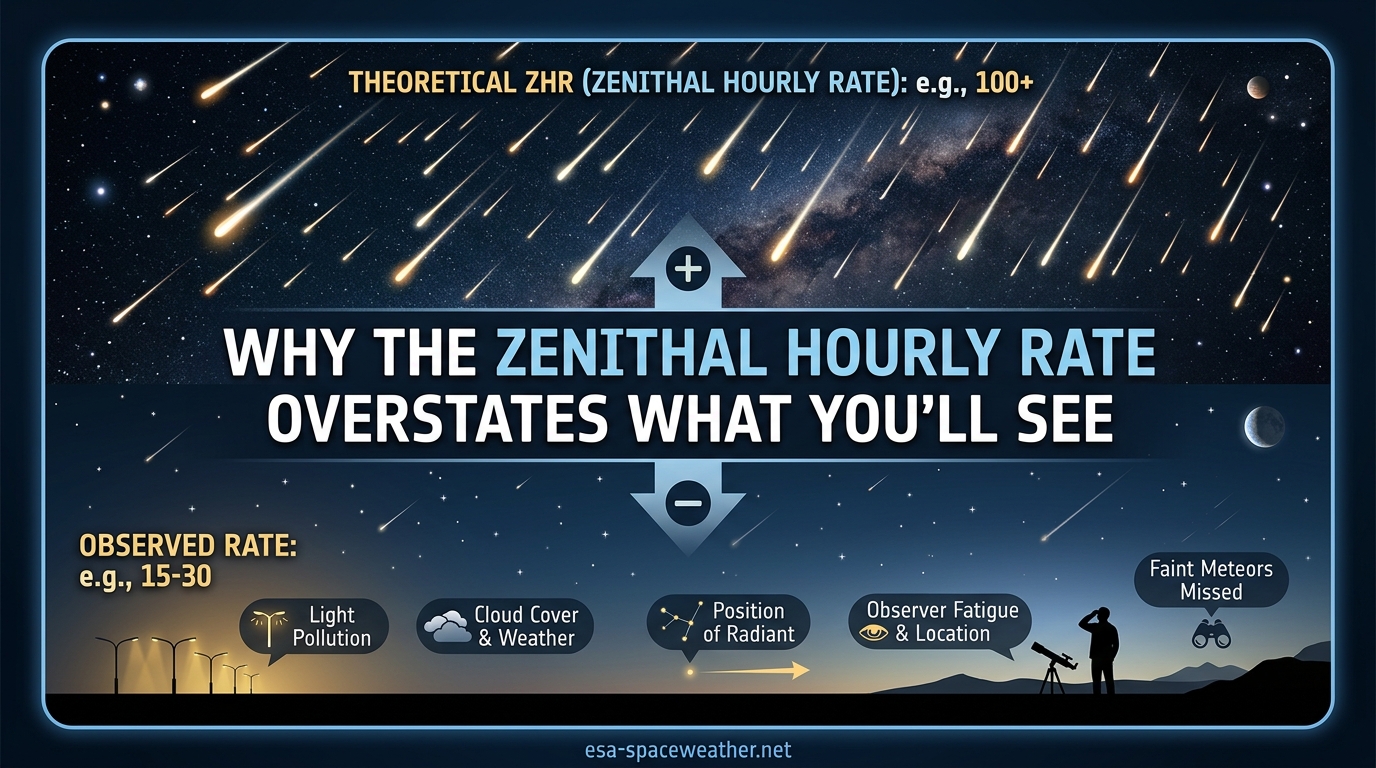
You saw the headline: “Perseids to Produce 100 Meteors Per Hour This Week!” So you dragged a lawn chair outside at 2 a.m., waited an hour, and counted maybe a dozen streaks of light. If you were lucky.
That gap between the advertised number and what you actually saw is not a mistake by the news outlet. It is a fundamental property of the metric they are quoting. The zenithal hourly rate, or ZHR, is a standardized theoretical number that almost no real-world observer will ever experience. Understanding why the zenithal hourly rate overstates what you will actually see is the difference between a frustrating night and a rewarding one.
In this article, I will break down exactly what ZHR measures, the four factors that cause it to overstate reality, and a worked numerical example so you can calculate your own realistic expectations for any meteor shower.
Table of Contents
What Is the Zenithal Hourly Rate (ZHR)?
The zenithal hourly rate (ZHR) is the hypothetical number of meteors a single observer would see in one hour of peak activity under ideal conditions, assuming the shower’s radiant is positioned directly overhead at the zenith and the sky is perfectly dark with a limiting magnitude of 6.5.
That definition packs in a lot of constraints. Every single one of them represents a condition that real observers almost never have. Let me unpack what “ideal conditions” actually requires, because each requirement is also a reason the number gets inflated for the average stargazer.
First, the radiant must be at the zenith, meaning the point in the sky from which the meteors appear to radiate sits dead overhead at 90 degrees altitude. Most of the time, the radiant is well below that. Second, the limiting magnitude must reach 6.5, which means the sky is dark enough that you can see stars as faint as magnitude 6.5 with the naked eye. That level of darkness only exists in truly remote, light-pollution-free locations. Third, the observer must have a completely unobstructed view of the entire sky with no clouds and no moonlight.
The International Meteor Organization (IMO) and the American Meteor Society (AMS) both use ZHR as a standardized metric. It lets astronomers compare the intrinsic strength of different meteor showers on an even playing field. A Geminid shower with a ZHR of 120 is genuinely more active than a Quadrantid shower with a ZHR of 60. The problem is not the metric itself. The problem is what happens when that number gets reported to the public as “how many meteors you will see.”
Why the Zenithal Hourly Rate Overstates Actual Meteor Rates
Four major correction factors drive the gap between ZHR and what you will actually observe. Each one independently reduces your visible meteor count, and they compound multiplicatively. When all four are working against you, the actual rate can drop to less than 10 percent of the published ZHR.
Factor 1: Radiant Altitude (the sin(hR) Correction)
The single biggest reason ZHR overstates reality is radiant altitude. When the radiant sits lower in the sky, fewer meteors are visible because Earth’s atmosphere presents a thinner “target” for meteoroids at lower angles. The correction uses the sine of the radiant’s altitude angle, written as sin(hR).
If the radiant is directly overhead at 90 degrees, sin(90) equals 1.0, meaning no correction is needed and the full ZHR applies. If the radiant is at 30 degrees altitude, sin(30) equals 0.5, so you lose half the meteors. If the radiant sits just 10 degrees above the horizon, sin(10) is roughly 0.17, meaning you see only about 17 percent of the ZHR.
For many meteor showers, the radiant does not even rise until well after midnight. The eta-Aquarids in May, for example, have a radiant that barely climbs above the horizon for northern hemisphere observers. A ZHR of 50 sounds impressive until you realize the radiant may reach only 15 degrees altitude, cutting your visible rate to about 26 percent of the published number before any other factor is applied.
Factor 2: Limiting Magnitude and Light Pollution
The ZHR assumes a limiting magnitude of 6.5, which represents an exceptionally dark sky. Most observers never experience this. In a typical suburban backyard, the limiting magnitude is around 4.5 to 5.0. Under city skies, it can drop to 3.0 or worse.
The correction for limiting magnitude uses the population index, symbolized as r, which describes how many faint meteors a shower produces relative to bright ones. Most showers have a population index between 2.0 and 2.5. The correction factor is r raised to the power of (6.5 minus your actual limiting magnitude).
If your limiting magnitude is 5.0 and the shower has a population index of 2.2, the math works out to 2.2 to the power of 1.5, which is approximately 3.26. That means you divide the rate by roughly 3.3 compared to ideal conditions. Under a city sky with a limiting magnitude of 3.5, the divisor jumps to about 8.4 for the same shower. Light pollution alone can eliminate 80 to 90 percent of visible meteors.
Factor 3: Cloud Cover and Field of View (the F Correction)
The ZHR assumes the entire sky is visible with no obstructions. Real observers deal with clouds, trees, buildings, and haze. The correction factor F accounts for this, calculated as 1 divided by (1 minus k), where k is the fraction of sky blocked.
If clouds cover 20 percent of your sky, k equals 0.2 and F equals 1.25. You divide your rate by 1.25, losing an additional 20 percent. With 50 percent cloud cover, F equals 2.0, and you lose half of what remains. Even a few pesky clouds scattered across the field of view can noticeably reduce your count.
Factor 4: Moonlight
Moonlight acts like a natural form of light pollution. A bright gibbous or full moon can raise the sky brightness dramatically, effectively reducing your limiting magnitude by one to two full points. A full moon can wash out all but the brightest meteors, collapsing the visible rate to a tiny fraction of what a moonless night would offer.
When a major meteor shower peaks near full moon, even experienced observers at dark-sky sites see rates far below the ZHR. This is why timing matters so much. A shower peaking near new moon will always deliver a better show than one competing with a bright moon, even if the latter has a higher published ZHR.
Working Example: Converting ZHR to Actual Observed Rate
Let me walk through a realistic scenario to show how these factors compound. Suppose the Perseids are peaking tonight with a ZHR of 100. You are observing from a suburban location at mid-northern latitude around 2 a.m., when the radiant is at roughly 45 degrees altitude.
The actual observed hourly rate is calculated using this formula:
Actual Rate = (ZHR x sin(hR)) / (F x r^(6.5 – LM))
Where sin(hR) is the sine of the radiant altitude, F is the cloud-cover correction factor, r is the population index, and LM is your actual limiting magnitude. Let us plug in the numbers.
The radiant is at 45 degrees, so sin(45) equals approximately 0.71. Skies are mostly clear with 10 percent cloud cover, so F equals 1 divided by (1 minus 0.1), which is about 1.11. Your suburban limiting magnitude is 4.5, and the Perseids have a population index of about 2.2. The magnitude correction is 2.2 raised to the power of (6.5 minus 4.5), which equals 2.2 to the power of 2.0, or about 4.84.
Now multiply it out. The numerator is 100 times 0.71, which equals 71. The denominator is 1.11 times 4.84, which equals about 5.37. Divide 71 by 5.37 and you get roughly 13 meteors per hour.
That is a shower advertised at 100 meteors per hour delivering about 13 under fairly typical suburban conditions. A few clouds, moderate light pollution, and a radiant that is high but not perfectly overhead cut the rate by nearly 90 percent. This is exactly the kind of scenario that leaves first-time observers disappointed.
Now consider the same shower from a truly dark rural site with a limiting magnitude of 6.2, clear skies, and the radiant at 60 degrees. The calculation yields roughly 42 meteors per hour. Still less than half the ZHR, but a far better experience. The lesson is clear: your observing location and timing matter far more than the headline number.
Setting Realistic Meteor Shower Expectations
Based on the factors above, here are practical rules of thumb you can use to estimate realistic rates from any published ZHR.
For a dark rural site under moonless skies with the radiant high overhead, expect roughly 40 to 60 percent of the ZHR. For a suburban location with moderate light pollution, expect 10 to 20 percent. Under bright city skies or with significant moonlight, expect 5 percent or less. If the radiant is low on the horizon for your location, divide these estimates further by the sin of the radiant altitude.
A shower with a ZHR of 100 will typically deliver 5 to 10 meteors per hour for a suburban observer and perhaps 1 to 3 per hour from a city. That matches what experienced observers on forums like Cloudy Nights report, and it aligns with the American Meteor Society’s own rate comparison data.
You can maximize your count by choosing moonless nights, traveling to the darkest site you can reach, timing your session for when the radiant is highest (often the hours before dawn), allowing 20 to 30 minutes for dark adaptation, and looking about 40 to 60 degrees away from the radiant rather than staring straight at it. Meteors near the radiant have very short trails, while those farther away appear longer and are easier to catch.
Frequently Asked Questions
What is the zenithal hourly rate?
The zenithal hourly rate (ZHR) is the hypothetical number of meteors a single observer would see in one hour under ideal conditions, meaning the radiant is directly overhead, the sky is perfectly clear, and the limiting magnitude reaches 6.5. It is a standardized metric used to compare the intrinsic strength of different meteor showers.
Does the published meteor rate for a shower really represent what I should expect to see?
No. The published ZHR almost always overstates what you will actually see. Real observing conditions involve a radiant that is rarely at the zenith, light pollution that reduces limiting magnitude below 6.5, partial cloud cover, and sometimes moonlight. These factors compound, often reducing the visible rate to 10 to 20 percent of the ZHR for suburban observers.
What’s a good ZHR for meteor showers?
A ZHR above 60 is considered a strong shower worth watching. The Perseids (ZHR ~100), Geminids (ZHR ~120 to 150), and Quadrantids (ZHR ~60 to 80) are the most active annual showers. Even so, actual observed rates from a suburban location will typically be 10 to 20 meteors per hour for these events.
Why can’t I see 100 meteors per hour when the ZHR is 100?
The ZHR of 100 assumes perfect conditions that almost never exist simultaneously: the radiant directly overhead, no light pollution, no moonlight, no clouds, and a limiting magnitude of 6.5. Radiant altitude alone can cut the rate by half or more. Light pollution and moonlight reduce it further. In practice, a ZHR of 100 typically translates to 10 to 20 meteors per hour for a suburban observer.
Conclusion
The zenithal hourly rate overstates what you will actually see because it describes a theoretical ideal that real observers almost never experience. Radiant altitude, light pollution, cloud cover, and moonlight each independently reduce your visible meteor count, and together they can cut the rate by 80 to 95 percent.
Armed with the formula and the rules of thumb above, you can translate any published ZHR into a realistic expectation for your specific location and conditions. A ZHR of 100 does not mean 100 meteors. It means grab a blanket, find the darkest sky you can, look 45 degrees away from the radiant after midnight, and enjoy the 10 to 20 streaks of light that a good shower will deliver. Knowing the difference turns disappointment into appreciation.