
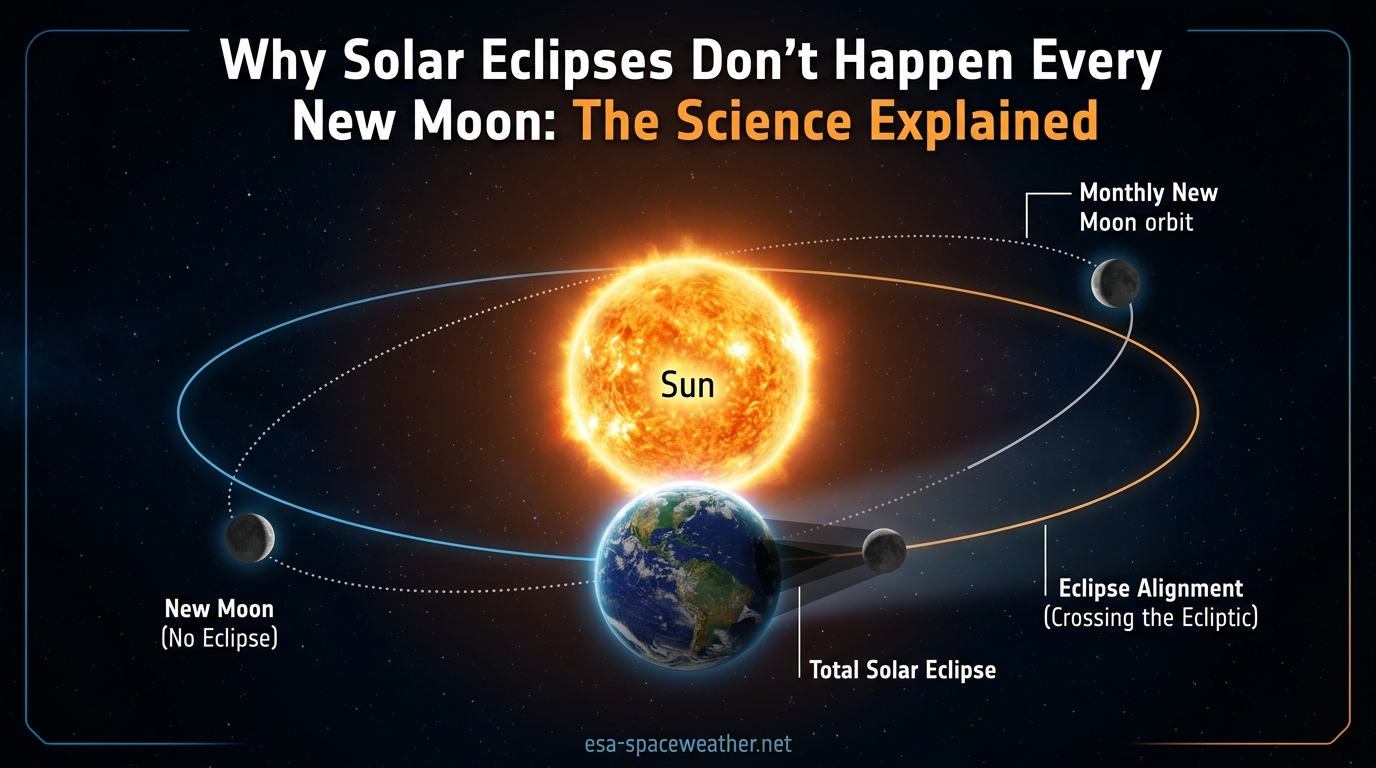
Every new moon, the Moon sits between the Earth and the Sun in its monthly orbit. So why doesn’t the Moon’s shadow fall on Earth every single time? The Moon’s orbit around Earth is tilted about 5 degrees relative to Earth’s orbit around the Sun. This means the Moon usually passes above or below the Sun from our perspective, and its shadow misses Earth entirely. Solar eclipses only happen when a new moon occurs near one of the two crossing points where the Moon’s tilted orbit intersects Earth’s orbital plane.
It’s a question that puzzled humans for thousands of years before orbital mechanics were understood. Ancient cultures from Babylon to China tracked eclipse cycles obsessively, noticing patterns without fully grasping the three-dimensional geometry at play. Today, we can predict eclipses to the second, but the underlying reason they are rare is surprisingly simple once you visualize the Moon’s tilted path.
Our team at ESA Space Weather has fielded this question more times than we can count. Students, amateur astronomers, and curious skywatchers all arrive at the same logical confusion: if a solar eclipse requires the Moon to be between Earth and the Sun, and that happens every new moon, why don’t we see one every month? The answer comes down to geometry, angles, and a tilted orbit that most diagrams fail to represent accurately. In this guide, we’ll break down exactly why solar eclipses don’t happen every new moon using clear explanations, simple analogies, and the precise numbers that govern eclipse timing.
Table of Contents
The Quick Answer: It’s All About the 5-Degree Tilt
Solar eclipses don’t happen every new moon because the Moon’s orbit is tilted about 5 degrees relative to Earth’s orbit around the Sun. During most new moons, the Moon passes above or below the Sun from our vantage point on Earth, and its shadow completely misses our planet. An eclipse can only occur when a new moon happens close to one of the two points called lunar nodes, where the Moon’s tilted orbit intersects Earth’s orbital plane. These node alignments happen roughly every 173 days, creating what astronomers call eclipse seasons.
Think of it this way. The ecliptic plane is the flat disk of Earth’s orbit around the Sun. The Moon’s orbit is not flat against that disk. It is angled upward by about 5 degrees, like a slightly tipped plate resting on a table. Most of the time, when the Moon reaches its new moon position between Earth and Sun, it is either too high or too low for its shadow to touch Earth. Only when the Moon happens to be crossing through the ecliptic plane at that exact moment does the geometry line up for an eclipse.
This is why solar eclipses are relatively rare events rather than monthly occurrences. The 5-degree tilt is small enough that you would never notice it looking up at the sky, but large enough compared to the apparent sizes of the Sun and Moon that it makes all the difference between a spectacular eclipse and an ordinary new moon.
The 5-Degree Orbital Tilt: The Real Reason Eclipses Are Rare
To understand why solar eclipses don’t happen every new moon, you need to understand the Moon’s orbital inclination. The Moon does not orbit Earth in the same flat plane that Earth orbits the Sun. Instead, the Moon’s orbital plane is tilted by approximately 5.1 degrees relative to the ecliptic plane. This is the single most important number in eclipse science.
Here is a simple analogy that forum communities on Reddit repeatedly upvote. Imagine Earth’s orbit around the Sun as a flat vinyl record on a turntable. Now picture the Moon’s orbit around Earth as a second, smaller record that is propped up slightly on one side, tilted at about 5 degrees off the surface of the first record. The Moon travels along the edge of that tilted smaller record. Most of the time, the tilted Moon is either above or below the level of the big record when it reaches the point between Earth and the Sun.
That vertical offset is the problem. The Sun appears about half a degree wide in our sky. The Moon also appears about half a degree wide. Together, that means the Moon needs to be aligned within about one degree of the Sun’s center for any part of its shadow to reach Earth. But the Moon can be as much as 5 degrees above or below the ecliptic at new moon. When it is, the shadow passes harmlessly above Earth’s North Pole or below Earth’s South Pole, and nobody on the ground sees an eclipse.
The numbers make this vivid. At its maximum displacement, the Moon’s center can be roughly 19,000 kilometers above or below the ecliptic plane at the time of a new moon. The Moon’s shadow cone is only about 100 to 200 kilometers wide at Earth’s surface. When the Moon is off to the side by thousands of kilometers, there is no possible way its narrow shadow can reach us. The geometry simply does not allow it.
This is also why the misconception persists that eclipses should be monthly. On a flat, two-dimensional diagram of the solar system, it looks like the Sun, Moon, and Earth line up perfectly every new moon. But the solar system is three-dimensional, and that 5-degree tilt in the third dimension changes everything.
What Are Lunar Nodes?
Lunar nodes are the two points where the Moon’s tilted orbit crosses the ecliptic plane. These crossing points are called the ascending node, where the Moon moves from below the ecliptic plane to above it, and the descending node, where the Moon moves from above to below. Together, these two points and the imaginary line connecting them are called the line of nodes.
A solar eclipse can only occur when a new moon happens while the Moon is very close to one of these node points. At a node, the Moon is physically crossing through the ecliptic plane, meaning it is neither above nor below the Sun-Earth line. If the new moon coincides with that crossing, the Sun, Moon, and Earth form a nearly straight line, and the Moon’s shadow falls on Earth.
The window for this alignment is tight. The Moon needs to be within about 18.5 degrees of a node (measured along the ecliptic) for any type of solar eclipse to occur. For a total solar eclipse, the alignment needs to be even tighter, roughly within 12 degrees of the node. Since the Moon moves about 13 degrees per day along its orbit, the eclipse window at each new moon lasts only about a day and a half at most.
Nodes are not fixed in space. They slowly drift westward along the ecliptic due to gravitational tugs from the Sun, completing a full backward circle every 18.6 years. This phenomenon is called nodal precession, and it is the reason eclipse seasons do not happen at the same dates every year. The dates slowly shift earlier by about 19 days per calendar year, cycling all the way around the calendar over those 18.6 years.
This drift matters for eclipse prediction. Because the nodes move, the periods when the new moon aligns with a node also move. Space weather agencies like ESA track these nodal crossings because they define the entire eclipse calendar, which in turn affects observations of the solar corona and other solar phenomena visible only during totality.
What Is an Eclipse Season?
An eclipse season is the period each year when the Sun is close enough to a lunar node for eclipses to occur. Each eclipse season lasts about 34 days. Because the new moon and full moon each occur roughly every 29.5 days, at least one solar eclipse and one lunar eclipse will happen during every eclipse season, and sometimes two of one type can squeeze in.
Eclipse seasons arrive approximately every 173 days, which is about 34 days shy of six months. This means there are typically two eclipse seasons per calendar year, and in some years, a partial third season spills over from one year to the next. During an eclipse season, the Sun is positioned near enough to a node that any new moon during that window will produce at least a partial solar eclipse somewhere on Earth, and any full moon will produce at least a partial lunar eclipse.
Here is where a common confusion arises that we see frequently on astronomy forums. People ask whether eclipses happen every six months. The answer is close but not exact. Eclipse seasons repeat every 173.3 days, not the 182.6 days of a half-year. That 9-day difference accumulates, which is why eclipse dates gradually creep backward through the calendar over the years.
Another detail that most sources skip: why some eclipse seasons produce three eclipses while most produce only two. If an eclipse season begins just after a new moon, the next new moon 29.5 days later may still fall within the 34-day window, producing two solar eclipses in a single season along with one lunar eclipse. This is called a staggered season, and it happens every few years. Most seasons, however, contain one solar and one lunar eclipse, often separated by about two weeks.
That two-week gap is called the fortnight interval, and it is remarkably consistent. When a solar eclipse occurs near the start of an eclipse season, the following full moon is almost always close enough to the node to produce a lunar eclipse about 14 days later. This pairing is why eclipses seem to come in bunches rather than being evenly spaced throughout the year.
Synodic Month vs Draconic Month: Why the Timing Never Lines Up
A major reason solar eclipses don’t happen every new moon comes down to two different lunar cycles that never quite synchronize. The synodic month is the time from one new moon to the next, which lasts about 29.5 days. The draconic month is the time it takes the Moon to return to the same lunar node, which lasts about 27.2 days. These two periods are different because the nodes are slowly drifting.
If these two cycles were the same length, eclipses would happen every single month. The Moon would reach its new moon phase and return to a node at the same moment every time. But because the synodic month is about 2.2 days longer than the draconic month, the Moon reaches each new moon at a slightly different position relative to the nodes.
Over the course of several months, the new moon drifts away from the node alignment. Eventually, after about five or six months, the new moon has drifted so far from the node that no eclipse occurs. Then, after roughly 173 days (the eclipse season interval), the new moon has drifted back close to the next node alignment, and eclipses become possible again.
This interplay between the synodic month and the draconic month is the mathematical heartbeat of eclipse prediction. Ancient Babylonian astronomers discovered this pattern empirically without knowing about orbital mechanics. They called it the Saros cycle: a period of exactly 223 synodic months, which equals 242 draconic months (and 239 anomalistic months). After one Saros cycle of about 18 years, 11 days, and 8 hours, nearly identical eclipses repeat because all three lunar cycles realign almost perfectly.
Why Solar Eclipses Need a New Moon (and Lunar Eclipses Need a Full Moon)
A solar eclipse can only happen during a new moon because that is the only phase when the Moon is positioned between Earth and the Sun. During a new moon, the Moon’s lit side faces away from Earth, making the Moon appear dark or invisible from our perspective. This is also the only geometry in which the Moon’s shadow can potentially be cast toward Earth.
Conversely, a lunar eclipse can only happen during a full moon. At full moon, Earth sits between the Sun and the Moon, and Earth’s shadow can potentially fall on the Moon’s surface. If the Moon were not exactly opposite the Sun in the sky, Earth’s shadow would miss it entirely, which is why we do not see a lunar eclipse at every full moon.
The symmetry is elegant. Solar eclipses require the Sun-Moon-Earth alignment (new moon). Lunar eclipses require the Sun-Earth-Moon alignment (full moon). In both cases, the 5-degree orbital tilt determines whether the three bodies form a true straight line or whether the shadow misses. During most new moons, the Moon’s shadow passes above or below Earth. During most full moons, Earth’s shadow passes above or below the Moon.
This answers a question we hear often: does a new moon always mean a solar eclipse is happening? The answer is no. A new moon simply means the Moon is on the same side of Earth as the Sun. Whether it is also at the right vertical position to cast its shadow on Earth depends entirely on where it is relative to its orbital nodes. Most of the time, it is not, and the new moon passes without any visible eclipse.
Types of Solar Eclipses: Total, Annular, Partial, and Hybrid
Not all solar eclipses are created equal. The type of eclipse that occurs depends on two factors: how close the Moon is to a node (how centered the alignment is) and how far the Moon is from Earth in its elliptical orbit (how large the Moon appears). There are four main types of solar eclipses.
Total Solar Eclipse
A total solar eclipse occurs when the Moon completely covers the Sun’s disk from the perspective of observers within the path of totality. This requires the Moon to be near perigee, its closest point to Earth, where it appears large enough to fully block the Sun. During the few minutes of totality, the sky darkens, stars appear, and the Sun’s corona, its outer atmosphere, becomes visible as a pearly white halo around the black disk of the Moon.
Total solar eclipses are the rarest and most dramatic type. The path of totality is typically only about 100 to 200 kilometers wide, meaning only a narrow strip of Earth’s surface experiences full coverage. The Moon’s dark central shadow, called the umbra, traces this path across the globe at speeds exceeding 2,000 kilometers per hour.
Annular Solar Eclipse
An annular solar eclipse happens when the Moon is near apogee, its farthest point from Earth, and appears too small to completely cover the Sun. Instead of full coverage, a bright ring of sunlight surrounds the Moon’s silhouette. This ring is called the annulus, and the shadow the Moon casts is called the antumbra, which is the region beyond the tip of the umbra where the Moon appears smaller than the Sun.
Annular eclipses are slightly more common than total eclipses because the Moon spends more time near apogee than perigee in terms of the geometry required. They are also less dramatic visually since the sky does not fully darken and the corona remains invisible. However, the ring of fire effect is still a striking sight for observers within the path of annularity.
Partial Solar Eclipse
A partial solar eclipse occurs when only a portion of the Sun is blocked by the Moon. This happens when the observer is in the penumbra, the lighter outer part of the Moon’s shadow where only part of the Sun’s disk is obscured. Most people who experience any solar eclipse see only a partial phase, because the paths of totality or annularity are narrow and cover a small fraction of Earth’s surface.
Partial eclipses can also occur on their own without any total or annular phase, when the Moon’s umbral shadow misses Earth entirely but the penumbral shadow grazes part of the planet. These standalone partial eclipses are the most common type of solar eclipse overall.
Hybrid Solar Eclipse
A hybrid solar eclipse, also called an annular-total eclipse, is the rarest type of all. In this case, the eclipse appears total along some parts of its path and annular along other parts. This happens because the curvature of Earth means the Moon’s apparent size changes along the shadow path. Near the center of the path, where the observer is slightly closer to the Moon, the eclipse is total. Near the ends of the path, where the observer is farther from the Moon, the eclipse becomes annular.
Hybrid eclipses account for only about 5% of all solar eclipses. They are dramatic demonstrations of how precisely the apparent sizes of the Sun and Moon must match for a total eclipse to occur, and how small changes in distance flip the result from total to annular.
The Cosmic Coincidence: Why the Sun and Moon Look the Same Size
There is a remarkable coincidence that makes total solar eclipses possible at all. The Sun is about 400 times larger in diameter than the Moon. But the Sun is also about 400 times farther from Earth than the Moon. This means both objects appear roughly the same angular size in our sky, about half a degree across.
If the Moon were significantly smaller or farther away, it could never fully cover the Sun, and total solar eclipses would be impossible. We would only ever see annular or partial eclipses. If the Moon were larger or closer, total eclipses would last much longer and cover wider paths, but the delicate ring of the corona would be hidden behind an oversized lunar disk.
This apparent size matching is temporary on geological timescales. The Moon is slowly drifting away from Earth at about 3.8 centimeters per year due to tidal interactions. In roughly 600 million years, the Moon will be far enough away that it will no longer appear large enough to fully cover the Sun. After that point, total solar eclipses will become impossible, and only annular and partial eclipses will remain. We happen to live in a narrow window of Earth’s history when the geometry is just right.
Forum communities on Reddit and Stack Exchange frequently highlight this as one of the most mind-bending facts in astronomy. It is not just that eclipses are rare because of orbital tilt. The existence of total eclipses at all depends on a size-distance ratio that is essentially a cosmic coincidence of timing.
How Often Do Eclipses Actually Happen?
Despite seeming rare, solar eclipses are more common than most people think. Earth experiences between 2 and 5 solar eclipses every calendar year. The long-term average is about 2.4 solar eclipses per year. Of these, roughly one every 18 months is a total solar eclipse visible from somewhere on Earth.
Over a century, Earth sees about 240 solar eclipses on average. Breaking that down by type: approximately 84 are partial only, 77 are annular, 66 are total, and about 14 are hybrid. Lunar eclipses follow a similar frequency, with about 150 lunar eclipses per century, though these are visible from entire hemispheres rather than narrow paths.
The reason eclipses feel rare to any individual observer is geographic. A total solar eclipse only covers a narrow strip of Earth, and the average location on Earth experiences a total solar eclipse only once every 375 years. That is why dedicated eclipse chasers travel the globe to stand in the path of totality, sometimes flying to remote ocean areas or polar regions just to experience a few minutes of darkness.
For comparison, a partial solar eclipse is visible from any given location much more frequently, roughly once every 2 to 3 years. Lunar eclipses are visible from any given hemisphere about twice every three years. The perceived rarity of eclipses is really about the rarity of total solar eclipses from your specific location, not the global frequency of eclipses overall.
Does a solar eclipse happen during a new moon?
Yes, a solar eclipse can only happen during a new moon, because that is the only phase when the Moon is positioned between Earth and the Sun. However, most new moons do not produce a solar eclipse because the Moon’s 5-degree orbital tilt usually causes its shadow to pass above or below Earth. A solar eclipse only occurs when the new moon coincides with the Moon being near a lunar node.
Why don’t solar eclipses happen every new moon?
Solar eclipses don’t happen every new moon because the Moon’s orbit is tilted about 5 degrees relative to Earth’s orbit around the Sun. During most new moons, the Moon passes above or below the Sun from our perspective, so its shadow misses Earth. Eclipses only occur when a new moon happens near one of the two lunar nodes where the Moon’s orbit crosses the ecliptic plane, which happens roughly every 173 days during eclipse seasons.
Why do lunar eclipses only happen on full moons?
Lunar eclipses only happen during a full moon because that is when Earth is positioned directly between the Sun and the Moon. For Earth’s shadow to fall on the Moon, the three bodies must be in a Sun-Earth-Moon alignment, which only occurs at full moon. Just like solar eclipses, most full moons do not produce a lunar eclipse because the Moon’s tilted orbit usually carries it above or below Earth’s shadow.
Why does there have to be a new moon for a solar eclipse?
A solar eclipse requires the Moon to be between Earth and the Sun so that the Moon’s shadow can reach Earth. This Sun-Moon-Earth alignment only happens during the new moon phase, when the Moon is on the same side of Earth as the Sun. Without this positioning, the Moon’s shadow points away from Earth and no eclipse is possible regardless of node alignment.
The Bottom Line
The reason solar eclipses don’t happen every new moon is simple once you see the three-dimensional picture. The Moon’s orbit is tilted about 5 degrees relative to the ecliptic plane, so during most new moons, the Moon’s shadow passes above or below Earth. Eclipses only occur when a new moon aligns with one of the two lunar nodes, creating the straight-line geometry needed for the shadow to reach us. These alignments happen during eclipse seasons roughly every 173 days, not every month.
Understanding why solar eclipses don’t happen every new moon opens the door to appreciating just how special these events are. The 5-degree tilt, the drifting nodes, the mismatch between synodic and draconic months, and the cosmic coincidence of apparent sizes all converge to make total solar eclipses among the rarest and most beautiful phenomena visible from Earth. The next time you hear about an upcoming eclipse, you will know exactly why it does not happen more often, and why it is worth traveling to see.