
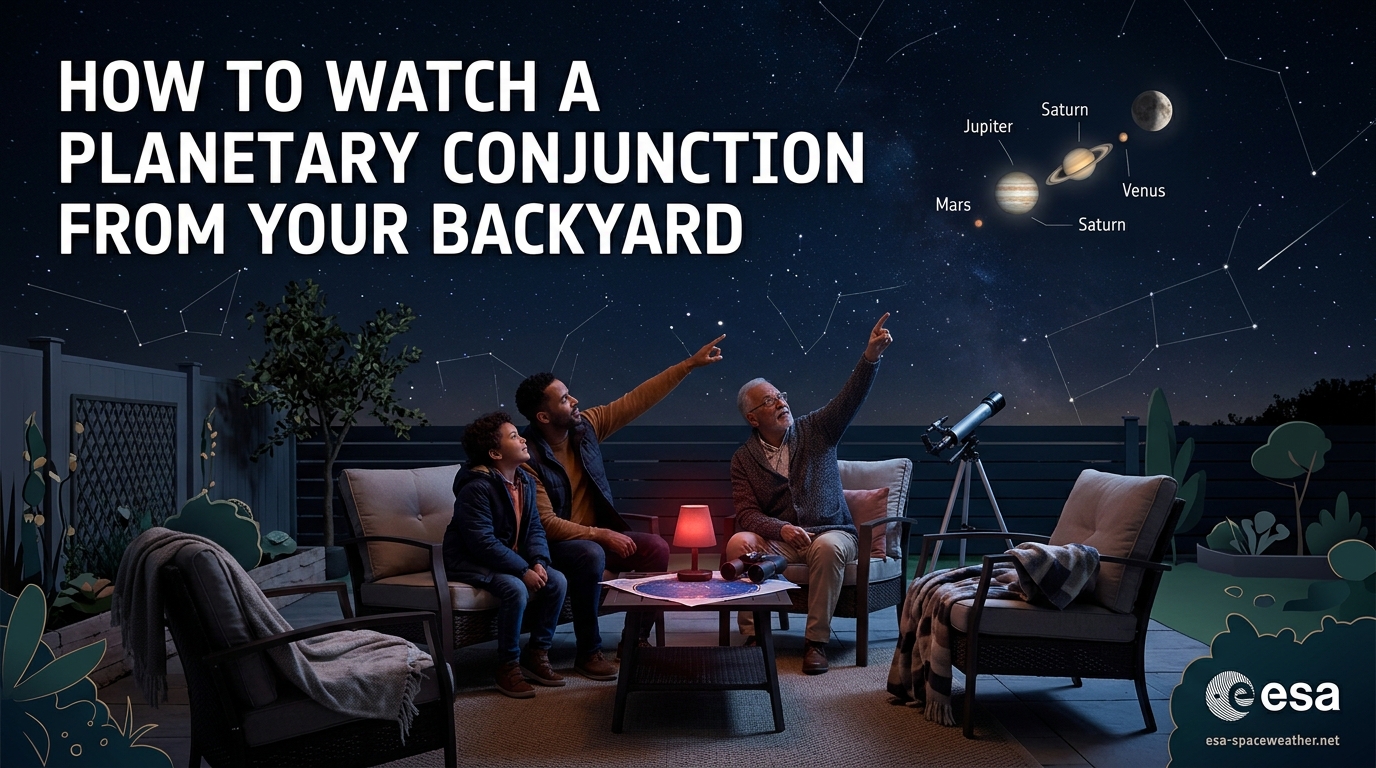
Watching planets line up in the night sky is one of those experiences that stops you in your tracks. You step outside, look up, and see Venus, Jupiter, Mars, and Saturn clustered together like glowing lanterns strung across the darkness. Learning how to watch a planetary conjunction from your backyard opens the door to that kind of awe without needing expensive equipment or a trip to a remote observatory.
Yes, you can absolutely see planets from your backyard. Five planets are visible to the naked eye, and during a conjunction, two or more of them appear dramatically close together. The trick is knowing when to look, where to face, and how to tell a planet from an ordinary star.
This guide walks you through everything: what a conjunction actually is, which planets you can spot without any gear, the best times to head outside, step-by-step instructions, phone photography tips, and a year-round viewing calendar that no other guide seems to bother putting together.
Table of Contents
What Is a Planetary Conjunction?
A planetary conjunction happens when two or more planets appear close together in Earth’s sky as seen from our vantage point on the ground. They are not actually near each other in space. Venus might be 40 million miles away while Jupiter sits 500 million miles beyond it, but from your backyard they look like neighbors.
The reason this happens comes down to the ecliptic. All the planets in our solar system orbit the Sun in roughly the same flat plane, like marbles rolling around on the same tabletop. When we look out from Earth, we see that plane edge-on as a line stretching across the sky. Astronomers call this line the ecliptic, and every planet travels along it.
Because planets share this highway, they occasionally bunch up from our perspective. Mercury zips around the Sun every 88 days, while Saturn takes 29 years. Their differing speeds mean that close approaches happen on a predictable schedule. Some conjunctions repeat every few months, while the really dramatic multi-planet parades might happen only a few times per decade.
A conjunction technically refers to two objects appearing within a few degrees of each other. A planet parade or planetary alignment is a looser term people use when three or more planets spread across a wider arc of sky on the same night. Both are worth watching, and the viewing technique is the same for either event.
Which Planets Can You See Without a Telescope?
Five planets are visible without optical aid: Mercury, Venus, Mars, Jupiter, and Saturn. Each has a personality that makes it identifiable once you know what to look for.
Venus is the easiest planet to spot, and it is usually the brightest object in the sky after the Sun and Moon. It shines with a steady, brilliant white light and appears either in the western sky shortly after sunset or in the eastern sky before dawn. During conjunctions, Venus is often the anchor point that helps you locate the other planets nearby.
Jupiter is the second-brightest planet and has a warm, cream-colored glow. It does not twinkle like stars do. Instead, it holds a steady light that makes it stand out once you train your eye. Jupiter participates in conjunctions more frequently than any other planet because of its position along the ecliptic.
Mars is unmistakable when it is bright. It has a distinct orange-red hue that distinguishes it from everything else in the sky. Mars varies dramatically in brightness depending on how close it is to Earth, but during a conjunction it is usually identifiable by that ruddy color.
Saturn appears as a pale yellowish light, dimmer than Jupiter but steady. It does not twinkle much, which helps separate it from background stars. You cannot see the rings without a telescope, but Saturn still puts on a good show during groupings.
Mercury is the trickiest naked-eye planet. It stays close to the Sun, so it only appears low on the horizon during twilight. You get a brief window of maybe 30 to 45 minutes after sunset or before sunrise to catch it. During conjunctions that include Mercury, timing is everything.
The simplest way to tell a planet from a star is the twinkle test. Stars twinkle because their light passes through turbulent layers of Earth’s atmosphere, causing rapid flickering. Planets are closer to us, so their light comes in as a wider beam and appears steady. If it twinkles sharply, it is a star. If it shines with a calm, unwavering glow, it is almost certainly a planet.
When Is the Best Time to Watch a Planetary Conjunction?
The best time to watch depends on which planets are involved and where they sit relative to the Sun. Most conjunctions are visible either during evening twilight, within an hour after sunset, or during morning twilight, about an hour before sunrise.
For evening conjunctions involving Venus, Mercury, or Saturn, you need to be outside and ready before the Sun fully sets. The planets will appear low on the western horizon as the sky darkens. Within 30 to 60 minutes, they may sink below buildings or trees. Arriving early is the single most important timing decision you can make.
For morning conjunctions, the window flips. You want to be in position about 45 minutes before local sunrise. The sky will still be dark enough to see the brighter planets, and you will have perhaps 30 minutes before dawn washes them out.
The twilight window is your friend. Pure darkness is not necessary for the brighter planets like Venus and Jupiter. In fact, a slightly lit sky helps suppress background stars, making the planets stand out even more. This is why conjunctions visible during civil twilight, when the Sun is just below the horizon, often look the most dramatic.
Seasonal timing matters too. Winter offers darker skies earlier in the evening but brings cold temperatures and potential haze. Summer gives comfortable viewing conditions but shorter nights and a later start time. Spring and fall tend to offer the best balance of reasonable temperatures and adequate darkness.
How to Watch a Planetary Conjunction From Your Backyard: Step by Step
Here is the exact process I use every time a conjunction is coming up. Follow these steps and you will not miss the show.
Step 1: Confirm the date and check a sky chart. A day or two before the event, visit a reliable source like NASA’s skywatching page or In-The-Sky.org. Note which planets are involved, the exact date, and whether it is an evening or morning event. Write down the time the conjunction reaches its closest point, called the moment of closest approach.
Step 2: Find a clear view of the horizon. Conjunctions often place planets low in the sky, within 15 to 30 degrees of the horizon. That means trees, houses, and hills can block your view entirely. Spend a few minutes the evening before scouting your backyard for the direction you will need to face. If your yard is obstructed, consider a nearby park, a hill, or even a rooftop.
Step 3: Arrive 20 to 30 minutes early. Give yourself time to settle in and let the sky darken. Use this buffer to orient yourself. Figure out which direction is west for evening events or east for morning events. If you brought binoculars, get them focused on a distant tree or star while there is still enough light to see.
Step 4: Let your eyes dark-adapt. Human eyes take 15 to 20 minutes to fully adjust to darkness. Avoid looking at your phone during this period. If you need light, use a red flashlight or switch your phone to a red screen filter. Red light preserves your night vision while white light resets it instantly.
Step 5: Sweep the horizon with your eyes first. Before reaching for binoculars or an app, scan the sky slowly. Look for steady, bright points that do not twinkle. The brightest one is usually Venus or Jupiter. From there, look nearby for the companion planet or planets.
Step 6: Confirm with a sky tracking app. Once you think you have found the planets, hold your phone up and open an app like Stellarium or Sky Tonight. The app will overlay planet positions on the live sky, confirming what you are seeing. This cross-check builds confidence and helps you learn the sky for next time.
Step 7: Enjoy the view. Spend a few minutes just looking. If you have binoculars, try them on Jupiter to spot its four Galilean moons, or on Venus to see its phase. Take a mental photo. Conjunctions are fleeting, and the planets will separate noticeably even within a single night.
Warning: Never point binoculars or a telescope at the sky while the Sun is above or near the horizon. Even a brief glimpse of the Sun through optics can cause permanent eye damage. Wait until the Sun is fully below the horizon before raising any optical aid.
Best Mobile Apps for Tracking Planetary Conjunctions
You do not need apps to see a conjunction, but they make finding planets dramatically easier. Here are the ones the astronomy community recommends most.
Stellarium is a free, open-source planetarium app available on iOS, Android, and desktop. It shows a realistic 3D sky from any location and time. Point your phone at the sky and it overlays constellations, planets, and conjunction events in real time. The desktop version is excellent for planning ahead.
Sky Tonight from Viavi is purpose-built for event tracking. It highlights upcoming conjunctions, meteor showers, and visible passes of the International Space Station. The app sends notifications for events visible from your specific location, which takes the guesswork out of timing.
SkyView Lite is a user-friendly option for complete beginners. Its augmented reality interface makes it easy to identify objects by pointing your phone. The free version covers planets and major constellations, which is enough for conjunction viewing.
The NASA app provides official skywatching tips, launch schedules, and astronomical event calendars. It is especially useful for confirming dates and reading authoritative descriptions of upcoming conjunctions.
One tip: use apps to confirm what you see, not to replace the experience of scanning the sky yourself. There is something deeply satisfying about finding Jupiter with your own eyes first, then checking your phone to verify.
How to Photograph a Planetary Conjunction With Your Phone
Capturing a conjunction on your phone is absolutely possible, and the results can be surprisingly good. The key is stabilizing your device and adjusting exposure settings.
First, mount your phone on a tripod or rest it against something solid. Handheld shots at night always blur because the camera needs a long exposure to gather enough light. A small phone tripod costs very little and transforms your results. If you do not have one, prop your phone against a wall or on the edge of a table.
Switch your camera to Night Mode if your phone has it. On recent iPhones and many Android devices, Night Mode automatically extends exposure time and reduces noise. For more control, try a third-party app like ProCam or Open Camera that lets you manually set ISO, shutter speed, and focus.
Lower the exposure deliberately. Phone cameras tend to overexpose bright planets, turning them into washed-out blobs. Tap on the brightest planet on your screen and drag the exposure slider down until the planet appears as a sharp point of light rather than a glowing circle.
For close conjunctions, like Venus and Jupiter appearing within a degree of each other, you can capture both planets and some foreground in a single wide shot. Frame a tree, rooftop, or distant hillline to give the photo scale and context. These landscape-style shots usually look better than zoomed-in attempts.
Avoid digital zoom. It degrades quality without adding real detail. If you want a closer view, crop the photo afterward in your editing app. The results will be sharper than zooming while shooting.
Take 10 to 15 shots with slightly different exposures. Night photography is unpredictable, and having multiple options gives you the best chance of getting one crisp, well-exposed image.
Common Mistakes to Avoid When Viewing Planetary Conjunctions
Mistake 1: Not checking the horizon beforehand. The number one reason people miss conjunctions is obstruction. You go outside at the right time, face the right direction, and a row of trees blocks the view entirely. Scout your location the night before.
Mistake 2: Going out too late. Evening conjunctions involving Mercury and Venus are gone within 45 minutes of sunset. If you step outside an hour after sunset, the planets may already be below the horizon. Set an alarm.
Mistake 3: Confusing stars and planets. Bright stars like Sirius, Arcturus, and Capella can rival planets in brightness. Use the twinkle test and cross-reference with a sky app to avoid misidentification.
Mistake 4: Ignoring light pollution. Suburban and urban skies wash out fainter planets like Saturn and Mercury. You can still see Venus and Jupiter, but for the full lineup you may need to travel 15 to 20 minutes away from city lights. Check a light pollution map like lightpollutionmap.info to find darker spots near you.
Mistake 5: Relying only on apps. Apps are helpful but they can drain your battery, ruin your night vision with screen glare, and become a crutch. Practice finding planets by eye and use apps as a backup confirmation tool.
Year-Round Planetary Conjunction Viewing Calendar
Conjunctions happen throughout the year, and knowing the seasonal rhythm helps you plan ahead. Here is what to watch for in each season.
Winter often features bright conjunctions involving Venus and Jupiter. The long, dark nights give extended viewing windows, and cold air tends to be stable and clear. Dress warmly, as standing still in cold weather drops your body temperature fast.
Spring brings Mercury higher into the evening sky during its best elongations. This is prime time for catching the most elusive naked-eye planet. Mars also reaches favorable positions during certain spring windows.
Summer offers comfortable viewing but shorter nights and later start times. Look for conjunctions involving Saturn and Jupiter, which reach opposition during summer months and shine at their brightest. Summer haze and humidity can reduce clarity, so check weather forecasts for clear nights.
Fall provides a mix of decent darkness and moderate temperatures. Venus often dominates the morning sky during autumn, creating beautiful dawn conjunctions with Mercury or Mars.
For specific dates, check resources like EarthSky.org or the Astronomical League’s event calendar at the start of each month. Conjunction predictions are typically published months in advance and are accurate to within a day.
The most dramatic events are multi-planet parades, where four or five planets stretch across the sky in a single evening. These happen roughly every one to two years and are worth making a special effort to see.
FAQs
Can I see planets from my backyard?
Yes, you can see five planets from your backyard without any equipment: Mercury, Venus, Mars, Jupiter, and Saturn. Venus and Jupiter are the brightest and easiest to spot. During a conjunction, two or more planets appear close together, making them even easier to identify.
What time do I go outside to see the planets align?
For evening conjunctions, be outside and ready 20 to 30 minutes before sunset and watch the western horizon as the sky darkens. For morning conjunctions, position yourself about 45 minutes before local sunrise and face east. The viewing window typically lasts 30 to 60 minutes.
How to see planets from Earth with a phone?
Download a sky tracking app like Stellarium, Sky Tonight, or SkyView Lite. Point your phone at the sky and the app overlays planet positions in real time. Use the app to confirm planets you have already spotted by eye, rather than relying on it exclusively.
How to see planet alignment on Feb 28?
To see a planet alignment on February 28, check a reliable source like NASA or EarthSky for which planets are involved and whether it is a morning or evening event. Arrive at your viewing spot 30 minutes early, find a clear horizon, and scan the sky for steady, bright points that do not twinkle.
Conclusion
Learning how to watch a planetary conjunction from your backyard is simpler than most people think. You need clear timing, an unobstructed horizon, dark-adapted eyes, and a basic sense of what planets look like. No telescope required, no expensive gear, no special location.
The next time a conjunction is announced for your area, set an alarm, grab a jacket, and step outside. Those steady points of light lined up along the ecliptic are entire worlds, and they are waiting for you to look up.