
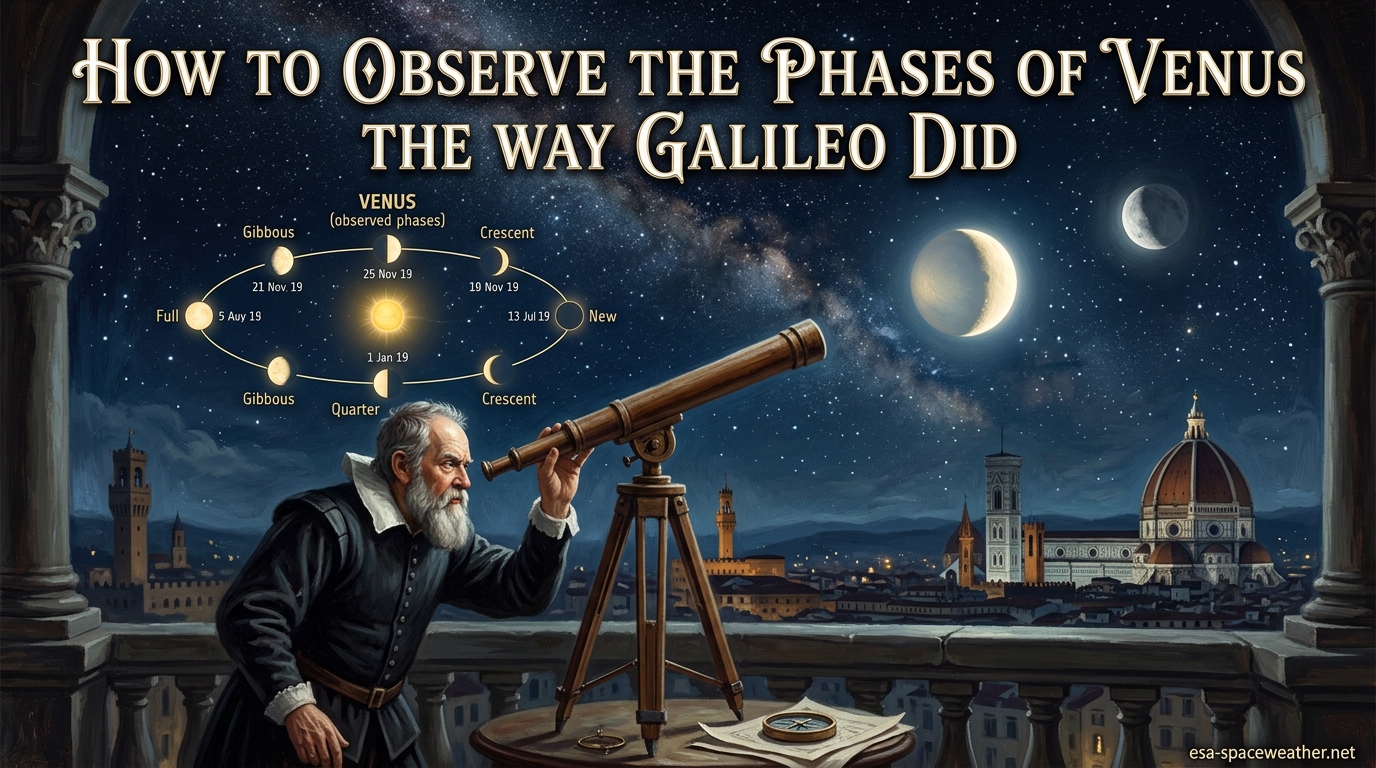
In late 1610, Galileo Galilei turned his primitive telescope toward Venus and watched the planet go through a complete series of phases, beginning from a thin crescent, gradually waxing to a full disk, then waning back to a crescent before disappearing altogether. That single observation shattered the ancient Ptolemaic model of the universe and confirmed that Venus orbits the Sun. Learning how to observe the phases of Venus the way Galileo did is one of the most rewarding projects in amateur astronomy. You do not need expensive equipment, advanced software, or dark skies to do it. All you need is a small telescope, a few months of patience, and the willingness to look up.
Our team has spent years guiding beginners through their first Venus observations, and we can tell you that seeing the crescent of Venus with your own eyes is a genuinely thrilling moment. It connects you to a turning point in human understanding that happened over four centuries ago. This guide covers the history, the science, and the practical steps you need to replicate Galileo’s discovery from your backyard in 2026.
We will walk you through what Galileo actually saw, why Venus shows phases at all, what equipment works best today, and exactly how to find and record each phase over the planet’s 584-day cycle. Whether you own a 60mm beginner refractor or a larger Dobsonian reflector, you can participate in this observing tradition.
Table of Contents
What Galileo Saw in 1610
Galileo first observed the phases of Venus in late 1610 using a telescope he built himself, with a magnification of roughly 20x to 30x. That telescope had an aperture of about 30 to 40 millimeters, meaning its main lens was smaller than what you find on many beginner scopes sold today. Despite those limitations, the phases were clearly visible to him.
At the time, Venus was shining brightly in the evening sky after sunset. Galileo noticed that the planet was not a perfect circle of light. Instead, it showed a distinct crescent shape, similar to a young Moon. He had already made headlines earlier that year with his observations of Jupiter’s moons and the rugged surface of Earth’s Moon, published in his famous pamphlet Sidereus Nuncius (Starry Messenger) in March 1610.
But the phases of Venus were different. Jupiter’s moons showed that not everything orbited Earth, but Venus showed something more specific. The changing phases meant Venus was sometimes mostly lit and sometimes mostly dark, depending on where it sat relative to the Sun and Earth. That behavior was impossible under the Ptolemaic system, which placed Venus in a tight loop always between Earth and the Sun.
Galileo was cautious. He did not immediately publish his findings because he wanted to confirm what he was seeing over a longer period. In a letter dated December 1610, he sent an encrypted anagram to his colleague Johannes Kepler. The scrambled letters, when rearranged, read in Latin: “Cynthiae figuras aemulatur Mater Amorum”, meaning “The Mother of Loves (Venus) imitates the figures of Cynthia (the Moon).” This was Galileo’s way of claiming priority for the discovery without revealing the details until he was ready.
He formally published his observations in 1613 as part of his Letters on Sunspots, a series of writings that debated the nature of sunspots with the Jesuit astronomer Christoph Scheiner. In those letters, Galileo described how Venus went through a full cycle of phases, from crescent to gibbous to full and back, over the course of many months of observation.
His telescope was rudimentary by today’s standards. The lenses produced chromatic aberration, where colored halos appeared around bright objects. The field of view was extremely narrow, and holding the instrument steady required practice. Yet the phases of Venus were unmistakable even through that imperfect glass. If Galileo could see them with a 30mm aperture in 1610, you can see them with almost any telescope available today.
Why Venus Has Phases: The Orbital Mechanics
Venus shows phases because it is an inferior planet, meaning its orbit lies closer to the Sun than Earth’s orbit. Mercury is the only other inferior planet. All planets outside Earth’s orbit, like Mars and Jupiter, are called superior planets and do not show full phase cycles visible from Earth.
Because Venus circles the Sun inside Earth’s path, the angle between the Sun, Venus, and Earth changes constantly. Depending on that geometry, we see different fractions of Venus’s sunlit hemisphere. When Venus is on the far side of the Sun from Earth, we see its fully illuminated face. When Venus passes between Earth and the Sun, we see its dark side. In between those extremes, Venus shows every shade of partial illumination.
This is exactly the same mechanism that produces lunar phases. The difference is that the Moon orbits Earth, while Venus orbits the Sun. The result is that Venus completes one full phase cycle every 584 days as seen from Earth, a period called the synodic period.
Here are the key orbital terms you need to understand the cycle:
Superior conjunction: Venus is on the far side of the Sun from Earth. The planet appears fully illuminated but very small and far away. It is also lost in the Sun’s glare and difficult or impossible to observe.
Greatest elongation: Venus appears farthest from the Sun in our sky, either to the east (evening sky) or west (morning sky). This is the best time to observe because Venus is high enough above the horizon and shows a half-illuminated phase.
Dichotomy: The moment when Venus appears exactly half illuminated, like a first quarter or last quarter Moon. Dichotomy occurs close to greatest elongation.
Inferior conjunction: Venus passes between Earth and the Sun. The planet shows a very thin crescent or is completely invisible as it crosses the Sun’s disk. This is when Venus transitions from the evening sky to the morning sky.
The Complete Phase Cycle of Venus
Venus goes through a predictable sequence of phases over its 584-day synodic period. Understanding this cycle helps you know what to look for and when. Here is the complete sequence, starting from superior conjunction:
1. Full Venus: Near superior conjunction, Venus appears as a tiny fully illuminated disk. Its apparent diameter is only about 10 arc seconds because it is at maximum distance from Earth, roughly 257 million kilometers away. The planet is very hard to observe at this point because it sits close to the Sun in the sky.
2. Gibbous Venus: As Venus moves away from superior conjunction, it begins to show a gibbous phase, meaning more than half illuminated but not full. The apparent diameter grows as Venus approaches Earth. During this phase, Venus is prominent in the evening sky (after eastern elongation) or morning sky (before western elongation).
3. Half Venus (Dichotomy): Near greatest elongation, Venus shows an exactly half-lit disk. The apparent diameter is around 25 arc seconds. This is one of the best times to observe because the phase is sharply defined and Venus sits far from the Sun in the sky. Dichotomy is visually striking through a telescope.
4. Crescent Venus: Between greatest elongation and inferior conjunction, Venus becomes a crescent. As the planet moves closer to Earth, the illuminated portion shrinks but the apparent diameter grows dramatically. By the time Venus is a thin crescent, its apparent diameter can reach 60 arc seconds or more, making it larger in apparent size than Jupiter.
5. Inferior Conjunction: Venus passes between Earth and the Sun. The crescent becomes vanishingly thin or disappears entirely. If Venus passes directly across the Sun’s face, a rare event called a transit occurs, but these happen in pairs separated by over a century. The last transits were in 2004 and 2012, and the next will be in 2117.
6. Return cycle: After inferior conjunction, Venus reappears in the morning sky and the sequence reverses. It goes from thin crescent to half phase to gibbous to full as it swings around to the far side of the Sun again. The entire cycle repeats every 584 days.
One of the most surprising things about the Venus phase cycle is that the planet’s apparent brightness does not change as dramatically as you might expect. Venus reaches its greatest brilliance not at full phase but when it is a thick crescent, around 30 to 40 percent illuminated. At that point, the large apparent diameter more than compensates for the reduced illuminated fraction. Venus shines at its peak apparent magnitude of about minus 4.6, making it the third brightest natural object in the sky after the Sun and Moon.
How the Phases of Venus the Way Galileo Did Changed Astronomy
The phases of Venus were not just a pretty sight. They were a scientific bombshell that helped dismantle a cosmological model that had dominated Western thought for over 1,400 years. Understanding why the phases mattered so much requires knowing what the competing models of the universe predicted.
The Ptolemaic system, developed by the Greek astronomer Claudius Ptolemy around 150 CE, placed Earth at the center of the universe. All other celestial bodies, including the Sun, revolved around Earth in complex circular paths. In this model, Venus was always located between Earth and the Sun, on a small orbit called an epicycle that kept it forever nearby. Under the Ptolemaic system, Venus could never appear fully illuminated from Earth because the Sun would always be behind it from our perspective. The model predicted Venus should only ever show crescent or new phases.
The Copernican system, proposed by Nicolaus Copernicus in 1543, placed the Sun at the center with Earth and all other planets orbiting it. In this heliocentric model, Venus circles the Sun independently of Earth. When Venus is on the far side of the Sun, we should see its fully lit face. When it is between Earth and the Sun, we should see a crescent or nothing at all. The Copernican model predicted a complete cycle of phases, from new to full and back.
Galileo’s observations showed exactly what Copernicus predicted. Venus went through every phase, including the full and gibbous phases that the Ptolemaic model said were impossible. This was the first direct observational proof that the Ptolemaic system was wrong.
It is worth noting that the phases alone did not prove the full Copernican system correct. A competing model called the Tychonic system, proposed by Tycho Brahe, placed the other planets in orbit around the Sun while keeping the Sun in orbit around a stationary Earth. Under the Tychonic system, Venus would also show a full set of phases. So while the phases killed the Ptolemaic model, they did not fully decide between heliocentric and geo-heliocentric models. That distinction required additional evidence, including stellar parallax and the laws of planetary motion developed by Kepler and Newton.
Still, Galileo’s discovery of the phases of Venus was the moment the old universe broke apart. It provided concrete, repeatable, telescopic evidence that the traditional Earth-centered cosmos was wrong. For amateur astronomers today, recreating this observation is a way to touch that history directly.
Equipment You Need to Observe Venus Phases Today
The good news for anyone reading this in 2026 is that your equipment will be vastly superior to what Galileo used. Even the most basic beginner telescopes today outperform the instrument Galileo built in 1610. Here is what you need to observe the phases of Venus from your own backyard.
Telescope Aperture
A telescope with an aperture of at least 60mm (2.4 inches) is sufficient to see the crescent phase of Venus. Amateur astronomers on observing forums consistently report that 60mm refractors reveal the crescent clearly once Venus shows a significant phase. A 70mm or 90mm telescope will show more detail and make the phases easier to discern, especially the subtle difference between a gibbous and half phase.
If you own a larger telescope, such as a 4.5-inch or 6-inch reflector or a 4-inch refractor, you have more than enough aperture. Larger telescopes do not necessarily show dramatically more phase detail because Venus’s phases are a low-resolution feature. What larger apertures do provide is brighter images and steadier views during moments of good atmospheric seeing.
Eyepiece and Magnification
Venus phases are best observed at moderate magnification, typically between 50x and 150x. Too little magnification makes Venus look like a bright dot, which is the number one complaint from beginners. Too much magnification amplifies atmospheric turbulence and makes the image blurry and unstable.
A good starting point is 50x to 75x with a standard eyepiece. Once you have found Venus and centered it, you can increase magnification to 100x or 120x if the atmosphere is steady. Avoid pushing beyond 150x for Venus unless you have exceptionally calm air and a large telescope, as the image will typically degrade.
Filters for Better Viewing
Venus is famously the brightest planet in the sky, and through a telescope it can be almost blindingly bright. This is the second most common complaint from beginners. The intense glare can wash out the phase detail entirely, making it difficult to tell where the illuminated portion ends and the dark portion begins.
Color filters help tame the glare and bring out phase contrast. The most recommended filters for Venus observation use the Wratten numbering system:
Wratten 25A (Red): The most popular Venus filter among experienced observers. Red light reduces the effect of atmospheric scattering and dims the overall brightness of Venus. It darkens the sky background and makes the terminator, the boundary between light and dark on Venus’s disk, easier to see.
Wratten 15 (Yellow): A milder option that slightly reduces brightness while maintaining a natural color balance. Good for beginners who want a subtler effect. Some observers report that the yellow filter helps bring out faint cloud markings on the Venus disk.
Wratten 47 (Blue/Violet): Used primarily by advanced observers to detect cloud features and cusp extensions on Venus. The violet filter can reveal subtle atmospheric details that are invisible in white light, but it also significantly darkens the image, so it works best with larger telescopes.
Neutral density filters: A polarizing or neutral density filter simply reduces overall brightness without changing color. This is an excellent choice if you find Venus too bright but do not want to alter the natural appearance of the disk.
Can You See Venus Phases With Binoculars?
This is a common question, and the answer is yes, but with caveats. Large binoculars of 10×50 or 15×70 size can show the crescent phase of Venus when the phase is large and obvious. You will not see fine detail or subtle phases, but a thin crescent Venus is visible in steadily held binoculars. Mounting binoculars on a tripod makes a significant difference, as hand-held shake makes it nearly impossible to discern the phase shape.
Galileo’s Telescope vs Your Telescope
For perspective, here is how Galileo’s instrument compares to a modern beginner scope. Galileo’s telescope had an aperture of about 30mm, magnification of roughly 20x, significant chromatic aberration, and a very narrow field of view. A typical modern 70mm beginner refractor has more than twice the light-gathering area, 2 to 4 times the magnification range, multi-coated optics that nearly eliminate false color, and a wide, comfortable viewing field. If Galileo could make his discovery with his telescope, you can absolutely do the same with yours.
How to Observe the Phases of Venus: Step-by-Step Guide
Now for the practical part. Here is a step-by-step procedure for observing the phases of Venus that any amateur astronomer can follow.
Step 1: Find out where Venus is in its cycle. Before you go outside, check a planetarium app or an online resource to find out whether Venus is currently in the evening or morning sky and what phase it is showing. Venus alternates between being visible after sunset (evening star) and before sunrise (morning star) as it goes through its synodic cycle. Knowing where to look saves you from searching the wrong part of the sky.
Step 2: Locate Venus in the sky. Venus is the brightest point of light in the sky after the Sun and Moon. When it is visible, it is unmistakable. Look toward the western horizon after sunset during an evening apparition, or toward the eastern horizon before sunrise during a morning apparition. Venus will be the brightest object in that part of the sky, shining far brighter than any star.
Step 3: Observe during twilight, not full darkness. This is the single most important tip for Venus observation, and it surprises many beginners. Venus is so bright that observing it against a fully dark sky creates overwhelming glare that hides phase detail. Instead, observe during early twilight when the sky is still bright blue. The twilight sky acts as a natural filter that reduces contrast and makes the phase shape much easier to see. Experienced observers from the British Astronomical Association recommend this technique consistently.
Step 4: Set up and align your telescope. Use a low-power eyepiece (about 25mm or 30mm) to find Venus first. Center it in the field of view, then switch to a higher-power eyepiece (10mm or 15mm) for closer inspection. If your telescope has a finderscope, use it to locate Venus by sighting along the tube toward the bright point of light.
Step 5: Wait for the atmosphere to settle. Atmospheric turbulence, called seeing, causes Venus to shimmer and blur through the eyepiece. Wait a few minutes and look for moments of steady air when the image sharpens. These brief windows of clarity are when you will see the most detail.
Step 6: Identify the phase shape. Look at Venus’s disk and try to determine the illuminated fraction. Is it a thin crescent, a half disk, or a gibbous shape? Trace the terminator, the line between the lit and dark portions, with your eye. The terminator on Venus is usually slightly fuzzy compared to the Moon’s terminator because Venus has a thick atmosphere.
Step 7: Try a filter if glare is a problem. If Venus is too bright to discern the phase clearly, add a Wratten 25A red filter or a neutral density filter to your eyepiece. This should immediately reduce glare and make the phase boundary more visible.
Step 8: Sketch or record what you see. Even a rough sketch in a notebook helps you track changes over time. Note the date, time, equipment used, magnification, and the approximate illuminated fraction. Over weeks and months, you will see the phase change noticeably.
Step 9: Repeat the observation regularly. To see the full phase cycle, observe Venus every week or two over a period of about five months for each apparition. You will watch the planet grow from a small gibbous disk to a thin, large crescent before it disappears near inferior conjunction.
Best Time to Observe Venus Phases
Timing matters enormously for Venus observation. Because Venus is always relatively close to the Sun in our sky, there are specific windows when observation is practical and productive.
The best time to observe Venus is around greatest elongation, when the planet appears farthest from the Sun. At greatest eastern elongation, Venus sits at its maximum angular distance from the Sun in the evening sky and is visible for the longest time after sunset. At greatest western elongation, the same occurs in the morning sky before sunrise. At these times, Venus shows a half-illuminated phase, which is one of the easiest and most striking phases to observe.
Eastern elongations present Venus as the evening star, visible after sunset in the western sky. Western elongations present Venus as the morning star, visible before sunrise in the eastern sky. Both are equally good for observation. The choice between them depends on whether you prefer observing in the evening or early morning.
Greatest elongation occurs roughly every nine months, alternating between eastern and western. The angular distance of greatest elongation varies between about 45 and 47 degrees because Venus’s orbit is slightly inclined and not perfectly circular. Venus spends several weeks near greatest elongation, so you do not need to hit an exact date to get a good view.
The most dramatic phase changes happen between greatest elongation and inferior conjunction. During this period, Venus transforms from a half-lit disk into a thin crescent while its apparent diameter swells dramatically. This is when the phase is most obvious even through small telescopes and binoculars. The crescent phase typically lasts for several weeks to a couple of months before inferior conjunction.
After inferior conjunction, Venus reappears in the morning sky and repeats the sequence in reverse, going from thin crescent to half to gibbous. A complete apparition cycle, from one inferior conjunction to the next, takes about 584 days.
If you want to catch Venus at a specific phase, check an astronomy almanac or planetarium app for the current date. These tools will tell you the phase percentage, angular separation from the Sun, and whether Venus is in the morning or evening sky. Planning ahead ensures you do not miss the best observing windows.
Recreating Galileo’s Sketches
One of the most engaging ways to observe the phases of Venus is to recreate the sketches that Galileo himself produced. This is not just an art exercise. Drawing what you see through the eyepiece trains your eye to notice detail and creates a personal record of your observations that no photograph can replace.
Galileo recorded his Venus observations as simple line drawings showing the illuminated portion as a crescent or gibbous shape within a circle. His drawings were not highly detailed because his telescope could not resolve fine features. But they captured the essential phase shape accurately enough to demonstrate the changing illumination pattern.
To create your own phase sketches, start with a simple observing blank. Draw a circle on paper about 40 to 50 millimeters in diameter. This represents the disk of Venus. Then, while looking through the eyepiece, carefully trace the shape of the illuminated portion inside the circle. Use a pencil so you can correct mistakes.
Pay attention to the terminator, the boundary line between the lit and dark portions. On Venus, the terminator is slightly softer than on the Moon because Venus’s thick atmosphere scatters light along the edge. If you see the terminator as slightly fuzzy rather than razor-sharp, that is normal and expected.
Some advanced observers also look for cusp extensions, which are thin extensions of the illuminated crescent that reach around toward the dark side of the disk. These are caused by sunlight scattering through Venus’s upper atmosphere and are more visible with violet filters and larger telescopes. Do not expect to see them with a beginner scope, but they are worth knowing about as you advance.
Record the date, time, telescope used, magnification, and any filters alongside each sketch. Over five or six months of regular observation, you will build a set of drawings that mirror what Galileo produced over 400 years ago. Seeing the progression from full to thin crescent in your own handwriting is a powerful connection to the history of science.
The British Astronomical Association maintains a Mercury and Venus Section that accepts amateur observations and sketches. If you produce a good series of phase drawings, consider submitting them. Amateur Venus observations continue to contribute to our understanding of the planet’s atmosphere and cloud behavior.
Common Mistakes and Troubleshooting
Beginners run into several predictable problems when first trying to observe the phases of Venus. Here are the most common issues and how to fix them.
“Venus just looks like a bright dot.” This is by far the most common complaint. The cause is almost always insufficient magnification. At 25x or below, Venus’s disk is too small for the eye to resolve phase detail. Increase your magnification to at least 50x, and preferably 75x to 100x. The phase shape should become visible immediately.
The glare is overwhelming. Venus’s extreme brightness creates a washed-out disk with no visible terminator. The fix is to observe during twilight rather than full darkness, as the brighter sky background reduces the contrast that causes glare. A Wratten 25A red filter or neutral density filter on the eyepiece will also help significantly.
The image is shimmering and blurry. Atmospheric seeing causes rapid fluctuations in image quality. This is normal and unavoidable. Wait for steady moments, keep observations short, and avoid observing Venus when it is very low on the horizon, where atmospheric turbulence is worst. Venus is best observed when it is at least 15 to 20 degrees above the horizon.
You cannot find Venus through the telescope. Venus is bright enough to see with the naked eye, but getting it into the telescope’s narrow field of view can be tricky for beginners. Use your finderscope first, then a low-power eyepiece. If your telescope does not have a finderscope, sight along the tube to get close, then scan gently.
The phase does not match what your app shows. Venus’s phase can look different through a telescope than it does in a diagram. The terminator may appear slightly curved differently than expected due to atmospheric seeing and optical effects. Trust what you see over what the app predicts. Small discrepancies are normal.
You are observing at the wrong time of the apparition. If Venus is near superior conjunction, it will appear very small and nearly full, making phase detection difficult. The best phases for beginners to observe are the half phase near greatest elongation and the crescent phases approaching inferior conjunction. Time your observations for these windows.
FAQs
What did Galileo observe about the phases of Venus?
Galileo observed that Venus goes through a complete series of phases, beginning from a thin crescent, gradually waxing to a full disk, then waning back to a crescent before disappearing. This full cycle was visible because Venus orbits the Sun inside Earth’s orbit, and it was impossible under the Ptolemaic geocentric model.
How was Galileo able to use his observations of the phases of Venus to prove that the Earth orbits the Sun?
Galileo’s observations showed that Venus displays a full range of phases including full and gibbous, which means Venus sometimes sits on the far side of the Sun from Earth. Under the Ptolemaic system, Venus was always between Earth and the Sun and could never appear fully illuminated. The complete phase cycle proved Venus orbits the Sun, not Earth, and disproved the geocentric model.
Can you see the phases of Venus?
Yes, you can see the phases of Venus with any telescope that has an aperture of at least 60mm (2.4 inches) at 50x or higher magnification. The crescent and half phases are the easiest to see. Large binoculars (10×50 or bigger) can also reveal the crescent phase when Venus is sufficiently illuminated and mounted on a tripod for stability.
What did Galileo’s observations of Venus demonstrate that Venus must be?
Galileo’s observations demonstrated that Venus must orbit the Sun, not Earth. The full cycle of phases from new to full and back could only occur if Venus circles the Sun at a distance closer than Earth’s orbit, confirming the Copernican heliocentric model and disproving the Ptolemaic geocentric system.
What telescope did Galileo use to observe Venus?
Galileo used a telescope he built himself with an aperture of about 30 to 40mm and a magnification of roughly 20x to 30x. The lenses were uncoated and produced significant chromatic aberration, but the phases of Venus were still clearly visible through this primitive instrument.
When is the best time to observe Venus phases?
The best time to observe Venus phases is around greatest elongation, when the planet appears farthest from the Sun in the sky and shows a half-illuminated phase. The crescent phases between greatest elongation and inferior conjunction are also excellent, as the large apparent diameter makes the phase obvious even through small telescopes. Observe during twilight rather than full darkness to reduce glare.
Conclusion
Learning how to observe the phases of Venus the way Galileo did is more than an astronomy exercise. It is a direct connection to one of the most important moments in the history of science. When you see that thin crescent through your eyepiece, you are seeing exactly what Galileo saw in 1610, the evidence that broke the old universe and built the new one.
You need only a small telescope, moderate magnification, and the patience to observe regularly over several months. Observe during twilight, use a filter to control glare, sketch what you see, and watch the phase change week by week. The 584-day cycle will carry you from gibbous to half to crescent and back, just as it carried Galileo from doubt to certainty.
Grab your telescope, check where Venus is in its current cycle, and step outside. The planet that changed our understanding of the cosmos is waiting for you to rediscover it.