
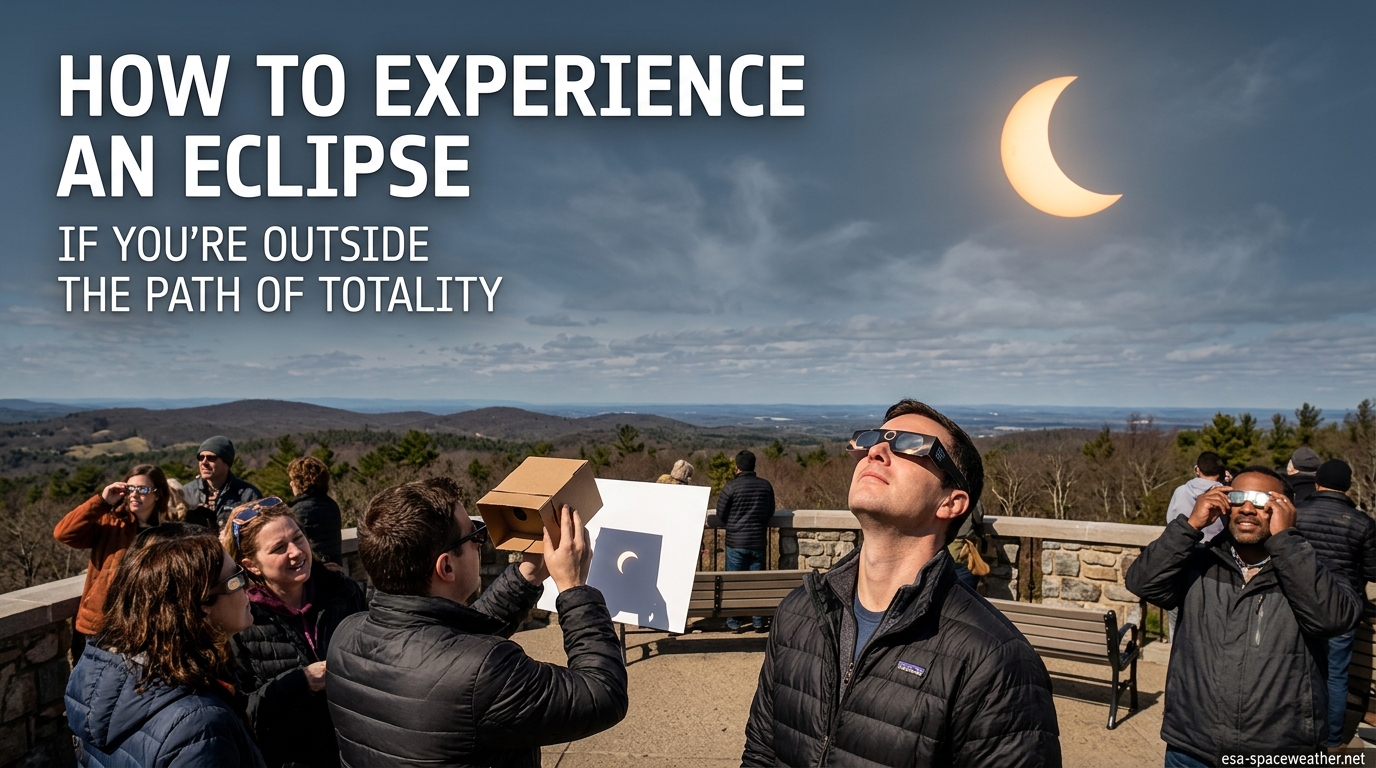
So you just realized you live outside the path of totality for an upcoming solar eclipse. Maybe you cannot take time off work, maybe travel is not an option, or maybe you simply did not plan ahead. Either way, you might be wondering whether the eclipse is even worth bothering with from where you are.
I have good news. A partial solar eclipse is genuinely one of the most rewarding skywatching events you can experience from your own backyard. You just need to know what to expect, how to prepare, and how to watch safely.
In this guide, I will walk you through exactly how to experience an eclipse if you are outside the path of totality. I will cover what you will actually see, the best viewing methods, safety rules, photography tips, and even citizen science projects you can participate in. By the end, you will be ready to make the most of partial eclipse day without traveling anywhere.
Table of Contents
Quick Summary: What You Need to Know Right Now
If you only have 30 seconds, here is the short version. Yes, you can absolutely see a solar eclipse from outside the path of totality. What you will witness is a partial solar eclipse, where the Moon covers a portion of the Sun’s disk. The closer you are to the path of totality, the larger the percentage of the Sun that gets blocked.
You must use proper eye protection at all times during a partial eclipse. There is never a safe moment to look directly at the partially covered Sun without ISO 12312-2 certified eclipse glasses or a solar viewer. Regular sunglasses, smoked glass, and camera filters are never safe.
A partial eclipse can last up to three hours, giving you plenty of time to observe, photograph, and enjoy the experience. The Moon’s shadow will visibly march across the Sun’s face, temperatures may drop slightly, and tree leaves will project tiny crescent shapes on the ground. It is a remarkable event in its own right.
What Does It Mean to Be Outside the Path of Totality?
To understand what you will see, it helps to understand why you see it. A total solar eclipse happens when the Moon passes directly between the Earth and the Sun, casting a shadow that completely blocks the Sun’s bright disk. That complete shadow is called the umbra, and it traces a narrow path across the Earth’s surface.
The path of totality is typically only about 70 to 100 miles wide. If you are standing inside that band, you experience the full total eclipse. If you are anywhere outside it, you are in the penumbra, which is the Moon’s lighter outer shadow.
Inside the penumbra, the Moon only partially covers the Sun. That is what creates a partial solar eclipse. The further you are from the path of totality, the smaller the percentage of the Sun that gets covered. Someone 50 miles outside the path might see 95 percent coverage. Someone 500 miles away might only see 50 percent.
Here is a critical point that catches many people off guard. Even at 99 percent coverage, you do not experience totality. The remaining one percent of sunlight is still bright enough to overwhelm the dramatic effects that totality brings. Reddit users from the astronomy community put it bluntly: totality is an all-or-nothing experience. But that does not mean a partial eclipse is not worth your time. It absolutely is.
What You Will Actually See: The Partial Eclipse Experience
A partial solar eclipse is a slow, stately celestial event that unfolds over several hours. The Moon’s silhouette gradually encroaches on the Sun’s disk, taking a visible bite out of it that grows larger over time. Through eclipse glasses, it looks like an invisible hand is gradually eating away at the Sun.
The shape of the uncovered portion changes throughout the event. Early on, you will see a small notch in the Sun’s edge. As maximum eclipse approaches, the remaining visible portion of the Sun forms a thick crescent shape. At high obscuration percentages, that crescent becomes razor-thin and intensely bright.
One of the most magical parts of a partial eclipse requires no equipment at all. Look at the ground beneath a leafy tree. The tiny gaps between leaves act as natural pinhole projectors, casting hundreds of tiny crescent-shaped images of the Sun on the pavement. This effect is stunning and is often the moment that gets people hooked on eclipse watching.
You may also notice subtle environmental changes. At 80 percent or higher coverage, the light takes on an odd, slightly silvery quality. Shadows become sharper. The temperature may drop a few degrees. Birds might quiet down or begin evening behaviors earlier than usual. These effects are subtle compared to totality, but they are noticeable if you pay attention.
Do not expect darkness. Even at 90 percent coverage, the sky remains bright. It might look like a thin cloud has passed over the Sun. The dramatic darkness, visible corona, and stars that define totality only happen inside the umbral path. But the partial phases offer something totality cannot: time. You get hours to observe, photograph, and appreciate the event instead of a couple of frantic minutes.
How Far From the Path of Totality Can You Be?
This is one of the most common questions in astronomy forums. The answer depends on what kind of experience you want.
If your goal is to see the largest possible partial eclipse, position yourself as close to the path of totality edge as you can manage. Even a few miles can make a measurable difference in the percentage of the Sun covered. Someone just outside the path might see 99 percent obscuration, while someone a few hundred miles away might see only 60 percent.
If your goal is a quieter, less crowded experience, being further from the path has real advantages. The areas just inside and outside totality draw huge crowds. Being 200 or 300 miles away means you can watch from your backyard, a local park, or anywhere with a clear view of the Sun, without fighting traffic.
Here is a rough guide to what different obscuration levels look like. At 50 percent, you will clearly see a crescent Sun through glasses, but the daylight will look completely normal. At 75 percent, you might notice slightly cooler temperatures and a subtle change in light quality. At 90 percent, the light becomes noticeably unusual and crescent shadows become prominent on the ground. At 95 percent or above, the experience becomes genuinely dramatic, though still not totality.
My recommendation is to get as close to the path edge as is practical for you. Even being one mile outside the path will give you an impressive partial eclipse. But if travel is not possible, a 70 or 80 percent partial eclipse from your home is still absolutely worth watching.
Safe Viewing Methods for Partial Eclipses
Safety is the single most important topic when it comes to solar eclipses. Looking at the Sun without proper protection can cause permanent eye damage, including solar retinopathy, which has no pain warning and can result in blind spots. During a partial eclipse, the Sun is never fully covered, so eye protection is required for the entire duration of the event.
Eclipse Glasses and Solar Viewers
The simplest and most popular method is a pair of ISO 12312-2 certified eclipse glasses. These are thousands of times darker than regular sunglasses and block harmful solar radiation. Look for the ISO 12312-2 international safety standard printed on the glasses themselves.
Buy your glasses from a reputable source well before eclipse day. The American Astronomical Society maintains a list of verified vendors. Avoid marketplace sellers with no track record, as counterfeit glasses flooded the market during the 2017 and 2024 eclipses. Inspect your glasses before use by holding them up to a bright indoor light. You should only see a very faint glow at most. If you can see household lighting clearly, the glasses are defective.
To use eclipse glasses, put them on before looking up at the Sun. Look at the Sun through the glasses, then turn away before removing them. Never look at the Sun through the glasses while moving or walking, as you will be essentially blind to your surroundings while wearing them.
Pinhole Projection
Pinhole projection is the safest indirect viewing method because you never look at the Sun directly. You create a small hole that projects an inverted image of the Sun onto a flat surface. It is simple, costs nothing, and is an excellent project for kids and families.
I will cover how to build a pinhole projector in detail in the next section. The basic principle is that light passing through a small opening creates an image of the Sun’s current shape on a screen behind it. During a partial eclipse, that projected image shows the crescent Sun clearly.
Binoculars and Telescopes With Solar Filters
For a closer view of the partial eclipse, you can use binoculars or a telescope, but only with proper solar filters mounted on the front of the instrument, never on the eyepiece. Front-mounted filters block harmful light before it enters the optics, which is the only safe approach.
A telescope with a white-light solar filter will show sunspots along with the Moon’s silhouette crossing the Sun. This is where the partial eclipse becomes truly fascinating for astronomy enthusiasts. You can watch the Moon cover and uncover individual sunspot groups over the course of the event.
Never use binoculars or a telescope without a certified solar filter. Concentrated sunlight through unfiltered optics can cause instant, severe eye damage. Also never look through eclipse glasses while using binoculars or a telescope. The magnified light can melt the filter material and damage your eyes in a fraction of a second.
What NOT to Do
Do not use regular sunglasses, no matter how dark they are. They offer zero protection against solar radiation. Do not use smoked glass, exposed film, CDs, or floppy disk media. None of these are safe. Do not use camera filters, neutral density filters, or polarizing filters meant for photography. They do not block the specific wavelengths of light that damage your eyes.
Do not point your smartphone camera at the Sun without a solar filter for extended periods. While a quick photo will not permanently damage most phone sensors, prolonged exposure can degrade the camera. Place an eclipse glass filter over the phone lens for safe partial eclipse photography.
Do not assume that cloud cover makes the Sun safe to look at. Thin clouds still allow dangerous levels of solar radiation through. If you can see the Sun’s disk at all through clouds, it is not safe to view without protection.
Viewing Methods Comparison
Here is a quick comparison of the main viewing methods for a partial solar eclipse to help you choose the right approach.
- Eclipse glasses: Direct viewing, simplest to use, very low cost, requires ISO 12312-2 certification. Best for casual viewing and families.
- Pinhole projector: Indirect viewing, free to make, totally safe, lower detail. Best for kids, groups, and extended observation.
- Telescope with solar filter: Direct magnified viewing, highest detail, moderate to high cost, requires careful setup. Best for serious astronomy enthusiasts.
- Binoculars with solar filters: Direct magnified viewing, moderate cost, portable. Best for intermediate observers wanting a closer look.
How to Make a Pinhole Projector: Step by Step
Building a pinhole projector is one of the easiest and most rewarding ways to watch a partial solar eclipse. You probably already have everything you need at home. Here is how to make two different versions.
Method 1: The Card Pinhole Projector
Step 1: Grab two pieces of stiff white cardboard or heavy white paper. One will be the projector card and the other will be the screen.
Step 2: Cut a small square hole in the center of the projector card, about one inch across. Tape a piece of aluminum foil over the hole.
Step 3: Use a pin or needle to poke a single clean hole through the center of the aluminum foil. The hole should be small and round, about one to two millimeters across.
Step 4: Stand with your back to the Sun. Hold the projector card up so sunlight passes through the pinhole. Hold the screen card about two to three feet behind it.
Step 5: Adjust the distance between the cards until you see a sharp, round image of the Sun projected on the screen card. During a partial eclipse, that round image will show the crescent shape of the partially covered Sun.
Method 2: The Cereal Box Viewer
Step 1: Take an empty cereal box or shoe box and tape the top closed securely. Cut a rectangular hole in one end of the box large enough to look through with one eye.
Step 2: Tape a piece of aluminum foil over a second smaller hole cut in the same end, next to the viewing hole. Poke a pinhole through the foil.
Step 3: Tape a sheet of white paper inside the box on the bottom to serve as the projection screen.
Step 4: Stand with your back to the Sun. Hold the box so sunlight enters through the pinhole and projects onto the white paper inside. Look through the viewing hole to see the projected image of the Sun.
You can also use everyday objects as improvised pinhole projectors. A kitchen colander will project dozens of tiny crescent Suns onto the ground. Even the gaps between your crossed fingers will project a small image. Hold your hands so the gaps between your fingers create small openings, and look at the shadow on the ground. Each gap will show a tiny crescent during the eclipse.
Photographing a Partial Eclipse
A partial eclipse is actually easier to photograph than totality because you have hours to experiment, and the Sun’s disk is always visible through a proper filter. Here is how to get decent photos without damaging your equipment.
Smartphone Photography
You can get surprisingly good partial eclipse photos with a smartphone if you use an eclipse glass as a filter. Hold or tape an eclipse glass securely over your phone’s camera lens. Point the phone at the Sun and snap away. The crescent Sun will appear clearly in the photo.
Do not use the digital zoom, as it will only degrade image quality. Instead, crop the photo afterwards. If your phone has a telephoto lens, use that for a slightly larger image of the Sun. Tap the screen to set focus and exposure on the Sun before taking the shot.
Keep your expectations realistic. Smartphone cameras are not designed for solar photography, so your images will not rival NASA’s. But you can capture a recognizable crescent Sun that makes a great keepsake.
DSLR and Mirrorless Cameras
For higher quality images, use a DSLR or mirrorless camera with a telephoto lens (at least 200mm, ideally 400mm or more) and a certified solar filter mounted on the front of the lens. A neutral density solar filter rated for photography will work well.
Use a tripod for stability. Set your camera to manual mode. Start with a low ISO of 100 or 200, a fast shutter speed around 1/500 or 1/1000, and an aperture around f/8 to f/11. Bracket your exposures and review the results to fine-tune your settings.
The great advantage of photographing a partial eclipse is time. You can take test shots, adjust settings, and reshoot over the course of hours. Photographers in the path of totality have only minutes. You can also create a composite image showing the Sun at different stages of the partial eclipse, which is a beautiful and satisfying project.
What to Expect: A Minute-by-Minute Timeline
Here is a general timeline of what a partial eclipse experience looks like, so you know what to watch for and when. Exact times will vary depending on your location and the specific eclipse, but this gives you a sense of the rhythm of the event.
First Contact (T minus 2 to 3 hours): The Moon’s silhouette first touches the edge of the Sun’s disk. Through eclipse glasses, you will see a tiny notch appear on one side. To the naked eye, nothing has changed yet. The sky looks completely normal.
30 Minutes In: The notch has grown into a visible bite. Through eclipse glasses, the crescent shape is unmistakable. On the ground beneath trees, you may start to notice crescent-shaped patterns in the dappled light.
1 Hour In: Roughly 30 to 50 percent of the Sun may be covered depending on your location. The light quality begins to shift subtly. Shadows look slightly crisper than usual. This is a good time to start photography if you are doing a composite series.
30 Minutes Before Maximum: The crescent Sun is now quite thin if you are near the path of totality. The ambient light takes on a strange, silvery quality that is hard to describe but noticeable. Temperatures may drop by a few degrees.
Maximum Eclipse: This is the peak of the partial eclipse for your location. The Moon covers the largest percentage of the Sun it will reach. If you are at 90 percent coverage or above, the thin remaining crescent of the Sun is intensely bright through eclipse glasses. This is the moment to really study the projected images from your pinhole projector and to photograph.
After Maximum: The Moon begins to retreat. The crescent thickens again as the Moon slides away from the Sun’s disk. The entire process reverses over another one to two hours until the Moon’s shadow clears the Sun completely.
Final Contact: The Moon’s silhouette leaves the Sun entirely. The eclipse is over. The Sun looks normal again. Time to compare photos, clean up your viewing setup, and reflect on what you just witnessed.
Citizen Science During a Partial Eclipse
One of the most overlooked aspects of a partial eclipse is the opportunity to contribute to real scientific research. You do not need to be in the path of totality to participate, and several projects actively welcome partial eclipse observers.
The NASA GLOBE Observer app lets you report on temperature, cloud cover, and atmospheric conditions during the eclipse. These reports help scientists study how partial eclipses affect local weather patterns. Simply download the free app, make observations before, during, and after maximum eclipse, and submit your data.
Zooniverse, the largest citizen science platform, frequently runs eclipse-related projects. These might involve classifying solar features in telescope images, tracking animal behavior changes, or analyzing historical eclipse data. Check their website before eclipse day for active projects related to the event.
If you have a telescope with a solar filter, you can photograph sunspots before and after the eclipse. The Moon’s path across the Sun provides a reference point for tracking sunspot positions and solar rotation. Some amateur astronomy communities collect and compile these images for shared research.
Wildlife observation is another area where partial eclipse data is genuinely valuable. Report any changes in bird behavior, insect activity, or animal sounds to citizen science platforms like iNaturalist or eBird. Even at 80 percent coverage, some animals show measurable behavioral shifts, and data from outside the path of totality helps scientists understand the thresholds for these reactions.
For educators and parents, a partial eclipse is a perfect opportunity for structured citizen science projects. Have students record temperature every 10 minutes, document cloud types, and log wildlife observations. These activities turn a skywatching event into a hands-on science lesson.
Eclipse Day Preparation Checklist
A little preparation goes a long way toward making your partial eclipse experience smooth and enjoyable. Here is a practical checklist for eclipse day.
- Get your glasses early: Order ISO 12312-2 certified eclipse glasses at least two to three weeks before the event. Do not wait until the last minute when stock runs low and counterfeiters flood the market.
- Check your local eclipse times: Visit a reliable source like NASA’s eclipse website or timeanddate.com to find exact start, maximum, and end times for your specific location.
- Scout your viewing location: Find a spot with a clear, unobstructed view of the Sun for the entire duration of the eclipse. A south-facing backyard, an open park, or a rooftop works well. Avoid spots where buildings or trees will block the Sun.
- Check the weather forecast: Cloud cover is the biggest threat to eclipse viewing. Check forecasts starting a week out and keep checking. If clouds are likely, consider whether a short drive to a clearer area is possible. Even under thin clouds, you may still feel the temperature drop and notice changes in light quality.
- Prepare your equipment: Charge your phone or camera batteries. Test your pinhole projector the day before. If using a telescope, set it up and practice mounting the solar filter. Lay out your eclipse glasses where you can find them.
- Pack comfort items: Bring water, snacks, sunscreen, a hat, and a chair. A partial eclipse lasts hours, and you will be outside the entire time. A notepad for recording observations is a nice touch.
- Plan for kids: If watching with children, explain what will happen beforehand. Have them help build the pinhole projector. Give them jobs like recording the temperature or drawing what they see through the glasses every 15 minutes.
- Have a cloud backup plan: If the weather does not cooperate, you can still watch live streams of the eclipse from NASA or other astronomy organizations. It is not the same as being outside, but it is better than missing the event entirely.
Upcoming Eclipses 2026 and Beyond
If you are reading this in 2026, there are several upcoming eclipses to put on your calendar. Even if you are outside the path of totality for these events, partial phases will be visible across wide areas.
August 12, 2026: A partial solar eclipse will be visible across parts of Europe, including the UK, northern Spain, Portugal, and Iceland. This event also features an annular eclipse visible from a narrow path, meaning the Moon does not completely cover the Sun and leaves a ring of fire visible. Outside the annular path, observers will see a partial eclipse of varying depth.
February 6, 2027: An annular solar eclipse will cross South America, the Atlantic, and Africa. A large partial eclipse will be visible across much of the Southern Hemisphere. This is a great opportunity for observers in South America and southern Africa to experience a significant partial eclipse.
August 2, 2027: A total solar eclipse will cross Spain, North Africa, the Middle East, and parts of Asia. This will be one of the longest total eclipses of the century, with totality lasting up to six minutes and 23 seconds in parts of Egypt. A partial eclipse will be visible across nearly all of Europe, Africa, and much of Asia. If you are anywhere in these regions, you will see a deep partial eclipse at minimum.
January 26, 2028: An annular eclipse will cross South America and the Atlantic. Partial phases visible across much of the Americas.
July 22, 2028: A total solar eclipse will cross Australia and New Zealand, with partial phases visible across much of the South Pacific and Southeast Asia.
For each of these events, check local eclipse maps to find the obscuration percentage for your specific location. Even a 60 percent partial eclipse is a worthwhile experience, and with the skills you learn from this guide, you will be ready to make the most of it.
FAQs
Can you see a solar eclipse outside the path of totality?
Yes. Anyone outside the path of totality but within the Moon’s penumbral shadow will see a partial solar eclipse. The closer you are to the path of totality, the larger the percentage of the Sun that will be covered. Even hundreds of miles away from the path, you can still see a meaningful partial eclipse.
What does a partial solar eclipse look like?
A partial solar eclipse looks like a crescent Sun. Through eclipse glasses, you can see the Moon’s silhouette taking a visible bite out of the Sun’s disk. As the eclipse progresses, the crescent shape thins and shifts. On the ground beneath trees, you will see hundreds of tiny crescent-shaped images of the Sun projected through the gaps in the leaves.
How long does a partial solar eclipse last?
A partial solar eclipse can last anywhere from two to three hours from first contact, when the Moon first touches the Sun, to last contact, when it fully clears the disk. Maximum eclipse, when the largest portion of the Sun is covered, occurs at the midpoint of this period. This is much longer than totality, which typically lasts only two to four minutes.
Is a partial solar eclipse worth watching?
Absolutely. A partial eclipse offers hours of observation time, unique photography opportunities, visible crescent shadows through tree leaves, subtle changes in light and temperature, and a chance to witness the Moon’s orbital motion in real time. While it does not match the dramatic darkness of totality, it is a rewarding experience on its own and requires no travel.
Can you look at a partial solar eclipse without protection?
No. You must never look at a partially eclipsed Sun without proper eye protection. ISO 12312-2 certified eclipse glasses or a safe solar viewer are required for the entire duration of a partial eclipse. Regular sunglasses, smoked glass, and camera filters are never safe. Looking at the partially covered Sun can cause permanent eye damage with no pain warning.
How do you make a pinhole projector for a solar eclipse?
Take two pieces of stiff white cardboard. Cut a small hole in one, cover it with aluminum foil, and poke a pinhole through the foil. Stand with your back to the Sun and hold the pinhole card so sunlight passes through it onto the second card held about two to three feet behind. You will see a projected image of the Sun showing the crescent shape during a partial eclipse.
How much of the Sun is covered in a partial eclipse?
The amount of the Sun covered depends entirely on your distance from the path of totality. Just outside the path, coverage can reach 99 percent. A few hundred miles away, it might be 70 to 80 percent. Across a continent, it can range from 50 percent down to 10 percent. Check an eclipse map for your specific location to find the exact obscuration percentage for any given eclipse.
Where can you see the next solar eclipse?
On August 12, 2026, a partial solar eclipse will be visible across much of Europe including the UK, Spain, Portugal, and Iceland. On August 2, 2027, a total solar eclipse crossing Spain, North Africa, and the Middle East will produce a deep partial eclipse visible across nearly all of Europe, Africa, and much of Asia. Check NASA eclipse maps for specific visibility details at your location.
Making the Most of Your Partial Eclipse
Learning how to experience an eclipse if you are outside the path of totality comes down to a few essentials. Get proper ISO 12312-2 eclipse glasses, build a pinhole projector, find a clear viewing spot, and pay attention to the subtle but beautiful changes happening around you.
A partial solar eclipse is not a consolation prize. It is a chance to spend a few hours watching our solar system in motion, right from wherever you happen to be. The crescent Sun, the tiny projected images in tree shadows, the slight chill in the air, and the hours of slow celestial choreography make it a genuinely memorable event.
Mark your calendar, prepare your gear, and step outside on eclipse day. The sky is putting on a show for you, even if you are hundreds of miles from the path of totality.