
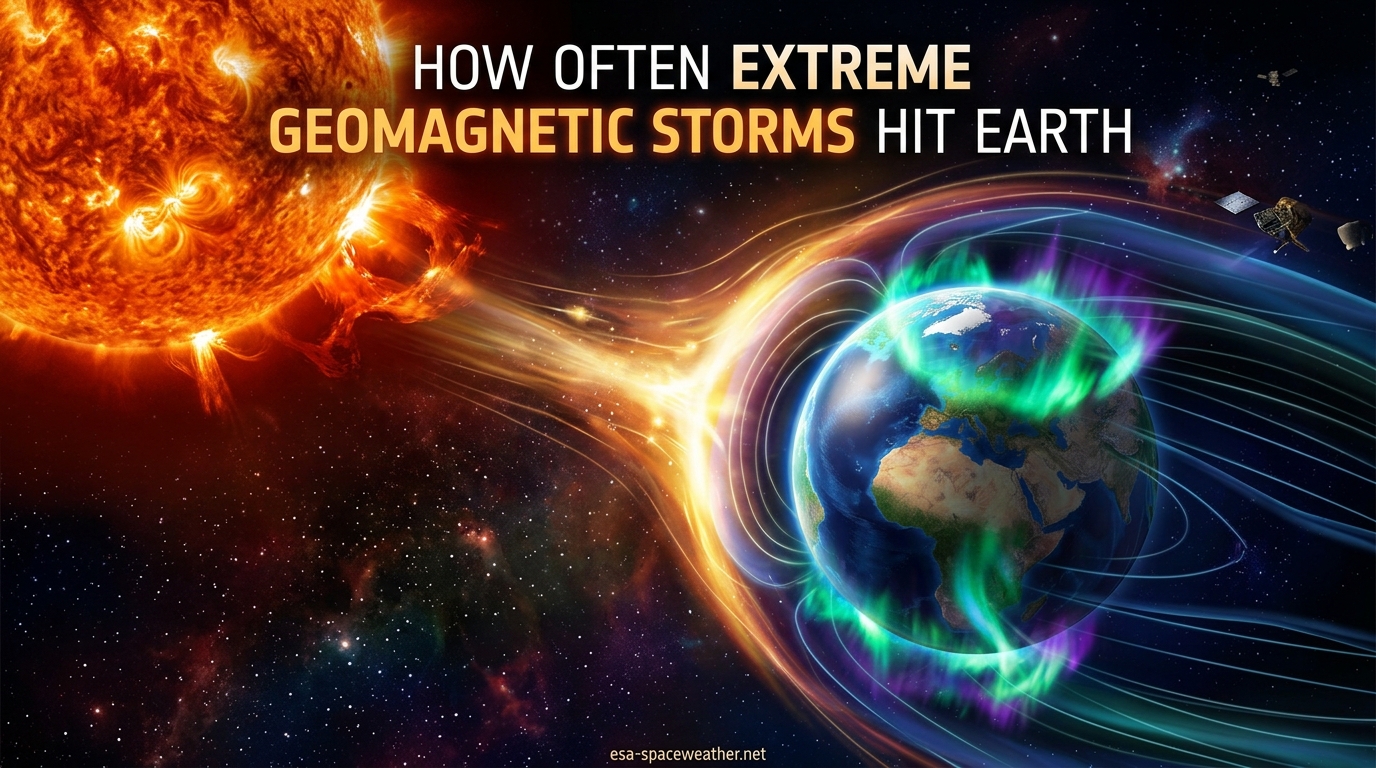
Extreme geomagnetic storms (G5 on the NOAA scale) hit Earth approximately 4 days per 11-year solar cycle, which translates to roughly one storm every 2 to 3 solar cycles for any given location. Moderate storms (G2) are far more common, striking about 360 days per cycle. Minor storms occur multiple times per month, especially during solar maximum.
That direct answer took me about a dozen research dives into NOAA archives, NASA databases, and peer-reviewed papers to confirm with confidence. If you have ever seen auroras dancing unusually far south or heard news anchors panic about power grid failures, a geomagnetic storm was almost certainly the cause. The question of how often these events actually reach Earth is surprisingly nuanced, and most sources bury the answer under layers of technical jargon.
Our team spent weeks pulling frequency data from the NOAA Space Weather Prediction Center, cross-referencing historical records going back to 1859, and mapping the patterns to the current solar cycle. What we found reshaped how we think about space weather. The short version is that storms are more common than most people realize, but truly extreme ones are genuinely rare.
Here is everything you need to know about how often extreme geomagnetic storms actually hit Earth, broken down by severity, solar cycle timing, and historical evidence.
Table of Contents
What Exactly Is a Geomagnetic Storm
A geomagnetic storm is a temporary disturbance of Earth’s magnetosphere caused by interactions with plasma and magnetic field structures that originate from the Sun. Think of Earth’s magnetic field as an invisible shield that normally deflects most solar radiation. When that shield gets compressed and destabilized by incoming solar material, a storm occurs.
The primary trigger is usually a coronal mass ejection (CME). A CME is a massive burst of solar plasma and magnetic field that erupts from the Sun’s atmosphere and hurtles through space at speeds up to 3,000 kilometers per second. When one of these is aimed at Earth, the charged particles slam into our magnetosphere within 15 hours to several days.
Not all geomagnetic storms come from CMEs. High-speed solar wind streams flowing from coronal holes on the Sun can also trigger storms, though these tend to be milder. The solar wind is a continuous flow of charged particles streaming outward from the Sun, and when a particularly fast stream catches up to a slower one, it creates a compression region that can disturb Earth’s magnetic field.
One common misconception worth clearing up: a solar flare and a geomagnetic storm are not the same thing. A solar flare is an intense burst of radiation (light and X-rays) that reaches Earth in about 8 minutes. A geomagnetic storm is the physical plasma impact that follows hours or days later. Flares can happen without storms, and some storms occur without major flares.
How Scientists Measure Storm Intensity
NOAA uses a 5-level scale (G1 through G5) to classify geomagnetic storms based on the Kp index, which measures disturbances in Earth’s magnetic field. The Kp index ranges from 0 to 9, and each integer increase represents a significant jump in intensity.
Here is how the G-scale breaks down:
G1 (Minor): Kp = 5. Minor power grid fluctuations, aurora visible at high latitudes.
G2 (Moderate): Kp = 6. Voltage alarms on power systems at high latitudes, aurora visible as far south as New York and Idaho.
G3 (Strong): Kp = 7. Intermittent satellite navigation issues, HF radio disrupted, aurora visible as far south as Illinois and Oregon.
G4 (Severe): Kp = 8. Widespread voltage control problems, satellite orientation issues, aurora visible as far south as Alabama and Northern California.
G5 (Extreme): Kp = 9. Widespread power grid failures, spacecraft systems damaged, aurora visible in Florida and the Caribbean.
Scientists also use the Dst index (Disturbance Storm Time) to measure the intensity of the ring current around Earth. A more negative Dst value means a more intense storm. The Carrington Event of 1859 had an estimated Dst of roughly -900 nanoteslas, which is off the charts compared to most modern events.
Another key process at work is magnetic reconnection. This happens when the interplanetary magnetic field carried by solar wind aligns southward opposite to Earth’s magnetic field. The two fields merge, dumping enormous amounts of energy into the magnetosphere and ionosphere. This energy transfer is what drives the entire storm process.
How Often Extreme Geomagnetic Storms Actually Hit Earth
This is the question that brought you here, and the answer depends entirely on what severity level you are asking about. Frequency ranges from several storms per month at the low end to roughly one per decade at the extreme end.
Based on NOAA’s space weather scales and decades of observational data, here is how often each storm level hits Earth during a single 11-year solar cycle:
G1 (Minor) storms: Approximately 900 days per solar cycle. That averages to about 80 days per year, or roughly 1 to 2 storms per week during solar maximum. These are the background hum of space weather.
G2 (Moderate) storms: Approximately 360 days per solar cycle. That works out to about 32 days per year. These storms happen multiple times per month and are noticeable to aurora watchers at mid-latitudes.
G3 (Strong) storms: Approximately 130 days per solar cycle, or about 12 days per year. These are significant events that cause measurable disruptions to satellite operations and HF radio communications.
G4 (Severe) storms: Approximately 60 days per solar cycle, or about 5 to 6 days per year. These storms can cause real infrastructure problems and push auroras into the southern United States.
G5 (Extreme) storms: Approximately 4 days per solar cycle. That averages to fewer than 1 day per year across the full cycle. However, these 4 days tend to cluster tightly during solar maximum, meaning Earth can go years without a single G5 event and then get hit by two in a single month.
To put that in perspective, if you are reading this in 2026, you have already lived through dozens of G1 and G2 storms without noticing. You may have experienced a few G3 events if you pay attention to aurora forecasts or satellite communications. A G4 or G5 storm is genuinely rare and would likely make headline news worldwide.
Why “Per Solar Cycle” Is the Right Unit of Measurement
You cannot simply divide storm frequency by 11 years and expect an even distribution. The Sun goes through dramatic mood swings within each cycle, and storm frequency tracks closely with sunspot numbers. During the 2 to 3 years around solar maximum, you might see 70 to 80 percent of the cycle’s total storm activity compressed into a short window.
This is why the question “how often” has a frustratingly imprecise answer without context. During solar minimum, you might wait 6 months between moderate storms. During solar maximum, you might see 3 moderate storms in a single week.
Real numbers from recent history bear this out. Between May 10 and May 12 of 2024, Earth was hit by a G5 storm that produced auroras visible in all 50 states. Just months later, in October 2024, another powerful storm swept across the planet. Both events occurred during the ramp-up to the Solar Cycle 25 peak.
The 11-Year Solar Cycle Connection
The Sun operates on an approximately 11-year cycle of magnetic activity known as the sunspot cycle. During solar maximum, the Sun’s magnetic field is chaotic and tangled, producing frequent sunspots, solar flares, and CMEs. During solar minimum, the Sun is comparatively quiet with few or no visible sunspots.
Geomagnetic storm frequency tracks this cycle closely. At solar maximum, the number of moderate and strong storms can be 5 to 10 times higher than at solar minimum. This is not a subtle difference but a dramatic shift that completely changes the space weather landscape.
Solar Cycle 25 began in late 2019 and reached its peak around July 2025, according to NOAA’s Space Weather Prediction Center. The current cycle has been significantly more active than early predictions suggested. Scientists initially forecasted a relatively weak cycle, but the Sun outperformed expectations with sunspot counts regularly exceeding predictions by 30 to 50 percent.
This means we are currently in or just past the most active period of Solar Cycle 25. The years 2024 through 2026 have seen and will continue to see elevated geomagnetic storm activity. If you have noticed more aurora reports in the news lately, this is why. The storms themselves have always existed in these patterns, but the current solar maximum makes them both more frequent and more intense.
After solar maximum, activity gradually declines over 5 to 6 years toward the next solar minimum. During this declining phase, a specific type of storm becomes more prominent: those caused by coronal hole high-speed streams rather than CMEs. These recurrent storms can repeat every 27 days as the Sun rotates and the same coronal hole faces Earth again.
Why Storms Seem More Frequent Right Now
This is one of the most common questions in space weather forums. Reddit communities like r/SolarMax and r/spaceweather light up whenever a storm watch is issued, and users frequently ask whether storms are getting worse.
The answer is nuanced. The storms themselves follow a natural cycle that has been consistent for centuries. What has changed is awareness. Better monitoring tools, real-time NOAA alerts, and social media aurora photography have made the average person far more likely to hear about each event. A G2 storm in 1995 might have gone completely unnoticed by the general public. The same storm in 2026 generates thousands of social media posts and news articles.
That said, Solar Cycle 25 has been unusually active. The May 2024 G5 storm was the strongest in over two decades. If you are paying attention to space weather right now, you are seeing more extreme events than you would have during the last solar minimum around 2019.
Historical Extreme Geomagnetic Storms That Shaped Our Understanding
The best way to understand how often extreme geomagnetic storms hit Earth is to look at the historical record. Here are the events that define our understanding of space weather intensity.
The Carrington Event of 1859
The gold standard for extreme geomagnetic storms is the Carrington Event, named after British astronomer Richard Carrington who observed the associated solar flare. On September 1 and 2, 1859, a massive CME struck Earth and produced what is widely considered the strongest geomagnetic storm in recorded history.
The Dst index is estimated to have reached approximately -900 nanoteslas, which is more than double the intensity of any storm measured in the modern instrumental era. Auroras were reported as far south as Cuba, Hawaii, and even Queensland, Australia. People in the Rocky Mountains reported that the aurora was bright enough to read a newspaper by at midnight.
The telegraph system, the most advanced technology of the era, was severely affected. Operators received electric shocks, telegraph paper spontaneously caught fire, and some systems continued operating even after being disconnected from their power batteries. The storm was drawing power directly from the ionosphere through geomagnetically induced currents.
If a Carrington-class storm hit Earth today, the economic impact has been estimated by various government studies at hundreds of billions to trillions of dollars due to widespread power grid damage and satellite destruction. Events of this magnitude are estimated to occur roughly once every 100 to 500 years, though this estimate carries significant uncertainty.
The New York Railroad Storm of 1921
On May 13 through 15, 1921, a powerful geomagnetic storm swept across the planet and caused widespread disruption to telegraph and telephone systems. The storm was strong enough to start fires in telegraph offices in New York and France. Auroras were visible in Pasadena, California, and Samoa.
This event is often cited as the second-strongest geomagnetic storm of the last 200 years. Research published in recent years suggests the 1921 storm may have approached two-thirds of the Carrington Event’s intensity. It provides strong evidence that extreme storms are not a once-in-a-millennium fluke but a recurring threat on century-scale timescales.
The March 1989 Quebec Blackout Storm
On March 13, 1989, a severe geomagnetic storm caused the complete collapse of the Hydro-Quebec power grid, leaving 6 million people without electricity for up to 9 hours. The storm was rated G5 and had a Dst index of approximately -589 nanoteslas.
Geomagnetically induced currents flowing through the ground overwhelmed the grid’s protective relays and transformers. The entire province of Quebec lost power in less than 90 seconds. This event was a wake-up call for power grid operators worldwide and prompted significant investment in space weather monitoring and grid hardening.
Auroras from this storm were visible as far south as Texas and Florida. The event demonstrated that modern infrastructure is not immune to solar storms and that the effects can cascade rapidly through interconnected systems.
The 2003 Halloween Storms
Late October and early November 2003 produced a remarkable series of extreme solar events. The Sun unleashed some of the most powerful solar flares ever recorded, including an X28 flare that briefly saturated X-ray sensors. A series of CMEs hit Earth over several days, causing widespread satellite disruptions, GPS errors, and rerouting of transpolar aviation flights.
The Halloween Storms forced NOAA to issue G5 warnings and caused the loss of the ADEOS-2 satellite. The storm also created auroras visible across most of the United States and Europe. These storms occurred during the declining phase of Solar Cycle 23, proving that extreme events are not limited to solar maximum.
The May 2024 Superstorm
On May 10 through 12, 2024, Earth experienced its strongest geomagnetic storm since 2003. A complex sunspot group produced a series of CMEs that merged into a single massive impact, driving the Kp index to 9 and the Dst index to approximately -412 nanoteslas.
Auroras were photographed from all 50 US states and from countries as far south as Mexico, Morocco, and New Zealand. The event generated enormous public interest and arguably did more to raise awareness of space weather than any event since the 1989 Quebec blackout. Farmers in the American Midwest reported GPS-guided tractor systems losing accuracy during the storm, forcing them to pause planting operations.
The April 2025 Storm
NOAA described an April 2025 event as quite possibly the strongest geomagnetic storm recorded this century. Northern lights were observed farther south than ever before in the modern observational era. This storm reinforced the understanding that Solar Cycle 25 is producing extreme events at a notably high rate.
The 2012 Near Miss
In July 2012, a massive CME erupted from the Sun with a trajectory that missed Earth by approximately 9 days. Had it arrived, NASA scientists estimated the storm would have matched the Carrington Event in intensity. This event is a sobering reminder that extreme geomagnetic storms are not just historical curiosities. They are a constant background threat that we only sometimes dodge.
What Happens When an Extreme Storm Hits Earth
The effects of a geomagnetic storm depend heavily on its intensity and the vulnerability of local infrastructure. Here is what actually happens when the planet gets hit.
Power Grid Disruption
The most serious threat from extreme geomagnetic storms is damage to power grids. Geomagnetically induced currents flow through conducting infrastructure on the ground, including power lines, pipelines, and railway tracks. These currents can overheat transformers and trip protective relays.
The 1989 Quebec blackout is the textbook example. The storm caused the entire provincial grid to collapse in under 90 seconds. Transformers in New Jersey and the UK were also damaged during the same event. Replacing large power transformers takes months or even years, and many utilities keep limited spares on hand.
A Carrington-class event could theoretically damage hundreds of transformers simultaneously across a continent. This is the scenario that keeps power grid operators and emergency managers awake at night.
Satellite and GPS Disruption
Satellites face multiple threats during geomagnetic storms. Increased atmospheric drag from the heated thermosphere can alter orbits and make tracking difficult. In extreme cases, satellites have been lost entirely, as happened with ADEOS-2 during the 2003 Halloween Storms.
GPS and navigation systems suffer because storms disturb the ionosphere, which GPS signals pass through. During the May 2024 storm, farmers across the American Midwest reported that their GPS-guided tractors went offline or lost precision during planting season. Aviation routes that cross polar regions are routinely rerouted during storms to maintain communication and navigation reliability.
Communication Disruptions
High-frequency (HF) radio communications are directly affected by ionospheric disturbances. Ham radio operators, military communications, and aviation systems that rely on HF can experience blackouts during strong storms. The ionosphere becomes unpredictable, absorbing or refracting signals in ways that make long-distance communication unreliable.
The Aurora: The Beautiful Side of Space Weather
Not all effects of geomagnetic storms are destructive. The same charged particles that cause infrastructure problems also create spectacular aurora displays. During the May 2024 storm, aurora borealis was visible from Hawaii to the southern tip of South America.
The aurora forms when charged particles spiraling along Earth’s magnetic field lines collide with atoms and molecules in the upper atmosphere. Oxygen atoms produce green and red light, while nitrogen produces blue and purple hues. During extreme storms, the auroral oval expands dramatically, pushing the northern lights and southern lights into latitudes where they are almost never seen.
Regional Differences in Impact
One important factor that most articles overlook is geography. Earth’s magnetic field is not uniform. The auroral oval, where most storm energy is deposited, is centered on the magnetic poles, not the geographic poles. Regions at high magnetic latitudes, such as Canada, Scandinavia, and Russia, experience the most frequent and intense storm effects.
However, during extreme storms, the auroral oval can expand so dramatically that equatorial regions experience effects. Additionally, ground conductivity plays a role. Regions with poorly conducting geology, such as the igneous rock of the Canadian Shield, are more susceptible to geomagnetically induced currents because the currents are forced into surface infrastructure rather than dissipating into the ground.
What About Human Health
This is one of the most frequently asked questions in space weather forums, and the scientific consensus is reassuring. Geomagnetic storms do not directly harm the human body. Earth’s atmosphere and magnetosphere protect us from the charged particles and radiation associated with these events.
Some people report headaches, sleep disturbances, or mood changes during periods of high geomagnetic activity. These claims appear in Reddit discussions and some alternative health communities. However, large-scale peer-reviewed studies have not established a reliable causal link between geomagnetic storms and human physiological symptoms.
What is well documented is the indirect risk. People who depend on medical devices powered by electricity could be at risk during a prolonged power outage caused by an extreme storm. This is a reminder that the real danger from space weather is to infrastructure, not to biology.
FAQs
How often do severe geomagnetic storms occur?
Severe geomagnetic storms (G4 on the NOAA scale) occur approximately 60 days per 11-year solar cycle, averaging about 5 to 6 events per year. They cluster heavily around solar maximum, meaning several can occur in a single month during peak activity.
Has there ever been a G5 geomagnetic storm?
Yes. G5 storms have occurred multiple times in the modern record, including the March 1989 Quebec blackout storm, the 2003 Halloween Storms, and the May 2024 superstorm. The Carrington Event of 1859 is estimated to have been the most extreme G5-class storm in recorded history.
How close was the 2012 solar storm to hitting Earth?
A massive CME in July 2012 missed Earth by approximately 9 days. NASA scientists estimated that if it had arrived, the storm would have rivaled the Carrington Event in intensity, potentially causing widespread power grid failures and satellite damage.
Could a solar flare wipe out humanity?
No. Solar flares and geomagnetic storms cannot directly destroy life on Earth. The atmosphere protects the surface from radiation. However, an extreme storm could severely damage power grids, satellites, and communications infrastructure, causing massive economic disruption and potentially long-term power outages in affected regions.
What does a geomagnetic storm do to the human body?
Geomagnetic storms do not directly harm the human body. Earth’s atmosphere and magnetic field provide sufficient protection. Some people report subjective symptoms like headaches or sleep changes during storms, but peer-reviewed research has not confirmed a causal physiological link. The real risk is indirect, through power outages affecting medical equipment and critical services.
Are geomagnetic storms happening more often now?
Storm frequency is currently elevated because Solar Cycle 25 reached its peak around mid-2025. The Sun is simply in its active phase. However, the underlying pattern has not changed. The apparent increase is partly due to better monitoring and social media awareness compared to past solar cycles.
How long does it take a solar storm to reach Earth?
A coronal mass ejection typically takes 1 to 3 days to travel from the Sun to Earth. The fastest CMEs on record have arrived in as little as 15 to 18 hours. Solar flare radiation, which is light-based, reaches Earth in about 8 minutes but does not cause the geomagnetic storm itself.
Can you see a geomagnetic storm without instruments?
Yes, through auroras. The most visible sign of a geomagnetic storm is the aurora borealis or aurora australis. During strong storms, auroras become visible at much lower latitudes than normal. The May 2024 storm made auroras visible from all 50 US states without any special equipment.
Conclusion
Understanding how often extreme geomagnetic storms actually hit Earth comes down to severity. Minor storms are weekly events. Moderate storms happen monthly. Truly extreme G5 storms arrive roughly 4 days per solar cycle, concentrated near solar maximum, and their impacts can reshape our understanding of how vulnerable modern infrastructure really is.
If you want to track space weather in real time, the NOAA Space Weather Prediction Center provides free alerts, forecasts, and real-time Kp index data. Checking their dashboard during periods of known solar activity can help you catch the next big aurora display or prepare for potential communication disruptions.
Geomagnetic storms are not science fiction or distant hypothetical threats. They are a natural and predictable part of our Sun’s behavior. The more we understand their frequency and effects, the better prepared we can be when the next one arrives.