
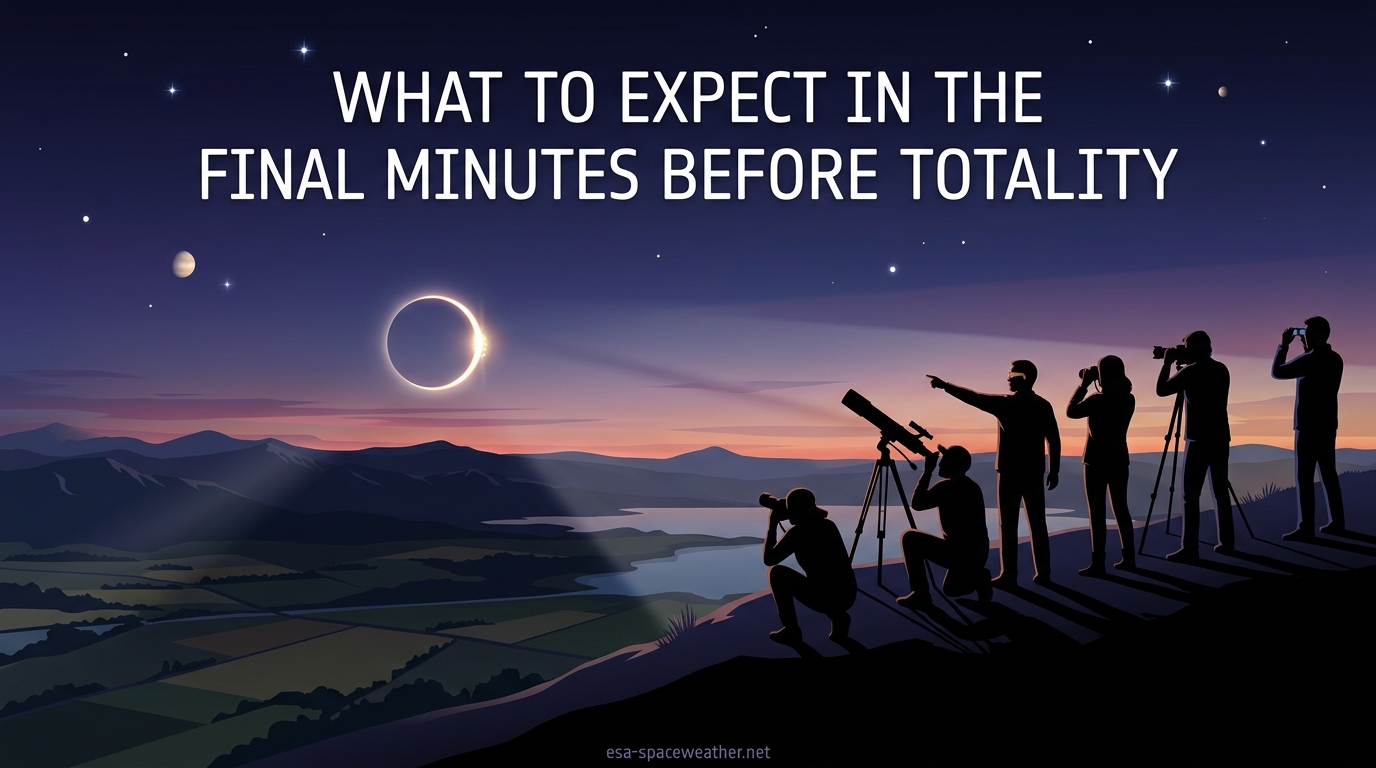
Nothing about a total solar eclipse prepares you for those last few minutes. I have talked with dozens of eclipse chasers over the years, and the story is always the same. The partial phase is interesting, sure. You watch the Moon take a bite out of the Sun for an hour or more. But then the final minutes before totality arrive, and everything changes.
In the final minutes before totality during a total solar eclipse, the sky darkens rapidly, temperatures drop noticeably, shadow bands may ripple across the ground, Baily’s Beads flash along the lunar edge, and a brilliant diamond ring effect signals the last seconds before the Sun’s corona is fully revealed. This countdown period lasts roughly 15 minutes and produces phenomena you will never see during a partial eclipse.
If you are planning to witness totality for the first time, understanding what happens in these final minutes is the single most important thing you can prepare for. Knowing the sequence of events means you will not miss anything. It means you will know when to remove your eclipse glasses and when to put them back on. And it means you can put the camera down at the right moment and actually experience what is happening above you.
Our team has compiled this guide from first-hand accounts, astronomical data, and community discussions to walk you through every minute of the approach to totality. Whether you are chasing the August 12, 2026 eclipse in Iceland or Spain, or planning ahead for the August 2, 2027 eclipse that will sweep across Egypt and the Mediterranean, this is what you need to know.
Table of Contents
Quick Reference: Minute-by-Minute Countdown Timeline
Here is the sequence of what happens as totality approaches. Use this as your quick-reference checklist during the eclipse.
- 15 minutes before totality: The light begins to look wrong. Colors shift toward silvery-gray. Shadows sharpen noticeably. The air temperature starts dropping.
- 10 minutes before totality: Birds go silent. Insects begin their evening routines. You may feel a chill. The western horizon starts to darken.
- 5 minutes before totality: Crescent Sun projections appear everywhere through leaves. The sky takes on an unnatural twilight quality unlike normal dusk.
- 3 minutes before totality: The Moon’s umbral shadow becomes visible as a dark wall racing across the landscape from the west. Venus may appear.
- 1-2 minutes before totality: Shadow bands appear. These are wavy lines of alternating light and dark that ripple across white surfaces, walls, and the ground.
- 30 seconds before totality: The last sliver of the Sun breaks into Baily’s Beads, then forms the diamond ring effect. This is your cue to remove eclipse glasses.
- The moment of totality (second contact): The diamond ring vanishes. The Sun’s corona blazes into view. Totality has begun.
This entire countdown sequence happens faster than most people expect. The partial phase drags on for over an hour, but the final minutes accelerate dramatically. You will feel the pace quicken.
15 Minutes Before Totality: The Light Begins to Change
Fifteen minutes before totality is when most observers first notice that something is genuinely different. Up until this point, the partial eclipse has been an interesting astronomical event viewed through safety filters. But now, the environment around you starts to transform.
The most striking change is the quality of daylight. It does not simply get dimmer the way it does at sunset. Instead, the light takes on a strange, silvery quality that photographers sometimes describe as metallic. Colors look slightly off. The sky may appear to have a grayish or even slightly purple tint. NASA’s eclipse guide describes this as light that looks “eerie or strange,” and that is the most accurate word for it.
Shadows become noticeably sharper at this stage. Because the visible portion of the Sun has been reduced to a narrowing crescent, the light source is effectively a thin sliver. This produces very crisp, well-defined shadows with hard edges. Look at your own shadow on the ground. Look at the shadows of trees and buildings. They will appear unnaturally sharp.
This is also when crescent Sun projections become spectacular. Light filtering through gaps between leaves acts as natural pinholes, projecting hundreds of tiny crescent Suns onto the ground beneath trees. If you have a colander, hold it up and watch the pattern of crescents it projects onto a surface. Every hole becomes a tiny pinhole projector.
The temperature has already begun to drop by this point. Depending on your location and the time of day, you may start to feel a slight chill that has nothing to do with wind or weather. The Sun has been partially blocked for over an hour at this stage, and the ground is no longer receiving its full warmth.
10 Minutes Before Totality: Temperature and Wildlife Shift
At the ten-minute mark, the changes become impossible to ignore. The world around you is behaving as if the Sun is setting, even though it is still well above the horizon.
The temperature drop becomes pronounced in these final minutes. Measurements taken during past eclipses show typical drops of 5 to 15 degrees Fahrenheit (3 to 8 degrees Celsius) in the path of totality. The exact amount depends on humidity, cloud cover, and local geography, but the cooling is always noticeable. I have seen observers reach for jackets they did not think they would need.
Wildlife reacts strongly during this window. Birds typically stop singing and head to roost. Crickets may begin their evening chirping. Bees and butterflies often return to their nests or resting spots. Farm animals like chickens may head toward their coops. Dogs and cats can become restless or anxious. If you are in a rural area, the sudden silence from wildlife is one of the most memorable parts of the experience.
The western horizon begins to darken noticeably. If you have a clear view to the west, you may see what looks like an approaching storm front. This is not weather. It is the leading edge of the Moon’s umbral shadow, which is rushing toward you at roughly 1,500 miles per hour (about 2,400 km/h). That darkening horizon is the shadow of the Moon cast on the atmosphere and landscape miles away.
Some observers report feeling a breeze spring up around this time. This happens because the rapid cooling of the ground causes a localized shift in air pressure, similar to what happens at sunset. Sky and Telescope specifically notes that a breeze may spring up about 30 seconds before totality, but some observers notice subtle air movement earlier.
3 Minutes Before Totality: The Shadow Approaches
Three minutes before totality is when the experience shifts from strange to dramatic. The pace of change accelerates rapidly, and you will feel it.
If you have a view to the west, this is the moment to look. The Moon’s umbral shadow is now close enough to see as a distinct dark wall sweeping across the landscape. Eclipse chasers describe it as a curtain of darkness descending over hills, fields, and buildings in the distance. It moves fast. It is one of the most visually striking things a person can witness on this planet.
The sky around the Sun is now significantly darker. Venus is typically the first planet to become visible, often appearing 3 to 5 minutes before totality depending on its position relative to the Sun. If Jupiter, Saturn, or Mars are in favorable positions, you may spot them as well. For the 2027 eclipse, Sky and Telescope has noted that several planets will be positioned conveniently for viewing during totality.
The temperature drop is now at its steepest rate of change. The cooling happens faster in these final minutes than at any other point during the eclipse. You will feel it on your skin.
The light quality has shifted from silvery to something closer to deep twilight. Colors are muted. The world looks like it is being viewed through a dark filter. But this is not normal twilight. Normal twilight happens gradually and evenly. This darkness is uneven, concentrated toward the west, and closing fast.
This is a good time to do a final check of your equipment. If you have a camera, make sure your settings are ready. If you have a white sheet or large piece of white cardboard, spread it out now so you are prepared to watch for shadow bands. Get your eclipse glasses in hand so you can remove them quickly when the diamond ring appears.
1-2 Minutes Before Totality: Shadow Bands Appear
Shadow bands are one of the most elusive and fascinating phenomena of a total solar eclipse. They appear in the final minute or two before totality and again briefly after totality ends.
Shadow bands are wavy, alternating lines of light and dark that ripple across flat surfaces. They look something like the patterns you see on the bottom of a swimming pool, except they are caused by atmospheric turbulence distorting the last thin sliver of sunlight. As the visible Sun narrows to a crescent only a few degrees wide, the atmosphere acts like an irregular lens, bending and shifting that narrow beam of light.
Not every eclipse produces clearly visible shadow bands, and not every location is ideal for seeing them. To maximize your chances, lay out a large white surface. A white bedsheet, a white poster board, or even the side of a white vehicle works well. NASA’s eclipse guide specifically mentions white cars and white sheets as good viewing surfaces.
Shadow bands move quickly. They shimmer and shift orientation. Some observers describe them as looking like heat shimmer or like ripples of alternating light and dark racing across the ground. They are subtle, so you need to be watching for them.
Not everyone sees shadow bands, even experienced eclipse chasers. Atmospheric conditions matter. If the air is very still, shadow bands may be faint or absent. If there is significant turbulence, they can be quite dramatic. Either way, watching for them in the final minutes is part of the experience.
30 Seconds Before Totality: The Diamond Ring Forms
The final 30 seconds are the most dramatic of the entire eclipse. Everything you have been watching for culminates here.
First, Baily’s Beads appear. These are bright points of light along the edge of the Moon, caused by sunlight streaming through valleys between mountains on the lunar surface. The Moon’s edge is not smooth. It has peaks and valleys, and in the final seconds, the remaining visible Sun is squeezed through these valleys, creating a string of bright beads.
The beads do not last long. Within seconds, most of them wink out one by one as the Moon’s mountains cover the remaining slivers of the Sun. What remains is a single, brilliant point of light. This is the diamond ring effect. The last bright point of sunlight blazes like a diamond, and the faintly glowing ring of the corona begins to emerge around the dark disk of the Moon.
The diamond ring is your signal. This is the moment to remove your eclipse glasses. The Sun is effectively covered. The photosphere, the blindingly bright surface of the Sun that causes eye damage, is fully blocked by the Moon. What remains is safe to view with the naked eye.
The diamond ring itself lasts only a few seconds. Do not linger on it with your naked eyes if it is still blazing. The transition from diamond ring to full totality is abrupt. The last bead vanishes, and suddenly the corona is there, blazing in the dark sky.
Many first-time observers miss the diamond ring because they are not expecting how fast it happens. If you are watching through eclipse glasses, you will see the crescent shrink to a sliver, then break into beads. The instant the last bead disappears, take off your glasses. The corona will be there.
The First 10 Seconds of Totality: What to Do Immediately
No competitor guide I have found tells you what to do in the first 10 seconds of totality. This is a gap I want to fill, because those first seconds are precious and they go by fast.
Here is what our team recommends, based on the experiences of veteran eclipse chasers:
- Remove your eclipse glasses immediately. The photosphere is covered. It is safe. The corona is roughly as bright as a full Moon and will not damage your eyes.
- Look up at the Sun. Do not look at your camera. Do not look at your phone. Look at the eclipsed Sun with your naked eyes. This is the moment you traveled for.
- Take in the corona. The solar corona looks like a pearly white, iridescent halo surrounding the dark Moon. It extends outward in streamers and plumes. It is larger than you expect.
- Scan the horizon. Look around in all directions. You should see the 360-degree sunset. Every horizon glows orange and pink because beyond the Moon’s shadow, the Sun is still partially visible.
- Look for planets and stars. Depending on the eclipse, you may see Venus, Jupiter, Saturn, Mars, and bright stars like Sirius or Capella.
- Breathe. Take a second to process what you are seeing. Totality is emotionally overwhelming for many people. Let yourself feel it.
The biggest mistake people make in the first seconds of totality is fumbling with cameras and phones instead of looking up. Totality for most eclipses lasts only 2 to 4 minutes. For the 2026 eclipse in Iceland, it may be under 2 minutes at low elevation. For the 2027 eclipse in Egypt, totality can last over 6 minutes. But even 6 minutes goes by shockingly fast when you are in the moment.
If you are photographing the eclipse, set up your camera before totality so that all you need to do is remove the solar filter and press the shutter. Better yet, set your camera on an intervalometer and let it run automatically. Then put it down and experience totality with your own eyes.
What the Corona Actually Looks Like
The solar corona is the outermost layer of the Sun’s atmosphere. It is always there, but it is normally invisible because the photosphere, the Sun’s bright surface, is a million times brighter. Only during totality, when the Moon blocks the photosphere, can you see the corona with your naked eye.
Most first-time observers are surprised by how large and bright the corona is. It extends outward from the Moon’s dark disk in all directions, often appearing 2 to 3 times the diameter of the Moon itself. During solar maximum, the period of peak solar activity in the Sun’s 11-year cycle, the corona tends to be larger and more symmetrical, with long streamers extending outward in many directions. We are currently in a period of solar maximum, which means upcoming eclipses should display particularly dramatic coronas.
The color of the corona is often described as pearly white or silvery. Some observers see faint hints of pink or red near the Moon’s edge, which comes from the chromosphere and solar prominences. The overall impression is of a glowing, structured halo that looks nothing like any photograph fully captures.
Photographs of the corona often show more detail and structure than the naked eye perceives. But no photograph conveys the visceral experience of seeing it in person, suspended in a dark sky with planets and stars around it. The corona is the single most compelling reason to travel to the path of totality.
The 360-Degree Sunset and Visible Planets
During totality, every horizon glows. This is the 360-degree sunset effect, and it happens because outside the Moon’s shadow, the Sun is still partially visible. In every direction, beyond the edge of the umbra, the atmosphere is lit by a partially eclipsed Sun. The result is a ring of sunset colors, orange and pink and gold, circling the entire horizon.
The effect is disorienting in the best possible way. You are standing in a circle of darkness roughly 100 to 170 miles wide, and every direction you look shows sunset colors. It is like being inside a dome where the edges are permanently glowing.
Planets and bright stars are also visible during totality. Which ones you see depends on the geometry of the eclipse and the positions of the planets at that time. Venus is almost always visible during totality because it is the brightest planet and never far from the Sun. Jupiter is frequently visible as well if it is in a favorable position. For the 2027 eclipse, Sky and Telescope notes that Venus and Jupiter should both be well-positioned for viewing.
You may also see bright stars like Sirius, Capella, Arcturus, or Procyon, depending on the season and which constellations are near the Sun at the time. The sky during totality is not as dark as a full night sky. It is more like deep twilight, so only the brightest objects appear.
Why 99% Partial Eclipse Is Nothing Like Totality
This is one of the most common points of confusion I see in eclipse discussions online. Many people assume that a 99% partial eclipse is 99% as good as totality. It is not. It is fundamentally different.
The Sun’s photosphere is so bright that even 1% of it visible will completely wash out the corona. At 99% coverage, the sky is dimmer, but it is still daytime. There is no corona visible. There are no planets or stars. There is no 360-degree sunset. There is no dramatic darkening. The temperature drops slightly, and the light looks a bit strange, but that is all.
The jump from 99% to 100% is not a 1% improvement. It is a qualitative transformation. The moment that last sliver of photosphere disappears behind the Moon, the corona blazes into view, darkness falls, and the entire experience changes. Reddit users who have witnessed both consistently describe a 99% eclipse as “barely worth going outside for” compared to totality.
This is why eclipse chasers obsess over being in the path of totality. Being 10 miles outside the path, where you see a 99.5% partial eclipse, is not almost the same experience. It is a completely different experience. If you are going to travel for an eclipse, get yourself inside the path of totality, even if it means driving a few more hours.
The 2026 eclipse has a particularly narrow path of totality because it occurs at low elevation near sunset in Iceland and Spain. The path may be only about 180 miles wide in some areas. Plan your location carefully and make sure you are comfortably inside the path, not on the edge.
What NOT to Do in the Final Minutes
Here are the critical mistakes to avoid during the final minutes before and during totality:
- Do not look at the Sun without eclipse glasses during the partial phase. Even when 99% of the Sun is covered, the remaining 1% of the photosphere is bright enough to cause permanent retinal damage. This condition is called solar retinopathy, and it can occur without pain because the retina has no pain receptors.
- Do not use sunglasses instead of eclipse glasses. Sunglasses, even very dark ones, do not provide adequate protection. Only certified ISO 12312-2 eclipse glasses or welder’s glass rated shade 14 or darker are safe for direct solar viewing.
- Do not look through binoculars or a telescope without a proper solar filter. Optical instruments concentrate sunlight and can cause instant, severe eye damage. This applies during the entire partial phase.
- Do not spend totality looking at your phone or camera screen. Totality is short. Experience it with your eyes. If you want photos, set your camera on automatic and let it run.
- Do not remove eclipse glasses too early. Wait until the diamond ring effect is ending and the photosphere is fully covered. Removing glasses during the partial phase risks eye damage.
- Do not forget to put eclipse glasses back on after totality ends. The moment the second diamond ring appears (third contact), the photosphere is visible again. Put your glasses on immediately.
- Do not panic about clouds. Even under cloudy skies, the onset of totality produces a dramatic darkening that is still worth experiencing. Thin clouds can even create interesting visual effects.
Photography Tips for the Final Countdown
Photographing the final minutes before totality is challenging but rewarding. Here are practical tips from eclipse photographers.
During the partial phase, you need a proper solar filter on your camera lens. This is non-negotiable. Without it, concentrated sunlight will destroy your camera sensor. Solar filters for camera lenses are available from several manufacturers and typically thread onto the front of the lens like a standard filter.
Set up your exposure settings before the final minutes. During the partial phase, exposure is relatively constant because you are shooting through a solar filter. Find your settings early and lock them in.
The critical moment for photography is the diamond ring and Baily’s Beads. These happen in the final 10 to 15 seconds before totality. You need to remove your solar filter just before totality begins, which means your exposure settings will need to change dramatically. Some photographers switch to aperture priority mode at this point and let the camera figure out exposure. Others pre-set two groups of settings, one for the filtered partial phase and one for unfiltered totality.
For the corona during totality, expect to use settings similar to what you would use for a bright full Moon. A typical starting point is around ISO 400, f/5.6 to f/8, and shutter speeds ranging from 1/1000 second (for the inner corona) to 1 second or longer (for the outer streamers). Bracketing your exposures is strongly recommended.
The best advice I can give is this. If this is your first total eclipse, do not try to be a photographer during totality. Set up a camera on a tripod with an intervalometer and let it run automatically. Then spend every second of totality looking up. You can always find professional photos of the corona online. You cannot replay the experience of seeing it with your own eyes.
Tips for First-Time Observers and Children
If this is your first total solar eclipse, or if you are bringing children, preparation makes a huge difference.
For first-time adults, the key is managing expectations. The partial phase is slow and, honestly, a bit boring. Do not let that discourage you. The payoff comes in the final minutes. If you know what to expect and when, the experience goes from confusing to magical. Read through the minute-by-minute timeline above and keep it handy.
For children, the experience can be overwhelming or even slightly frightening. The sudden darkness, the temperature drop, and the strange animal behavior can be unsettling. Talk to kids beforehand about what will happen. Explain that it will get dark like nighttime in the middle of the day, that birds will stop singing, and that it will get cold. Frame it as an adventure and a rare opportunity.
Keep children engaged during the long partial phase with activities. Have them do pinhole projections with their fingers or a colander. Let them look through eclipse glasses at the crescent Sun every few minutes and describe how it has changed. Give them a notebook to draw what they see.
For the moment of totality, make sure children know it is safe to look without glasses. Explain that they will see a “glowing ring” around the Moon. If they are old enough, help them look for planets and the 360-degree sunset.
One more tip for groups. Designate one person as the timekeeper. Totality has a defined duration at your location, and someone needs to call out when it is about to end. This person should also be responsible for reminding everyone to put eclipse glasses back on the instant totality ends.
The End of Totality: The Second Diamond Ring
Totality ends as abruptly as it begins. The Moon continues its orbital motion, and the first sliver of the Sun’s photosphere emerges from behind the Moon’s eastern edge.
This moment is called third contact, and it produces a second diamond ring effect. A bright point of light flares into existence on the opposite side of the Moon from where the first diamond ring appeared. For a brief moment, the diamond ring blazes again.
This is your signal to put your eclipse glasses back on. The instant any part of the photosphere is visible, it is no longer safe to look with the naked eye. If you are with a group, the designated timekeeper should call out loudly. Put glasses on yourself and help children with theirs.
The shadow bands may reappear briefly after totality ends, as the thin crescent of sunlight produces the same atmospheric distortion that caused them before totality. If you laid out a white sheet earlier, watch it again for a minute or so after third contact.
The post-totality partial phase plays out in reverse. The Moon gradually uncovers the Sun over the next hour or so. Light returns to normal. The temperature climbs back up. Birds resume singing. Wildlife returns to daytime behavior. Many observers describe a sense of emotional letdown after totality, a feeling that the most extraordinary thing they have ever witnessed is over.
This is completely normal. Totality is a profound experience, and returning to ordinary daylight can feel jarring. Take time to process what you saw. Talk with your group about what you each noticed. Compare observations. The shared experience is part of what makes totality so memorable.
FAQs
Why will the Sun disappear for 6 minutes in 2027?
The August 2, 2027 total solar eclipse will produce one of the longest periods of totality of the 21st century, lasting up to 6 minutes and 23 seconds in parts of Egypt. This happens because the Moon will be near perigee, its closest point to Earth, making it appear large enough to fully cover the Sun for an extended period. The Moon’s umbral shadow will be wide and the geometry of the Sun, Moon, and Earth alignment will be nearly perfect along the central path.
What should you not do during a solar eclipse?
Do not look at the partially eclipsed Sun without certified ISO 12312-2 eclipse glasses. Do not use regular sunglasses, smoked glass, or unfiltered cameras, binoculars, or telescopes. Do not remove eclipse glasses during the partial phase, even when 99% of the Sun is covered. Do not spend totality looking at your phone screen instead of the sky. Do not forget to put eclipse glasses back on the moment totality ends.
What happens if you look at a solar eclipse for 5 seconds?
Looking at the partially eclipsed Sun for even 5 seconds without proper eye protection can cause solar retinopathy, a condition where the retina is damaged by concentrated solar radiation. The retina has no pain receptors, so you may not feel anything wrong immediately. Damage can include blurred vision, blind spots, or permanent vision loss. Always use certified eclipse glasses during any partial phase.
How long does totality last on average?
Totality typically lasts between 2 and 4 minutes for most locations within the central path of a total solar eclipse. The exact duration depends on the Moon’s distance from Earth, the observer’s position within the path, and the geometry of the eclipse. Locations near the center line of the path experience the longest totality. The maximum possible duration is about 7.5 minutes, but such long eclipses are extremely rare.
When exactly should I remove my eclipse glasses?
Remove your eclipse glasses the moment the diamond ring effect fades and the last sliver of the Sun’s photosphere disappears behind the Moon. This is the instant totality begins, known as second contact. The corona that becomes visible during totality is roughly as bright as a full Moon and is safe to view with the naked eye. Put your glasses back on the moment totality ends and the first sliver of the Sun reappears.
Final Thoughts on the Final Minutes Before Totality
The final minutes before totality are the most extraordinary countdown you will ever experience. From the first eerie shift in daylight quality 15 minutes out, through the temperature drop and wildlife silence, to shadow bands and the blazing diamond ring, each moment builds toward the reveal of the solar corona. Understanding what to expect in the final minutes before totality means you will not miss a single phenomenon.
If you have the chance to position yourself in the path of totality for an upcoming eclipse, do it. The August 12, 2026 eclipse crosses Iceland and Spain. The August 2, 2027 eclipse sweeps across southern Spain, North Africa, and the Middle East with up to 6 minutes and 23 seconds of totality. These are opportunities that do not come often.
Prepare. Know the timeline. Know when to remove and replace your glasses. Bring a white sheet for shadow bands. And when totality arrives, put the camera down and look up. The final minutes before totality solar eclipse are something you will remember for the rest of your life, but only if you are present enough to experience them.