
You step outside on a clear night, look up, and see a particularly bright light. Is it a planet or just another star? If you have ever wondered this, you are in good company. It is one of the most common questions beginner stargazers ask, and fortunately, the answer is surprisingly simple once you know what to look for.
Learning how to tell a planet from a star in the night sky opens up a whole new appreciation for what you see overhead. Instead of a random scattering of lights, the sky becomes a map you can read with nothing more than your own two eyes. No telescope required.
Five planets are visible without any equipment at all: Mercury, Venus, Mars, Jupiter, and Saturn. Each one gives away its identity through a combination of how it shines, what color it appears, and where it sits relative to the stars around it. Once you learn these telltale signs, you will never look at the night sky the same way again.
Table of Contents
Quick Identification: How to Tell a Planet From a Star
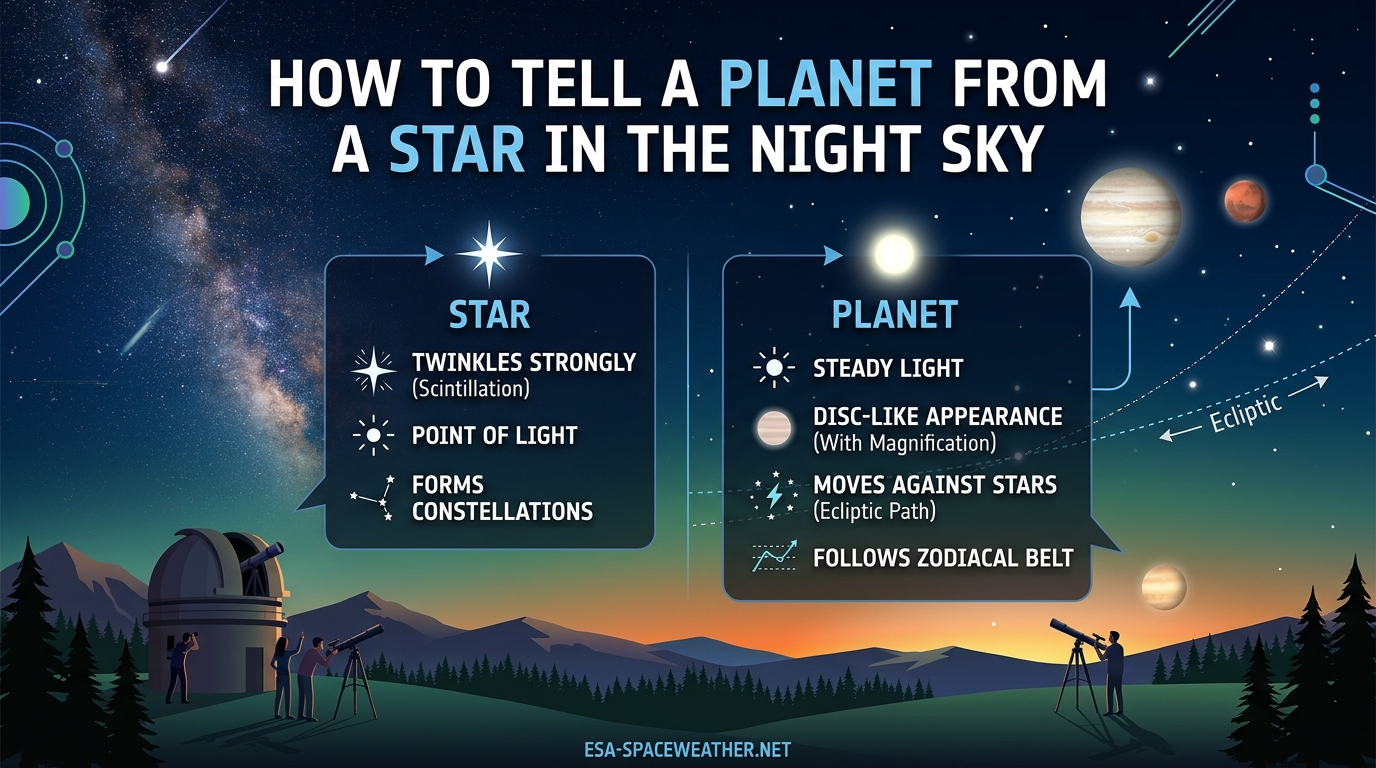
The single fastest way to tell a planet from a star is this: stars twinkle, and planets shine with a steady light. This is not just a helpful saying. It is a real physical phenomenon rooted in how our atmosphere interacts with light from different distances.
Here is a quick checklist you can use tonight:
- Watch for twinkling. If the light flickers rapidly, shifts between colors, or seems to dance, it is almost certainly a star.
- Look for a steady glow. Planets maintain constant brightness and rarely flicker, even when stars around them are going wild.
- Notice the color. Stars tend toward white or blue-white, while planets show distinct colors like red (Mars), cream (Jupiter), or brilliant white (Venus).
- Check the position. Planets always appear along a curved path across the sky called the ecliptic, never scattered randomly in all directions.
If you only remember one thing from this guide, make it the twinkling rule. It works almost every time, and it requires zero equipment.
Why Stars Twinkle but Planets Don’t
To understand why stars twinkle while planets hold steady, you need to know a little about what happens to light as it travels through Earth’s atmosphere. This effect is called stellar scintillation, and it is the same phenomenon that makes distant road signs appear to shimmer on hot days.
Stars are incredibly far away. Even the nearest star, Proxima Centauri, sits over 4 light-years from Earth. Because of this enormous distance, a star’s light arrives as essentially a single geometric point. Our atmosphere is full of turbulent layers of air at different temperatures and densities, and these layers bend and distort that pinpoint of light in constantly shifting ways. Your eye perceives this rapid distortion as twinkling.
Planets, by contrast, are much closer. Mars, Jupiter, and Saturn are only light-minutes or light-hours away rather than light-years. Because they are nearer, planets do not appear as pinpoints. Even to the naked eye, a planet presents a tiny but measurable disk of light. While the atmosphere still distorts this light just as much, the distortion is spread across the entire face of the disk. Some parts get brighter while other parts get dimmer simultaneously, and the effects average out. The result is a steady glow that barely flickers.
This is why experienced observers say that on nights of poor atmospheric seeing, stars twinkle wildly while planets barely react. The worse the air turbulence, the more obvious the difference becomes. A turbulent night is actually a great time to practice planet identification.
It is worth noting that planets can occasionally appear to twinkle when they are very low on the horizon, because their light then passes through a much thicker slice of atmosphere. If a normally steady planet starts flickering near the horizon, atmospheric thickness is the cause, not the planet itself.
The Five Naked-Eye Planets and Their Colors
Five planets have been known to humanity since ancient times because they are bright enough to see without optical aid. Each has a characteristic color and brightness that helps you identify it.
Venus is the brightest planet in the night sky, often outshining everything except the Moon. It appears as a brilliant, steady white or slightly yellowish light. Venus is famously called both the “morning star” and the “evening star” because it appears either before sunrise or after sunset, depending on its orbital position. It never strays far from the Sun in the sky, so you will always find it relatively close to the horizon during twilight hours.
Jupiter is the second-brightest planet and shines with a steady cream or tan-colored light. It is noticeably bright, often brighter than any star in its vicinity, and its light carries a warm tone that distinguishes it from the cold blue-white of stars like Sirius. Jupiter moves slowly across the sky and can appear anywhere along the ecliptic.
Mars is impossible to miss once you spot it. It gives off a distinctive red, orange, or ruby-colored glow that stands out dramatically against the pale white of surrounding stars. Mars varies significantly in brightness depending on how close it is to Earth in its orbit, but its color remains its most reliable identifier.
Saturn appears as a pale yellow or butterscotch light, dimmer than Jupiter but still brighter than most stars. It shines steadily with a warm golden hue that some observers describe as looking like a faded version of Jupiter. Without a telescope, you cannot see Saturn’s rings, but its color and steadiness give it away.
Mercury is the trickiest of the five. It is relatively faint, appears only briefly near the horizon just before dawn or just after sunset, and never climbs high into the dark sky. Mercury has a pinkish or grayish tint and is easy to miss entirely. Most people who think they have never seen Mercury actually have not, because timing and a clear horizon view are critical.
How Planets Move Differently Than Stars
The word “planet” comes from the ancient Greek word planetes, which literally means “wanderer.” The Greeks noticed that certain lights in the sky did not stay in fixed positions relative to the others. While stars maintained the same constellation patterns night after night, year after year, a handful of objects drifted slowly across the background of fixed stars.
This wandering behavior is one of the most reliable identification methods over time. Stars form permanent patterns. The Big Dipper always looks like the Big Dipper. Orion always looks like Orion. But planets slowly shift their positions against this starry backdrop as they orbit the Sun. A planet that sits next to a particular star this week may be several degrees away next month.
All planets travel along a path in the sky called the ecliptic, which is the projection of Earth’s orbital plane against the celestial sphere. The ecliptic traces a great arc across the sky, and you will find every planet somewhere along or near this line. Stars, on the other hand, can appear anywhere, including well off the ecliptic path. If you see a bright, steady light sitting right on the ecliptic among the zodiac constellations, your planet suspicions should be high.
Occasionally, planets even appear to reverse direction against the stars. This phenomenon, called retrograde motion, happens because Earth periodically overtakes slower outer planets in its orbit. It baffled ancient astronomers for centuries but is now understood as a simple consequence of planets orbiting the Sun at different speeds.
Telling Planets Apart from Bright Stars
One of the biggest challenges beginners face is confusing planets with exceptionally bright stars. The most common source of this confusion is Sirius, the brightest star in the night sky. Sirius is dazzlingly bright, appears white-blue, and sits in the winter sky in a position where planets can also appear. Many people mistake it for a planet, especially when atmospheric conditions make it twinkle dramatically through many colors.
The key distinction is that Sirius always twinkles vigorously. No matter how steady the night, Sirius will flicker and flash through colors because it is a true point source of light. Planets near Sirius will hold steady while it dances. If you see two bright lights close together and one twinkles while the other does not, the steady one is your planet.
Other bright stars that cause confusion include Arcturus (orange-red, twinkles noticeably) and Vega (blue-white, also twinkles). None of these hold a steady light the way planets do, but their brightness can fool you at first glance. Always default to the twinkling test when in doubt.
Mercury deserves special mention here because it is the hardest naked-eye planet to identify with confidence. It hugs the horizon, competes with twilight glow, and is only visible in brief windows of a few weeks at a time. If you think you have spotted Mercury, note its position relative to the sunset or sunrise point, confirm it is not twinkling like a star, and cross-check with a visibility chart for that date.
If you have even a small pair of binoculars, they can settle the question instantly. Stars remain points of light even under magnification. Planets, however, resolve into tiny disks. You may even catch the tiny gibbous or crescent phase of Venus or the pale dot of Saturn through steady binoculars on a clear night.
Planets vs Satellites and Other Moving Objects
Not every non-twinkling light in the sky is a planet. Satellites, the International Space Station, and aircraft can all confuse first-time observers. Knowing how each of these behaves will sharpen your identification skills.
Satellites appear as steady lights that move steadily across the sky over the course of a few minutes. They do not twinkle, which can make them look planetary at first. However, no planet moves visibly during a single observing session. If a steady light is drifting across your field of view in real time, it is a satellite, not a planet. Satellites are also typically white or slightly yellow and fade in and out of visibility as they catch sunlight at different angles.
The International Space Station is especially brilliant and can be brighter than Jupiter for the few minutes it is overhead. It crosses the sky in about 5 to 7 minutes and is unmistakable once you see it move. Starlink satellite trains create an entirely different visual: a line of evenly spaced lights moving in formation.
Aircraft are the easiest to rule out because they carry blinking red, green, or white lights and move relatively quickly. Planets and stars never blink with aviation lights. If you see alternating colored flashes, you are looking at an airplane, not a celestial object.
How to Check Tonight’s Planet Visibility
Planet visibility changes throughout the year as Earth and other planets orbit the Sun at different speeds. A planet that dominated the evening sky last month might now be lost in the Sun’s glare or only visible before dawn. Knowing where to look for current information saves a lot of frustration.
The Time and Date website (timeanddate.com) is one of the most trusted resources among astronomy communities for real-time planet visibility data. It provides interactive sky charts tailored to your exact location and shows which planets are above the horizon at any given moment. Forum communities and experienced observers consistently recommend this tool.
EarthSky.org publishes daily and monthly guides to what is visible in the night sky, including specific dates for planet conjunctions, oppositions, and close encounters with the Moon. Their nightly guides are written for beginners and tell you exactly where to look.
If you want an app for your phone, Stellarium is the most frequently recommended option across astronomy forums. It provides a real-time, interactive star map that you can aim at the sky to identify whatever you are looking at. Point your phone at a bright light, and the app tells you instantly whether it is Venus, Jupiter, Sirius, or something else entirely. It is available free for both Android and iOS.
Seasonal patterns matter too. Venus and Mercury stay near the Sun, so they appear either in the evening western sky after sunset or the morning eastern sky before dawn. Mars, Jupiter, and Saturn can appear anywhere along the ecliptic and are visible at various times of night depending on the season. Jupiter reaches opposition roughly every 13 months, which is when it appears brightest and is visible all night.
Tips for Better Naked-Eye Observation
Before you head outside, a few simple habits will dramatically improve your ability to identify planets and stars. These require no equipment and only a few minutes of preparation.
Give your eyes at least 15 to 20 minutes in darkness to fully dark-adapt. Your pupils dilate and your retinal rod cells become far more sensitive to faint light, making color differences between planets and stars much more apparent. Avoid looking at your phone or any white light during this time, as even a brief flash resets the adaptation process. If you need light, use a red flashlight or red screen filter, which preserves night vision.
Get away from light pollution if possible. City lights wash out the subtle color and brightness differences that make planet identification possible. Even moving to a local park or a darker suburb helps significantly. The more stars you can see, the easier it becomes to notice which lights are behaving differently.
Observe on nights with clear, dry air. Humidity and haze scatter light and reduce contrast between objects. Crisp winter nights, despite the cold, often provide the best viewing conditions because cold air holds less moisture and tends to be more stable.
Finally, be patient. Planet identification becomes second nature with practice. After just a few nights of deliberate observation, you will start recognizing Venus on sight, picking out Jupiter’s warm glow, and spotting Mars’s red light without needing to think about it.
FAQs
How can I tell if it’s a planet or a star?
The simplest method is to watch for twinkling. Stars twinkle rapidly because their light reaches Earth as a pinpoint that gets distorted by atmospheric turbulence. Planets shine steadily because they are closer and appear as small disks, so atmospheric distortion averages out across their surface. If the light holds steady, it is likely a planet.
Which planet is most often mistaken for a star?
Venus is the planet most commonly mistaken for a star because it is incredibly bright and often appears near the horizon during twilight when people are outside. Ancient cultures even called it the morning star and evening star. Sirius, the brightest actual star, is also frequently mistaken for a planet, but its intense twinkling gives it away as a star.
How do I identify Venus and Jupiter in the night sky?
Venus appears as a brilliant, steady white light near the horizon, either after sunset in the west or before dawn in the east. It is always the brightest planet. Jupiter shines with a warm cream or tan color and is the second-brightest planet. It can appear anywhere along the ecliptic and holds its light steady without twinkling, making it easy to distinguish from nearby stars.
Why is Mercury so hard to spot compared to other planets?
Mercury is the smallest planet and orbits closest to the Sun, so it never appears far from the Sun in our sky. It is only visible briefly near the horizon just before sunrise or just after sunset, when twilight glow competes with its faint light. You need a clear, unobstructured western or eastern horizon and good timing to catch it during its short visibility windows.
Conclusion
Learning how to tell a planet from a star in the night sky comes down to a few simple principles. Stars twinkle because they are distant pinpoints of light distorted by our atmosphere. Planets shine steadily because they are close enough to appear as tiny disks. Each planet has a signature color, from the brilliant white of Venus to the ruby red of Mars, and all of them travel along the ecliptic path like wandering visitors among the fixed constellations.
The best way to master these skills is to step outside tonight and start practicing. Pick the brightest steady light you can find, note its color, and check its position with a free app like Stellarium. Before long, you will be pointing out Jupiter, Venus, and Saturn to friends and family with the confidence of someone who has been reading the sky for years.