
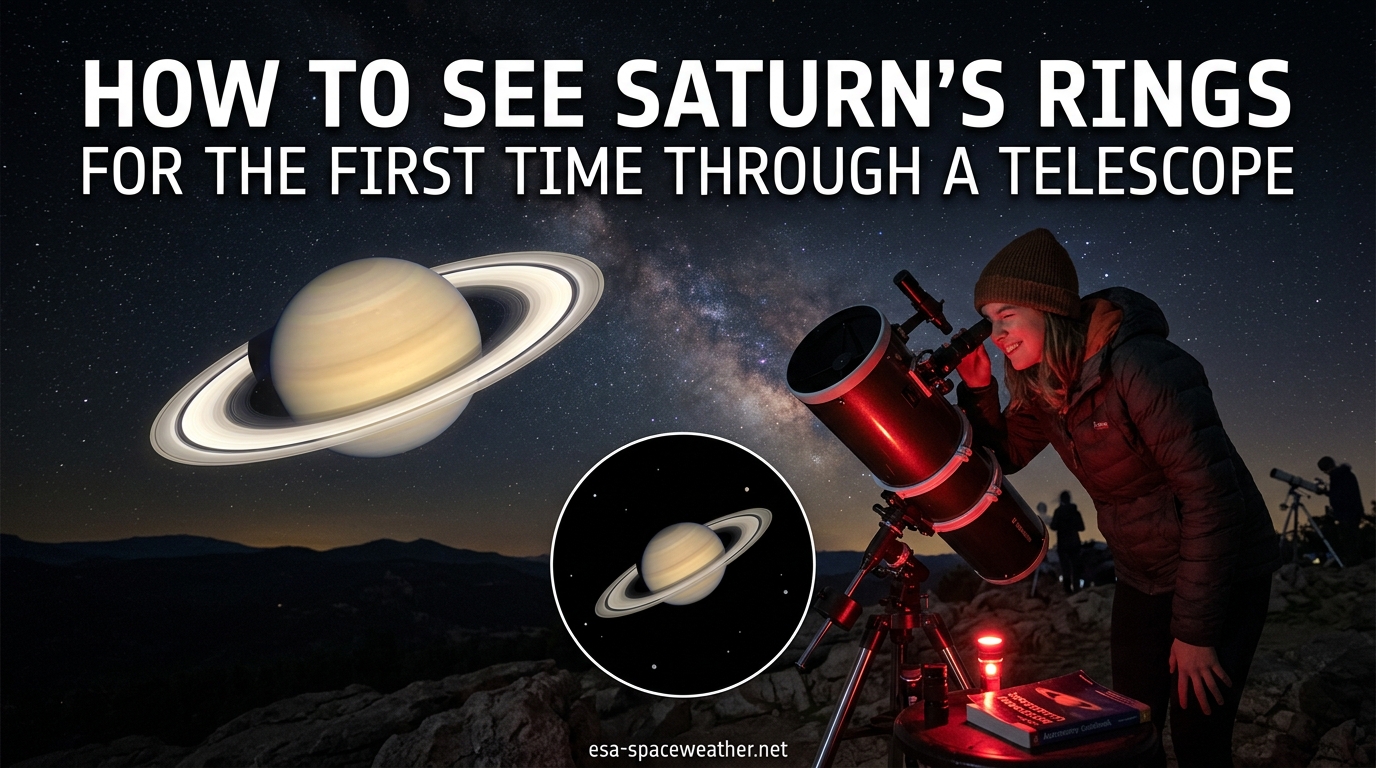
I still remember the first time I saw Saturn through a telescope. It was a humid August night in my backyard, and I had spent forty minutes fumbling with a borrowed 6-inch Dobsonian, trying to aim it at what I thought was the right “bright star.” When the pale yellow ball with its perfectly tilted rings finally swam into the eyepiece, I actually laughed out loud. It looked fake — like someone had glued a tiny illustration of Saturn onto the inside of my telescope tube.
That moment is what brings most people into amateur astronomy, and if you are here, you are probably chasing it yourself. Learning how to see Saturn’s rings for the first time through a telescope is easier than you might think. You do not need expensive equipment, a dark-sky site, or years of experience. You need a clear night, any modest telescope, and about twenty minutes of patience.
This guide walks you through everything from choosing the right magnification to finding Saturn in the sky, plus the troubleshooting tips that no other guide covers — like why Saturn looks white instead of golden, why it drifts out of view every thirty seconds, and why it will not look like a NASA photograph. I have pulled together advice from experienced observers on Reddit’s r/telescopes, Cloudy Nights forums, and my own hundreds of hours at the eyepiece to make sure your first view of Saturn lives up to the hype.
Table of Contents
The Short Answer: Yes, You Can See Saturn’s Rings Tonight
Yes, you can see Saturn’s rings with even the smallest telescope at 25x magnification. A basic 3-inch telescope at 50x reveals the rings as a clearly separate structure encircling the planet’s disk. You do not need a powerful or expensive scope — any working telescope will show them.
Here are the quick answers to the four most common questions beginners ask:
- Can you see Saturn with a beginner telescope? Absolutely. Even a 60mm refractor or a small tabletop Dobsonian at 25x will show Saturn as a tiny ball with ring “ears” on each side.
- How powerful of a telescope do you need? You need at least 25x magnification. A 3-inch (80mm) scope at 50x is the sweet spot for beginners. For the Cassini Division detail, aim for a 4-to-6-inch scope at 100-150x.
- Can you see Saturn’s rings with a phone? Not with the phone alone. You need a telescope first, then you can hold the phone camera to the eyepiece for afocal photography.
- Can you see Saturn’s rings with binoculars? No. Even quality 10×50 binoculars show Saturn as a small, slightly oval disk. They cannot resolve the rings. You need a telescope.
If you already own any telescope, skip ahead to the section on finding Saturn in the night sky. If you are still figuring out equipment, the next section breaks down exactly what works and why.
What Makes Saturn So Special to See Through a Telescope
Saturn is the sixth planet from the Sun, a gas giant composed mostly of hydrogen and helium with no solid surface to land on. It is the second-largest planet in our solar system, about 9.5 times the diameter of Earth. But none of those facts explain why amateur astronomers get emotional about it.
What makes Saturn unforgettable is the rings. Saturn’s ring system spans roughly 175,000 miles (282,000 km) in diameter — a vast, flat disk of ice particles, rocky debris, and dust chunks ranging in size from microscopic grains to objects the size of houses. When sunlight reflects off those countless ice particles, the rings glow bright enough to see across hundreds of millions of miles of space, straight into your backyard telescope.
Through the eyepiece, Saturn looks three-dimensional in a way that no other planet does. Jupiter is a striped disk. Mars is a red dot. Venus is a blindingly bright phase. But Saturn looks like a tiny world suspended in space, tilted at an angle, wearing a hat made of light. That sense of depth — the planet floating in front of the ring plane, casting its curved shadow onto the ring material behind it — is what makes first-time observers gasp.
One thing that affects your view significantly is the ring tilt. Saturn’s axial tilt is 26.7 degrees, so as the planet orbits the Sun over its 29.5-year period, our viewing angle of the rings changes. When the rings are wide open, you see a broad, bright ring system. When they appear edge-on, the rings nearly vanish — looking like a thin needle piercing the planet. In 2026, Saturn’s rings are tilted at a shallow angle (around 1-2 degrees), which means they appear as a thin but still visible line. The rings will continue to open up over the coming years, reaching maximum tilt around 2032.
Telescope Requirements: What You Actually Need
The most reassuring fact in all of amateur astronomy is this: any telescope can show Saturn’s rings. You do not need a specific brand, a massive aperture, or computerized tracking. You need working optics and at least 25x magnification.
That said, the size and type of your telescope determines how much detail you see. Here is what to expect at different aperture sizes:
- 60mm (2.4-inch) refractor: At 25-50x, Saturn shows a small pale disk with clearly visible ring “ears” extending on both sides. You can tell it is ringed, but fine detail is limited.
- 80mm (3-inch) refractor or reflector: At 50-100x, the rings separate from the planet’s body and appear as a distinct structure. Saturn’s largest moon, Titan, becomes visible as a steady point of light nearby.
- 114mm-150mm (4.5-to-6-inch) reflector or Dobsonian: At 100-200x, you can spot the Cassini Division — the dark gap between the A ring and B ring. Cloud bands on the planet’s surface may become faintly visible, and several moons appear.
- 200mm+ (8-inch and larger): At 200-300x on a steady night, the rings show multiple bands, the Cassini Division is crisp, you can glimpse the thin C ring (crepe ring) inside the main rings, and subtle color variations appear across the planet’s disk.
The sweet spot for most beginners is a 6-inch or 8-inch Dobsonian reflector. These telescopes offer enough aperture to show real detail on Saturn, they are simple to operate, and they cost far less than equivalent computerized models. A Dobsonian is essentially a Newtonian reflector tube mounted on a simple swivel base — no motors, no electronics, just smooth manual movement.
Telescope Types Compared for Saturn Observing
Different telescope designs handle planetary observing differently. Here is a quick comparison:
- Refractors (lens-based): Deliver crisp, high-contrast views that are excellent for planets. A 90mm or 100mm refractor is a superb Saturn scope. Downside: larger apertures become very expensive and long.
- Dobsonians / Newtonian reflectors (mirror-based): Offer the most aperture per dollar. An 8-inch Dobsonian shows stunning Saturn detail. Downside: mirrors need occasional collimation (alignment), and the telescope needs 20-30 minutes to cool down to outside temperature before delivering sharp views.
- Schmidt-Cassegrain (SCT) (compound): Compact tubes with long focal lengths, ideal for high-magnification planetary work. Downside: higher cost, and they also require cooldown and occasional collimation.
For a first-time observer, I recommend a 6-inch or 8-inch Dobsonian. It gives you the most Saturn detail for your budget and teaches you the night sky through manual aiming.
Eyepiece Selection: Which Magnification Works Best
Magnification is determined by dividing your telescope’s focal length by the eyepiece’s focal length. For example, a telescope with a 1200mm focal length paired with a 10mm eyepiece gives 120x magnification.
For Saturn, here are the magnification ranges that work well:
- 25-50x: Saturn appears small but the rings are clearly visible as “ears.” Good for locating the planet and framing it with moons.
- 80-150x: The sweet spot. The rings separate from the disk, the Cassini Division may appear in larger scopes, and the image stays bright and steady.
- 200-300x: Maximum useful magnification on nights with excellent seeing conditions. Pushing beyond this usually just magnifies atmospheric blur.
A practical starter combo: use a 25mm eyepiece to find and center Saturn, then switch to a 10mm or 6mm eyepiece for detailed viewing. A 2x Barlow lens effectively doubles your eyepiece collection — a 15mm eyepiece with a 2x Barlow gives you 30x and 60x options with a single eyepiece.
Avoid the “maximum magnification” claims on cheap department-store telescopes. A 60mm scope advertising “600x magnification” is lying to you. The practical limit for any telescope is about 50x per inch of aperture, and atmospheric conditions usually cap you lower than that.
How to Find Saturn in the Night Sky
Finding Saturn is the step where most beginners get stuck. The planet looks like a moderately bright star to the naked eye, and star-hopping to it can feel intimidating. But with a modern sky app and a few minutes of preparation, the process is straightforward.
Step 1: Know When Saturn Is Visible
Saturn is visible for most of the year except when it is too close to the Sun in the sky. The best time to observe is around opposition — the point when Earth passes between Saturn and the Sun, placing Saturn opposite the Sun in our sky.
At opposition, Saturn is closest to Earth, appears largest and brightest, and is visible all night long. Saturn reaches opposition once per year. For 2026, Saturn reaches opposition in late September, shining at approximately magnitude +0.6 in the constellation Pisces. The planet appears about 19 arcseconds across (excluding the rings), which is small but easily resolvable in any telescope.
Even outside of opposition week, Saturn is a fine target for months before and after. From roughly May through November in 2026, Saturn is well-placed for evening observation from the Northern Hemisphere.
Step 2: Use a Sky App to Locate Saturn
The fastest way to find Saturn is to use a free smartphone sky app. Point the app at the sky, and it will show you exactly where Saturn is relative to the horizon and nearby stars.
Recommended free apps include Stellarium (mobile and desktop), SkyView, Star Walk, and SkySafari. For observing conditions, Astrospheric (North America) provides forecasts for seeing, transparency, and cloud cover at your specific location.
Step 3: Align Your Finderscope
Before you try to find Saturn, make sure your finderscope (the small scope mounted on the side of the main telescope) is aligned. Do this during the day on a distant rooftop, chimney, or telephone pole.
- Point the main telescope at a distant, stationary object and center it in the eyepiece.
- Check the finderscope — if the object is not centered in its crosshairs, adjust the finderscope’s alignment screws until it is.
- Once aligned, anything you center in the finderscope crosshairs will appear in the main telescope’s field of view.
This step is non-negotiable. A misaligned finderscope is the number one reason beginners cannot find anything through their telescope.
Step 4: Center Saturn in the Finderscope, Then the Eyepiece
Once your app shows you where Saturn is, point the telescope roughly in that direction. Look through the finderscope and move the tube until Saturn sits in the crosshairs. Then switch to your lowest-magnification eyepiece (usually 25mm) and look through the main telescope.
Saturn should be visible as a small, pale oval shape — clearly not a star, which would be a sharp point of light. Once you have it centered in the low-power eyepiece, switch to your higher-magnification eyepiece for the detailed view.
If Saturn is not in the field of view after switching eyepieces, go back to the low-power eyepiece, re-center, and try again. Higher magnification means a narrower field of view, which makes it easy to lose the target during the switch.
What You Can See Through Your Telescope
Managing expectations is critical for first-time Saturn observers. You will not see anything resembling a NASA Cassini spacecraft image. What you will see is a small, real, three-dimensional object floating in space — and that reality carries an emotional weight that photographs cannot match.
The Rings
Through any telescope at 25x or more, Saturn’s rings are unmistakable. They appear as a bright, flat band encircling the planet, tilted at whatever angle the ring tilt cycle currently presents. In 2026, that tilt is shallow, so the rings appear as a thin bright line crossing the planet’s equator.
The ring system has distinct zones. The brightest portion is the B ring, and outside it sits the slightly dimmer A ring. The dark gap between them — the Cassini Division — is the feature most beginners try to spot next. In a 4-inch or larger scope on a steady night, the Cassini Division appears as a thin black line splitting the ring system.
The Cassini Division
The Cassini Division is a gap in the ring system caused by gravitational interactions with Saturn’s moon Mimas. It was discovered by Giovanni Cassini in 1675 and remains the most satisfying detail to observe as a beginner. Spotting it for the first time feels like a real achievement because it requires decent aperture, steady seeing, and patient viewing.
To maximize your chance of seeing the Cassini Division, wait for a night with stable atmospheric seeing, use at least 100x magnification in a 4-inch or larger scope, and look specifically at the outer portion of the ring system. The division is most visible on the ansae — the left and right ends of the ring where the ring material is most elongated from our line of sight.
Cloud Bands on the Planet
Saturn’s disk shows subtle cloud bands — alternating darker belts and lighter zones running parallel to the equator. These are much fainter than Jupiter’s bold stripes, and beginners often cannot see them at all. In a 6-inch or larger scope on a good night, you may detect one or two faint bands crossing Saturn’s pale surface.
The planet’s overall color through a telescope is usually described as pale yellow or cream, not the vivid gold and amber seen in processed photographs. This is normal, and I address why in the troubleshooting section below.
Saturn’s Moons
Saturn has 146 confirmed moons, but only a handful are visible through amateur telescopes. Titan, the largest, shines at about magnitude 8.5 and is easily visible in a 3-inch scope as a steady orange-tinted point of light near the planet. Titan orbits Saturn every 16 days, so it changes position noticeably from night to night.
In a 6-inch or larger scope, you may also spot Rhea, Tethys, and Dione — three fainter moons that appear as tiny pinpoints closer to the planet than Titan. On excellent nights with an 8-inch scope, Iapetus and Enceladus become possible targets. Use Stellarium or a similar app to identify which moons are visible and where to look on any given night.
Observing Tips for First-Time Saturn Viewers
A few practical techniques separate a frustrating first session from a memorable one. These tips come from experienced observers who have helped hundreds of beginners through star parties and astronomy club outreach events.
Check the Seeing Conditions
“Seeing” refers to the stability of Earth’s atmosphere. Good seeing means the air is calm and the image through the telescope is steady and sharp. Poor seeing means the atmosphere is turbulent and the planet appears to shimmer, blur, or boil.
Seeing matters more for planetary observation than almost any other factor. On a night with poor seeing, even an 8-inch telescope at 300x will show a blurry, useless image of Saturn. On a night with excellent seeing, a modest 4-inch scope at 150x can deliver a view so crisp it takes your breath away.
To check seeing before you set up, look at a bright star with the naked eye. If it twinkles violently, seeing is poor. If it shines steadily with minimal flickering, seeing is good. The Astrospheric app also provides seeing forecasts specific to your location.
Let Your Telescope Cool Down
If you store your telescope indoors and bring it outside, the optics need time to reach the ambient outdoor temperature. Warm mirrors and lenses create air currents inside the telescope tube that distort the image — a problem called “tube currents.”
For a small refractor, 10-15 minutes of cooldown is usually sufficient. For a larger reflector or Dobsonian, allow 20-30 minutes. For an 8-inch or larger scope, 45-60 minutes is ideal. Set the telescope outside and let it acclimate while you set up your chair, eyepieces, and red flashlight.
Collimate Reflector Telescopes
If you own a Newtonian reflector or Dobsonian, collimation is essential. Collimation means aligning the mirrors so that they focus light precisely. An uncollimated reflector produces soft, dim images — exactly what you do not want for Saturn.
Check collimation before each session using a collimation cap, Cheshire eyepiece, or laser collimator. Most Dobsonians hold collimation well once set, but transport and temperature changes can shift the alignment. A quick 5-minute check ensures your optics are performing at their best.
Your 10-Step Observing Checklist
Follow this checklist every time you observe Saturn for consistent, rewarding results:
- Check the weather and seeing forecast using Astrospheric or a similar app.
- Bring the telescope outside 30 minutes early to cool down.
- Verify collimation if using a reflector or Dobsonian.
- Align the finderscope on a distant terrestrial object (or a bright star).
- Use a sky app to locate Saturn and note its position relative to nearby stars.
- Point the telescope at Saturn and center it in the finderscope crosshairs.
- Confirm Saturn is visible in your lowest-magnification eyepiece (25mm).
- Switch to a medium-power eyepiece (10-15mm) for the main view.
- Try a high-power eyepiece (6mm or a Barlow) only if seeing conditions support it.
- Take your time — spend at least 10-15 minutes at the eyepiece letting your eye adjust and notice detail.
That last step is critical. Beginners often look for three seconds, declare “I see it,” and move on. The best views come after your eye has fully adapted to the dark and your brain has learned to extract faint detail from the image. Sit comfortably, rest your eye, and let the view develop.
Troubleshooting Common Problems
This section addresses the specific frustrations that first-time Saturn observers post about repeatedly on Reddit and astronomy forums. No other observing guide covers these issues directly, but they are the difference between a magical first night and a disappointing one.
Why Does Saturn Look White Instead of Orange?
This is one of the most common questions on r/telescopes. A beginner looks at Saturn with the naked eye or binoculars and sees a warm, golden-orange tint. Then they look through their telescope and the planet appears white, pale, or colorless.
There are several reasons. First, at higher magnification, the light from Saturn’s disk is spread over a larger area on your retina, reducing the apparent brightness and making colors harder to perceive. Second, light pollution washes out subtle color tints. Third, many beginner telescopes come with low-contrast eyepieces that reduce color saturation.
To improve color perception, observe from as dark a site as possible, let your eyes fully dark-adapt for 20-30 minutes, use quality eyepieces (Plossl or better), and try a light yellow or #8 yellow filter threaded onto your eyepiece. Some observers report that slightly defocusing and refocusing helps the eye pick up color. Saturn’s true color through a telescope is a pale, muted yellow-cream — not the vivid gold of long-exposure photographs.
Why Does Saturn Drift Out of View So Quickly?
If you use a manual telescope (most Dobsonians and entry-level scopes), Saturn will drift out of the eyepiece field within seconds at high magnification. This is caused by Earth’s rotation — the planet moves through your field of view at the same rate the stars move across the sky.
At 200x magnification, your field of view is so narrow that Saturn crosses it in about 30-60 seconds. This is normal physics, not a problem with your telescope. To manage drift:
- Use a lower magnification eyepiece with a wider field of view when locating and framing Saturn.
- Gently nudge the telescope tube to track Saturn as it drifts. With practice, you develop a feel for the smooth motion needed to keep the planet centered.
- Use eyepieces with longer eye relief and wider apparent fields (like 68-degree or 82-degree designs) to maximize the time Saturn stays visible.
- Consider an equatorial mount with slow-motion controls, or a motorized tracking mount, if manual tracking frustrates you.
Manual tracking is a skill that improves quickly. After a few nights of practice, keeping Saturn centered becomes second nature.
Why Is Saturn Blurry at High Magnification?
Pushing magnification too high is the most common observing mistake. If Saturn looks sharp at 100x but blurry at 250x, the problem is almost always atmospheric seeing, not your telescope.
Earth’s atmosphere acts like a distorting lens. On most nights from most locations, the practical magnification limit is 150-200x for planetary observation. On exceptional nights, you might reach 300x or more. On poor nights, even 100x may show a shimmering, soft image.
The solution is patience. Start at low magnification, increase gradually, and stop at the point where the image stops improving. Some nights, that sweet spot is 120x. A few rare nights allow 300x. Accept what the atmosphere gives you and enjoy the view at whatever magnification is sharpest.
Why Does Saturn Look Smaller Than I Expected?
Many beginners feel disappointed that Saturn appears tiny in the eyepiece — about the size of a pea at arm’s length at 100x magnification. This comes from unrealistic expectations shaped by NASA images and internet astrophotography.
Professional Saturn images are captured using specialized planetary cameras, stacked from thousands of video frames, and processed extensively to bring out detail and color. No human eye looking through a telescope sees anything that looks like a processed image.
The reward of visual observing is not image quality. It is the experience of seeing a real, three-dimensional world with your own eyes — light that traveled hundreds of millions of miles from the Sun to Saturn’s rings to your retina. That direct connection is something no photograph can provide. Most observers who push past the initial size disappointment find the experience deeply moving after settling in at the eyepiece for several minutes.
What If I Cannot Find Saturn at All?
If you cannot find Saturn, the issue is almost always finderscope misalignment or using too high a magnification eyepiece to search. Go back to basics: align the finderscope on a distant terrestrial object during the day, then use your lowest-magnification eyepiece (25mm or longer) at night. Confirm your sky app’s time and location settings are correct. If Saturn is near the horizon, atmospheric distortion and obstructions may make it difficult — wait an hour or two for it to rise higher.
How Light Pollution Affects Saturn Viewing
Saturn is bright enough (around magnitude +0.6 at opposition) to observe from light-polluted urban and suburban locations. Unlike faint deep-sky objects, Saturn does not require dark skies to be enjoyable. However, light pollution does reduce contrast and suppress color perception, making the planet appear more washed-out.
If you live under bright urban skies, you can still see Saturn’s rings clearly. To improve contrast, observe from a spot shielded from direct streetlights, use a dew shield or light shroud on your telescope tube, and avoid observing over warm surfaces (like rooftops) that create heat distortion. A light pollution filter has minimal effect on planets but can slightly improve background darkness.
Capturing Saturn with Your Smartphone
One of the most common questions beginners ask is whether they can photograph Saturn through their telescope with a phone. The answer is yes, but it requires technique and managed expectations. Your phone photo will look like a small, pale dot with a ring — and that is a genuine achievement worth being proud of.
The basic method is called afocal photography: holding the phone camera lens up to the telescope eyepiece and capturing what you see. Here is how to get the best results:
- Center Saturn in the eyepiece at medium magnification (80-150x).
- Use a phone-to-eyepiece adapter clamp (available online for under $20) to hold the phone steady. Hand-holding works but makes focusing nearly impossible.
- Open your phone’s camera app and tap on the planet to set focus and exposure.
- Lower the exposure (brightness) slider until the planet is not blown out — Saturn should appear as a dim but defined shape.
- Record a short video rather than taking a single photo. Video captures moments of sharp seeing that you can later extract.
- Use a free stacking app like Pipp, AutoStakkert, or RegiStax on a computer to combine the best video frames into a single improved image.
Do not expect Hubble-quality results. The goal is to capture a recognizable Saturn with visible rings — a personal record of your first night at the eyepiece. Even a basic phone capture of Saturn is enormously satisfying to share with friends and family.
FAQs
Can you see Saturn with a beginner telescope?
Yes. Even the smallest telescope at 25x magnification shows Saturn’s rings. A 3-inch telescope at 50x reveals the rings as a separate structure detached from the planet. Any beginner telescope — including tabletop Dobsonians and entry-level refractors — will give you a good view of Saturn.
How powerful of a telescope do I need to see the rings of Saturn?
You need at least 25x magnification, achievable with any telescope. A 3-inch (80mm) scope at 50x is the beginner sweet spot. To see the Cassini Division — the dark gap in the rings — aim for a 4-to-6-inch telescope at 100-150x magnification on a steady night.
Can you see Saturn’s rings with a phone?
Not with the phone alone. You need a telescope to resolve Saturn’s rings visually. However, you can hold your phone camera to the telescope eyepiece (afocal photography) or use a phone adapter clamp to capture images of the rings through the scope.
Can I see Saturn’s rings tonight with binoculars?
No. Even quality 10×50 binoculars cannot resolve Saturn’s rings. Binoculars will show Saturn as a small, slightly oval or non-circular disk, but you need a telescope — even a small one — to see the rings as a distinct structure.
Why does Saturn look white through my telescope?
At higher magnification, Saturn’s light spreads over more of your retina, reducing color perception. Light pollution and low-contrast eyepieces also suppress color. Saturn’s true telescopic color is a pale, muted yellow-cream. A yellow filter and dark-adapted eyes can help bring out the subtle golden tint.
When is the best time to see Saturn’s rings?
The best time is around Saturn’s opposition, which occurs once per year. In 2026, Saturn reaches opposition in late September in the constellation Pisces. However, Saturn is a good target from May through November. The planet is visible all night at opposition and appears largest and brightest then.
Why does Saturn drift out of my telescope’s view so fast?
Earth’s rotation causes objects to move through the telescope’s field of view. At high magnification, the field is so narrow that Saturn crosses it in 30-60 seconds. This is normal for manual telescopes. Use lower magnification for framing, gently nudge the tube to track, or consider a motorized tracking mount.
What magnification do I need to see the Cassini Division in Saturn’s rings?
The Cassini Division becomes visible in a 4-inch or larger telescope at 100-150x magnification on a night with stable seeing conditions. Look at the outer portion of the ring system, particularly at the ansae (the left and right ends of the rings).
Your First Night with Saturn
Seeing Saturn’s rings for the first time through a telescope is one of those experiences that stays with you. The planet will look smaller, paler, and less dramatic than a NASA image — and somehow that makes it more real, not less. You are seeing actual sunlight reflecting off ice particles orbiting a gas giant 800 million miles away, with your own eyes, from your own backyard.
If you take one thing from this guide, let it be this: any telescope works, any clear night works, and patience at the eyepiece is what separates a forgettable glance from a view you will describe to people for years. Learning how to see Saturn’s rings for the first time through a telescope is not about equipment. It is about showing up, setting up, and giving yourself enough time at the eyepiece for the magic to register.
Set a reminder for the next clear night. Bring your telescope outside early. Align your finderscope. Use a sky app to find Saturn. Start at low power, work your way up, and spend at least fifteen minutes at the eyepiece. The first time those rings swim into focus, you will understand exactly why so many people call it the moment they fell in love with the night sky.