
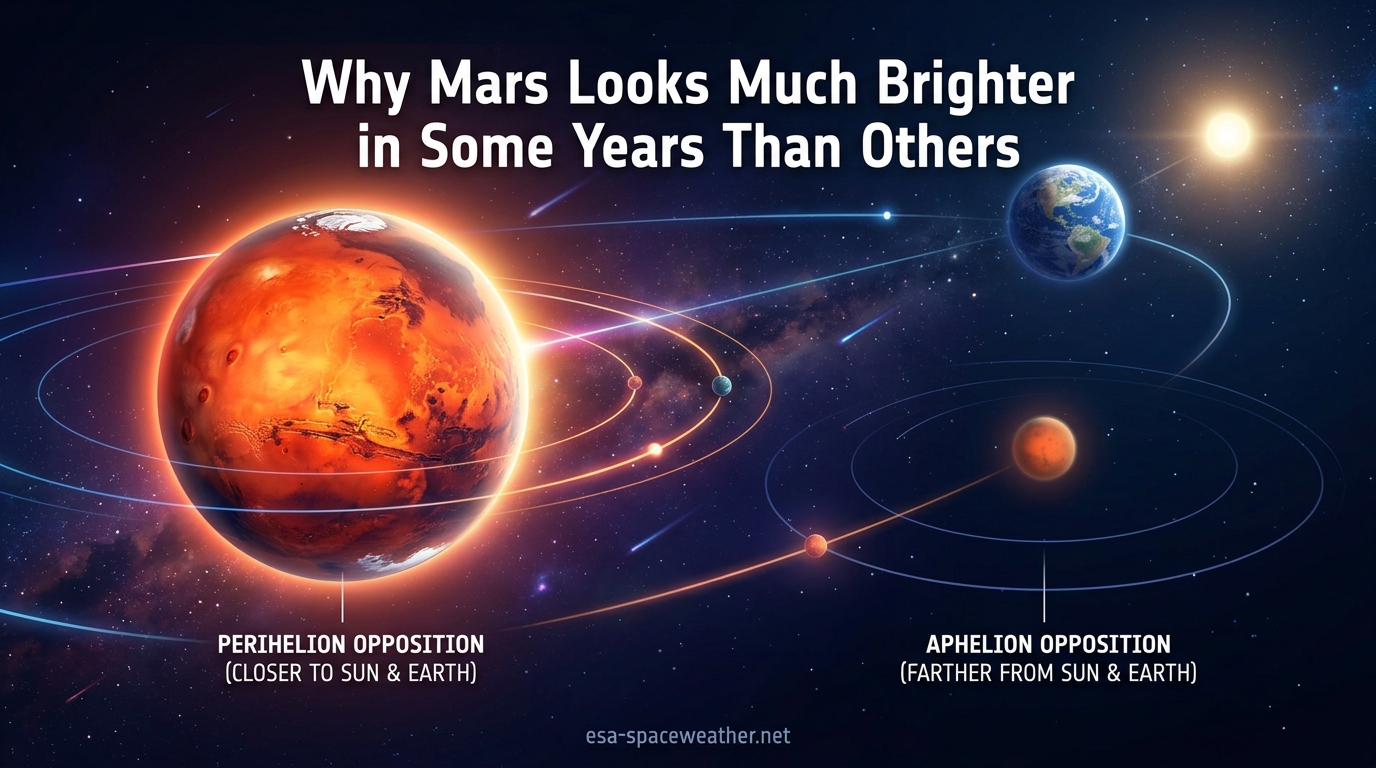
Have you ever looked up at the night sky and noticed a blazing orange-red light that seemed far brighter than usual? That was probably Mars. And if you paid attention over several years, you probably noticed something strange: the Red Planet does not look the same from one opposition to the next. Some years it dominates the night sky, outshining every star except Sirius. Other years it looks like a modest orange dot, barely distinguishable from a bright star.
This dramatic variation has confused skywatchers for centuries. Ancient astronomers tracked these brightness swings without understanding why they happened. Today, we know the answer comes down to the geometry of two elliptical orbits and a phenomenon called opposition. The reason Mars looks much brighter in some years than others is that the distance between Earth and Mars swings from about 34 million miles at its closest to over 250 million miles at its farthest, and this distance changes depending on where both planets are in their elongated orbits around the Sun.
I have spent years tracking Mars through its brightness cycle, and the difference between a great opposition and a mediocre one is stunning. During the 2018 perihelic opposition, Mars was so bright that people with no astronomy background were asking me what that “weird light” in the sky was. During the 2027 aphelic opposition coming up, Mars will be so far away that even a decent telescope will struggle to show surface detail.
In this guide, I will walk you through exactly why Mars brightness changes so dramatically from year to year. We will cover orbital mechanics, the 15-year brightness cycle, the opposition surge effect, and practical tips for catching Mars at its absolute best. Whether you are a backyard astronomer or just curious about that bright red light you noticed last night, you will understand the full picture by the end.
Table of Contents
Why Mars Looks Much Brighter in Some Years Than Others: The Direct Answer
Mars appears much brighter in some years because its elliptical orbit brings it dramatically closer to Earth during certain oppositions. When Earth passes between Mars and the Sun while Mars is near its closest point to the Sun (perihelion), the two planets can be just 34 to 36 million miles apart. But when opposition occurs while Mars is near its farthest point from the Sun (aphelion), that distance stretches to 60 million miles or more.
This distance difference is enormous. Because brightness follows the inverse square law, doubling the distance does not cut brightness in half. It cuts it to one-quarter. So when Mars is 35 million miles away instead of 63 million miles, it appears roughly three to four times brighter. That is the difference between a planet that outshines Jupiter and one that looks like an ordinary bright star.
The key factors combine in a repeating pattern. Mars reaches opposition every 26 months. But only every 15 to 17 years does opposition line up with Mars being near perihelion. Those rare alignments produce the spectacular brightness events that people remember for decades. The most recent was in 2018. The next will come in 2033 and 2035.
To put this in perspective: Jupiter is always bright because it is enormous, and Venus is always bright because it is close to Earth and wrapped in reflective clouds. Mars is small, only about half the diameter of Earth. Its brightness depends almost entirely on how close it is, which makes the variation far more extreme than any other planet visible from Earth.
What Is a Mars Opposition?
A Mars opposition happens when Earth passes directly between the Sun and Mars. The three bodies line up in a straight line with Earth in the middle. From our perspective on Earth, Mars appears on the opposite side of the sky from the Sun, which is where the term “opposition” comes from.
During opposition, Mars rises in the east as the Sun sets in the west. It climbs highest in the sky around midnight and sets at dawn. This means Mars is visible all night long, making opposition the best time to observe the planet. Mars also appears fully illuminated at opposition, showing us its complete sunlit face, much like a full Moon.
Oppositions occur roughly every 26 months, or about 2 years and 2 months. This interval is called the synodic period of Mars. Earth completes its orbit in 365 days, while Mars takes 687 Earth days. Earth gradually laps Mars in their orbital race, and each time it passes, we get an opposition.
Here is the critical point that most people miss: not all oppositions are equal. The distance between Earth and Mars at opposition varies enormously depending on where Mars is in its orbit. This is where things get interesting, and it is the reason Mars brightness can swing so dramatically from one opposition to the next.
Forum discussions on r/askastronomy and r/telescopes are full of people expressing surprise at this. Someone who saw Mars during the 2018 opposition and then tried to observe it during the 2025 opposition was disappointed, wondering if their telescope was broken. The telescope was fine. Mars was simply 24 million miles farther away.
Mars’s Unusually Elliptical Orbit: The 15-Year Brightness Cycle
The reason Mars brightness varies so much comes down to one number: orbital eccentricity. Eccentricity measures how stretched-out an orbit is compared to a perfect circle. A perfectly circular orbit has an eccentricity of zero.
Earth’s orbital eccentricity is 0.017, which means our orbit is very close to circular. Our distance from the Sun changes by only about 3 million miles throughout the year. Mars, on the other hand, has an eccentricity of 0.093. That is more than five times more eccentric than Earth’s orbit. Mars’s distance from the Sun ranges from about 1.38 AU (128 million miles) at perihelion to about 1.67 AU (155 million miles) at aphelion.
This stretched-out orbit is the key to everything. When Mars opposition happens to occur while Mars is near perihelion, the planet is close to both the Sun and Earth simultaneously. Astronomers call this a perihelic opposition. Mars can come within 34 to 36 million miles of Earth during these events, producing spectacular brightness.
When opposition occurs while Mars is near aphelion, we get an aphelic opposition. Mars is far from the Sun and relatively far from Earth. The closest approach might be 60 to 63 million miles. Mars appears much dimmer and smaller through a telescope.
These two types of opposition do not alternate randomly. They follow a predictable cycle that repeats approximately every 15 to 17 years. Astronomers sometimes refer to this as the 15.8-year periodic cycle. The pattern goes something like this: a series of three or four aphelic oppositions where Mars is getting progressively farther away, followed by a transition, then three consecutive perihelic oppositions where Mars comes roaring back to brilliant brightness.
This cycle exists because the 26-month synodic period and Mars’s orbital period do not divide evenly into each other. Each opposition happens at a slightly different point in Mars’s orbit. Over about 15 years, the opposition point drifts all the way around Mars’s orbit, passing through both aphelion and perihelion before the pattern repeats.
Understanding this cycle transforms how you think about Mars observing. If you know where we are in the 15-year cycle, you can predict whether an upcoming opposition will be spectacular or disappointing. Right now in 2026, we are in the aphelic portion of the cycle, which means the next several oppositions will be modest. But the cycle will swing back to perihelic territory around 2033.
Notable Mars Oppositions: From 2003 to 2035
Looking at specific opposition data makes the brightness pattern crystal clear. Here is how Mars oppositions have played out and what is coming next.
August 2003 was a legendary opposition. Mars came within 34.65 million miles of Earth, the closest approach in nearly 60,000 years. Mars reached an apparent magnitude of -2.9 and an apparent diameter of 25.11 arcseconds. People who observed Mars that summer still talk about it. The planet was brilliant enough to cast faint reflections on calm water, and even small telescopes showed substantial surface detail.
July 2018 was the most recent perihelic opposition. Mars came within 35.8 million miles and reached magnitude -2.8 with an apparent diameter of 24.3 arcseconds. This was the closest Mars had been since 2003. Observers reported that Mars was unmistakable in the sky, brighter than Jupiter, with a vivid orange-red color that made it easy to distinguish from any star.
October 2020 was a transitional opposition. Mars came within about 38.6 million miles and reached magnitude -2.6. Still quite good, though not quite at the 2003 or 2018 level. This was the last genuinely bright opposition before the current aphelic stretch.
December 2022 brought a moderate opposition at about 50.6 million miles. Mars reached magnitude -1.9 with an apparent diameter of about 17 arcseconds. Respectable, but noticeably less impressive than 2020.
January 2025 was a clearly aphelic opposition. Mars was about 59.7 million miles away, reaching magnitude -1.4 with an apparent diameter of about 14.6 arcseconds. Functional for observing, but far from spectacular.
February 2027 will be one of the faintest oppositions in the current cycle. Mars will be about 63 million miles away, appearing at roughly magnitude -1.2 with an apparent diameter around 13.8 arcseconds. Even in a good telescope, Mars will look small during this opposition.
June 2033 is when the cycle swings back. This perihelic opposition will bring Mars within about 39.4 million miles, reaching approximately magnitude -2.5. Not quite as close as 2018, but a massive improvement over the late 2020s oppositions.
September 2035 could be the next truly exceptional opposition. Mars is projected to come within about 35.4 million miles, potentially reaching magnitude -2.8 or brighter. This may be the best opposition between now and the late 2040s. If you missed 2003 and 2018, circle September 2035 on your calendar.
The Opposition Surge: Mars’s Secret Brightness Boost
Distance is the main driver of Mars brightness variation, but there is a second factor that most astronomy articles never mention. It is called the opposition surge, also known as the Seeliger effect, and it adds a measurable brightness boost when Mars is exactly at opposition.
Here is how it works. At opposition, Earth is looking straight down on the sunlit side of Mars. The Sun is behind us, and Mars is fully illuminated. But it is more than just full illumination. When we view Mars at opposition, sunlight hits the Martian surface almost straight-on, and from our viewing angle, the shadows on Mars disappear.
Think about standing outside at noon on the equator. The Sun is directly overhead, and shadows shrink to almost nothing. Now think about late afternoon, when the Sun is low and every rock and hill casts a long shadow. The surface appears darker because shadows hide large areas from view.
The same thing happens with Mars. At opposition, with the Sun directly behind Earth, shadows on Mars vanish from our perspective. Without shadows darkening the surface, more sunlight reflects back toward us. Mars appears brighter than you would predict from distance alone.
This opposition surge effect is not huge, but it is measurable. Astronomers estimate it adds roughly half a magnitude or more to Mars brightness at opposition compared to what you would expect purely from the distance. Combined with the already close distance, this effect helps explain why Mars at perihelic opposition can look so astonishingly bright.
One of our competitors mentions the opposition surge, but most skip it entirely. I think this is a mistake because understanding this effect deepens your appreciation for why opposition is so special. It is not just about Mars being close. It is about the geometry of light and shadow working together to maximize what we see.
How Bright Is Bright? Understanding Mars Apparent Magnitude
Astronomers measure brightness using the apparent magnitude scale. This scale can be confusing at first because it runs backwards: lower numbers mean brighter objects. The brightest objects have negative magnitudes.
At its faintest, when Mars is on the far side of the Sun from Earth, the planet can fade to about magnitude +1.8. At that point, Mars looks like an ordinary reddish star, easy to miss if you do not know where to look. At its brightest during a perihelic opposition, Mars can reach magnitude -2.9. That is a swing of nearly 4.7 magnitudes, which translates to a brightness ratio of roughly 75 to 1.
To put these numbers in context, here are some familiar reference points on the magnitude scale. Sirius, the brightest star in the night sky, shines at magnitude -1.46. Jupiter at its brightest reaches about -2.9. Venus, the brightest planet, can hit magnitude -4.9. The full Moon blazes at about -12.7.
During a great perihelic opposition, Mars at magnitude -2.9 essentially matches Jupiter at its best and far outshines Sirius. Mars becomes the second-brightest planet in the sky after Venus and the brightest star-like object that is not Jupiter or Venus. This is why people who know nothing about astronomy suddenly notice Mars during these events.
During an aphelic opposition, Mars at magnitude -1.4 is still brighter than Sirius but not by a huge margin. Mars looks like a very bright star with an orange tint. It is noticeable but not jaw-dropping. The difference between -1.4 and -2.9 on the magnitude scale represents roughly a 4x difference in brightness.
The apparent diameter of Mars also changes dramatically. At perihelic opposition, Mars can span about 25 arcseconds across. At aphelic opposition, that shrinks to about 14 arcseconds. For comparison, Jupiter typically spans 35 to 50 arcseconds. Even at its best, Mars is a small target for telescopes, which is why experienced observers treasure the perihelic oppositions.
Mars vs. Other Bright Planets: Why the Variation Matters
People often ask why Mars has such dramatic brightness swings when other planets do not. The answer lies in size, distance, and reflectivity.
Jupiter is always bright because it is enormous. With a diameter of about 86,881 miles, Jupiter is roughly 20 times larger in apparent diameter than Mars at a comparable distance. Jupiter’s brightness varies somewhat depending on its distance from Earth, but the variation is modest because Jupiter is so large and so reflective that it stays brilliant year-round. Jupiter typically ranges from magnitude -1.6 to -2.9.
Venus is always the brightest planet because it is close to Earth and covered in highly reflective sulfuric acid clouds. Venus reflects about 65 to 70 percent of the sunlight that hits it, compared to Mars at about 15 percent. Venus can reach magnitude -4.9, making it brighter than anything in the night sky except the Moon. Venus brightness does vary, but it is always brighter than Mars.
Saturn is moderately bright, typically ranging from magnitude 0 to +0.5. Like Jupiter, Saturn’s brightness varies less dramatically than Mars because of its large size. Saturn’s rings also contribute to its brightness when tilted favorably toward Earth.
Mercury is never very bright from Earth because it stays close to the Sun and is small. Mercury can reach about magnitude -1.9 at best, but it is always low on the horizon and hard to observe.
Mars is the outlier. With a diameter of only about 4,219 miles, roughly half the size of Earth, Mars is simply not large enough to reflect much light. Its brightness depends almost entirely on distance. When Mars is close, it is brilliant. When it is far, it is faint. No other naked-eye planet shows this degree of variation.
This is why the question “why does Mars look much brighter in some years than others” makes sense for Mars but not for Jupiter or Venus. Jupiter and Venus are reliably bright. Mars is the only planet that can shift from “unmissable” to “where did it go?” over the course of its orbital cycle.
Why Mars Is Red (And Why That Affects How Bright It Looks)
Mars gets its distinctive red-orange color from iron oxide, essentially rust, covering its surface. The fine dust that blankets Mars contains iron-rich minerals that oxidize over geological time, giving the entire planet a reddish-brown appearance. This is why Mars has been called the Red Planet since ancient times, and why the Romans named it after their god of war.
The red color actually helps observers identify Mars in the night sky. Mars has a steady, warm orange-red glow that distinguishes it from twinkling stars. Skywatchers on forums like r/space frequently mention comparing Mars to red stars like Aldebaran in Taurus, Antares in Scorpius, and Betelgeuse in Orion. Mars is noticeably redder and steadier than all of these.
One factor that competitors rarely discuss is the impact of Martian dust storms on observed brightness. Mars is famous for its planet-encircling dust storms, which can engulf the entire planet for weeks or months. These storms typically occur near perihelion when Mars is closest to the Sun and receiving the most solar heating.
During a global dust storm, fine dust particles rise into the thin Martian atmosphere and block surface features from view. Telescopic observers see Mars turn into a featureless orange blob. The dust can also slightly alter Mars’s apparent brightness by changing how much sunlight the planet reflects and scattering light differently than the bare surface would.
The 2018 global dust storm was a perfect example. It coincided with the perihelic opposition and frustrated observers worldwide who had been hoping for their best views of Mars in 15 years. Instead of dark surface markings and polar ice caps, telescope users saw a nearly blank orange disk. This is an unpredictable factor that adds an element of chance to Mars observing even when the orbital geometry is perfect.
How to See Mars at Its Brightest
The best time to observe Mars is during opposition, when the planet is closest to Earth and visible all night. But within that window, some oppositions are far better than others. Here is how to make the most of Mars observing.
Naked eye observing: Mars is easily visible without any equipment during any opposition. Look for a bright, steady orange-red light that does not twinkle like the surrounding stars. Mars rises in the east around sunset at opposition and is highest in the sky near midnight. The lack of twinkling is a key identifier. Stars scintillate because they are point sources of light whose beam gets disturbed by Earth’s atmosphere. Mars is close enough to be a tiny disk, so its light is steadier.
Binoculars: A decent pair of binoculars (10×50 or larger) will show Mars as a small disk rather than a point of light during opposition. You will not see surface detail, but you can tell it is a planet. During perihelic oppositions, you might glimpse the bright polar ice cap as a tiny white spot.
Telescope observing: This is where Mars gets really interesting, but only during favorable oppositions. A telescope with at least 4 inches of aperture can show the dark surface markings, polar ice caps, and sometimes large features like Syrtis Major or the Hellas Basin during a perihelic opposition. During an aphelic opposition, even a large telescope will show Mars as a small, frustratingly tiny disk with minimal detail.
Experienced observers on astronomy forums consistently recommend observing Mars when it is highest in the sky, typically around midnight during opposition. This minimizes the amount of Earth’s atmosphere you are looking through, which reduces distortion. Patience is key. Moments of steady air, called “seeing,” reveal fleeting details that disappear seconds later.
For planning, tools like Stellarium (a free planetarium program) and The Sky Live (a web-based orbital visualization tool) are highly recommended by the amateur astronomy community. Both let you check Mars’s position, apparent size, and brightness for any date.
Looking ahead, the next reasonable opposition is February 2027, though it will be aphelic and modest. The oppositions to really get excited about are June 2033 and September 2035. Mark those dates now if you want to see Mars at its absolute best.
Mars Retrograde: The Backwards Loop Explained
If you track Mars’s position against the background stars over several months around opposition, you will notice something strange. Mars normally drifts slowly eastward against the star field. But near opposition, it appears to stop, reverse direction, and loop backwards westward for a few weeks before resuming its normal eastward drift.
This is called retrograde motion, and it is an optical illusion caused by Earth passing Mars in its orbit. Think of it like passing a slower car on the highway. As you pull alongside and pass, the other car appears to drift backwards relative to distant scenery, even though it is still moving forward.
Retrograde motion is directly connected to Mars brightness. It occurs around opposition, which is when Mars is closest to Earth and brightest. So if you hear that Mars is “in retrograde,” that is actually a signal that Mars is near its peak brightness. The retrograde loop is larger and more dramatic during perihelic oppositions because Mars is moving faster relative to the background stars when it is closer to the Sun.
Beginners sometimes confuse retrograde motion with a change in Mars itself, but Mars is not actually moving backwards. It is just our changing viewing angle from Earth as we overtake Mars in our faster, inner orbit. The ancient astronomers who watched this happen without understanding the heliocentric model found it deeply puzzling. Today, retrograde motion is one of the clearest demonstrations that we are watching planets move in real time.
FAQs
Why does Mars look brighter some years than others?
Mars brightness varies because its distance from Earth changes dramatically as both planets orbit the Sun in elliptical paths. At perihelic opposition, when Earth passes between Mars and the Sun while Mars is near its closest point to the Sun, Mars can be just 34 to 36 million miles away and blaze at magnitude -2.9. At aphelic opposition, when Mars is near its farthest point from the Sun, the distance stretches to 60 million miles or more and Mars dims significantly.
How often does Mars reach opposition?
Mars reaches opposition approximately every 26 months, or about 2 years and 2 months. This interval is called the synodic period of Mars. However, only every 15 to 17 years does opposition coincide with Mars being near perihelion, producing the exceptionally bright perihelic oppositions that skywatchers remember.
When was Mars last at its brightest?
Mars was last at its brightest during the July 2018 perihelic opposition, when it came within 35.8 million miles of Earth and reached magnitude -2.8. Before that, the August 2003 opposition brought Mars within 34.65 million miles, the closest approach in nearly 60,000 years.
When is the next time Mars will be very bright?
The next truly spectacular Mars oppositions will occur in June 2033 (about 39.4 million miles) and September 2035 (about 35.4 million miles). The 2035 opposition may be the best one between now and the late 2040s. The February 2027 opposition will be aphelic and modest by comparison.
Why is Mars sometimes brighter than Jupiter?
Jupiter is normally brighter than Mars because it is enormous. But during a perihelic opposition, Mars comes so close to Earth that it can briefly match or exceed Jupiter’s brightness. At magnitude -2.9, Mars at perihelic opposition ties Jupiter at its best. This only happens during the 15 to 17 year cycle when opposition geometry is just right.
Can you see Mars with the naked eye?
Yes, Mars is easily visible to the naked eye during any opposition. It appears as a bright, steady orange-red light that does not twinkle like stars. At its brightest during perihelic opposition, Mars can outshine every star except Sirius and may even cast a faint reflection on calm water.
What is the opposition surge effect?
The opposition surge is a brightness boost that occurs when Mars is exactly at opposition. Because the Sun is directly behind Earth, sunlight hits Mars straight-on and shadows on the Martian surface disappear from our viewing angle. Without shadows darkening the surface, more light reflects back toward Earth, adding up to half a magnitude or more to Mars brightness.
Why is Mars called the Red Planet?
Mars appears red because its surface is covered in iron oxide, essentially rust. Fine dust containing iron-rich minerals blankets the planet, giving it a distinctive reddish-brown color. This led ancient civilizations to associate Mars with blood and war, and the Romans named it after their god of war.
Conclusion
Understanding why Mars looks much brighter in some years than others comes down to three things working together. The elliptical shape of Mars’s orbit (with its unusually high eccentricity of 0.093) creates a huge range in Earth-Mars distance. The 26-month opposition cycle determines when Mars is closest. And the 15 to 17 year perihelic cycle governs when oppositions align with Mars being near its closest point to the Sun, producing those unforgettable brightness peaks.
Add in the opposition surge effect, which gives Mars an extra brightness boost when the Sun-Earth-Mars geometry eliminates surface shadows, and you have a complete picture of why this planet’s brightness swings so dramatically. No other naked-eye planet behaves this way, which is what makes Mars so special to follow over the years.
If you are planning ahead, the oppositions to circle on your calendar are June 2033 and September 2035. Those perihelic events will bring Mars roaring back to brilliant, unmissable brightness. Until then, every opposition still offers something worth seeing, even if Mars is farther away and smaller in a telescope. The Red Planet is always worth a look. You just need to know when to expect it at its best.