
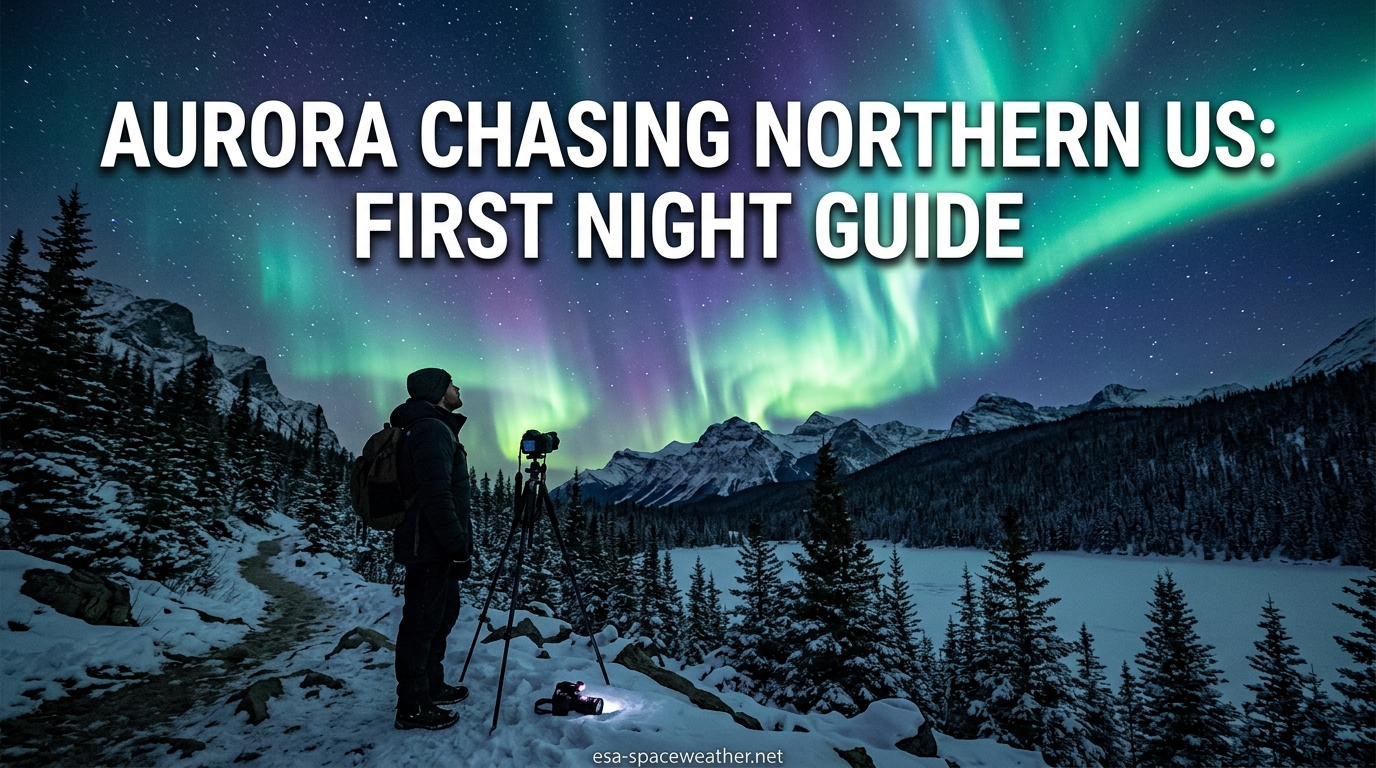
You are standing in a frozen field somewhere in northern Minnesota at 1:47 AM. Your fingers ache through two layers of gloves. You have been staring at the sky for three hours, and so far, you have seen exactly nothing. Then someone in your group whispers, “There.” A pale band of light, barely visible, stretches across the northern horizon like a thin cloud glowing from the inside. You raise your phone camera. The screen erupts in green.
That moment, the gap between what your eyes see and what the sky is actually doing, is the single biggest surprise first-time aurora chasers experience. And it is just one of dozens of things nobody tells you before your first night out.
If you are planning your first aurora-chasing night in the northern United States, this guide walks you through what to expect from the moment you start checking forecasts to the moment you finally see the lights dance. We cover the science simplified, the cold-weather reality, the emotional roller coaster of waiting, and specific northern US locations that give you the best shot, all without sending you to Alaska.
2026 is also an exceptional year for this. We are in the declining phase of Solar Cycle 25’s peak, which means geomagnetic activity remains elevated and aurora viewing opportunities at lower latitudes, including the northern US, are more frequent than they will be for years to come. If you have been thinking about chasing the northern lights, now is the time.
Table of Contents
What Aurora Chasing Actually Means
The word “chasing” is misleading. It sounds fast, active, maybe even a little reckless. The reality is closer to patient waiting in a carefully chosen location.
Aurora chasing is the practice of monitoring space weather forecasts, driving to an area with dark skies and clear clouds, and then waiting. Sometimes for hours. Sometimes all night. The “chase” part refers to the willingness to relocate if conditions change, such as clouds rolling in or a new forecast showing better activity two hours north.
Forum posts from first-timers on Reddit’s r/northernlights community consistently describe the same pattern: they expected action and got stillness. One user wrote that their first night felt like “fishing in the dark, except the fish are made of light and they decide if they show up.” That captures the experience well. You prepare, you position yourself, and then you wait for the sky to decide.
The mindset shift matters more than any piece of gear. Aurora chasing rewards patience above all else. People who expect a scheduled light show leave disappointed. People who treat it as an adventure, who bring hot drinks and good company and enjoy being outside under the stars, tend to have memorable nights whether or not the aurora appears.
The Science Behind the Northern Lights (Simplified)
You do not need a physics degree to chase aurora, but understanding the basics helps you read forecasts and set expectations.
The sun constantly releases a stream of charged particles called solar wind. This wind travels through space and hits Earth’s magnetic field. Most particles are deflected around the planet. But some get funneled toward the north and south poles, where the magnetic field lines converge and dip toward the surface.
When those charged particles reach the upper atmosphere, roughly 60 to 150 miles above the ground, they collide with gas molecules. Oxygen at higher altitudes produces red light. Oxygen at lower altitudes produces the familiar green. Nitrogen creates blues and purples. These collisions release energy as visible light, and when enough of them happen at once, you see the aurora borealis.
The region where aurora typically appears is called the auroral oval. It is a ring-shaped zone centered on the magnetic north pole. On quiet nights, the oval sits far north, covering Alaska, northern Canada, and Scandinavia. During geomagnetic storms, the oval expands southward, pushing aurora visibility into the northern United States and sometimes even farther.
That expansion is driven by coronal mass ejections (CMEs), which are massive bursts of solar plasma that intensify the solar wind. When a strong CME hits Earth’s magnetic field, the auroral oval can stretch dramatically. This is why some of the best aurora displays in places like Minnesota, Michigan, and Maine happen during geomagnetic storm events rather than on calm, ordinary nights.
Understanding the Kp Index and Aurora Forecasts
The Kp index is the number you will check more than any other. It is a scale from 0 to 9 that measures geomagnetic activity worldwide, updated every three hours by NOAA’s Space Weather Prediction Center.
For the northern United States, here is what the numbers mean in practical terms. A Kp of 3 or lower means aurora stays far north, mostly visible only in Alaska and northern Canada. Kp 4 pushes the aurora oval into far northern Minnesota, North Dakota, and northern Maine. Kp 5, which corresponds to a minor geomagnetic storm (G1), brings aurora visibility into the upper Midwest, upper Michigan, and northern Montana.
Kp 6 and 7 are where things get exciting for the northern US. A Kp 7 (G3 storm) can make aurora visible as far south as the northern half of Oregon, Idaho, Wyoming, Iowa, and Pennsylvania. The legendary May 2024 storm that pushed aurora visibility into Texas and Florida registered as an extreme G5 event, which is exceptionally rare.
But the Kp index alone does not guarantee a show. Another critical value is the Bz component, which measures the orientation of the interplanetary magnetic field. When Bz is negative (southward), it means the solar wind’s magnetic field aligns with Earth’s in a way that allows more particles to penetrate the atmosphere. A strong negative Bz can trigger aurora even when the Kp forecast looked modest. When Bz is positive, even a high Kp might produce a disappointing display.
For forecasting, I recommend checking at least two sources before heading out. The NOAA Space Weather Prediction Center provides official data. Apps like My Aurora Forecast aggregate that data into user-friendly predictions with push notifications. Many experienced chasers in the northern US also follow dedicated space weather accounts on social media that post real-time alerts when conditions change rapidly.
What to Expect on Your First Aurora-Chasing Night in the Northern US (Hour by Hour)
Here is what a typical first night looks like, based on the experiences shared by dozens of chasers across forums and community groups. Your timeline may vary, but the rhythm is remarkably consistent.
8:00 PM to 9:00 PM: Preparation and Departure
You check the forecast one final time. The Kp looks promising, the Bz is trending negative, and cloud cover forecasts show clearing skies in your target area. You layer up: thermal base layer, insulating mid-layer, windproof outer shell, warm boots, two pairs of gloves, and a hat that covers your ears completely.
You pack a thermos of hot coffee or tea, snacks, a blanket for the car, a phone charger, a small tripod, and hand warmers. You fill up the gas tank. Then you drive to your chosen dark-sky location, ideally 30 to 60 minutes from the nearest town to minimize light pollution.
9:00 PM to 10:00 PM: Arrival and Setup
You arrive at your spot. It is dark, genuinely dark, the kind of dark where you cannot see your hand in front of your face without a red-light flashlight. You let your eyes adjust for at least 15 to 20 minutes. This is critical: white light from your phone or headlamp resets your night vision every time.
You scan the northern horizon. Right now, you probably see nothing but stars. That is normal. Aurora activity typically picks up after 10 PM local time and can continue through 2 AM or even 3 AM. The hours between 10 PM and 2 AM are considered the primary aurora viewing window for most northern US locations.
10:00 PM to Midnight: The Waiting Game
This is where patience gets tested. You check your aurora app every 15 to 20 minutes. The Kp holds steady or maybe ticks up slightly. You look north. Stars, clouds maybe, but no aurora. The temperature has dropped 10 degrees since you arrived. Your toes are starting to feel it.
Many first-timers report this as the hardest stretch. Two hours of staring at nothing in freezing conditions tests your resolve. This is where having good company, warm drinks, and the right mindset makes the difference. People who expected a show by now start questioning whether they are in the right place or whether the forecast was wrong.
Stay put. Moving to a new location rarely helps, and the driving breaks your night vision each time you use headlights. Experienced chasers emphasize staying in one good dark-sky location rather than driving around chasing gaps in the clouds.
Midnight to 2:00 AM: The Action Window
This is statistically the most likely window for aurora activity. Something shifts in the data, or it does not. When it does, it often happens fast.
The first sign is usually a faint glow on the northern horizon that looks like a pale cloud or distant city light. It may have a barely perceptible green tint. To the naked eye, it often appears grayish-white at first. Many first-timers mistake it for cloud cover illuminated from below. This is why checking with your phone camera matters: point it at the glow, and if the screen shows green, that is aurora.
If conditions intensify, the band brightens and starts to move. It develops structure: vertical pillars, curtain-like folds, arcs that stretch higher into the sky. At its peak, the aurora can dance rapidly, pulsing and rippling from horizon to directly overhead. This is what chasers call a “substorm,” and it can last anywhere from 15 minutes to over an hour.
Then it fades. The lights dim back to a faint glow or disappear entirely. The aurora can return in another wave 30 to 60 minutes later, or it may be done for the night. You will not know until it happens.
2:00 AM to 3:00 AM: Decision Time
Activity has tapered off. Your app shows the Kp holding but no new substorms predicted. You are exhausted, cold, and deciding whether to stay another hour or call it.
This is normal. Most first nights end somewhere between 1 AM and 3 AM. If you saw the aurora, even briefly, savor the experience. If you did not, you are in good company. Every experienced chaser has nights where nothing appeared despite perfect-looking conditions. That is the nature of a natural phenomenon driven by space weather.
What You Will Actually See vs. What Photos Show
This is the section first-timers need to read most carefully, because it prevents the single biggest disappointment in aurora chasing.
Your eyes are not cameras. The human eye is terrible at processing color in low light. The photoreceptor cells that handle night vision, called rods, are highly sensitive to light but essentially colorblind. The cells that process color, called cones, need much more light to activate. Aurora displays are often too dim for your cones to fire fully.
The result: faint aurora appears to the naked eye as gray, white, or pale green. Only during strong displays does the green become vivid and obvious to the unaided eye. Reds, purples, and pinks are almost always invisible to the naked eye unless the display is extremely intense.
Your phone camera, on the other hand, uses long exposure times that collect light for several seconds. This means the camera gathers far more photons than your eyes can, and it captures colors your brain never processes. That is why your phone screen shows brilliant green while your eyes see only a grayish haze.
This creates a strange experience. You might be looking at one of the most famous natural phenomena on Earth and feel underwhelmed. Then you raise your phone and see what the camera captures, and suddenly it clicks. Many chasers describe this moment as when the experience becomes real.
One frequent forum complaint: people who saw aurora but felt disappointed because the colors were not vivid. Understanding this ahead of time transforms the experience. When you know the camera will show more than your eyes, you can appreciate both perspectives, the subtle beauty of what you see and the dramatic colors your phone reveals.
Cloud Cover: The One Factor That Decides Everything
You can have perfect Kp numbers, a strong negative Bz, and a prime dark-sky location. None of it matters if clouds block the sky.
Cloud cover is the number one reason aurora chasers go home empty-handed. The aurora happens 60 to 150 miles above the ground, well above any weather system. If clouds sit between you and that altitude, you will see nothing. There is no workaround, no app, no trick.
Before any aurora night, check cloud forecasts as carefully as space weather forecasts. The National Weather Service, NOAA’s Cloud Forecast tool, and apps like Clear Outside provide hourly cloud cover predictions by location. Look for areas with under 30 percent cloud cover, ideally closer to zero.
What happens when clouds roll in mid-chase? This is where the “chase” part becomes real. If you are mobile and the cloud forecast shows clearing skies an hour’s drive north or south, relocating can save the night. But this requires real-time satellite data and knowledge of local roads. For first-timers, a better strategy is choosing a location that historically has clear microclimates.
In northern Michigan, for example, the Lake Superior shoreline often has clearer skies than inland areas due to lake-effect cloud dynamics. In Minnesota, the Boundary Waters region tends to hold clear skies when surrounding areas cloud over. Knowing these local patterns comes with experience, but a quick search in local aurora-chasing Facebook groups before your trip can point you toward reliable spots.
Dressing for Hours in the Cold
Aurora chasing means standing still outdoors for three to five hours in temperatures that routinely drop below freezing, and in northern US states during prime aurora season (October through March), that means anything from 20 degrees Fahrenheit down to negative digits.
The cold catches people off guard because standing still is fundamentally different from hiking or skiing. Your body generates almost no heat when you are standing and looking up. What feels manageable at 10 PM becomes brutal by midnight.
Here is the layering system that experienced chasers recommend. Start with a moisture-wicking thermal base layer, top and bottom. Add an insulating mid-layer such as fleece or down. Top it with a windproof, insulated outer shell. For your lower half, thermal underwear under insulated pants or snow pants works well.
For extremities, this is where most people fail. Wear insulated boots rated for sub-freezing temperatures. Use two glove layers: a thin liner glove for operating your phone and a heavy insulated mitten that goes over the liner. Chemical hand warmers tucked inside mittens extend comfort by hours. A warm hat that fully covers your ears is non-negotiable, and a balaclava or neck gaiter protects your face from wind.
Bring more than you think you need. You can always remove layers, but you cannot add what you did not bring. Every chaser has a story about leaving a critical layer in the car and paying for it.
Best Northern US Locations for Aurora Viewing
You do not need to fly to Alaska to see the northern lights. Several northern US states regularly host aurora displays during active geomagnetic conditions, and 2026‘s elevated solar activity makes them even more promising.
Minnesota: The Boundary Waters Canoe Area Wilderness and Voyageurs National Park offer some of the darkest skies in the lower 48 states. The Cook County area along the North Shore of Lake Superior is a favorite among Midwest chasers, with accessible roads and wide northern horizons over the lake.
Michigan: The Upper Peninsula, particularly the Keweenaw Peninsula and Pictured Rocks National Lakeshore, provides dark skies and clear northern horizons over Lake Superior. Marquette and Copper Harbor are popular base camps for Michigan aurora chasers.
North Dakota: With its northern latitude and wide-open prairie horizons, North Dakota is surprisingly good for aurora viewing. Theodore Roosevelt National Park and the areas around Fargo and Grand Forks offer dark skies with minimal light pollution.
Montana: Glacier National Park and the surrounding areas of northwest Montana offer mountain-backed aurora viewing with excellent dark skies. The latitude is slightly lower than Minnesota, but the lack of light pollution compensates during stronger displays.
Maine: Acadia National Park and the far northern areas around Caribou and Presque Isle give East Coast chasers their best shot. Maine’s northern latitude and Atlantic horizons make it a solid option during Kp 5 or higher events.
Aurora Forecasting Apps and Tools You Should Download Tonight
The difference between catching the aurora and missing it often comes down to having the right information at the right time. Here are the tools experienced chasers rely on.
My Aurora Forecast: This is the most popular aurora app for beginners. It provides a simple Kp index display, a visibility map showing where aurora can currently be seen, push notifications for geomagnetic activity increases, and a weather overlay for cloud cover. The interface is clean and the alerts are timely.
NOAA Space Weather Prediction Center (swpc.noaa.gov): The official US government source for space weather data. It provides detailed forecasts, real-time Kp readings, Bz component data, and coronal mass ejection predictions. The interface is technical and data-heavy, but it is the most accurate source available.
SpaceWeatherLive: A favorite among experienced chasers for its detailed real-time data displays. It shows solar wind speed, Bz orientation, and Kp trends in graph form, which helps you spot activity building before the Kp number officially updates.
Local Facebook groups and Discord servers: Search for aurora-chasing groups specific to your state or region. Members post real-time sightings with locations, which is invaluable when conditions are changing fast. Minnesota, Michigan, and Montana all have active aurora communities that share alerts.
Set push notifications on at least one app before your chase night. Conditions can shift rapidly, and a Kp jump from 4 to 6 in 30 minutes is not uncommon during active solar events.
Tour vs DIY: Which Approach Fits Your First Night
For your first aurora-chasing experience, deciding between joining a tour and going solo depends on your location, budget, and comfort level with cold-weather navigation.
In the northern US, dedicated aurora tours are less common than in Alaska or Iceland, but they exist. Minnesota’s North Shore and Michigan’s Upper Peninsula have local guides who run small-group aurora nights, especially during peak season from December through March. These tours handle location selection, provide warmth stations or vehicles, and include experienced eyes that can spot faint aurora before most first-timers would notice it.
The main advantage of a tour is local knowledge. Guides know which roads stay passable in winter, which spots have the clearest microclimates, and how to read conditions in real time. For someone who has never stood in a frozen field at 1 AM, having an experienced person make decisions reduces stress significantly.
DIY chasing gives you flexibility and costs nothing but gas and snacks. If you have done your research on dark-sky locations, checked cloud forecasts carefully, and have proper cold-weather gear, going solo or with friends is absolutely viable. The freedom to stay out as long as you want or leave when you are done is a real benefit.
For a true first experience, I recommend DIY with at least one other person. Choose a location you have scouted in daylight, arrive early to get oriented, and treat it as an adventure rather than a guaranteed show. If you live near a community with aurora tours and want the educational component, a single guided night can teach you more in three hours than a week of solo reading.
Phone Photography Basics for Your First Aurora
You do not need a DSLR camera to capture aurora on your first night. Modern smartphones, especially recent iPhone and Samsung models, have night modes that can capture surprising detail. Mount your phone on a small tripod, switch to night mode or pro mode, increase exposure time to 3 to 10 seconds, and set ISO to 800 or higher if your phone allows manual control.
Key Takeaways Before You Head Out
Here is what matters most for your first aurora-chasing night in the northern US:
Patience is everything. Expect to wait two to four hours. Bring food, warm drinks, and good company.
Clouds are the real boss. Check cloud forecasts as carefully as space weather data. No amount of aurora activity matters through an overcast sky.
Your phone sees more than your eyes. Faint aurora often looks gray or white in person but shows vivid green on camera. Use your phone to confirm what you are seeing.
Dress twice as warm as you think. Standing still in the cold is harder than any hike. Layers, hand warmers, and proper boots are non-negotiable.
The Kp index is a guide, not a guarantee. Kp 5 or higher gives the northern US a real shot, but Bz orientation and local cloud conditions matter just as much.
2026 is a prime year. Solar maximum conditions mean more frequent and stronger aurora events at lower latitudes than you will see for years.
Not seeing the aurora is normal. Every chaser has blank nights. The experience of being under a dark sky is its own reward.
FAQs
What are the best months for aurora chasing?
The best months for aurora chasing in the northern US are October through March, when nights are longest and darkest. September and April can also produce good viewing opportunities during periods of high solar activity. December, January, and February offer the longest hours of darkness, giving you the widest viewing window from roughly 9 PM to 3 AM.
Where in North America is the best place to see the northern lights?
The best places in the northern US include Voyageurs National Park and the Boundary Waters in Minnesota, the Keweenaw Peninsula and Pictured Rocks in Michigan Upper Peninsula, Theodore Roosevelt National Park in North Dakota, Glacier National Park in Montana, and Acadia National Park in northern Maine. For guaranteed frequent viewing, Fairbanks, Alaska sits directly beneath the auroral oval and offers the most reliable sightings in the United States.
Can aurora borealis cause headaches?
There is no scientific evidence that the aurora borealis itself causes headaches. Some people report headaches during nights of high geomagnetic activity, but researchers have found no confirmed link between aurora displays and physical health effects. Any headaches experienced during a chase are far more likely caused by cold, dehydration, lack of sleep, or tension from standing in one position for hours.
What setting should I put my phone on to see the northern lights?
Switch your phone to Night Mode or Pro Mode. Set the exposure time to 3 to 10 seconds, increase ISO to 800 or higher, and keep the phone perfectly still on a tripod or resting on a stable surface. Turn off the flash entirely. If your phone has an aurora-specific shooting mode, use that. Recent iPhone and Samsung Galaxy models handle aurora photography remarkably well in default Night Mode.
What is the rarest color of aurora?
The rarest aurora color is deep red, produced by high-altitude oxygen at roughly 150 to 300 miles above Earth. Red aurora only appears during intense geomagnetic storms. Blue and purple aurora, caused by nitrogen molecules, are also uncommon and typically visible only at the lower edges of very active displays. Green is the most common and familiar aurora color.
Will aurora be strong in 2026?
Yes, aurora activity remains elevated in 2026 due to Solar Cycle 25. While the solar maximum officially peaked in late 2024 to early 2025, geomagnetic activity stays high for one to two years after the peak. This means the northern US continues to experience more frequent Kp 5 and higher events than during solar minimum years. Aurora viewing opportunities in the northern US should remain above average through approximately 2027.
Final Thoughts Before Your First Night
What to expect on your first aurora-chasing night in the northern US, more than anything, is an exercise in patience and perspective. The sky does not perform on command. Conditions change without warning. Some nights deliver a show that makes you weep, and some nights deliver nothing but cold toes and a car full of empty coffee cups.
Both outcomes are part of the experience. The chasers who keep going back are not the ones who saw aurora on their first try. They are the ones who learned to love the waiting, the stillness, and the rare, electric moment when the sky finally lights up.
Go prepared. Dress warmer than you think necessary. Bring people you enjoy being stuck with for four hours in the cold. Check your forecasts, download your apps, and pick a dark location with a clear northern horizon. Then give the sky the time it needs to decide.
The northern lights are waiting. And in 2026, they are closer and more active than they will be for years. Your first night might be the one you remember for the rest of your life, whether you see green pillars dancing overhead or just stars and silence. Either way, you will have been there, under one of the darkest skies the lower 48 has to offer, waiting for something extraordinary.