
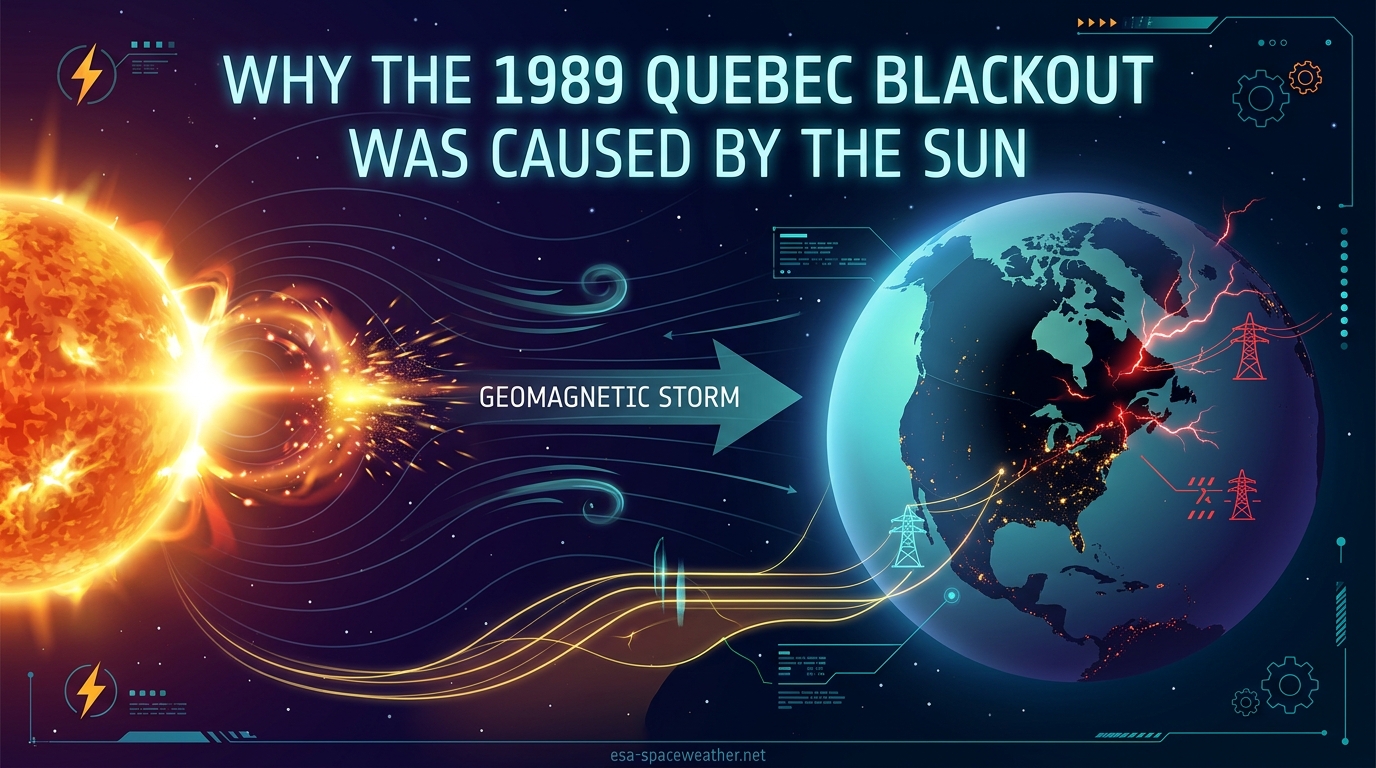
On March 13, 1989, a coronal mass ejection from the Sun slammed into Earth’s magnetic field and collapsed Hydro-Quebec’s entire power grid in just 90 seconds, leaving six million people without electricity for nine hours. The 1989 Quebec blackout remains the most dramatic example of how solar activity can disrupt modern infrastructure, and understanding why it happened reveals a chain of events stretching 93 million miles from the surface of the Sun to the Canadian power lines below.
I have spent years studying space weather events and their effects on power systems, and the March 1989 geomagnetic storm stands out as the event that changed how utilities think about the Sun. Before that morning, most power companies treated solar storms as a curiosity. After it, they became a threat to be taken seriously.
In this article, I will walk you through exactly why the 1989 Quebec Blackout was caused by the Sun — from the solar flares erupting on the Sun’s surface, to the invisible currents that fried Quebec’s transformers, to the lessons that still shape grid protection today. We will cover the physics in plain language, the human experience on the ground, and whether something like this could happen again in 2026.
Table of Contents
Quick Overview: Key Facts About the March 1989 Geomagnetic Storm
Here are the essential numbers behind the event. I find that having these facts up front makes the detailed explanation much easier to follow.
- Date of impact: March 13, 1989, at approximately 2:44 AM EST
- Solar source: Sunspot region 5395 (also called NOAA region 5395), one of the largest sunspot groups of solar cycle 22
- Solar flares involved: X4.5-class flare on March 10, 1989, and an M7.3-class flare on March 12, 1989
- Geomagnetic storm intensity: Kp-index of 9 (the maximum possible value) and a Dst (disturbance storm time) index of -589 nT
- Grid collapse time: Less than 90 seconds from first relay trip to total blackout
- People affected: Six million residents across Quebec, Canada
- Duration of blackout: Approximately nine hours for most customers, longer in some areas
- Aurora visibility: Northern lights seen as far south as Florida, Texas, and Cuba
- Double CME: Research published in 2019 revealed that two coronal mass ejections struck Earth in rapid succession, amplifying the storm’s effects
These numbers tell you the scale of what happened. Now let us look at how the events actually unfolded on the ground.
What Happened on March 13, 1989
At 2:44 AM on March 13, 1989, the residents of Quebec were fast asleep. Temperatures outside were well below freezing, as you would expect for a March night in eastern Canada. Everything was normal.
Then, in the span of about 90 seconds, the entire Hydro-Quebec power grid went dark. All of it. Not a neighborhood, not a city — the whole province. Six million people lost power simultaneously, including those in Montreal and Quebec City.
The speed of the collapse is what makes this event so striking. Grid operators had no time to respond. By the time alarms sounded, seven static var compensators at Hydro-Quebec’s James Bay transmission network had already tripped offline. The loss of those compensators caused voltage to plummet across the system, and protective relays cascaded, disconnecting transmission lines one after another. In less than a minute and a half, the grid was gone.
People woke up in total darkness with no explanation. In forum discussions I have followed, Quebec residents recall the confusion vividly. Some initially feared a nuclear attack — this was 1989, still the Cold War era, and waking up to a sky full of strange red and green lights did nothing to calm those fears. Those lights were the aurora borealis, pushed far south by the storm, visible over parts of Quebec that had never seen them before.
Others connected the eerie lights to the Space Shuttle Discovery, which had launched on March 13 as part of mission STS-29. That was pure coincidence, but in the absence of information, people reached for any explanation they could find.
The blackout lasted nine hours for most customers. In the dead of a Canadian winter, that meant no heat, no light, and no running water for anyone relying on electric pumps. Hydro-Quebec engineers worked through the night to restore power, manually reconnecting transmission lines and bringing stations back online one at a time. Full restoration took until later that morning.
But the question everyone kept asking was simple: what actually caused this? The answer starts 93 million miles away.
The Solar Trigger: Coronal Mass Ejection and Solar Flares
The root cause of the 1989 Quebec blackout was a massive disturbance on the Sun, originating from a sunspot region designated NOAA 5395. This was not just any sunspot group. Region 5395 was one of the most active and largest sunspot clusters recorded during solar cycle 22, and it produced a staggering number of solar flares over a two-week period in March 1989.
Here is where the story gets interesting. For decades, the standard explanation was that a single coronal mass ejection caused the blackout. But a landmark 2019 paper published in the AGU journal Space Weather by Dr. David Boteler revealed something more complex: two CMEs struck Earth in close succession.
The First Eruption: X4.5 Flare on March 10
On March 10, 1989, sunspot region 5395 unleashed an X4.5-class solar flare. For context, solar flares are ranked by intensity on a letter scale: A, B, C, M, and X, with X being the most powerful. An X4.5 flare is a major eruption, releasing enormous amounts of electromagnetic radiation across the spectrum.
This flare was accompanied by a coronal mass ejection — a massive cloud of magnetized plasma hurled away from the Sun at speeds exceeding 1,000 kilometers per second. A CME is essentially a chunk of the Sun’s atmosphere being launched into space. Think of it as a solar hurricane traveling through the void.
The Second Eruption: M7.3 Flare on March 12
Two days later, on March 12, region 5395 produced another significant flare, this time an M7.3-class event. This second eruption launched another CME. The key insight from the 2019 research is that the second CME was faster than the first and overtook it in transit, creating what scientists call a “cannibal CME” or interacting CME event.
When the second CME caught up to the first, the interaction compressed and amplified the magnetic fields within the combined cloud. By the time this merged structure reached Earth on March 13, it carried a far more powerful magnetic punch than either CME alone would have delivered.
This double-CME mechanism is important because it explains why the March 1989 storm was so unusually intense. It was not just one eruption — it was two solar storms merging into a single devastating blow.
During this same period, region 5395 also produced an astonishing X15-class solar flare on March 6, one of the most powerful flares ever recorded. While that particular flare’s CME did not head directly toward Earth, it underscored just how dangerous this sunspot region was.
How the Sun’s Energy Reached Quebec
Once the combined CME left the Sun, it traveled through interplanetary space at roughly 1.5 to 2 million miles per hour. The journey from the Sun to Earth took approximately two to three days. This is why the March 10 flare did not cause problems immediately — the plasma cloud needed time to cover the 93 million miles between the Sun and our planet.
When the CME arrived at Earth on March 13, it struck the planet’s magnetosphere. The magnetosphere is the invisible magnetic shield that surrounds Earth, generated by the churning of molten iron in the planet’s core. Normally, this shield deflects most solar wind particles around the planet like water flowing around a rock in a stream.
But this CME was no ordinary gust of solar wind. The cloud carried its own magnetic field, and that field had a critical property: it pointed southward. In space weather physics, a southward-pointing magnetic field is the key ingredient for a major geomagnetic storm, because it allows the CME’s magnetic field to connect with Earth’s magnetic field through a process called magnetic reconnection.
Think of it like two magnets. If you hold them with opposite poles facing each other, they snap together violently. The same thing happened at the boundary between the CME and the magnetosphere. The magnetic fields merged, and enormous amounts of energy were transferred into Earth’s magnetosphere in a matter of minutes.
This energy transfer caused Earth’s magnetic field to oscillate and compress violently. The magnetosphere shrank, satellites found themselves exposed to solar radiation they were normally shielded from, and the ionosphere — the electrically charged layer of the upper atmosphere — became highly disturbed.
All of this happened hundreds of miles above the ground. But the effects would soon reach down to the surface, and that is where Quebec’s power grid entered the crosshairs.
Geomagnetically Induced Currents (GICs): The Hidden Killer
To understand why the 1989 Quebec Blackout was caused by the Sun, you need to understand geomagnetically induced currents, or GICs. This is the mechanism that links solar activity to power grid failure, and I find that most articles either skip this explanation entirely or bury it in jargon. Let me break it down step by step.
What Are Geomagnetically Induced Currents?
GICs are electrical currents that flow through conductive materials on Earth’s surface — including the ground itself, pipelines, railway tracks, and crucially, power transmission lines. They are created when Earth’s magnetic field changes rapidly, which is exactly what happens during a geomagnetic storm.
The underlying physics principle is electromagnetic induction, the same principle that powers generators in power plants. When a magnetic field changes near a conductor, it creates an electric current in that conductor. Michael Faraday discovered this in 1831, and it is one of the most important laws in physics. During a geomagnetic storm, the Sun causes Earth’s magnetic field to fluctuate wildly, and those fluctuations induce currents in any large conductor on the ground.
How GICs Cause a Power Blackout: Step by Step
Here is the chain of events, laid out as simply as I can make it:
Step 1: A coronal mass ejection from the Sun strikes Earth’s magnetic field, causing it to oscillate rapidly.
Step 2: These magnetic oscillations induce electrical currents in the ground. These currents are direct current (DC), not the alternating current (AC) that power grids are designed to handle.
Step 3: The DC currents flow into power transmission lines through their grounding connections. The longer the transmission line, the more current is induced.
Step 4: When DC current enters a transformer designed for AC power, it causes the transformer’s iron core to saturate magnetically. This is like trying to pour water into an already-full glass — the transformer cannot handle the extra magnetic energy.
Step 5: Saturated transformers begin drawing excessive current, overheating and generating electrical harmonics — distorted waveforms that do not belong in the power system.
Step 6: Protective equipment detects these abnormalities and trips circuit breakers to prevent equipment damage. When enough breakers trip at once, the grid collapses.
This entire sequence played out in under 90 seconds in Quebec. The GICs did not physically destroy the grid in the traditional sense — they caused the protective systems to do exactly what they were designed to do, which was to disconnect equipment to save it. The irony is that by protecting individual components, the system triggered a cascading failure that brought down everything.
Why GICs Are So Dangerous to Power Transformers
Transformers are the heart of any power grid. They step voltage up for long-distance transmission and step it back down for consumer use. They are also expensive, with large units costing millions of dollars each and taking months to replace.
When GICs cause transformer saturation, the heating can permanently damage the insulation and windings. In the March 1989 storm, a large transformer at a nuclear plant in New Jersey was damaged and had to be replaced at a cost of several million dollars. The same storm caused transformer damage across the northeastern United States, even though those grids did not experience a total blackout like Quebec did.
Why Quebec Was Especially Vulnerable
One question that comes up repeatedly in forum discussions is: why Quebec? If the solar storm affected the entire planet, why did only Hydro-Quebec’s grid collapse completely? The answer involves a combination of geology, grid design, and bad luck.
The Canadian Shield and Precambrian Rock
Quebec sits on the Canadian Shield, a vast expanse of ancient Precambrian igneous rock that forms the geological foundation of much of eastern and central Canada. This rock is extremely old — billions of years in many places — and it is highly resistive to electrical current. In other words, it does not conduct electricity well.
This geological fact matters enormously for GICs. When geomagnetically induced currents flow through the ground, they seek the path of least resistance. In regions with conductive rock, those currents spread out through the earth and dissipate. But in Quebec, where the Precambrian rock resists electrical flow, the currents are channeled into the path of least resistance — which happens to be the power transmission lines.
In effect, Quebec’s geology turned its power grid into a giant antenna for solar-induced currents. The same GICs that caused minor voltage fluctuations in other parts of North America were funneled directly into Hydro-Quebec’s transmission network at destructive levels.
The 735 kV Ultra-High-Voltage Network
Hydro-Quebec operated one of the most extensive ultra-high-voltage transmission networks in the world, using 735 kV lines to carry electricity from hydroelectric dams in the James Bay region in northern Quebec to population centers in the south. These lines stretched hundreds of miles, and longer lines collect more induced current.
The James Bay network was particularly vulnerable because it relied on static var compensators — devices that regulate voltage on the grid. When GICs caused harmonics and voltage distortions, the compensators’ protection systems interpreted these as faults and disconnected them. Without the compensators, voltage across the network collapsed, and the grid fell domino-style.
Lack of GIC Protection in 1989
In 1989, the threat of geomagnetically induced currents was poorly understood by the power industry. Hydro-Quebec’s grid was designed to handle lightning strikes, short circuits, and equipment failures — not invisible currents flowing in from space. There were no protocols for detecting GICs, no procedures for reducing grid load during geomagnetic storms, and no hardware specifically designed to block DC currents from entering transformers.
This lack of preparation was not unique to Quebec. Most utilities worldwide were in the same position. The difference was that Quebec’s combination of geology, grid architecture, and exposure to the storm created a perfect storm — pardon the expression — for catastrophic failure.
The 90-Second Collapse of Hydro-Quebec
Let us zoom in on those critical 90 seconds, because the technical details reveal just how quickly a modern power grid can fail when the conditions are right.
At approximately 2:44 AM EST on March 13, the first GIC-induced disturbances began affecting Hydro-Quebec’s James Bay transmission network. The geomagnetically induced currents were flowing into the 735 kV lines, causing transformer saturation and generating harmonic distortions across the system.
Within seconds, the harmonic distortions triggered the protective relays on five static var compensators at the Albanel, Nemiscau, and La Verendrye substations. These compensators were the primary voltage regulation devices for the James Bay corridor, and when they tripped offline, the network lost its ability to maintain stable voltage.
The voltage drop was immediate and severe. As voltage fell across the system, additional protective relays began tripping transmission lines to prevent damage to equipment. Each line that disconnected increased the burden on the remaining lines, accelerating the collapse.
In a matter of seconds, the entire James Bay transmission corridor was disconnected. The loss of the James Bay supply — which carried a huge fraction of Quebec’s total generating capacity — caused frequency and voltage to plummet across the entire Hydro-Quebec system. One by one, other transmission lines and generating stations disconnected to protect themselves.
The entire collapse, from the first compensator trip to total system blackout, took less than 90 seconds. Hydro-Quebec operators had virtually no time to intervene manually. The automated protection systems, operating exactly as designed, tore the grid apart in an effort to save individual components.
Restoration began almost immediately, but it was painstaking work. Engineers had to reconnect transmission lines, restart generating stations, and carefully rebuild the grid section by section. Power began returning to some customers within a few hours, but full restoration took most of the day. For six million people, the nine-hour wait was long, cold, and dark.
Beyond Quebec: Global Effects of the March 1989 Storm
The March 1989 geomagnetic storm did not just affect Quebec. Its effects were felt across the planet, demonstrating just how wide-ranging space weather impacts can be.
Auroras From Florida to Cuba
One of the most visible effects was the aurora borealis, or northern lights. During normal conditions, auroras are visible only at high latitudes — think northern Canada, Scandinavia, and Alaska. But the March 1989 storm pushed the auroral oval so far equatorward that northern lights were reported across the southern United States, including Florida, Texas, and even Cuba.
This was not just a scientific curiosity. For people living in these areas, the sudden appearance of red and green glowing lights in the sky was genuinely alarming. In the absence of any announcement about a solar storm, many assumed the lights were something far more sinister. The aurora itself did not cause damage, but it was a visible reminder that something extraordinary was happening to the planet’s magnetic environment.
United States Power Grid Impacts
The storm did not spare the United States. Utilities across the northeastern U.S. experienced voltage depressions, fluctuating power quality, and transformer overheating. A major transformer at the Salem Nuclear Generating Station in New Jersey was permanently damaged by GIC-induced heating and had to be replaced at significant cost.
Other utilities reported near-misses. Several transmission lines tripped, and some automatic voltage control devices were forced offline. The grid held together in the U.S., but just barely. The difference between a minor disturbance and a Quebec-style collapse came down to geology, grid architecture, and a degree of luck.
Satellites and Space Systems
In orbit, the storm caused significant anomalies. The TDRS-1 satellite, a key NASA communications relay, experienced an electronics glitch that disrupted service. The GOES-7 weather satellite also reported problems. These incidents highlighted the vulnerability of spacecraft to space weather, an issue that has become even more pressing given the growth of satellite infrastructure since 1989.
The Space Shuttle Discovery, launched on March 13, 1989, as part of mission STS-29, was in orbit during the storm. While no serious problems were reported on the shuttle itself, the timing added to the public confusion and speculation about what was happening in the skies above.
Shortwave Radio Disruptions
The solar flares from region 5395 caused extensive shortwave radio blackouts, particularly on the sunlit side of Earth during each flare event. This disrupted communications for maritime operators, aviation traffic, and military channels. Radio amateurs reported sudden signal dropouts lasting from minutes to hours, a direct result of the X-ray and ultraviolet radiation from the flares ionizing the upper atmosphere.
The Carrington Event Connection: How 1989 Compares
The March 1989 storm was extraordinary, but it was not the most powerful geomagnetic storm in recorded history. That distinction belongs to the Carrington Event of September 1859, named after English astronomer Richard Carrington who observed the associated solar flare.
The Carrington Event produced auroras visible in Hawaii, Cuba, and even as far south as Colombia. Telegraph systems — the high-tech communications infrastructure of the day — sparked, caught fire, and reportedly operated even when disconnected from their power supplies, powered by the induced currents alone.
If we compare the two events using modern measurements, the Carrington Event is estimated to have had a Dst index of roughly -900 to -1,750 nT, compared to the March 1989 storm’s -589 nT. In other words, the Carrington Event was significantly more powerful.
Another notable historical storm is the May 1921 Railroad Storm, which caused fires in telegraph stations and disrupted communications across the Northern Hemisphere. That event is estimated to have been comparable in intensity to the 1989 storm, possibly stronger.
What makes the 1989 Quebec event unique is not its raw intensity but its timing. It struck when modern electrical infrastructure was widespread and vulnerable, and when power grids had become essential to daily life. The Carrington Event hit a world lit by candles and oil lamps. The March 1989 storm hit a world that could not function without electricity.
That distinction is why the 1989 Quebec blackout became the wake-up call that reshaped space weather preparedness around the globe.
Lessons Learned: How Grids Are Protected Today
The March 1989 blackout forced the power industry to take space weather seriously. In the decades since, utilities, regulators, and scientists have worked to harden grids against geomagnetically induced currents. Here is what changed.
Hydro-Quebec’s Upgrades
Hydro-Quebec invested approximately 1.2 billion Canadian dollars in the years following the blackout to upgrade its transmission network. The key improvement was adding series compensation to the 735 kV lines, which helps block DC currents from flowing through transformers. The utility also installed monitoring equipment specifically designed to detect GICs and alert operators to geomagnetic disturbances.
Hydro-Quebec also established communication protocols with space weather monitoring agencies, so that operators receive advance warning when solar storms are headed toward Earth. This gives them time to take precautionary measures before the storm arrives.
Conservative Operations During Storms
One of the most effective strategies developed after 1989 is what the industry calls conservative operations. When a geomagnetic storm warning is issued, grid operators proactively reduce the load on their systems, increase spinning reserves (backup generation that can be brought online instantly), and delay any non-essential maintenance work.
The idea is simple: a grid running below maximum capacity has more margin to absorb disturbances. If GICs cause voltage fluctuations or transformer heating, the system can ride through the event without collapsing. This approach has been adopted by utilities across North America and Europe.
NERC Standards and Regulatory Action
In the United States, the North American Electric Reliability Corporation (NERC) developed reliability standards that require utilities to assess their vulnerability to geomagnetic disturbances and implement mitigation measures. The Federal Energy Regulatory Commission (FERC) directed NERC to develop these standards after a series of reports highlighted the ongoing risk.
These standards require grid operators to conduct GIC vulnerability assessments, identify at-risk transformers, and develop operational procedures for geomagnetic storm conditions. They represent a formal recognition that space weather is a legitimate threat to grid reliability, not just an academic curiosity.
Modern Space Weather Monitoring
In 1989, space weather monitoring was primitive by today’s standards. There were no satellites positioned between Earth and the Sun to provide advance warning of incoming CMEs. Utilities had minimal connection to space weather forecasting services, and real-time geomagnetic data was hard to come by.
Today, the picture is dramatically different. The Solar and Heliospheric Observatory (SOHO), launched in 1995, continuously monitors the Sun from the L1 Lagrange point. The Deep Space Climate Observatory (DSCOVR), launched in 2015, provides real-time measurements of the solar wind and interplanetary magnetic field from the same location, giving grid operators 30 to 60 minutes of advance warning before a CME arrives at Earth.
NOAA’s Space Weather Prediction Center operates around the clock, issuing alerts and watches that are distributed directly to power utilities, satellite operators, and aviation authorities. This early warning system gives grid operators the time they need to implement conservative operations and minimize the risk of a cascading failure.
Could the 1989 Quebec Blackout Happen Again?
This is the question I hear most often, and it is a fair one. The short answer is: a similar solar storm will absolutely happen again, but whether it causes a similar blackout depends on how well prepared we are.
Solar Activity Is Cyclical
The Sun goes through approximately 11-year cycles of activity, alternating between quiet periods (solar minimum) and active periods (solar maximum). The 1989 storm occurred during solar cycle 22. We are currently in solar cycle 25, which has been more active than predicted.
In May 2024, a series of powerful solar storms produced auroras visible across all 50 U.S. states and many parts of Europe. These storms reached G5 conditions — the same severity level as the March 1989 event. Power grids held up well, but the event demonstrated that extreme space weather is not a relic of the past. It is an ongoing reality.
Modern Grids: Better Protected, but Not Invulnerable
The grid protection measures developed since 1989 have significantly reduced the risk of a repeat blackout. Series compensation blocks DC currents, conservative operations provide margin during storms, and early warning systems give operators time to prepare. Hydro-Quebec’s network is far more resilient today than it was in 1989.
However, the electrical grid has also become vastly more interconnected and more dependent on electronic control systems. Some experts worry that a storm significantly stronger than the 1989 event — something approaching Carrington-level intensity — could overwhelm even modern protections. A 2017 study by Lloyd’s of London estimated that a Carrington-class storm could cause widespread power outages lasting weeks or months, with economic damages in the trillions of dollars.
Nuclear Power Plant Considerations
One often-overlooked vulnerability is nuclear power plants. After the 1989 storm damaged the transformer at the Salem Nuclear Generating Station in New Jersey, the U.S. Nuclear Regulatory Commission began taking space weather more seriously. Nuclear facilities require offsite power to run cooling systems, and an extended grid blackout caused by a solar storm could force plants to rely on backup diesel generators, which have limited fuel supplies.
The Fukushima disaster in 2011, while caused by a tsunami rather than space weather, highlighted what happens when a nuclear plant loses power for an extended period. This has led to increased scrutiny of how nuclear facilities would cope with a prolonged grid outage caused by an extreme geomagnetic storm.
The Bottom Line on Recurrence Risk
A storm exactly like the March 1989 event will happen again. It is practically guaranteed by the nature of solar physics. But the combination of improved monitoring, hardened infrastructure, and operational preparedness means that the next time such a storm arrives, the outcome should be very different. The real concern is a storm significantly larger than 1989 — and for that scenario, work continues.
FAQs
What caused the 1989 Quebec Blackout?
The 1989 Quebec blackout was caused by a powerful geomagnetic storm triggered by a coronal mass ejection (CME) from the Sun. On March 13, 1989, a CME struck Earth’s magnetic field, inducing powerful electrical currents known as geomagnetically induced currents (GICs) that flowed through Hydro-Quebec’s power lines, causing circuit breakers to trip and collapsing the entire grid in just 90 seconds.
How does the Sun cause radio blackouts?
The Sun causes radio blackouts through solar flares, which release intense bursts of X-rays and ultraviolet radiation. When powerful X-class or M-class flares occur, the radiation ionizes Earth’s upper atmosphere, disrupting the reflection of high-frequency radio waves and causing shortwave radio blackouts that can last from minutes to hours on the sunlit side of Earth.
What happened in Canada in 1989 related to the Sun?
On March 13, 1989, a geomagnetic storm caused by a coronal mass ejection from the Sun collapsed Hydro-Quebec’s entire electricity transmission system in less than 90 seconds. Six million people across Quebec lost power for approximately nine hours. The storm also produced auroras visible as far south as Florida, Texas, and Cuba.
What is the Sun phenomenon that causes blackouts?
The Sun phenomenon that causes power blackouts is the coronal mass ejection (CME), often accompanied by powerful solar flares. A CME is a massive eruption of magnetized plasma from the Sun’s atmosphere that can travel to Earth in two to three days. When it strikes Earth’s magnetic field, it triggers geomagnetic storms that induce electrical currents in power grids, potentially causing widespread blackouts.
What was the geomagnetic storm in Quebec 1989?
The March 1989 geomagnetic storm was an extreme space weather event that struck Earth on March 13, 1989, during solar cycle 22. It was caused by two coronal mass ejections from sunspot region 5395. The storm reached a Kp-index of 9 (the maximum value) and a Dst of -589 nT, making it one of the most intense geomagnetic storms of the Space Age.
How strong was the 1989 solar storm?
The 1989 solar storm was an extreme geomagnetic event with a Kp-index of 9 and a Dst (disturbance storm time) index of -589 nT. It was triggered by an X4.5-class solar flare on March 10 and an M7.3-class flare on March 12, both originating from sunspot region 5395. An X15 flare also erupted from the same region on March 6, one of the most powerful flares ever recorded.
What year did a solar storm cause electricity blackouts in Canada?
In 1989, specifically on March 13, a powerful solar storm caused electricity blackouts across the Canadian province of Quebec. The geomagnetic storm collapsed Hydro-Quebec’s power grid in 90 seconds, leaving six million people without power for approximately nine hours in what remains the most significant space weather-induced power outage in history.
Could the 1989 Quebec blackout happen again?
A solar storm similar to the March 1989 event will happen again, as solar activity is cyclical. In fact, the May 2024 solar storms reached the same G5 severity level. However, modern grids are significantly better protected with series compensation, conservative operations protocols, and real-time space weather monitoring from satellites like DSCOVR. The risk of a similar blackout is reduced but not eliminated, especially for storms larger than the 1989 event.
The Sun’s Warning Shot
The 1989 Quebec blackout was caused by the Sun through a precise chain of events: a massive sunspot region unleashed solar flares and coronal mass ejections, those CMEs traveled across the solar system to strike Earth’s magnetic field, the resulting geomagnetic storm induced electrical currents in the ground, and those currents overwhelmed Hydro-Quebec’s power grid in just 90 seconds. Understanding why the 1989 Quebec Blackout was caused by the Sun means understanding that our planet sits inside the Sun’s atmosphere, and that our technology is more vulnerable to cosmic forces than we often realize.
The March 1989 event was a warning shot across the bow. It showed us that space weather is not theoretical — it is a real threat that can knock out power for millions of people in the blink of an eye. The grid improvements made since then have made us safer, but the Sun has not changed. It will produce more storms, and some day, one will test our defenses again.
If this story tells us anything, it is that the connection between the Sun and our daily lives is closer than most people think. The next time you flip a light switch, remember that the electricity flowing through your wires exists in a delicate balance between human engineering and the forces of nature — forces that occasionally remind us just how powerful they can be.